×

Martinique🇲🇶 | national parksPresqu’île de la Caravelle Nature ReserveAtlantic surf, mangrove inlets, lighthouse, Château Dubuc ruins | things to do and best time to go

Explore Les Gorges de la FalaiseExplore Mount Pelée National Park

Backpacking in Presqu’île de la Caravelle Nature Reserve
👌 Worth visitingnational park ranked #4
By Johan Kruseman 🇳🇱 | Updated October 23, 2026

The first thing you notice on the Caravelle peninsula is the sound: surf slamming the black rocks on the Atlantic side while the mangrove side stays hushed, with land crabs rustling in the leaf litter. Caravelle Nature Reserve sits on a long finger of land in the northeast of Martinique, jutting into the Atlantic from Trinité. The walking is easy and the views of rough ocean and pale-sand coves are huge, but shade is patchy and the sun is fierce by late morning, so start early and you get cool air and the ruins nearly to yourself. Wildlife is modest: herons, kestrels and iguanas rather than big sightings. Public transport gets you only to Trinité, and the last stretch needs a car or a taxi. Weekends bring local families to the beaches, so go midweek. The trail climbs to the lighthouse, where the horizon opens in every direction.

Discover everything you want to know in the 📖 Martinique Travel Guide.


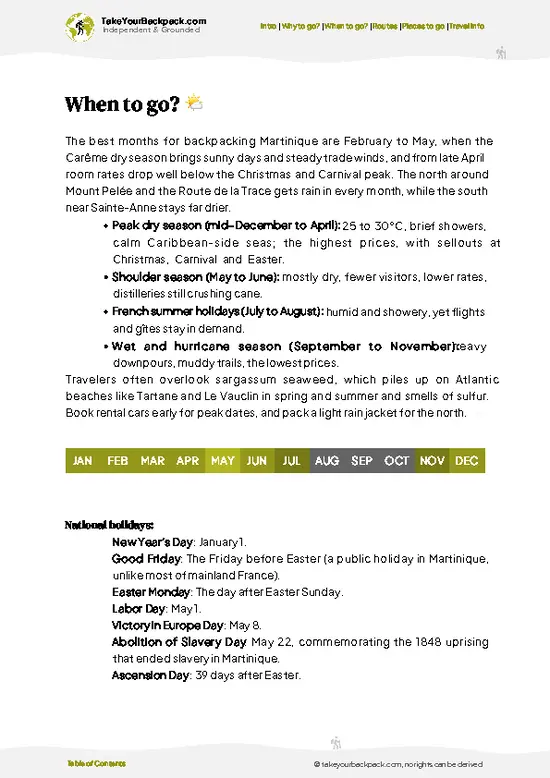
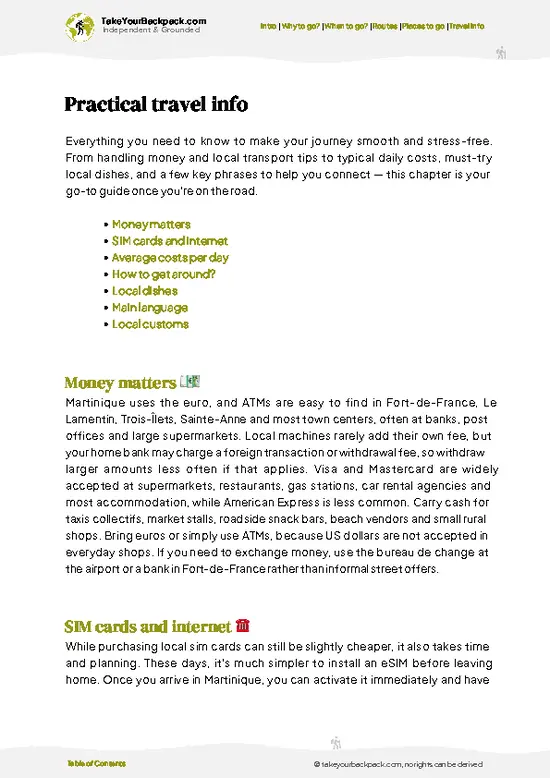
example page 0 from our offline Travel Guide for Martinique
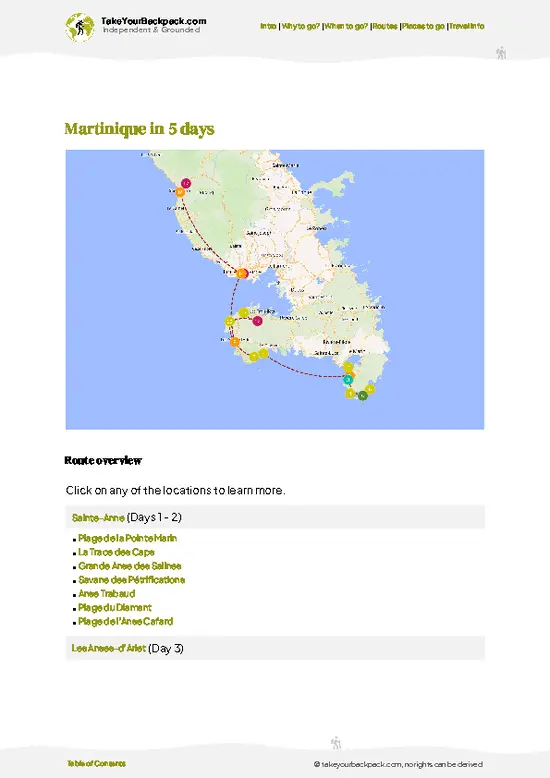
example page 1 from our offline Travel Guide for Martinique
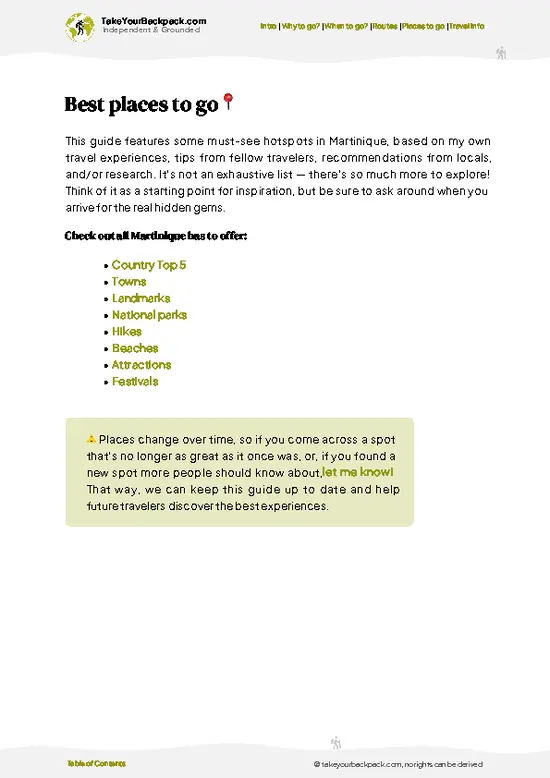
example page 2 from our offline Travel Guide for Martinique
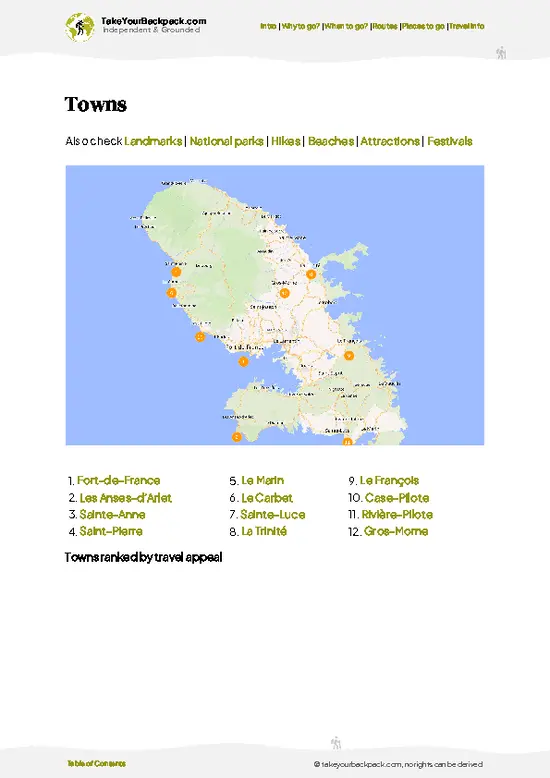
example page 3 from our offline Travel Guide for Martinique
example page 4 from our offline Travel Guide for Martinique
example page 5 from our offline Travel Guide for Martinique
example page 6 from our offline Travel Guide for Martinique
example page 7 from our offline Travel Guide for Martinique
Loading the map 🌍
CLICK TO FILTER
towns
landmarks
national parks
hikes
beaches
attractions
festivals
SHOW COUNTRY’S BESTSHOW ALL

✨ Why go?
Ranked #4 national park in Martinique
Why Presqu’île de la Caravelle Nature Reserve should be on your travel list

Caravelle Nature Reserve suits backpackers who want a coastal walk without a guide, a booking or a schedule. The peninsula is small enough that you can pick your own pace and turn back whenever the heat wins. The big draw is the Château Dubuc ruins, a sugar plantation estate whose stone kitchens, boiling house and slave quarters sit among the trees and give the landscape real historical weight, far more than a pretty viewpoint would. Then there is the contrast of two coasts: the wild Atlantic side with its dark cliffs, and the calm mangrove bays used by local fishers. The lighthouse and the coastal loop to Pointe Caracoli give you clear goals for a self-guided day. Tours exist, but the paths are easy to follow and signposted, so you do not need one. Bring water, a hat and sturdy sandals, and you are set.

💡 HighlightsTop highlights of Presqu’île de la Caravelle Nature Reserve

  1. Château Dubuc: The ruined plantation house, sugar mill and cellars are the best-known sight of the peninsula, with an on-site exhibit and sea views from the hillside. Allow an hour.
  2. Caravelle Lighthouse: The white lighthouse stands near the end of the road and offers a clear, windy look along the cliffs.
  3. Anse Spoutourne: A small cove on the exposed side, good for watching waves break against dark volcanic rock rather than for swimming.
  4. Mangrove boardwalk and bays: Quiet inlets on the sheltered side where herons feed and crabs scatter along the roots.
  5. Tartane village: A small fishing and surfing village at the base of the peninsula, with a long beach and grilled fish stalls.
  6. Coastal cliff viewpoints: Open lookouts above the Atlantic where the wind is constant and the light is best early.
Do Château … read more 👉
  1. Château Dubuc: The ruined plantation house, sugar mill and cellars are the best-known sight of the peninsula, with an on-site exhibit and sea views from the hillside. Allow an hour.
  2. Caravelle Lighthouse: The white lighthouse stands near the end of the road and offers a clear, windy look along the cliffs.
  3. Anse Spoutourne: A small cove on the exposed side, good for watching waves break against dark volcanic rock rather than for swimming.
  4. Mangrove boardwalk and bays: Quiet inlets on the sheltered side where herons feed and crabs scatter along the roots.
  5. Tartane village: A small fishing and surfing village at the base of the peninsula, with a long beach and grilled fish stalls.
  6. Coastal cliff viewpoints: Open lookouts above the Atlantic where the wind is constant and the light is best early.
Do Château Dubuc first, early in the morning, since its exposed stone walls turn hot quickly and the walk to the coast is easier before midday.
Spotted a mistake or missing something? Contact us.

Things to do near Presqu’île de la Caravelle Nature Reserve

Ratings based on Tripadvisor reviews. When you book through this link, you support our work at no extra cost to you.

🌤️ When to go?Best time to explore Presqu’île de la Caravelle Nature Reserve

  • Dry Season (Feb to May): Caravelle Nature Reserve is at its easiest from February to May. Days run 24 to 30°C (75 to 86°F), rain is light, and the Caravelle peninsula trails stay firm underfoot. Daylight lasts about 11.5 to 12.5 hours.
  • Hot, Wet Season (Jun to Nov): Expect 26 to 32°C (79 to 90°F), high humidity and afternoon downpours. Trails around the mangroves turn muddy and slick. August to October is peak hurricane risk, so check forecasts and keep dates flexible.
  • Winter Peak (Dec to Jan): Slightly cooler at 23 to 29°C (73 to 84°F) with breezy trade winds off the Atlantic. Domestic and French holiday visitors fill the Trinité area, and lodging prices climb by roughly 20 to 40 percent.
  • Crowds: Weekends and French school holidays draw local families to the Tartane beaches. Weekday mornings
… read more 👉
  • Dry Season (Feb to May): Caravelle Nature Reserve is at its easiest from February to May. Days run 24 to 30°C (75 to 86°F), rain is light, and the Caravelle peninsula trails stay firm underfoot. Daylight lasts about 11.5 to 12.5 hours.
  • Hot, Wet Season (Jun to Nov): Expect 26 to 32°C (79 to 90°F), high humidity and afternoon downpours. Trails around the mangroves turn muddy and slick. August to October is peak hurricane risk, so check forecasts and keep dates flexible.
  • Winter Peak (Dec to Jan): Slightly cooler at 23 to 29°C (73 to 84°F) with breezy trade winds off the Atlantic. Domestic and French holiday visitors fill the Trinité area, and lodging prices climb by roughly 20 to 40 percent.
  • Crowds: Weekends and French school holidays draw local families to the Tartane beaches. Weekday mornings are quiet.
Start walking by 8 a.m. to beat the heat and the afternoon showers.


source: climatestotravel.comJANJanuary: excellent for travelingFEBFebruary: excellent for travelingMARMarch: excellent for travelingAPRApril: excellent for travelingMAYMay: highly recommended for travelingJUNJune: fair for travelingJULJuly: fair for travelingAUGAugust: fair for travelingSEPSeptember: fair for travelingOCTOctober: fair for travelingNOVNovember: highly recommended for travelingDECDecember: excellent for traveling
when-to-go

✈️ The backpacker research shortcutMartinique Travel Guide

An offline-friendly backpacking guide with optimized travel routes, ranked highlights, transport advice, and the best areas to stay.
example page 0 from our offline Travel Guide for Martinique
example page 1 from our offline Travel Guide for Martinique
example page 2 from our offline Travel Guide for Martinique
example page 3 from our offline Travel Guide for Martinique
example page 4 from our offline Travel Guide for Martinique
example page 5 from our offline Travel Guide for Martinique
example page 6 from our offline Travel Guide for Martinique
example page 7 from our offline Travel Guide for Martinique
The digital guide (180 pages) contains:
✅ 43 highlights, ranked by travel appeal
✅ Optimized 2, 3 & 5-day travel routes
✅ Cities, national parks, landmarks, beaches
✅ How to get around
✅ Offline-friendly for travel without Wi-Fi
👉 Click to see all 30+ guide features

📅 Plan smarter in minutes, not weeks
✅ Month by month travel advice
✅ Festivals & national holidays
✅ Budget expectations

🗺️ Go to the right places, skip the overrated ones
✅ Honest pros & cons of destinations
✅ Top hikes, parks & viewpoints
✅ Lesser-known places most travelers miss
✅ Clear “worth it vs skip it” guidance

🛏️ Travel smoothly without rookie mistakes
✅ Best areas to stay
✅ Transport systems explained simply
✅ Common scams & safety advice
✅ SIM cards, money & practical tips

🌍 Understand the country, not just visit it
✅ Culture & traditions
✅ 52 Essential phrases & customs
✅ Festivals worth planning around
✅ Traveler-friendly historical context
✅ Insights that make places more meaningful

📱 Built for real travel conditions
✅ Fully downloadable PDF
✅ Works completely offline
✅ Optimized for phone use
✅ Useful in remote areas & buses
✅ Everything in one place
Stop searching, start planning
Get instant access to your full guide. 30‑day money-back guarantee.
+ Add another guide for just

By proceeding you agree to our terms.
Sent to your inbox immediately after payment • 100% Secure Checkout
Best Backpacking Travel Advisor 2025 tourism awardBest Backpacking
Travel Advisor
2025
What others say about Take Your Backpack Guides:
⭐⭐⭐⭐⭐
Fantastic, amazing amount of information!
⭐⭐⭐⭐⭐
My goodness this is amazing, it's what I've been looking for hats off too you!
⭐⭐⭐⭐⭐
I think this is absolutely BRILLIANT
⭐⭐⭐⭐
Very complete and informative. It's still missing places, but I gotta to commend you
⭐⭐⭐⭐⭐
This is truly amazing, thank you, can't wait to explore it with my kids!
⭐⭐⭐⭐⭐
Awesome resource, thank you!
⭐⭐⭐⭐⭐
This is amazing! Can't wait to explore the ones I haven't seen
⭐⭐⭐⭐
I love this! Well done, great idea.
⭐⭐⭐⭐⭐
Thanks for taking the time to make this gem!
⭐⭐⭐⭐⭐
This might be the best website I've ever seen.
⭐⭐⭐⭐⭐
Congratulations, and thank you so much for your work; it's incredibly valuable.
⭐⭐⭐⭐
In all seriousness I think you did a great job pointing out the important spots
⭐⭐⭐⭐⭐
10/10 very good
⭐⭐⭐⭐⭐
As someone who's only just starting to visit regularly this is awesome, thank you.
⭐⭐⭐⭐
Thank you very much! I'm going to visit my dad, it's going to be very useful!
⭐⭐⭐⭐⭐
This is really cool! We'll be travelling for the first time and this definitely come in handy.
⭐⭐⭐⭐⭐
You are now our minister of culture, congratulations 👨‍💼
⭐⭐⭐⭐⭐
Just wanted to tell you that this is a pearl! Going to follow your recommendations.
⭐⭐⭐⭐⭐
This is so cool. I'll definitely be using the resource for my travels soon.
⭐⭐⭐⭐⭐
This is very impressive! Good work.
⭐⭐⭐⭐⭐
This is an amazing and informative site. Very well done!

🛏️ Where to stay?How to pick the right area

There is no lodging inside Caravelle Nature Reserve, so most backpackers sleep in Tartane, the small fishing village at the peninsula’s base and the closest option to the trailheads. Expect simple guesthouses, Creole-style studios and self-catering apartments rather than hostels, at roughly €45 to 90 a night. Many have kitchenettes, which helps because Tartane has only a few small restaurants and snack stands, plus a bakery and a small grocery. Surfers and kitesurfers favor the village, so the mood is relaxed and sandy-footed.

Trinité, about 15 minutes away by road, is the nearest real town. … read more 👉
There is no lodging inside Caravelle Nature Reserve, so most backpackers sleep in Tartane, the small fishing village at the peninsula’s base and the closest option to the trailheads. Expect simple guesthouses, Creole-style studios and self-catering apartments rather than hostels, at roughly €45 to 90 a night. Many have kitchenettes, which helps because Tartane has only a few small restaurants and snack stands, plus a bakery and a small grocery. Surfers and kitesurfers favor the village, so the mood is relaxed and sandy-footed.

Trinité, about 15 minutes away by road, is the nearest real town. It has supermarkets, a market, banks, buses to Fort-de-France and a few budget rooms and guesthouses from about €40 to 70. It makes a sensible base if you lack a car and want better transport links.

Fort-de-France, roughly an hour away, has the widest choice, including budget hotels and apartments from about €50 to 80, and is better for nightlife and onward buses. Camping is not officially available in the reserve itself. Book Tartane ahead from December to April, since the village has limited beds.

👛 Costs (as of 23 October 2026)How expensive it really is

Caravelle Nature Reserve costs roughly €63 to 150 per day for a backpacker, mostly for lodging and food, since walking the trails is free. The table below shows typical ranges.
CategoryBudget RangeLocal Reality
Entrance fee€0Trails are open without a ticket. The Château Dubuc ruins on the peninsula have a small fee of about €5 to 8.
Accommodation (high season)€45 to 90Guesthouses and studios in Tartane or Trinité, with higher prices from December to April.
Local transport€3 to 15Collective taxis and buses reach Trinité. Getting to Tartane usually needs a taxi or a lift. Rental cars cost about €40 to 60 a day.
Food and supplies€15 to 30Bakery breakfasts, snack stands and supermarket groceries. Restaurant mains run about €12 to 20.
Activities€0 to 15Hiking is free. Surf or kayak rentals add a bit.
… read more 👉
Caravelle Nature Reserve costs roughly €63 to 150 per day for a backpacker, mostly for lodging and food, since walking the trails is free. The table below shows typical ranges.
CategoryBudget RangeLocal Reality
Entrance fee€0Trails are open without a ticket. The Château Dubuc ruins on the peninsula have a small fee of about €5 to 8.
Accommodation (high season)€45 to 90Guesthouses and studios in Tartane or Trinité, with higher prices from December to April.
Local transport€3 to 15Collective taxis and buses reach Trinité. Getting to Tartane usually needs a taxi or a lift. Rental cars cost about €40 to 60 a day.
Food and supplies€15 to 30Bakery breakfasts, snack stands and supermarket groceries. Restaurant mains run about €12 to 20.
Activities€0 to 15Hiking is free. Surf or kayak rentals add a bit.
Total Daily Budget€63 to 150About €70 to 120 is realistic for most backpackers. Everything is paid in euros.
⚠️ Prices can change and everyone travels differently, so take this as a rough guide. Hope it helps you plan your adventure!

🥾 TrailsPlan your hike in Presqu’île de la Caravelle Nature Reserve: routes, terrain, and sights

Caravelle Nature Reserve offers short, mostly gentle coastal walking on a peninsula that rises and falls over low hills, dry forest and mangrove edges. The terrain is a mix of packed dirt, rocky stretches and a few muddy patches after rain.
  • Château Dubuc trail: A short loop of roughly 1 to 2 kilometers around the plantation ruins, taking about an hour. Easy, with stone steps and shaded sections.
  • Tour de la Caravelle: The main coastal walk toward the lighthouse and Pointe Caracoli, about 6 to 8 kilometers round trip and 2 to 3 hours. Easy to moderate, with some uneven rock and exposed stretches.
  • Mangrove
… read more 👉
Caravelle Nature Reserve offers short, mostly gentle coastal walking on a peninsula that rises and falls over low hills, dry forest and mangrove edges. The terrain is a mix of packed dirt, rocky stretches and a few muddy patches after rain.
  • Château Dubuc trail: A short loop of roughly 1 to 2 kilometers around the plantation ruins, taking about an hour. Easy, with stone steps and shaded sections.
  • Tour de la Caravelle: The main coastal walk toward the lighthouse and Pointe Caracoli, about 6 to 8 kilometers round trip and 2 to 3 hours. Easy to moderate, with some uneven rock and exposed stretches.
  • Mangrove path: A flat, short walk along the sheltered side where you can spot herons and crabs. Easy, 30 to 45 minutes.
  • Wildlife: Expect herons, kestrels, hummingbirds, iguanas and land crabs. Sightings are quiet and small scale.
Public transport reaches Trinité, from where you need a taxi or a rental car to reach the trailheads. Weekends are busier at the beaches, while the trails stay quiet most of the year. Shade is limited, so carry plenty of water and sun protection. Entry to the reserve itself is free, although the Château Dubuc exhibit may charge a small admission, around €5 to 8.
⚠️ Hiking info can sometimes be outdated or inaccurate. Before you hit the trail, check the latest conditions with locals. If you do spot anything that's off, I'd love to hear from you, so I can update it for fellow travelers.

🛡️ SafetySafety Tips and Common Scams in Presqu’île de la Caravelle Nature Reserve

Caravelle Nature Reserve is a straightforward, well-signed set of coastal trails, and the main hazards are heat, mud and sun. The Caravelle peninsula is exposed, with little shade on the headland, so bring at least 1.5 liters of water per person, a hat and sunscreen. After rain the red clay paths become slippery, and shoes with real tread matter more than anything else you pack. Trade winds and strong Atlantic surf make swimming off the rocky shores risky, so stay out of the water at the exposed beaches unless locals are swimming. Martinique has the fer-de-lance snake, but encounters are rare on maintained trails. Keep to the path, watch where you put hands and feet, and do not step into dense brush. Mosquitoes are active near the mangroves, so carry repellent. Cell coverage can be patchy, … read more 👉
Caravelle Nature Reserve is a straightforward, well-signed set of coastal trails, and the main hazards are heat, mud and sun. The Caravelle peninsula is exposed, with little shade on the headland, so bring at least 1.5 liters of water per person, a hat and sunscreen. After rain the red clay paths become slippery, and shoes with real tread matter more than anything else you pack. Trade winds and strong Atlantic surf make swimming off the rocky shores risky, so stay out of the water at the exposed beaches unless locals are swimming. Martinique has the fer-de-lance snake, but encounters are rare on maintained trails. Keep to the path, watch where you put hands and feet, and do not step into dense brush. Mosquitoes are active near the mangroves, so carry repellent. Cell coverage can be patchy, so check the weather and finish walks well before dark.

FAQCommon questions from travelers

One full day covers Caravelle Nature Reserve. The Caravelle lighthouse loop and the Château Dubuc ruins take about 3 to 5 hours, and adding the longer coastal trails stretches it to a full day. Staying one or two nights in Tartane lets you pair the walks with a beach afternoon.
Public transport gets you only part of the way to Caravelle Nature Reserve. Buses and collective taxis run from Fort-de-France to Trinité in roughly 1 hour, but the last 10 to 15 minutes to Tartane usually need a taxi costing about €15 to 25. A rental car is easiest, and the trailheads are a short walk from Tartane.
Caravelle Nature Reserve has no entrance fee, and no permit is required for day hiking on the marked trails. Parking near the trailheads is generally free. The Château Dubuc ruins on the peninsula charge a small admission of about €5 to 8, and overnight camping is not offered in the reserve.
⚠️ Things can change over time, so always validate details locally before you go.

Other Martinican national parks near Presqu’île de la Caravelle Nature Reserve

Explore more nearby:


💡 Not sure where to go next?
Create a personalized itinerary for Martinique including Presqu’île de la Caravelle Nature Reserve and the places that fit your trip.

Generate my itinerary

👉 Discover all national parks

Or checkout all Martinique has to offer (think cities, towns, villages, national parks, hikes, beaches, festivals)
Country photo of Martinique

We 💚 feedbackParting advice and final tips

Caravelle Nature Reserve works best as a single long morning plus a lazy afternoon, so a full day is plenty and an overnight nearby in Tartane is a bonus if you like surf villages. I would go midweek, start walking early and bring more water than you think you need.

✍️ Help improve this page!
The information on this page is based on in-depth research, insights shared by experienced travelers, and feedback from the local travel community in Martinique. While every effort is made to keep the information accurate and current, conditions can change — so if you spot anything incorrect or outdated, please get in touch.


🙋‍♂️ Give feedback

👋 Meet the founderWho’s Behind Take Your Backpack?

Johan, backpacker and founder of TakeYourBackpackHi, I’m Johan (Netherlands 🇳🇱), the creator of TakeYourBackpack. Over the past 3 decades, I’ve backpacked through 90+ countries across six continents, gaining extensive experience with independent travel, long-term trips, and overland routes.

This site is built on a combination of firsthand travel experience and carefully curated insights from other backpackers. Many guides are based on places I’ve personally visited, while others bring together tips, observations, and practical advice shared by trusted travelers I’ve met along the way.

The goal is to provide realistic, experience-driven guidance — not generic itineraries — so you can explore destinations with better context, clearer expectations, and more confidence.