×

Martinique🇲🇶 | best national parksWhere to Find the 4 Best national parks in Martinique

Martinique’s protected land is mostly a regional nature park, forest reserves and coastal sites rather than gated parks with ticket booths, so access is largely free and trailheads sit beside ordinary roads. The north is wet, volcanic and cool, the south dry and beachy, and independent travelers will want a rental car to link them. Go early, because clouds settle on the peaks by midday.

By Johan Kruseman 🇳🇱 | Updated October 23, 2026
Explore the best hikes in Martinique

Why go?Understanding Their Importance

Martinique packs rainforest, active volcano and dry coast into an island about 70 kilometers long, so the protected areas change character every 30 minutes by car. Much of the interior falls under the regional nature park, which means managed trails, marked walking routes and shared land with farms and villages rather than wilderness fenced off. Because Martinique is a French department, the infrastructure is excellent, with paved roads and a volcano observatory that monitors Pelée. Roads are narrow and winding, so allow extra time. English is limited outside hotels, so a few French phrases and a greeting of “Bonjour” on every trail help.
Before you choose it, know that trails are steep and muddy and slower than the distance suggests, that guides and rental cars cost French prices, and that … read more 👉
Martinique packs rainforest, active volcano and dry coast into an island about 70 kilometers long, so the protected areas change character every 30 minutes by car. Much of the interior falls under the regional nature park, which means managed trails, marked walking routes and shared land with farms and villages rather than wilderness fenced off. Because Martinique is a French department, the infrastructure is excellent, with paved roads and a volcano observatory that monitors Pelée. Roads are narrow and winding, so allow extra time. English is limited outside hotels, so a few French phrases and a greeting of “Bonjour” on every trail help.
Before you choose it, know that trails are steep and muddy and slower than the distance suggests, that guides and rental cars cost French prices, and that mountain weather turns fast. Plan around mornings.
Behind the Scenes of Selection
The list of best national parks in Martinique is created based on landscapes, wildlife, adventure opportunities, facilities, and overall experience. If you feel a national park is missing in this list, please let us know.

When to go?Timing Your Visit for the Best Experience

The dry season wins: February to April is the best window for Martinique’s parks, because the dry season (Carême) brings the lowest rainfall and coastal highs of 28 to 30°C. Trails dry out, though the north still gets showers. Summits sit around 15 to 20°C and often disappear into cloud after 11 a.m., so start at dawn.Shoulder and wet months: December, January and May are shoulder months: greener, a little wetter, and flights and rooms cost less than over Christmas and Carnival season. June to November is the hurricane and rainy season, with peak risk from August to October. The Atlantic-facing north can receive well over 3,000 mm a year, while the south stays closer to 1,000 mm, so head south when it pours. Mid-July to August brings French school holidays and full rental car lots, so book cars early.

national park hoppingSuggested Travel Strategies

Five to seven days is the right length: A trip linking several of Martinique’s protected areas needs 5 to 7 days, with 2 to 3 hours of driving a day at most. Fort-de-France and the airport at Le Lamentin make the natural hub. Start in the north (Saint-Pierre area, 45 to 60 minutes from the capital), loop through the cooler center, then finish in the dry south, 60 to 75 minutes away, so the beach days come last. Give each stop half a day to a full day, with hikes done before noon. Public buses and collective taxis are sparse and rarely reach trailheads, so a rental car is the practical answer. Common mistakes are pairing north and south in one day, packing two summit hikes back to back, and driving after dark on unlit mountain roads. Instead, keep one base per region and treat afternoons as flexible.

The ListThe Best national parks of Martinique

1 Parc Naturel Régional de la Martinique

Mont Pelée, Pitons du Carbet, canyon wading, forest waterfalls

Hike from the crater rim of Mont Pelée to jagged ridges and cool waterfall pools, across a protected region covering most of the island.

martinique-national-park-parc-naturel-regional-de-la-martinique
© Google | Christian Rabbat

2 Domaine d’Émeraude

Forest pond, tree ferns, picnic carbets, hummingbirds

Follow short, muddy loops under mahogany and bamboo to a still pond, then eat under a covered shelter while the forest drips around you.

martinique-national-park-domaine-demeraude
© Google |

3 Savane des Pétrifications

Silicified wood, cactus scrub, salt lagoon, wild beach

Scan the red, dry ground for gray and rust-streaked fragments of petrified trunk, then continue to a heron-filled salt lagoon and the Atlantic coast.

martinique-national-park-savane-des-petrifications
© Google |

4 Presqu’île de la Caravelle Nature Reserve

Atlantic surf, mangrove inlets, lighthouse, Château Dubuc ruins

Walk the peninsula from the sugar mill ruins to the lighthouse, with rough Atlantic cliffs on one side and quiet mangrove bays on the other.

Loading the map 🌍

Expert viewTips and Advice from Travelers

How many to visit: Three or four protected areas is the right number for a week, one from the wet north, one from the cool interior and one from the dry south. That mix gives you different landscapes without turning the trip into a checklist of drives. Each extra stop costs 40 to 60 minutes on winding roads and the clear early-morning hours you need for views, so a fifth stop buys you less than a slow breakfast would.
Which kind for which traveler: Hikers get the most from the volcanic and rainforest areas. A summit or ridge walk costs a full morning of 3 to 5 hours, entry is usually free, and the only real spend is shoes with grip, which beat any other comfort upgrade. Beach and snorkel travelers get more from the dry south, where half a day and a €15 to 25 mask and snorkel set deliver the … read more 👉
How many to visit: Three or four protected areas is the right number for a week, one from the wet north, one from the cool interior and one from the dry south. That mix gives you different landscapes without turning the trip into a checklist of drives. Each extra stop costs 40 to 60 minutes on winding roads and the clear early-morning hours you need for views, so a fifth stop buys you less than a slow breakfast would.
Which kind for which traveler: Hikers get the most from the volcanic and rainforest areas. A summit or ridge walk costs a full morning of 3 to 5 hours, entry is usually free, and the only real spend is shoes with grip, which beat any other comfort upgrade. Beach and snorkel travelers get more from the dry south, where half a day and a €15 to 25 mask and snorkel set deliver the most comfort per euro. Short on time, pick one big hike and one coastal day. A guide adds roughly €30 to 60 per person for a half day, and I would pay it only on faint, poorly marked routes or when volcano conditions are uncertain, never on well-signed paths.
What it costs: Budget €70 to 120 a day if you travel alone with a rental car, or €50 to 80 each when two share it. A small car runs €35 to 60 a day plus about €10 to 15 of fuel, a room in a gîte or guesthouse €45 to 90, and market, bakery and roadside food €15 to 25. Per visit, entry and parking are usually free to €5, so the guide and the car are the real expenses.
Safety and etiquette: Trails turn slick within minutes of rain, so turn back when the sky darkens and never cross swollen ravines. The fer-de-lance, a venomous pit viper, lives in forest and cane fields, so stay on marked paths and look before placing hands. Avoid manchineel trees on beaches (small green apples, toxic sap). Leave nothing visible in a parked car at trailheads, greet people with “Bonjour” before asking anything, and keep out of private plantation land.

✈️ The backpacker research shortcutMartinique Travel Guide

An offline-friendly backpacking guide with optimized travel routes, ranked highlights, transport advice, and the best areas to stay.
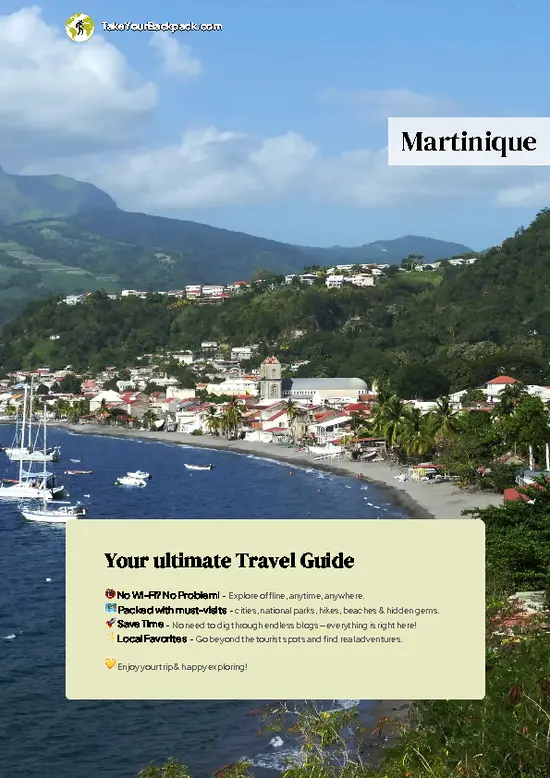
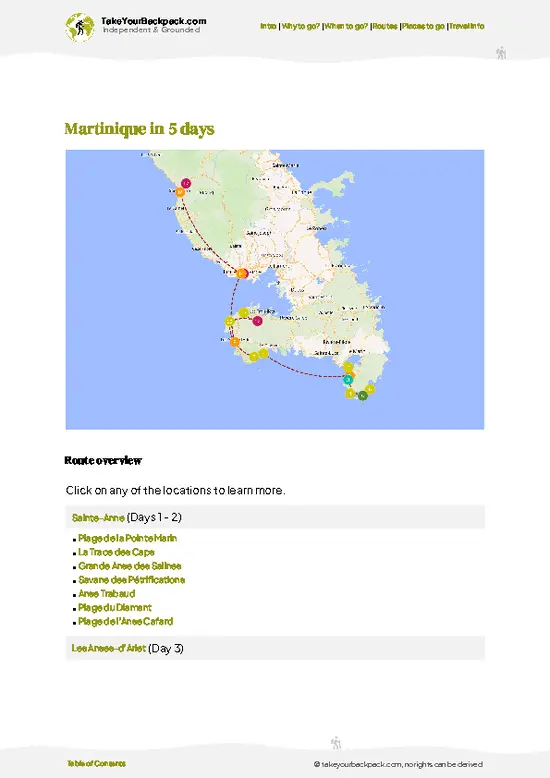
example page 0 from our offline Travel Guide for Martinique
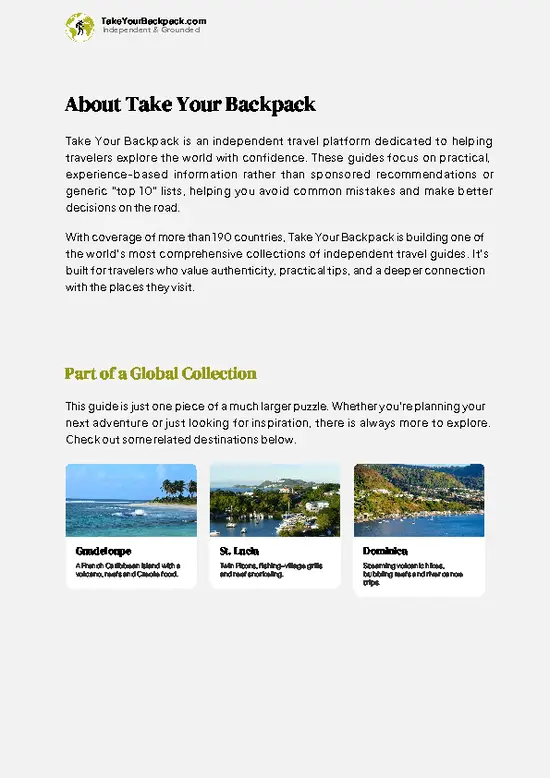
example page 1 from our offline Travel Guide for Martinique
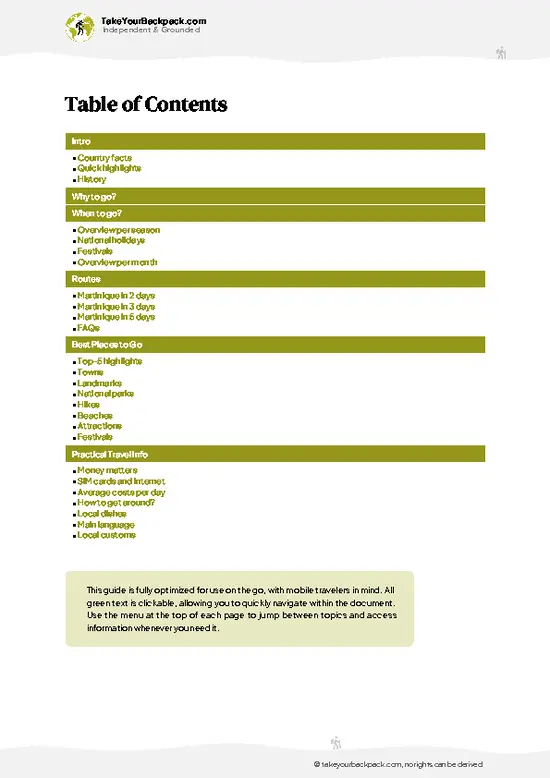
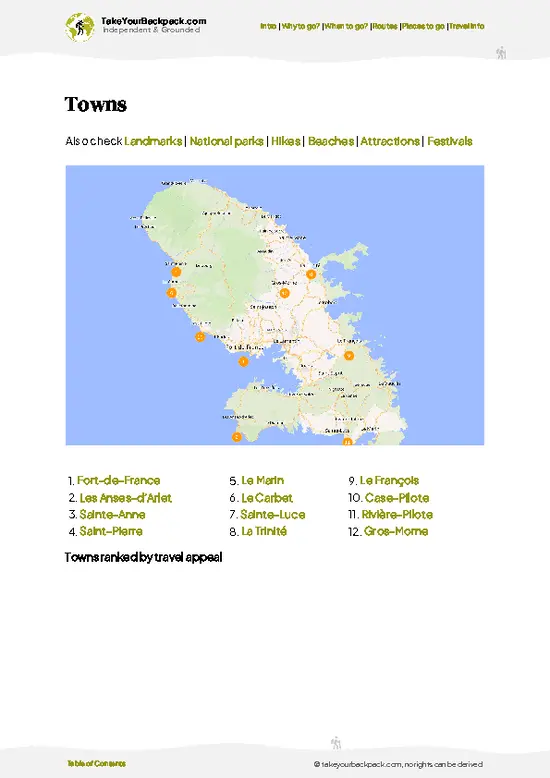
example page 2 from our offline Travel Guide for Martinique
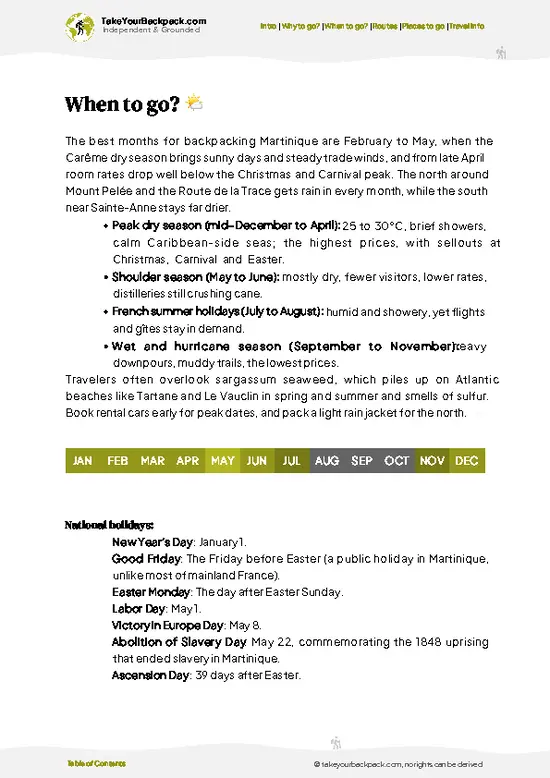
example page 3 from our offline Travel Guide for Martinique
example page 4 from our offline Travel Guide for Martinique
example page 5 from our offline Travel Guide for Martinique
example page 6 from our offline Travel Guide for Martinique
example page 7 from our offline Travel Guide for Martinique
The digital guide (180 pages) contains:
✅ 43 highlights, ranked by travel appeal
✅ Optimized 2, 3 & 5-day travel routes
✅ Cities, national parks, landmarks, beaches
✅ How to get around
✅ Offline-friendly for travel without Wi-Fi
👉 Click to see all 30+ guide features

📅 Plan smarter in minutes, not weeks
✅ Month by month travel advice
✅ Festivals & national holidays
✅ Budget expectations

🗺️ Go to the right places, skip the overrated ones
✅ Honest pros & cons of destinations
✅ Top hikes, parks & viewpoints
✅ Lesser-known places most travelers miss
✅ Clear “worth it vs skip it” guidance

🛏️ Travel smoothly without rookie mistakes
✅ Best areas to stay
✅ Transport systems explained simply
✅ Common scams & safety advice
✅ SIM cards, money & practical tips

🌍 Understand the country, not just visit it
✅ Culture & traditions
✅ 52 Essential phrases & customs
✅ Festivals worth planning around
✅ Traveler-friendly historical context
✅ Insights that make places more meaningful

📱 Built for real travel conditions
✅ Fully downloadable PDF
✅ Works completely offline
✅ Optimized for phone use
✅ Useful in remote areas & buses
✅ Everything in one place
Stop searching, start planning
Get instant access to your full guide. 30‑day money-back guarantee.
+ Add another guide for just

By proceeding you agree to our terms.
Sent to your inbox immediately after payment • 100% Secure Checkout
Best Backpacking Travel Advisor 2025 tourism awardBest Backpacking
Travel Advisor
2025
What others say about Take Your Backpack Guides:
⭐⭐⭐⭐⭐
Fantastic, amazing amount of information!
⭐⭐⭐⭐⭐
My goodness this is amazing, it's what I've been looking for hats off too you!
⭐⭐⭐⭐⭐
I think this is absolutely BRILLIANT
⭐⭐⭐⭐
Very complete and informative. It's still missing places, but I gotta to commend you
⭐⭐⭐⭐⭐
This is truly amazing, thank you, can't wait to explore it with my kids!
⭐⭐⭐⭐⭐
Awesome resource, thank you!
⭐⭐⭐⭐⭐
This is amazing! Can't wait to explore the ones I haven't seen
⭐⭐⭐⭐
I love this! Well done, great idea.
⭐⭐⭐⭐⭐
Thanks for taking the time to make this gem!
⭐⭐⭐⭐⭐
This might be the best website I've ever seen.
⭐⭐⭐⭐⭐
Congratulations, and thank you so much for your work; it's incredibly valuable.
⭐⭐⭐⭐
In all seriousness I think you did a great job pointing out the important spots
⭐⭐⭐⭐⭐
10/10 very good
⭐⭐⭐⭐⭐
As someone who's only just starting to visit regularly this is awesome, thank you.
⭐⭐⭐⭐
Thank you very much! I'm going to visit my dad, it's going to be very useful!
⭐⭐⭐⭐⭐
This is really cool! We'll be travelling for the first time and this definitely come in handy.
⭐⭐⭐⭐⭐
You are now our minister of culture, congratulations 👨‍💼
⭐⭐⭐⭐⭐
Just wanted to tell you that this is a pearl! Going to follow your recommendations.
⭐⭐⭐⭐⭐
This is so cool. I'll definitely be using the resource for my travels soon.
⭐⭐⭐⭐⭐
This is very impressive! Good work.
⭐⭐⭐⭐⭐
This is an amazing and informative site. Very well done!

🛏️ Where to stay?Where to Base Yourself

Martinique has very few true hostels, so budget stays here mostly mean guesthouses, rooms in private homes and small self-catering gîtes, typically around €40 to €70 a night for a private room. Fort-de-France has the best bus and ferry links but empties out and feels deserted after dark. Les Trois-Îlets (especially Anse Mitan) pairs beaches and the liveliest evenings with a ferry into the capital; Sainte-Anne and Le Marin in the south sit near the best beaches and the sailing scene, while Saint-Pierre in the north is quiet and cheap, close to diving and the Montagne Pelée trails, though far from everything else.

If you enjoy meeting fellow travelers, consider choosing hostels with high ratings … read more 👉
Martinique has very few true hostels, so budget stays here mostly mean guesthouses, rooms in private homes and small self-catering gîtes, typically around €40 to €70 a night for a private room. Fort-de-France has the best bus and ferry links but empties out and feels deserted after dark. Les Trois-Îlets (especially Anse Mitan) pairs beaches and the liveliest evenings with a ferry into the capital; Sainte-Anne and Le Marin in the south sit near the best beaches and the sailing scene, while Saint-Pierre in the north is quiet and cheap, close to diving and the Montagne Pelée trails, though far from everything else.

If you enjoy meeting fellow travelers, consider choosing hostels with high ratings for atmosphere. On the other hand, if you prefer having your own space, a hotel might be a better option.

MartiniqueExpand Your Journey

👋 Meet the founderWho’s Behind Take Your Backpack?

Johan, backpacker and founder of TakeYourBackpackHi, I’m Johan (Netherlands 🇳🇱), the creator of TakeYourBackpack. Over the past 3 decades, I’ve backpacked through 90+ countries across six continents, gaining extensive experience with independent travel, long-term trips, and overland routes.

This site is built on a combination of firsthand travel experience and carefully curated insights from other backpackers. Many guides are based on places I’ve personally visited, while others bring together tips, observations, and practical advice shared by trusted travelers I’ve met along the way.

The goal is to provide realistic, experience-driven guidance — not generic itineraries — so you can explore destinations with better context, clearer expectations, and more confidence.