×

Mongolia🇲🇳 | regionsKhentii Mountains
Forest wilderness, sacred sites, Genghis Khan legacy | things to do and best time to go

Explore Bayan-UlgiiExplore Orkhon Valley

Backpacking in Khentii Mountains
👌 Worth visitingregion ranked #4
By Johan Kruseman 🇳🇱 | Updated April 27, 2026

Most people only realize on the bus back to Ulaanbaatar that the real win in the Khentii Mountains is this: you get Gobi-level remoteness and Khuvsgul-level scenery without the crowds or the price tag of either.

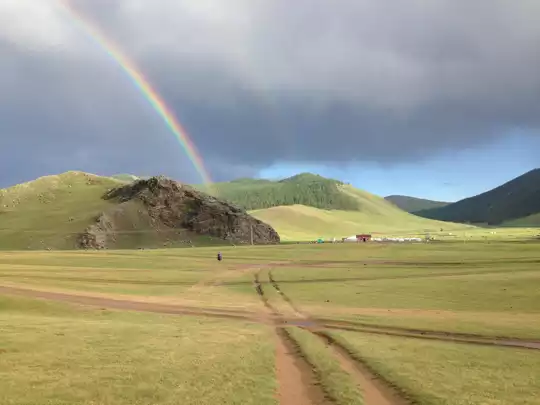
Khentii sits in eastern Mongolia, rolling out from the forests and hills east of Ulaanbaatar toward the Russian border and the Onon River. It’s big-sky country with larch forests, river valleys, and soft, walkable ridgelines rather than macho, technical peaks. Backpacking here is cheap once you arrive, but getting between places like Öndörkhaan (Chinggis City), Binder, and the Onon-Balj National Park area is slow, bumpy, and very “hope-a-minivan-shows-up-today.” You trade convenience for raw, everyday Mongolian life: herders on horseback, vodka-fueled ger hospitality, almost no tour groups. Compared with Terelj or the Orkhon Valley, Khentii is quieter, less polished, and better if you want stories, not Instagram.

Discover everything you want to know in the 📖 Mongolia Travel Guide.
Loading the map 🌍
CLICK TO FILTER
city
town
village
unique site
national park
hike
attraction
festival
region
SHOW COUNTRY‘S BESTSHOW ALL

✨ Why go?
Ranked #4 region in Mongolia
What makes this region worth visiting

The Khentii Mountains in Mongolia are a backpacker’s playground, offering a variety of landscapes that keep your senses buzzing. Picture this: rolling hills, dense forests, and wide-open steppes all in one spot. You can hike, ride horses, or just soak in the views without the hassle of constant relocation.

Transport here is surprisingly flexible. You can hop on a local bus or rent a bike, making it easy to explore at your own pace. This isn’t just about the scenery; it’s about mixing nature and culture. Spend a night in a traditional ger, sip on some milk tea, and swap stories with locals.

The beauty of slow travel in the Khentii is that you’re not just ticking boxes; you’re diving deep into the experience. You’ll find that every corner has a story, and every sunset feels like a personal … read more 👉
The Khentii Mountains in Mongolia are a backpacker’s playground, offering a variety of landscapes that keep your senses buzzing. Picture this: rolling hills, dense forests, and wide-open steppes all in one spot. You can hike, ride horses, or just soak in the views without the hassle of constant relocation.

Transport here is surprisingly flexible. You can hop on a local bus or rent a bike, making it easy to explore at your own pace. This isn’t just about the scenery; it’s about mixing nature and culture. Spend a night in a traditional ger, sip on some milk tea, and swap stories with locals.

The beauty of slow travel in the Khentii is that you’re not just ticking boxes; you’re diving deep into the experience. You’ll find that every corner has a story, and every sunset feels like a personal gift. This region invites you to linger, to breathe, and to truly connect with the land and its people. It’s the kind of place where you’ll leave with more than just photos; you’ll carry memories that resonate long after you’ve returned home.
Get the complete Travel Guide for Mongolia
Everything organized for offline planning — routes, highlights, costs & tips

See what’s inside 👉

Get the Travel Guide -

💡 HighlightsKey sights and experiences for travelers

  1. Burkhan Khaldun — The sacred heart of the Khentii Mountains and the place most tightly tied to Genghis Khan’s life; wind-carved ridges, old-growth larch and pine groves, and ovoo rituals make hiking here feel like stepping into Mongolia’s origin story. (Personal favorite)
  2. Dulun / Deluun Boldog — A compact, visitable spot on the foothills where local tradition marks Temüjin’s childhood and birthplace; a small memorial and the surrounding meadows give a direct, almost theatrical link to the region’s history without the crowds.
  3. Onon River valley (Onon-Balj protected area) — The river where Temüjin’s early life unfolded; sweeping river meadows, poplar-lined banks and forested ridges make this the best place in Khentii for peaceful horsepacking, fishing, and low-impact camping with nomadic
read more 👉
  1. Burkhan Khaldun — The sacred heart of the Khentii Mountains and the place most tightly tied to Genghis Khan’s life; wind-carved ridges, old-growth larch and pine groves, and ovoo rituals make hiking here feel like stepping into Mongolia’s origin story. (Personal favorite)
  2. Dulun / Deluun Boldog — A compact, visitable spot on the foothills where local tradition marks Temüjin’s childhood and birthplace; a small memorial and the surrounding meadows give a direct, almost theatrical link to the region’s history without the crowds.
  3. Onon River valley (Onon-Balj protected area) — The river where Temüjin’s early life unfolded; sweeping river meadows, poplar-lined banks and forested ridges make this the best place in Khentii for peaceful horsepacking, fishing, and low-impact camping with nomadic families.
  4. Kherlen River headwaters — A quieter, lesser-visited source area where clear springs and braided streams begin their long eastward run; the small meadows and wetlands here are intimate, photogenic, and rarely crowded. (Hidden gem)
  5. Khan Khentii Strictly Protected Area (wilderness tracts) — Vast, regulated forest-and-hills country surrounding Burkhan Khaldun where access is limited and the landscape still feels primeval; expect solitude, old trees, and the best chance to see large mammals from a respectful distance.
  6. Remote nomad ger-stays in the Onon/Kherlen foothills — Local family stays tucked off the main tracks where you can learn milking, taste airag, ride short loop trails, and sleep under a real nomad timetable; intimate, real-life hospitality that most bus-tourists never see. (Hidden gem)
  7. Sacred grove pockets on Burkhan Khaldun’s slopes — Small enclaves of ancient trees and ritual sites where locals come to leave offerings and perform ceremonies; these groves feel unique to Khentii because of their blend of natural silence and living belief. (Hidden gem)
Spotted a mistake or missing something? Contact us.
⌛️ 5 daysHow to make the most of Khentii Mountains

Day 1: Ulaanbaatar
The adventure kicks off in Ulaanbaatar, the bustling capital. Spend your first day acclimating and gathering supplies. The transport system here is a mix of taxis, buses, and the occasional horse-drawn cart. Get a local SIM card for navigation and communication. This city is your launchpad, and you’ll want to stock up on snacks and gear before heading into the wild.

Day 2: Khentii Mountains (Tsenkher)
Rise early and catch a shared minibus to Tsenkher, a gateway to the Khentii Mountains. The ride is about five hours, so settle in and enjoy the scenery. This is where the mountains start to loom, and the air gets crisper. The bus system is reliable but can be crowded, so be prepared to share your space. Once you arrive, set up camp and soak in the tranquility.

Day 3: … read more 👉
Day 1: Ulaanbaatar
The adventure kicks off in Ulaanbaatar, the bustling capital. Spend your first day acclimating and gathering supplies. The transport system here is a mix of taxis, buses, and the occasional horse-drawn cart. Get a local SIM card for navigation and communication. This city is your launchpad, and you’ll want to stock up on snacks and gear before heading into the wild.

Day 2: Khentii Mountains (Tsenkher)
Rise early and catch a shared minibus to Tsenkher, a gateway to the Khentii Mountains. The ride is about five hours, so settle in and enjoy the scenery. This is where the mountains start to loom, and the air gets crisper. The bus system is reliable but can be crowded, so be prepared to share your space. Once you arrive, set up camp and soak in the tranquility.

Day 3: Khentii Mountains (Khan Khentii National Park)
Today’s the day to explore Khan Khentii National Park. Hike the trails that wind through the lush valleys and rugged peaks. The park is well-marked, but don’t hesitate to veer off the main paths for a more intimate experience with nature. This is where you’ll feel the pulse of Mongolia.

Day 4: Off-Path Reward (Shine Jinst)
Take a detour to Shine Jinst, a lesser-known area with stunning views and fewer tourists. The journey involves a bit of off-roading, but the payoff is worth it. You’ll find hidden waterfalls and serene lakes that feel like your own private paradise. This is the kind of place where you can sit in silence and truly connect with the landscape.

Day 5: Return to Ulaanbaatar
Head back to Ulaanbaatar, reflecting on your journey. The return trip can be a bit chaotic, but it’s a chance to mingle with locals and fellow travelers. Grab a final meal in the city, savoring the flavors of Mongolia.

The must-do day? Day 3 in Khan Khentii National Park. It’s where the heart of Mongolia beats strongest, and you’ll leave with stories that resonate long after you’ve returned home.
Build the Right Itinerary
Use the Mongolia Travel Guide’s 7, 14 & 21-day routes as a starting point to plan a trip that actually works on the ground.

Get the Travel Guide -

🌤️ When to go?When to go for the best experience


  • Weather: The Khentii Mountains are at their friendliest from late May to early September. Before that, snow lingers, and after, it’s a quick slide into freezing temps. Summer means dry trails and fewer mud bogs.

  • Temperature: Daytime highs in summer hover around 20-25°C (68-77°F), perfect for hiking without overheating. Nights dip to 5-10°C (41-50°F), so pack a warm layer. Shoulder seasons can be a gamble—expect chilly mornings and sudden rain.

  • Daylight Hours: Summer grants you up to 16 hours of daylight. That’s a serious advantage for covering ground and soaking in the landscape without rushing. Early spring and late fall shrink your window to 8-10 hours, which can cramp your pace.

  • Crowds: The Khentii Mountains aren’t exactly a tourist hotspot, but summer sees a modest bump in local
read more 👉

  • Weather: The Khentii Mountains are at their friendliest from late May to early September. Before that, snow lingers, and after, it’s a quick slide into freezing temps. Summer means dry trails and fewer mud bogs.

  • Temperature: Daytime highs in summer hover around 20-25°C (68-77°F), perfect for hiking without overheating. Nights dip to 5-10°C (41-50°F), so pack a warm layer. Shoulder seasons can be a gamble—expect chilly mornings and sudden rain.

  • Daylight Hours: Summer grants you up to 16 hours of daylight. That’s a serious advantage for covering ground and soaking in the landscape without rushing. Early spring and late fall shrink your window to 8-10 hours, which can cramp your pace.

  • Crowds: The Khentii Mountains aren’t exactly a tourist hotspot, but summer sees a modest bump in local hikers and nomads moving livestock. If you crave solitude, aim for late May or early September—fewer people, same great trails.

  • Seasonal Activities: Summer is prime for horseback trekking and river fishing, while autumn brings wild berry picking and the start of the nomadic migration. Winter? Forget it unless you’re into hardcore survival mode.

  • Price Fluctuations: Expect local guesthouses and guides to hike prices during peak summer months. Booking just before or after peak season can save you a solid 20-30%, and locals appreciate the business when it’s quieter.


Pro-tip: Arrive just as the snow melts in late May—trails are fresh, prices are low, and you’ll catch the mountains waking up without the summer scramble.


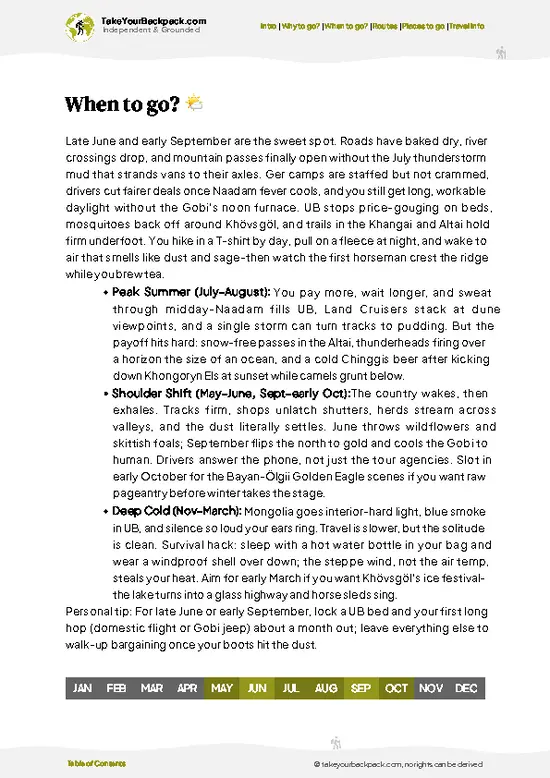
source: climatestotravel.comJANJanuary: below average for travelingFEBFebruary: below average for travelingMARMarch: fair for travelingAPRApril: fair for travelingMAYMay: highly recommended for travelingJUNJune: excellent for travelingJULJuly: excellent for travelingAUGAugust: excellent for travelingSEPSeptember: highly recommended for travelingOCTOctober: good for travelingNOVNovember: fair for travelingDECDecember: below average for traveling
mongolia-region-khentii-mountains
© Google |

✈️ The backpacker research shortcutMongolia Travel Guide

An offline-friendly backpacking guide with optimized travel routes, ranked highlights, transport advice, and the best areas to stay.
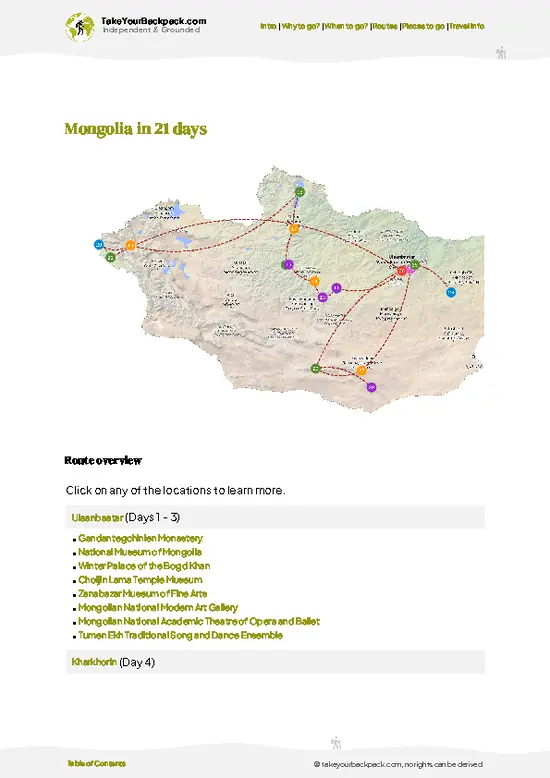
example page 0 from our offline Travel Guide for Mongoliaexample page 1 from our offline Travel Guide for Mongoliaexample page 2 from our offline Travel Guide for Mongoliaexample page 3 from our offline Travel Guide for Mongoliaexample page 4 from our offline Travel Guide for Mongoliaexample page 5 from our offline Travel Guide for Mongolia
The digital guide (250 pages) contains:
70 highlights, ranked by travel appeal
Optimized 7, 14 & 21-day travel routes
Best neighborhoods to stay
How to get around
Offline-friendly for travel without Wi-Fi
👉 See all 30+ guide features

📅 Plan smarter in minutes, not weeks
Month by month travel advice
Festivals & national holidays
Budget expectations

🗺️ Go to the right places, skip the overrated ones
Honest pros & cons of destinations
Top hikes, parks & viewpoints
Lesser-known places most travelers miss
Clear “worth it vs skip it” guidance

🛏️ Travel smoothly without rookie mistakes
Best areas to stay
Transport systems explained simply
Common scams & safety advice
SIM cards, money & practical tips

🌍 Understand the country, not just visit it
Culture & traditions
52 Essential phrases & customs
Festivals worth planning around
Traveler-friendly historical context
Insights that make places more meaningful

📱 Built for real travel conditions
Fully downloadable PDF
Works completely offline
Optimized for phone use
Useful in remote areas & buses
Everything in one place
Save weeks of stressful planning
Get instant access to the full guide directly. 30-day money-back guarantee.


Sent to your inbox immediately after payment • 100% Secure Checkout
Best Backpacking Travel Advisor 2025 tourism awardBest Backpacking
Travel Advisor
2025
What others say about Take Your Backpack Guides:
⭐⭐⭐⭐⭐
Fantastic, amazing amount of information!
⭐⭐⭐⭐⭐
My goodness this is amazing, it's what I've been looking for hats off too you!
⭐⭐⭐⭐⭐
I think this is absolutely BRILLIANT
⭐⭐⭐⭐
Very complete and informative. It's still missing places, but I gotta to commend you
⭐⭐⭐⭐⭐
This is truly amazing, thank you, can't wait to explore it with my kids!
⭐⭐⭐⭐⭐
Awesome resource, thank you!
⭐⭐⭐⭐⭐
This is amazing! Can't wait to explore the ones I haven't seen
⭐⭐⭐⭐
I love this! Well done, great idea.
⭐⭐⭐⭐⭐
Thanks for taking the time to make this gem!
⭐⭐⭐⭐⭐
This might be the best website I've ever seen.
⭐⭐⭐⭐⭐
Congratulations, and thank you so much for your work; it's incredibly valuable.
⭐⭐⭐⭐
In all seriousness I think you did a great job pointing out the important spots
⭐⭐⭐⭐⭐
10/10 very good
⭐⭐⭐⭐⭐
As someone who's only just starting to visit regularly this is awesome, thank you.
⭐⭐⭐⭐
Thank you very much! I'm going to visit my dad, it's going to be very useful!
⭐⭐⭐⭐⭐
This is really cool! We'll be travelling for the first time and this definitely come in handy.
⭐⭐⭐⭐⭐
You are now our minister of culture, congratulations 👨‍💼
⭐⭐⭐⭐⭐
Just wanted to tell you that this is a pearl! Going to follow your recommendations.
⭐⭐⭐⭐⭐
This is so cool. I'll definitely be using the resource for my travels soon.
⭐⭐⭐⭐⭐
This is very impressive! Good work.
⭐⭐⭐⭐⭐
This is an amazing and informative site. Very well done!

🛏️ Where to stay?Best areas and accommodation options

When you’re roaming the Khentii Mountains, your choice of where to stay can make or break your experience. Let’s dive into the best spots that balance safety, social vibes, and budget-friendly options.

Start in Tsetserleg, the capital of Arkhangai Province. It’s a hub for backpackers, with a laid-back atmosphere and friendly locals. You’ll find plenty of cafes where you can swap stories with fellow travelers. Plus, it’s a great launchpad for exploring the surrounding mountains.

Next up is Kharkhorin, the ancient capital of Mongolia. This town is steeped in history, and you can feel it in the … read more 👉
When you’re roaming the Khentii Mountains, your choice of where to stay can make or break your experience. Let’s dive into the best spots that balance safety, social vibes, and budget-friendly options.

Start in Tsetserleg, the capital of Arkhangai Province. It’s a hub for backpackers, with a laid-back atmosphere and friendly locals. You’ll find plenty of cafes where you can swap stories with fellow travelers. Plus, it’s a great launchpad for exploring the surrounding mountains.

Next up is Kharkhorin, the ancient capital of Mongolia. This town is steeped in history, and you can feel it in the air. The Erdene Zuu Monastery is a must-see, and the local market buzzes with life. It’s a perfect spot to meet other backpackers and share tips over a bowl of hearty soup.

Don’t overlook Bayanlig, a small village that offers a more intimate experience. Here, you can connect with nomadic families and learn about their way of life. It’s quieter, but that’s the charm. You’ll leave with stories that no guidebook can capture.

Choose wisely, and you’ll find that each place offers its own slice of Mongolia’s soul.

🚌 Getting aroundTransportation options and practical tips

The Khentii Mountains pulse with a rhythm that’s anything but predictable. Here, time feels fluid, like the rivers carving through the valleys. Schedules? They’re more like suggestions. You’ll find yourself navigating a landscape where intuition reigns supreme, and the journey is as much about the experience as the destination. This is a place where the wind whispers tales of Genghis Khan, and every twist in the road reveals a new adventure. Embrace the chaos, and you’ll discover the true spirit of Mongolia.


  • Shared Minibus (Marshrutka): These are your lifelines, running between major towns like Khentii and Ulaanbaatar. They typically leave when full, so be prepared for a wait. Expect to pay around 10,000 MNT ($3) for a 3-4 hour ride. Comfort is basic, but the camaraderie is real.


  • Private
read more 👉
The Khentii Mountains pulse with a rhythm that’s anything but predictable. Here, time feels fluid, like the rivers carving through the valleys. Schedules? They’re more like suggestions. You’ll find yourself navigating a landscape where intuition reigns supreme, and the journey is as much about the experience as the destination. This is a place where the wind whispers tales of Genghis Khan, and every twist in the road reveals a new adventure. Embrace the chaos, and you’ll discover the true spirit of Mongolia.


  • Shared Minibus (Marshrutka): These are your lifelines, running between major towns like Khentii and Ulaanbaatar. They typically leave when full, so be prepared for a wait. Expect to pay around 10,000 MNT ($3) for a 3-4 hour ride. Comfort is basic, but the camaraderie is real.


  • Private Taxi: If you’re feeling a bit flush, a private taxi can whisk you away at your own pace. Prices vary, but budget around 50,000 MNT ($15) for a short trip. It’s faster and more comfortable, but you’ll miss out on the local interactions that make the journey memorable.


  • Horseback Riding: For the adventurous, nothing beats the thrill of riding through the mountains. Local guides offer day trips starting at about 30,000 MNT ($9). It’s a slow pace, but you’ll soak in the stunning landscapes and feel the connection to the land.


  • Hitchhiking: This is a rite of passage in Mongolia. It’s free, but you’ll need patience and a good sense of humor. Locals are friendly and often willing to help, but don’t expect a quick ride. It’s all about the journey, not just the destination.


  • Bus Services: Regular buses connect major towns, with prices around 15,000 MNT ($4.50) for longer routes. They run on a loose schedule, so check local listings. It’s a budget-friendly option, but comfort can be hit or miss.


For a smooth ride across the Khentii Mountains, aim to travel early in the morning. The locals are more active, and you’ll have a better chance of finding transport. Plus, the early light casts a magical glow over the landscape, setting the tone for your adventure. Embrace the unpredictability, and let the mountains guide you.

🍲 FoodLocal Cuisine & Drinks

In the **Khentii Mountains**, food is a celebration of the land and its nomadic culture. Dive into **buuz**, those delightful steamed dumplings filled with juicy mutton or beef, often served with a side of tangy dipping sauce. The aroma wafts through the air, pulling you into local gatherings. Don’t miss **khuushuur**, the fried version, perfect for a quick snack while trekking.

For drinks, **airag**—fermented mare’s milk—is a must-try. It’s a unique taste, slightly sour and refreshing, best enjoyed in a traditional **ger** setting. You’ll find it at local markets or offered by families, a true rite of passage for any backpacker.

Casual eateries abound, from bustling **markets** where vendors serve up hearty bowls of **mutton soup** to roadside stalls dishing out **fried bread**. Grab a … read more 👉
In the **Khentii Mountains**, food is a celebration of the land and its nomadic culture. Dive into **buuz**, those delightful steamed dumplings filled with juicy mutton or beef, often served with a side of tangy dipping sauce. The aroma wafts through the air, pulling you into local gatherings. Don’t miss **khuushuur**, the fried version, perfect for a quick snack while trekking.

For drinks, **airag**—fermented mare’s milk—is a must-try. It’s a unique taste, slightly sour and refreshing, best enjoyed in a traditional **ger** setting. You’ll find it at local markets or offered by families, a true rite of passage for any backpacker.

Casual eateries abound, from bustling **markets** where vendors serve up hearty bowls of **mutton soup** to roadside stalls dishing out **fried bread**. Grab a seat at a communal table, and you’ll feel the warmth of camaraderie as locals share stories over meals.

Dining here isn’t just about food; it’s about connection. Expect to share your dish, and don’t be shy about trying everything. Remember, it’s polite to accept a drink when offered—this is how friendships are forged in the heart of Mongolia.

Other Mongolian regions near Khentii Mountains

Explore more nearby:

  • Orkhon Valley—Steppe grasslands, ancient ruins, nomadic camps| 542 km away
  • Uvs Nuur Basin—Salt lake, desert edges, migratory birds| 1347 km away
  • Bayan-Ulgii—Kazakh traditions, eagle hunting, Altai peaks| 1646 km away

👉 Discover all regions

Or checkout all Mongolia has to offer (think cities, towns, villages, national parks, hikes, beaches, festivals)
Country photo of Mongolia

We 💚 feedbackParting advice and final tips

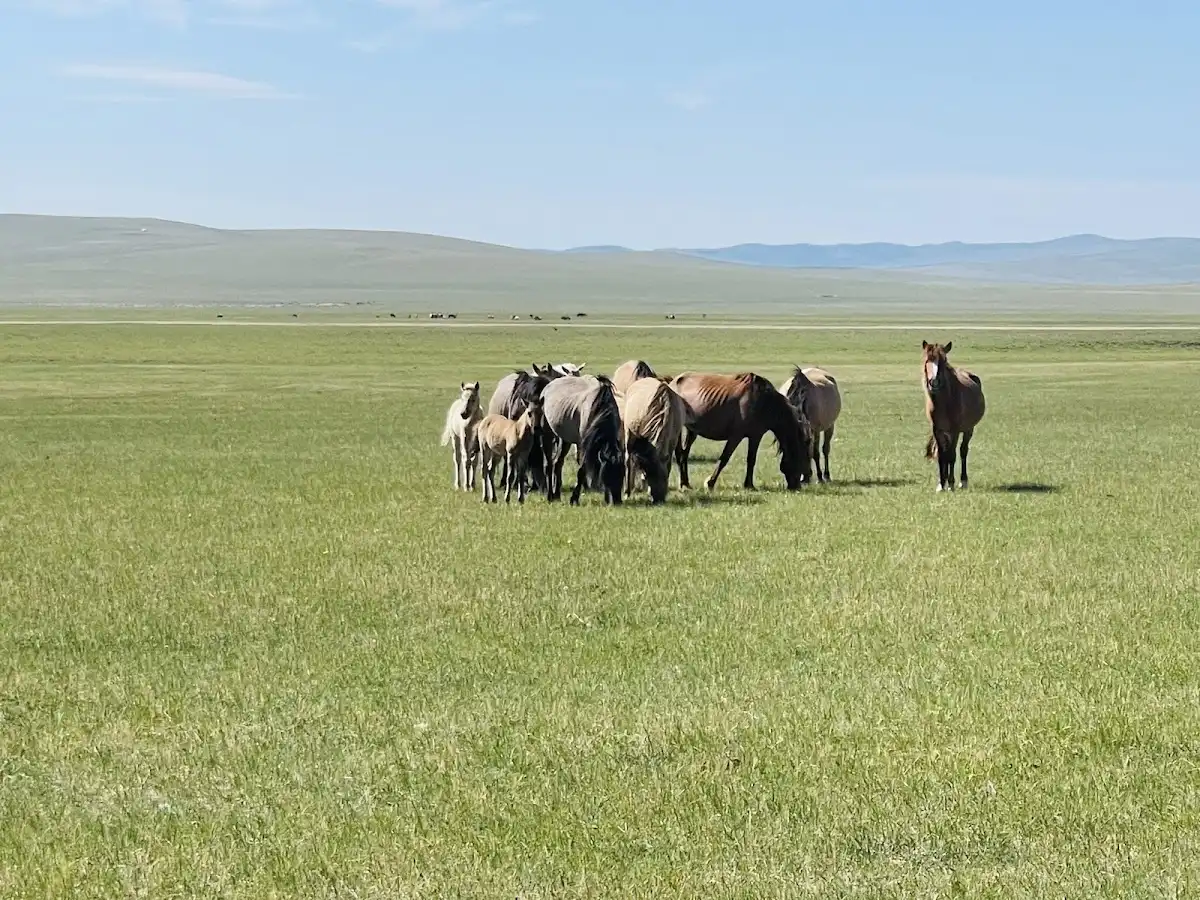
The Khentii Mountains are a slice of Mongolia that feels like stepping into a time machine. The vastness, the wild horses, and the untouched landscapes are a dream for any backpacker. But here’s the kicker: the remoteness can be a pain. Expect long travel times and limited amenities. Embrace the discomfort, though; it’s part of the adventure. You’ll leave with stories that no guidebook can capture. Trust me, it’s worth it.

✈️ When did I visit Mongolia?
As part of my 1.5 year travel around the world trip, I visited Mongolia in July 2015. After a month of horse-riding and hitch-hiking I took the TransMongolia express to China.

✍️ Help improve this page!
The information on this page is based on my own backpacking experience in Mongolia, supplemented with up-to-date research and feedback from other travelers. Travel details can change, so if you notice anything outdated or incomplete, feel free to let me know.


🙋‍♂️ Give feedback

👋 Meet the founderWho’s Behind Take Your Backpack?

Johan, backpacker and founder of TakeYourBackpackHi, I’m Johan (Netherlands 🇳🇱), the creator of TakeYourBackpack. Over the past decade, I’ve backpacked through 80+ countries across six continents, gaining extensive experience with independent travel, long-term trips, and overland routes.

This site is built on a combination of firsthand travel experience and carefully curated insights from other backpackers. Many guides are based on places I’ve personally visited, while others bring together tips, observations, and practical advice shared by trusted travelers I’ve met along the way.

The goal is to provide realistic, experience-driven guidance — not generic itineraries — so you can explore destinations with better context, clearer expectations, and more confidence.

Get Full Country Guide |
Instant download • 70 highlights • Full Offline guide