×

Mongolia🇲🇳 | best regionsExplore the 5 Best regions in Mongolia

Mongolia is 1.56 million square kilometers with about 3.4 million people, so its regions are defined by distance, landscape and nomadic life rather than cities or sights. Pick a region and you pick a whole way of traveling. The central steppe and river valleys sit closest to Ulaanbaatar, with paved roads, ger camps and the most visitors. The Gobi in the south means dunes, canyons and long jeep days, with higher costs. The far north and west trade comfort for forests, lakes and glaciers, and almost nobody else is there. Backpacking here means choosing between cheap but slow public transport and faster, pricier shared jeeps. Roads vanish, distances stretch, and that is the fun. Pack hard, point yourself at the horizon and go explore.

By Johan Kruseman 🇳🇱 | Updated October 18, 2026
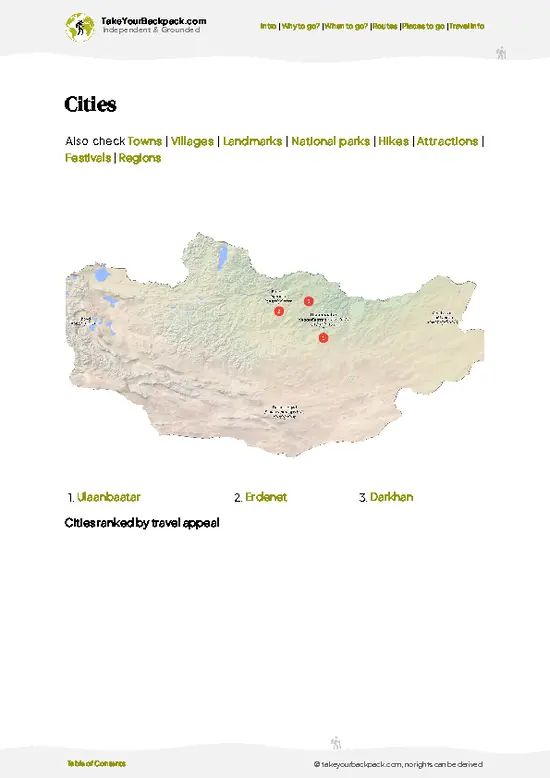
Explore the best cities in Mongolia

Why go?Why These region Stand Out

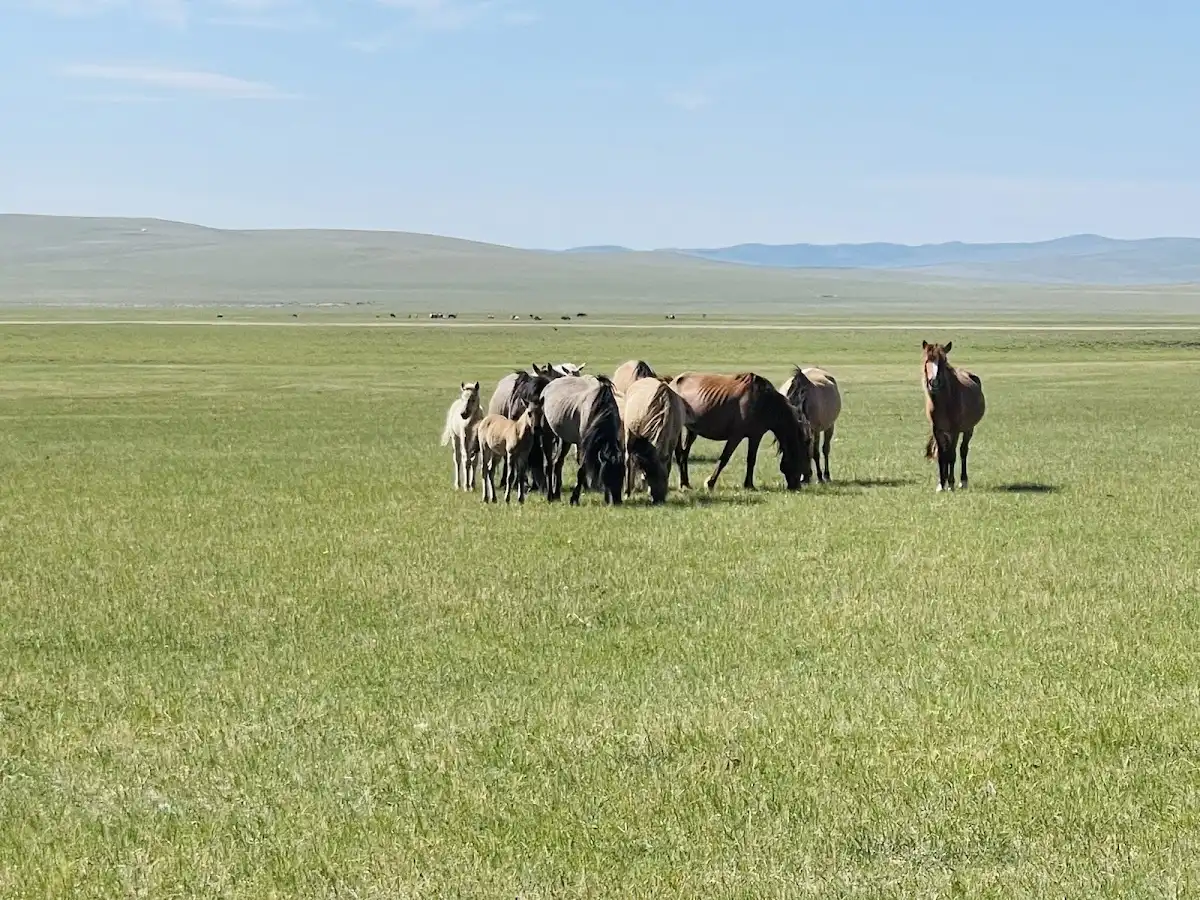
Mongolia is the least densely populated sovereign country on Earth, and that single fact shapes everything about exploring it. Roughly 30 percent of people still live as herders, moving livestock between seasonal pastures, so the countryside is a working landscape, not a park with gates. You can often camp freely, follow tracks across open grassland and be welcomed into a ger for tea. That freedom is the draw.

Geography sets the rules. The country spans desert, steppe, taiga and alpine mountains, held together by a very thin road network. Paved highways link Ulaanbaatar to major provincial towns, but beyond them you drive on dirt tracks that braid across the plains. Travel times run long, and a 300 kilometer leg can take a full day. Public transport reaches provincial centers, while remote … read more 👉
Mongolia is the least densely populated sovereign country on Earth, and that single fact shapes everything about exploring it. Roughly 30 percent of people still live as herders, moving livestock between seasonal pastures, so the countryside is a working landscape, not a park with gates. You can often camp freely, follow tracks across open grassland and be welcomed into a ger for tea. That freedom is the draw.

Geography sets the rules. The country spans desert, steppe, taiga and alpine mountains, held together by a very thin road network. Paved highways link Ulaanbaatar to major provincial towns, but beyond them you drive on dirt tracks that braid across the plains. Travel times run long, and a 300 kilometer leg can take a full day. Public transport reaches provincial centers, while remote sights usually need a hired jeep and driver, often shared to cut costs.

The climate is extreme continental, with scorching summers and winters that drop below minus 30°C, so the season decides what is possible. Services shrink fast outside towns. Expect limited phone signal, few shops, fuel stations spaced far apart and homestays rather than hotels.

Culture matters just as much. Nomadic hospitality is real, and so are customs: step over the threshold, never on it, accept tea with your right hand and keep your voice calm. Before choosing Mongolia, accept that you trade convenience for space. Plan around distance, carry cash, download offline maps and keep your schedule loose. Do that and the country gives back horizons, night skies thick with stars and encounters no city can match.
Evaluating the Top Choices
The list of best regions in Mongolia is created based on landscapes, local culture, attractions, vibes, and overall appeal. If you feel a region is missing in this list, please let us know.

When to go?Seasonal Guide to Visiting

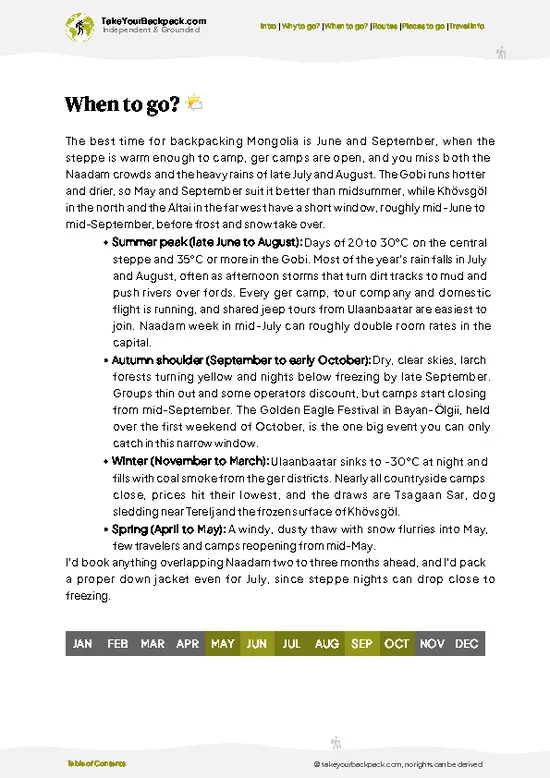
Best months and weather: June to September is the best window for Mongolia's regions, because daytime temperatures reach 15 to 28°C, grass is green and nearly every ger camp, road and ferry runs. July brings the Naadam festival (July 11 to 13 nationally) and the highest prices and crowds. It also brings the heaviest rain, with most of the country's modest 200 to 300 mm annual precipitation falling from July to August, often as short afternoon storms that can turn dirt tracks to mud.
Shoulder seasons: Late May to early June and September are the smart picks. Crowds thin, jeep and camp prices often drop 10 to 20 percent from July peaks, and light is gorgeous. Nights can fall to near freezing, especially in the northern mountains and by the western lakes, so a proper sleeping bag matters. Early … read more 👉
Best months and weather: June to September is the best window for Mongolia's regions, because daytime temperatures reach 15 to 28°C, grass is green and nearly every ger camp, road and ferry runs. July brings the Naadam festival (July 11 to 13 nationally) and the highest prices and crowds. It also brings the heaviest rain, with most of the country's modest 200 to 300 mm annual precipitation falling from July to August, often as short afternoon storms that can turn dirt tracks to mud.
Shoulder seasons: Late May to early June and September are the smart picks. Crowds thin, jeep and camp prices often drop 10 to 20 percent from July peaks, and light is gorgeous. Nights can fall to near freezing, especially in the northern mountains and by the western lakes, so a proper sleeping bag matters. Early September brings golden larches in the forested north.
Winter and early spring: November to March is brutally cold, with lows of minus 25 to minus 40°C in much of the country. Many tourist camps close and roads can ice over. It suits seasoned travelers chasing frozen lakes, the Tsagaan Sar lunar new year in February and reindeer-herder country in the far north, but it is a different kind of trip. April is windy, dusty and unpredictable, with spring storms sweeping the southern Gobi.
Regional timing: The Gobi is hot, often 35 to 40°C in July, so May, June and September are more comfortable. The northern forests and western mountains are best July to August, when high passes clear of snow. The central steppe works from late May to mid-October.

region hoppingPlanning Your Route Efficiently

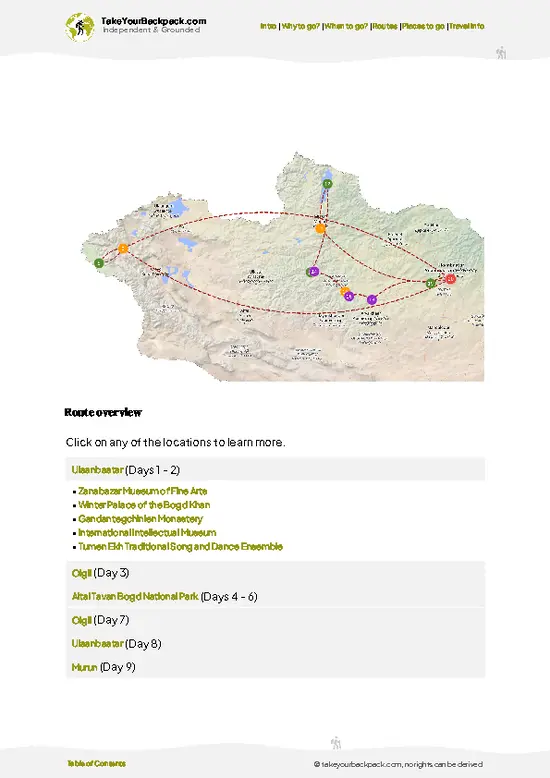
How many days to plan: A trip linking several regions of Mongolia needs 14 to 21 days, because distances are long and roads slow. Anything under 10 days works for one or two areas at most, as an average day on unpaved tracks covers only 200 to 300 kilometers.
What clusters together: Ulaanbaatar is the hub for everything. The central steppe and ancient capital area pairs naturally with the Gobi, since both run southwest and west of the capital on partly paved roads. The northern lakes and forests sit in a separate corridor, linked by flights or a long overland push to Mörön or Khatgal. The far west sits furthest, and combining it with anything else normally means flying to Ölgii or Khovd, a trip of about 3 to 4 hours from the capital.
Direction and pacing: Travel in a loop outward and return … read more 👉
How many days to plan: A trip linking several regions of Mongolia needs 14 to 21 days, because distances are long and roads slow. Anything under 10 days works for one or two areas at most, as an average day on unpaved tracks covers only 200 to 300 kilometers.
What clusters together: Ulaanbaatar is the hub for everything. The central steppe and ancient capital area pairs naturally with the Gobi, since both run southwest and west of the capital on partly paved roads. The northern lakes and forests sit in a separate corridor, linked by flights or a long overland push to Mörön or Khatgal. The far west sits furthest, and combining it with anything else normally means flying to Ölgii or Khovd, a trip of about 3 to 4 hours from the capital.
Direction and pacing: Travel in a loop outward and return by a different road, which avoids repeating the same highway. Start with the closest region to adjust to dirt tracks, then push farther. Allow 3 to 5 days per major region, with one stop of two nights at least before moving, because driving days of 6 to 10 hours leave little room for sightseeing. Between regions, expect 8 to 12 hours by road, or 1.5 to 3 hours by domestic flight.
Planning mistakes: The most common error is cramming three or four regions into ten days, which leaves you mostly staring at a windshield. Choose two regions and linger. Another is trusting map distances, as 100 kilometers on a track can mean four hours. Add buffer days for weather and breakdowns, especially after rain. Book domestic flights early for July and August, and book return transport before heading into remote areas, since seats and jeeps fill fast around Naadam.

The ListThe Best regions of Mongolia

1 Orkhon Valley

Steppe grasslands, ancient ruins, nomadic camps

Follow the river through open plains dotted with archaeological sites, where nomadic families graze livestock and history shapes daily life.

mongolia-region-orkhon-valley
© Google |

2 Gobi Desert

sand dunes, fossil sites, camel herding

Cross vast arid plains by foot or camel, passing through shifting dunes, dinosaur remains, and the seasonal camps of nomadic families.

3 Bayan-Ulgii

Kazakh traditions, eagle hunting, Altai peaks

Experience a remote borderland where Kazakh herders maintain ancient customs, and the landscape shifts from glacier-fed rivers to rugged highlands.

4 Khentii Mountains

Forest wilderness, sacred sites, Genghis Khan legacy

Travel through dense forests and rolling hills, encountering spiritual landmarks and the birthplace of Mongolia’s most influential historical figure.

mongolia-region-khentii-mountains
© Google |

5 Uvs Nuur Basin

Salt lake, desert edges, migratory birds

Observe dramatic ecological contrasts as saline waters meet arid steppe, attracting rare wildlife and supporting isolated communities on the frontier.

Loading the map 🌍

Expert viewInsights from Locals and Experts

How many regions to visit: Two regions is the number I advise for a trip of two to three weeks, and three only if you have a full month. Mongolian roads are slow, with typical driving days of 5 to 9 hours on bumpy tracks, so each additional region steals time from the part that matters: sitting in a valley with a bowl of milk tea, watching herds drift across the slope. Two regions leave you rested enough to say yes to an invitation into a herder’s ger.
Choosing your kind of region: Match the landscape to your style. Travelers who want easy access, culture and horse riding should pick the steppe and river valleys near the capital, where homestays are frequent and shared transport is simplest. Those chasing dramatic desert, dunes and dinosaur country head south, accepting heat and longer drives. … read more 👉
How many regions to visit: Two regions is the number I advise for a trip of two to three weeks, and three only if you have a full month. Mongolian roads are slow, with typical driving days of 5 to 9 hours on bumpy tracks, so each additional region steals time from the part that matters: sitting in a valley with a bowl of milk tea, watching herds drift across the slope. Two regions leave you rested enough to say yes to an invitation into a herder’s ger.
Choosing your kind of region: Match the landscape to your style. Travelers who want easy access, culture and horse riding should pick the steppe and river valleys near the capital, where homestays are frequent and shared transport is simplest. Those chasing dramatic desert, dunes and dinosaur country head south, accepting heat and longer drives. Hikers, paddlers and anyone craving solitude belong in the mountains and forests of the north and west, where trails are rough, signs are rare and you trade comfort for silence and glaciers. Mix one easy region with one wild one.
What it costs: Budget US$30 to 50 a day if you use public buses, guesthouses, ger stays and shared meals. A tour by shared jeep with a driver runs about US$80 to 120 a day per vehicle split between passengers, which usually makes it US$25 to 40 each for four people, fuel included. Ger camps cost about US$15 to 40 per person with meals, while homestays are often less. National park entry is small, typically 3,000 to 10,000 MNT (about US$1 to 3) per person, with extra fees for vehicles and cameras at some sites. Guides for trekking or horse trips run US$30 to 60 a day. Short domestic flights range from about US$100 to 200 one way. Overall, a two-region, 15-day trip costs roughly US$900 to 1,800, excluding international flights. Cash in tögrög matters, as card machines vanish outside towns.
Safety on the ground: The big risks are remote travel, weather and road conditions, not crime. Sudden storms, river crossings after rain and long gaps between fuel stations make a reliable driver worth paying for. Carry extra water, a sleeping bag rated to 0°C even in summer and a paper map, since phone coverage fades quickly. Stay clear of unfamiliar dogs near gers. Herding dogs can be fierce, so ask your host to restrain them before you step outside after dark. Pickpocketing exists in busy markets and on crowded buses in the capital, so keep valuables close. Water should be filtered or boiled, and bubonic plague warnings around marmot hunting are real, so never touch or eat marmot.
Cultural courtesy: Mongolian hospitality is generous, and a few habits earn you warmth. Step over the ger threshold, never onto it. Walk clockwise around the stove, accept food and drink with your right hand or both hands, and take at least a sip. Ask before photographing people or their animals. Sacred cairns called ovoo should be circled clockwise three times, a custom visitors can follow. Bring small gifts such as tea, sweets or school supplies. Respect pasture and wildlife, and pack out all trash. Treat each ger as someone’s home, and you will get the best seat by the stove, a warm bowl of mutton broth and a story that outlasts the trip.

✈️ The backpacker research shortcutMongolia Travel Guide

An offline-friendly backpacking guide with optimized travel routes, ranked highlights, transport advice, and the best areas to stay.
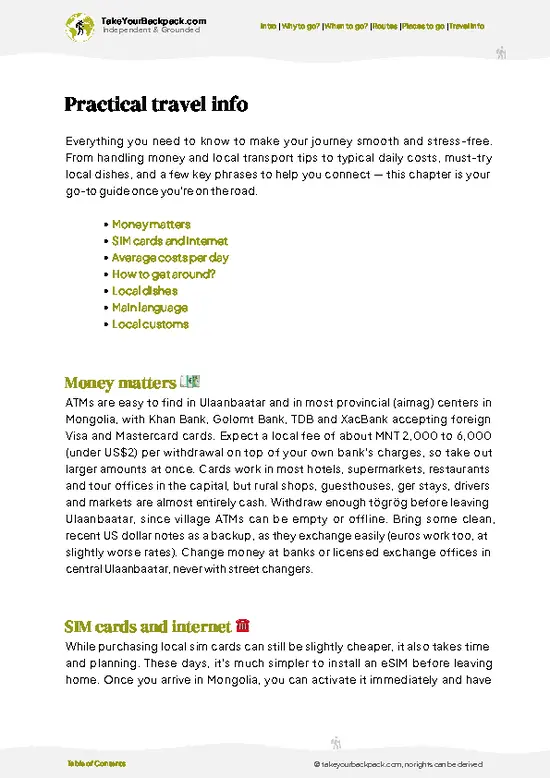
example page 0 from our offline Travel Guide for Mongolia
example page 1 from our offline Travel Guide for Mongolia
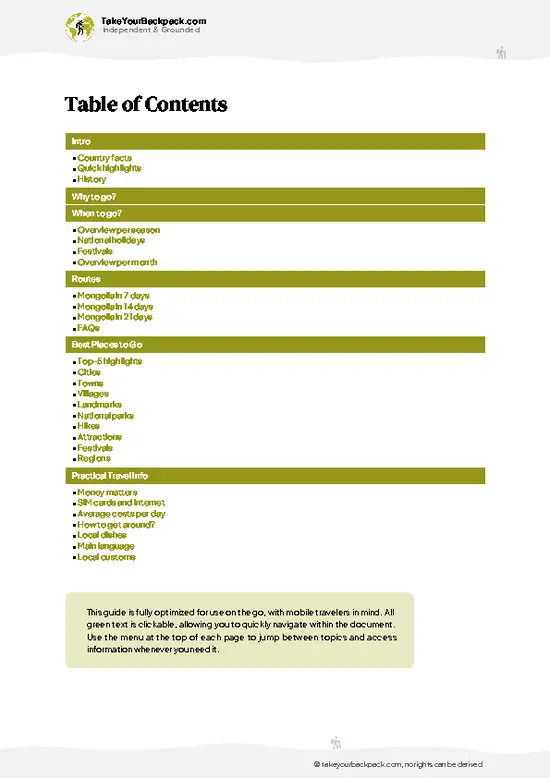
example page 2 from our offline Travel Guide for Mongolia
example page 3 from our offline Travel Guide for Mongolia
example page 4 from our offline Travel Guide for Mongolia
example page 5 from our offline Travel Guide for Mongolia
example page 6 from our offline Travel Guide for Mongolia
example page 7 from our offline Travel Guide for Mongolia
The digital guide (272 pages) contains:
✅ 67 highlights, ranked by travel appeal
✅ Optimized 7, 14 & 21-day travel routes
✅ Cities, national parks, landmarks, beaches
✅ How to get around
✅ Offline-friendly for travel without Wi-Fi
👉 Click to see all 30+ guide features

📅 Plan smarter in minutes, not weeks
✅ Month by month travel advice
✅ Festivals & national holidays
✅ Budget expectations

🗺️ Go to the right places, skip the overrated ones
✅ Honest pros & cons of destinations
✅ Top hikes, parks & viewpoints
✅ Lesser-known places most travelers miss
✅ Clear “worth it vs skip it” guidance

🛏️ Travel smoothly without rookie mistakes
✅ Best areas to stay
✅ Transport systems explained simply
✅ Common scams & safety advice
✅ SIM cards, money & practical tips

🌍 Understand the country, not just visit it
✅ Culture & traditions
✅ 52 Essential phrases & customs
✅ Festivals worth planning around
✅ Traveler-friendly historical context
✅ Insights that make places more meaningful

📱 Built for real travel conditions
✅ Fully downloadable PDF
✅ Works completely offline
✅ Optimized for phone use
✅ Useful in remote areas & buses
✅ Everything in one place
Stop searching, start planning
Get instant access to your full guide. 30‑day money-back guarantee.
+ Add another guide for just

By proceeding you agree to our terms.
Sent to your inbox immediately after payment • 100% Secure Checkout
Best Backpacking Travel Advisor 2025 tourism awardBest Backpacking
Travel Advisor
2025
What others say about Take Your Backpack Guides:
⭐⭐⭐⭐⭐
Fantastic, amazing amount of information!
⭐⭐⭐⭐⭐
My goodness this is amazing, it's what I've been looking for hats off too you!
⭐⭐⭐⭐⭐
I think this is absolutely BRILLIANT
⭐⭐⭐⭐
Very complete and informative. It's still missing places, but I gotta to commend you
⭐⭐⭐⭐⭐
This is truly amazing, thank you, can't wait to explore it with my kids!
⭐⭐⭐⭐⭐
Awesome resource, thank you!
⭐⭐⭐⭐⭐
This is amazing! Can't wait to explore the ones I haven't seen
⭐⭐⭐⭐
I love this! Well done, great idea.
⭐⭐⭐⭐⭐
Thanks for taking the time to make this gem!
⭐⭐⭐⭐⭐
This might be the best website I've ever seen.
⭐⭐⭐⭐⭐
Congratulations, and thank you so much for your work; it's incredibly valuable.
⭐⭐⭐⭐
In all seriousness I think you did a great job pointing out the important spots
⭐⭐⭐⭐⭐
10/10 very good
⭐⭐⭐⭐⭐
As someone who's only just starting to visit regularly this is awesome, thank you.
⭐⭐⭐⭐
Thank you very much! I'm going to visit my dad, it's going to be very useful!
⭐⭐⭐⭐⭐
This is really cool! We'll be travelling for the first time and this definitely come in handy.
⭐⭐⭐⭐⭐
You are now our minister of culture, congratulations 👨‍💼
⭐⭐⭐⭐⭐
Just wanted to tell you that this is a pearl! Going to follow your recommendations.
⭐⭐⭐⭐⭐
This is so cool. I'll definitely be using the resource for my travels soon.
⭐⭐⭐⭐⭐
This is very impressive! Good work.
⭐⭐⭐⭐⭐
This is an amazing and informative site. Very well done!

🛏️ Where to stay?Top Areas to Stay

Backpacking Mongolia is easy on the wallet, with dorm beds in Ulaanbaatar running roughly US$8 to 15 a night, and most hostels doubling as tour desks that set up the multi-day jeep trips to the countryside, while outside the capital you sleep in family-run guesthouses or ger camps in towns like Kharkhorin and Mörön. In the capital, the densest cluster sits in central Sükhbaatar District around Peace Avenue and Sükhbaatar Square, where you can walk to the museums, cafés and the bars of Seoul Street, though traffic noise and pickpockets near the State Department Store come with the location. West toward Gandan Monastery, beds are a little cheaper and nights quieter, but you will lean on buses … read more 👉
Backpacking Mongolia is easy on the wallet, with dorm beds in Ulaanbaatar running roughly US$8 to 15 a night, and most hostels doubling as tour desks that set up the multi-day jeep trips to the countryside, while outside the capital you sleep in family-run guesthouses or ger camps in towns like Kharkhorin and Mörön. In the capital, the densest cluster sits in central Sükhbaatar District around Peace Avenue and Sükhbaatar Square, where you can walk to the museums, cafés and the bars of Seoul Street, though traffic noise and pickpockets near the State Department Store come with the location. West toward Gandan Monastery, beds are a little cheaper and nights quieter, but you will lean on buses or taxis to reach the center and its nightlife.

If you enjoy meeting fellow travelers, consider choosing hostels with high ratings for atmosphere. On the other hand, if you prefer having your own space, a hotel might be a better option.

MongoliaDiscover the Country

👋 Meet the founderWho’s Behind Take Your Backpack?

Johan, backpacker and founder of TakeYourBackpackHi, I’m Johan (Netherlands 🇳🇱), the creator of TakeYourBackpack. Over the past 3 decades, I’ve backpacked through 90+ countries across six continents, gaining extensive experience with independent travel, long-term trips, and overland routes.

This site is built on a combination of firsthand travel experience and carefully curated insights from other backpackers. Many guides are based on places I’ve personally visited, while others bring together tips, observations, and practical advice shared by trusted travelers I’ve met along the way.

The goal is to provide realistic, experience-driven guidance — not generic itineraries — so you can explore destinations with better context, clearer expectations, and more confidence.