×

Morocco🇲🇦 | national parksBouhachem Regional Nature ParkCork oak woods, Jebala hamlets, ridge viewpoints, misty springs | things to do and best time to go

Explore Merja Zerga LagoonExplore Eastern High Atlas National Park

Backpacking in Bouhachem Regional Nature Park
👌 Worth visitingnational park ranked #10
By Johan Kruseman 🇳🇱 | Updated October 22, 2026

Bouhachem is one of the wettest, greenest corners of Morocco, with cork oak and pine forest that looks more like Galicia than the Sahara fringe. The park sits in the Rif mountains of northern Morocco, inland from the Mediterranean coast between Tetouan and Ksar es-Seghir. I took a shared taxi from Chefchaouen and the driver stopped halfway to buy bread and pour me tea from a thermos. Skip the idea of a quick visit by public transport: the roads are slow, and you need a plan for the way back before you go. Go for forest walks, quiet villages and almost no crowds. Wildlife spotting is modest, and trail marking is patchy. Hikers who like self-reliance will love it; anyone wanting polished facilities won't.

Discover everything you want to know in the 📖 Morocco Travel Guide.


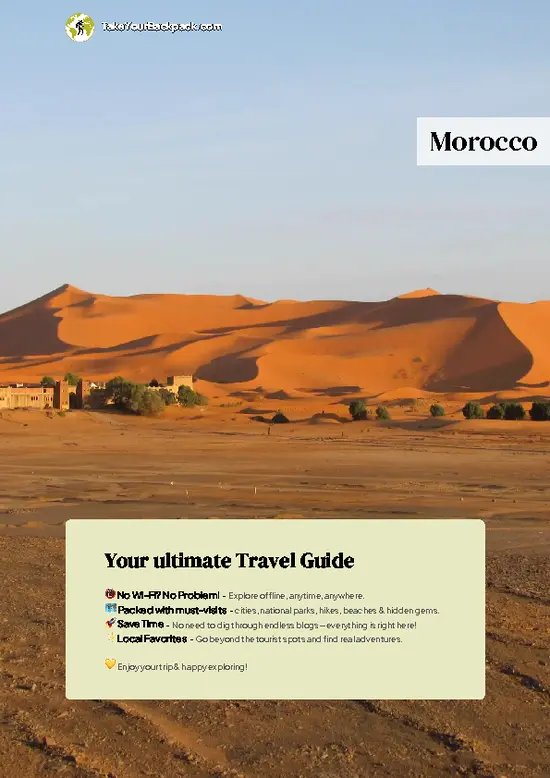
example page 0 from our offline Travel Guide for Morocco
example page 1 from our offline Travel Guide for Morocco
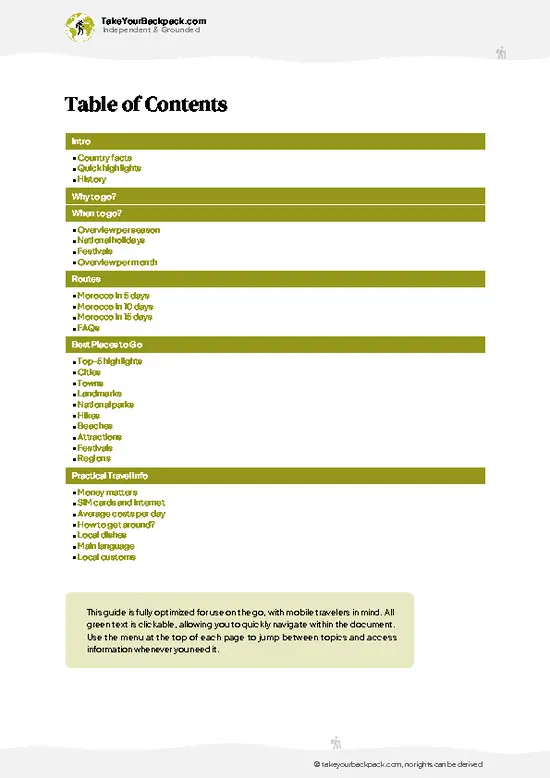
example page 2 from our offline Travel Guide for Morocco
example page 3 from our offline Travel Guide for Morocco
example page 4 from our offline Travel Guide for Morocco
example page 5 from our offline Travel Guide for Morocco
example page 6 from our offline Travel Guide for Morocco
example page 7 from our offline Travel Guide for Morocco
Loading the map 🌍
CLICK TO FILTER
cities
towns
landmarks
national parks
hikes
beaches
attractions
festivals
regions
SHOW COUNTRY’S BESTSHOW ALL

✨ Why go?
Ranked #10 national park in Morocco
What sets this place apart

Bouhachem Regional Nature Park suits backpackers who prefer finding their own way over joining a coach tour. Few foreigners come, so village paths, cork oak groves and mountain tracks feel like yours alone, and locals tend to be curious rather than commercial. The park's biggest draw is its forest variety: cork oak, Atlas cedar relics and maritime pine grow in a damp Atlantic-influenced climate rare for Morocco, giving shaded walking even in warm months. It also sits close to Tetouan and Chefchaouen, so you can combine it with a Rif circuit without long detours. Guesthouses and simple camping in the area keep things cheap, and a local guide is easy to arrange if you don't want to navigate unmarked tracks alone.

💡 HighlightsMust-see experiences and standout moments

  1. Cork oak forests: The park's signature landscape, with thick, spongy-barked trees and mossy ground that stay green long after the rest of northern Morocco dries out.
  2. Jbel Lakraa area: A high ridge zone with wide views over the surrounding hills and, on clear days, toward the Mediterranean.
  3. Berber mountain villages: Small Jebala hamlets of stone and tile houses, terraced gardens and walnut trees, where you can see farming life that has changed slowly.
  4. Maritime pine and cedar stands: Darker, cooler woodland patches that make good picnic and rest spots on longer walks.
  5. Streams and springs: Seasonal water runs through the valleys, especially after winter rain, and adds bird song and cool air to the trails.
  6. Birdlife and small wildlife: Look for raptors overhead, woodpeckers in the oaks, and with luck
… read more 👉
  1. Cork oak forests: The park's signature landscape, with thick, spongy-barked trees and mossy ground that stay green long after the rest of northern Morocco dries out.
  2. Jbel Lakraa area: A high ridge zone with wide views over the surrounding hills and, on clear days, toward the Mediterranean.
  3. Berber mountain villages: Small Jebala hamlets of stone and tile houses, terraced gardens and walnut trees, where you can see farming life that has changed slowly.
  4. Maritime pine and cedar stands: Darker, cooler woodland patches that make good picnic and rest spots on longer walks.
  5. Streams and springs: Seasonal water runs through the valleys, especially after winter rain, and adds bird song and cool air to the trails.
  6. Birdlife and small wildlife: Look for raptors overhead, woodpeckers in the oaks, and with luck Barbary macaques or wild boar tracks near quieter slopes.
  7. Mediterranean viewpoints: Open clearings on the northern edge where the forest breaks and the coastline appears below.
Bouhachem Regional Nature Park costs nothing to wander through, so the forests, viewpoints and villages are all free.
Spotted a mistake or missing something? Contact us.

Things to do near Bouhachem Regional Nature Park

Ratings based on Tripadvisor reviews. When you book through this link, you support our work at no extra cost to you.

🌤️ When to go?When to go for the best experience

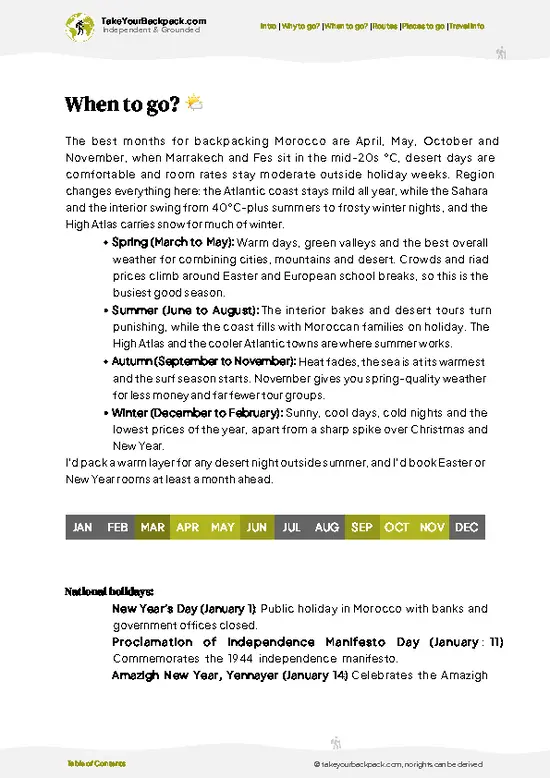
Spring, from April to early June, is the best window for hiking Bouhachem, with daytime highs of 17 to 25°C (63 to 77°F) and cork oak forest at its greenest.
  • Spring (April to June): Wildflowers, running streams and clear ridge views. Weekends fill with Moroccan day-trippers from Chefchaouen and Tetouan, so midweek is quieter. Days are long enough for a full loop.
  • Summer (July to August): Highs reach 28 to 33°C (82 to 91°F), but the shaded forest stays several degrees cooler than the coast. Local families camp, and nearby guesthouse prices climb.
  • Autumn (September to November): Mild at 15 to 26°C (59 to 79°F), with quiet trails and mushrooms after the first rains.
  • Winter (December to March): Cold and wet at 4 to 14°C (39 to 57°F). Fog and mud are common, and daylight is short. Rates are lowest.
… read more 👉
Spring, from April to early June, is the best window for hiking Bouhachem, with daytime highs of 17 to 25°C (63 to 77°F) and cork oak forest at its greenest.
  • Spring (April to June): Wildflowers, running streams and clear ridge views. Weekends fill with Moroccan day-trippers from Chefchaouen and Tetouan, so midweek is quieter. Days are long enough for a full loop.
  • Summer (July to August): Highs reach 28 to 33°C (82 to 91°F), but the shaded forest stays several degrees cooler than the coast. Local families camp, and nearby guesthouse prices climb.
  • Autumn (September to November): Mild at 15 to 26°C (59 to 79°F), with quiet trails and mushrooms after the first rains.
  • Winter (December to March): Cold and wet at 4 to 14°C (39 to 57°F). Fog and mud are common, and daylight is short. Rates are lowest.
Aim for midweek in May or October for green forest and empty paths.


source: climatestotravel.comJANJanuary: fair for travelingFEBFebruary: fair for travelingMARMarch: highly recommended for travelingAPRApril: excellent for travelingMAYMay: highly recommended for travelingJUNJune: fair for travelingJULJuly: below average for travelingAUGAugust: below average for travelingSEPSeptember: highly recommended for travelingOCTOctober: excellent for travelingNOVNovember: highly recommended for travelingDECDecember: fair for traveling
morocco-national-park-bouhachem-regional-nature-park v1
© Google |

✈️ The backpacker research shortcutMorocco Travel Guide

An offline-friendly backpacking guide with optimized travel routes, ranked highlights, transport advice, and the best areas to stay.
example page 0 from our offline Travel Guide for Morocco
example page 1 from our offline Travel Guide for Morocco
example page 2 from our offline Travel Guide for Morocco
example page 3 from our offline Travel Guide for Morocco
example page 4 from our offline Travel Guide for Morocco
example page 5 from our offline Travel Guide for Morocco
example page 6 from our offline Travel Guide for Morocco
example page 7 from our offline Travel Guide for Morocco
The digital guide (424 pages) contains:
✅ 112 highlights, ranked by travel appeal
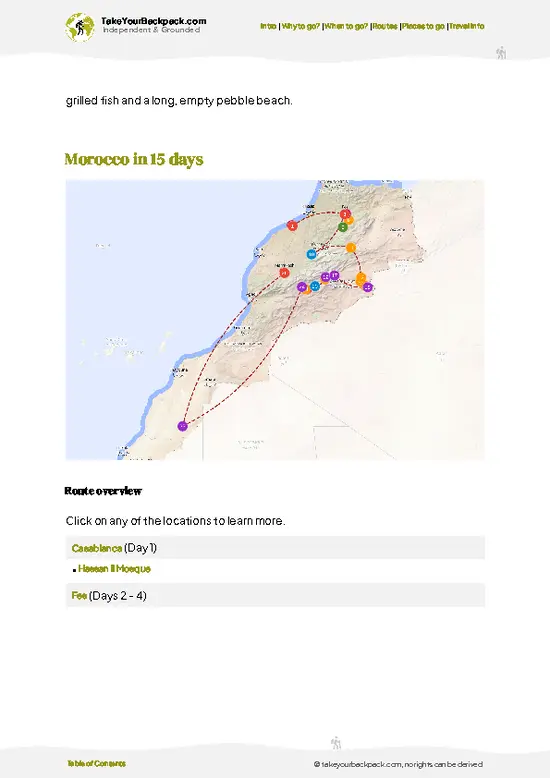
✅ Optimized 5, 10 & 15-day travel routes
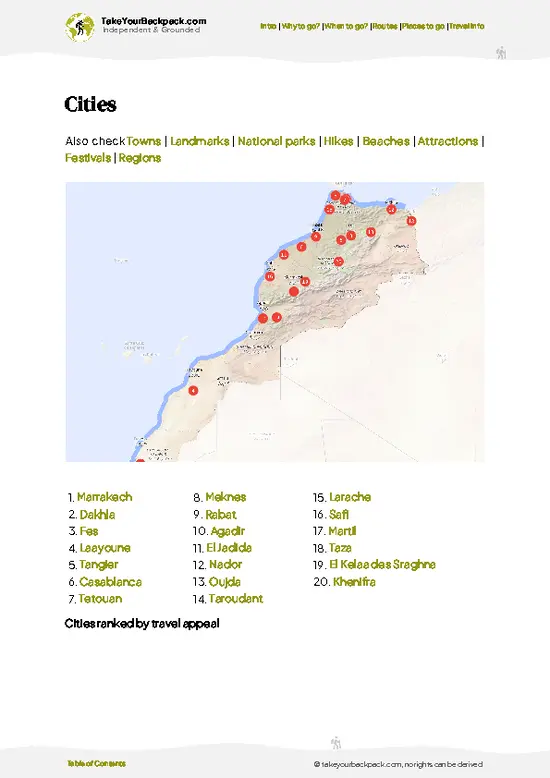
✅ Cities, national parks, landmarks, beaches
✅ How to get around
✅ Offline-friendly for travel without Wi-Fi
👉 Click to see all 30+ guide features

📅 Plan smarter in minutes, not weeks
✅ Month by month travel advice
✅ Festivals & national holidays
✅ Budget expectations

🗺️ Go to the right places, skip the overrated ones
✅ Honest pros & cons of destinations
✅ Top hikes, parks & viewpoints
✅ Lesser-known places most travelers miss
✅ Clear “worth it vs skip it” guidance

🛏️ Travel smoothly without rookie mistakes
✅ Best areas to stay
✅ Transport systems explained simply
✅ Common scams & safety advice
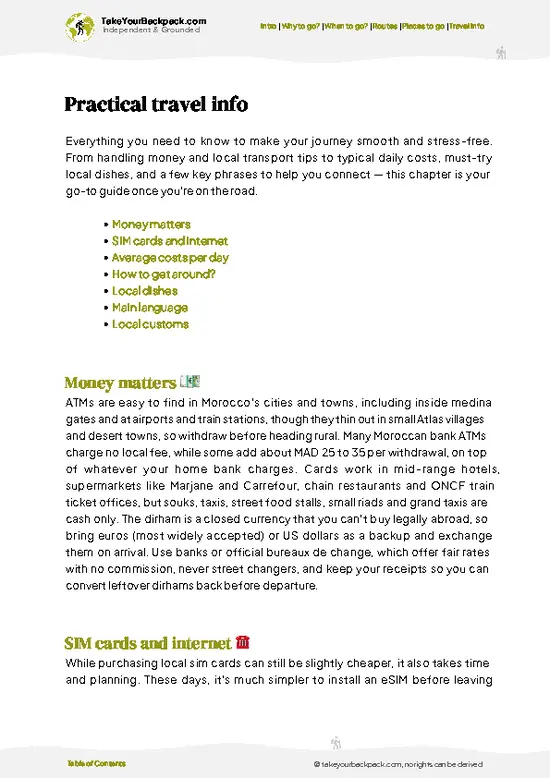
✅ SIM cards, money & practical tips

🌍 Understand the country, not just visit it
✅ Culture & traditions
✅ 52 Essential phrases & customs
✅ Festivals worth planning around
✅ Traveler-friendly historical context
✅ Insights that make places more meaningful

📱 Built for real travel conditions
✅ Fully downloadable PDF
✅ Works completely offline
✅ Optimized for phone use
✅ Useful in remote areas & buses
✅ Everything in one place
Stop searching, start planning
Get instant access to your full guide. 30‑day money-back guarantee.
+ Add another guide for just

By proceeding you agree to our terms.
Sent to your inbox immediately after payment • 100% Secure Checkout
Best Backpacking Travel Advisor 2025 tourism awardBest Backpacking
Travel Advisor
2025
What others say about Take Your Backpack Guides:
⭐⭐⭐⭐⭐
Fantastic, amazing amount of information!
⭐⭐⭐⭐⭐
My goodness this is amazing, it's what I've been looking for hats off too you!
⭐⭐⭐⭐⭐
I think this is absolutely BRILLIANT
⭐⭐⭐⭐
Very complete and informative. It's still missing places, but I gotta to commend you
⭐⭐⭐⭐⭐
This is truly amazing, thank you, can't wait to explore it with my kids!
⭐⭐⭐⭐⭐
Awesome resource, thank you!
⭐⭐⭐⭐⭐
This is amazing! Can't wait to explore the ones I haven't seen
⭐⭐⭐⭐
I love this! Well done, great idea.
⭐⭐⭐⭐⭐
Thanks for taking the time to make this gem!
⭐⭐⭐⭐⭐
This might be the best website I've ever seen.
⭐⭐⭐⭐⭐
Congratulations, and thank you so much for your work; it's incredibly valuable.
⭐⭐⭐⭐
In all seriousness I think you did a great job pointing out the important spots
⭐⭐⭐⭐⭐
10/10 very good
⭐⭐⭐⭐⭐
As someone who's only just starting to visit regularly this is awesome, thank you.
⭐⭐⭐⭐
Thank you very much! I'm going to visit my dad, it's going to be very useful!
⭐⭐⭐⭐⭐
This is really cool! We'll be travelling for the first time and this definitely come in handy.
⭐⭐⭐⭐⭐
You are now our minister of culture, congratulations 👨‍💼
⭐⭐⭐⭐⭐
Just wanted to tell you that this is a pearl! Going to follow your recommendations.
⭐⭐⭐⭐⭐
This is so cool. I'll definitely be using the resource for my travels soon.
⭐⭐⭐⭐⭐
This is very impressive! Good work.
⭐⭐⭐⭐⭐
This is an amazing and informative site. Very well done!

🛏️ Where to stay?Where staying makes the most sense

Chefchaouen, roughly 30 to 45 minutes by road from the park, is the best base, with hostels and riads from US$8 to 15 for a dorm bed and US$30 to 60 for a private room. Inside Bouhachem itself, lodging is limited to a few rural guesthouses (gîtes) and eco-lodges run by local families near villages such as Talembote and Tazia, typically US$15 to 40 per person with dinner and breakfast included. They book out on summer weekends, so call ahead. Wild camping is practiced locally, but ask a villager or the park office before pitching a tent. Tetouan, about an hour away, has more hotels and better bus … read more 👉
Chefchaouen, roughly 30 to 45 minutes by road from the park, is the best base, with hostels and riads from US$8 to 15 for a dorm bed and US$30 to 60 for a private room. Inside Bouhachem itself, lodging is limited to a few rural guesthouses (gîtes) and eco-lodges run by local families near villages such as Talembote and Tazia, typically US$15 to 40 per person with dinner and breakfast included. They book out on summer weekends, so call ahead. Wild camping is practiced locally, but ask a villager or the park office before pitching a tent. Tetouan, about an hour away, has more hotels and better bus links, though it is a city stay with little forest atmosphere. Backpackers who want trail access at dawn should sleep in a village guesthouse. Those who prefer cafés, cheap meals and a social hostel scene will like Chefchaouen more, and a shared taxi covers the ride to the park.

👛 Costs (as of 22 October 2026)How expensive it really is

Bouhachem Regional Nature Park costs roughly US$46 to 64 per day for a backpacker, using a village guesthouse. Entry to the forest is free, and most spending goes to lodging, meals and transport from Chefchaouen or Tetouan. Payment is in dirhams, and cash is needed in the villages.
CategoryBudget RangeLocal Reality
Entrance feeUS$0No ticket office on the main forest tracks.
Accommodation (high season)US$15 to 25Village guesthouse bed, often with dinner and breakfast bundled. Chefchaouen hostel dorms run US$8 to 15.
Local transportUS$5 to 12Shared or private taxi from Chefchaouen, with fares agreed before departure.
Food and suppliesUS$6 to 12Tagine or grilled meat meals in villages, plus bread, cheese and fruit for the trail.
Guide (optional)US$10 to 15Day rate of US$25 to 40 is usually split among
… read more 👉
Bouhachem Regional Nature Park costs roughly US$46 to 64 per day for a backpacker, using a village guesthouse. Entry to the forest is free, and most spending goes to lodging, meals and transport from Chefchaouen or Tetouan. Payment is in dirhams, and cash is needed in the villages.
CategoryBudget RangeLocal Reality
Entrance feeUS$0No ticket office on the main forest tracks.
Accommodation (high season)US$15 to 25Village guesthouse bed, often with dinner and breakfast bundled. Chefchaouen hostel dorms run US$8 to 15.
Local transportUS$5 to 12Shared or private taxi from Chefchaouen, with fares agreed before departure.
Food and suppliesUS$6 to 12Tagine or grilled meat meals in villages, plus bread, cheese and fruit for the trail.
Guide (optional)US$10 to 15Day rate of US$25 to 40 is usually split among a group.
Total Daily BudgetUS$46 to 64Lower if you hike without a guide and cook your own meals.
⚠️ Prices can change and everyone travels differently, so take this as a rough guide. Hope it helps you plan your adventure!

🥾 TrailsScenic routes and wildlife spotting in Bouhachem Regional Nature Park

Bouhachem Regional Nature Park is a walker's park of forest tracks, shepherd paths and village links rather than a network of signed, numbered trails. Most people start from a village trailhead, follow a ridge or valley through cork oak and pine, and loop back by a different path.
  • Village-to-village walks: Easy to moderate, usually 2 to 5 hours, on dirt tracks and stony paths linking Jebala hamlets, with terraced fields and walnut groves along the way.
  • Ridge walks toward Jbel Lakraa: Moderate to demanding, often 4 to 7 hours, with steady climbs, open views and exposed stretches that turn slick after
… read more 👉
Bouhachem Regional Nature Park is a walker's park of forest tracks, shepherd paths and village links rather than a network of signed, numbered trails. Most people start from a village trailhead, follow a ridge or valley through cork oak and pine, and loop back by a different path.
  • Village-to-village walks: Easy to moderate, usually 2 to 5 hours, on dirt tracks and stony paths linking Jebala hamlets, with terraced fields and walnut groves along the way.
  • Ridge walks toward Jbel Lakraa: Moderate to demanding, often 4 to 7 hours, with steady climbs, open views and exposed stretches that turn slick after rain.
  • Forest loops: Easy, 1 to 3 hours, through shaded cork oak and pine, good for birdwatching and for photographing moss and bark texture.
  • Valley and stream routes: Moderate, 3 to 5 hours, best in spring when water is running, though crossings can be muddy.
Wildlife is shy. Expect birds first, then possibly macaques, boar or foxes at quieter hours. Terrain is steep in places, and mist can settle in quickly, so carry a map app downloaded offline and a headlamp.
Getting there by public transport is possible but slow: you reach Tetouan or a nearby town first, then use a shared taxi or a local ride toward the park villages, and services thin out in the afternoon. A local guide or arranged driver makes logistics far easier. Crowds are minimal, even on weekends, and there is no entrance fee.
⚠️ Hiking info can sometimes be outdated or inaccurate. Before you hit the trail, check the latest conditions with locals. If you do spot anything that's off, I'd love to hear from you, so I can update it for fellow travelers.

🛡️ SafetyTraveler Safety Guide

Bouhachem is a low-risk park for hikers, with the main problems being poor signage and wet ground. Trails through the cork oak and pine forest are lightly marked, so download an offline map and consider hiring a local guide for about US$25 to 40 a day. After rain, clay paths turn slick and streams swell, so wear boots with real grip. Fog can roll in quickly on the ridges and hide junctions. Wildlife is shy: wild boar and Barbary macaques are present, and the most you will meet are curious macaques, which should never be fed. Village dogs sometimes bark at walkers, and walking calmly past is enough. Carry at least two liters of water, since sources are not always safe to drink, and start early so you are out of the forest well before dusk. Mobile signal is patchy in the valleys.

FAQFrequently asked questions about Bouhachem Regional Nature Park

Two days is enough for Bouhachem Regional Nature Park, giving you one full day of forest hiking and a second for a longer ridge loop or a village visit. Day hikes of 10 to 18 kilometers (6 to 11 miles) are common. Add a third day if you want to link a walk with Chefchaouen, about 30 to 45 minutes away by road.
Yes, Bouhachem Regional Nature Park can be reached without a car, though it takes planning. Take a bus or shared taxi to Chefchaouen or Tetouan, then hire a taxi for the 30 to 60 minute ride into the park, usually US$10 to 25 each way. Many guesthouses can arrange pickup, and walking between villages is feasible.
Bouhachem Regional Nature Park has no entrance fee or permit for ordinary hiking, and the forest tracks are open to walkers all year. Expect to pay only for guesthouse beds (US$15 to 40 with meals) and an optional local guide at about US$25 to 40 per day. Camping is best arranged with villagers or the park administration beforehand.
⚠️ Things can change over time, so always validate details locally before you go.

Other Moroccan national parks near Bouhachem Regional Nature Park

Explore more nearby:


💡 Not sure where to go next?
Create a personalized itinerary for Morocco including Bouhachem Regional Nature Park and the places that fit your trip.

Generate my itinerary

👉 Discover all national parks

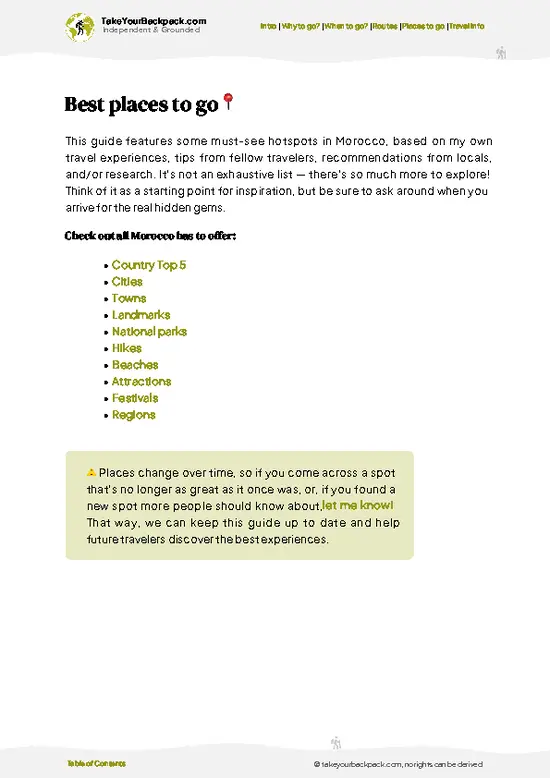
Or checkout all Morocco has to offer (think cities, towns, villages, national parks, hikes, beaches, festivals)
Country photo of Morocco

We 💚 feedbackSumming up the experience

Bouhachem Regional Nature Park trips go wrong when people arrive late and rely on finding a ride back at dusk, when shared taxis dry up. I would start walking early, arrange the return with a driver or guide beforehand, and pack layers, since the forest stays damp and cool.

✈️ When did I visit Morocco?
In October 2011, I backpacked Morocco for two weeks, with climbing the Mount Toubkal in summer clothing as a highlight.

✍️ Help improve this page!
The information on this page is based on my own backpacking experience in Morocco, supplemented with up-to-date research and feedback from other travelers. Travel details can change, so if you notice anything outdated or incomplete, feel free to let me know.


🙋‍♂️ Give feedback

👋 Meet the founderWho’s Behind Take Your Backpack?

Johan, backpacker and founder of TakeYourBackpackHi, I’m Johan (Netherlands 🇳🇱), the creator of TakeYourBackpack. Over the past 3 decades, I’ve backpacked through 90+ countries across six continents, gaining extensive experience with independent travel, long-term trips, and overland routes.

This site is built on a combination of firsthand travel experience and carefully curated insights from other backpackers. Many guides are based on places I’ve personally visited, while others bring together tips, observations, and practical advice shared by trusted travelers I’ve met along the way.

The goal is to provide realistic, experience-driven guidance — not generic itineraries — so you can explore destinations with better context, clearer expectations, and more confidence.