×

Morocco🇲🇦 | best national parksTop-Rated 12 national parks in Morocco

Morocco’s national parks are small, mountain-heavy and lightly staffed, not the vast, fenced reserves of East Africa. Most sit in the High Atlas, Middle Atlas, Rif and Souss-Massa coast, with a few desert and wetland sites. Entry is usually free or a few dirhams, and facilities are thin. Expect trails, villages and guesthouses, not visitor centers. The High Atlas draws the crowds and the guides. The Rif and Middle Atlas are quieter, cheaper and harder to reach without a car. Backpackers who like independent travel get the most from the shared taxis and village homestays. Skip anything promising big-game safaris, because Morocco doesn’t offer them.

By Johan Kruseman 🇳🇱 | Updated October 18, 2026
Explore the best hikes in Morocco

Why go?Why These national park Stand Out

Morocco suits national parks built around mountains, birds and landscapes, and it is a poor choice for big wildlife. Centuries of grazing, farming and cedar logging mean the large mammals are mostly gone, so the Barbary macaque and a few rare birds are the headline species. What you get instead is altitude and contrast: the Atlas rises above 4,000 meters within a day’s drive of the Atlantic and the Sahara, so cedar forest, snow, gorges and dunes sit close together.

The parks are also working landscapes. Berber (Amazigh) villages, terraced fields and shepherds live inside or beside most boundaries, which is the main attraction for many travelers, but it means there are few wilderness rules and little signage. Infrastructure is uneven. Roads to the High Atlas are good, while the Rif and remote … read more 👉
Morocco suits national parks built around mountains, birds and landscapes, and it is a poor choice for big wildlife. Centuries of grazing, farming and cedar logging mean the large mammals are mostly gone, so the Barbary macaque and a few rare birds are the headline species. What you get instead is altitude and contrast: the Atlas rises above 4,000 meters within a day’s drive of the Atlantic and the Sahara, so cedar forest, snow, gorges and dunes sit close together.

The parks are also working landscapes. Berber (Amazigh) villages, terraced fields and shepherds live inside or beside most boundaries, which is the main attraction for many travelers, but it means there are few wilderness rules and little signage. Infrastructure is uneven. Roads to the High Atlas are good, while the Rif and remote desert sites need a rental car or a patient hunt for shared taxis.

Before choosing Morocco for its parks, accept that this is a hiking and culture destination, not a wildlife one. Hire local guides where trails are unmarked, pack for cold nights at altitude, and expect French and Tamazight more than English in rural areas.
Behind the Scenes of Selection
The list of best national parks in Morocco is created based on landscapes, wildlife, adventure opportunities, facilities, and overall experience. If you feel a national park is missing in this list, please let us know.

When to go?Timing Your Visit for the Best Experience

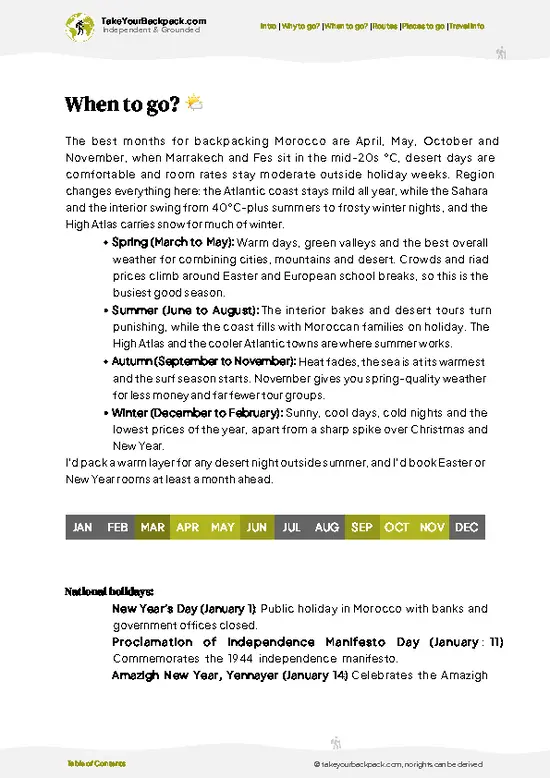
Best months: April to June and September to October are the best months, because mountain trails are snow-free, daytime highs in the Atlas sit around 15 to 25°C and the desert has not yet reached its furnace heat. Spring brings green valleys and meltwater; autumn offers the clearest light.
Winter and summer: From December to March, High Atlas peaks hold snow, and routes above 3,000 meters need crampons and an ice axe. Nights in the Middle Atlas often drop below freezing, and rain peaks in the Rif, which gets the most precipitation in the country. July and August are not worth the time for the desert and south: daytime temperatures regularly pass 40°C. The High Atlas stays workable in summer, with cool nights, though trails in July and August are the busiest.
Coast and prices: The Atlantic coast … read more 👉
Best months: April to June and September to October are the best months, because mountain trails are snow-free, daytime highs in the Atlas sit around 15 to 25°C and the desert has not yet reached its furnace heat. Spring brings green valleys and meltwater; autumn offers the clearest light.
Winter and summer: From December to March, High Atlas peaks hold snow, and routes above 3,000 meters need crampons and an ice axe. Nights in the Middle Atlas often drop below freezing, and rain peaks in the Rif, which gets the most precipitation in the country. July and August are not worth the time for the desert and south: daytime temperatures regularly pass 40°C. The High Atlas stays workable in summer, with cool nights, though trails in July and August are the busiest.
Coast and prices: The Atlantic coast near Souss-Massa stays mild most of the year, roughly 18 to 28°C, and is good for winter birdwatching when migrants arrive. Prices rise around Easter, Christmas and in summer in Marrakech, where guesthouse rates can climb 20 to 40 percent. Ramadan shifts with the lunar calendar and shortens opening hours, so check the dates, since daytime hiking becomes harder without water or food stops in villages.

national park hoppingTips for Visiting Multiple Destinations

Days needed: A trip combining several national parks in Morocco needs 10 to 14 days, because distances are long and mountain roads are slow. Anything under a week means you spend most of it in vehicles.
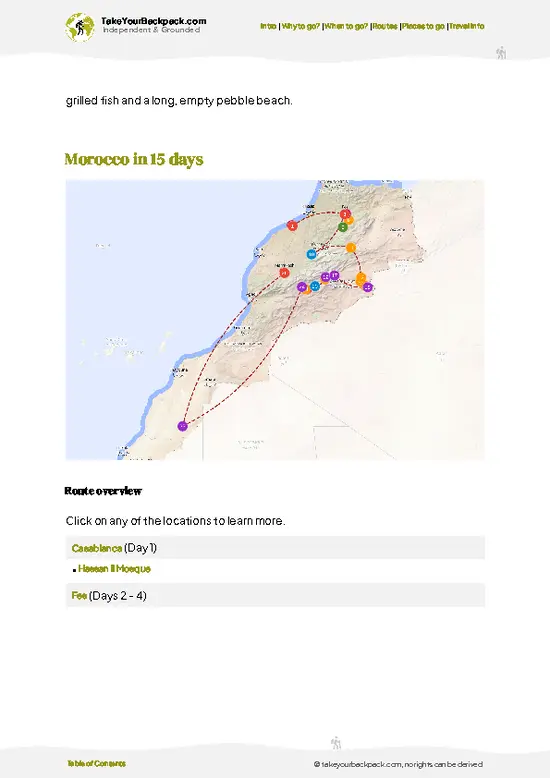
Grouping and direction: The High Atlas, Souss-Massa coast and the desert fringe cluster around Marrakech and Agadir, so they combine well in a southern loop. The Middle Atlas and Rif sit in the north, around Fez, Ifrane and Chefchaouen, and make a separate northern trip. Start in Marrakech and finish in Fez, or the reverse, to avoid backtracking. Plan 2 to 4 days per mountain stop and 1 to 2 for a coastal or wetland site. Expect 3 to 4 hours between Marrakech and Agadir, 7 to 9 hours from Marrakech to Fez by bus or about 4 hours more by train with a connection, and 4 to 5 hours from Fez to Chefchaouen. … read more 👉
Days needed: A trip combining several national parks in Morocco needs 10 to 14 days, because distances are long and mountain roads are slow. Anything under a week means you spend most of it in vehicles.
Grouping and direction: The High Atlas, Souss-Massa coast and the desert fringe cluster around Marrakech and Agadir, so they combine well in a southern loop. The Middle Atlas and Rif sit in the north, around Fez, Ifrane and Chefchaouen, and make a separate northern trip. Start in Marrakech and finish in Fez, or the reverse, to avoid backtracking. Plan 2 to 4 days per mountain stop and 1 to 2 for a coastal or wetland site. Expect 3 to 4 hours between Marrakech and Agadir, 7 to 9 hours from Marrakech to Fez by bus or about 4 hours more by train with a connection, and 4 to 5 hours from Fez to Chefchaouen.
Planning mistakes: The common error is trying to cover the north and south in one short trip. Pick one region and go deeper. Another is trusting map distances, since Atlas passes can double drive times, especially in snow. Instead, add a buffer day and use CTM or Supratours buses for long hauls. Do not rely on shared taxis for tight onward connections, because they leave only when full.

The ListTop national parks of Morocco

1 Toubkal National Park

highest peak, alpine passes, Berber mountain villages

Climb to North Africa’s summit, passing through remote villages and high passes with sweeping views over the Atlas range.

2 Dakhla Lagoon

shallow tidal flats, migratory birdlife, wind-sculpted dunes

Watch shifting sands and tidal pools attract flocks of birds, while the open horizon and gentle breezes create a tranquil, isolated atmosphere.

3 Talassemtane National Park

limestone cliffs, cedar forests, Rif mountain trails

Hike through dramatic gorges and dense forests, encountering rare fir trees and panoramic views unique to Morocco’s northern mountains.

4 Souss Massa

coastal dunes, argan forests, endangered bird colonies

Walk sandy tracks between ocean and forest, spotting rare birds and learning about the unique ecology of Morocco’s southwest coast.

morocco-national-park-souss-massa
© Google |

5 Al Hoceima National Park

Mediterranean coastline, secluded coves, rocky headlands

Swim in clear blue waters, watch for dolphins offshore, and wander coastal paths above wild, rugged beaches and steep cliffs.

morocco-national-park-al-hoceima-national-park
© Google |

6 Akchour

waterfalls, turquoise pools, forested canyons

Follow winding trails to hidden waterfalls, swim in cool pools, and picnic beneath trees in a lush mountain gorge.

morocco-national-park-akchour
© Google |

7 Merja Zerga Lagoon

tidal lagoon, wetland birdlife, reed beds

Watch thousands of migratory birds gather in shallow waters, with shifting light and open skies defining this peaceful wetland landscape.

8 Tazekka

limestone caves, cedar forests, wildflower meadows

Explore underground caverns, hike through ancient woods, and find spring meadows alive with color in the Middle Atlas foothills.

9 Bouhachem Regional Nature Park

cork oak woodlands, rural Berber villages, rolling hills

Travel through patchwork forests and traditional villages, where local life and nature blend across gentle hills and quiet valleys.

morocco-national-park-bouhachem-regional-nature-park
© Google |

10 Khenifra National Park

Middle Atlas lakes, cedar groves, Barbary macaque habitat

Walk quiet forest trails, spot monkeys in the trees, and rest beside tranquil mountain lakes surrounded by wildflowers.

11 Eastern High Atlas National Park

high plateaus, alpine meadows, Berber transhumance routes

Trek across open uplands dotted with wildflowers, following ancient paths used by herders and passing through remote mountain hamlets.

12 Dakhla National Park

Atlantic lagoons, desert dunes, migratory bird habitats

Experience vast desert meeting ocean, with flamingos feeding in shallow waters and shifting sands stretching toward the horizon.

Loading the map 🌍

Expert viewPro Tips for Exploring the Best

How many parks to visit: I advise two or three parks, no more. Morocco’s parks are spread across a large country, access is slow and each rewards time on foot, so a sprint through five gives you only car windows. Two in different landscapes, one mountain and one coast or forest, show you the range. A third works if you have two weeks.
Which kind to prioritize: First-timers and trekkers should put the High Atlas first: it has the best trail network, guesthouse infrastructure and guide availability. Birders and slow travelers get more from the Atlantic wetlands, where winter migrants and quiet beaches replace trekking crowds. Those chasing forests, monkeys and cooler air should choose the Middle Atlas or Rif, which are cheaper and emptier but need a car or patience with irregular transport. The … read more 👉
How many parks to visit: I advise two or three parks, no more. Morocco’s parks are spread across a large country, access is slow and each rewards time on foot, so a sprint through five gives you only car windows. Two in different landscapes, one mountain and one coast or forest, show you the range. A third works if you have two weeks.
Which kind to prioritize: First-timers and trekkers should put the High Atlas first: it has the best trail network, guesthouse infrastructure and guide availability. Birders and slow travelers get more from the Atlantic wetlands, where winter migrants and quiet beaches replace trekking crowds. Those chasing forests, monkeys and cooler air should choose the Middle Atlas or Rif, which are cheaper and emptier but need a car or patience with irregular transport. The desert-edge sites suit anyone with a taste for sparse landscape, though they are not worth it in summer heat.
What it costs: Budget US$25 to 45 a day on a backpacker setup: roughly 80 to 150 Moroccan dirhams (MAD) for a dorm or simple guesthouse bed, 60 to 120 MAD for tagine meals, and 20 to 100 MAD for local transport. Park entry is often free or under 20 MAD. A licensed mountain guide runs about 400 to 700 MAD a day (US$40 to 70) for a group, and a mule for gear adds around 200 to 300 MAD. A realistic cost per park visit, with guide and transfers, is US$60 to 150. Rental cars cost US$30 to 50 a day and make the quiet northern parks far more practical.
Safety and culture: Hire a guide for any high or unmarked route, particularly in winter, since weather turns fast and rescue is slow. Mobile signal fails in the valleys, so download offline maps. Carry water, layers and a headlamp. Dress modestly in villages, with covered shoulders and knees, and ask before photographing people. Women traveling alone are generally fine on guided treks but may face harassment in towns, so arrange pickups in advance. Bargain politely and agree on prices before a guide or driver starts. Respect grazing land and do not cross cultivated fields. Tipping a guide 10 to 15 percent is normal.
What makes it worth the trip: Crowds are thin outside the main High Atlas trailheads and facilities are basic, but the reward is walking between Amazigh villages, sleeping in family homes and eating bread baked that morning. That human texture is the reason to go, and it is the reason to skip the fantasy of a safari.

✈️ The backpacker research shortcutMorocco Travel Guide

An offline-friendly backpacking guide with optimized travel routes, ranked highlights, transport advice, and the best areas to stay.
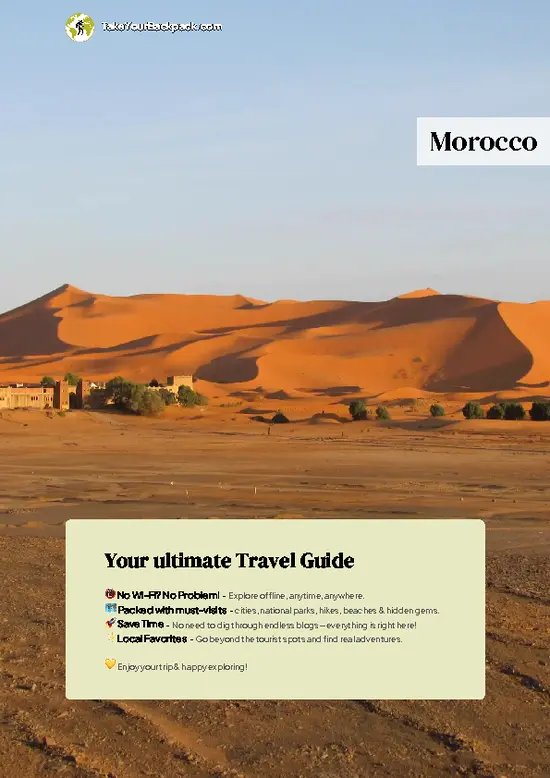
example page 0 from our offline Travel Guide for Morocco
example page 1 from our offline Travel Guide for Morocco
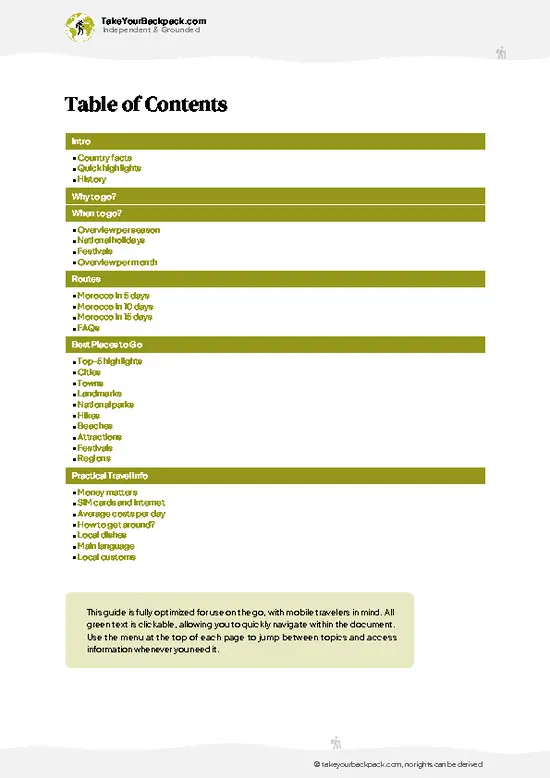
example page 2 from our offline Travel Guide for Morocco
example page 3 from our offline Travel Guide for Morocco
example page 4 from our offline Travel Guide for Morocco
example page 5 from our offline Travel Guide for Morocco
example page 6 from our offline Travel Guide for Morocco
example page 7 from our offline Travel Guide for Morocco
The digital guide (424 pages) contains:
✅ 112 highlights, ranked by travel appeal
✅ Optimized 5, 10 & 15-day travel routes
✅ Cities, national parks, landmarks, beaches
✅ How to get around
✅ Offline-friendly for travel without Wi-Fi
👉 Click to see all 30+ guide features

📅 Plan smarter in minutes, not weeks
✅ Month by month travel advice
✅ Festivals & national holidays
✅ Budget expectations

🗺️ Go to the right places, skip the overrated ones
✅ Honest pros & cons of destinations
✅ Top hikes, parks & viewpoints
✅ Lesser-known places most travelers miss
✅ Clear “worth it vs skip it” guidance

🛏️ Travel smoothly without rookie mistakes
✅ Best areas to stay
✅ Transport systems explained simply
✅ Common scams & safety advice
✅ SIM cards, money & practical tips

🌍 Understand the country, not just visit it
✅ Culture & traditions
✅ 52 Essential phrases & customs
✅ Festivals worth planning around
✅ Traveler-friendly historical context
✅ Insights that make places more meaningful

📱 Built for real travel conditions
✅ Fully downloadable PDF
✅ Works completely offline
✅ Optimized for phone use
✅ Useful in remote areas & buses
✅ Everything in one place
Stop searching, start planning
Get instant access to your full guide. 30‑day money-back guarantee.
+ Add another guide for just

By proceeding you agree to our terms.
Sent to your inbox immediately after payment • 100% Secure Checkout
Best Backpacking Travel Advisor 2025 tourism awardBest Backpacking
Travel Advisor
2025
What others say about Take Your Backpack Guides:
⭐⭐⭐⭐⭐
Fantastic, amazing amount of information!
⭐⭐⭐⭐⭐
My goodness this is amazing, it's what I've been looking for hats off too you!
⭐⭐⭐⭐⭐
I think this is absolutely BRILLIANT
⭐⭐⭐⭐
Very complete and informative. It's still missing places, but I gotta to commend you
⭐⭐⭐⭐⭐
This is truly amazing, thank you, can't wait to explore it with my kids!
⭐⭐⭐⭐⭐
Awesome resource, thank you!
⭐⭐⭐⭐⭐
This is amazing! Can't wait to explore the ones I haven't seen
⭐⭐⭐⭐
I love this! Well done, great idea.
⭐⭐⭐⭐⭐
Thanks for taking the time to make this gem!
⭐⭐⭐⭐⭐
This might be the best website I've ever seen.
⭐⭐⭐⭐⭐
Congratulations, and thank you so much for your work; it's incredibly valuable.
⭐⭐⭐⭐
In all seriousness I think you did a great job pointing out the important spots
⭐⭐⭐⭐⭐
10/10 very good
⭐⭐⭐⭐⭐
As someone who's only just starting to visit regularly this is awesome, thank you.
⭐⭐⭐⭐
Thank you very much! I'm going to visit my dad, it's going to be very useful!
⭐⭐⭐⭐⭐
This is really cool! We'll be travelling for the first time and this definitely come in handy.
⭐⭐⭐⭐⭐
You are now our minister of culture, congratulations 👨‍💼
⭐⭐⭐⭐⭐
Just wanted to tell you that this is a pearl! Going to follow your recommendations.
⭐⭐⭐⭐⭐
This is so cool. I'll definitely be using the resource for my travels soon.
⭐⭐⭐⭐⭐
This is very impressive! Good work.
⭐⭐⭐⭐⭐
This is an amazing and informative site. Very well done!

🛏️ Where to stay?Where to Stay in Morocco

Morocco has plenty of hostels and budget guesthouses, most set in converted riads with dorms around a tiled courtyard and a rooftop terrace where breakfast is usually included. In Marrakech, the Medina near Jemaa el-Fnaa keeps you walking distance from the souks and food stalls but comes with motorbike noise, touts and confusing alleys after dark, while Gueliz is calmer and has most of the city’s bars, at the cost of a 20 to 30 minute walk to the old town. In Fes, staying inside Fes el-Bali puts the tanneries and medersas on your doorstep (the lanes go quiet and dim at night, so note your route), whereas the medinas of Chefchaouen and Essaouira are smaller, safer-feeling and easy to find your … read more 👉
Morocco has plenty of hostels and budget guesthouses, most set in converted riads with dorms around a tiled courtyard and a rooftop terrace where breakfast is usually included. In Marrakech, the Medina near Jemaa el-Fnaa keeps you walking distance from the souks and food stalls but comes with motorbike noise, touts and confusing alleys after dark, while Gueliz is calmer and has most of the city’s bars, at the cost of a 20 to 30 minute walk to the old town. In Fes, staying inside Fes el-Bali puts the tanneries and medersas on your doorstep (the lanes go quiet and dim at night, so note your route), whereas the medinas of Chefchaouen and Essaouira are smaller, safer-feeling and easy to find your way around, and Taghazout near Agadir is packed with surf hostels that suit a social crowd more than sightseers.

If you enjoy meeting fellow travelers, consider choosing hostels with high ratings for atmosphere. On the other hand, if you prefer having your own space, a hotel might be a better option.

MoroccoMore of Morocco

👋 Meet the founderWho’s Behind Take Your Backpack?

Johan, backpacker and founder of TakeYourBackpackHi, I’m Johan (Netherlands 🇳🇱), the creator of TakeYourBackpack. Over the past 3 decades, I’ve backpacked through 90+ countries across six continents, gaining extensive experience with independent travel, long-term trips, and overland routes.

This site is built on a combination of firsthand travel experience and carefully curated insights from other backpackers. Many guides are based on places I’ve personally visited, while others bring together tips, observations, and practical advice shared by trusted travelers I’ve met along the way.

The goal is to provide realistic, experience-driven guidance — not generic itineraries — so you can explore destinations with better context, clearer expectations, and more confidence.