v2.webp)
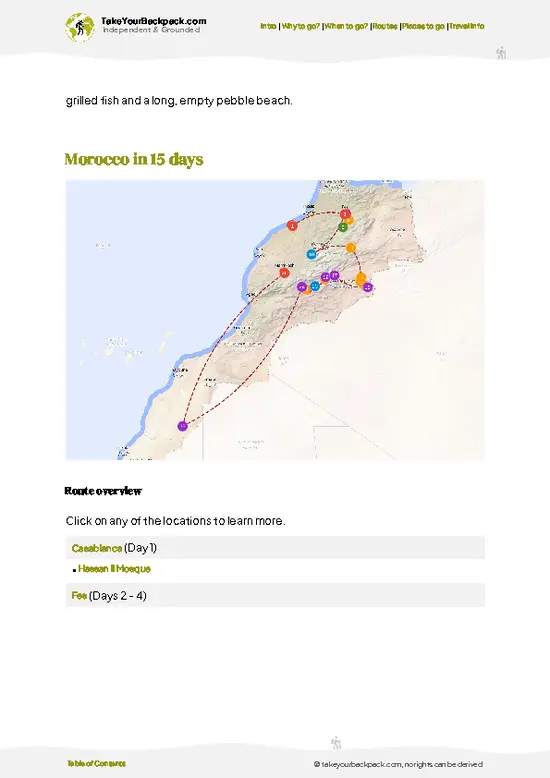
- Source Bleue (Lalla Tiznit spring): the legend says the town grew around this spring, tied to a woman of the same name. A small pool sits in a walled square near the medina entrance. Go in the evening when locals gather. Free, 15 to 20 minutes.
- Tiznit city walls: roughly 5 kilometers of earthen rampart with 8 gates, built in the 1880s. Walk the outer path in the late afternoon for warm light on the clay. Free, 1 to 1.5 hours for a loop.
- Silver souk (Souk des Bijoutiers): workshops sell Berber fibulae, bracelets and amulets. Mornings are busiest and the best for watching work. Browsing is free, haggling is expected, and pieces start around US$10. Allow 1 hour.
- Mechouar and Grand Mosque area: the open square and the mosque, with its distinctive spiky wooden pegs in the minaret, are the center of
- Source Bleue (Lalla Tiznit spring): the legend says the town grew around this spring, tied to a woman of the same name. A small pool sits in a walled square near the medina entrance. Go in the evening when locals gather. Free, 15 to 20 minutes.
- Tiznit city walls: roughly 5 kilometers of earthen rampart with 8 gates, built in the 1880s. Walk the outer path in the late afternoon for warm light on the clay. Free, 1 to 1.5 hours for a loop.
- Silver souk (Souk des Bijoutiers): workshops sell Berber fibulae, bracelets and amulets. Mornings are busiest and the best for watching work. Browsing is free, haggling is expected, and pieces start around US$10. Allow 1 hour.
- Mechouar and Grand Mosque area: the open square and the mosque, with its distinctive spiky wooden pegs in the minaret, are the center of town life. Visit at dusk. Free, 30 minutes. Non-Muslims cannot enter the mosque.
- Musée Régional du Patrimoine Amazigh: a small museum in a restored house showing jewelry, costumes and household items from the Souss region. Open most days except some holidays. Entry about US$2, 45 minutes.
Spotted a mistake or missing something? Contact us.

Surf Lessons in Mirleft with Certified Local Coach

Taghazout Beach Horse Riding Experience (Morning or Sunset)

Beginners Surf lessons in Mirleft

Agadir & Taghazout 2-in-1 Tour: Camel Ride & Dune Sandboarding

2-in-1 Agadir Desert Tour Sandboarding, Camel Ride & BBQ

Sandboarding Tour Adventure From Agadir & Taghazout

From Agadir: Taghazout & Local Souk Tour

Agadir Cable Car & Oufella Kasbah Tour – Ticket Included

Agadir Goats on Argan Trees, Crocoparc & Souk El Had Market Tour


 Best Backpacking
.jpg) Hi, I’m Johan (Netherlands 🇳🇱), the creator of TakeYourBackpack. Over the past 3 decades, I’ve backpacked through 90+ countries across six continents, gaining extensive experience with independent travel, long-term trips, and overland routes.
Hi, I’m Johan (Netherlands 🇳🇱), the creator of TakeYourBackpack. Over the past 3 decades, I’ve backpacked through 90+ countries across six continents, gaining extensive experience with independent travel, long-term trips, and overland routes.