×
Great Himalaya Trail

Nepal🇳🇵 | hikesGreat Himalaya Trail
long-distance traverse, remote passes, varied ecosystems | things to do and best time to go

Explore Ghorepani Poon HillExplore Langtang Valley

Backpacking in Great Himalaya Trail
👌 Worth visitinghike ranked #11
By Johan Kruseman 🇳🇱 | Updated April 29, 2026

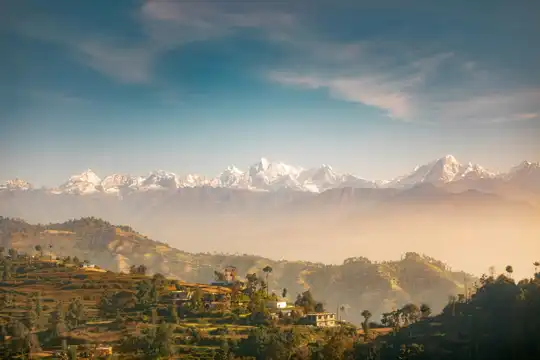
Your lungs scrape a little as you grind up another loose, dusty switchback, yak bells clanking somewhere below, juniper smoke drifting from a stone village that looks a week behind time. This is the Great Himalaya Trail, a rough, stitched-together high route that runs across Nepal’s spine, shadowing the giants from Kanchenjunga to Humla. It’s long, brutal, and logistically messy; buses to trailheads are slow, cramped, and often late, and this isn’t a neat, waymarked thru-hike like Annapurna or Everest. But the payoff is wild: empty passes, raw village life, and horizons that make the classic treks feel like guided museum tours. You trade comfort for scale, and the trade feels absolutely fair.

Discover everything you want to know in the 📖 Nepal Travel Guide.
Best time to go: February - May, September - November
Duration: 150 to 160 days
Distance: 1,700 kilometers
Total ascent: 65,000 meters
Loading the map 🌍
CLICK TO FILTER
city
town
village
unique site
national park
hike
attraction
festival
region
SHOW COUNTRY‘S BESTSHOW ALL

✨ Why go?
Ranked #11 hike in Nepal
What makes this hike worth hiking

The Great Himalaya Trail in Nepal is a magnet for backpackers craving adventure. The scenery-to-effort ratio is off the charts; you’re rewarded with jaw-dropping vistas after every steep climb. Public transport access is surprisingly good, making it easy to hop from one trailhead to another without breaking the bank. Speaking of costs, this trek is a low-cost option compared to many global hikes, allowing you to stretch your budget further.

You can choose flexible distances, tailoring your journey to match your stamina or time constraints. Plus, it fits seamlessly into a longer backpacking route across Nepal, letting you explore vibrant villages and rich culture along the way. Each step is a challenge, but the payoff—a cold beer at a local teahouse or a sunset over the peaks—is what keeps you moving forward.
Get the complete Travel Guide for Nepal
Everything organized for offline planning — routes, highlights, costs & tips

See what’s inside 👉

Get the Travel Guide -

💡 HighlightsKey sights and experiences for travelers

  1. Kanchenjunga massif (eastern high route) — Rugged, remote and wildly alpine, the eastern GHT gives you big, uncluttered views of Kanchenjunga’s ridges with tiny villages clinging to green terraces below. It feels less touristy than Everest or Annapurna; you get genuine village life, rhododendron forests, and the kind of silence only a place with very few trekkers can offer.
  2. Larkya La pass & the Manaslu amphitheatre — One of the real “high pass” moments on the trail: Larkya La is a long, exposed saddle with an epic frontal view of jagged peaks. The surrounding Manaslu valleys mix wide moraines, glacial rivers and classic Himalayan village culture—good for both dramatic scenery and the physical satisfaction of a proper alpine crossing.
  3. Shey Phoksundo Lake & Dolpo plateau — Turquoise, otherworldly
read more 👉
  1. Kanchenjunga massif (eastern high route) — Rugged, remote and wildly alpine, the eastern GHT gives you big, uncluttered views of Kanchenjunga’s ridges with tiny villages clinging to green terraces below. It feels less touristy than Everest or Annapurna; you get genuine village life, rhododendron forests, and the kind of silence only a place with very few trekkers can offer.
  2. Larkya La pass & the Manaslu amphitheatre — One of the real “high pass” moments on the trail: Larkya La is a long, exposed saddle with an epic frontal view of jagged peaks. The surrounding Manaslu valleys mix wide moraines, glacial rivers and classic Himalayan village culture—good for both dramatic scenery and the physical satisfaction of a proper alpine crossing.
  3. Shey Phoksundo Lake & Dolpo plateau — Turquoise, otherworldly lake set in a lunar-like Tibetan plateau. Dolpo’s isolation preserves ancient Bon and Tibetan-Buddhist culture, stone-walled villages, and real chances (not guarantees) of seeing kiang, blue sheep or even a snow leopard print if you’re lucky. It’s the “you’re far from everything” part of the GHT.
  4. Upper Mustang / Lo Manthang — A desert inside the Himalaya: wind-carved canyons, red-cliff fortresses, and walled Lo Manthang—the old Tibetan kingdom—full of gompas, murals and people living a distinct, plateau-influenced life. The light and textures here are unlike the leafy, green trekking valleys elsewhere in Nepal.
  5. Rara Lake & Far-Western alpine meadows — Quiet, blue Rara sits in a bowl of pine and rhododendron forests with very few trekkers compared to central routes. The western section gives sweeping meadows, alpine lakes and a different cultural flavor—great for nights under the stars and long, empty ridge walks.


Favorite: Shey Phoksundo Lake — its color, remoteness and Tibetan-flavored villages always stick with me.
Spotted a mistake or missing something? Contact us.

🌤️ When to go?Best time to hike the Great Himalaya Trail


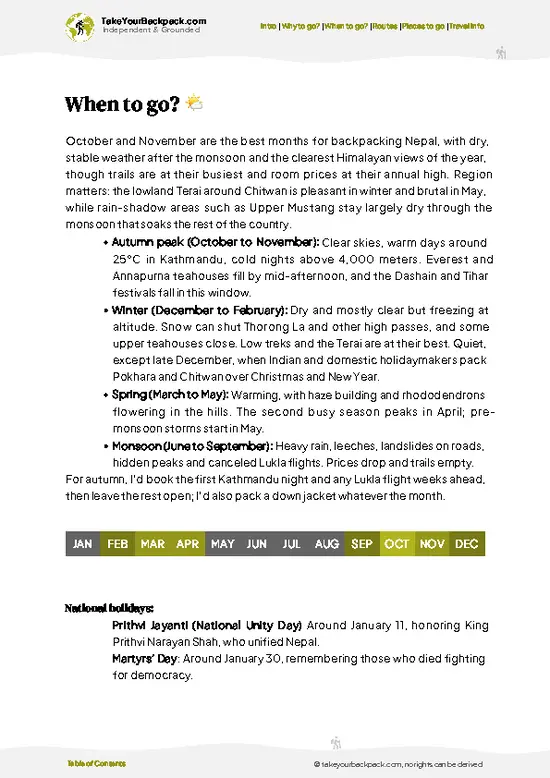
  • Weather: The best windows are spring (March to May) and autumn (late September to November). These months dodge the monsoon’s relentless downpours and the bitter cold of winter. Expect clear skies and dry trails, perfect for pushing hard without slipping on mud or ice.

  • Temperature: Daytime highs range from 10°C to 20°C (50°F to 68°F) in spring and autumn, comfortable for long days on the trail. Nights can dip below freezing, especially above 3,000 meters, so pack layers that breathe and insulate.

  • Daylight Hours: Spring and autumn offer roughly 10 to 12 hours of daylight, giving you enough time to cover serious ground without rushing or camping in the dark.

  • Crowds: Peak trekking seasons bring more hikers, especially on popular sections. If you want solitude, aim for early spring or late autumn,
read more 👉

  • Weather: The best windows are spring (March to May) and autumn (late September to November). These months dodge the monsoon’s relentless downpours and the bitter cold of winter. Expect clear skies and dry trails, perfect for pushing hard without slipping on mud or ice.

  • Temperature: Daytime highs range from 10°C to 20°C (50°F to 68°F) in spring and autumn, comfortable for long days on the trail. Nights can dip below freezing, especially above 3,000 meters, so pack layers that breathe and insulate.

  • Daylight Hours: Spring and autumn offer roughly 10 to 12 hours of daylight, giving you enough time to cover serious ground without rushing or camping in the dark.

  • Crowds: Peak trekking seasons bring more hikers, especially on popular sections. If you want solitude, aim for early spring or late autumn, but be ready for colder nights and fewer services.

  • Seasonal Activities: Spring bursts with rhododendron blooms, painting the hills red and pink—a visual reward for every uphill grunt. Autumn delivers crisp air and clear mountain panoramas, the kind that make you forget the blisters.

  • Price Fluctuations: Expect higher prices for permits, guides, and lodges during peak seasons. Off-peak months offer better deals but come with trade-offs in weather and trail conditions.


Pro-tip: Start your trek early in the season to catch blooming rhododendrons and avoid the thickest crowds, but pack for cold nights—you’ll earn every breathtaking view with sweat and grit.


source: climatestotravel.comJANJanuary: fair for travelingFEBFebruary: good for travelingMARMarch: excellent for travelingAPRApril: excellent for travelingMAYMay: highly recommended for travelingJUNJune: fair for travelingJULJuly: below average for travelingAUGAugust: below average for travelingSEPSeptember: good for travelingOCTOctober: excellent for travelingNOVNovember: excellent for travelingDECDecember: fair for traveling
Nepal - the Great Himalaya Trail

✈️ The backpacker research shortcutNepal Travel Guide

An offline-friendly backpacking guide with optimized travel routes, ranked highlights, transport advice, and the best areas to stay.
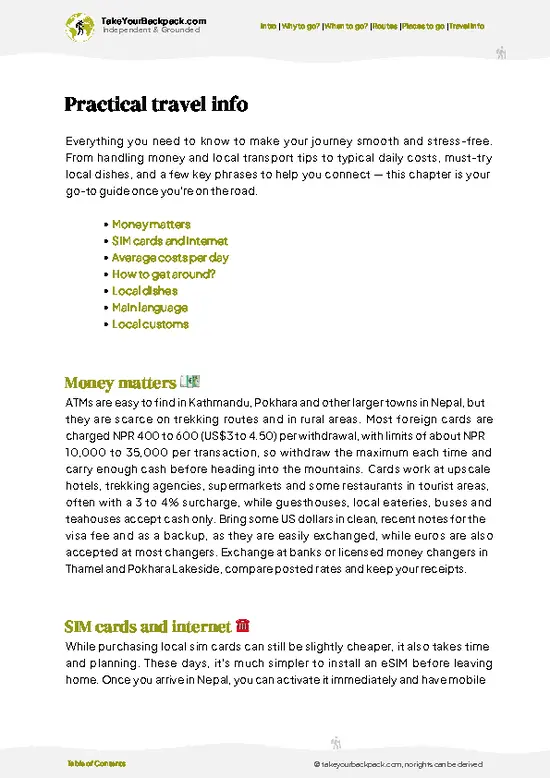
example page 0 from our offline Travel Guide for Nepalexample page 1 from our offline Travel Guide for Nepalexample page 2 from our offline Travel Guide for Nepalexample page 3 from our offline Travel Guide for Nepalexample page 4 from our offline Travel Guide for Nepalexample page 5 from our offline Travel Guide for Nepal
The digital guide (347 pages) contains:
107 highlights, ranked by travel appeal
Optimized 5, 10 & 15-day travel routes
Best neighborhoods to stay
How to get around
Offline-friendly for travel without Wi-Fi
👉 See all 30+ guide features

📅 Plan smarter in minutes, not weeks
Month by month travel advice
Festivals & national holidays
Budget expectations

🗺️ Go to the right places, skip the overrated ones
Honest pros & cons of destinations
Top hikes, parks & viewpoints
Lesser-known places most travelers miss
Clear “worth it vs skip it” guidance

🛏️ Travel smoothly without rookie mistakes
Best areas to stay
Transport systems explained simply
Common scams & safety advice
SIM cards, money & practical tips

🌍 Understand the country, not just visit it
Culture & traditions
52 Essential phrases & customs
Festivals worth planning around
Traveler-friendly historical context
Insights that make places more meaningful

📱 Built for real travel conditions
Fully downloadable PDF
Works completely offline
Optimized for phone use
Useful in remote areas & buses
Everything in one place
Save weeks of stressful planning
Get instant access to the full guide directly. 30-day money-back guarantee.


Sent to your inbox immediately after payment • 100% Secure Checkout
Best Backpacking Travel Advisor 2025 tourism awardBest Backpacking
Travel Advisor
2025
What others say about Take Your Backpack Guides:
⭐⭐⭐⭐⭐
Fantastic, amazing amount of information!
⭐⭐⭐⭐⭐
My goodness this is amazing, it's what I've been looking for hats off too you!
⭐⭐⭐⭐⭐
I think this is absolutely BRILLIANT
⭐⭐⭐⭐
Very complete and informative. It's still missing places, but I gotta to commend you
⭐⭐⭐⭐⭐
This is truly amazing, thank you, can't wait to explore it with my kids!
⭐⭐⭐⭐⭐
Awesome resource, thank you!
⭐⭐⭐⭐⭐
This is amazing! Can't wait to explore the ones I haven't seen
⭐⭐⭐⭐
I love this! Well done, great idea.
⭐⭐⭐⭐⭐
Thanks for taking the time to make this gem!
⭐⭐⭐⭐⭐
This might be the best website I've ever seen.
⭐⭐⭐⭐⭐
Congratulations, and thank you so much for your work; it's incredibly valuable.
⭐⭐⭐⭐
In all seriousness I think you did a great job pointing out the important spots
⭐⭐⭐⭐⭐
10/10 very good
⭐⭐⭐⭐⭐
As someone who's only just starting to visit regularly this is awesome, thank you.
⭐⭐⭐⭐
Thank you very much! I'm going to visit my dad, it's going to be very useful!
⭐⭐⭐⭐⭐
This is really cool! We'll be travelling for the first time and this definitely come in handy.
⭐⭐⭐⭐⭐
You are now our minister of culture, congratulations 👨‍💼
⭐⭐⭐⭐⭐
Just wanted to tell you that this is a pearl! Going to follow your recommendations.
⭐⭐⭐⭐⭐
This is so cool. I'll definitely be using the resource for my travels soon.
⭐⭐⭐⭐⭐
This is very impressive! Good work.
⭐⭐⭐⭐⭐
This is an amazing and informative site. Very well done!

🛏️ Where to stay?Where staying makes the most sense

If you enjoy meeting fellow travelers, consider choosing hostels with high ratings for atmosphere. On the other hand, if you prefer having your own space, a hotel might be a better option.

🥾 Hike detailsTrail overview: what to expect on the hike

Total Distance: Approximately 1,700 kilometers (1,056 miles) from east to west across Nepal, making it one of the longest trekking routes in the world.

Estimated Duration: Typically takes around 150 to 180 days to complete, depending on your pace and how many side trips you take.

Difficulty Level: Challenging. Expect high altitudes, varied terrain, and some remote sections that require good navigation skills. It’s not for the faint-hearted or inexperienced hikers.

Starting Point: The trail can start at various points, but a popular one is in the eastern region at the town of Mechhi, near the … read more 👉
Total Distance: Approximately 1,700 kilometers (1,056 miles) from east to west across Nepal, making it one of the longest trekking routes in the world.

Estimated Duration: Typically takes around 150 to 180 days to complete, depending on your pace and how many side trips you take.

Difficulty Level: Challenging. Expect high altitudes, varied terrain, and some remote sections that require good navigation skills. It’s not for the faint-hearted or inexperienced hikers.

Starting Point: The trail can start at various points, but a popular one is in the eastern region at the town of Mechhi, near the border with India.
  • How to Get There: Take a bus or jeep from Kathmandu to Bhadrapur, then a short ride to Mechhi. Buses leave frequently from the Ratna Park bus station in Kathmandu.

Major Landmarks:
  • Kanchenjunga Base Camp: A stunning spot with breathtaking views of the third-highest mountain in the world.
  • Makalu Base Camp: Offers a more remote experience with jaw-dropping scenery.
  • Everest Region: Includes famous landmarks like Namche Bazaar and the Khumbu Glacier.
  • Rara Lake: The largest lake in Nepal, surrounded by picturesque hills and forests.

Type of Terrain and Scenery: The trail features diverse terrain, including:
  • Mountain Passes: High passes like the Thorong La and Larkya La, which offer stunning panoramic views.
  • Forests: Dense rhododendron and pine forests in lower elevations.
  • Alpine Meadows: Beautiful meadows filled with wildflowers during spring and summer.
  • Glacial Valleys: Spectacular valleys carved by ancient glaciers.

Typical Vegetation and Wildlife:
  • Vegetation: Expect to see a variety of plants, including rhododendrons, bamboo, and various medicinal herbs.
  • Wildlife: Keep an eye out for elusive creatures like the snow leopard, red panda, and various species of pheasants.

This trail is a real adventure, so make sure you’re well-prepared with gear, permits, and a solid plan before you dive in!
⚠️ Hiking info can sometimes be outdated or inaccurate. Before you hit the trail, check the latest conditions with locals. If you do spot anything that's off, I'd love to hear from you, so I can update it for fellow travelers.

🛡️ SafetyScams, Hazards, and Annoyances

The Great Himalaya Trail is a thrilling challenge, but it demands respect. Weather can shift in an instant; sunny mornings can morph into afternoon storms. Be prepared with layers and a solid rain jacket. The terrain varies—some sections are steep and rocky, while others require careful navigation across rivers. Good footwear is essential; a sturdy pair of trekking boots will save you from slips and sore feet.

Wildlife encounters are rare but possible. If you spot a yak or a goat, keep your distance and let them pass. Altitude can sneak up on you, so pace yourself and stay hydrated. Embrace the grind; the views at the top are worth every step.

Other Nepali hikes near Great Himalaya Trail

Explore more nearby:


👉 Discover all hikes

Or checkout all Nepal has to offer (think cities, towns, villages, national parks, hikes, beaches, festivals)
Country photo of Nepal

We 💚 feedbackParting advice and final tips

The Great Himalaya Trail is a raw, exhilarating test of endurance, where every grueling step is rewarded with breathtaking panoramas that feel like they’re straight out of a dream. But be ready: the altitude can hit hard, and acclimatization is no joke. Embrace the challenge, and you’ll find a connection to nature that’s hard to shake off.

✈️ When did I visit Nepal?
Being a mountain lover, Nepal is one of my favorites. I visited it in November 2006, hiking the full Annapurna circuit as my highlight.

✍️ Help improve this page!
The information on this page is based on my own backpacking experience in Nepal, supplemented with up-to-date research and feedback from other travelers. Travel details can change, so if you notice anything outdated or incomplete, feel free to let me know.


🙋‍♂️ Give feedback

👋 Meet the founderWho’s Behind Take Your Backpack?

Johan, backpacker and founder of TakeYourBackpackHi, I’m Johan (Netherlands 🇳🇱), the creator of TakeYourBackpack. Over the past decade, I’ve backpacked through 80+ countries across six continents, gaining extensive experience with independent travel, long-term trips, and overland routes.

This site is built on a combination of firsthand travel experience and carefully curated insights from other backpackers. Many guides are based on places I’ve personally visited, while others bring together tips, observations, and practical advice shared by trusted travelers I’ve met along the way.

The goal is to provide realistic, experience-driven guidance — not generic itineraries — so you can explore destinations with better context, clearer expectations, and more confidence.

Get Full Country Guide |
Instant download • 107 highlights • Full Offline guide