×

The Netherlands🇳🇱 | citiesMaastrichtLimburg hills, Vrijthof, Maas bridge, Burgundian table | things to do and best time to go

Explore LeidenExplore Rotterdam

Backpacking in Maastricht
🌟 Highlightcity ranked #5
By Johan Kruseman 🇳🇱 | Updated October 16, 2026

Maastricht is not the cheap, flat, bike-lane Netherlands of the postcards: it sits in the far southeast, in the province of Limburg, wedged between Belgium and Germany, with hills nearby and a dialect, food and Burgundian habits that belong more to the south than to Amsterdam. That pattern explains the pricing too. Students and day-trippers keep cafes cheap and terraces busy, while hotels stay pricey. It suits food-minded walkers and slow travelers, and it bores anyone chasing nightlife on the Amsterdam scale. Compared with Utrecht or Rotterdam it is smaller, older and far more relaxed. I once ate a warm vlaai (fruit pie) slice at a market stall on the Markt, US$3.50 with a coffee, and understood why locals treat dessert as a daily appointment.

Discover everything you want to know in the 📖 The Netherlands Travel Guide.


example page 0 from our offline Travel Guide for Netherlands
example page 1 from our offline Travel Guide for Netherlands
example page 2 from our offline Travel Guide for Netherlands
example page 3 from our offline Travel Guide for Netherlands
example page 4 from our offline Travel Guide for Netherlands
example page 5 from our offline Travel Guide for Netherlands
example page 6 from our offline Travel Guide for Netherlands
example page 7 from our offline Travel Guide for Netherlands
Loading the map 🌍
CLICK TO FILTER
cities
towns
villages
landmarks
national parks
hikes
beaches
attractions
festivals
regions
SHOW COUNTRY’S BESTSHOW ALL

✨ Why go?
Ranked #5 city in The Netherlands
What makes it a must-see city

Backpackers come to Maastricht because it works as a compact, walkable base on the far edge of the country. Almost everything sits within a 20-minute walk of the Vrijthof square, so you spend nothing on local transport and little time deciding what to do. Food is the second draw: Limburg cooking, markets and cheap student lunches make eating well easier on a budget than in Amsterdam. Hostel beds are limited, and dorm prices in summer often run US$40 to 70, so book early or look across the border. The real strength is onward travel. Trains to Liège take about 50 minutes, Aachen is under an hour by regional connections, and Brussels and Cologne are both reachable in a few hours. It fits well as a two-night stop between Belgium and Germany. It is a poor fit if you want big nightlife or wild landscapes.

💡 HighlightsMust-see experiences and standout moments

  1. Vrijthof and St. Servatius Basilica: the main square, ringed by terraces, with a Romanesque church holding a treasury of medieval reliquaries. Visit in the morning for quiet. Church entry is around US$6 to 12, allow 1 to 1.5 hours.
  2. Boekhandel Dominicanen: a 13th-century Gothic church converted into a bookshop, with shelves climbing the nave and a cafe in the choir. Free to enter, 30 to 45 minutes, best on a weekday morning.
  3. Town walls and Helpoort: the oldest surviving city gate in the Netherlands, from around 1229, and a stretch of medieval wall with gardens. Free to walk, about 45 minutes, lovely in late afternoon light.
  4. Sint Servaasbrug and the Maas riverfront: the old stone bridge links the center with the Wyck quarter. Free, 30 minutes, and good at sunset.
  5. Wyck and Stationstraat cafes: a
… read more 👉
  1. Vrijthof and St. Servatius Basilica: the main square, ringed by terraces, with a Romanesque church holding a treasury of medieval reliquaries. Visit in the morning for quiet. Church entry is around US$6 to 12, allow 1 to 1.5 hours.
  2. Boekhandel Dominicanen: a 13th-century Gothic church converted into a bookshop, with shelves climbing the nave and a cafe in the choir. Free to enter, 30 to 45 minutes, best on a weekday morning.
  3. Town walls and Helpoort: the oldest surviving city gate in the Netherlands, from around 1229, and a stretch of medieval wall with gardens. Free to walk, about 45 minutes, lovely in late afternoon light.
  4. Sint Servaasbrug and the Maas riverfront: the old stone bridge links the center with the Wyck quarter. Free, 30 minutes, and good at sunset.
  5. Wyck and Stationstraat cafes: a lively district of small shops and bars across the river. Free to wander, 1 to 2 hours, best in the evening.
  6. Fort Sint Pieter and the caves: hilltop fortress and the Northern Catacombs of the marl tunnels beneath it. Guided cave tours cost roughly US$8 to 12 and last about an hour. Go on a dry day.
  7. Bonnefanten Museum: a modern art museum in a distinctive rocket-topped building by the river. Entry about US$14 to 18, 1.5 to 2 hours, best on a rainy afternoon.
  8. Friday market on the Markt: stalls selling cheese, vlaai and fresh herring, around 9 AM to 1 PM. Free to browse, a snack costs US$3 to 8, allow an hour.
Day trips from the city include the Valkenburg caves and castle ruins, the Sint Pietersberg hills, Liège in Belgium and Aachen in Germany.
The Dominicanen bookshop is the best pick for a first visit.
Spotted a mistake or missing something? Contact us.

Things to do in Maastricht

Ratings based on Tripadvisor reviews. When you book through this link, you support our work at no extra cost to you.

🏘️ NeighborhoodsKey areas and districts to know

Maastricht is compact, and its districts follow the river and the old Roman and medieval walls, so the logic is simple: the center is dense and touristy, and the quieter, cheaper areas sit just across the Maas or outside the wall line.
  • Centrum (Vrijthof and Markt): The core, fully walkable in 20 minutes end to end. Terraces fill the Vrijthof square beside two big churches, and the Markt hosts a produce market on Wednesday and Friday mornings. Prices run highest here, so look at the side streets for better value. Best for a first afternoon on foot.
  • Jekerkwartier: A short walk from the center along the Jeker creek, with the oldest city wall and quiet lanes. It costs nothing to wander and gives the best photos with the fewest people.
  • Wyck: Across the Sint Servaasbrug bridge, near the station. Locals
… read more 👉
Maastricht is compact, and its districts follow the river and the old Roman and medieval walls, so the logic is simple: the center is dense and touristy, and the quieter, cheaper areas sit just across the Maas or outside the wall line.
  • Centrum (Vrijthof and Markt): The core, fully walkable in 20 minutes end to end. Terraces fill the Vrijthof square beside two big churches, and the Markt hosts a produce market on Wednesday and Friday mornings. Prices run highest here, so look at the side streets for better value. Best for a first afternoon on foot.
  • Jekerkwartier: A short walk from the center along the Jeker creek, with the oldest city wall and quiet lanes. It costs nothing to wander and gives the best photos with the fewest people.
  • Wyck: Across the Sint Servaasbrug bridge, near the station. Locals shop and eat here, so cafés and bakeries are cheaper than in the center, and bars stay lively late. It is the best value for evenings, five minutes from everything.
  • Sint Pieter: South of the center, a 30-minute walk or short bus ride, with the fort and the marl caves hillside. Quiet and green, so go for a half day rather than for nightlife.
  • Boschstraat and Stokstraat area: Student-driven nightlife with cheap pints and loud weekends. Everything is walkable, and the Stokstraat lanes are the better choice for dining without the premium.

⌛️ 1 dayHow to make the most of one day

Maastricht rewards a slow day on foot, with medieval stone, riverside cafes and good food packed into a small center.
9:00 AM: Boekhandel Dominicanen. Browse the Gothic nave before crowds arrive and have coffee in the choir. Then walk five minutes to the Vrijthof.
10:15 AM: Vrijthof and St. Servatius. See the square and visit the basilica treasury, about an hour. Wander south through the lanes toward the walls.
12:00 PM: Helpoort and town walls. Walk the old wall section and gardens, then stop for a quick lunch in the lanes nearby, such as a sandwich or soup for US$7 to 12.
1:30 PM: Sint Pietersberg and the caves. Slightly off the standard route, the hillside paths above the city give quiet views over the Maas valley and a guided cave tour in the marl tunnels. It is about 40 minutes on foot or … read more 👉
Maastricht rewards a slow day on foot, with medieval stone, riverside cafes and good food packed into a small center.
9:00 AM: Boekhandel Dominicanen. Browse the Gothic nave before crowds arrive and have coffee in the choir. Then walk five minutes to the Vrijthof.
10:15 AM: Vrijthof and St. Servatius. See the square and visit the basilica treasury, about an hour. Wander south through the lanes toward the walls.
12:00 PM: Helpoort and town walls. Walk the old wall section and gardens, then stop for a quick lunch in the lanes nearby, such as a sandwich or soup for US$7 to 12.
1:30 PM: Sint Pietersberg and the caves. Slightly off the standard route, the hillside paths above the city give quiet views over the Maas valley and a guided cave tour in the marl tunnels. It is about 40 minutes on foot or a short bus ride from the center.
4:30 PM: Sint Servaasbrug and Wyck. Cross the old bridge and spend the late afternoon exploring Wyck’s shops, then try a vlaai slice.
7:00 PM: Dinner by the Maas. Pick a riverside terrace or a simple Limburg restaurant, then end with a quiet stroll along the water as the lights come on.

🌤️ When to go?Best time to visit Maastricht

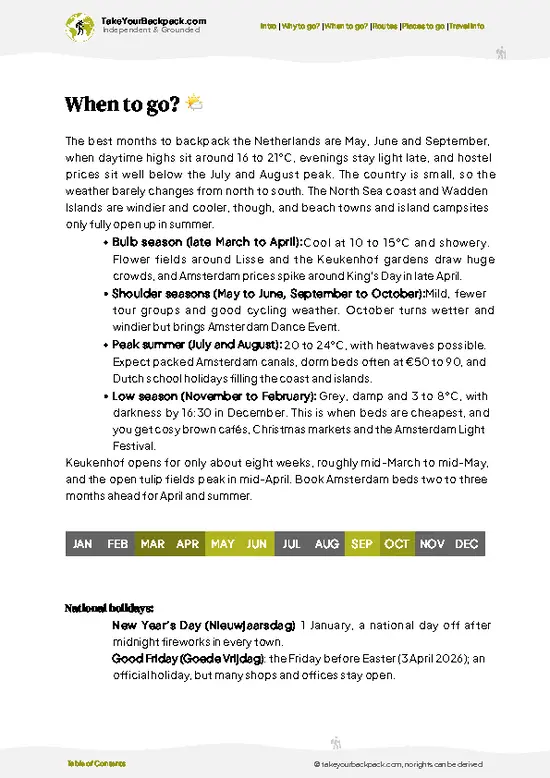
May to September is the best window for backpacking in Maastricht, with long days and open terraces.
  • Summer (June to August): Highs of 20 to 24°C (68 to 75°F), with about 16 hours of daylight. Terraces are packed, hostel prices peak and the weekends fill early.
  • Spring and Early Autumn (April to May, September to October): Highs of 12 to 19°C (54 to 66°F). Fewer crowds, softer prices and good cycling weather, though showers are common.
  • Winter (November to February): Highs of 3 to 7°C (37 to 45°F) and just 8 hours of daylight. Rooms are cheapest, but the Christmas market in December and the Carnival weeks in February or March push prices up sharply.
  • Events: The TEFAF art fair in March and the Preuvenemint food festival in late August both lift prices for the period.
Book at least a month ahead for summer weekends and Carnival.

source: climatestotravel.comJANJanuary: fair for travelingFEBFebruary: fair for travelingMARMarch: good for travelingAPRApril: highly recommended for travelingMAYMay: excellent for travelingJUNJune: highly recommended for travelingJULJuly: highly recommended for travelingAUGAugust: highly recommended for travelingSEPSeptember: excellent for travelingOCTOctober: highly recommended for travelingNOVNovember: good for travelingDECDecember: good for traveling
when-to-go

✈️ The backpacker research shortcutThe Netherlands Travel Guide

An offline-friendly backpacking guide with optimized travel routes, ranked highlights, transport advice, and the best areas to stay.
example page 0 from our offline Travel Guide for Netherlands
example page 1 from our offline Travel Guide for Netherlands
example page 2 from our offline Travel Guide for Netherlands
example page 3 from our offline Travel Guide for Netherlands
example page 4 from our offline Travel Guide for Netherlands
example page 5 from our offline Travel Guide for Netherlands
example page 6 from our offline Travel Guide for Netherlands
example page 7 from our offline Travel Guide for Netherlands
The digital guide (373 pages) contains:
✅ 127 highlights, ranked by travel appeal
✅ Optimized 5, 10 & 15-day travel routes
✅ Cities, national parks, landmarks, beaches
✅ How to get around
✅ Offline-friendly for travel without Wi-Fi
👉 Click to see all 30+ guide features

📅 Plan smarter in minutes, not weeks
✅ Month by month travel advice
✅ Festivals & national holidays
✅ Budget expectations

🗺️ Go to the right places, skip the overrated ones
✅ Honest pros & cons of destinations
✅ Top hikes, parks & viewpoints
✅ Lesser-known places most travelers miss
✅ Clear “worth it vs skip it” guidance

🛏️ Travel smoothly without rookie mistakes
✅ Best areas to stay
✅ Transport systems explained simply
✅ Common scams & safety advice
✅ SIM cards, money & practical tips

🌍 Understand the country, not just visit it
✅ Culture & traditions
✅ 52 Essential phrases & customs
✅ Festivals worth planning around
✅ Traveler-friendly historical context
✅ Insights that make places more meaningful

📱 Built for real travel conditions
✅ Fully downloadable PDF
✅ Works completely offline
✅ Optimized for phone use
✅ Useful in remote areas & buses
✅ Everything in one place
Stop searching, start planning
Get instant access to your full guide. 30‑day money-back guarantee.
+ Add another guide for just

By proceeding you agree to our terms.
Sent to your inbox immediately after payment • 100% Secure Checkout
Best Backpacking Travel Advisor 2025 tourism awardBest Backpacking
Travel Advisor
2025
What others say about Take Your Backpack Guides:
⭐⭐⭐⭐⭐
Fantastic, amazing amount of information!
⭐⭐⭐⭐⭐
My goodness this is amazing, it's what I've been looking for hats off too you!
⭐⭐⭐⭐⭐
I think this is absolutely BRILLIANT
⭐⭐⭐⭐
Very complete and informative. It's still missing places, but I gotta to commend you
⭐⭐⭐⭐⭐
This is truly amazing, thank you, can't wait to explore it with my kids!
⭐⭐⭐⭐⭐
Awesome resource, thank you!
⭐⭐⭐⭐⭐
This is amazing! Can't wait to explore the ones I haven't seen
⭐⭐⭐⭐
I love this! Well done, great idea.
⭐⭐⭐⭐⭐
Thanks for taking the time to make this gem!
⭐⭐⭐⭐⭐
This might be the best website I've ever seen.
⭐⭐⭐⭐⭐
Congratulations, and thank you so much for your work; it's incredibly valuable.
⭐⭐⭐⭐
In all seriousness I think you did a great job pointing out the important spots
⭐⭐⭐⭐⭐
10/10 very good
⭐⭐⭐⭐⭐
As someone who's only just starting to visit regularly this is awesome, thank you.
⭐⭐⭐⭐
Thank you very much! I'm going to visit my dad, it's going to be very useful!
⭐⭐⭐⭐⭐
This is really cool! We'll be travelling for the first time and this definitely come in handy.
⭐⭐⭐⭐⭐
You are now our minister of culture, congratulations 👨‍💼
⭐⭐⭐⭐⭐
Just wanted to tell you that this is a pearl! Going to follow your recommendations.
⭐⭐⭐⭐⭐
This is so cool. I'll definitely be using the resource for my travels soon.
⭐⭐⭐⭐⭐
This is very impressive! Good work.
⭐⭐⭐⭐⭐
This is an amazing and informative site. Very well done!

🛏️ Where to stay?How to pick the right area

The best budget bases are Wyck and the streets just around the station, both within a 10 minute walk of the old town. Wyck has the strongest mix of hostel and budget-bed options, and its station side gives you the quickest links to trains, buses and the airport shuttle. Streets are lit and busy into the evening, with plenty of other travelers walking home, so it suits solo travelers arriving late.
Noise is the thing to weigh. Wyck is livelier on weekend nights with bars open until the early hours, so ask for a room on the courtyard side or bring earplugs. Streets close to the station are quieter … read more 👉
The best budget bases are Wyck and the streets just around the station, both within a 10 minute walk of the old town. Wyck has the strongest mix of hostel and budget-bed options, and its station side gives you the quickest links to trains, buses and the airport shuttle. Streets are lit and busy into the evening, with plenty of other travelers walking home, so it suits solo travelers arriving late.
Noise is the thing to weigh. Wyck is livelier on weekend nights with bars open until the early hours, so ask for a room on the courtyard side or bring earplugs. Streets close to the station are quieter at night, though you will hear some train and bus traffic.
The city center itself is atmospheric but costs more per bed, and rooms fill early in summer and during Carnival and the major fairs. Book well ahead if your dates match those. If the central beds are full or too pricey, the Sint Pieter side offers calm and greenery, but bus links drop off late, so it only works if you are fine with a 30 minute walk home.

🚌 Getting aroundHow to get from A to B

From Maastricht station, the center is a 10 to 15 minute walk west across the Sint Servaasbrug bridge, or a short bus ride of about 5 minutes. Most backpackers never need more than their feet and a bike, because the old town is small and mostly car-free. Public transport is reliable, but few trips justify it within the city itself.
  • Walking: Free, and the fastest way to see the center, Wyck and the Jekerkwartier, where nothing is more than 20 to 25 minutes apart. Cobblestones are hard on thin shoes, so wear sturdy ones. For anything inside the ring, this is the best value by far.
  • Bicycle: Rentals run about €12 to 15 a day, with shared bikes and station rental points as options. Cycling is quicker than the bus over 2 to 5 km, and flat paths along the Maas lead out of town. Lock the bike with two
… read more 👉
From Maastricht station, the center is a 10 to 15 minute walk west across the Sint Servaasbrug bridge, or a short bus ride of about 5 minutes. Most backpackers never need more than their feet and a bike, because the old town is small and mostly car-free. Public transport is reliable, but few trips justify it within the city itself.
  • Walking: Free, and the fastest way to see the center, Wyck and the Jekerkwartier, where nothing is more than 20 to 25 minutes apart. Cobblestones are hard on thin shoes, so wear sturdy ones. For anything inside the ring, this is the best value by far.
  • Bicycle: Rentals run about €12 to 15 a day, with shared bikes and station rental points as options. Cycling is quicker than the bus over 2 to 5 km, and flat paths along the Maas lead out of town. Lock the bike with two locks, as theft is the main risk.
  • City buses (Arriva): Single tickets cost about €3 to 4, and contactless debit card tap in and tap out works on board. Buses run from roughly 6 am to midnight, with fewer on Sundays. They matter mainly for Sint Pieter, the university area and the airport route. If you take more than two rides a day, a day ticket usually costs less.
  • Regional trains and buses: Trains reach Liège in about 40 minutes and Aachen via bus or rail in about an hour. Buses connect to Valkenburg in 25 to 30 minutes. Expect €5 to 12 per leg, and use contactless with OV-chipkaart rules where required.
  • Taxi and ride-hailing: Starting fares are about €4 to 5, with a typical in-town ride costing €10 to 15. Comfort is high and speed is similar to the bus, but only worth it for late nights or heavy luggage.

👛 Costs (as of 16 October 2026)How expensive it really is

Backpacking in Maastricht costs more than most of Europe’s budget bases, mainly because of accommodation. Expect about €65 to 110 a day, depending on the season and how often you eat out.
CategoryBudget RangeLocal Reality
Dorm accommodation (high season)€35 to 55Summer and Carnival weekends sell out early; book ahead.
Dorm accommodation (off-season)€25 to 40Midweek winter beds are the cheapest.
Meals€18 to 32Bakery lunch €5 to 8, simple dinner €12 to 20.
Local transport€0 to 8Walking covers most; bus single about €3 to 4.
City transport pass€8 to 12Day ticket pays off only on busy days; bike rental €12 to 15.
Basic activities and entry fees€0 to 15Walls and Sint Pieter hillside free; cave and museum visits €8 to 15.
Miscellaneous€5 to 15Beer €3.50 to 5, coffee €3, laundry €5 to 8.
Total Daily Budget€65
… read more 👉
Backpacking in Maastricht costs more than most of Europe’s budget bases, mainly because of accommodation. Expect about €65 to 110 a day, depending on the season and how often you eat out.
CategoryBudget RangeLocal Reality
Dorm accommodation (high season)€35 to 55Summer and Carnival weekends sell out early; book ahead.
Dorm accommodation (off-season)€25 to 40Midweek winter beds are the cheapest.
Meals€18 to 32Bakery lunch €5 to 8, simple dinner €12 to 20.
Local transport€0 to 8Walking covers most; bus single about €3 to 4.
City transport pass€8 to 12Day ticket pays off only on busy days; bike rental €12 to 15.
Basic activities and entry fees€0 to 15Walls and Sint Pieter hillside free; cave and museum visits €8 to 15.
Miscellaneous€5 to 15Beer €3.50 to 5, coffee €3, laundry €5 to 8.
Total Daily Budget€65 to 110Lower end with dorm, bakery meals and walking.
Buy lunch and snacks at the Wednesday or Friday market, and book a dorm midweek to cut costs.
⚠️ Prices can change and everyone travels differently, so take this as a rough guide. Hope it helps you plan your adventure!

🚌 Day tripsShort trips worth adding

Maastricht sits on the border, so day trips are easy by train or bus, usually under an hour and often under €15 return.Liège, Belgium: A direct train takes about 40 minutes and costs around €10 to 15 each way. You get a grittier, cheaper city with the hilltop Montagne de Bueren stairs and waffles from street stands. Go midweek, since many shops close on Sunday and Monday.
Valkenburg: About 25 to 30 minutes by bus or train, with return fares around €6 to 8. It has castle ruins, caves and a hilly cycling area. A common mistake is visiting on a summer Sunday, when day-trippers crowd every lane. April to October is best.
👉 Explore ValkenburgAachen, Germany: Allow about an hour by train or bus, for roughly €10 to 15 each way. Charlemagne’s cathedral is the draw, followed by cheap German bakeries. … read more 👉
Maastricht sits on the border, so day trips are easy by train or bus, usually under an hour and often under €15 return.Liège, Belgium: A direct train takes about 40 minutes and costs around €10 to 15 each way. You get a grittier, cheaper city with the hilltop Montagne de Bueren stairs and waffles from street stands. Go midweek, since many shops close on Sunday and Monday.
Valkenburg: About 25 to 30 minutes by bus or train, with return fares around €6 to 8. It has castle ruins, caves and a hilly cycling area. A common mistake is visiting on a summer Sunday, when day-trippers crowd every lane. April to October is best.
👉 Explore ValkenburgAachen, Germany: Allow about an hour by train or bus, for roughly €10 to 15 each way. Charlemagne’s cathedral is the draw, followed by cheap German bakeries. Take your passport or ID, as spot checks happen.
Sint Pietersberg and Fort Sint Pieter: Walk or cycle 30 to 40 minutes from the center. Cave tours cost roughly €8 to 15, and the hillside paths are free. Wear layers, as caves stay around 10°C (50°F). It works well in any season.

🍲 FoodLocal Cuisine & Drinks

Maastricht eats with a Burgundian streak, with Dutch, Belgian and German influences. Start with a vlaai, a fruit tart from Limburg, filled with cherry, apricot or rice, and sold by the slice for about €2 to 3 at bakeries. Zuurvlees, a sweet and sour beef stew, is the local comfort plate, usually served with fries or bread. Look for Limburgse mosterdsoep too, a creamy mustard soup that is better than it sounds.
For budget meals, the Wednesday and Friday market at the Markt has cheese, fresh stroopwafels and herring sandwiches. Wyck has the best bakeries, snack bars and casual cafés, and the student streets offer cheap pizza and shawarma late into the night. A fresh frites cone with mayonnaise is a standard stop.
Drinking is warm and social. Order a Limburg beer such as a Brand pils or a Belgian-style … read more 👉
Maastricht eats with a Burgundian streak, with Dutch, Belgian and German influences. Start with a vlaai, a fruit tart from Limburg, filled with cherry, apricot or rice, and sold by the slice for about €2 to 3 at bakeries. Zuurvlees, a sweet and sour beef stew, is the local comfort plate, usually served with fries or bread. Look for Limburgse mosterdsoep too, a creamy mustard soup that is better than it sounds.
For budget meals, the Wednesday and Friday market at the Markt has cheese, fresh stroopwafels and herring sandwiches. Wyck has the best bakeries, snack bars and casual cafés, and the student streets offer cheap pizza and shawarma late into the night. A fresh frites cone with mayonnaise is a standard stop.
Drinking is warm and social. Order a Limburg beer such as a Brand pils or a Belgian-style dubbel on a terrace, and expect to pay about €3.50 to 5 a glass. Tipping is small, and rounding up is enough. Many locals share bitterballen with a drink. Kitchens often close early, so eat dinner by about 9 pm.

🛡️ SafetySafety Tips and Common Scams in Maastricht

Maastricht is very safe, and most problems are petty. Bicycle theft is the main nuisance, so use two locks and never leave a bike overnight on the street. Pickpockets work crowded summer terraces, the Markt on market days and the train station, so keep phones off tables and bags zipped in front of you. Solo travelers, including women, walk home at night without trouble. The Stokstraat and Boschstraat bar areas get rowdy on weekends, mostly drunk students, and the easiest fix is to step into another street. Drug touts appear near the border and station, and the only response needed is a clear no and keep walking. Coffeeshops are for adults over 18 and often ask for ID. Scams are rare, though check your card receipt in tourist-heavy spots. Emergency number is 112.

FAQCommon questions from travelers

Two days is enough for most backpackers to see the main sights, and a third day works if you add a trip to Valkenburg or Liège. The old center takes about half a day to walk, and the Sint Pietersberg caves and Bonnefanten Museum fill another few hours. Liège is around 50 minutes by train.
Yes, Maastricht is very safe for solo backpackers, with low violent crime and well-lit streets in the center at night. The main risks are bicycle theft, so lock yours with two locks, and pickpockets at the Friday market or during Carnival in February or March. Emergency number is 112.
Maastricht is known for the 1992 Treaty of Maastricht that founded the European Union, along with its Roman and medieval history. Visitors also come for the Boekhandel Dominicanen bookshop in a 13th-century church, Limburgish food such as vlaai fruit pies, and the Carnival before Lent. The old Helpoort gate dates from around 1229.
⚠️ Things can change over time, so always validate details locally before you go.

Other Dutch cities near Maastricht

Explore more nearby:

  • Eindhoven—Design district, Philips legacy, Strijp-S, Stratumseind bars| 66 km away
  • ’s-Hertogenbosch—Binnendieze boats, Bosch art, Brabant ramparts, cathedral square| 98 km away
  • Breda—Grote Markt, castle grounds, Valkenberg, Haven district| 103 km away

💡 Not sure where to go next?
Create a personalized itinerary for The Netherlands including Maastricht and the places that fit your trip.

Generate my itinerary

👉 Discover all cities

Or checkout all The Netherlands has to offer (think cities, towns, villages, national parks, hikes, beaches, festivals)
Country photo of The Netherlands

We 💚 feedbackParting advice and final tips

Go on a spring or early autumn evening, when the Vrijthof terraces are warm enough to sit outside but the summer crowds have thinned. That is when Maastricht makes sense: slow dinners, church bells, and river light on old stone. It is small, so two nights is plenty, and if you crave raves or mountains, look elsewhere.

✈️ When did I visit The Netherlands?
Netherlands is my home base, so whenever I don’t travel, you can find me in this tiny spot on the globe. When friends from abroad visit me, it’s the time to actually explore my own country as a traveler.

✍️ Help improve this page!
The information on this page is based on my own backpacking experience in The Netherlands, supplemented with up-to-date research and feedback from other travelers. Travel details can change, so if you notice anything outdated or incomplete, feel free to let me know.


🙋‍♂️ Give feedback

👋 Meet the founderWho’s Behind Take Your Backpack?

Johan, backpacker and founder of TakeYourBackpackHi, I’m Johan (Netherlands 🇳🇱), the creator of TakeYourBackpack. Over the past 3 decades, I’ve backpacked through 90+ countries across six continents, gaining extensive experience with independent travel, long-term trips, and overland routes.

This site is built on a combination of firsthand travel experience and carefully curated insights from other backpackers. Many guides are based on places I’ve personally visited, while others bring together tips, observations, and practical advice shared by trusted travelers I’ve met along the way.

The goal is to provide realistic, experience-driven guidance — not generic itineraries — so you can explore destinations with better context, clearer expectations, and more confidence.