×

Niger🇳🇪 | attractionsMarché de Zinderleather goods, millet, bustling courtyards | things to do and best time to go

Explore Marché Central d’AgadezExplore Vieux Quartier et Palais du Sultan de Zinder

Backpacking in Marché de Zinder
👌 Worth visitingattraction ranked #11
By Johan Kruseman 🇳🇱 | Updated September 3, 2026

You won’t see this on Instagram: Marché de Zinder is not a photogenic bazaar lined with curated handicrafts—it’s a raw, sprawling, semi-chaotic trading nerve center where livestock, salt, and battered electronics change hands in clouds of dust and shouts. Zinder sits in southern Niger, closer to Nigeria than to Niamey, and its market is the city’s pulsing heart, not a tourist sideshow. Here’s the truth: if you’re hunting for a sanitized, easy market stroll, skip it. But if you want to feel the adrenaline of West African commerce in full, unfiltered swing, this is the real deal. The crowds are relentless, the noise is a wall, and the heat is a test. You’ll pay local prices—no tourist markup, but no tourist comfort, either. Compared to Agadez’s old city or Niamey’s riverfront, Zinder’s market is grittier, more intense, and far less staged. It’s not easy, but it’s unforgettable for all the right reasons.

Discover everything you want to know in the 📖 Niger Travel Guide.
Safety warning

The current risk level for Niger is high. Check the advice before going.


Get your Niger guide
67 ranked highlights, routes & tips, works offline (284 pages)
Loading the map 🌍
CLICK TO FILTER
cities
towns
villages
landmarks
national parks
hikes
attractions
festivals
regions
SHOW COUNTRY’S BESTSHOW ALL

✨ Why go?
Ranked #11 attraction in Niger
What sets this place apart

The Marché de Zinder isn’t some polished tourist trap with curated stalls and Instagram-perfect backdrops. It’s raw, chaotic, and yes—crowded. You’ll wrestle through a sea of people, dodge motorbikes, and haggle over goods in a market that’s been the beating heart of southern Niger for centuries. But here’s the kicker: this market is a living archive of Sahelian culture and commerce, where Tuareg traders, Hausa merchants, and Fulani herders converge. It’s not just about buying or selling; it’s about witnessing a centuries-old network of trade routes still pulsing with life.

Backpackers make time for Marché de Zinder because it’s a milestone on the Niger route—proof you’ve stepped beyond the usual and into a place where history and daily hustle collide. The effort to navigate the market’s … read more 👉
The Marché de Zinder isn’t some polished tourist trap with curated stalls and Instagram-perfect backdrops. It’s raw, chaotic, and yes—crowded. You’ll wrestle through a sea of people, dodge motorbikes, and haggle over goods in a market that’s been the beating heart of southern Niger for centuries. But here’s the kicker: this market is a living archive of Sahelian culture and commerce, where Tuareg traders, Hausa merchants, and Fulani herders converge. It’s not just about buying or selling; it’s about witnessing a centuries-old network of trade routes still pulsing with life.

Backpackers make time for Marché de Zinder because it’s a milestone on the Niger route—proof you’ve stepped beyond the usual and into a place where history and daily hustle collide. The effort to navigate the market’s sensory overload pays off with encounters you won’t find in guidebooks: the scent of spices, the clatter of metalwork, and the unfiltered stories of locals who’ve traded here for generations. It’s gritty, it’s intense, and it’s a rare chance to see Niger’s soul in motion. If you want a snapshot of authentic West African trade and culture, this market delivers in spades.
Want to include Marché de Zinder in your Niger route?
Create a personalized Niger itinerary that includes Marché de Zinder and the places that fit your trip — based on your travel style, budget, and available time. Get your route in seconds.

Generate my trip

💡 HighlightsDon't-miss highlights and experiences

The Camel Market
Forget the sanitized, Instagram-filtered version of “local markets.” The camel section at Marché de Zinder is a living, breathing, snorting spectacle. This isn’t a petting zoo. It’s a full-on, dust-choked negotiation arena where Tuareg and Hausa traders haggle over animals that are both status symbols and survival tools. The scale is wild—hundreds of camels, their owners in flowing robes, the air thick with the scent of livestock and the sound of serious business. You’ll see deals sealed with a handshake and a stare that could cut glass. It’s not for the faint-hearted, but it’s the real pulse of Sahelian commerce.


The Indigo Dyers’ Alley
If you’re expecting a sanitized “artisan quarter,” brace yourself. The indigo dyers of Zinder work in open-air workshops, their hands and … read more 👉
The Camel Market
Forget the sanitized, Instagram-filtered version of “local markets.” The camel section at Marché de Zinder is a living, breathing, snorting spectacle. This isn’t a petting zoo. It’s a full-on, dust-choked negotiation arena where Tuareg and Hausa traders haggle over animals that are both status symbols and survival tools. The scale is wild—hundreds of camels, their owners in flowing robes, the air thick with the scent of livestock and the sound of serious business. You’ll see deals sealed with a handshake and a stare that could cut glass. It’s not for the faint-hearted, but it’s the real pulse of Sahelian commerce.


The Indigo Dyers’ Alley
If you’re expecting a sanitized “artisan quarter,” brace yourself. The indigo dyers of Zinder work in open-air workshops, their hands and arms stained blue-black from years of labor. The process is raw: vats of dye bubble in the heat, and strips of cloth are slapped and wrung out with practiced violence. This is where the city’s famous indigo turbans and robes are born. The colors are deep, almost electric, and the patterns are improvised—no two pieces are ever the same. Watching the dyers work is hypnotic, and if you’re lucky, you’ll get a crash course in the difference between a tourist trinket and a robe that actually means something in Hausa culture.


The Spice and Grain Maze
This isn’t your curated “foodie market.” The spice and grain section is a labyrinth of burlap sacks, open-air scales, and women who can spot a bad millet kernel from ten paces. The air is a punch of chili, dried fish, and fermented locust beans—an olfactory gauntlet that will either make you hungry or send you running. The real magic is in the rhythm: the sing-song bargaining, the slap of scoops against metal pans, the way everyone seems to know everyone else’s business. If you want to understand what people actually eat in Niger, this is your crash course.


The Hausa Leatherworkers
No, you won’t find “bespoke” handbags with Parisian price tags. What you will find are Hausa leatherworkers hunched over their benches, carving, dyeing, and stitching everything from camel saddles to amulets. The smell of tanned hide is sharp and earthy. The tools are basic, but the craftsmanship is anything but. If you’re after a souvenir with actual soul, skip the airport shops and watch these artisans turn raw skin into something that will outlast your Instagram account.


The Social Theater
The real entertainment isn’t always in the stalls. It’s in the people-watching. Marché de Zinder is where the city’s characters come to perform: griots with their battered lutes, fortune-tellers with cowrie shells, and self-appointed comedians who roast passersby for sport. You’ll see marriage negotiations, political debates, and the kind of gossip that could fuel a soap opera. It’s chaotic, loud, and occasionally overwhelming—but it’s the best reality show you’ll ever see, and you don’t need a ticket.
Spotted a mistake or missing something? Contact us.
🌤️ When to go?Best time to visit Marché de Zinder


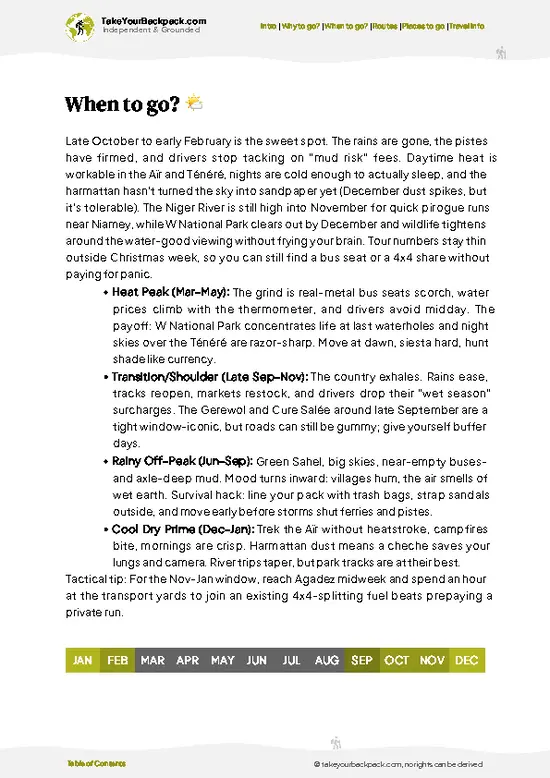
  • Topic: Weather and Temperature – The best time to visit Marché de Zinder is between November and February. During these months, temperatures are more bearable, ranging from 20°C to 30°C (68°F to 86°F). Avoid April to June when the mercury spikes above 40°C (104°F), turning the market into a sweatbox that kills the vibe.

  • Topic: Daylight Hours – Daylight is fairly consistent year-round, roughly 11 to 12 hours daily. But in the cooler months, early mornings and late afternoons are perfect for exploring without frying under the sun.

  • Topic: Crowds – The market is busiest during the dry season (November to February), especially around local festivals. It’s a double-edged sword: more people means more energy but also more hustle and noise.

  • Topic: Seasonal Activities – November to February
read more 👉

  • Topic: Weather and Temperature – The best time to visit Marché de Zinder is between November and February. During these months, temperatures are more bearable, ranging from 20°C to 30°C (68°F to 86°F). Avoid April to June when the mercury spikes above 40°C (104°F), turning the market into a sweatbox that kills the vibe.

  • Topic: Daylight Hours – Daylight is fairly consistent year-round, roughly 11 to 12 hours daily. But in the cooler months, early mornings and late afternoons are perfect for exploring without frying under the sun.

  • Topic: Crowds – The market is busiest during the dry season (November to February), especially around local festivals. It’s a double-edged sword: more people means more energy but also more hustle and noise.

  • Topic: Seasonal Activities – November to February brings a burst of local trade and cultural events, offering a real slice of life beyond the tourist gloss. The rainy season (July to September) shuts down much of the market, making visits less rewarding.

  • Topic: Price Fluctuations – Prices tend to stabilize during the dry season when supply chains are steady. During the rainy season, scarcity can hike prices on essentials, so plan accordingly to avoid paying a premium.


Pro-tip: Aim for early mornings in the dry season to catch the market waking up—cooler temps, fewer crowds, and the freshest goods.


source: climatestotravel.comJANJanuary: excellent for travelingFEBFebruary: excellent for travelingMARMarch: good for travelingAPRApril: fair for travelingMAYMay: fair for travelingJUNJune: fair for travelingJULJuly: below average for travelingAUGAugust: below average for travelingSEPSeptember: below average for travelingOCTOctober: good for travelingNOVNovember: excellent for travelingDECDecember: excellent for traveling
when-to-go

✈️ The backpacker research shortcutNiger Travel Guide

An offline-friendly backpacking guide with optimized travel routes, ranked highlights, transport advice, and the best areas to stay.
example page 0 from our offline Travel Guide for Niger
example page 1 from our offline Travel Guide for Niger
example page 2 from our offline Travel Guide for Niger
example page 3 from our offline Travel Guide for Niger
example page 4 from our offline Travel Guide for Niger
example page 5 from our offline Travel Guide for Niger
example page 6 from our offline Travel Guide for Niger
example page 7 from our offline Travel Guide for Niger
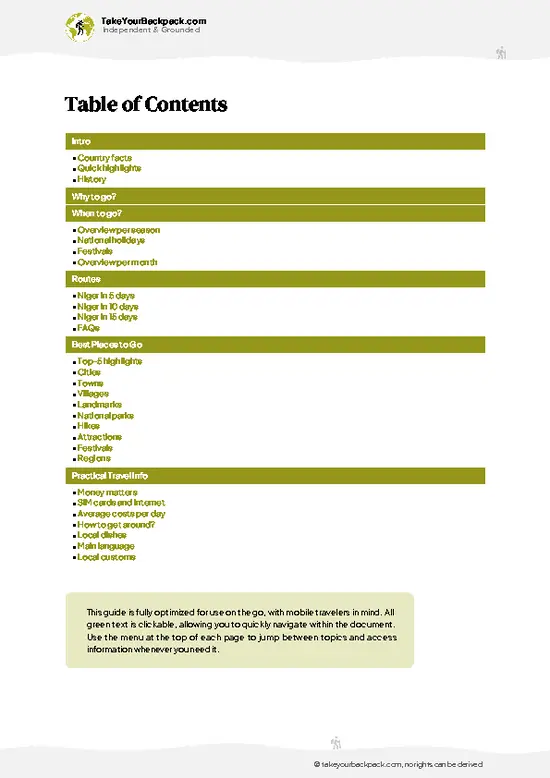
The digital guide (284 pages) contains:
67 highlights, ranked by travel appeal
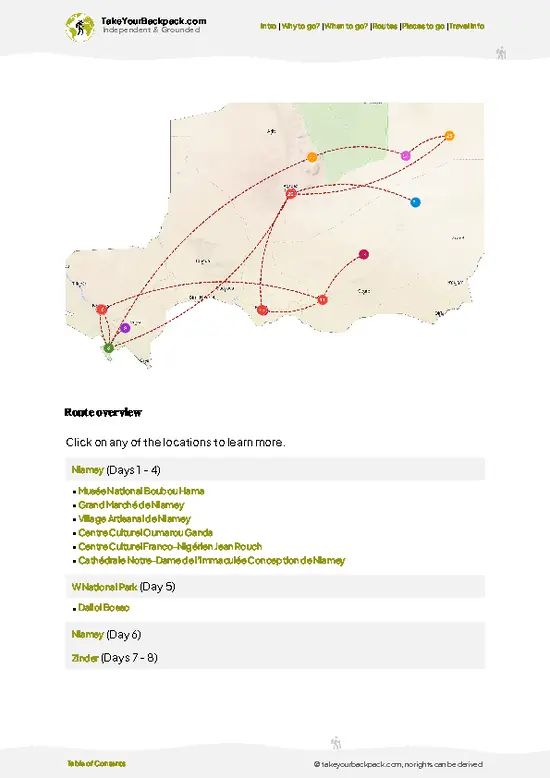
Optimized 5, 10 & 15-day travel routes
Cities, national parks, landmarks, beaches
How to get around
Offline-friendly for travel without Wi-Fi
👉 Click to see all 30+ guide features

📅 Plan smarter in minutes, not weeks
Month by month travel advice
Festivals & national holidays
Budget expectations

🗺️ Go to the right places, skip the overrated ones
Honest pros & cons of destinations
Top hikes, parks & viewpoints
Lesser-known places most travelers miss
Clear “worth it vs skip it” guidance

🛏️ Travel smoothly without rookie mistakes
Best areas to stay
Transport systems explained simply
Common scams & safety advice
SIM cards, money & practical tips

🌍 Understand the country, not just visit it
Culture & traditions
52 Essential phrases & customs
Festivals worth planning around
Traveler-friendly historical context
Insights that make places more meaningful

📱 Built for real travel conditions
Fully downloadable PDF
Works completely offline
Optimized for phone use
Useful in remote areas & buses
Everything in one place
Save weeks of stressful planning
Get instant access to your full guide. 30‑day money-back guarantee.
+ Add another guide for just US$7.80

By proceeding you agree to our terms.
Sent to your inbox immediately after payment • 100% Secure Checkout
Best Backpacking Travel Advisor 2025 tourism awardBest Backpacking
Travel Advisor
2025
What others say about Take Your Backpack Guides:
⭐⭐⭐⭐⭐
Fantastic, amazing amount of information!
⭐⭐⭐⭐⭐
My goodness this is amazing, it's what I've been looking for hats off too you!
⭐⭐⭐⭐⭐
I think this is absolutely BRILLIANT
⭐⭐⭐⭐
Very complete and informative. It's still missing places, but I gotta to commend you
⭐⭐⭐⭐⭐
This is truly amazing, thank you, can't wait to explore it with my kids!
⭐⭐⭐⭐⭐
Awesome resource, thank you!
⭐⭐⭐⭐⭐
This is amazing! Can't wait to explore the ones I haven't seen
⭐⭐⭐⭐
I love this! Well done, great idea.
⭐⭐⭐⭐⭐
Thanks for taking the time to make this gem!
⭐⭐⭐⭐⭐
This might be the best website I've ever seen.
⭐⭐⭐⭐⭐
Congratulations, and thank you so much for your work; it's incredibly valuable.
⭐⭐⭐⭐
In all seriousness I think you did a great job pointing out the important spots
⭐⭐⭐⭐⭐
10/10 very good
⭐⭐⭐⭐⭐
As someone who's only just starting to visit regularly this is awesome, thank you.
⭐⭐⭐⭐
Thank you very much! I'm going to visit my dad, it's going to be very useful!
⭐⭐⭐⭐⭐
This is really cool! We'll be travelling for the first time and this definitely come in handy.
⭐⭐⭐⭐⭐
You are now our minister of culture, congratulations 👨‍💼
⭐⭐⭐⭐⭐
Just wanted to tell you that this is a pearl! Going to follow your recommendations.
⭐⭐⭐⭐⭐
This is so cool. I'll definitely be using the resource for my travels soon.
⭐⭐⭐⭐⭐
This is very impressive! Good work.
⭐⭐⭐⭐⭐
This is an amazing and informative site. Very well done!

🛏️ Where to stay?How to pick the right area

Marché de Zinder is a sensory overload in the best and most chaotic way. But let’s cut through the tourist brochure gloss: this market is loud, crowded, and not exactly a polished postcard. If you’re chasing Instagram perfection, you’ll find more filters than authenticity here. The real magic is in the grit—the raw, unfiltered pulse of daily life in Niger’s second-largest city.

Now, where to crash? Forget the outskirts or sterile hotel zones. The best spots are right in the thick of it, within walking distance of the market. Staying close means you’re plugged into the rhythm of Zinder—early … read more 👉
Marché de Zinder is a sensory overload in the best and most chaotic way. But let’s cut through the tourist brochure gloss: this market is loud, crowded, and not exactly a polished postcard. If you’re chasing Instagram perfection, you’ll find more filters than authenticity here. The real magic is in the grit—the raw, unfiltered pulse of daily life in Niger’s second-largest city.

Now, where to crash? Forget the outskirts or sterile hotel zones. The best spots are right in the thick of it, within walking distance of the market. Staying close means you’re plugged into the rhythm of Zinder—early morning calls to prayer, vendors shouting their wares, the smell of spices and grilled meat thick in the air. It’s not luxury, but it’s real.

Look for neighborhoods where locals live and work, not just where tourists are funneled. These areas are safer than you might expect if you keep your wits about you, and they’re buzzing with fellow backpackers and solo travelers who want to swap stories over a cheap meal or a shared bottle of local beer. Social life here happens on the streets and in small cafés, not in isolated hotel lobbies.

If you want to experience Zinder beyond the surface, stay close, stay alert, and dive into the chaos. That’s where the city’s true character lives.

👛 Costs (as of 3 September 2026)How expensive it really is

Le Grand Marché de Zinder, également connu sous le nom de Kassua’n Dollé, est un marché en plein air sans frais d'entrée. Les visiteurs peuvent explorer gratuitement les divers étals proposant des produits locaux tels que des viandes, des colas, des bois parfumés et des médicaments traditionnels. Les prix des produits varient en fonction des articles choisis, mais il n'y a pas de frais d'entrée associés à la visite du marché.

source: visit-niger.com
⚠️ Prices can change and everyone travels differently, so take this as a rough guide. Hope it helps you plan your adventure!

FAQFrequently asked questions about Marché de Zinder

2 to 3 hours is sufficient to explore Marché de Zinder thoroughly. This allows time to browse the various stalls selling local crafts, spices, and textiles. Visiting in the morning is best to avoid the afternoon heat and crowds.
Yes, Marché de Zinder is worth the entrance fee, which is typically around 500 CFA francs (less than 1 USD). The market offers an authentic cultural experience and a chance to buy unique handmade goods directly from local vendors. It is one of the largest and most vibrant markets in Niger, making it a valuable stop for travelers.
To get to Marché de Zinder, take a taxi or moto-taxi from the city center; the market is located centrally in Zinder town. It is about a 10-minute ride from the main bus station. Walking is also possible if staying nearby, but taxis are recommended for convenience and safety.
⚠️ Things can change over time, so always validate details locally before you go.

Other Nigerien attractions near Marché de Zinder

Explore more nearby:


💡 Not sure where to go next?
Create a personalized itinerary for Niger including Marché de Zinder and the places that fit your trip.

Generate my itinerary

👉 Discover all attractions

Or checkout all Niger has to offer (think cities, towns, villages, national parks, hikes, beaches, festivals)
Country photo of Niger

We 💚 feedbackKey takeaways before you go

Marché de Zinder isn’t your polished souvenir shop. It’s loud, chaotic, and packed with locals bartering fiercely—crowds can overwhelm if you’re not ready. But that’s exactly where its charm lies: the raw pulse of daily life in Niger, unfiltered and unapologetic. The real magic? The unexpected moments—a child’s grin, the scent of spices thick in the air, the way a vendor’s pride turns a simple cloth into a story. Come with patience and curiosity, and you’ll leave with more than just a purchase.

✍️ Help improve this page!
The information on this page is based on in-depth research, insights shared by experienced travelers, and feedback from the local travel community in Niger. While every effort is made to keep the information accurate and current, conditions can change — so if you spot anything incorrect or outdated, please get in touch.


🙋‍♂️ Give feedback

👋 Meet the founderWho’s Behind Take Your Backpack?

Johan, backpacker and founder of TakeYourBackpackHi, I’m Johan (Netherlands 🇳🇱), the creator of TakeYourBackpack. Over the past decade, I’ve backpacked through 80+ countries across six continents, gaining extensive experience with independent travel, long-term trips, and overland routes.

This site is built on a combination of firsthand travel experience and carefully curated insights from other backpackers. Many guides are based on places I’ve personally visited, while others bring together tips, observations, and practical advice shared by trusted travelers I’ve met along the way.

The goal is to provide realistic, experience-driven guidance — not generic itineraries — so you can explore destinations with better context, clearer expectations, and more confidence.

Get full Niger guide •
Instant download • 67 highlights • Full Offline guide