×

Niger🇳🇪 | best attractionsThe Must-See 10 attractions in Niger

Niger is a Sahara-and-Sahel country, and its attractions split cleanly by region. The north (Agadez, the Aïr Mountains, the Ténéré dunes) holds the big desert and Tuareg draws, but it is costly, needs a guide and often an official escort, and has almost no other visitors. The south along the Niger River and around Niamey offers museums, markets and river life, cheap and easy to reach by bus. Wildlife in the southwest is seasonal and thin. For independent travel, the south is simple, the north is arranged through an agency. Skip anything that needs a long detour without a local operator.

By Johan Kruseman 🇳🇱 | Updated October 18, 2026
Explore the best festivals in Niger

Why go?Why These attraction Stand Out

Niger suits travelers who want raw Sahara landscape and living Tuareg, Hausa and Wodaabe culture more than ticketed sights. Most of the country is desert, and the empty distances are the point: dune seas, volcanic massifs and rock art sit far from any town, with no crowds and no visitor facilities around them. Caravan-trade history shaped the old mud-brick cities on the southern edge of the desert, so the architecture and markets are the heritage here, not stone monuments.

It is poorly suited to casual sightseeing. Tourism infrastructure is thin, signage is rare, and few sites have set opening hours or ticket offices. Paved roads run mainly along the south, so reaching anything in the north means a 4x4 and a driver. Distances are large, fuel and water must be carried, and costs per day are … read more 👉
Niger suits travelers who want raw Sahara landscape and living Tuareg, Hausa and Wodaabe culture more than ticketed sights. Most of the country is desert, and the empty distances are the point: dune seas, volcanic massifs and rock art sit far from any town, with no crowds and no visitor facilities around them. Caravan-trade history shaped the old mud-brick cities on the southern edge of the desert, so the architecture and markets are the heritage here, not stone monuments.

It is poorly suited to casual sightseeing. Tourism infrastructure is thin, signage is rare, and few sites have set opening hours or ticket offices. Paved roads run mainly along the south, so reaching anything in the north means a 4x4 and a driver. Distances are large, fuel and water must be carried, and costs per day are high compared with neighboring Burkina Faso or Benin.

Before choosing Niger, check the security picture and your government’s travel advice, because large parts of the country, especially the borderlands with Mali, Burkina Faso, Nigeria and Libya, are under serious warnings. Land borders and flight options have changed repeatedly since 2023. A visa must be arranged in advance, and plans need a reputable local operator. If you want easy, flexible, low-budget sightseeing, pick another country. If you accept the logistics, few places feel this remote.
Why These Made the Cut
The list of best attractions in Niger is created based on cultural significance or entertainment value. If you feel a attraction is missing in this list, please let us know.

When to go?Best Time to Visit Niger for attractions

Best months: November to February: The best months are November to February, when daytime highs in Agadez and the Sahara sit around 25 to 32°C and nights drop to 5 to 12°C, which makes desert travel and long drives workable. Rain is not a concern in these months. Expect harmattan dust from December to February, which hazes the horizon and can flatten views on the dunes, so photography is better in November or late February.Shoulder and hot seasons: March and October are the shoulder months. Heat builds quickly in March, and by April to June the Sahel and Sahara reach 40 to 46°C by day. That period is not worth the discomfort, and vehicle breakdowns become far more dangerous. Skip it unless a fixed event forces the date.Rainy season in the south: In the south, rain falls from June to September. … read more 👉
Best months: November to February: The best months are November to February, when daytime highs in Agadez and the Sahara sit around 25 to 32°C and nights drop to 5 to 12°C, which makes desert travel and long drives workable. Rain is not a concern in these months. Expect harmattan dust from December to February, which hazes the horizon and can flatten views on the dunes, so photography is better in November or late February.Shoulder and hot seasons: March and October are the shoulder months. Heat builds quickly in March, and by April to June the Sahel and Sahara reach 40 to 46°C by day. That period is not worth the discomfort, and vehicle breakdowns become far more dangerous. Skip it unless a fixed event forces the date.Rainy season in the south: In the south, rain falls from June to September. Niamey receives roughly 500 to 600 mm a year, mostly in July and August, and dirt roads to the southwest wildlife areas become impassable, so those parks are effectively closed from about July to October. Agadez gets only about 150 mm a year, but flash floods can cut desert tracks in July and August. Wildlife viewing in the southwest is best in the dry months of February to May, accepting the heat.Festivals and prices: Tuareg and Wodaabe gatherings usually follow the rains, around September, with dates set locally and sometimes cancelled for security reasons. Tour prices rise in the main winter season, so book desert vehicles well ahead for December and January.

attraction hoppingPlanning Your Route Efficiently

Plan 10 to 14 days: A trip combining several attractions in Niger needs 10 to 14 days, and less than a week only makes sense if you stay in Niamey and the immediate south. Distances are the main constraint: Niamey to Agadez is roughly 900 to 1,000 km, about 12 to 15 hours by road, and Agadez to Zinder is around 8 to 10 hours.Which areas group together: Two clusters work. The southern cluster around Niamey and the Niger River needs 2 to 3 days. The northern cluster around Agadez, the Aïr and the Ténéré needs 6 to 9 days, including 1 to 2 days in Agadez town for permits, supplies and the market, then 4 to 7 days in the desert. Zinder, in the east, fits as an add-on of 1 to 2 days.Direction of travel: Go Niamey to Agadez first, then east to Zinder, and return to Niamey by the southern road or … read more 👉
Plan 10 to 14 days: A trip combining several attractions in Niger needs 10 to 14 days, and less than a week only makes sense if you stay in Niamey and the immediate south. Distances are the main constraint: Niamey to Agadez is roughly 900 to 1,000 km, about 12 to 15 hours by road, and Agadez to Zinder is around 8 to 10 hours.Which areas group together: Two clusters work. The southern cluster around Niamey and the Niger River needs 2 to 3 days. The northern cluster around Agadez, the Aïr and the Ténéré needs 6 to 9 days, including 1 to 2 days in Agadez town for permits, supplies and the market, then 4 to 7 days in the desert. Zinder, in the east, fits as an add-on of 1 to 2 days.Direction of travel: Go Niamey to Agadez first, then east to Zinder, and return to Niamey by the southern road or by air if flights are running. Doing the long haul early, while you are fresh, avoids arriving in the desert exhausted. Leave the southwest wildlife area for a separate dry-season trip, since it adds a full extra day each way.Planning mistakes: The most common error is squeezing the desert into 3 days. Driving in and out eats most of that, so allow at least 4 full days beyond Agadez. Another is underestimating checkpoints and daylight, which slow overland travel. Do not drive at night, and plan 10 to 12 hours of road a day at most. Finally, build in 1 to 2 buffer days for permit delays, vehicle repairs or escort scheduling, rather than booking tight onward flights.

The ListMust-Visit attractions in Niger

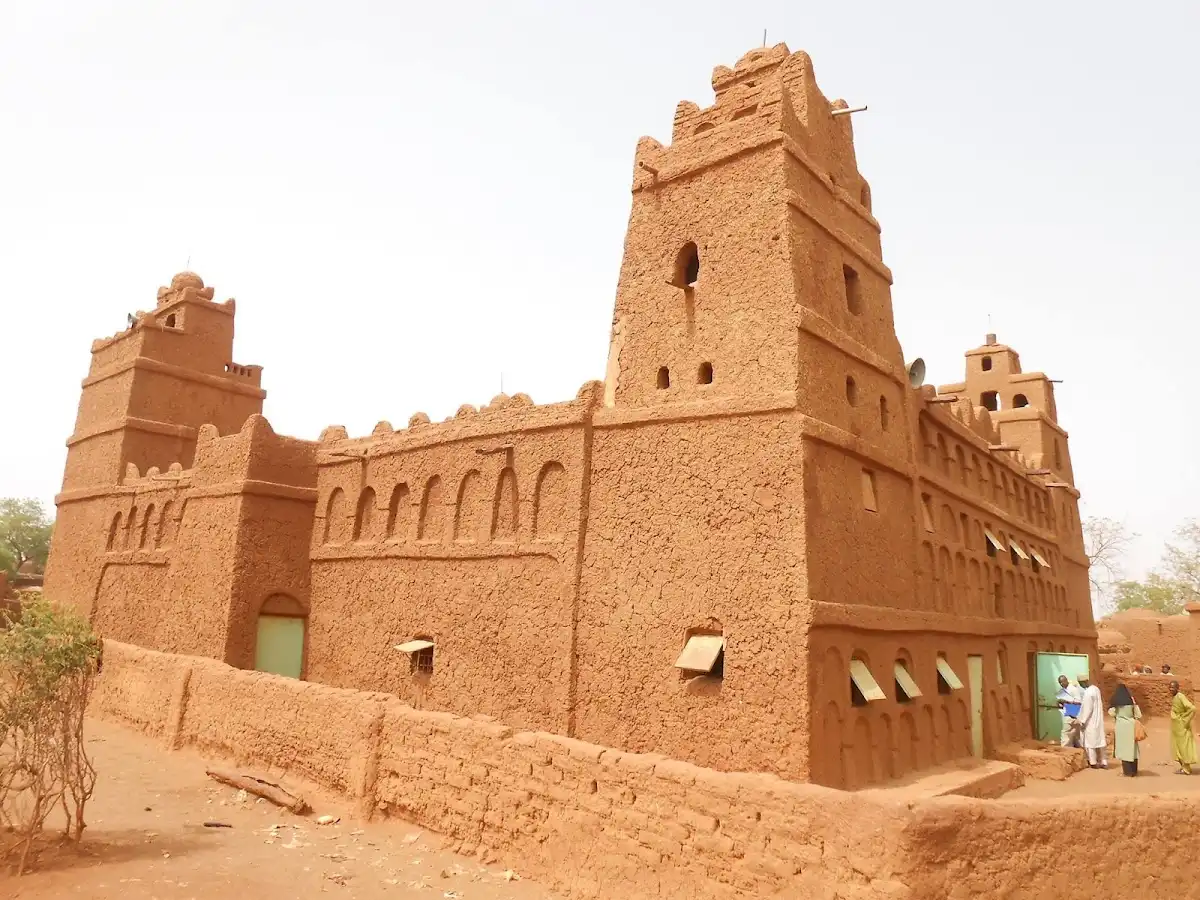
1 Grande Mosquée d’Agadez

mud-brick minaret, Sahelian design, Friday prayers

Climb the iconic tower for panoramic views and witness centuries-old construction techniques still shaping communal religious practice.

2 Palais du Sultan d’Agadez

adobe palace, ceremonial courtyard, sultan’s residence

Tour the seat of traditional authority, where local governance and ritual intersect in a centuries-old architectural complex.

3 Palais du Sultan de Zinder

mud-brick houses, labyrinthine lanes, royal compound

Walk through narrow streets lined with historic homes and enter the palace grounds that anchor Zinder’s oldest neighborhood.

4 Musée National Boubou Hama

ethnographic displays, dinosaur fossils, open-air zoo

Explore collections spanning Niger’s natural history, cultural diversity, and wildlife in a museum designed for both education and leisure.

5 Grand Marché de Niamey

textile stalls, spice vendors, labyrinthine alleys

Navigate a sprawling commercial hub where daily commerce, bargaining, and sensory overload define the heart of Niamey’s trading life.

6 Grande Mosquée de Niamey

modern mosque, prayer hall, city landmark

Visit a prominent site for communal worship and observe the architectural contrast between contemporary design and traditional practice.

7 Musée du Désert vivant

archaeological finds, Tuareg artifacts, local history

Discover the region’s layered past through curated exhibits that highlight nomadic heritage and archaeological discoveries.

niger-attraction-musee-du-desert-vivant
© Google |

8 Musée Régional de Zinder

historic relics, royal regalia, ethnographic objects

Gain insight into Zinder’s evolution from sultanate to modern city by viewing artifacts linked to its political and cultural legacy.

9 Village Artisanal de Niamey

craft workshops, pottery, woven baskets

Watch artisans at work and purchase directly from makers in a cooperative setting focused on preserving traditional skills.

niger-attraction-village-artisanal-de-niamey
© Google |

10 Marché Central d’Agadez

Tuareg crafts, silver jewelry, open-air stalls

Browse handmade wares and regional specialties in a market that serves as a crossroads for desert traders and local shoppers.

11 Marché de Zinder

leather goods, millet, bustling courtyards

Wander through interconnected courtyards where artisans, farmers, and merchants converge in a lively regional marketplace.

12 Marché de Maradi

livestock trading, Hausa fabrics, seasonal produce

Observe the rhythms of rural commerce and agricultural exchange in a market central to the economic life of southern Niger.

13 Cathédrale de Niamey

colonial-era architecture, stained glass, tranquil nave

Step inside to observe subtle European influences and quiet religious life in a city where Catholic heritage is rarely foregrounded.

14 Centre Culturel Oumarou Ganda

open-air theater, music performances, youth programs

Join audiences for live shows and community gatherings that highlight both traditional and modern expressions of Nigerien identity.

15 Centre Culturel Franco-Nigérien Jean Rouch

cinema screenings, literary events, gallery space

Experience contemporary Nigerien creativity through film, literature, and visual arts in a venue named for a pioneering ethnographer.

Think you know Niger?

Prove you’re a true local — uncover 5 lesser-known attractions in Niger that locals tend to keep to themselves.
Loading the map 🌍

Expert viewTips and Advice from Travelers

How many attractions to plan: Plan three to five attractions, spread over a single region. Niger rewards depth, not quantity: each desert or cultural stop takes a full day of driving or more, and a rushed list will cost you more in vehicle days than it gives back. A trip built around one northern desert area and one southern city stop is realistic in 10 to 14 days.Prioritizing by travel style: If you want landscape and adventure, put your money into the northern desert with a licensed operator and ignore everything else. If you want culture and markets, stay in the south and the old trading towns, where costs are lower and you can move by bus. If you want wildlife, accept that numbers are small and seasonal and treat it as a bonus, not a reason to come. A museum or craft center is worth an … read more 👉
How many attractions to plan: Plan three to five attractions, spread over a single region. Niger rewards depth, not quantity: each desert or cultural stop takes a full day of driving or more, and a rushed list will cost you more in vehicle days than it gives back. A trip built around one northern desert area and one southern city stop is realistic in 10 to 14 days.Prioritizing by travel style: If you want landscape and adventure, put your money into the northern desert with a licensed operator and ignore everything else. If you want culture and markets, stay in the south and the old trading towns, where costs are lower and you can move by bus. If you want wildlife, accept that numbers are small and seasonal and treat it as a bonus, not a reason to come. A museum or craft center is worth an hour or two, not a day.What it costs: Budget US$40 to 70 a day in the south (about CFA 25,000 to 42,000), covering a basic room at CFA 15,000 to 30,000, local meals at CFA 2,000 to 5,000, and bus or shared taxi fares. Desert travel costs far more: a 4x4 with driver, cook and fuel typically runs US$150 to 300 a day per vehicle, which is cheaper per person in a group of three or four. Escort fees, permits and camp supplies are usually quoted inside the tour price, so ask for an itemized quote. Site entry is small, often CFA 1,000 to 5,000 (US$2 to 8), but local guides add roughly US$15 to 30 a visit. Bus Niamey to Agadez costs about CFA 15,000 to 25,000 (US$25 to 40).Costs and delays that catch travelers out: Paying a full cash deposit to an unvetted agent is the biggest loss. Use an operator with verifiable references and pay in stages. ATMs are scarce outside Niamey, so carry enough CFA francs in small notes, since change is hard to find. Photography permits and checkpoint paperwork can eat half a day, so keep several copies of your passport and visa. Vehicle breakdowns are common; insist on two spare tires, extra fuel and at least 5 liters of water per person per day.Safety and cultural considerations: Check your government’s advice before booking, because many regions carry the highest warning levels and travel insurance may be void in them. Never travel outside agreed routes, and follow the escort’s decisions on timing without argument. Dress modestly in this largely Muslim country: cover shoulders and knees, and women should carry a scarf. Ask before photographing people, military sites, bridges and checkpoints, since unauthorized photos can lead to detention. During Ramadan, avoid eating or drinking openly in daylight, and expect reduced services. Greetings matter, so take a minute for them before business.

✈️ The backpacker research shortcutNiger Travel Guide

An offline-friendly backpacking guide with optimized travel routes, ranked highlights, transport advice, and the best areas to stay.
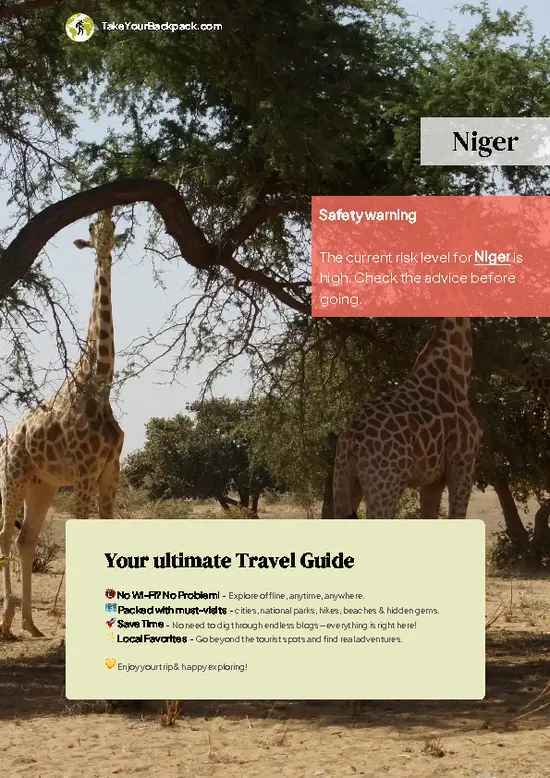
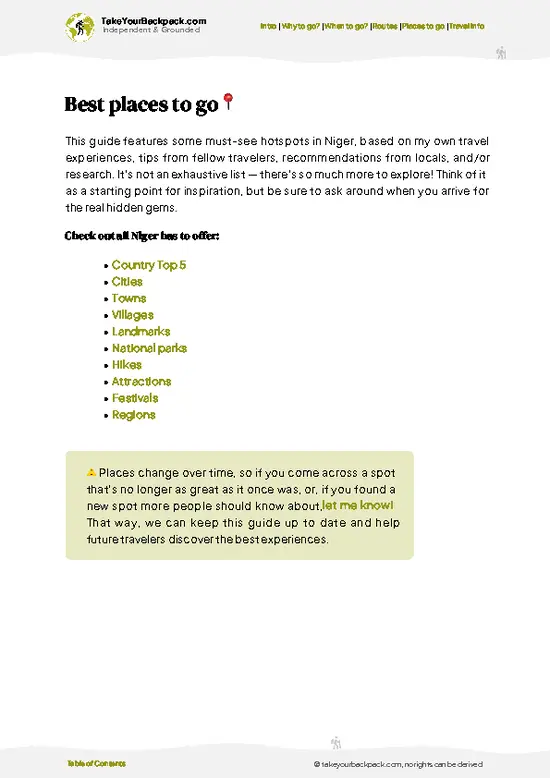
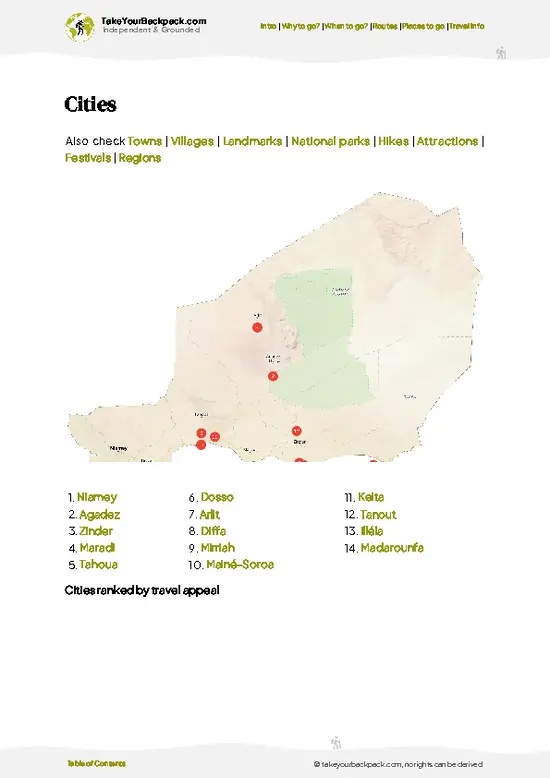
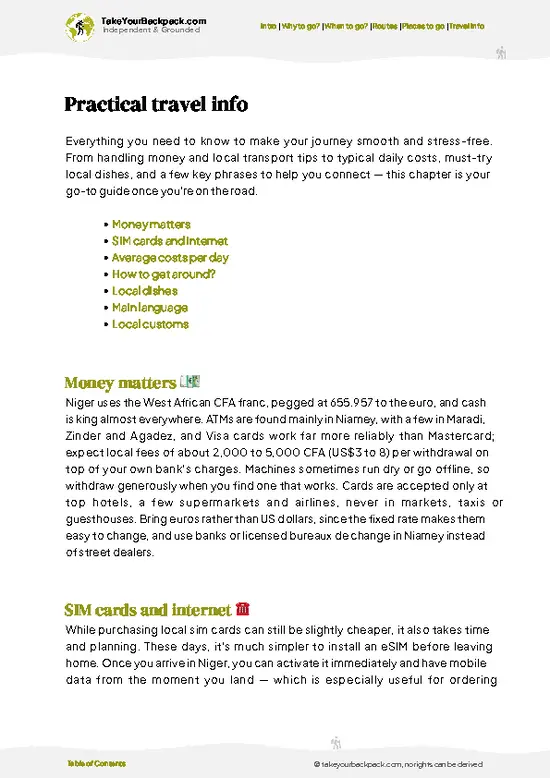
example page 0 from our offline Travel Guide for Niger
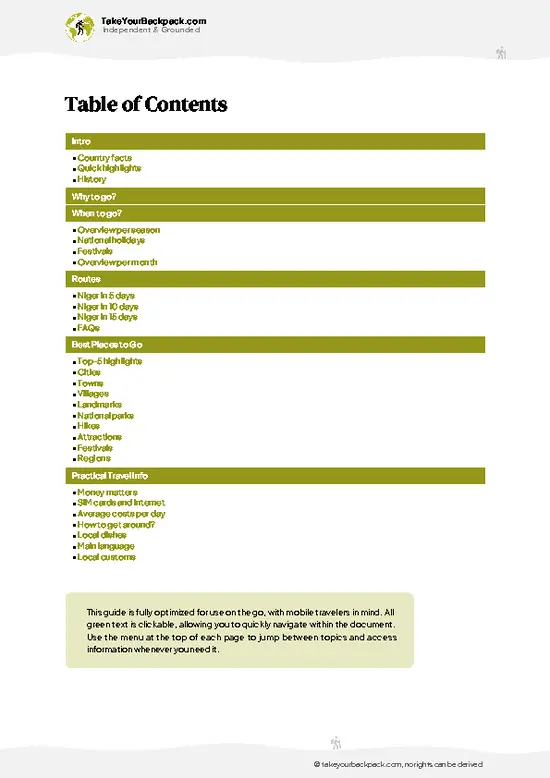
example page 1 from our offline Travel Guide for Niger
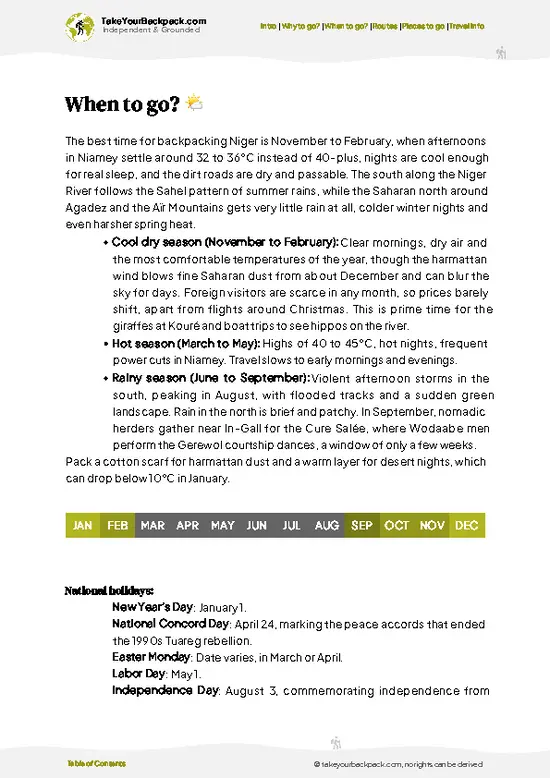
example page 2 from our offline Travel Guide for Niger
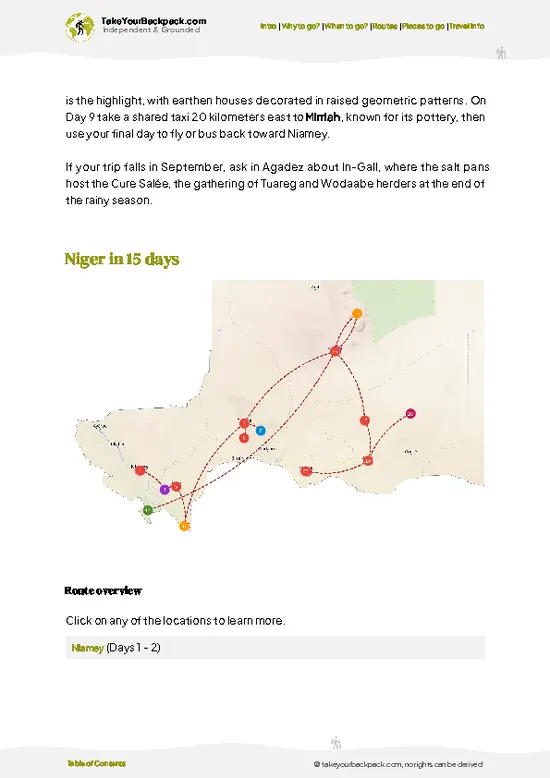
example page 3 from our offline Travel Guide for Niger
example page 4 from our offline Travel Guide for Niger
example page 5 from our offline Travel Guide for Niger
example page 6 from our offline Travel Guide for Niger
example page 7 from our offline Travel Guide for Niger
The digital guide (254 pages) contains:
✅ 57 highlights, ranked by travel appeal
✅ Optimized 5, 10 & 15-day travel routes
✅ Cities, national parks, landmarks, beaches
✅ How to get around
✅ Offline-friendly for travel without Wi-Fi
👉 Click to see all 30+ guide features

📅 Plan smarter in minutes, not weeks
✅ Month by month travel advice
✅ Festivals & national holidays
✅ Budget expectations

🗺️ Go to the right places, skip the overrated ones
✅ Honest pros & cons of destinations
✅ Top hikes, parks & viewpoints
✅ Lesser-known places most travelers miss
✅ Clear “worth it vs skip it” guidance

🛏️ Travel smoothly without rookie mistakes
✅ Best areas to stay
✅ Transport systems explained simply
✅ Common scams & safety advice
✅ SIM cards, money & practical tips

🌍 Understand the country, not just visit it
✅ Culture & traditions
✅ 52 Essential phrases & customs
✅ Festivals worth planning around
✅ Traveler-friendly historical context
✅ Insights that make places more meaningful

📱 Built for real travel conditions
✅ Fully downloadable PDF
✅ Works completely offline
✅ Optimized for phone use
✅ Useful in remote areas & buses
✅ Everything in one place
Stop searching, start planning
Get instant access to your full guide. 30‑day money-back guarantee.
+ Add another guide for just

By proceeding you agree to our terms.
Sent to your inbox immediately after payment • 100% Secure Checkout
Best Backpacking Travel Advisor 2025 tourism awardBest Backpacking
Travel Advisor
2025
What others say about Take Your Backpack Guides:
⭐⭐⭐⭐⭐
Fantastic, amazing amount of information!
⭐⭐⭐⭐⭐
My goodness this is amazing, it's what I've been looking for hats off too you!
⭐⭐⭐⭐⭐
I think this is absolutely BRILLIANT
⭐⭐⭐⭐
Very complete and informative. It's still missing places, but I gotta to commend you
⭐⭐⭐⭐⭐
This is truly amazing, thank you, can't wait to explore it with my kids!
⭐⭐⭐⭐⭐
Awesome resource, thank you!
⭐⭐⭐⭐⭐
This is amazing! Can't wait to explore the ones I haven't seen
⭐⭐⭐⭐
I love this! Well done, great idea.
⭐⭐⭐⭐⭐
Thanks for taking the time to make this gem!
⭐⭐⭐⭐⭐
This might be the best website I've ever seen.
⭐⭐⭐⭐⭐
Congratulations, and thank you so much for your work; it's incredibly valuable.
⭐⭐⭐⭐
In all seriousness I think you did a great job pointing out the important spots
⭐⭐⭐⭐⭐
10/10 very good
⭐⭐⭐⭐⭐
As someone who's only just starting to visit regularly this is awesome, thank you.
⭐⭐⭐⭐
Thank you very much! I'm going to visit my dad, it's going to be very useful!
⭐⭐⭐⭐⭐
This is really cool! We'll be travelling for the first time and this definitely come in handy.
⭐⭐⭐⭐⭐
You are now our minister of culture, congratulations 👨‍💼
⭐⭐⭐⭐⭐
Just wanted to tell you that this is a pearl! Going to follow your recommendations.
⭐⭐⭐⭐⭐
This is so cool. I'll definitely be using the resource for my travels soon.
⭐⭐⭐⭐⭐
This is very impressive! Good work.
⭐⭐⭐⭐⭐
This is an amazing and informative site. Very well done!

🛏️ Where to stay?Best Stay Options in Niger

Niger has no real hostel scene, so budget stays in Niamey mean simple guesthouses, auberges and church-run mission lodgings at roughly 10,000 to 25,000 CFA (US$17 to 42) a night, with air-conditioned rooms costing more. Plateau is the calmest and best-guarded district, close to embassies, banks and the Niger riverfront but quiet after dark, while the Centre-ville around the Grand Marché puts you near the markets, street food and evening maquis bars at the cost of noise, traffic and more petty theft. Residential Koira Kano and Yantala have villa-style guesthouses with gardens and a relaxed feel, though you will need taxis to reach most sights.

If you enjoy meeting fellow travelers, consider choosing … read more 👉
Niger has no real hostel scene, so budget stays in Niamey mean simple guesthouses, auberges and church-run mission lodgings at roughly 10,000 to 25,000 CFA (US$17 to 42) a night, with air-conditioned rooms costing more. Plateau is the calmest and best-guarded district, close to embassies, banks and the Niger riverfront but quiet after dark, while the Centre-ville around the Grand Marché puts you near the markets, street food and evening maquis bars at the cost of noise, traffic and more petty theft. Residential Koira Kano and Yantala have villa-style guesthouses with gardens and a relaxed feel, though you will need taxis to reach most sights.

If you enjoy meeting fellow travelers, consider choosing hostels with high ratings for atmosphere. On the other hand, if you prefer having your own space, a hotel might be a better option.

NigerWhere to Go Next

👋 Meet the founderWho’s Behind Take Your Backpack?

Johan, backpacker and founder of TakeYourBackpackHi, I’m Johan (Netherlands 🇳🇱), the creator of TakeYourBackpack. Over the past 3 decades, I’ve backpacked through 90+ countries across six continents, gaining extensive experience with independent travel, long-term trips, and overland routes.

This site is built on a combination of firsthand travel experience and carefully curated insights from other backpackers. Many guides are based on places I’ve personally visited, while others bring together tips, observations, and practical advice shared by trusted travelers I’ve met along the way.

The goal is to provide realistic, experience-driven guidance — not generic itineraries — so you can explore destinations with better context, clearer expectations, and more confidence.