×

Niger🇳🇪 | townsTimiaPalm gardens, ruined hilltop village, Aïr gorge, citrus shade | things to do and best time to go

Explore TessaouaExplore Dallol Bosso

Backpacking in Timia
🏆 Top picktown ranked #1
By Johan Kruseman 🇳🇱 | Updated October 22, 2026

Timia is famous for its gardens: lemon, orange, pomegranate and fig trees and date palms packed into a green strip fed by spring water, set against bare rock. It sits in the Aïr Mountains in the north of Niger, northeast of Agadez. Streets are sandy lanes between mud-brick walls, and a ten-minute stroll puts you under fruit trees where the temperature drops noticeably, which is the best thing the place offers. A ruined old village sits on the rock above, and the climb gives you the whole oasis laid out in green. Don’t expect cafés, nightlife or a hostel scene. Evenings are quiet, tea with locals is the social life, and you meet other travelers mostly through guides and shared vehicles. Reaching it takes real effort, which keeps it unhurried. Compared with Iferouane, which is the larger jumping-off point for the Tamgak peaks, Timia is smaller, greener and better for slow walking.

Discover everything you want to know in the 📖 Niger Travel Guide.
Safety warning

The current risk level for Niger is high. Check the advice before going.


example page 0 from our offline Travel Guide for Niger
example page 1 from our offline Travel Guide for Niger
example page 2 from our offline Travel Guide for Niger
example page 3 from our offline Travel Guide for Niger
example page 4 from our offline Travel Guide for Niger
example page 5 from our offline Travel Guide for Niger
example page 6 from our offline Travel Guide for Niger
example page 7 from our offline Travel Guide for Niger
Loading the map 🌍
CLICK TO FILTER
cities
towns
villages
landmarks
national parks
hikes
attractions
festivals
regions
SHOW COUNTRY’S BESTSHOW ALL

✨ Why go?
Ranked #1 town in Niger
What makes this town worth visiting

Timia works for the traveler who wants an Aïr oasis at walking pace rather than a checklist. The draw is the contrast: a palm and fruit garden belt running through a landscape of black granite and sand, with channels of spring water you can follow on foot. Add the ruined old village on its rock, where fallen mud-brick houses and a quiet viewpoint reward a short climb, and you have the two reasons to come. Most people stay one to three nights. Beyond that, the place suits those who like to sit, talk and wander, with Tuareg hosts, simple guesthouse-style stays and tea poured slowly. Hikers get a base for gorge walks and, when the water runs, a visit to the seasonal waterfall. Solo travelers will find it welcoming but quiet, so bring a book and patience. If you need nightlife, markets on every … read more 👉
Timia works for the traveler who wants an Aïr oasis at walking pace rather than a checklist. The draw is the contrast: a palm and fruit garden belt running through a landscape of black granite and sand, with channels of spring water you can follow on foot. Add the ruined old village on its rock, where fallen mud-brick houses and a quiet viewpoint reward a short climb, and you have the two reasons to come. Most people stay one to three nights. Beyond that, the place suits those who like to sit, talk and wander, with Tuareg hosts, simple guesthouse-style stays and tea poured slowly. Hikers get a base for gorge walks and, when the water runs, a visit to the seasonal waterfall. Solo travelers will find it welcoming but quiet, so bring a book and patience. If you need nightlife, markets on every corner or fast connections, treat it as a short stop at most.

💡 HighlightsKey sights and experiences for travelers

  1. Old village ruins: The abandoned mud-brick quarter climbs a rocky rise above the oasis. Walk through broken lanes and roofless rooms, then stand on the top for the best view of the green belt below. Go in the morning when the stone is still cool. Allow 1 to 2 hours; a local guide to show the way costs about €3 to 6.
  2. Timia gardens: The palmeraie is the town’s signature: orange, lemon, pomegranate and fig trees, grapevines and date palms watered by hand-dug channels. Wander the shaded paths and watch gardeners work the plots. Late afternoon is cooler and busier with people. Plan on 1 to 2 hours; a small tip of €1 to 3 to the garden owner or guide is customary.
  3. Timia waterfall and gorge: A short walk from the village leads into a rocky gorge where, in good seasons, water drops into a pool in the
… read more 👉
  1. Old village ruins: The abandoned mud-brick quarter climbs a rocky rise above the oasis. Walk through broken lanes and roofless rooms, then stand on the top for the best view of the green belt below. Go in the morning when the stone is still cool. Allow 1 to 2 hours; a local guide to show the way costs about €3 to 6.
  2. Timia gardens: The palmeraie is the town’s signature: orange, lemon, pomegranate and fig trees, grapevines and date palms watered by hand-dug channels. Wander the shaded paths and watch gardeners work the plots. Late afternoon is cooler and busier with people. Plan on 1 to 2 hours; a small tip of €1 to 3 to the garden owner or guide is customary.
  3. Timia waterfall and gorge: A short walk from the village leads into a rocky gorge where, in good seasons, water drops into a pool in the stone. Water levels vary, so ask locally before you set out. Go early to have it to yourself. Count on 2 to 3 hours round trip with a guide at roughly €5 to 10.
  4. Viewpoint over the oasis: A rocky ledge near the old village gives an unobstructed look at the palm belt, the village roofs and the surrounding Aïr ridges. It costs nothing and makes a calm sunset spot. Give it 30 to 45 minutes.
From Timia, day trips and short excursions reach Iferouane, the Tamgak massif and parts of the Aïr and Ténéré Nature Reserve. The viewpoint over the oasis costs nothing at all, and the gardens come next with only a small tip.
Spotted a mistake or missing something? Contact us.

Things to do near Timia

Ratings based on Tripadvisor reviews. When you book through this link, you support our work at no extra cost to you.

🏘️ NeighborhoodsKey areas and districts to know

Timia is small enough to cover on foot in a morning, so the real choice is how you split your time between five areas.
  • The Gardens: A maze of mud-walled plots along the wadi, packed with date palms, lemon and orange trees, pomegranates, grapes and vegetable beds, watered through hand-dug channels. Paths are sandy, shaded and flat. Go here first and take your time; you leave with a pocket of fresh fruit and the sound of running water in a desert range.
  • The Old Kasbah: Crumbling mud-brick walls on a rocky rise above the oasis, once the seat of local Tuareg power. There is little left to read, no signs and no ticket booth, so a local to point things out helps. The ten-minute scramble up earns a view over the green belt and the dark Aïr ridges behind it.
  • The Village Center: A few sandy lanes around
… read more 👉
Timia is small enough to cover on foot in a morning, so the real choice is how you split your time between five areas.
  • The Gardens: A maze of mud-walled plots along the wadi, packed with date palms, lemon and orange trees, pomegranates, grapes and vegetable beds, watered through hand-dug channels. Paths are sandy, shaded and flat. Go here first and take your time; you leave with a pocket of fresh fruit and the sound of running water in a desert range.
  • The Old Kasbah: Crumbling mud-brick walls on a rocky rise above the oasis, once the seat of local Tuareg power. There is little left to read, no signs and no ticket booth, so a local to point things out helps. The ten-minute scramble up earns a view over the green belt and the dark Aïr ridges behind it.
  • The Village Center: A few sandy lanes around the main square, with small shops selling tea, sugar, millet, canned sardines and batteries. Evenings are quiet, with no bars and no nightlife to speak of. It is worth your time for a glass of sweet Tuareg tea and a plate of rice or spaghetti with goat, and nothing more.
  • The Waterfall Approach: The gorge and path leading out of the oasis toward the falls, about an hour or less on foot. It is rocky underfoot, so bring real shoes. After rains you get a cool pool and a drop of water splashing over red stone; in dry months, skip it and spend the time in the gardens.
  • The Outskirts and Camps: Scattered Tuareg tents and herders’ settlements on the plain around the village. They are not sights as such, and visiting without a host feels intrusive. Walk out at dusk with a guide for the long light on the cliffs and a quiet sit among the goats.

⌛️ 1 daySeeing the highlights in 24 hours

The day runs on foot, with an early start for the climbs and a long break through the afternoon heat under the garden trees.
7:00 AM, Old village ruins: Start while the rock is cool and light is soft. Climb through the ruined lanes with a local guide, who knows which routes are stable. The viewpoint at the top shows you the oasis layout, which helps you plan the rest of the day.
9:30 AM, Gardens: Walk down into the palmeraie. Follow the water channels past orange, lemon and pomegranate trees and watch how plots are flooded in turn. Gardeners are usually happy to explain what grows and when. It is the best place to understand why people settled here.
11:30 AM, Tea in the village: Settle in for tea at a family compound or guesthouse. Tuareg tea comes in rounds, each stronger and sweeter than the … read more 👉
The day runs on foot, with an early start for the climbs and a long break through the afternoon heat under the garden trees.
7:00 AM, Old village ruins: Start while the rock is cool and light is soft. Climb through the ruined lanes with a local guide, who knows which routes are stable. The viewpoint at the top shows you the oasis layout, which helps you plan the rest of the day.
9:30 AM, Gardens: Walk down into the palmeraie. Follow the water channels past orange, lemon and pomegranate trees and watch how plots are flooded in turn. Gardeners are usually happy to explain what grows and when. It is the best place to understand why people settled here.
11:30 AM, Tea in the village: Settle in for tea at a family compound or guesthouse. Tuareg tea comes in rounds, each stronger and sweeter than the last, and accepting all three is part of the exchange. This is also when you sort out lunch.
1:00 PM, Rest in the shade: The middle of the day is too hot for walking. Stay under the trees or inside thick mud walls, read, write, or nap.
3:30 PM, Waterfall gorge: Head out with a guide on the easy walk into the gorge. Whether water is flowing or only pooled, the rock walls and quiet make this the day’s most unusual stop, and few people go beyond the village itself.
6:00 PM, Oasis viewpoint: Return to the ledge near the old village as the heat eases. Watch the palms darken and village smoke rise, then walk back as the lanes fill with evening talk.

🌤️ When to go?Choosing the right time of year

Timia is most comfortable from November to February, when days hover around 25 to 30°C (77 to 86°F) and nights drop to 8 to 13°C (46 to 55°F).
  • Cool Season (November to February): Clear skies, walkable days and cold nights that call for a real blanket. Daylight runs roughly 11 hours. Guides and pickups are busiest, so expect higher prices and book ahead.
  • Hot Season (March to June): Highs reach 36 to 42°C (97 to 108°F) by midday. Hiking is only realistic at dawn and dusk. Dust-laden winds can cut visibility, but rates for guides and rooms soften.
  • Rainy Season (July to September): Short, sharp storms bring the waterfall to life and green up the gardens, with highs around 34 to 38°C (93 to 100°F). Tracks from Agadez can wash out, so allow slack in your schedule.
  • Festival Time: Tuareg gatherings in
… read more 👉
Timia is most comfortable from November to February, when days hover around 25 to 30°C (77 to 86°F) and nights drop to 8 to 13°C (46 to 55°F).
  • Cool Season (November to February): Clear skies, walkable days and cold nights that call for a real blanket. Daylight runs roughly 11 hours. Guides and pickups are busiest, so expect higher prices and book ahead.
  • Hot Season (March to June): Highs reach 36 to 42°C (97 to 108°F) by midday. Hiking is only realistic at dawn and dusk. Dust-laden winds can cut visibility, but rates for guides and rooms soften.
  • Rainy Season (July to September): Short, sharp storms bring the waterfall to life and green up the gardens, with highs around 34 to 38°C (93 to 100°F). Tracks from Agadez can wash out, so allow slack in your schedule.
  • Festival Time: Tuareg gatherings in the Aïr cluster in the cooler months and swell demand for transport.
Schedule the waterfall walk for the weeks right after the rains, in the first part of the cool season, when water still flows and temperatures are mild.


source: climatestotravel.comJANJanuary: excellent for travelingFEBFebruary: excellent for travelingMARMarch: highly recommended for travelingAPRApril: highly recommended for travelingMAYMay: fair for travelingJUNJune: below average for travelingJULJuly: below average for travelingAUGAugust: below average for travelingSEPSeptember: fair for travelingOCTOctober: excellent for travelingNOVNovember: excellent for travelingDECDecember: excellent for traveling
when-to-go

✈️ The backpacker research shortcutNiger Travel Guide

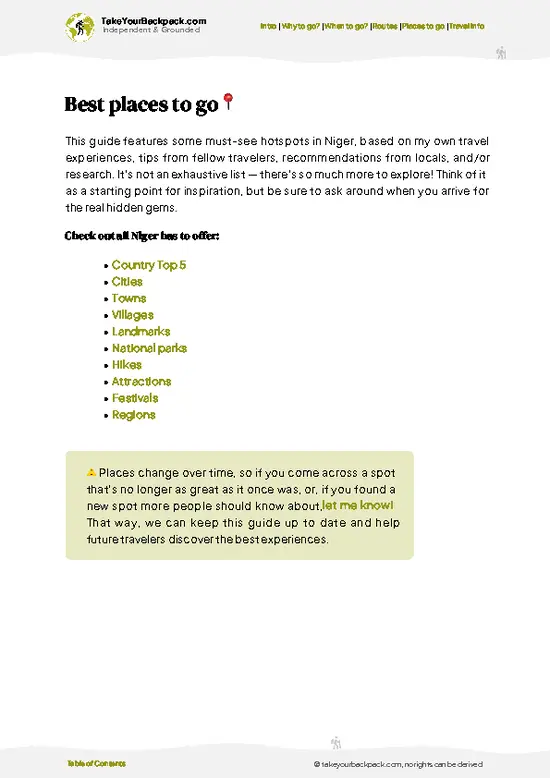
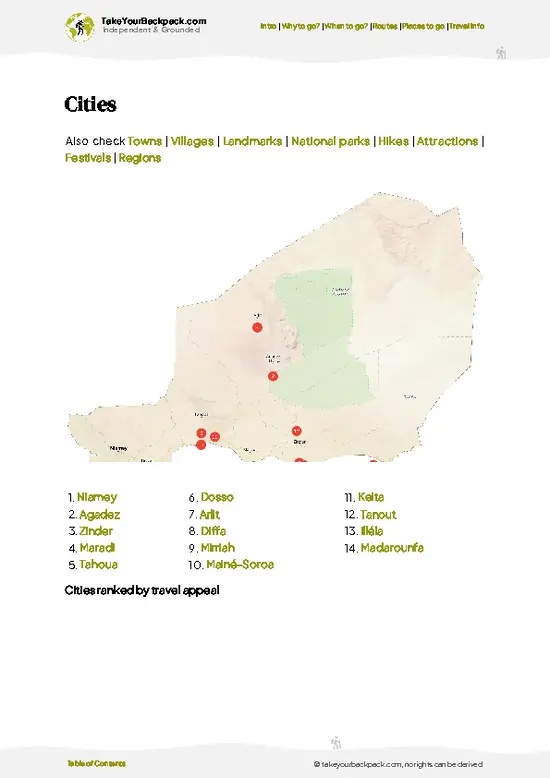
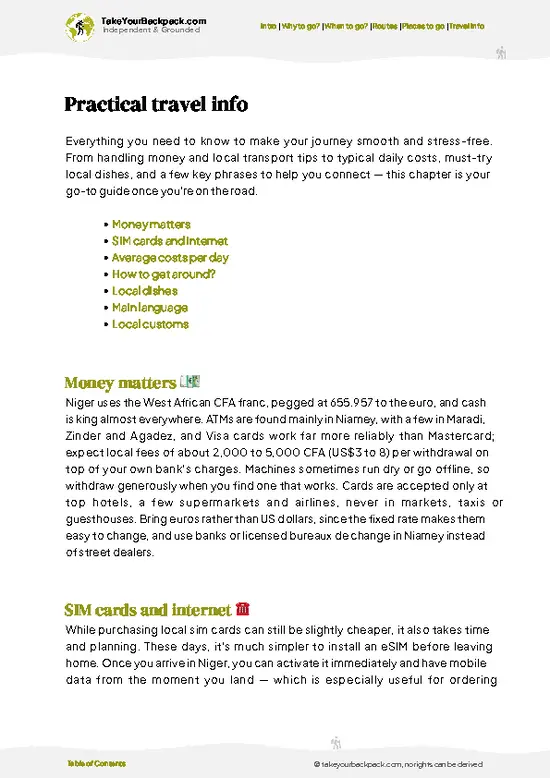
An offline-friendly backpacking guide with optimized travel routes, ranked highlights, transport advice, and the best areas to stay.
example page 0 from our offline Travel Guide for Niger
example page 1 from our offline Travel Guide for Niger
example page 2 from our offline Travel Guide for Niger
example page 3 from our offline Travel Guide for Niger
example page 4 from our offline Travel Guide for Niger
example page 5 from our offline Travel Guide for Niger
example page 6 from our offline Travel Guide for Niger
example page 7 from our offline Travel Guide for Niger
The digital guide (254 pages) contains:
✅ 57 highlights, ranked by travel appeal
✅ Optimized 5, 10 & 15-day travel routes
✅ Cities, national parks, landmarks, beaches
✅ How to get around
✅ Offline-friendly for travel without Wi-Fi
👉 Click to see all 30+ guide features

📅 Plan smarter in minutes, not weeks
✅ Month by month travel advice
✅ Festivals & national holidays
✅ Budget expectations

🗺️ Go to the right places, skip the overrated ones
✅ Honest pros & cons of destinations
✅ Top hikes, parks & viewpoints
✅ Lesser-known places most travelers miss
✅ Clear “worth it vs skip it” guidance

🛏️ Travel smoothly without rookie mistakes
✅ Best areas to stay
✅ Transport systems explained simply
✅ Common scams & safety advice
✅ SIM cards, money & practical tips

🌍 Understand the country, not just visit it
✅ Culture & traditions
✅ 52 Essential phrases & customs
✅ Festivals worth planning around
✅ Traveler-friendly historical context
✅ Insights that make places more meaningful

📱 Built for real travel conditions
✅ Fully downloadable PDF
✅ Works completely offline
✅ Optimized for phone use
✅ Useful in remote areas & buses
✅ Everything in one place
Stop searching, start planning
Get instant access to your full guide. 30‑day money-back guarantee.
+ Add another guide for just

By proceeding you agree to our terms.
Sent to your inbox immediately after payment • 100% Secure Checkout
Best Backpacking Travel Advisor 2025 tourism awardBest Backpacking
Travel Advisor
2025
What others say about Take Your Backpack Guides:
⭐⭐⭐⭐⭐
Fantastic, amazing amount of information!
⭐⭐⭐⭐⭐
My goodness this is amazing, it's what I've been looking for hats off too you!
⭐⭐⭐⭐⭐
I think this is absolutely BRILLIANT
⭐⭐⭐⭐
Very complete and informative. It's still missing places, but I gotta to commend you
⭐⭐⭐⭐⭐
This is truly amazing, thank you, can't wait to explore it with my kids!
⭐⭐⭐⭐⭐
Awesome resource, thank you!
⭐⭐⭐⭐⭐
This is amazing! Can't wait to explore the ones I haven't seen
⭐⭐⭐⭐
I love this! Well done, great idea.
⭐⭐⭐⭐⭐
Thanks for taking the time to make this gem!
⭐⭐⭐⭐⭐
This might be the best website I've ever seen.
⭐⭐⭐⭐⭐
Congratulations, and thank you so much for your work; it's incredibly valuable.
⭐⭐⭐⭐
In all seriousness I think you did a great job pointing out the important spots
⭐⭐⭐⭐⭐
10/10 very good
⭐⭐⭐⭐⭐
As someone who's only just starting to visit regularly this is awesome, thank you.
⭐⭐⭐⭐
Thank you very much! I'm going to visit my dad, it's going to be very useful!
⭐⭐⭐⭐⭐
This is really cool! We'll be travelling for the first time and this definitely come in handy.
⭐⭐⭐⭐⭐
You are now our minister of culture, congratulations 👨‍💼
⭐⭐⭐⭐⭐
Just wanted to tell you that this is a pearl! Going to follow your recommendations.
⭐⭐⭐⭐⭐
This is so cool. I'll definitely be using the resource for my travels soon.
⭐⭐⭐⭐⭐
This is very impressive! Good work.
⭐⭐⭐⭐⭐
This is an amazing and informative site. Very well done!

🛏️ Where to stay?Choosing the right base

Timia has very few places to sleep, and the best budget option is a simple room or a bed in a family-run auberge near the village center. Expect €4 to 8 for a basic room with a mattress, shared toilet and a bucket shower, and sometimes a bed on a rooftop or in a courtyard for less. Rooms are scarce in the cool season, so arrive before dark and ask for a place early.

The village center suits most travelers because the shop, the tea stalls and the track out of town are within a short walk. Nights are quiet, with no bars and almost no traffic, so the main noise is roosters and the morning call to … read more 👉
Timia has very few places to sleep, and the best budget option is a simple room or a bed in a family-run auberge near the village center. Expect €4 to 8 for a basic room with a mattress, shared toilet and a bucket shower, and sometimes a bed on a rooftop or in a courtyard for less. Rooms are scarce in the cool season, so arrive before dark and ask for a place early.

The village center suits most travelers because the shop, the tea stalls and the track out of town are within a short walk. Nights are quiet, with no bars and almost no traffic, so the main noise is roosters and the morning call to prayer. Solo travelers will find it safe in the sense of petty theft, and hosts usually keep an eye on guests. Power runs on generators or solar and may cut out, so carry a headlamp and charge devices when you can.

The second option is a campsite or a tent on the edge of the gardens, which many guides arrange for about €3 to 6 per person. You bring a sleeping bag, because desert nights in winter fall to near 8°C (46°F), and you get silence, a sky packed with stars and the smell of wood smoke. There is no running water, so carry your own supply. Transport links are limited either way: pickups gather near the village center, so staying there makes a dawn departure easier to catch.

🚌 Getting aroundGetting around like a local

Timia has no taxis or buses, and a motorcycle ride across the village runs about €0.50 to 1, paid in cash CFA francs, agreed before you climb on. The village itself is tiny and sandy, and the real transport question is how you reach it. Pavement ends well before you do, the roads are gravel and sand track, and nothing runs on a posted timetable.
  • Walking: Everything inside the oasis is within 20 minutes on foot, including the gardens and the kasbah hill. It costs nothing and puts you at eye level with the palm shade, the irrigation channels and the people working them. Carry water, because there is no shade between the village and the gorge.
  • Motorcycle taxi: Locals use motorbikes for short hops and the ride to the waterfall trailhead, usually €1 to 3 one way depending on distance and bargaining.
… read more 👉
Timia has no taxis or buses, and a motorcycle ride across the village runs about €0.50 to 1, paid in cash CFA francs, agreed before you climb on. The village itself is tiny and sandy, and the real transport question is how you reach it. Pavement ends well before you do, the roads are gravel and sand track, and nothing runs on a posted timetable.
  • Walking: Everything inside the oasis is within 20 minutes on foot, including the gardens and the kasbah hill. It costs nothing and puts you at eye level with the palm shade, the irrigation channels and the people working them. Carry water, because there is no shade between the village and the gorge.
  • Motorcycle taxi: Locals use motorbikes for short hops and the ride to the waterfall trailhead, usually €1 to 3 one way depending on distance and bargaining. Bikes are quick but the sand is deep, so keep your bag strapped and your feet tucked. It saves your legs for the hike itself.
  • Shared pickup from Agadez: Overloaded Toyota pickups and trucks run irregularly along the track north through the Aïr, roughly 8 to 12 hours, often longer after rain. Expect €15 to 25 for a spot in the back, with sacks of grain and goats for company. Departure is when the vehicle fills, usually at dawn. You get a long, bone-shaking, spectacular view of granite ridges and dry wadis.
  • Chartered 4x4 with driver: The practical option for most visitors, around €100 to 160 per day plus fuel, and the only way to reach Elmeki or Iferouane in a day. Split it between four people and it becomes sensible. You choose the stops and the timing.
  • Camel or donkey: Local herders can arrange them for gentle outings around the oasis for about €5 to 15 per day. It is slow and good for a taste of Tuareg travel, but not worth it for covering distance.
Fuel is scarce and priced at a premium, so confirm the cost of fuel and the return leg before you leave. Waiting for a pickup costs more patience than money, and mornings are your best bet for finding one heading out.

👛 Costs (as of 22 October 2026)What things cost and how to budget

Timia costs roughly €18 to 35 per day for a backpacker, and most of that goes on guides and transport rather than beds or food.
CategoryBudget RangeLocal Reality
Dorm accommodation€4 to 8No dorms exist. A mattress in a simple room or a spot in a courtyard or campsite is the standard, with shared toilets.
Meals€3 to 6Rice or spaghetti with goat, bread, eggs, tea and fruit from the gardens. Choices are limited and simple.
Local transport€0.50 to 2Motorcycle hops around the village and to the waterfall trailhead. Paid in cash CFA francs.
Basic activities and entry fees€8 to 15A local guide for the gorge, gardens and kasbah, usually negotiated per outing. Vehicle hire for farther trips is extra.
Miscellaneous€2 to 4Bottled water, snacks, phone credit and small tips for hosts.
Total Daily Budget€18 to
… read more 👉
Timia costs roughly €18 to 35 per day for a backpacker, and most of that goes on guides and transport rather than beds or food.
CategoryBudget RangeLocal Reality
Dorm accommodation€4 to 8No dorms exist. A mattress in a simple room or a spot in a courtyard or campsite is the standard, with shared toilets.
Meals€3 to 6Rice or spaghetti with goat, bread, eggs, tea and fruit from the gardens. Choices are limited and simple.
Local transport€0.50 to 2Motorcycle hops around the village and to the waterfall trailhead. Paid in cash CFA francs.
Basic activities and entry fees€8 to 15A local guide for the gorge, gardens and kasbah, usually negotiated per outing. Vehicle hire for farther trips is extra.
Miscellaneous€2 to 4Bottled water, snacks, phone credit and small tips for hosts.
Total Daily Budget€18 to 35Higher if you hire a 4x4 for a day trip, which can add €100 to 160 split among the group.
Bring small notes and agree on every price before you start, since change is hard to find. To save money, share a vehicle and guide with other travelers and buy fruit and bread directly from the gardens and the morning stalls.
⚠️ Prices can change and everyone travels differently, so take this as a rough guide. Hope it helps you plan your adventure!

🚌 Day tripsBest day trips from Timia

Timia works well as a base for short outings, but anything beyond the oasis needs a guide or a hired vehicle, so plan on sharing costs.
Timia Waterfall and Gorge:
A walk of about an hour from the village leads into a rocky gorge with a small fall and a pool at the bottom. The flow is strongest after the rains and into early winter, and nearly gone by spring. Budget €5 to 10 for a local guide, and carry more water than you think you need. First-timers often go at midday, when the walls reflect heat; leave early instead.

Elmeki:
A smaller oasis reached by 4x4 track across the plain and through wadis, roughly 2 to 3 hours each way depending on conditions. It has palms, a handful of houses and a sense of being far from anywhere, which is the reward. Most people hire a vehicle for the day, about … read more 👉
Timia works well as a base for short outings, but anything beyond the oasis needs a guide or a hired vehicle, so plan on sharing costs.
Timia Waterfall and Gorge:
A walk of about an hour from the village leads into a rocky gorge with a small fall and a pool at the bottom. The flow is strongest after the rains and into early winter, and nearly gone by spring. Budget €5 to 10 for a local guide, and carry more water than you think you need. First-timers often go at midday, when the walls reflect heat; leave early instead.

Elmeki:
A smaller oasis reached by 4x4 track across the plain and through wadis, roughly 2 to 3 hours each way depending on conditions. It has palms, a handful of houses and a sense of being far from anywhere, which is the reward. Most people hire a vehicle for the day, about €100 to 160, so splitting costs matters. The cool season is the only comfortable window, and you should leave at first light to be back before dark.

Iferouane and the Tamgak Foothills:
The road north to Iferouane crosses open desert and rough terrain toward the dark Tamgak peaks, about 3 to 4 hours each way. It makes a long day with a driver-guide, and it costs about the same as a regular charter, around €100 to 160 plus fuel. The reward is a view of the highest massif in the Aïr and a glimpse of a town built around Tuareg trade. Do not try it by public pickup, because you may not find a way back the same day.

🛡️ SafetyTraveler Safety Guide

Timia sits in a remote part of the Aïr where official advisories from many governments warn against travel, so check current guidance and local conditions with your guide or host before you go. Petty crime inside the village is rare, and the typical annoyances are persistent offers for guiding, camel rides and souvenirs, which a polite no settles. Settle prices for guides, vehicles and fuel in advance and agree the return plan in writing or in front of a witness. Travel with a local guide who knows the tracks, and do not walk long distances alone in the desert, where heat, sandstorms and the absence of phone signal are the actual hazards. Carry plenty of water, cash in small CFA franc notes, and a basic medical kit. Dress modestly, ask before photographing people, and avoid wandering at night, … read more 👉
Timia sits in a remote part of the Aïr where official advisories from many governments warn against travel, so check current guidance and local conditions with your guide or host before you go. Petty crime inside the village is rare, and the typical annoyances are persistent offers for guiding, camel rides and souvenirs, which a polite no settles. Settle prices for guides, vehicles and fuel in advance and agree the return plan in writing or in front of a witness. Travel with a local guide who knows the tracks, and do not walk long distances alone in the desert, where heat, sandstorms and the absence of phone signal are the actual hazards. Carry plenty of water, cash in small CFA franc notes, and a basic medical kit. Dress modestly, ask before photographing people, and avoid wandering at night, when the village is dark and the paths are uneven. Women traveling alone will get more attention than men, and a trusted host helps.

FAQFrequently asked questions about Timia

Timia is worth visiting rather than treating as a stopover, if you have the time and a guide, because its palm gardens, kasbah ruins and waterfall make a compact destination in the Aïr Mountains. The track from Agadez takes 8 to 12 hours each way, so nobody passes through by accident. Rooms cost about €4 to 8, and most of your spending goes on guides at roughly €8 to 15 a day.
Timia needs two to three days on the ground: one for the gardens and the kasbah, one for the waterfall gorge and a half day to rest or walk. Add a day if you want a hired 4x4 to Elmeki or toward Iferouane, which costs about €100 to 160 for the vehicle. Allow extra days for the long track from Agadez, which can stretch past 12 hours after rain.
Timia cannot be done as a day trip from Agadez, since the track takes 8 to 12 hours each way by pickup or 4x4. A round trip in one day would leave no time on the ground and would be tiring. Plan at least two nights in the village, and budget €15 to 25 for a shared pickup seat or €100 to 160 for a chartered vehicle.
⚠️ Things can change over time, so always validate details locally before you go.

Other Nigerien towns near Timia

Explore more nearby:

  • Bilma—Salt pans, Kawar oasis, caravan end point, old fort| 441 km away
  • Gouré—Highway stop, livestock trading, roadside tea, Zinder Region| 486 km away
  • Tessaoua—Sarki’s palace, Hausa quarter, camel and cattle market, Zinder road| 492 km away

💡 Not sure where to go next?
Create a personalized itinerary for Niger including Timia and the places that fit your trip.

Generate my itinerary

👉 Discover all towns

Or checkout all Niger has to offer (think cities, towns, villages, national parks, hikes, beaches, festivals)
Country photo of Niger

We 💚 feedbackWhat to keep in mind

Timia gets treated as a drive-through, and that is the mistake: travelers arrive, glance at the gardens and push on. Give it at least one night, hire a local guide for the old village and the gorge, and slow down. Bring small bills, a hat and plenty of water, and skip rushing the tea.

✍️ Help improve this page!
The information on this page is based on in-depth research, insights shared by experienced travelers, and feedback from the local travel community in Niger. While every effort is made to keep the information accurate and current, conditions can change — so if you spot anything incorrect or outdated, please get in touch.


🙋‍♂️ Give feedback

👋 Meet the founderWho’s Behind Take Your Backpack?

Johan, backpacker and founder of TakeYourBackpackHi, I’m Johan (Netherlands 🇳🇱), the creator of TakeYourBackpack. Over the past 3 decades, I’ve backpacked through 90+ countries across six continents, gaining extensive experience with independent travel, long-term trips, and overland routes.

This site is built on a combination of firsthand travel experience and carefully curated insights from other backpackers. Many guides are based on places I’ve personally visited, while others bring together tips, observations, and practical advice shared by trusted travelers I’ve met along the way.

The goal is to provide realistic, experience-driven guidance — not generic itineraries — so you can explore destinations with better context, clearer expectations, and more confidence.