×

Niger🇳🇪 | best townsThe Must-See 9 towns in Niger

Towns in Niger are working Sahel and Saharan settlements, not resort stops. Expect mud-brick quarters, dusty markets, heat and very few other foreigners. The southwest river valley is the easiest region, with the most hotels, paved roads and cash machines. The central Hausa belt along the Nigerian border is cheaper and busier with traders. The Saharan north is the most atmospheric and the most restricted, with Tuareg culture and limited, costly movement. Independent travel here means planning around official advisories, permits and long road hours. Skip any town that needs an armed escort just to reach it.

By Johan Kruseman 🇳🇱 | Updated October 18, 2026
Explore the best villages in Niger

Why go?Why These town Stand Out

Niger suits towns because the country is organized around them. Almost all of the roughly 25 million people live in a southern strip along the river and the Nigerian border, while the Sahara covers most of the land. Settlements grew where water, caravan routes and markets met, so old trading quarters, sultanate compounds and Sudano-Sahelian mud architecture survive in everyday use. Nothing is staged for visitors.

That same history limits what you can do. Infrastructure is thin: one main paved east-west road, long gaps between cities, power cuts in the hot season, and card payments that rarely work. Tourism has collapsed since the 2010s, so guides, hotels and permit offices are few and rely on personal contacts.

Before choosing Niger, accept that security decides everything. Many governments … read more 👉
Niger suits towns because the country is organized around them. Almost all of the roughly 25 million people live in a southern strip along the river and the Nigerian border, while the Sahara covers most of the land. Settlements grew where water, caravan routes and markets met, so old trading quarters, sultanate compounds and Sudano-Sahelian mud architecture survive in everyday use. Nothing is staged for visitors.

That same history limits what you can do. Infrastructure is thin: one main paved east-west road, long gaps between cities, power cuts in the hot season, and card payments that rarely work. Tourism has collapsed since the 2010s, so guides, hotels and permit offices are few and rely on personal contacts.

Before choosing Niger, accept that security decides everything. Many governments advise against travel to large parts of the country, especially the Tillabéri and Diffa regions, border zones, and the roads north of Agadez. Coup-related border and flight changes since 2023 have also complicated entry. If you want easy, flexible wandering between dozens of towns, Senegal or Ghana give far better value. If you want rare, working Sahelian urban life and accept strict limits, Niger offers something few countries can.
How the List Was Created
The list of best towns in Niger is created based on charm, local culture, atmosphere, hidden gems, and visitor appeal. If you feel a town is missing in this list, please let us know.

When to go?Best Time to Visit Niger for towns

Best months: The best months for Niger’s towns are November to February, when daytime highs sit around 30 to 35°C and nights drop to 14 to 20°C, with no rain.
The cool season has a cost: Harmattan dust from December to February turns the sky hazy and irritates the throat, and in the north nights can fall close to 5 to 10°C in the desert around Agadez. Pack a fleece and a scarf.
Shoulder and hot season: March to May is the worst window for walking around. Temperatures reach 40 to 45°C, and in the river valley and Hausa belt the heat peaks just before the rains. Plan for early starts and a long midday break. Anything outside November to February needs a good reason.
Rainy season: June to September brings the rains, heaviest in July and August, mostly in the south. Niamey gets roughly 500 to 600 … read more 👉
Best months: The best months for Niger’s towns are November to February, when daytime highs sit around 30 to 35°C and nights drop to 14 to 20°C, with no rain.
The cool season has a cost: Harmattan dust from December to February turns the sky hazy and irritates the throat, and in the north nights can fall close to 5 to 10°C in the desert around Agadez. Pack a fleece and a scarf.
Shoulder and hot season: March to May is the worst window for walking around. Temperatures reach 40 to 45°C, and in the river valley and Hausa belt the heat peaks just before the rains. Plan for early starts and a long midday break. Anything outside November to February needs a good reason.
Rainy season: June to September brings the rains, heaviest in July and August, mostly in the south. Niamey gets roughly 500 to 600 mm a year, while Agadez receives well under 200 mm. Storms flood unpaved tracks and slow buses, and the south turns humid and green, with malaria risk at its highest. September and October are workable if you need cheaper rooms and can accept delays.
Prices and crowds: Crowds are never an issue, and prices barely move with season. Eid and Ramadan matter more: transport fills before Eid, and daytime restaurants close during Ramadan.

town hoppingPlanning Your Route Efficiently

How long to allow: A trip linking several towns in Niger needs 10 to 14 days, because the distances are huge and every transfer eats most of a day.
The logical grouping runs west to east along the southern belt: start in the Niamey area, move through the central Hausa cities, then loop north to Agadez only if the situation allows it. Niamey to Zinder is roughly 900 km and takes 12 to 15 hours by bus. Niamey to Agadez is around 950 km and takes 12 to 14 hours. Agadez to Zinder is about 450 km, 7 to 9 hours. Niamey is the main transport hub and the best place to arrange permits and onward tickets.
Time per stop: Give each town two nights. One night means you arrive tired, spend a day on logistics and leave before seeing a market. More than three nights rarely pays off, because there are few formal … read more 👉
How long to allow: A trip linking several towns in Niger needs 10 to 14 days, because the distances are huge and every transfer eats most of a day.
The logical grouping runs west to east along the southern belt: start in the Niamey area, move through the central Hausa cities, then loop north to Agadez only if the situation allows it. Niamey to Zinder is roughly 900 km and takes 12 to 15 hours by bus. Niamey to Agadez is around 950 km and takes 12 to 14 hours. Agadez to Zinder is about 450 km, 7 to 9 hours. Niamey is the main transport hub and the best place to arrange permits and onward tickets.
Time per stop: Give each town two nights. One night means you arrive tired, spend a day on logistics and leave before seeing a market. More than three nights rarely pays off, because there are few formal sights.
Mistakes to avoid: The first error is squeezing in too many towns. Three bases is realistic, and four needs the full two weeks. The second is traveling after dark: buses sometimes depart at dawn and drivers push on late, so pick morning departures and arrive before dusk. The third is planning rigid connections. Buses leave when full, breakdowns are normal and rain delays everything, so leave one spare day before any flight home. Finally, do not backtrack across the whole country. Choose a one-way line and fly or bus out from the far end.

The ListMust-Visit towns in Niger

1 Timia

oasis gardens, volcanic hills, seasonal waterfalls

Hike through volcanic landscapes and discover lush gardens, where seasonal waterfalls and fruit groves offer a rare Saharan contrast.

2 Bilma

salt caravans, palm groves, oasis wells

Follow the route of salt caravans to a palm-shaded oasis, where ancient wells sustain life at the edge of the desert.

3 N’Guigmi

Lake Chad basin, nomadic encampments, fishing villages

Venture to the edge of Lake Chad, where nomads and fishing communities coexist in a landscape shaped by shifting water levels.

4 Gaya

river crossing, border trade, humid farmlands

Cross the Niger River into a region shaped by trade and agriculture, with a humid climate distinct from the country’s arid north.

5 Say

university town, Niger River banks, Islamic heritage

Walk riverbanks and visit mosques in a town known for its academic life and longstanding religious traditions.

niger-city-say
© Google |

6 Gouré

Sahel farming, seasonal migration, roadside town

Travelers encounter a town marked by seasonal rhythms, where migration and farming define the landscape along the main east-west route.

7 Tessaoua

transit stop, Hausa crafts, regional livestock trade

Pause in a town where travelers and traders converge, with local crafts and livestock markets reflecting the area’s economic role.

8 Matameye

cotton fields, Hausa settlements, rural trade hub

Travel through cotton-growing country and experience a town that serves as a trading point for surrounding Hausa villages.

9 Loga

weekly market, peanut farming, small-town atmosphere

Join locals at the weekly market and observe daily routines in a town where agriculture and community ties remain strong.

Loading the map 🌍

Expert viewTips and Advice from Travelers

How many towns to visit: Three towns is the most I would advise. Each transfer costs a full day, permits and police registration are needed in each place, and the extra days add little new. A fourth stop only makes sense if you have more than two weeks.
Choosing which kind: If this is your first Sahel trip, favor the river-valley capital region: it has the most hotels, working banks and embassies. If your interest is architecture and Hausa trading culture, the central belt is cheaper and less polished. The Saharan north is the draw for Tuareg culture, but it is the costliest and most restricted, so choose it only when current advisories and local contacts support it. Skip towns that exist only as transit points near the border: they add risk and nothing else.
What it costs: Budget US$35 to 60 … read more 👉
How many towns to visit: Three towns is the most I would advise. Each transfer costs a full day, permits and police registration are needed in each place, and the extra days add little new. A fourth stop only makes sense if you have more than two weeks.
Choosing which kind: If this is your first Sahel trip, favor the river-valley capital region: it has the most hotels, working banks and embassies. If your interest is architecture and Hausa trading culture, the central belt is cheaper and less polished. The Saharan north is the draw for Tuareg culture, but it is the costliest and most restricted, so choose it only when current advisories and local contacts support it. Skip towns that exist only as transit points near the border: they add risk and nothing else.
What it costs: Budget US$35 to 60 a day (about 21,000 to 36,000 CFA francs). Guesthouses run 10,000 to 25,000 CFA (US$17 to 42) a night, a plain meal 1,500 to 4,000 CFA (US$2.50 to 7), and a long-distance bus ticket 10,000 to 20,000 CFA (US$17 to 34). Add 5,000 to 15,000 CFA (US$8 to 25) per visit for a local guide, plus small entry or photo fees at historic sites, typically 1,000 to 3,000 CFA (US$1.70 to 5). Hiring a vehicle with driver costs far more, and escorts, where required, add substantially.
Costs and delays that catch people out: Cash is the biggest trap. Cards and cash machines rarely work outside the capital, so carry euros and change them in Niamey into small CFA notes. Taxis and moto-taxis have no meters, so agree a price before getting in, usually 300 to 1,000 CFA (US$0.50 to 1.70) for short hops. Buses wait until full, so ask the previous evening and buy your seat early. Power cuts are routine in the hot months, so pay extra for a room with a generator or fan backup only when the heat is above 40°C.
Safety and cultural points: Check your government’s advisory immediately before booking and again before each leg, because conditions change quickly and insurers often void cover in advised-against zones. Register with local police when asked, carry photocopies of your passport and visa, and expect checkpoints where patience helps. Never photograph soldiers, police, bridges or government buildings. Ask before photographing people, especially women, and expect to be asked to pay in some communities. The country is overwhelmingly Muslim, so dress with covered shoulders and knees, greet people before asking anything, and use your right hand for eating and handing over money. Alcohol is hard to find outside the capital. Avoid tap water, and begin malaria prophylaxis before arrival.

✈️ The backpacker research shortcutNiger Travel Guide

An offline-friendly backpacking guide with optimized travel routes, ranked highlights, transport advice, and the best areas to stay.
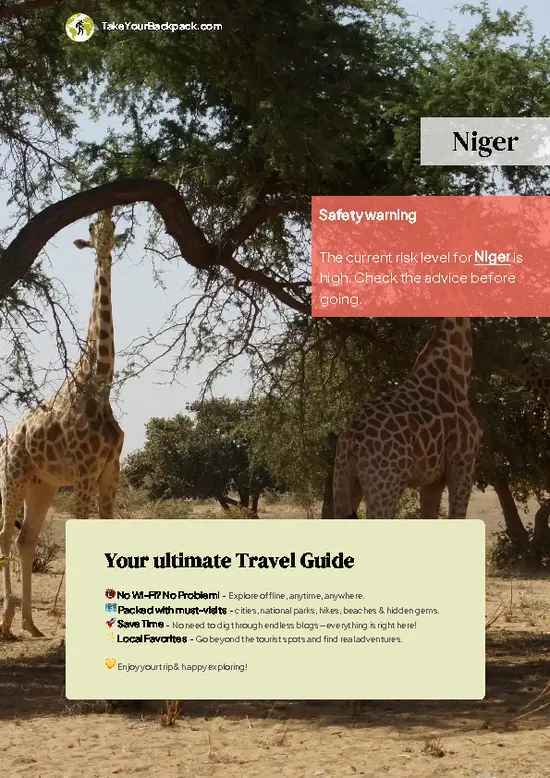
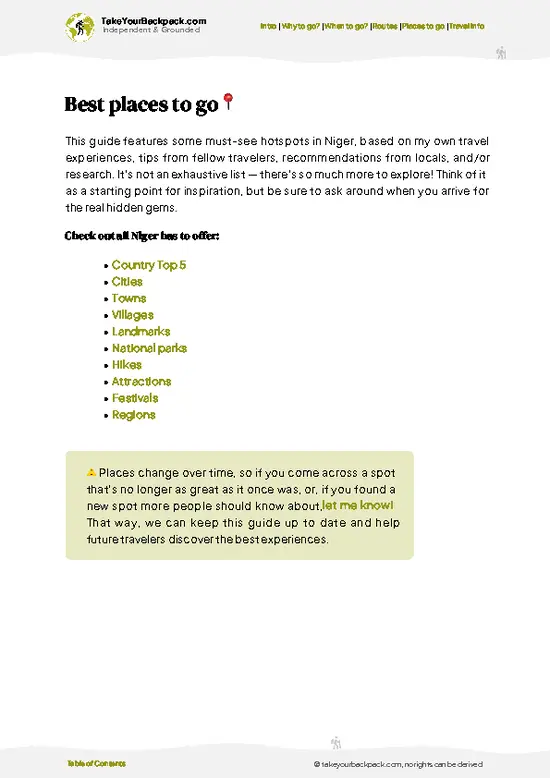
example page 0 from our offline Travel Guide for Niger
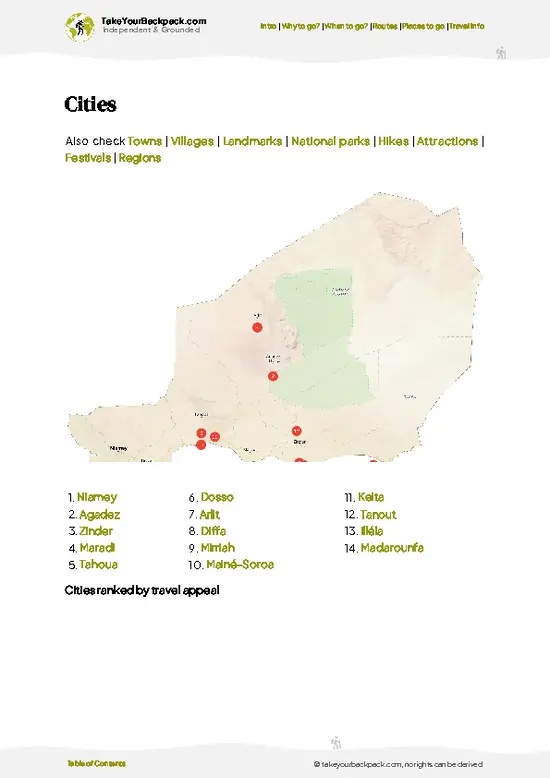
example page 1 from our offline Travel Guide for Niger
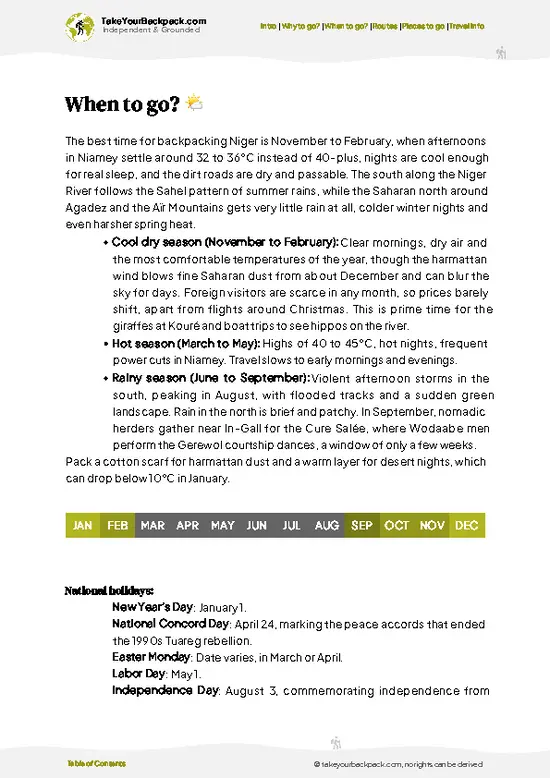
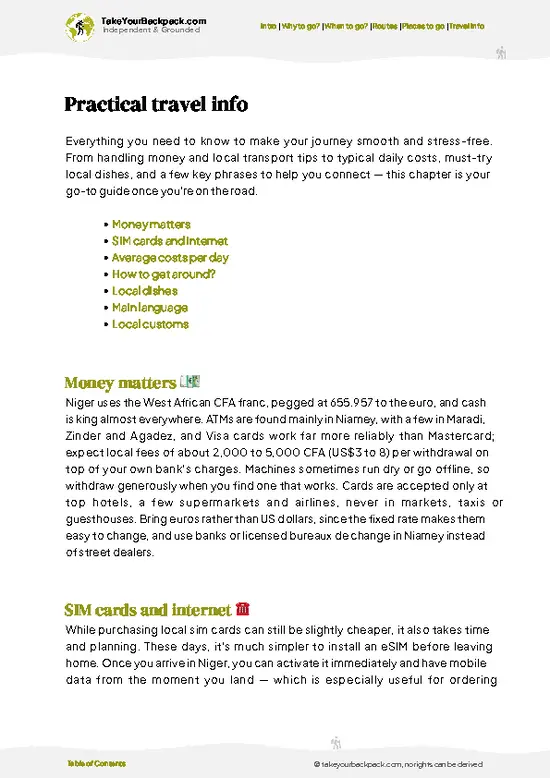
example page 2 from our offline Travel Guide for Niger
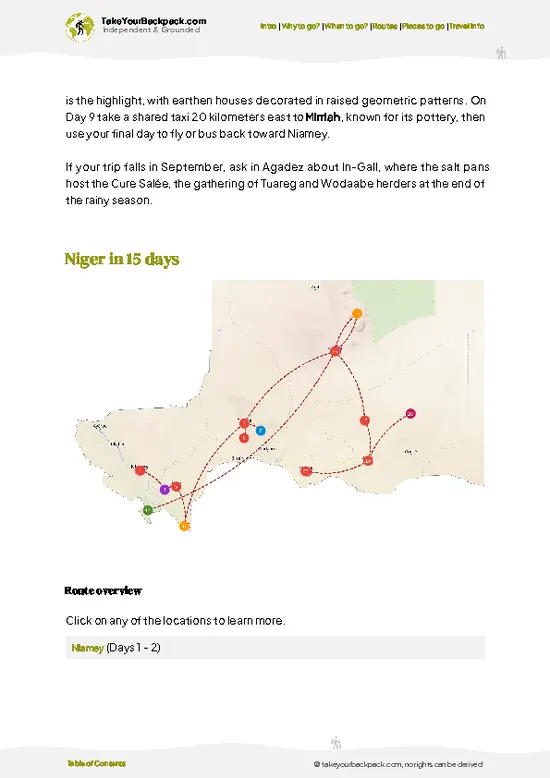
example page 3 from our offline Travel Guide for Niger
example page 4 from our offline Travel Guide for Niger
example page 5 from our offline Travel Guide for Niger
example page 6 from our offline Travel Guide for Niger
example page 7 from our offline Travel Guide for Niger
The digital guide (254 pages) contains:
✅ 57 highlights, ranked by travel appeal
✅ Optimized 5, 10 & 15-day travel routes
✅ Cities, national parks, landmarks, beaches
✅ How to get around
✅ Offline-friendly for travel without Wi-Fi
👉 Click to see all 30+ guide features

📅 Plan smarter in minutes, not weeks
✅ Month by month travel advice
✅ Festivals & national holidays
✅ Budget expectations

🗺️ Go to the right places, skip the overrated ones
✅ Honest pros & cons of destinations
✅ Top hikes, parks & viewpoints
✅ Lesser-known places most travelers miss
✅ Clear “worth it vs skip it” guidance

🛏️ Travel smoothly without rookie mistakes
✅ Best areas to stay
✅ Transport systems explained simply
✅ Common scams & safety advice
✅ SIM cards, money & practical tips

🌍 Understand the country, not just visit it
✅ Culture & traditions
✅ 52 Essential phrases & customs
✅ Festivals worth planning around
✅ Traveler-friendly historical context
✅ Insights that make places more meaningful

📱 Built for real travel conditions
✅ Fully downloadable PDF
✅ Works completely offline
✅ Optimized for phone use
✅ Useful in remote areas & buses
✅ Everything in one place
Stop searching, start planning
Get instant access to your full guide. 30‑day money-back guarantee.
+ Add another guide for just

By proceeding you agree to our terms.
Sent to your inbox immediately after payment • 100% Secure Checkout
Best Backpacking Travel Advisor 2025 tourism awardBest Backpacking
Travel Advisor
2025
What others say about Take Your Backpack Guides:
⭐⭐⭐⭐⭐
Fantastic, amazing amount of information!
⭐⭐⭐⭐⭐
My goodness this is amazing, it's what I've been looking for hats off too you!
⭐⭐⭐⭐⭐
I think this is absolutely BRILLIANT
⭐⭐⭐⭐
Very complete and informative. It's still missing places, but I gotta to commend you
⭐⭐⭐⭐⭐
This is truly amazing, thank you, can't wait to explore it with my kids!
⭐⭐⭐⭐⭐
Awesome resource, thank you!
⭐⭐⭐⭐⭐
This is amazing! Can't wait to explore the ones I haven't seen
⭐⭐⭐⭐
I love this! Well done, great idea.
⭐⭐⭐⭐⭐
Thanks for taking the time to make this gem!
⭐⭐⭐⭐⭐
This might be the best website I've ever seen.
⭐⭐⭐⭐⭐
Congratulations, and thank you so much for your work; it's incredibly valuable.
⭐⭐⭐⭐
In all seriousness I think you did a great job pointing out the important spots
⭐⭐⭐⭐⭐
10/10 very good
⭐⭐⭐⭐⭐
As someone who's only just starting to visit regularly this is awesome, thank you.
⭐⭐⭐⭐
Thank you very much! I'm going to visit my dad, it's going to be very useful!
⭐⭐⭐⭐⭐
This is really cool! We'll be travelling for the first time and this definitely come in handy.
⭐⭐⭐⭐⭐
You are now our minister of culture, congratulations 👨‍💼
⭐⭐⭐⭐⭐
Just wanted to tell you that this is a pearl! Going to follow your recommendations.
⭐⭐⭐⭐⭐
This is so cool. I'll definitely be using the resource for my travels soon.
⭐⭐⭐⭐⭐
This is very impressive! Good work.
⭐⭐⭐⭐⭐
This is an amazing and informative site. Very well done!

🛏️ Where to stay?Top Places to Consider Staying

Niger has no real hostel scene, so budget stays in Niamey mean simple guesthouses, auberges and church-run mission lodgings at roughly 10,000 to 25,000 CFA (US$17 to 42) a night, with air-conditioned rooms costing more. Plateau is the calmest and best-guarded district, close to embassies, banks and the Niger riverfront but quiet after dark, while the Centre-ville around the Grand Marché puts you near the markets, street food and evening maquis bars at the cost of noise, traffic and more petty theft. Residential Koira Kano and Yantala have villa-style guesthouses with gardens and a relaxed feel, though you will need taxis to reach most sights.

If you enjoy meeting fellow travelers, consider choosing … read more 👉
Niger has no real hostel scene, so budget stays in Niamey mean simple guesthouses, auberges and church-run mission lodgings at roughly 10,000 to 25,000 CFA (US$17 to 42) a night, with air-conditioned rooms costing more. Plateau is the calmest and best-guarded district, close to embassies, banks and the Niger riverfront but quiet after dark, while the Centre-ville around the Grand Marché puts you near the markets, street food and evening maquis bars at the cost of noise, traffic and more petty theft. Residential Koira Kano and Yantala have villa-style guesthouses with gardens and a relaxed feel, though you will need taxis to reach most sights.

If you enjoy meeting fellow travelers, consider choosing hostels with high ratings for atmosphere. On the other hand, if you prefer having your own space, a hotel might be a better option.

NigerMore Places Across Niger

👋 Meet the founderWho’s Behind Take Your Backpack?

Johan, backpacker and founder of TakeYourBackpackHi, I’m Johan (Netherlands 🇳🇱), the creator of TakeYourBackpack. Over the past 3 decades, I’ve backpacked through 90+ countries across six continents, gaining extensive experience with independent travel, long-term trips, and overland routes.

This site is built on a combination of firsthand travel experience and carefully curated insights from other backpackers. Many guides are based on places I’ve personally visited, while others bring together tips, observations, and practical advice shared by trusted travelers I’ve met along the way.

The goal is to provide realistic, experience-driven guidance — not generic itineraries — so you can explore destinations with better context, clearer expectations, and more confidence.