×

Paraguay🇵🇾 | townsCaazapáMission-era church, Guaraní history, forest reserve, chipa bakeries | things to do and best time to go

Explore TobatíExplore Villa Hayes

Backpacking in Caazapá
👌 Worth visitingtown ranked #11
By Johan Kruseman 🇳🇱 | Updated October 19, 2026

Caazapá gives you a quiet Paraguayan town with real Franciscan mission history and almost no tourist infrastructure, so prices stay local and conversations stay easy. It sits in the southeast of Paraguay, in the department of the same name, off the main highways. I expected a sleepy plaza and little else, and was surprised that a nearby reserve holds some of the last big stretches of Atlantic forest in the country. The town itself is worth a morning, not more: a church, a small museum, a plaza. Skip it if you want nightlife or hostels, because there are only simple guesthouses and few other backpackers. Go for the forest. The evening ends with the smell of wood smoke and the clatter of tereré thermoses on the sidewalk.

Part of Backpacking in Paraguay: all 65 places on one map, with routes and the best time to go.
Discover everything you want to know in the 📖 Paraguay Travel Guide.


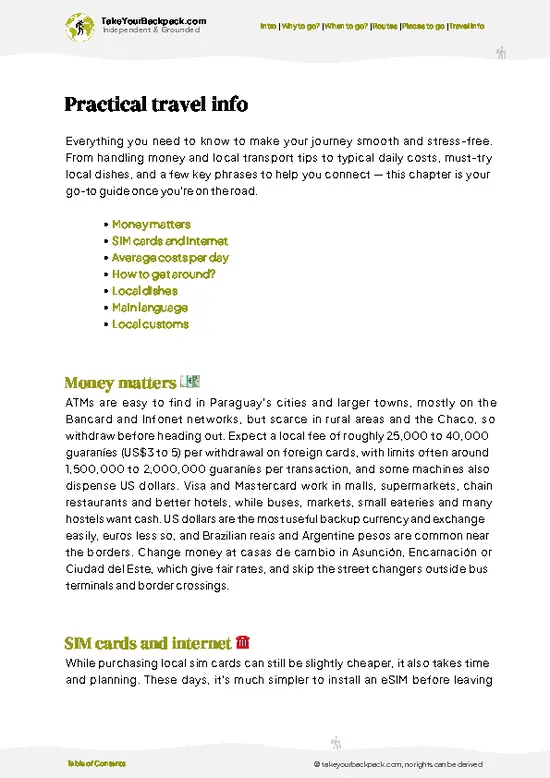
example page 0 from our offline Travel Guide for Paraguay
example page 1 from our offline Travel Guide for Paraguay
example page 2 from our offline Travel Guide for Paraguay
example page 3 from our offline Travel Guide for Paraguay
example page 4 from our offline Travel Guide for Paraguay
example page 5 from our offline Travel Guide for Paraguay
example page 6 from our offline Travel Guide for Paraguay
example page 7 from our offline Travel Guide for Paraguay
Loading the map 🌍
CLICK TO FILTER
cities
towns
landmarks
national parks
hikes
beaches
attractions
festivals
regions
SHOW COUNTRY’S BESTSHOW ALL

✨ Why go?
Ranked #11 town in Paraguay
The unique appeal for travelers

Caazapá works for travelers who want southeastern Paraguay at ground level, without tour groups. The reason to come is the Caazapá National Park forest, more than 60 kilometers east of town, where trails run under tall native trees and birds are easier to hear than to see. Add the Franciscan-founded church on the plaza, and you have a stay of one or two days. Slow travelers, birders and solo hikers will like it best. Nights are quiet, the guesthouses are few and plain, and you will meet locals far more often than other backpackers. Food is simple, built around chipa, mandioca and grilled meat at small comedores. Anyone chasing social hostels or big sights should treat Caazapá as a short detour rather than a destination, and pair it with livelier towns elsewhere on the route.

💡 HighlightsTop highlights of Caazapá

  1. Iglesia San Pablo: the parish church on the plaza, which keeps a carved altarpiece saved from the old Franciscan church. Mornings are best, when it is more likely to be open. Entry is usually free, and a visit takes 20 to 30 minutes.
  2. Plaza central: the center of town life, where people sit with tereré in the evening. Come around dusk for the most activity. It is free, and an hour is plenty.
  3. Museo Fray Juan Bernardo: a small local museum on the town's founding by Franciscans and the area's indigenous Guaraní past. Opening hours vary, so ask at the plaza. Expect little or no fee and about 30 to 45 minutes.
  4. Parque Nacional Caazapá: the forest reserve more than 60 kilometers east of town, with remnant Atlantic forest, walking paths and birdlife. Go in the cooler months for comfortable walking. Entry
… read more 👉
  1. Iglesia San Pablo: the parish church on the plaza, which keeps a carved altarpiece saved from the old Franciscan church. Mornings are best, when it is more likely to be open. Entry is usually free, and a visit takes 20 to 30 minutes.
  2. Plaza central: the center of town life, where people sit with tereré in the evening. Come around dusk for the most activity. It is free, and an hour is plenty.
  3. Museo Fray Juan Bernardo: a small local museum on the town's founding by Franciscans and the area's indigenous Guaraní past. Opening hours vary, so ask at the plaza. Expect little or no fee and about 30 to 45 minutes.
  4. Parque Nacional Caazapá: the forest reserve more than 60 kilometers east of town, with remnant Atlantic forest, walking paths and birdlife. Go in the cooler months for comfortable walking. Entry is typically US$1 to 3, and a good visit takes 2 to 4 hours.
  5. Local chipa and bakery stops: small shops around the center sell fresh chipa and sopa paraguaya. Mornings are best, while it is warm. Budget US$1 to 3 and 20 minutes.
The park and the church pair well in one day, forest in the morning and the plaza at dusk. For day trips, Yuty to the south and Villarrica to the northwest are within reach, and both have historic centers worth a half day.
Spotted a mistake or missing something? Contact us.

🏘️ NeighborhoodsNeighborhood guide to Caazapá

Caazapá is small enough to cover on foot in an afternoon, and the useful areas sit within a few blocks of each other.
  • Plaza and Center: The main plaza holds the Franciscan-founded church, with its colonial-era wood carving, plus the municipal buildings and a few simple eateries serving chipa, sopa paraguaya and grilled meat. Spend your time here first. It is quiet by 9 pm.
  • Franciscan Mission Heritage Zone: Caazapá was founded by Franciscans in 1607, and the church and its small museum of Guaraní-baroque pieces are the best reason to stop. Allow an hour or two, no more.
  • Bus Terminal Area: Practical rather than interesting. Expect kiosks, a few cheap lunch counters and nothing worth lingering for.
  • Outskirts and Countryside: The roads leading out pass farms, yerba mate fields and patches of the Caazapá
… read more 👉
Caazapá is small enough to cover on foot in an afternoon, and the useful areas sit within a few blocks of each other.
  • Plaza and Center: The main plaza holds the Franciscan-founded church, with its colonial-era wood carving, plus the municipal buildings and a few simple eateries serving chipa, sopa paraguaya and grilled meat. Spend your time here first. It is quiet by 9 pm.
  • Franciscan Mission Heritage Zone: Caazapá was founded by Franciscans in 1607, and the church and its small museum of Guaraní-baroque pieces are the best reason to stop. Allow an hour or two, no more.
  • Bus Terminal Area: Practical rather than interesting. Expect kiosks, a few cheap lunch counters and nothing worth lingering for.
  • Outskirts and Countryside: The roads leading out pass farms, yerba mate fields and patches of the Caazapá National Park forest. Distances are too long to walk, so skip this on foot and arrange a ride.
Nightlife is minimal. A couple of bars near the plaza fill up on weekends, and that is all.

⌛️ 1 dayWhat you can realistically do in a day

8:00 AM, Parque Nacional Caazapá: Start in the forest while the air is cool and birds are active. Follow the main paths for about three hours, keeping to marked routes and carrying water. The reserve is the town's real draw, and few visitors reach it.
11:30 AM, Return to the center: Ride the 60-plus kilometers back to town and stop at a bakery for fresh chipa and a coffee. It is a simple, filling break before the heat peaks.
1:00 PM, Lunch at a local comedor: Order the daily plate, usually grilled meat, mandioca and salad. Servings are generous and the room is full of locals, which is half the point.
3:00 PM, Iglesia San Pablo: Walk to the plaza and see the parish church and its Franciscan-era altarpiece. Take your time, as the interior is small.
4:30 PM, Museo Fray Juan Bernardo: Spend under … read more 👉
8:00 AM, Parque Nacional Caazapá: Start in the forest while the air is cool and birds are active. Follow the main paths for about three hours, keeping to marked routes and carrying water. The reserve is the town's real draw, and few visitors reach it.
11:30 AM, Return to the center: Ride the 60-plus kilometers back to town and stop at a bakery for fresh chipa and a coffee. It is a simple, filling break before the heat peaks.
1:00 PM, Lunch at a local comedor: Order the daily plate, usually grilled meat, mandioca and salad. Servings are generous and the room is full of locals, which is half the point.
3:00 PM, Iglesia San Pablo: Walk to the plaza and see the parish church and its Franciscan-era altarpiece. Take your time, as the interior is small.
4:30 PM, Museo Fray Juan Bernardo: Spend under an hour on the town's mission origins and Guaraní heritage. Check opening hours at the plaza first.
6:00 PM, Backstreets and the edge of town: Wander the residential streets beyond the plaza, where neighbors sit outside with tereré and horse carts still pass. It is not on any standard route, and it shows daily life better than the monuments do.
7:30 PM, Plaza at dusk: Finish on a bench with a cold drink as the town slowly lights up.

🌤️ When to go?Seasonal considerations and timing

March to May and September to November are the most comfortable months for Caazapá, with daytime highs of 22 to 28°C (72 to 82°F).
  • Summer (December to February): Hot and humid, with highs of 32 to 38°C (90 to 100°F), heavy afternoon storms and long daylight of around 14 hours. Red dirt roads turn muddy.
  • Autumn and Spring: Mild, dry and clear. Best for walking and the national park.
  • Winter (June to August): Cool, 5 to 20°C (41 to 68°F), with occasional frosty mornings and short days of about 10 hours.
  • Festivals: The patron saint celebrations on January 25 (San Pablo) and the Ykua Bolaños festival in January draw crowds, and prices barely move because lodging is limited anyway.
Check the forecast before heading out, since rain closes unpaved roads for a day or two.

source: climatestotravel.comJANJanuary: fair for travelingFEBFebruary: fair for travelingMARMarch: fair for travelingAPRApril: good for travelingMAYMay: highly recommended for travelingJUNJune: highly recommended for travelingJULJuly: highly recommended for travelingAUGAugust: highly recommended for travelingSEPSeptember: excellent for travelingOCTOctober: good for travelingNOVNovember: good for travelingDECDecember: fair for traveling
when-to-go

✈️ The backpacker research shortcutParaguay Travel Guide

What the free pages can't give you: ready-made routes, every place ranked, and it works offline. All in 1 guide.
example page 0 from our offline Travel Guide for Paraguay
example page 1 from our offline Travel Guide for Paraguay
example page 2 from our offline Travel Guide for Paraguay
example page 3 from our offline Travel Guide for Paraguay
example page 4 from our offline Travel Guide for Paraguay
example page 5 from our offline Travel Guide for Paraguay
example page 6 from our offline Travel Guide for Paraguay
example page 7 from our offline Travel Guide for Paraguay
The digital guide (226 pages) contains:-page digital guide:
✅ Ready-made 5, 10 & 15-day routes
✅ All 65 places ranked, so you skip the overrated ones
✅ Works offline, all in 1 guide
✅ Cities, national parks, landmarks, beaches
✅ How to get around
👉 Click to see all 30+ guide features

📅 Plan smarter in minutes, not weeks
✅ Month by month travel advice
✅ Festivals & national holidays
✅ Budget expectations

🗺️ Go to the right places, skip the overrated ones
✅ Honest pros & cons of destinations
✅ Top hikes, parks & viewpoints
✅ Lesser-known places most travelers miss
✅ Clear “worth it vs skip it” guidance

🛏️ Travel smoothly without rookie mistakes
✅ Best areas to stay
✅ Transport systems explained simply
✅ Common scams & safety advice
✅ SIM cards, money & practical tips

🌍 Understand the country, not just visit it
✅ Culture & traditions
✅ 52 Essential phrases & customs
✅ Festivals worth planning around
✅ Traveler-friendly historical context
✅ Insights that make places more meaningful

📱 Built for real travel conditions
✅ Fully downloadable PDF
✅ Works completely offline
✅ Optimized for phone use
✅ Useful in remote areas & buses
✅ All in 1 guide
Stop searching, start planning
Get instant access to your full guide. 30‑day money-back guarantee.


By proceeding you agree to our terms.
Sent to your inbox immediately after payment • 100% Secure Checkout
Best Backpacking Travel Advisor 2025 tourism awardBest Backpacking
Travel Advisor
2025
What others say about Take Your Backpack Guides:
⭐⭐⭐⭐⭐
Fantastic, amazing amount of information!
⭐⭐⭐⭐⭐
My goodness this is amazing, it's what I've been looking for hats off too you!
⭐⭐⭐⭐⭐
I think this is absolutely BRILLIANT
⭐⭐⭐⭐
Very complete and informative. It's still missing places, but I gotta to commend you
⭐⭐⭐⭐⭐
This is truly amazing, thank you, can't wait to explore it with my kids!
⭐⭐⭐⭐⭐
Awesome resource, thank you!
⭐⭐⭐⭐⭐
This is amazing! Can't wait to explore the ones I haven't seen
⭐⭐⭐⭐
I love this! Well done, great idea.
⭐⭐⭐⭐⭐
Thanks for taking the time to make this gem!
⭐⭐⭐⭐⭐
This might be the best website I've ever seen.
⭐⭐⭐⭐⭐
Congratulations, and thank you so much for your work; it's incredibly valuable.
⭐⭐⭐⭐
In all seriousness I think you did a great job pointing out the important spots
⭐⭐⭐⭐⭐
10/10 very good
⭐⭐⭐⭐⭐
As someone who's only just starting to visit regularly this is awesome, thank you.
⭐⭐⭐⭐
Thank you very much! I'm going to visit my dad, it's going to be very useful!
⭐⭐⭐⭐⭐
This is really cool! We'll be travelling for the first time and this definitely come in handy.
⭐⭐⭐⭐⭐
You are now our minister of culture, congratulations 👨‍💼
⭐⭐⭐⭐⭐
Just wanted to tell you that this is a pearl! Going to follow your recommendations.
⭐⭐⭐⭐⭐
This is so cool. I'll definitely be using the resource for my travels soon.
⭐⭐⭐⭐⭐
This is very impressive! Good work.
⭐⭐⭐⭐⭐
This is an amazing and informative site. Very well done!

🛏️ Where to stay?Best areas and accommodation options

The streets within five or six blocks of the main plaza are the best place to sleep in Caazapá. Budget beds are limited to a handful of small guesthouses and family-run lodgings, with private rooms at roughly US$12 to 25 and no real dorm culture. Book ahead for the January festivals, when rooms fill.
This central zone is quiet at night, well within walking distance of the bus terminal, restaurants and the church, and you will rarely need a taxi after dark. Noise is mostly roosters and the odd motorbike. Streets are lit around the plaza and feel calm late into the evening.
A second option is the … read more 👉
The streets within five or six blocks of the main plaza are the best place to sleep in Caazapá. Budget beds are limited to a handful of small guesthouses and family-run lodgings, with private rooms at roughly US$12 to 25 and no real dorm culture. Book ahead for the January festivals, when rooms fill.
This central zone is quiet at night, well within walking distance of the bus terminal, restaurants and the church, and you will rarely need a taxi after dark. Noise is mostly roosters and the odd motorbike. Streets are lit around the plaza and feel calm late into the evening.
A second option is the roadside near the terminal, convenient for early departures, though it gets some truck and bus noise. Rural lodges near the national park exist but need your own transport and are better for travelers with a car.

🚌 Getting aroundGetting around like a local

Local rides are usually moto-taxis or short taxi hops costing US$1 to 3, paid in cash in guaraníes. Caazapá is compact, so most visitors walk, and the real transport question is how to reach the surrounding countryside.
  • Walking: Worth it. The plaza, church and terminal are within about 10 minutes of one another on flat streets.
  • Moto-taxi: The quickest local option, US$1 to 2 within town. Agree the price before you get on. Helmets are not always offered.
  • Taxi: Few cars operate. Expect US$2 to 4 in town, or US$15 to 30 for a round trip to nearby sites with waiting time. Ask your host to call one.
  • Intercity bus: Services link Caazapá to Asunción (about 3 to 4 hours, US$5 to 8) and to Coronel Oviedo and Encarnación on regional routes. Most run between early morning and late afternoon, so confirm the
… read more 👉
Local rides are usually moto-taxis or short taxi hops costing US$1 to 3, paid in cash in guaraníes. Caazapá is compact, so most visitors walk, and the real transport question is how to reach the surrounding countryside.
  • Walking: Worth it. The plaza, church and terminal are within about 10 minutes of one another on flat streets.
  • Moto-taxi: The quickest local option, US$1 to 2 within town. Agree the price before you get on. Helmets are not always offered.
  • Taxi: Few cars operate. Expect US$2 to 4 in town, or US$15 to 30 for a round trip to nearby sites with waiting time. Ask your host to call one.
  • Intercity bus: Services link Caazapá to Asunción (about 3 to 4 hours, US$5 to 8) and to Coronel Oviedo and Encarnación on regional routes. Most run between early morning and late afternoon, so confirm the last departure at the terminal. Buses are basic, sometimes without air conditioning, and stop often.
Public transport within town barely exists, and you do not need it. Plan onward travel by daylight, because evening buses thin out quickly.

👛 Costs (as of 19 October 2026)What things cost and how to budget

Expect to spend about US$32 a day in Caazapá if you stay in a simple private room and eat local food.
CategoryBudget RangeLocal Reality
Dorm accommodationUS$12 to 18No true dorms. Basic private rooms in family guesthouses, higher in high season
MealsUS$8 to 12Set lunches, empanadas, chipa and grilled meat at plain local counters
Local transportUS$2 to 4Moto-taxis and short taxi hops, paid in cash
Basic activities/entry feesUS$1 to 5Church and museum visits are low-cost, national park entry is small
Miscellaneous expensesUS$2 to 4Water, snacks, SIM data top-ups
Total Daily BudgetUS$25 to 43About US$32 on average, using the high-season room rate
Eating the fixed-price lunch menu rather than ordering à la carte is the easiest way to save.

source: senatur.gov.py
⚠️ Prices can change and everyone travels differently, so take this as a rough guide. Hope it helps you plan your adventure!

🚌 Day tripsExploring the surroundings

Caazapá works as a base for quiet rural day trips, though public transport to outlying sites is thin, so plan on taxis or a hired driver.
Caazapá National Park:
Atlantic Forest remnant with walking trails, birds and cool shade, more than 60 kilometers east of town, reached by taxi or hired car. Go in autumn or spring, and do not arrive without arranging your return ride, since no buses wait there.
👉 Explore Caazapá National Park
Yuty:
A small town known for its role in the Paraguayan War and its history museum, roughly 1 to 1.5 hours by road. Bus fares run US$2 to 4 each way, but check return times at the terminal first, as connections are limited. Visits fit comfortably into a morning.

San Juan Nepomuceno:
Founded in 1797 as a Franciscan reducción, with a well-kept plaza and a relaxed feel, … read more 👉
Caazapá works as a base for quiet rural day trips, though public transport to outlying sites is thin, so plan on taxis or a hired driver.
Caazapá National Park:
Atlantic Forest remnant with walking trails, birds and cool shade, more than 60 kilometers east of town, reached by taxi or hired car. Go in autumn or spring, and do not arrive without arranging your return ride, since no buses wait there.
👉 Explore Caazapá National Park
Yuty:
A small town known for its role in the Paraguayan War and its history museum, roughly 1 to 1.5 hours by road. Bus fares run US$2 to 4 each way, but check return times at the terminal first, as connections are limited. Visits fit comfortably into a morning.

San Juan Nepomuceno:
Founded in 1797 as a Franciscan reducción, with a well-kept plaza and a relaxed feel, about 45 minutes to an hour away. Local buses cost US$1 to 3. It is best on weekdays, when shops are open.

🛡️ SafetyStaying Safe: What Travelers Should Know

Caazapá is a calm, low-crime town where the main hazards are ordinary ones. Petty theft is uncommon, but keep phones and cash out of sight in the terminal and market. Solo travelers, including women, generally walk the center after dark without trouble, though streets beyond the plaza are dim and quiet, so stay on the lit blocks late at night. Dogs roam freely and can be territorial near the edges of town. Moto-taxi drivers may quote higher prices to foreigners, so settle the fare first. On rural roads, heavy rain makes surfaces slick, and drivers can be fast. Carry water and sun protection in summer.

FAQTraveler FAQ

Caazapá is worth a short stop if you like quiet colonial-era towns and Atlantic Forest rather than nightlife. The Franciscan church and mission-era carvings take one to two hours, and the nearby Caazapá National Park adds a half day. It works poorly as a pure stopover because buses are infrequent.
Most travelers need one full day in Caazapá, or two if you add the national park. The town itself takes about half a day on foot, and the park, more than 60 kilometers east, needs a full day by taxi. Add a night around the January 25 San Pablo festival.
Yes, Caazapá can be done as a day trip from Asunción, but it is a long one. The ride takes about 3 to 4 hours each way and costs US$5 to 8, so you get only a few hours on the ground. Sleeping one night is more comfortable, and check the last return bus before leaving.
⚠️ Things can change over time, so always validate details locally before you go.

Other Paraguayan towns near Caazapá

Explore more nearby:

  • Villarrica—Plaza Mayor, terminal snacks, university crowd, Guairá market| 46 km away
  • Carapeguá—Roadside chipa, lace workshops, tereré plaza, interior stop| 99 km away
  • San Ignacio—Jesuit-Guaraní wood carvings, mission plaza, tereré corners, Ruta 1 stop| 102 km away

💡 Not sure where to go next?
Create a personalized itinerary for Paraguay including Caazapá and the places that fit your trip.

Generate my itinerary

👉 Discover all towns

Or checkout all Paraguay has to offer (think cities, towns, villages, national parks, hikes, beaches, festivals)
Country photo of Paraguay

We 💚 feedbackIs it worth it?

Caazapá needs one night and two half-days: forest first, plaza and church second. Stay longer only if you are a birder or want a quiet reset between bigger stops. I would bring insect repellent, small bills for the park and a thermos, since tereré is the easiest way into a conversation.

✈️ When did I visit Paraguay?
Before visiting Argentina in September 2012, I crossed through Paraguay, ending up at the magical Iguazu Falls.

✍️ Help improve this page!
The information on this page is based on my own backpacking experience in Paraguay, supplemented with up-to-date research and feedback from other travelers. Travel details can change, so if you notice anything outdated or incomplete, feel free to let me know.


🙋‍♂️ Give feedback

👋 Meet the founderWho’s Behind Take Your Backpack?

Johan, backpacker and founder of TakeYourBackpackHi, I’m Johan (Netherlands 🇳🇱), the creator of TakeYourBackpack. Over the past 30 years, I’ve backpacked through 88 countries across six continents, gaining extensive experience with independent travel, long-term trips, and overland routes.

This site is built on a combination of firsthand travel experience and carefully curated insights from other backpackers. Many guides are based on places I’ve personally visited, while others bring together tips, observations, and practical advice shared by trusted travelers I’ve met along the way.

The goal is to provide realistic, experience-driven guidance — not generic itineraries — so you can explore destinations with better context, clearer expectations, and more confidence.