×

Paraguay🇵🇾 | best townsTop-Rated 10 towns in Paraguay

Towns in Paraguay are small, flat, quiet and built around a plaza, a church and a market. The country has no mountain resorts or colonial showpieces on the scale of its neighbors, so differences are subtle. Towns in the Asunción hinterland, the Central Department and the Cordillera, are close together and easy to reach by bus. The Jesuit south around Itapúa has stone ruins and Guaraní heritage, and the eastern border is busier and more commercial. The Chaco is sparse, hot and expensive to cross. For backpacking and independent travel, prices stay low, crowds are rare and Spanish or Guaraní does most of the work.

By Johan Kruseman 🇳🇱 | Updated November 18, 2026
Explore the best landmarks in Paraguay

Why go?Key Factors That Shape the Experience

Paraguay suits towns because its history happened in them. Spanish settlers and Jesuit missionaries founded settlements among the Guaraní, and the country stayed relatively isolated for long periods, so craft traditions, Guaraní language and rural rhythms survive in daily life rather than in museums. About 90 percent of the population speaks Guaraní, often mixed with Spanish, and you hear it in markets, buses and shops.

Geography shapes the rest. The eastern half is green, rolling and farmed, with red soil and dense road links. The western Chaco covers roughly 60 percent of the land but holds a small share of the people, so towns there are far apart and services thin. Rivers, the Paraguay and the Paraná, define the borders and many settlements.

Before choosing Paraguay, know that tourism … read more 👉
Paraguay suits towns because its history happened in them. Spanish settlers and Jesuit missionaries founded settlements among the Guaraní, and the country stayed relatively isolated for long periods, so craft traditions, Guaraní language and rural rhythms survive in daily life rather than in museums. About 90 percent of the population speaks Guaraní, often mixed with Spanish, and you hear it in markets, buses and shops.

Geography shapes the rest. The eastern half is green, rolling and farmed, with red soil and dense road links. The western Chaco covers roughly 60 percent of the land but holds a small share of the people, so towns there are far apart and services thin. Rivers, the Paraguay and the Paraná, define the borders and many settlements.

Before choosing Paraguay, know that tourism infrastructure is modest. Few towns have more than a handful of guesthouses, English is rarely spoken, and signage is limited. Opening hours follow a long midday break, and many places close on Sunday afternoons. Cash in guaraníes is the norm outside larger centers. In return, visits feel unhurried, prices are low and locals are curious about foreign visitors, which makes this a country for travelers comfortable with simple, unscripted days.
How the List Was Created
The list of best towns in Paraguay is created based on charm, local culture, atmosphere, hidden gems, and visitor appeal. If you feel a town is missing in this list, please let us know.

When to go?Seasonal Guide to Visiting

Best months: The best months for towns in Paraguay are April to June and September to October, when daytime temperatures sit around 20 to 29°C and the humidity of summer has eased. These stretches are comfortable for walking plazas, markets and ruins in the middle of the day.
Summer heat: December to February is hot and humid, with highs of 33 to 40°C, and heavy thunderstorms can turn unpaved roads to red mud. The Chaco is the hottest region, and midday travel there is unpleasant. Rain falls year-round in the east, with roughly 1,300 to 1,700 mm annually, while the western Chaco is drier, though its dirt tracks can still close after downpours.
Winter: June to August brings mild days of 18 to 25°C but cold nights that can drop to 5°C or lower, and occasional cold fronts bring a few damp, gray … read more 👉
Best months: The best months for towns in Paraguay are April to June and September to October, when daytime temperatures sit around 20 to 29°C and the humidity of summer has eased. These stretches are comfortable for walking plazas, markets and ruins in the middle of the day.
Summer heat: December to February is hot and humid, with highs of 33 to 40°C, and heavy thunderstorms can turn unpaved roads to red mud. The Chaco is the hottest region, and midday travel there is unpleasant. Rain falls year-round in the east, with roughly 1,300 to 1,700 mm annually, while the western Chaco is drier, though its dirt tracks can still close after downpours.
Winter: June to August brings mild days of 18 to 25°C but cold nights that can drop to 5°C or lower, and occasional cold fronts bring a few damp, gray days. Guesthouses often lack heating, so a warm layer is needed.
Crowds and prices: Crowds are small year-round. Domestic holidays raise demand and bus fares: Semana Santa (the week before Easter), when many shops close, and the Caacupé pilgrimage around December 8, which fills the Cordillera. Rates for rooms stay stable for most of the year, roughly US$15 to 35 for a simple private room, with small rises at those peaks. Booking ahead is wise then.

town hoppingOptimizing Your Multi-Stop Itinerary

Trip length: A trip combining several towns in Paraguay needs 7 to 12 days, which allows for slow buses and unhurried stops. Fewer days work if you stay within one region.
Regions and direction: Group stops by region. The Asunción area works as a hub, with the Central Department and Cordillera reachable on day trips or short hops of 1 to 2 hours. From there, travel southeast along Route 1 toward Encarnación and the Jesuit area, about 5 to 6 hours by bus from Asunción. Heading south to north or the reverse both work, but starting in the capital and ending at the southern border makes sense if you continue to Argentina. The eastern border near Ciudad del Este is reached by Route 2 in 4 to 5 hours. The Chaco is best treated as a separate, longer trip, since Filadelfia is 7 to 8 hours from Asunción … read more 👉
Trip length: A trip combining several towns in Paraguay needs 7 to 12 days, which allows for slow buses and unhurried stops. Fewer days work if you stay within one region.
Regions and direction: Group stops by region. The Asunción area works as a hub, with the Central Department and Cordillera reachable on day trips or short hops of 1 to 2 hours. From there, travel southeast along Route 1 toward Encarnación and the Jesuit area, about 5 to 6 hours by bus from Asunción. Heading south to north or the reverse both work, but starting in the capital and ending at the southern border makes sense if you continue to Argentina. The eastern border near Ciudad del Este is reached by Route 2 in 4 to 5 hours. The Chaco is best treated as a separate, longer trip, since Filadelfia is 7 to 8 hours from Asunción along the Trans-Chaco Highway.
Pacing: Allow one to two nights per stop, and a third night only where there is a lot to see on foot or by bike. Keep daily transfers to about 4 hours.
Common mistakes: Travelers often pack too many regions into a week, underestimate bus times on rural roads, and plan long days in summer heat. Choose two regions, leave buffer days, and book onward tickets at the terminal the day before, since some routes run only a few times daily.

The ListMust-Visit towns in Paraguay

1 San Bernardino

Lake promenade, old summer villas, town beach, weekday calm

Stroll the Ypacaraí lakefront at dusk, then look over the grand lakeside hotel and wooden-balconied villas left by Asunción’s summer residents.

2 Areguá

Glazed pottery, lake views, sloping lanes, weekend families

Browse potters’ workshops along the sloping streets, then walk down to the old wooden station and the Ypacaraí shoreline for a slow afternoon.

3 Ybyrarobana

Red-earth farm roads, soy country, tereré benches, forest remnants

Walk dirt roads between silos and family plots, then sit on the plaza with locals sharing tereré and chipa from corner stores.

4 Caacupé

Domed basilica, pilgrim esplanade, holy well, candle stalls

Step inside the basilica to see the Virgin’s statue and wall plaques, then fill the half-day with the well and the stalls.

5 Villarrica

Plaza Mayor, terminal snacks, university crowd, Guairá market

Begin with chipa guasu at the bus terminal, then settle on Plaza Mayor and browse the market for cheese, herbs and tereré supplies.

6 Concepción

Cargo port, river trips, market stalls, northern river town

Walk the working riverfront at dusk, browse the municipal market and book a boat trip past islands and birdlife on the Paraguay River.

7 Filadelfia

Mennonite colony, Chaco museums, cooperative dairy, Indigenous weaving

Trace Chaco settlement history in the Jakob Unger Museum, then shop cooperative cheeses and Enxet and Nivaclé weavings along orderly avenues.

8 San Ignacio

Jesuit-Guaraní wood carvings, mission plaza, tereré corners, Ruta 1 stop

Step into the old Jesuit workshop to study carved saints and angels, then wander the quiet mission plaza and low houses at dusk.

9 Piribebuy

War-era museum, sixty-stripe ponchos, colonial porches, plaza food stalls

Visit the museum on Piribebuy’s wartime past, then wander tile-roofed streets and buy ponchos directly from the weavers.

paraguay-city-piribebuy
© Google |

10 Ayolas

Yacyretá dam, Paraná promenade, river fish, border waters

Tour the binational dam, then follow the riverside promenade to the fishing port where dorado and surubí come ashore.

paraguay-city-ayolas
© Google |

11 Tobatí

Clay kilns, wood carvers, hilltop viewpoint, Cordillera village

Watch potters and carvers at work on a weekday morning, then climb Cerro Tobatí for views across the plain.

12 Caazapá

Mission-era church, Guaraní history, forest reserve, chipa bakeries

Pair a morning among the carved church and small museum with a walk through remnant Atlantic forest on the town’s edge.

13 Villa Hayes

River crossing, Hayes monument, working port, plaza empanadas

Watch barges and fishing boats along the Paraguay River, then find the monument to the U.S. president who gave the town its name.

14 Carapeguá

Roadside chipa, lace workshops, tereré plaza, interior stop

Taste warm chipa from Ruta 1 stalls, then ask local families to show their lace and textile work near the shady plaza.

15 Horqueta

Cattle country, plaza tereré, ranch roads, Ypané banks

Spend an afternoon among farm-town routines, from the morning market to quiet ranch roads and muddy fishing spots on the Río Ypané.

16 Tembiaporã

Red-dirt tracks, soybean fields, local market, football sidelines

Cycle red-dirt farm roads at first light, then join locals for chipa, tereré and weekend football in Caaguazú farm country.

Think you know Paraguay?

Prove you’re a true local — uncover 6 lesser-known towns in Paraguay that locals tend to keep to themselves.
Loading the map 🌍

Expert viewWhat You Should Know

How many towns: Visit four to six towns on a trip of one to two weeks. Fewer than four leaves the variation between regions unseen, and more than six turns the trip into a series of bus terminals. Roads are slow, services thin, and the pleasure of Paraguayan towns is in lingering over a tereré circle in the plaza, a plate of chipa fresh from a roadside oven, or a market where nobody hurries you.
Which kind: Choose by travel style. For culture and craft, pick towns in the Central Department and Cordillera, where lace weaving, ceramics and woodwork are sold by the people who make them. For history, the Jesuit south gives you carved stone ruins and quiet museums, with long shade under the old walls. For river views and cheap shopping, the eastern border has crowded commercial streets and waterfalls … read more 👉
How many towns: Visit four to six towns on a trip of one to two weeks. Fewer than four leaves the variation between regions unseen, and more than six turns the trip into a series of bus terminals. Roads are slow, services thin, and the pleasure of Paraguayan towns is in lingering over a tereré circle in the plaza, a plate of chipa fresh from a roadside oven, or a market where nobody hurries you.
Which kind: Choose by travel style. For culture and craft, pick towns in the Central Department and Cordillera, where lace weaving, ceramics and woodwork are sold by the people who make them. For history, the Jesuit south gives you carved stone ruins and quiet museums, with long shade under the old walls. For river views and cheap shopping, the eastern border has crowded commercial streets and waterfalls nearby. The Chaco suits those with a vehicle or a tour, interested in Mennonite settlements and birdlife, and willing to accept long distances and higher costs.
Budget: Expect US$25 to 45 a day in the east. That covers a dorm bed or simple room (US$10 to 30), meals of grilled meat, soup or empanadas (US$3 to 8), and local buses at roughly US$1 to 3 per hour of travel. Entry fees to ruins and small museums run about US$3 to 8. Guides, where offered, cost roughly US$10 to 30 for a half day. Per visit, plan about US$15 to 25 beyond lodging for entry, snacks and local transport. The Chaco can double daily costs once fuel, tours and limited lodging are added.
Safety and culture: Small towns are generally calm, but petty theft happens in bus terminals and at border markets, so keep phones out of sight and bags in front of you. Avoid walking empty streets late at night, even in quiet centers. Carry cash in guaraníes, since cards and ATMs are unreliable away from larger towns. Greet shopkeepers before asking for anything, and accept a shared tereré with a simple gracias if offered, the cup moves around the circle and returning it empty signals you are done. Dress modestly for church visits, and expect a long midday pause when shops close and streets empty. Dengue is present in the warm months, so bring repellent and cover up at dusk.

✈️ The backpacker research shortcutParaguay Travel Guide

What the free pages can't give you: ready-made routes, every place ranked, and it works offline. All in 1 guide.
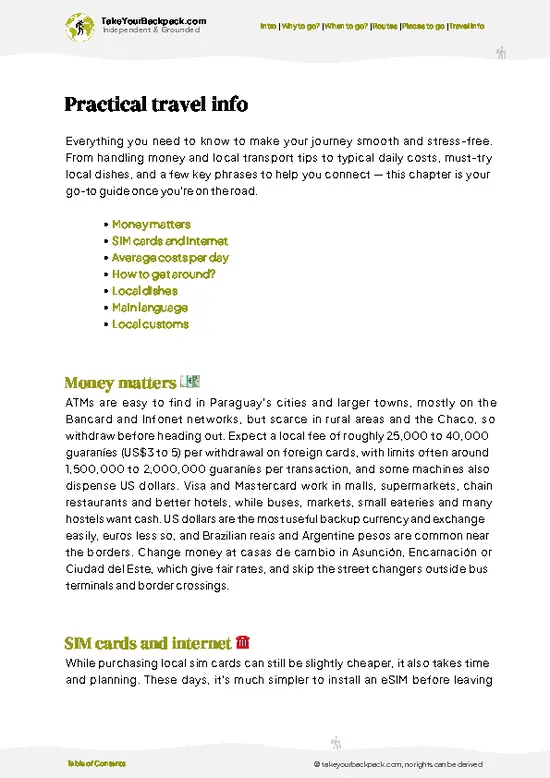
example page 0 from our offline Travel Guide for Paraguay
example page 1 from our offline Travel Guide for Paraguay
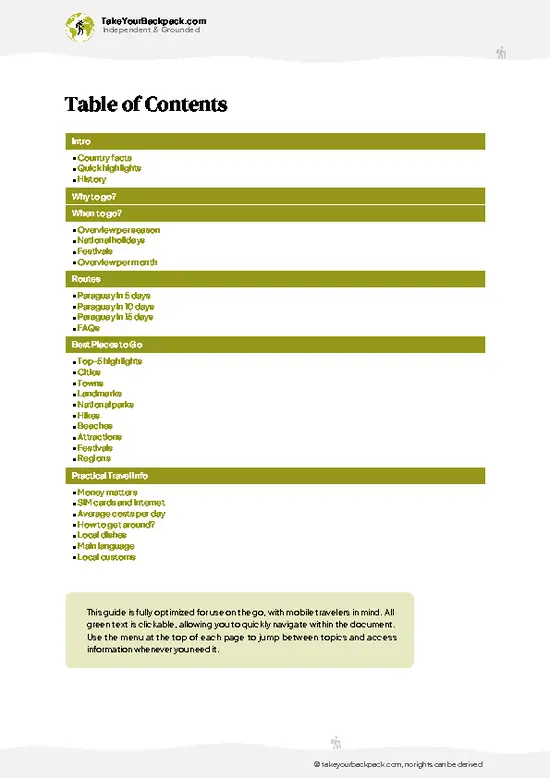
example page 2 from our offline Travel Guide for Paraguay
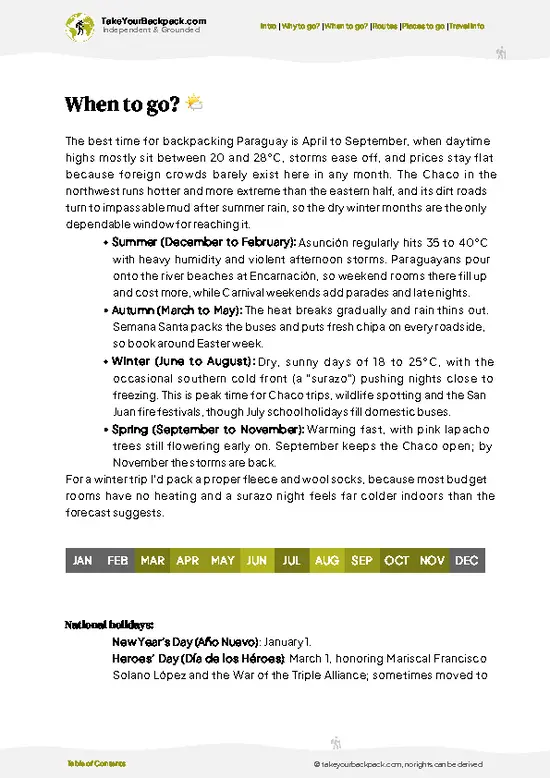
example page 3 from our offline Travel Guide for Paraguay
example page 4 from our offline Travel Guide for Paraguay
example page 5 from our offline Travel Guide for Paraguay
example page 6 from our offline Travel Guide for Paraguay
example page 7 from our offline Travel Guide for Paraguay
The digital guide (226 pages) contains:-page digital guide:
✅ Ready-made 5, 10 & 15-day routes
✅ All 65 places ranked, so you skip the overrated ones
✅ Works offline, all in 1 guide
✅ Cities, national parks, landmarks, beaches
✅ How to get around
👉 Click to see all 30+ guide features

📅 Plan smarter in minutes, not weeks
✅ Month by month travel advice
✅ Festivals & national holidays
✅ Budget expectations

🗺️ Go to the right places, skip the overrated ones
✅ Honest pros & cons of destinations
✅ Top hikes, parks & viewpoints
✅ Lesser-known places most travelers miss
✅ Clear “worth it vs skip it” guidance

🛏️ Travel smoothly without rookie mistakes
✅ Best areas to stay
✅ Transport systems explained simply
✅ Common scams & safety advice
✅ SIM cards, money & practical tips

🌍 Understand the country, not just visit it
✅ Culture & traditions
✅ 52 Essential phrases & customs
✅ Festivals worth planning around
✅ Traveler-friendly historical context
✅ Insights that make places more meaningful

📱 Built for real travel conditions
✅ Fully downloadable PDF
✅ Works completely offline
✅ Optimized for phone use
✅ Useful in remote areas & buses
✅ All in 1 guide
Stop searching, start planning
Get instant access to your full guide. 30‑day money-back guarantee.


By proceeding you agree to our terms.
Sent to your inbox immediately after payment • 100% Secure Checkout
Best Backpacking Travel Advisor 2025 tourism awardBest Backpacking
Travel Advisor
2025
What others say about Take Your Backpack Guides:
⭐⭐⭐⭐⭐
Fantastic, amazing amount of information!
⭐⭐⭐⭐⭐
My goodness this is amazing, it's what I've been looking for hats off too you!
⭐⭐⭐⭐⭐
I think this is absolutely BRILLIANT
⭐⭐⭐⭐
Very complete and informative. It's still missing places, but I gotta to commend you
⭐⭐⭐⭐⭐
This is truly amazing, thank you, can't wait to explore it with my kids!
⭐⭐⭐⭐⭐
Awesome resource, thank you!
⭐⭐⭐⭐⭐
This is amazing! Can't wait to explore the ones I haven't seen
⭐⭐⭐⭐
I love this! Well done, great idea.
⭐⭐⭐⭐⭐
Thanks for taking the time to make this gem!
⭐⭐⭐⭐⭐
This might be the best website I've ever seen.
⭐⭐⭐⭐⭐
Congratulations, and thank you so much for your work; it's incredibly valuable.
⭐⭐⭐⭐
In all seriousness I think you did a great job pointing out the important spots
⭐⭐⭐⭐⭐
10/10 very good
⭐⭐⭐⭐⭐
As someone who's only just starting to visit regularly this is awesome, thank you.
⭐⭐⭐⭐
Thank you very much! I'm going to visit my dad, it's going to be very useful!
⭐⭐⭐⭐⭐
This is really cool! We'll be travelling for the first time and this definitely come in handy.
⭐⭐⭐⭐⭐
You are now our minister of culture, congratulations 👨‍💼
⭐⭐⭐⭐⭐
Just wanted to tell you that this is a pearl! Going to follow your recommendations.
⭐⭐⭐⭐⭐
This is so cool. I'll definitely be using the resource for my travels soon.
⭐⭐⭐⭐⭐
This is very impressive! Good work.
⭐⭐⭐⭐⭐
This is an amazing and informative site. Very well done!

🛏️ Where to stay?Top Places to Consider Staying

Paraguay has a small but growing hostel scene, with dorm beds mostly in the US$10 to 18 range and simple guesthouses and budget hotels filling the gaps, though private hostels cluster mainly in Asunción and Encarnación. In Asunción, the Centro puts you within walking distance of the Palacio de los López, the Panteón and the riverfront for the lowest prices, but its streets empty out after dark and on weekends, while Villa Morra and Recoleta cost a bit more and sit a 15 to 25 minute bus ride from the old town, in exchange for safer sidewalks, shopping malls and the city’s best bars and restaurants. In Encarnación, the blocks between the center and the Costanera beachfront are the easiest base, … read more 👉
Paraguay has a small but growing hostel scene, with dorm beds mostly in the US$10 to 18 range and simple guesthouses and budget hotels filling the gaps, though private hostels cluster mainly in Asunción and Encarnación. In Asunción, the Centro puts you within walking distance of the Palacio de los López, the Panteón and the riverfront for the lowest prices, but its streets empty out after dark and on weekends, while Villa Morra and Recoleta cost a bit more and sit a 15 to 25 minute bus ride from the old town, in exchange for safer sidewalks, shopping malls and the city’s best bars and restaurants. In Encarnación, the blocks between the center and the Costanera beachfront are the easiest base, close to the riverside nightlife in summer and an easy hop to the Jesuit ruins at Trinidad.

If you enjoy meeting fellow travelers, consider choosing hostels with high ratings for atmosphere. On the other hand, if you prefer having your own space, a hotel might be a better option.

ParaguayMore Places Across Paraguay

👋 Meet the founderWho’s Behind Take Your Backpack?

Johan, backpacker and founder of TakeYourBackpackHi, I’m Johan (Netherlands 🇳🇱), the creator of TakeYourBackpack. Over the past 30 years, I’ve backpacked through 88 countries across six continents, gaining extensive experience with independent travel, long-term trips, and overland routes.

This site is built on a combination of firsthand travel experience and carefully curated insights from other backpackers. Many guides are based on places I’ve personally visited, while others bring together tips, observations, and practical advice shared by trusted travelers I’ve met along the way.

The goal is to provide realistic, experience-driven guidance — not generic itineraries — so you can explore destinations with better context, clearer expectations, and more confidence.