×

Paraguay🇵🇾 | townsFiladelfiaMennonite colony, Chaco museums, cooperative dairy, Indigenous weaving | things to do and best time to go

Explore ConcepciónExplore San Ignacio

Backpacking in Filadelfia
🌟 Highlighttown ranked #6
By Johan Kruseman 🇳🇱 | Updated October 19, 2026

Years ago Filadelfia was a dusty Mennonite colony reached by rough tracks, and most outsiders had no reason to come. Today a paved highway, the Ruta Transchaco, delivers you to a tidy, orderly town in the north of Paraguay, the heart of the Chaco's Boquerón department. It is a practical base for the dry forest and the Mennonite museums rather than a place of nightlife. Buses arrive from Asunción, hostels are few, and meeting other backpackers takes luck, because most travelers pass through in a day or two. I still connect the town with the rumble of farm trucks and the smell of fresh bread from its bakeries. Sunday is quiet and shops close at midday on Saturdays, so an experienced traveler buys supplies early and eats at the cooperative-run places. A first day could run from a museum visit to a slow walk along the main avenue and an early dinner.

Part of Backpacking in Paraguay: all 65 places on one map, with routes and the best time to go.
Discover everything you want to know in the 📖 Paraguay Travel Guide.


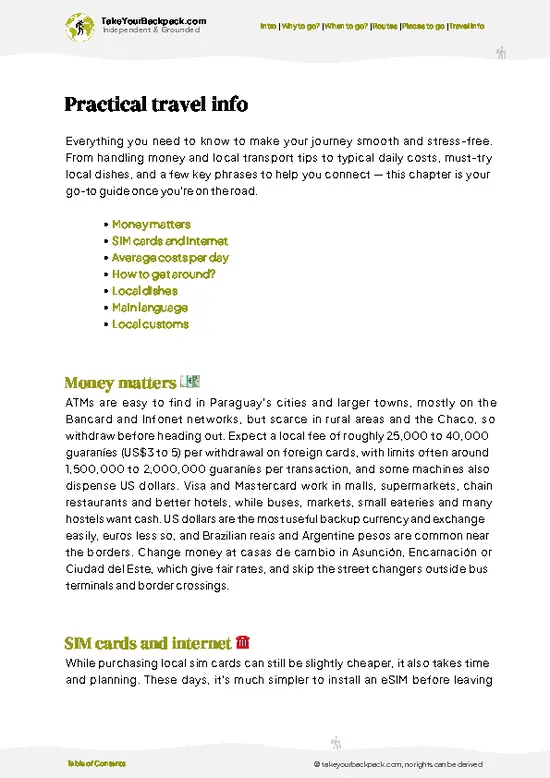
example page 0 from our offline Travel Guide for Paraguay
example page 1 from our offline Travel Guide for Paraguay
example page 2 from our offline Travel Guide for Paraguay
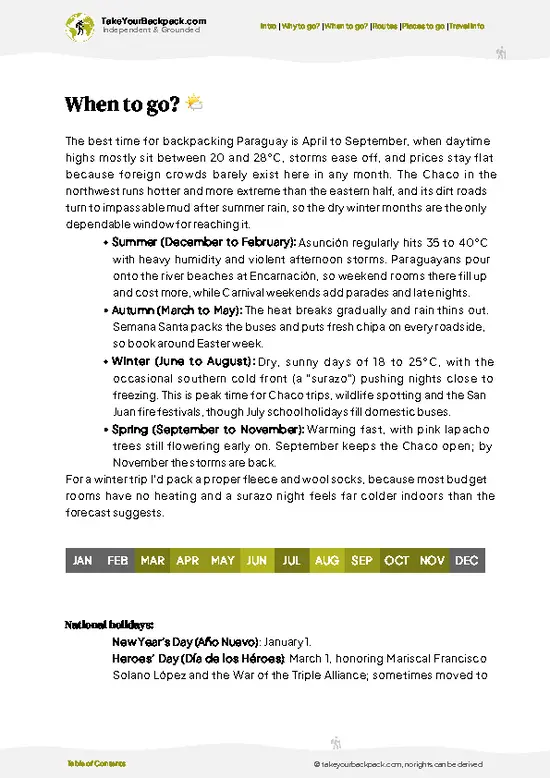
example page 3 from our offline Travel Guide for Paraguay
example page 4 from our offline Travel Guide for Paraguay
example page 5 from our offline Travel Guide for Paraguay
example page 6 from our offline Travel Guide for Paraguay
example page 7 from our offline Travel Guide for Paraguay
Loading the map 🌍
CLICK TO FILTER
cities
towns
landmarks
national parks
hikes
beaches
attractions
festivals
regions
SHOW COUNTRY’S BESTSHOW ALL

✨ Why go?
Ranked #6 town in Paraguay
Why Filadelfia should be on your travel list

Filadelfia is the easiest door into the Paraguayan Chaco, and that is the whole case for it. Founded by Mennonite settlers, the town gives you a clear picture of how farmers turned thorn forest into dairy country, and the Jakob Unger Museum tells it well. Indigenous Enxet, Nivaclé and Ayoreo communities live nearby too, so the cultural picture is wider than the German-speaking colony. Hikers will find little here, but anyone heading toward Parque Nacional Defensores del Chaco or the Bolivian border uses the town to rest, restock and arrange transport. Evenings are calm, with cafés closing early, so it suits solo travelers who like order and slow travelers curious about Paraguay beyond the river towns. Most people stay one or two nights. If you want beaches, markets or a hostel scene, look … read more 👉
Filadelfia is the easiest door into the Paraguayan Chaco, and that is the whole case for it. Founded by Mennonite settlers, the town gives you a clear picture of how farmers turned thorn forest into dairy country, and the Jakob Unger Museum tells it well. Indigenous Enxet, Nivaclé and Ayoreo communities live nearby too, so the cultural picture is wider than the German-speaking colony. Hikers will find little here, but anyone heading toward Parque Nacional Defensores del Chaco or the Bolivian border uses the town to rest, restock and arrange transport. Evenings are calm, with cafés closing early, so it suits solo travelers who like order and slow travelers curious about Paraguay beyond the river towns. Most people stay one or two nights. If you want beaches, markets or a hostel scene, look elsewhere. If you want a clean room, good dairy products and an unusual history lesson, it delivers.

💡 HighlightsKey sights and experiences for travelers

  1. Jakob Unger Museum: The town's best-known sight covers Mennonite settlement, with tools, photos and Indigenous artifacts from the Chaco. Allow 1 to 1.5 hours. Entry is about US$2 to 4. Visit in the morning, when it is cooler.
  2. Plaza and Monument to the Pioneers: A short stroll around the central area shows the colony's layout, wide avenues and neat brick buildings. Free, 30 to 45 minutes, best at dusk.
  3. Cooperativa Fernheim and dairy shops: The cooperative runs a supermarket and sells local cheese, milk and sausages. Browsing takes 30 minutes and a picnic costs US$3 to 6. Go on weekday mornings.
  4. Local Indigenous craft stalls: Enxet and Nivaclé weavings and carved items are sold at small stalls and cooperatives. Prices run US$3 to 25, and an hour is plenty. Weekday mornings are best.
Day trips from … read more 👉
  1. Jakob Unger Museum: The town's best-known sight covers Mennonite settlement, with tools, photos and Indigenous artifacts from the Chaco. Allow 1 to 1.5 hours. Entry is about US$2 to 4. Visit in the morning, when it is cooler.
  2. Plaza and Monument to the Pioneers: A short stroll around the central area shows the colony's layout, wide avenues and neat brick buildings. Free, 30 to 45 minutes, best at dusk.
  3. Cooperativa Fernheim and dairy shops: The cooperative runs a supermarket and sells local cheese, milk and sausages. Browsing takes 30 minutes and a picnic costs US$3 to 6. Go on weekday mornings.
  4. Local Indigenous craft stalls: Enxet and Nivaclé weavings and carved items are sold at small stalls and cooperatives. Prices run US$3 to 25, and an hour is plenty. Weekday mornings are best.
Day trips from Filadelfia can take in Loma Plata, Neu-Halbstadt, Fortín Boquerón and the wildlife of Defensores del Chaco National Park. Start with the Jakob Unger Museum, because it gives context that makes everything else in town and the surrounding colonies easier to read.
Spotted a mistake or missing something? Contact us.

🏘️ NeighborhoodsHow different areas shape the experience

Filadelfia is a compact Mennonite colony town in the Paraguayan Chaco, and its areas are easy to read once you know the grid. Distances are short, but the heat and wide dirt-edged streets make a bicycle or short taxi ride smarter than walking at midday.
  • Centro and Avenida Hindenburg: The main avenue holds the supermarkets, banks, bakeries and the Jakob Unger Museum, which covers Mennonite settlement and the Indigenous peoples of the region. Shops close for a long midday break because of the heat, so do your errands before noon or after 3 pm. Try the dairy products, sausages and cakes of German-Mennonite origin.
  • Plaza and Fernheim cooperative area: Around the plaza are the cooperative offices, the dairy and the agricultural buildings that explain the town’s economy. It is quiet and orderly, and
… read more 👉
Filadelfia is a compact Mennonite colony town in the Paraguayan Chaco, and its areas are easy to read once you know the grid. Distances are short, but the heat and wide dirt-edged streets make a bicycle or short taxi ride smarter than walking at midday.
  • Centro and Avenida Hindenburg: The main avenue holds the supermarkets, banks, bakeries and the Jakob Unger Museum, which covers Mennonite settlement and the Indigenous peoples of the region. Shops close for a long midday break because of the heat, so do your errands before noon or after 3 pm. Try the dairy products, sausages and cakes of German-Mennonite origin.
  • Plaza and Fernheim cooperative area: Around the plaza are the cooperative offices, the dairy and the agricultural buildings that explain the town’s economy. It is quiet and orderly, and a short stroll covers it. Visit on weekday mornings, when it is actually working.
  • The outskirts: Farms, workshops and paved roads stretch out beyond the center, and the distances grow quickly. Renting a bike or hiring a driver saves time here. Evenings are calm, with little nightlife beyond a few restaurants and cafes, so plan on an early dinner.
  • Indigenous communities nearby: Enxet, Nivaclé and Ayoreo people live in settlements around town and are a large part of the local population. Visit crafts cooperatives rather than wandering into villages unannounced, which is how respectful travelers do it.

⌛️ 1 dayHow to make the most of one day

8:00 AM, Cooperative bakery and café: Start where locals do, with coffee and fresh bread, since shops here open early and slow down by midday. Buy water and snacks before walking to the center.
9:30 AM, Jakob Unger Museum: Spend about an hour and a half with the settlement history and Indigenous displays. It is the best primer for the rest of the day.
11:30 AM, Pioneer monument and plaza: Walk the wide avenues and note the brick buildings and the Plautdietsch signage. The route is flat and shaded in patches.
1:00 PM, Lunch at a local restaurant: Order the regional meat plates or a dairy-heavy dish. Kitchens often close by mid-afternoon.
3:00 PM, Indigenous craft stalls: Head to the stalls selling Enxet and Nivaclé weaving. Buying directly supports the makers, and chatting with them adds perspective … read more 👉
8:00 AM, Cooperative bakery and café: Start where locals do, with coffee and fresh bread, since shops here open early and slow down by midday. Buy water and snacks before walking to the center.
9:30 AM, Jakob Unger Museum: Spend about an hour and a half with the settlement history and Indigenous displays. It is the best primer for the rest of the day.
11:30 AM, Pioneer monument and plaza: Walk the wide avenues and note the brick buildings and the Plautdietsch signage. The route is flat and shaded in patches.
1:00 PM, Lunch at a local restaurant: Order the regional meat plates or a dairy-heavy dish. Kitchens often close by mid-afternoon.
3:00 PM, Indigenous craft stalls: Head to the stalls selling Enxet and Nivaclé weaving. Buying directly supports the makers, and chatting with them adds perspective you will not find in the museum.
4:30 PM, Cooperative farm roads on the edge of town: Off the standard route, walk or cycle the quiet farm tracks past dairy paddocks and cattle. Birds are active, and the flat Chaco horizon opens up.
6:30 PM, Dinner and early night: Eat a cheese-heavy meal and call it a day, as the town winds down early.

🌤️ When to go?When to go for the best experience

May to September is the easiest window, with daytime highs of 22 to 30°C (72 to 86°F) and cool nights that can drop to 5°C (41°F) or lower.
  • Winter (May to September): Dry, sunny and comfortable for walking and cycling. Days are shorter, around 10 to 11 hours of light. Cold snaps need a jacket.
  • Summer (November to March): Highs often reach 38 to 42°C (100 to 108°F), and storms can turn dirt roads to mud, closing routes toward the Trans-Chaco Highway. Few travelers visit, so rooms are easy to find.
  • Shoulder months (April, October): Warm, 28 to 35°C (82 to 95°F), and generally manageable. Around Filadelfia’s anniversary on August 17 and the cooperative events, accommodation tightens slightly.
Book bus seats a day ahead in winter, when Chaco-bound travelers are most numerous.

source: climatestotravel.comJANJanuary: below average for travelingFEBFebruary: below average for travelingMARMarch: below average for travelingAPRApril: fair for travelingMAYMay: highly recommended for travelingJUNJune: excellent for travelingJULJuly: highly recommended for travelingAUGAugust: highly recommended for travelingSEPSeptember: excellent for travelingOCTOctober: fair for travelingNOVNovember: fair for travelingDECDecember: below average for traveling
when-to-go

✈️ The backpacker research shortcutParaguay Travel Guide

What the free pages can't give you: ready-made routes, every place ranked, and it works offline. All in 1 guide.
example page 0 from our offline Travel Guide for Paraguay
example page 1 from our offline Travel Guide for Paraguay
example page 2 from our offline Travel Guide for Paraguay
example page 3 from our offline Travel Guide for Paraguay
example page 4 from our offline Travel Guide for Paraguay
example page 5 from our offline Travel Guide for Paraguay
example page 6 from our offline Travel Guide for Paraguay
example page 7 from our offline Travel Guide for Paraguay
The digital guide (226 pages) contains:-page digital guide:
✅ Ready-made 5, 10 & 15-day routes
✅ All 65 places ranked, so you skip the overrated ones
✅ Works offline, all in 1 guide
✅ Cities, national parks, landmarks, beaches
✅ How to get around
👉 Click to see all 30+ guide features

📅 Plan smarter in minutes, not weeks
✅ Month by month travel advice
✅ Festivals & national holidays
✅ Budget expectations

🗺️ Go to the right places, skip the overrated ones
✅ Honest pros & cons of destinations
✅ Top hikes, parks & viewpoints
✅ Lesser-known places most travelers miss
✅ Clear “worth it vs skip it” guidance

🛏️ Travel smoothly without rookie mistakes
✅ Best areas to stay
✅ Transport systems explained simply
✅ Common scams & safety advice
✅ SIM cards, money & practical tips

🌍 Understand the country, not just visit it
✅ Culture & traditions
✅ 52 Essential phrases & customs
✅ Festivals worth planning around
✅ Traveler-friendly historical context
✅ Insights that make places more meaningful

📱 Built for real travel conditions
✅ Fully downloadable PDF
✅ Works completely offline
✅ Optimized for phone use
✅ Useful in remote areas & buses
✅ All in 1 guide
Stop searching, start planning
Get instant access to your full guide. 30‑day money-back guarantee.


By proceeding you agree to our terms.
Sent to your inbox immediately after payment • 100% Secure Checkout
Best Backpacking Travel Advisor 2025 tourism awardBest Backpacking
Travel Advisor
2025
What others say about Take Your Backpack Guides:
⭐⭐⭐⭐⭐
Fantastic, amazing amount of information!
⭐⭐⭐⭐⭐
My goodness this is amazing, it's what I've been looking for hats off too you!
⭐⭐⭐⭐⭐
I think this is absolutely BRILLIANT
⭐⭐⭐⭐
Very complete and informative. It's still missing places, but I gotta to commend you
⭐⭐⭐⭐⭐
This is truly amazing, thank you, can't wait to explore it with my kids!
⭐⭐⭐⭐⭐
Awesome resource, thank you!
⭐⭐⭐⭐⭐
This is amazing! Can't wait to explore the ones I haven't seen
⭐⭐⭐⭐
I love this! Well done, great idea.
⭐⭐⭐⭐⭐
Thanks for taking the time to make this gem!
⭐⭐⭐⭐⭐
This might be the best website I've ever seen.
⭐⭐⭐⭐⭐
Congratulations, and thank you so much for your work; it's incredibly valuable.
⭐⭐⭐⭐
In all seriousness I think you did a great job pointing out the important spots
⭐⭐⭐⭐⭐
10/10 very good
⭐⭐⭐⭐⭐
As someone who's only just starting to visit regularly this is awesome, thank you.
⭐⭐⭐⭐
Thank you very much! I'm going to visit my dad, it's going to be very useful!
⭐⭐⭐⭐⭐
This is really cool! We'll be travelling for the first time and this definitely come in handy.
⭐⭐⭐⭐⭐
You are now our minister of culture, congratulations 👨‍💼
⭐⭐⭐⭐⭐
Just wanted to tell you that this is a pearl! Going to follow your recommendations.
⭐⭐⭐⭐⭐
This is so cool. I'll definitely be using the resource for my travels soon.
⭐⭐⭐⭐⭐
This is very impressive! Good work.
⭐⭐⭐⭐⭐
This is an amazing and informative site. Very well done!

🛏️ Where to stay?Choosing the right base

The center around Avenida Hindenburg is the best area for a budget bed, since guesthouses, small hotels, restaurants and the bus terminal are all within a short walk. Dorm-style hostels are rare in Filadelfia, so expect simple private rooms at around US$20 to 40, sometimes with air conditioning, which matters from November to March. Book ahead in the winter months and around cooperative events.

The quieter residential streets just off the main avenue are the second choice. They are calmer at night and still within about ten minutes of the shops, though you will want a bicycle or a short taxi … read more 👉
The center around Avenida Hindenburg is the best area for a budget bed, since guesthouses, small hotels, restaurants and the bus terminal are all within a short walk. Dorm-style hostels are rare in Filadelfia, so expect simple private rooms at around US$20 to 40, sometimes with air conditioning, which matters from November to March. Book ahead in the winter months and around cooperative events.

The quieter residential streets just off the main avenue are the second choice. They are calmer at night and still within about ten minutes of the shops, though you will want a bicycle or a short taxi for anything farther. Night-time safety is rarely a problem in either area, with little traffic and very little noise after 9 pm. Shared kitchens are uncommon, but supermarkets and bakeries on the main avenue make self-catering simple. Staying outside town on farms or ranches can be appealing but depends on having your own transport.

🚌 Getting aroundTransportation options and practical tips

Trying to cover Filadelfia and its surroundings on foot or by waiting for buses wastes the most time, because the town is spread out, the heat is heavy and Chaco distances are long. Everything central is walkable in the cooler hours. Beyond the center you need wheels. Paved roads are good, but public transport within town barely exists.
  • Walking: Free, and fine for the center in the morning or evening. The midday sun is harsh, so experienced travelers carry water and a hat and avoid walking between noon and 3 pm.
  • Bicycle: Rental from some guesthouses or shops runs about US$5 to 10 a day. The terrain is flat and roads are wide, so it is the cheapest way to reach the outskirts, though sand on unpaved edges slows you down.
  • Taxi or local driver: A ride within town costs around US$2 to 4. For visits
… read more 👉
Trying to cover Filadelfia and its surroundings on foot or by waiting for buses wastes the most time, because the town is spread out, the heat is heavy and Chaco distances are long. Everything central is walkable in the cooler hours. Beyond the center you need wheels. Paved roads are good, but public transport within town barely exists.
  • Walking: Free, and fine for the center in the morning or evening. The midday sun is harsh, so experienced travelers carry water and a hat and avoid walking between noon and 3 pm.
  • Bicycle: Rental from some guesthouses or shops runs about US$5 to 10 a day. The terrain is flat and roads are wide, so it is the cheapest way to reach the outskirts, though sand on unpaved edges slows you down.
  • Taxi or local driver: A ride within town costs around US$2 to 4. For visits to nearby Indigenous communities or farms, arrange a driver for half a day, roughly US$25 to 50, because there is no public service to those places.
  • Long-distance bus: Services link Filadelfia with Asunción, taking about 7 to 9 hours for US$20 to 30, mostly overnight and morning departures. Buy tickets at the terminal a day ahead, as seats fill and schedules change. Routes toward Bolivia are less frequent and slower.
  • Rental car or 4x4: Daily rates typically run US$60 to 100. Useful for the national parks and the Trans-Chaco Highway, but rain can close dirt roads for days, so check conditions locally before leaving.

👛 Costs (as of 19 October 2026)Money, prices, and spending tips

A backpacker in Filadelfia can expect to spend about US$39 to 88 a day, with the biggest costs in accommodation and arranging transport.
CategoryBudget RangeLocal Reality
Dorm accommodationUS$20 to 40True dorms are scarce, so a simple private room is the norm, with prices rising in winter.
MealsUS$10 to 20Bakeries, supermarkets and simple restaurants serve filling meals, with German-influenced sausages and cakes.
Local transportUS$3 to 10Short taxi rides or a bike rental. No regular city buses.
Basic activities/entry feesUS$3 to 10Museum entry is low, and guided community visits cost more.
Miscellaneous expensesUS$3 to 8Water, snacks, SIM data and laundry.
Total Daily BudgetUS$39 to 88Roughly US$63 using a mid-range high-season room.
Buying groceries at the supermarkets on the main avenue instead … read more 👉
A backpacker in Filadelfia can expect to spend about US$39 to 88 a day, with the biggest costs in accommodation and arranging transport.
CategoryBudget RangeLocal Reality
Dorm accommodationUS$20 to 40True dorms are scarce, so a simple private room is the norm, with prices rising in winter.
MealsUS$10 to 20Bakeries, supermarkets and simple restaurants serve filling meals, with German-influenced sausages and cakes.
Local transportUS$3 to 10Short taxi rides or a bike rental. No regular city buses.
Basic activities/entry feesUS$3 to 10Museum entry is low, and guided community visits cost more.
Miscellaneous expensesUS$3 to 8Water, snacks, SIM data and laundry.
Total Daily BudgetUS$39 to 88Roughly US$63 using a mid-range high-season room.
Buying groceries at the supermarkets on the main avenue instead of eating out each meal trims several dollars a day. Pay in guaraníes, and withdraw cash in town, as card acceptance can be patchy.


source: senatur.gov.py
⚠️ Prices can change and everyone travels differently, so take this as a rough guide. Hope it helps you plan your adventure!

🚌 Day tripsBest day trips from Filadelfia

Filadelfia works well as a base for half-day and full-day outings, but public transport is thin, so most trips need a hired driver or a rental car.
Loma Plata and Neuland: Loma Plata, the oldest Mennonite town in the Chaco, lies about 30 km east, and Neuland sits farther south. A driver costs roughly US$40 to 70 for the loop. You can see museums, cooperatives and dairies in half a day. Go in the dry months, as rain makes side roads impassable.

Teniente Enciso National Park: This park, more than 200 km northwest of town, protects dry thorn forest and has a basic visitor area. A day return by car takes around 4 to 5 hours of driving each way depending on road conditions, so start at dawn. Bring all your water and fuel. First-timers often underestimate the heat and distance.

Indigenous craft … read more 👉
Filadelfia works well as a base for half-day and full-day outings, but public transport is thin, so most trips need a hired driver or a rental car.
Loma Plata and Neuland: Loma Plata, the oldest Mennonite town in the Chaco, lies about 30 km east, and Neuland sits farther south. A driver costs roughly US$40 to 70 for the loop. You can see museums, cooperatives and dairies in half a day. Go in the dry months, as rain makes side roads impassable.

Teniente Enciso National Park: This park, more than 200 km northwest of town, protects dry thorn forest and has a basic visitor area. A day return by car takes around 4 to 5 hours of driving each way depending on road conditions, so start at dawn. Bring all your water and fuel. First-timers often underestimate the heat and distance.

Indigenous craft communities: Communities near town, including Enxet and Nivaclé settlements, sell woven bags and crafts. A half-day with a local guide costs about US$30 to 60. Going with an arranged contact is more respectful than turning up unannounced.

🛡️ SafetySafety Tips and Common Scams in Filadelfia

Filadelfia is one of the calmest towns in Paraguay, and violent crime against visitors is rare. Petty theft is uncommon, though you should still lock your room and keep valuables out of sight on the bus. The real hazards are environmental. Midday heat can reach 40°C (104°F) in summer, so carry water and avoid exertion between noon and 3 pm. Mosquitoes are active after rain, and repellent is worthwhile. Solo travelers, including women, generally report few problems, and streets are quiet after dark, which means little street life rather than danger. Dirt roads outside town turn to mud in storms, so check conditions before driving, and tell someone where you are headed. Scams are rare. Taxi fares are straightforward, but agree on a price before a longer trip. Respect for local customs and requesting … read more 👉
Filadelfia is one of the calmest towns in Paraguay, and violent crime against visitors is rare. Petty theft is uncommon, though you should still lock your room and keep valuables out of sight on the bus. The real hazards are environmental. Midday heat can reach 40°C (104°F) in summer, so carry water and avoid exertion between noon and 3 pm. Mosquitoes are active after rain, and repellent is worthwhile. Solo travelers, including women, generally report few problems, and streets are quiet after dark, which means little street life rather than danger. Dirt roads outside town turn to mud in storms, so check conditions before driving, and tell someone where you are headed. Scams are rare. Taxi fares are straightforward, but agree on a price before a longer trip. Respect for local customs and requesting permission before photographing people goes a long way.

FAQTraveler FAQ

Filadelfia is worth a stop of a night or two if you are heading through the Chaco, though it is not a classic backpacker destination. The Jakob Unger Museum, the cooperative dairies and the Mennonite bakeries give a clear picture of a settlement culture unlike anywhere else in Paraguay. Indigenous crafts and Teniente Enciso National Park add reasons to linger, and it is a practical base for the Trans-Chaco route.
Two days is enough for Filadelfia, with a third if you add Loma Plata or a national park trip. A full day covers the museum, the center and the cooperatives, and half a day more suits Loma Plata with a hired driver at roughly US$40 to 70. Overnight buses from Asunción take about 7 to 9 hours, so arriving in the morning gives you a full first day.
Filadelfia is too far from Asunción for a realistic day trip, as the bus alone takes about 7 to 9 hours each way for US$20 to 30. Loma Plata, about 30 km away, is the only nearby town where a day outing makes sense, and that works well by car or taxi. Plan on at least one night in Filadelfia, since buses are mostly overnight or early morning.
⚠️ Things can change over time, so always validate details locally before you go.

Other Paraguayan towns near Filadelfia

Explore more nearby:

  • Concepción—Cargo port, river trips, market stalls, northern river town| 292 km away
  • Horqueta—Cattle country, plaza tereré, ranch roads, Ypané banks| 326 km away
  • Villa Hayes—River crossing, Hayes monument, working port, plaza empanadas| 397 km away

💡 Not sure where to go next?
Create a personalized itinerary for Paraguay including Filadelfia and the places that fit your trip.

Generate my itinerary

👉 Discover all towns

Or checkout all Paraguay has to offer (think cities, towns, villages, national parks, hikes, beaches, festivals)
Country photo of Paraguay

We 💚 feedbackKey takeaways before you go

Filadelfia deserves one night, two if you want the museum and a slow loop through the neighboring colonies without rushing. Any longer and you will run out of things to do unless you head into the park. I would arrive by midday, book a room ahead, and leave the next morning.

✈️ When did I visit Paraguay?
Before visiting Argentina in September 2012, I crossed through Paraguay, ending up at the magical Iguazu Falls.

✍️ Help improve this page!
The information on this page is based on my own backpacking experience in Paraguay, supplemented with up-to-date research and feedback from other travelers. Travel details can change, so if you notice anything outdated or incomplete, feel free to let me know.


🙋‍♂️ Give feedback

👋 Meet the founderWho’s Behind Take Your Backpack?

Johan, backpacker and founder of TakeYourBackpackHi, I’m Johan (Netherlands 🇳🇱), the creator of TakeYourBackpack. Over the past 30 years, I’ve backpacked through 88 countries across six continents, gaining extensive experience with independent travel, long-term trips, and overland routes.

This site is built on a combination of firsthand travel experience and carefully curated insights from other backpackers. Many guides are based on places I’ve personally visited, while others bring together tips, observations, and practical advice shared by trusted travelers I’ve met along the way.

The goal is to provide realistic, experience-driven guidance — not generic itineraries — so you can explore destinations with better context, clearer expectations, and more confidence.