×

Paraguay🇵🇾 | townsTobatíClay kilns, wood carvers, hilltop viewpoint, Cordillera village | things to do and best time to go

Explore AyolasExplore Caazapá

Backpacking in Tobatí
👌 Worth visitingtown ranked #10
By Johan Kruseman 🇳🇱 | Updated October 19, 2026

Tobatí was once a quiet pottery village that few outsiders ever saw, reached by dirt roads and known mostly to Paraguayans buying clay pieces. Today it is still small, but a paved road and a trickle of visitors have arrived. It sits in the Cordillera department of Paraguay, east of Asunción. My advice, after wrongly assuming the workshops open all day on Sundays and finding doors shut: go on a weekday morning. The ceramics, wood carving and the hill views are worth your time. Nightlife is not, and there are few hostels, so meeting other backpackers is rare. Unlike nearby Altos, a lakeside town with more lodging and a German-founded feel, Tobatí is about craft and hills, not beaches.

Part of Backpacking in Paraguay: all 65 places on one map, with routes and the best time to go.
Discover everything you want to know in the 📖 Paraguay Travel Guide.


example page 0 from our offline Travel Guide for Paraguay
example page 1 from our offline Travel Guide for Paraguay
example page 2 from our offline Travel Guide for Paraguay
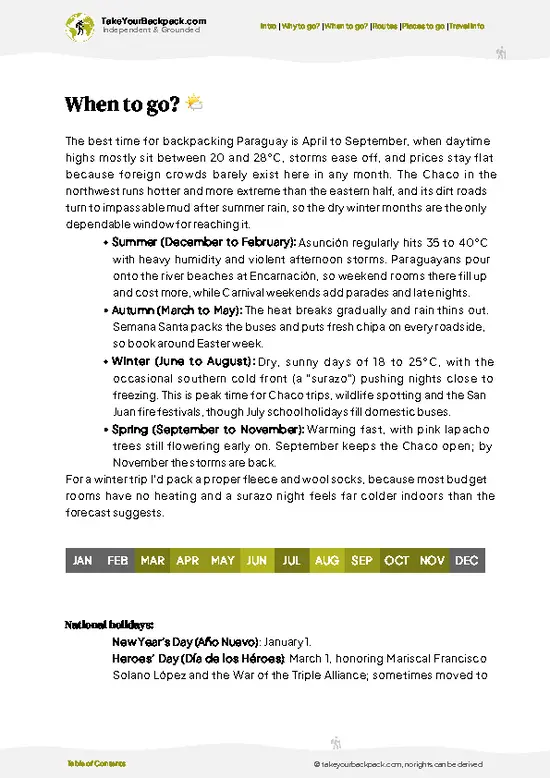
example page 3 from our offline Travel Guide for Paraguay
example page 4 from our offline Travel Guide for Paraguay
example page 5 from our offline Travel Guide for Paraguay
example page 6 from our offline Travel Guide for Paraguay
example page 7 from our offline Travel Guide for Paraguay
Loading the map 🌍
CLICK TO FILTER
cities
towns
landmarks
national parks
hikes
beaches
attractions
festivals
regions
SHOW COUNTRY’S BESTSHOW ALL

✨ Why go?
Ranked #10 town in Paraguay
Reasons people choose to visit here

Tobatí earns a place on a route for its craft culture, not for ticking off sights. Families here have shaped clay and carved wood for generations, and you can watch the work in small workshops, often talking directly with the maker. The surrounding hills, including the rocky Cerro Tobatí area, give you short walks with wide views over farmland, and the parish church of the Immaculate Conception anchors a plaza that is easy to cover on foot. Most travelers pass through for half a day, though slow travelers who like pottery or photography can happily stay overnight. It is quiet after dark, which suits solo travelers seeking calm and does not suit anyone wanting company or a bar scene. Pair it with Altos or Caacupé rather than treating it as a destination on its own.

💡 HighlightsWhat this place is best known for

  1. Ceramic workshops (talleres de cerámica): This is what Tobatí is known for. Families shape and fire clay figures, pots and tiles, often in open-air kilns. Go on a weekday morning, when the potters are working. Browsing is free and pieces cost roughly US$3 to 40. Allow 1 to 2 hours.
  2. Wood carving workshops: Local carvers make religious figures and animals from native wood, a tradition as old as the clay work. Prices run about US$5 to 60 depending on size. Mornings are best. Plan 45 minutes.
  3. Iglesia de Tobatí: The town church on the main plaza is a simple colonial-style building and the center of local festivals. Entry is free, and a visit takes 15 to 20 minutes. Late afternoon is calm.
  4. Cerro Tobatí viewpoint: A short climb on the hills outside the center gives broad views over the cultivated plain
… read more 👉
  1. Ceramic workshops (talleres de cerámica): This is what Tobatí is known for. Families shape and fire clay figures, pots and tiles, often in open-air kilns. Go on a weekday morning, when the potters are working. Browsing is free and pieces cost roughly US$3 to 40. Allow 1 to 2 hours.
  2. Wood carving workshops: Local carvers make religious figures and animals from native wood, a tradition as old as the clay work. Prices run about US$5 to 60 depending on size. Mornings are best. Plan 45 minutes.
  3. Iglesia de Tobatí: The town church on the main plaza is a simple colonial-style building and the center of local festivals. Entry is free, and a visit takes 15 to 20 minutes. Late afternoon is calm.
  4. Cerro Tobatí viewpoint: A short climb on the hills outside the center gives broad views over the cultivated plain and rocky outcrops. It is free. Allow 1.5 to 2 hours, and go in the cooler morning.
  5. Plaza and market streets: A slow loop around the plaza shows everyday life, with small shops selling crafts and snacks such as chipa. Spending is minimal, around US$1 to 4 for a snack. Allow 30 to 45 minutes.
For day trips, Altos and its lake, the basilica in Caacupé and the Ypacaraí lake area are all close. All five stops together fill roughly five to six unhurried hours.
Spotted a mistake or missing something? Contact us.

Things to do near Tobatí

Ratings based on Tripadvisor reviews. When you book through this link, you support our work at no extra cost to you.

🏘️ NeighborhoodsKey areas and districts to know

Tobatí is small enough that its areas blur into each other, but they differ in what they offer. Most of your time belongs in the first two.
  • Plaza and church area. The center is a few streets around the main plaza and the church, with bakeries, small shops and simple eateries serving chipa, sopa paraguaya and grilled meat. It is flat and walkable in twenty minutes. Spend an hour here, no more.
  • Artisan workshops. Tobatí is known for its woodcarving and for clay pottery and brick kilns. Workshops sit scattered along the edges of town and in the surrounding compañías, and visiting them is the best use of your time. Walking works for the nearer ones, though the farther ones are hot, dusty walks.
  • Cerro Tobatí and the hills. The hills north of town have the viewpoints and rural lanes. Go for the views
… read more 👉
Tobatí is small enough that its areas blur into each other, but they differ in what they offer. Most of your time belongs in the first two.
  • Plaza and church area. The center is a few streets around the main plaza and the church, with bakeries, small shops and simple eateries serving chipa, sopa paraguaya and grilled meat. It is flat and walkable in twenty minutes. Spend an hour here, no more.
  • Artisan workshops. Tobatí is known for its woodcarving and for clay pottery and brick kilns. Workshops sit scattered along the edges of town and in the surrounding compañías, and visiting them is the best use of your time. Walking works for the nearer ones, though the farther ones are hot, dusty walks.
  • Cerro Tobatí and the hills. The hills north of town have the viewpoints and rural lanes. Go for the views and quiet; it is worth a half day, but bring water and start early because there is little shade.
  • Evenings. Nightlife is close to nonexistent. Expect a few bars, tereré circles on sidewalks and an early quiet. Do not plan an evening out here.

⌛️ 1 day1-day itinerary for Tobatí

8:30 AM, Plaza and Iglesia de Tobatí: Start on the main plaza, because the workshops are most active in the morning and the church gives you your bearings. Look inside, then walk a few minutes to the first craft streets.
9:30 AM, Ceramic workshops: Visit two or three potters. Watch the shaping and ask about the kilns. Buy small pieces that fit in a pack.
11:30 AM, Wood carving workshops: Move on foot to the carvers, who work in small home studios. The detail on saints and animals is worth seeing up close.
1:00 PM, Lunch: Eat a simple meal at a local comedor near the plaza. Try chipa or sopa paraguaya.
2:30 PM, Cerro Tobatí: Head out to the hills for a gentle climb and views over the farmland. Go slowly and carry water.
4:30 PM, Back-lane walk: Skip the main streets and wander the dirt lanes behind … read more 👉
8:30 AM, Plaza and Iglesia de Tobatí: Start on the main plaza, because the workshops are most active in the morning and the church gives you your bearings. Look inside, then walk a few minutes to the first craft streets.
9:30 AM, Ceramic workshops: Visit two or three potters. Watch the shaping and ask about the kilns. Buy small pieces that fit in a pack.
11:30 AM, Wood carving workshops: Move on foot to the carvers, who work in small home studios. The detail on saints and animals is worth seeing up close.
1:00 PM, Lunch: Eat a simple meal at a local comedor near the plaza. Try chipa or sopa paraguaya.
2:30 PM, Cerro Tobatí: Head out to the hills for a gentle climb and views over the farmland. Go slowly and carry water.
4:30 PM, Back-lane walk: Skip the main streets and wander the dirt lanes behind the plaza, where families fire pieces in backyard kilns and few visitors go. Say hello, since people are happy to chat.
6:00 PM, Plaza: Finish with a drink and watch evening life settle. Buses back toward the main road thin out later, so leave while they still run.

🌤️ When to go?Choosing the right time of year

March to May and September to November are the most comfortable months for walking between workshops and hills.
  • Autumn (Mar to May): Highs of 22 to 28°C (72 to 82°F), cool nights and little crowding.
  • Winter (Jun to Aug): Days of 17 to 23°C (63 to 73°F), with cold snaps near 5°C (41°F) at night. Daylight is shorter, and prices stay flat.
  • Spring (Sep to Nov): Warming to 25 to 32°C (77 to 90°F), with clear skies and green hills.
  • Summer (Dec to Feb): Highs of 32 to 38°C (90 to 100°F), humid, with heavy afternoon storms. Dirt roads turn muddy.
  • Festivals: The patron saint celebrations on December 8 bring the largest local crowds.
Check for rain before heading to the hills, since the dirt tracks get slick.

source: climatestotravel.comJANJanuary: fair for travelingFEBFebruary: fair for travelingMARMarch: fair for travelingAPRApril: fair for travelingMAYMay: highly recommended for travelingJUNJune: highly recommended for travelingJULJuly: highly recommended for travelingAUGAugust: excellent for travelingSEPSeptember: excellent for travelingOCTOctober: fair for travelingNOVNovember: fair for travelingDECDecember: fair for traveling
when-to-go

✈️ The backpacker research shortcutParaguay Travel Guide

What the free pages can't give you: ready-made routes, every place ranked, and it works offline. All in 1 guide.
example page 0 from our offline Travel Guide for Paraguay
example page 1 from our offline Travel Guide for Paraguay
example page 2 from our offline Travel Guide for Paraguay
example page 3 from our offline Travel Guide for Paraguay
example page 4 from our offline Travel Guide for Paraguay
example page 5 from our offline Travel Guide for Paraguay
example page 6 from our offline Travel Guide for Paraguay
example page 7 from our offline Travel Guide for Paraguay
The digital guide (226 pages) contains:-page digital guide:
✅ Ready-made 5, 10 & 15-day routes
✅ All 65 places ranked, so you skip the overrated ones
✅ Works offline, all in 1 guide
✅ Cities, national parks, landmarks, beaches
✅ How to get around
👉 Click to see all 30+ guide features

📅 Plan smarter in minutes, not weeks
✅ Month by month travel advice
✅ Festivals & national holidays
✅ Budget expectations

🗺️ Go to the right places, skip the overrated ones
✅ Honest pros & cons of destinations
✅ Top hikes, parks & viewpoints
✅ Lesser-known places most travelers miss
✅ Clear “worth it vs skip it” guidance

🛏️ Travel smoothly without rookie mistakes
✅ Best areas to stay
✅ Transport systems explained simply
✅ Common scams & safety advice
✅ SIM cards, money & practical tips

🌍 Understand the country, not just visit it
✅ Culture & traditions
✅ 52 Essential phrases & customs
✅ Festivals worth planning around
✅ Traveler-friendly historical context
✅ Insights that make places more meaningful

📱 Built for real travel conditions
✅ Fully downloadable PDF
✅ Works completely offline
✅ Optimized for phone use
✅ Useful in remote areas & buses
✅ All in 1 guide
Stop searching, start planning
Get instant access to your full guide. 30‑day money-back guarantee.


By proceeding you agree to our terms.
Sent to your inbox immediately after payment • 100% Secure Checkout
Best Backpacking Travel Advisor 2025 tourism awardBest Backpacking
Travel Advisor
2025
What others say about Take Your Backpack Guides:
⭐⭐⭐⭐⭐
Fantastic, amazing amount of information!
⭐⭐⭐⭐⭐
My goodness this is amazing, it's what I've been looking for hats off too you!
⭐⭐⭐⭐⭐
I think this is absolutely BRILLIANT
⭐⭐⭐⭐
Very complete and informative. It's still missing places, but I gotta to commend you
⭐⭐⭐⭐⭐
This is truly amazing, thank you, can't wait to explore it with my kids!
⭐⭐⭐⭐⭐
Awesome resource, thank you!
⭐⭐⭐⭐⭐
This is amazing! Can't wait to explore the ones I haven't seen
⭐⭐⭐⭐
I love this! Well done, great idea.
⭐⭐⭐⭐⭐
Thanks for taking the time to make this gem!
⭐⭐⭐⭐⭐
This might be the best website I've ever seen.
⭐⭐⭐⭐⭐
Congratulations, and thank you so much for your work; it's incredibly valuable.
⭐⭐⭐⭐
In all seriousness I think you did a great job pointing out the important spots
⭐⭐⭐⭐⭐
10/10 very good
⭐⭐⭐⭐⭐
As someone who's only just starting to visit regularly this is awesome, thank you.
⭐⭐⭐⭐
Thank you very much! I'm going to visit my dad, it's going to be very useful!
⭐⭐⭐⭐⭐
This is really cool! We'll be travelling for the first time and this definitely come in handy.
⭐⭐⭐⭐⭐
You are now our minister of culture, congratulations 👨‍💼
⭐⭐⭐⭐⭐
Just wanted to tell you that this is a pearl! Going to follow your recommendations.
⭐⭐⭐⭐⭐
This is so cool. I'll definitely be using the resource for my travels soon.
⭐⭐⭐⭐⭐
This is very impressive! Good work.
⭐⭐⭐⭐⭐
This is an amazing and informative site. Very well done!

🛏️ Where to stay?Where staying makes the most sense

Stay in the area around the central plaza, because it is the only part of Tobatí with a handful of simple guesthouses and a few places to eat nearby. Dedicated hostels are almost nonexistent, so budget beds usually mean a basic room at roughly US$12 to 25 a night. Expect a quiet night, since the town winds down early and the main noise is roosters and the occasional motorbike. Walking back after dark is comfortable in the center, though streets are poorly lit further out.
If rooms are full or you want more choice, many backpackers sleep in Asunción or in a larger town along the route and visit … read more 👉
Stay in the area around the central plaza, because it is the only part of Tobatí with a handful of simple guesthouses and a few places to eat nearby. Dedicated hostels are almost nonexistent, so budget beds usually mean a basic room at roughly US$12 to 25 a night. Expect a quiet night, since the town winds down early and the main noise is roosters and the occasional motorbike. Walking back after dark is comfortable in the center, though streets are poorly lit further out.
If rooms are full or you want more choice, many backpackers sleep in Asunción or in a larger town along the route and visit Tobatí by bus. That gives you far more hostels, better nightlife and frequent transport, at the cost of a long ride each way. Staying in Tobatí itself is the better choice if you want early light at the workshops.

🚌 Getting aroundGetting around like a local

The center of Tobatí can be crossed on foot in about fifteen minutes, but the workshops and hills spread several kilometers out, and that is where walking stops making sense. Traffic is light, with motorbikes and the occasional truck. Public transport is limited to buses on the main road, so plan around their timetable.
  • Walking. Free, and right for the plaza, church and nearby workshops. Midday heat from October to March makes anything over 3 km tiring.
  • Intercity bus from Asunción. The trip takes about 1.5 to 2 hours and costs US$1.50 to 3. Buses run from early morning until early evening, so confirm the last return before you go.
  • Moto-taxi. The best value for reaching outlying workshops and viewpoints at US$1 to 3 per ride. Agree the price first, and arrange a pickup for the return.
  • Taxi or ride-hailing
… read more 👉
The center of Tobatí can be crossed on foot in about fifteen minutes, but the workshops and hills spread several kilometers out, and that is where walking stops making sense. Traffic is light, with motorbikes and the occasional truck. Public transport is limited to buses on the main road, so plan around their timetable.
  • Walking. Free, and right for the plaza, church and nearby workshops. Midday heat from October to March makes anything over 3 km tiring.
  • Intercity bus from Asunción. The trip takes about 1.5 to 2 hours and costs US$1.50 to 3. Buses run from early morning until early evening, so confirm the last return before you go.
  • Moto-taxi. The best value for reaching outlying workshops and viewpoints at US$1 to 3 per ride. Agree the price first, and arrange a pickup for the return.
  • Taxi or ride-hailing car. Taxis are rare in town, so expect to arrange one by phone, and costs for a return trip from Asunción run US$35 to 50. Worth it only if you are splitting with others.
  • Bicycle. Rentals are informal and rare, so bring your own if you want to ride. The roads are quiet but hilly, and some are unpaved.

👛 Costs (as of 19 October 2026)Travel costs and budget guide for Tobatí

A backpacker in Tobatí spends about US$28 to 58 a day, with the total below counting high-season accommodation.
CategoryBudget RangeLocal Reality
Dorm accommodationUS$12 to 25Few true dorms exist, so you pay for a simple private room in a guesthouse.
MealsUS$8 to 14Chipa, sopa paraguaya and grilled meat at local eateries, cooked simply and cheaply.
Local transportUS$3 to 6Moto-taxis at US$1 to 3 a ride, plus a bus fare from Asunción.
Basic activities/entry feesUS$0 to 5Workshops are free to visit, though most visitors buy a small piece.
Miscellaneous expensesUS$5 to 8Water, snacks, sunscreen and the occasional drink.
Total Daily BudgetUS$28 to 58About US$45 a day on average.
Buy crafts directly from the workshops rather than shops in Asunción, and you pay noticeably less.

source: senatur.gov.py
⚠️ Prices can change and everyone travels differently, so take this as a rough guide. Hope it helps you plan your adventure!

🚌 Day tripsEasy escapes and nearby places

Tobatí works better as a day trip from Asunción than as a base, but a few nearby spots make it worth an overnight if you are not rushed.Cerro Tobatí lookouts: The hills just outside town give long views over farmland and a patchwork of kilns. Allow half a day, and go between April and October when the heat is manageable. A moto-taxi there costs US$2 to 4. First-timers often start at noon and regret it.
Atyrá: This hill town about an hour away by bus and shared ride is known for its cool air, small crafts and slow main street. Budget US$5 to 10 for transport and a lunch. It is greener in spring, and weekends are the busiest.
Caacupé: Paraguay’s main pilgrimage site, with a large basilica, sits about 17 km away. Buses cost about US$1 to 3 each way. Avoid December 8, when the crowds are enormous. … read more 👉
Tobatí works better as a day trip from Asunción than as a base, but a few nearby spots make it worth an overnight if you are not rushed.Cerro Tobatí lookouts: The hills just outside town give long views over farmland and a patchwork of kilns. Allow half a day, and go between April and October when the heat is manageable. A moto-taxi there costs US$2 to 4. First-timers often start at noon and regret it.
Atyrá: This hill town about an hour away by bus and shared ride is known for its cool air, small crafts and slow main street. Budget US$5 to 10 for transport and a lunch. It is greener in spring, and weekends are the busiest.
Caacupé: Paraguay’s main pilgrimage site, with a large basilica, sits about 17 km away. Buses cost about US$1 to 3 each way. Avoid December 8, when the crowds are enormous.
👉 Explore CaacupéPiribebuy: A historic town with a museum and a quiet plaza, reached in about an hour by bus for US$1 to 3. Go on a weekday, as some sites close on Sundays.
👉 Explore Piribebuy

🛡️ SafetyTraveler Safety Guide

Tobatí is calm, and most problems are minor. Petty theft is uncommon, but keep your phone out of sight on buses from Asunción and watch your bag in the crowded terminal. Walking in the center at night is fine, though poorly lit lanes toward the edges are best avoided alone. Solo travelers, including women, usually find locals curious and helpful. The main annoyances are sun and unmarked dirt roads, so carry water and a hat, and let your guesthouse know where you are heading. Stray dogs sometimes chase bicycles and motorbikes, so slow down if one follows. Use a registered moto-taxi and agree the price in advance.

FAQCommon questions from travelers

Tobatí rewards a visit in its own right. The town sits in the Cordillera department, about 74 km east of Asunción, and is known for its pottery and for the stone and woodcarving workshops that line the roads. The hills are the other draw, with short walks from town up Cerro Tobatí and Cerro Kavajú. Budget a few dollars (US$2 to 5) for a workshop stop and a few more for a local lunch.
One full day covers the main sights, and two days give you room for the hills. Tobatí takes in the town’s ceramic workshops, the church and the plaza in a morning, while an afternoon can go to a walk up the nearby ridges and the Cerro del Mirador lookout. Staying a second day lets you see the countryside at a slower pace and pairs well with Caacupé, roughly 17 km away. Expect to spend about US$20 to 35 per day on food, local transport and small entry fees.
Yes, Tobatí works well as a day trip from Asunción, with an early start. Buses from the Asunción terminal run via Caacupé and take about 2 to 3 hours each way, with fares of roughly US$2 to 4 in total, so leave before 8 a.m. to have a full day in town. Return services thin out in the late afternoon, so confirm the last bus back to Caacupé or Asunción when you arrive. Anyone with a car or a shared ride from Caacupé can cut the trip to around 1.5 hours.
⚠️ Things can change over time, so always validate details locally before you go.

Other Paraguayan towns near Tobatí

Explore more nearby:

  • Caacupé—Domed basilica, pilgrim esplanade, holy well, candle stalls| 15 km away
  • San Bernardino—Lake promenade, old summer villas, town beach, weekday calm| 21 km away
  • Piribebuy—War-era museum, sixty-stripe ponchos, colonial porches, plaza food stalls| 23 km away

💡 Not sure where to go next?
Create a personalized itinerary for Paraguay including Tobatí and the places that fit your trip.

Generate my itinerary

👉 Discover all towns

Or checkout all Paraguay has to offer (think cities, towns, villages, national parks, hikes, beaches, festivals)
Country photo of Paraguay

We 💚 feedbackKey takeaways before you go

Tobatí works best as a half-day add-on, paired with Altos for the lake and Caacupé for its basilica, rather than a stay of its own. I would come on a weekday morning with cash in small bills and room in my bag. Skip it if crafts leave you cold.

✈️ When did I visit Paraguay?
Before visiting Argentina in September 2012, I crossed through Paraguay, ending up at the magical Iguazu Falls.

✍️ Help improve this page!
The information on this page is based on my own backpacking experience in Paraguay, supplemented with up-to-date research and feedback from other travelers. Travel details can change, so if you notice anything outdated or incomplete, feel free to let me know.


🙋‍♂️ Give feedback

👋 Meet the founderWho’s Behind Take Your Backpack?

Johan, backpacker and founder of TakeYourBackpackHi, I’m Johan (Netherlands 🇳🇱), the creator of TakeYourBackpack. Over the past 30 years, I’ve backpacked through 88 countries across six continents, gaining extensive experience with independent travel, long-term trips, and overland routes.

This site is built on a combination of firsthand travel experience and carefully curated insights from other backpackers. Many guides are based on places I’ve personally visited, while others bring together tips, observations, and practical advice shared by trusted travelers I’ve met along the way.

The goal is to provide realistic, experience-driven guidance — not generic itineraries — so you can explore destinations with better context, clearer expectations, and more confidence.