×

Paraguay🇵🇾 | national parksYpoá National ParkReedy lake, floating camalote islands, caimans and capybaras, boat guides | things to do and best time to go

Explore Ybycuí National ParkExplore Itaipu Nature Reserve

Backpacking in Ypoá
🌟 Highlightnational park ranked #7
By Johan Kruseman 🇳🇱 | Updated October 19, 2026

The real decision at Ypoá National Park is whether to go by land on your own or hire a local boat guide, and the water level tips it toward the guide. The park sits in the Central, Paraguarí and Ñeembucú departments of Paraguay, southeast of Asunción, around Lake Ypoá, and most of it is marsh, floating vegetation and lagoon. Marked trails barely exist, so this is a place for birding and paddling rather than long hikes. Caimans, capybara and wading birds are easy to see. Crowds are close to zero, and so are services. I once set off on a dirt track after rain, assuming it would dry out, and spent an afternoon pushing a rental car free of mud. Experienced travelers ask locals about road conditions first, because clay here turns slick for days. A first day could mean a morning drive to the lakeshore, a boat trip at midday, and an early return before dark.

Part of Backpacking in Paraguay: all 65 places on one map, with routes and the best time to go.
Discover everything you want to know in the 📖 Paraguay Travel Guide.


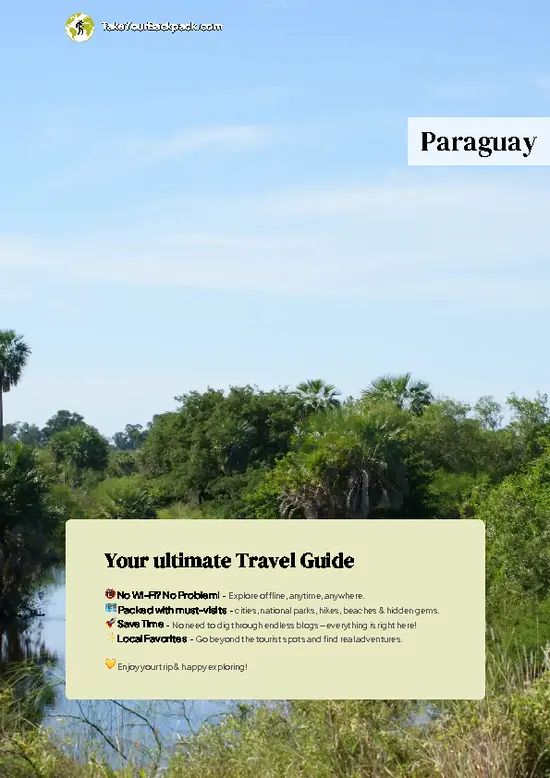
example page 0 from our offline Travel Guide for Paraguay
example page 1 from our offline Travel Guide for Paraguay
example page 2 from our offline Travel Guide for Paraguay
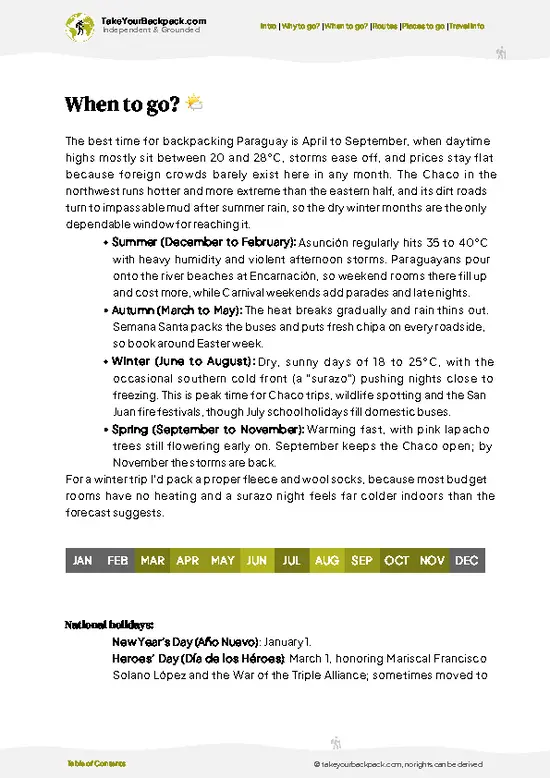
example page 3 from our offline Travel Guide for Paraguay
example page 4 from our offline Travel Guide for Paraguay
example page 5 from our offline Travel Guide for Paraguay
example page 6 from our offline Travel Guide for Paraguay
example page 7 from our offline Travel Guide for Paraguay
Loading the map 🌍
CLICK TO FILTER
cities
towns
landmarks
national parks
hikes
beaches
attractions
festivals
regions
SHOW COUNTRY’S BESTSHOW ALL

✨ Why go?
Ranked #7 national park in Paraguay
What makes it a must-see national park

Ypoá National Park appeals to backpackers who prefer water and wildlife to summit views. The wetland around Lake Ypoá is one of the largest shallow lake systems in Paraguay, and it supports caimans, marsh deer, capybara and a long list of herons, ibises and storks. That makes it a strong pick for self-guided travelers with binoculars and patience, since nothing here is packaged into tours and the pace is set by you and your boatman. The second draw is the floating vegetation mats (camalotes) that drift across the lagoons, creating a landscape that changes with wind and water level. If you want a quiet corner of Paraguay where you may be the only visitor, this fits. Access takes some planning, and you should be comfortable asking locals for directions in Spanish or a little Guaraní. The reward … read more 👉
Ypoá National Park appeals to backpackers who prefer water and wildlife to summit views. The wetland around Lake Ypoá is one of the largest shallow lake systems in Paraguay, and it supports caimans, marsh deer, capybara and a long list of herons, ibises and storks. That makes it a strong pick for self-guided travelers with binoculars and patience, since nothing here is packaged into tours and the pace is set by you and your boatman. The second draw is the floating vegetation mats (camalotes) that drift across the lagoons, creating a landscape that changes with wind and water level. If you want a quiet corner of Paraguay where you may be the only visitor, this fits. Access takes some planning, and you should be comfortable asking locals for directions in Spanish or a little Guaraní. The reward is an empty wetland and a fishing-village atmosphere unlike the busier parts of the country.

💡 HighlightsMust-see experiences and standout moments

  1. Lake Ypoá: The broad, shallow lake at the heart of the park, ringed by reeds and open to the horizon. A small boat gives the best view of its size.
  2. Floating vegetation islands: Mats of camalotes drift with the wind, carrying birds and sometimes small mammals across the water.
  3. Wetland birdlife: Herons, egrets, ibises, storks and kingfishers feed in the shallows. Binoculars matter more than a long lens here.
  4. Yacare caimans: Common along quiet channels and lagoon edges, often seen sunning on banks or floating with only their eyes showing.
  5. Capybaras: The world’s largest rodents graze at the water’s edge in family groups, most visible at dusk.
  6. Marsh deer habitat: The wet grasslands shelter marsh deer, a large, shy species that is hard to spot but worth scanning for from a boat.
  7. Lakeside fishing communities:
… read more 👉
  1. Lake Ypoá: The broad, shallow lake at the heart of the park, ringed by reeds and open to the horizon. A small boat gives the best view of its size.
  2. Floating vegetation islands: Mats of camalotes drift with the wind, carrying birds and sometimes small mammals across the water.
  3. Wetland birdlife: Herons, egrets, ibises, storks and kingfishers feed in the shallows. Binoculars matter more than a long lens here.
  4. Yacare caimans: Common along quiet channels and lagoon edges, often seen sunning on banks or floating with only their eyes showing.
  5. Capybaras: The world’s largest rodents graze at the water’s edge in family groups, most visible at dusk.
  6. Marsh deer habitat: The wet grasslands shelter marsh deer, a large, shy species that is hard to spot but worth scanning for from a boat.
  7. Lakeside fishing communities: Small settlements where residents fish from canoes. They show how people live alongside the wetland.
Lake Ypoá and the birdlife pair well in a single day, since a morning boat trip across the lake covers both.
Spotted a mistake or missing something? Contact us.

Things to do near Ypoá National Park

Ratings based on Tripadvisor reviews. When you book through this link, you support our work at no extra cost to you.

🌤️ When to go?Choosing the right time of year

  • Cool Dry Season (May to September): Ypoá National Park is most comfortable now, with days of 18 to 26°C (64 to 79°F), cool nights that can dip to 8°C (46°F) and the least rain. Birdlife concentrates around open water, and mosquitoes ease off. Days are shorter, with roughly 10 to 11 hours of light.
  • Hot Wet Season (October to March): Expect 28 to 36°C (82 to 97°F), heavy humidity and sudden storms. The marshes swell, dirt tracks turn to slick clay and boat access gets easier than road access. Daylight stretches to about 14 hours, and insects are fierce.
  • Shoulder Months (April and October): Temperatures sit around 22 to 30°C (72 to 86°F), with fewer storms and good light for wildlife.
  • Crowds and Prices: The park sees very few visitors all year. Local guides and lodging barely change in price, though
… read more 👉
  • Cool Dry Season (May to September): Ypoá National Park is most comfortable now, with days of 18 to 26°C (64 to 79°F), cool nights that can dip to 8°C (46°F) and the least rain. Birdlife concentrates around open water, and mosquitoes ease off. Days are shorter, with roughly 10 to 11 hours of light.
  • Hot Wet Season (October to March): Expect 28 to 36°C (82 to 97°F), heavy humidity and sudden storms. The marshes swell, dirt tracks turn to slick clay and boat access gets easier than road access. Daylight stretches to about 14 hours, and insects are fierce.
  • Shoulder Months (April and October): Temperatures sit around 22 to 30°C (72 to 86°F), with fewer storms and good light for wildlife.
  • Crowds and Prices: The park sees very few visitors all year. Local guides and lodging barely change in price, though Paraguayan holidays such as Holy Week bring weekend traffic to nearby lake towns.
Plan around a dry spell, since a few days of rain can close the unpaved approach roads.


source: climatestotravel.comJANJanuary: fair for travelingFEBFebruary: fair for travelingMARMarch: fair for travelingAPRApril: fair for travelingMAYMay: highly recommended for travelingJUNJune: excellent for travelingJULJuly: excellent for travelingAUGAugust: excellent for travelingSEPSeptember: excellent for travelingOCTOctober: fair for travelingNOVNovember: fair for travelingDECDecember: fair for traveling
when-to-go

✈️ The backpacker research shortcutParaguay Travel Guide

What the free pages can't give you: ready-made routes, every place ranked, and it works offline. All in 1 guide.
example page 0 from our offline Travel Guide for Paraguay
example page 1 from our offline Travel Guide for Paraguay
example page 2 from our offline Travel Guide for Paraguay
example page 3 from our offline Travel Guide for Paraguay
example page 4 from our offline Travel Guide for Paraguay
example page 5 from our offline Travel Guide for Paraguay
example page 6 from our offline Travel Guide for Paraguay
example page 7 from our offline Travel Guide for Paraguay
The digital guide (226 pages) contains:-page digital guide:
✅ Ready-made 5, 10 & 15-day routes
✅ All 65 places ranked, so you skip the overrated ones
✅ Works offline, all in 1 guide
✅ Cities, national parks, landmarks, beaches
✅ How to get around
👉 Click to see all 30+ guide features

📅 Plan smarter in minutes, not weeks
✅ Month by month travel advice
✅ Festivals & national holidays
✅ Budget expectations

🗺️ Go to the right places, skip the overrated ones
✅ Honest pros & cons of destinations
✅ Top hikes, parks & viewpoints
✅ Lesser-known places most travelers miss
✅ Clear “worth it vs skip it” guidance

🛏️ Travel smoothly without rookie mistakes
✅ Best areas to stay
✅ Transport systems explained simply
✅ Common scams & safety advice
✅ SIM cards, money & practical tips

🌍 Understand the country, not just visit it
✅ Culture & traditions
✅ 52 Essential phrases & customs
✅ Festivals worth planning around
✅ Traveler-friendly historical context
✅ Insights that make places more meaningful

📱 Built for real travel conditions
✅ Fully downloadable PDF
✅ Works completely offline
✅ Optimized for phone use
✅ Useful in remote areas & buses
✅ All in 1 guide
Stop searching, start planning
Get instant access to your full guide. 30‑day money-back guarantee.


By proceeding you agree to our terms.
Sent to your inbox immediately after payment • 100% Secure Checkout
Best Backpacking Travel Advisor 2025 tourism awardBest Backpacking
Travel Advisor
2025
What others say about Take Your Backpack Guides:
⭐⭐⭐⭐⭐
Fantastic, amazing amount of information!
⭐⭐⭐⭐⭐
My goodness this is amazing, it's what I've been looking for hats off too you!
⭐⭐⭐⭐⭐
I think this is absolutely BRILLIANT
⭐⭐⭐⭐
Very complete and informative. It's still missing places, but I gotta to commend you
⭐⭐⭐⭐⭐
This is truly amazing, thank you, can't wait to explore it with my kids!
⭐⭐⭐⭐⭐
Awesome resource, thank you!
⭐⭐⭐⭐⭐
This is amazing! Can't wait to explore the ones I haven't seen
⭐⭐⭐⭐
I love this! Well done, great idea.
⭐⭐⭐⭐⭐
Thanks for taking the time to make this gem!
⭐⭐⭐⭐⭐
This might be the best website I've ever seen.
⭐⭐⭐⭐⭐
Congratulations, and thank you so much for your work; it's incredibly valuable.
⭐⭐⭐⭐
In all seriousness I think you did a great job pointing out the important spots
⭐⭐⭐⭐⭐
10/10 very good
⭐⭐⭐⭐⭐
As someone who's only just starting to visit regularly this is awesome, thank you.
⭐⭐⭐⭐
Thank you very much! I'm going to visit my dad, it's going to be very useful!
⭐⭐⭐⭐⭐
This is really cool! We'll be travelling for the first time and this definitely come in handy.
⭐⭐⭐⭐⭐
You are now our minister of culture, congratulations 👨‍💼
⭐⭐⭐⭐⭐
Just wanted to tell you that this is a pearl! Going to follow your recommendations.
⭐⭐⭐⭐⭐
This is so cool. I'll definitely be using the resource for my travels soon.
⭐⭐⭐⭐⭐
This is very impressive! Good work.
⭐⭐⭐⭐⭐
This is an amazing and informative site. Very well done!

🛏️ Where to stay?Best areas and accommodation options

Ypoá National Park has no lodging inside it, so most backpackers sleep in the lake towns on its edge or in Asunción, about 1.5 to 2 hours away by road. Villeta and Guarambaré, along the Río Paraguay, have simple hostels and family-run hospedajes for roughly US$12 to 25 a night. Quiindy, about 20 km from the lake by the dirt road from Valle Apuá, is the usual starting point for guided visits.

Asunción gives you the widest range of dorms (US$10 to 18) and the easiest bus connections, so many travelers sleep there and arrange a guide or driver for the marsh. Informal camping near the park is possible … read more 👉
Ypoá National Park has no lodging inside it, so most backpackers sleep in the lake towns on its edge or in Asunción, about 1.5 to 2 hours away by road. Villeta and Guarambaré, along the Río Paraguay, have simple hostels and family-run hospedajes for roughly US$12 to 25 a night. Quiindy, about 20 km from the lake by the dirt road from Valle Apuá, is the usual starting point for guided visits.

Asunción gives you the widest range of dorms (US$10 to 18) and the easiest bus connections, so many travelers sleep there and arrange a guide or driver for the marsh. Informal camping near the park is possible with the permission of local landowners or the park rangers, but facilities are basic and you should carry water. Book ahead on Paraguayan holiday weekends, when lake towns fill with day-trippers and weekenders.

👛 Costs (as of 19 October 2026)Travel costs and budget guide for Ypoá

A day at Ypoá National Park runs about US$50 to 85 for a backpacker, and the total below uses the US$75 high-season case. Costs are driven mostly by getting a guide and transport, since the park itself is lightly serviced.
CategoryBudget RangeLocal Reality
Entrance FeesUS$0 to 5Access is low-key and often informal, so ask rangers or your guide about any small fee.
Accommodation (High Season)US$12 to 30Hostels or hospedajes in lake towns and Villeta; Asunción dorms start near US$10.
Accommodation (Low Season)US$10 to 25Prices barely change, with small discounts midweek.
Local TransportUS$8 to 25Buses from Asunción cost a few dollars each way; the last stretch needs a hired driver or taxi.
GuideUS$15 to 30A local guide is the practical way to cross the marsh and find wildlife areas.
Food and SuppliesUS$8
… read more 👉
A day at Ypoá National Park runs about US$50 to 85 for a backpacker, and the total below uses the US$75 high-season case. Costs are driven mostly by getting a guide and transport, since the park itself is lightly serviced.
CategoryBudget RangeLocal Reality
Entrance FeesUS$0 to 5Access is low-key and often informal, so ask rangers or your guide about any small fee.
Accommodation (High Season)US$12 to 30Hostels or hospedajes in lake towns and Villeta; Asunción dorms start near US$10.
Accommodation (Low Season)US$10 to 25Prices barely change, with small discounts midweek.
Local TransportUS$8 to 25Buses from Asunción cost a few dollars each way; the last stretch needs a hired driver or taxi.
GuideUS$15 to 30A local guide is the practical way to cross the marsh and find wildlife areas.
Food and SuppliesUS$8 to 15Pay in guaraníes for empanadas, chipa, and set lunches; bring snacks and water since nothing is sold in the park.
Total Daily BudgetUS$75Per person, per day, in high season.


source: senatur.gov.py
⚠️ Prices can change and everyone travels differently, so take this as a rough guide. Hope it helps you plan your adventure!

🥾 TrailsBest hikes in Ypoá national park

Ypoá National Park has no well-marked hiking network, so exploring means short walks along dikes, tracks and lake edges plus time on the water. Expect flat, wet and sometimes muddy ground, with little shade and plenty of insects.
  • Lakeshore walks: Starting at access points near the fishing communities, these flat strolls of one to three hours follow the reed edge and suit all fitness levels.
  • Dirt track walks: Unpaved tracks cross the surrounding grassland and lead past ponds where caimans and capybaras gather. Allow two to four hours, and turn back if the clay turns slick.
  • Boat excursions: Local boatmen
… read more 👉
Ypoá National Park has no well-marked hiking network, so exploring means short walks along dikes, tracks and lake edges plus time on the water. Expect flat, wet and sometimes muddy ground, with little shade and plenty of insects.
  • Lakeshore walks: Starting at access points near the fishing communities, these flat strolls of one to three hours follow the reed edge and suit all fitness levels.
  • Dirt track walks: Unpaved tracks cross the surrounding grassland and lead past ponds where caimans and capybaras gather. Allow two to four hours, and turn back if the clay turns slick.
  • Boat excursions: Local boatmen take visitors across the lagoons for around two to three hours, passing floating vegetation and bird colonies. This is the most rewarding way to see the park.
  • Terrain and difficulty: Easy on gradient, but heat, humidity, mud and mosquitoes make it tiring. Rubber boots, repellent, a hat and plenty of water help.
Public transport is limited. Buses from Asunción reach towns near the wetland, but the last stretch to the lake usually needs a hired vehicle, a motorbike taxi or a local arrangement. Rain can close dirt roads for days. Crowds are almost nonexistent, and facilities are minimal, so bring food and cash in small bills. Entry arrangements are informal and ranger presence is light, so confirm access and any fee locally before you set out.
⚠️ Hiking info can sometimes be outdated or inaccurate. Before you hit the trail, check the latest conditions with locals. If you do spot anything that's off, I'd love to hear from you, so I can update it for fellow travelers.

🛡️ SafetyStaying Safe: What Travelers Should Know

Ypoá National Park is a flat, remote wetland, so the main hazards are heat, insects and mud rather than steep terrain. In summer, carry at least 3 liters of water per person, wear a hat and use strong repellent, as mosquitoes are relentless at dusk. Rain turns clay tracks impassable, so check conditions and have a local driver or guide, since marked trails are scarce and navigation across open marsh is easy to get wrong. Carry offline maps and tell someone your plan.

Wildlife includes caimans, capybaras, marsh deer and snakes. Keep your distance, watch where you step and stay out of the water near caimans. Mobile signal is patchy, and services are far apart, so bring a basic first-aid kit and fuel up beforehand.

FAQTraveler FAQ

One full day is enough to see the edge of Ypoá National Park, while two days lets you reach deeper marsh areas with a guide. Most travelers base themselves in Asunción, roughly 1.5 to 2 hours away, or in Quiindy. Add a third day if heavy rain slows the dirt roads.
Reaching Ypoá National Park without a car is possible but slow. Buses run from Asunción to towns near the park such as Quiindy or Caapucú for a few dollars, and from there you need a taxi, moto-taxi or arranged driver, typically US$15 to 30 for the day. Public transport does not enter the park.
Ypoá National Park has no formal ticket booth, and entry is generally free or carries a very small fee of up to about US$5. It is worth contacting the environment ministry (MADES) or a local guide beforehand to confirm access and any permission required, particularly if you plan to camp. Guides cost roughly US$15 to 30 per day.
⚠️ Things can change over time, so always validate details locally before you go.

Other Paraguayan national parks near Ypoá

Explore more nearby:


💡 Not sure where to go next?
Create a personalized itinerary for Paraguay including Ypoá and the places that fit your trip.

Generate my itinerary

👉 Discover all national parks

Or checkout all Paraguay has to offer (think cities, towns, villages, national parks, hikes, beaches, festivals)
Country photo of Paraguay

We 💚 feedbackSumming up the experience

Ypoá National Park is a wetland, so the water level decides what you actually get. Most first-timers plan around trails and find marsh, lagoons and floating vegetation instead. I would bring binoculars and a local guide’s contact from the nearest town, and treat the park as a slow birding outing rather than a hike.

✈️ When did I visit Paraguay?
Before visiting Argentina in September 2012, I crossed through Paraguay, ending up at the magical Iguazu Falls.

✍️ Help improve this page!
The information on this page is based on my own backpacking experience in Paraguay, supplemented with up-to-date research and feedback from other travelers. Travel details can change, so if you notice anything outdated or incomplete, feel free to let me know.


🙋‍♂️ Give feedback

👋 Meet the founderWho’s Behind Take Your Backpack?

Johan, backpacker and founder of TakeYourBackpackHi, I’m Johan (Netherlands 🇳🇱), the creator of TakeYourBackpack. Over the past 30 years, I’ve backpacked through 88 countries across six continents, gaining extensive experience with independent travel, long-term trips, and overland routes.

This site is built on a combination of firsthand travel experience and carefully curated insights from other backpackers. Many guides are based on places I’ve personally visited, while others bring together tips, observations, and practical advice shared by trusted travelers I’ve met along the way.

The goal is to provide realistic, experience-driven guidance — not generic itineraries — so you can explore destinations with better context, clearer expectations, and more confidence.