×

Congo🇨🇬 | national parksDimonika Biosphere ReserveHilly Mayombe forest, village guides, canopy calls, ridge views | things to do and best time to go

Explore Sangha TrinationalExplore Kouilou

Backpacking in Dimonika Biosphere Reserve
👀 For curious travelersnational park ranked #6
By Johan Kruseman 🇳🇱 | Updated October 22, 2026

Dimonika sits in the southwest, not the north, and it is a patch of Mayombe rainforest on hills, not a savanna safari park where animals line up at waterholes. The reserve lies in the Kouilou region of the Republic of the Congo, inland from Pointe-Noire and close to the Gabon-side Mayombe ridges. Expect dripping green walls, cicada screech, mud that grips boots, and a thick, leafy smell after rain. Canopy is tall, light arrives in coins, and you hear chimpanzees and hornbills far more than you see them. Trails are rough and facilities almost nonexistent, which is why it feels truly remote. Roads turn slick in the rains, so go in the drier months. Hire a local guide through the village of Dimonika, because paths fork and fade without markers.

Discover everything you want to know in the 📖 Congo Travel Guide.
Safety warning

The current risk level for Congo is high. Check the advice before going.


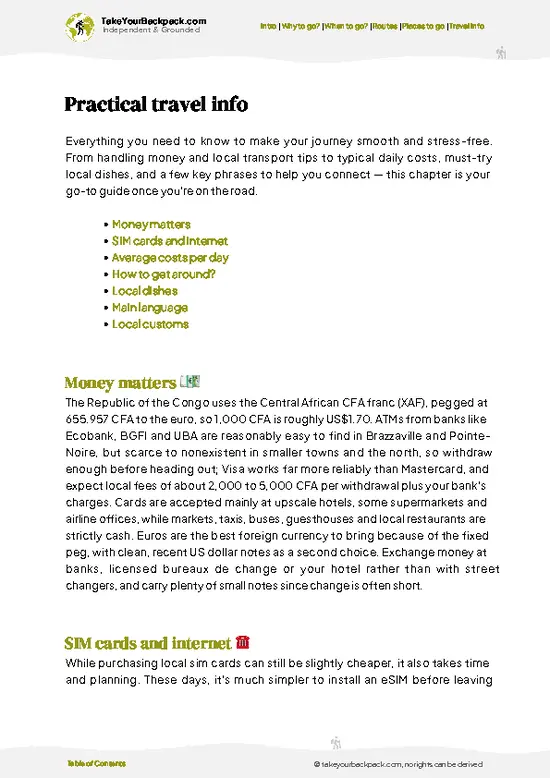
example page 0 from our offline Travel Guide for Republic of the Congo
example page 1 from our offline Travel Guide for Republic of the Congo
example page 2 from our offline Travel Guide for Republic of the Congo
example page 3 from our offline Travel Guide for Republic of the Congo
example page 4 from our offline Travel Guide for Republic of the Congo
example page 5 from our offline Travel Guide for Republic of the Congo
example page 6 from our offline Travel Guide for Republic of the Congo
example page 7 from our offline Travel Guide for Republic of the Congo
Loading the map 🌍
CLICK TO FILTER
cities
towns
landmarks
national parks
hikes
beaches
attractions
festivals
regions
SHOW COUNTRY’S BESTSHOW ALL

✨ Why go?
Ranked #6 national park in Congo
Reasons people choose to explore here

Dimonika Biosphere Reserve suits backpackers who want primary Mayombe forest without a tour-bus crowd, because you walk it on your own schedule with a local guide. Its appeal is the Mayombe rainforest itself: steep, layered, humid hills with giant buttressed trees and a very short list of other visitors. The village at its edge gives you a base where you can arrange guides and ask about the Dimonika forest paths that locals use for hunting and farming. It also rewards people who like slow, low-tech travel, since there is no ticket gate, no paved loop and no souvenir row. You trade comfort for solitude, and that exchange is the point. If you need signposts and a café at the trailhead, pick a different park. If you can handle a muddy afternoon and a bucket wash afterward, this is a rare, quiet corner of Central Africa.

💡 HighlightsWhat this place is best known for

  1. Mayombe rainforest canopy: The reserve protects steep, hilly forest with huge buttressed trunks, lianas and a dim, dripping understory that few travelers ever see.
  2. Chimpanzee and primate calls: Chimpanzees and monkeys live in the forest, and most encounters begin as hoots and branch crashes high overhead rather than clear sightings.
  3. Forest birdlife: Hornbills and other canopy birds make the loudest wingbeats, and dawn is the best time to hear them.
  4. Dimonika village: The settlement at the edge of the reserve is where you meet guides, and it shows how local people farm and use the forest margin.
  5. Forest streams: Small clear streams cut through the hills, offering cool stops, frogs and butterflies near the banks.
  6. Giant trees and understory plants: Guides point out medicinal plants, fig trees and old
… read more 👉
  1. Mayombe rainforest canopy: The reserve protects steep, hilly forest with huge buttressed trunks, lianas and a dim, dripping understory that few travelers ever see.
  2. Chimpanzee and primate calls: Chimpanzees and monkeys live in the forest, and most encounters begin as hoots and branch crashes high overhead rather than clear sightings.
  3. Forest birdlife: Hornbills and other canopy birds make the loudest wingbeats, and dawn is the best time to hear them.
  4. Dimonika village: The settlement at the edge of the reserve is where you meet guides, and it shows how local people farm and use the forest margin.
  5. Forest streams: Small clear streams cut through the hills, offering cool stops, frogs and butterflies near the banks.
  6. Giant trees and understory plants: Guides point out medicinal plants, fig trees and old timber giants, which turns an ordinary walk into a lesson in forest use.
  7. Ridge viewpoints: Where the trees thin on higher slopes, you get glimpses over rolling green hills that stretch toward the coast.
Dimonika Biosphere Reserve has no formal ticket booth, but you should arrange a local guide in the village before you set off.
Spotted a mistake or missing something? Contact us.

🌤️ When to go?When to go for the best experience

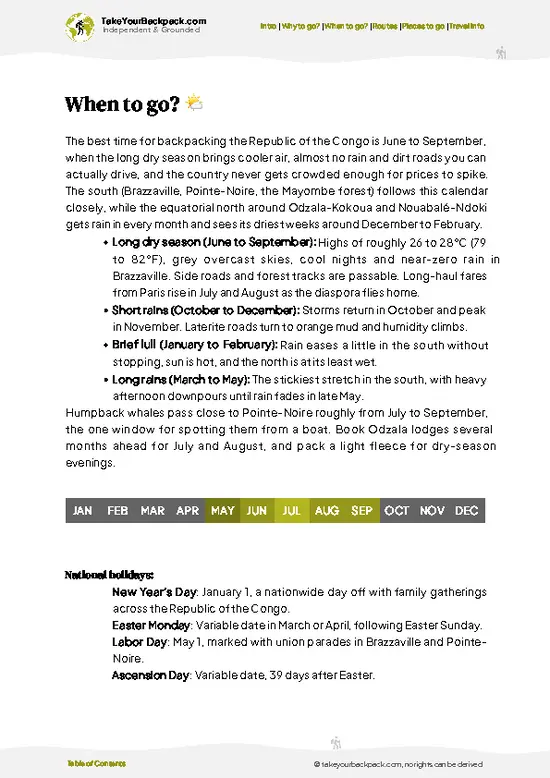
The dry season from June to September is the easiest window for walking in Dimonika, with the Mayombe forest trails firmest underfoot and the least rain.
  • Dry Season (June to September): Cloudy, cooler days of about 20-27°C (68-81°F), little rain, and mist hanging in the canopy. Trails dry out and the road from Dolisie and Pointe-Noire is most reliable. Visitors are few, and lodging prices barely move.
  • Short Dry Spell (December to February): Warmer, around 23-31°C (73-88°F), with lighter rain. Birdwatching and butterfly activity pick up.
  • Wet Seasons (March to May, October to November): Heavy downpours, muddy tracks, swollen streams, and 24-30°C (75-86°F) heat with thick humidity. Leeches and slick roots slow progress.
Daylight runs close to 12 hours all year, so start walking early. Book your guide a few days ahead, whatever the month.

source: climatestotravel.comJANJanuary: fair for travelingFEBFebruary: fair for travelingMARMarch: fair for travelingAPRApril: fair for travelingMAYMay: fair for travelingJUNJune: excellent for travelingJULJuly: excellent for travelingAUGAugust: excellent for travelingSEPSeptember: excellent for travelingOCTOctober: fair for travelingNOVNovember: fair for travelingDECDecember: fair for traveling
when-to-go

✈️ The backpacker research shortcutCongo Travel Guide

An offline-friendly backpacking guide with optimized travel routes, ranked highlights, transport advice, and the best areas to stay.
example page 0 from our offline Travel Guide for Republic of the Congo
example page 1 from our offline Travel Guide for Republic of the Congo
example page 2 from our offline Travel Guide for Republic of the Congo
example page 3 from our offline Travel Guide for Republic of the Congo
example page 4 from our offline Travel Guide for Republic of the Congo
example page 5 from our offline Travel Guide for Republic of the Congo
example page 6 from our offline Travel Guide for Republic of the Congo
example page 7 from our offline Travel Guide for Republic of the Congo
The digital guide (205 pages) contains:
✅ 46 highlights, ranked by travel appeal
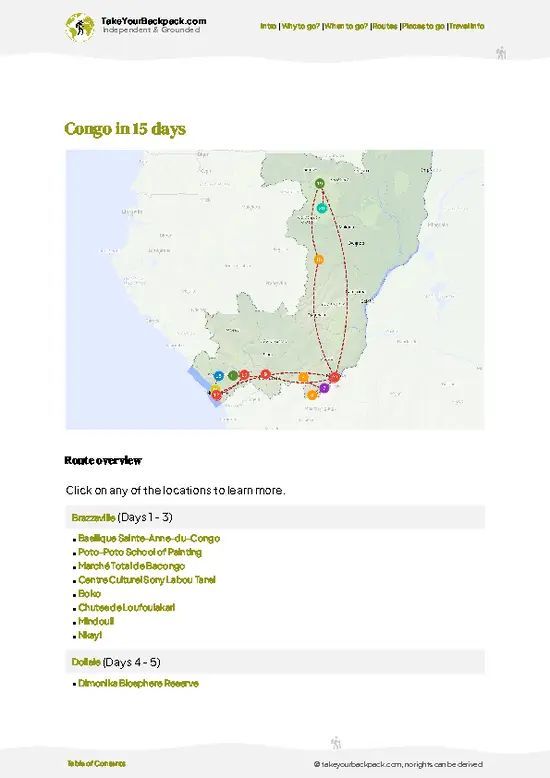
✅ Optimized 5, 10 & 15-day travel routes
✅ Cities, national parks, landmarks, beaches
✅ How to get around
✅ Offline-friendly for travel without Wi-Fi
👉 Click to see all 30+ guide features

📅 Plan smarter in minutes, not weeks
✅ Month by month travel advice
✅ Festivals & national holidays
✅ Budget expectations

🗺️ Go to the right places, skip the overrated ones
✅ Honest pros & cons of destinations
✅ Top hikes, parks & viewpoints
✅ Lesser-known places most travelers miss
✅ Clear “worth it vs skip it” guidance

🛏️ Travel smoothly without rookie mistakes
✅ Best areas to stay
✅ Transport systems explained simply
✅ Common scams & safety advice
✅ SIM cards, money & practical tips

🌍 Understand the country, not just visit it
✅ Culture & traditions
✅ 52 Essential phrases & customs
✅ Festivals worth planning around
✅ Traveler-friendly historical context
✅ Insights that make places more meaningful

📱 Built for real travel conditions
✅ Fully downloadable PDF
✅ Works completely offline
✅ Optimized for phone use
✅ Useful in remote areas & buses
✅ Everything in one place
Stop searching, start planning
Get instant access to your full guide. 30‑day money-back guarantee.
+ Add another guide for just

By proceeding you agree to our terms.
Sent to your inbox immediately after payment • 100% Secure Checkout
Best Backpacking Travel Advisor 2025 tourism awardBest Backpacking
Travel Advisor
2025
What others say about Take Your Backpack Guides:
⭐⭐⭐⭐⭐
Fantastic, amazing amount of information!
⭐⭐⭐⭐⭐
My goodness this is amazing, it's what I've been looking for hats off too you!
⭐⭐⭐⭐⭐
I think this is absolutely BRILLIANT
⭐⭐⭐⭐
Very complete and informative. It's still missing places, but I gotta to commend you
⭐⭐⭐⭐⭐
This is truly amazing, thank you, can't wait to explore it with my kids!
⭐⭐⭐⭐⭐
Awesome resource, thank you!
⭐⭐⭐⭐⭐
This is amazing! Can't wait to explore the ones I haven't seen
⭐⭐⭐⭐
I love this! Well done, great idea.
⭐⭐⭐⭐⭐
Thanks for taking the time to make this gem!
⭐⭐⭐⭐⭐
This might be the best website I've ever seen.
⭐⭐⭐⭐⭐
Congratulations, and thank you so much for your work; it's incredibly valuable.
⭐⭐⭐⭐
In all seriousness I think you did a great job pointing out the important spots
⭐⭐⭐⭐⭐
10/10 very good
⭐⭐⭐⭐⭐
As someone who's only just starting to visit regularly this is awesome, thank you.
⭐⭐⭐⭐
Thank you very much! I'm going to visit my dad, it's going to be very useful!
⭐⭐⭐⭐⭐
This is really cool! We'll be travelling for the first time and this definitely come in handy.
⭐⭐⭐⭐⭐
You are now our minister of culture, congratulations 👨‍💼
⭐⭐⭐⭐⭐
Just wanted to tell you that this is a pearl! Going to follow your recommendations.
⭐⭐⭐⭐⭐
This is so cool. I'll definitely be using the resource for my travels soon.
⭐⭐⭐⭐⭐
This is very impressive! Good work.
⭐⭐⭐⭐⭐
This is an amazing and informative site. Very well done!

🛏️ Where to stay?Choosing the right base

Dimonika village has a basic guesthouse and the reserve’s own simple lodging near the park office, and that is where most backpackers sleep. Expect bare rooms, bucket washing, and limited or no electricity, so bring a headlamp, a power bank, and a mosquito net. Rooms cost roughly €8 to 20 a night. Staying here puts you minutes from the trailheads and lets you leave at dawn with a guide when birds and monkeys are active.
For more comfort, use Dolisie, the nearest real town, about two hours away by road depending on conditions. It has several mid-range hotels from about €20 to 45, restaurants, ATMs, … read more 👉
Dimonika village has a basic guesthouse and the reserve’s own simple lodging near the park office, and that is where most backpackers sleep. Expect bare rooms, bucket washing, and limited or no electricity, so bring a headlamp, a power bank, and a mosquito net. Rooms cost roughly €8 to 20 a night. Staying here puts you minutes from the trailheads and lets you leave at dawn with a guide when birds and monkeys are active.
For more comfort, use Dolisie, the nearest real town, about two hours away by road depending on conditions. It has several mid-range hotels from about €20 to 45, restaurants, ATMs, and taxis and minibuses to Dimonika. Pointe-Noire, the coastal hub with the airport and the widest choice of hotels, sits farther away. Most people reach the reserve from there with a hired car or a shared taxi to Dolisie, then a local connection.
Camping near the village is possible if you arrange it with the reserve staff, who can also tell you which guesthouse has water that day. Carry cash, because card machines do not exist locally.

👛 Costs (as of 22 October 2026)Typical daily expenses

A realistic budget for Dimonika Biosphere Reserve is about €34 to 60 per day, with guides and transport making up most of it.
CategoryBudget RangeLocal Reality
Entrance and Guide€8 to 15Fees and a compulsory local guide are arranged at the reserve office; pay in cash.
Accommodation (high season)€8 to 20Basic village guesthouse rooms with a net; Dolisie hotels cost more at €20 to 45.
Accommodation (low season)€6 to 15Prices change little, but rooms are easier to get.
Local Transport€12 to 20Shared taxis or minibuses from Dolisie, plus a moto-taxi or hired car for the last stretch; costs rise when roads are muddy.
Food and Supplies€6 to 10Rice, cassava, fish, and chicken in village eateries; bring snacks and water purification.
Total Daily Budget€34 to 60About €50 per day with a guide and one night in the village.
⚠️ Prices can change and everyone travels differently, so take this as a rough guide. Hope it helps you plan your adventure!

🥾 TrailsExploring Dimonika Biosphere Reserve: trails, terrain, and views

The Dimonika Biosphere Reserve in the Republic of the Congo is a hidden gem for those who crave adventure in the wild. With its dense rainforests, winding rivers, and a cacophony of wildlife, you’ll find plenty of scenic highlights that make every step worthwhile. Expect to encounter everything from towering trees to curious monkeys peeking through the foliage. The terrain can be tricky—think muddy paths, uneven ground, and the occasional stream to cross, so sturdy boots are a must. It’s not a walk in the park, but for those who enjoy a challenge, it’s absolutely rewarding.

If you’re looking … read more 👉
The Dimonika Biosphere Reserve in the Republic of the Congo is a hidden gem for those who crave adventure in the wild. With its dense rainforests, winding rivers, and a cacophony of wildlife, you’ll find plenty of scenic highlights that make every step worthwhile. Expect to encounter everything from towering trees to curious monkeys peeking through the foliage. The terrain can be tricky—think muddy paths, uneven ground, and the occasional stream to cross, so sturdy boots are a must. It’s not a walk in the park, but for those who enjoy a challenge, it’s absolutely rewarding.

If you’re looking for a designated trail, check out the Mbomo Trail. Here are the details:
  • Length: 8 km
  • Estimated Duration: 3-4 hours
  • Difficulty Level: Moderate
  • Key Features: Stunning river views, diverse flora, and chances to spot wildlife like elephants and various bird species.
  • Terrain: Primarily forested with some steep sections and muddy areas.

Getting to the park isn’t too complicated, but public transport can be a bit of an adventure in itself. Buses or shared taxis from nearby towns can drop you off at the park entrance, but be prepared for a bumpy ride. It’s not overly crowded, so you’ll likely have the trails to yourself, which is a huge plus for those seeking solitude in nature. As for the entrance fee, it’s relatively affordable, but it’s always good to check ahead as prices can change. Just make sure you’re ready to embrace the wild!
⚠️ Hiking info can sometimes be outdated or inaccurate. Before you hit the trail, check the latest conditions with locals. If you do spot anything that's off, I'd love to hear from you, so I can update it for fellow travelers.

🛡️ SafetyTraveler Safety Guide

Dimonika is a quiet forest walk where the main problems are mud, heat, and humidity rather than crime or big animals. Trails in the Mayombe forest are narrow, root-tangled, and slippery after rain, so wear boots with real tread, carry gaiters in the wet months, and move slowly on descents. Streams can rise quickly. Hire a local guide through the reserve office, because side paths multiply and signage is minimal. Wildlife is mostly seen and heard: monkeys, forest birds, and many insects. Elephants and gorillas are rare here, but if you meet any large animal, stop, back away quietly, and let the guide lead. Carry at least two liters of water per person, a rain jacket, insect repellent, and a basic first-aid kit. Check malaria prophylaxis and yellow fever vaccination before you arrive. Tell your … read more 👉
Dimonika is a quiet forest walk where the main problems are mud, heat, and humidity rather than crime or big animals. Trails in the Mayombe forest are narrow, root-tangled, and slippery after rain, so wear boots with real tread, carry gaiters in the wet months, and move slowly on descents. Streams can rise quickly. Hire a local guide through the reserve office, because side paths multiply and signage is minimal. Wildlife is mostly seen and heard: monkeys, forest birds, and many insects. Elephants and gorillas are rare here, but if you meet any large animal, stop, back away quietly, and let the guide lead. Carry at least two liters of water per person, a rain jacket, insect repellent, and a basic first-aid kit. Check malaria prophylaxis and yellow fever vaccination before you arrive. Tell your guesthouse your return time, as phone signal is patchy.

FAQTraveler FAQ

Plan two to three days for Dimonika Biosphere Reserve. One full day covers a guided forest walk of four to six hours, while a second day allows a longer trek or early bird and monkey watching. The road from Dolisie takes roughly two hours, so add travel time if you start from Pointe-Noire.
Yes, Dimonika Biosphere Reserve can be reached without a car, but it takes patience. Take a shared taxi or minibus from Pointe-Noire to Dolisie (several hours, about €10 to 20), then arrange a local connection or moto-taxi toward the village, roughly two hours. Once there, trails start within walking distance of the village and park office.
Yes, Dimonika Biosphere Reserve requires a modest entrance fee and a local guide, both organized at the reserve office in the village. Expect to pay about €8 to 15 in cash for fees and guiding for a day. Bring your passport for any registration, and arrange the visit a few days ahead if you can.
⚠️ Things can change over time, so always validate details locally before you go.

Other Congolese national parks near Dimonika Biosphere Reserve

Explore more nearby:


💡 Not sure where to go next?
Create a personalized itinerary for Congo including Dimonika Biosphere Reserve and the places that fit your trip.

Generate my itinerary

👉 Discover all national parks

Or checkout all Congo has to offer (think cities, towns, villages, national parks, hikes, beaches, festivals)
Country photo of Congo

We 💚 feedbackWhat to keep in mind

Dimonika Biosphere Reserve works best as a short forest detour from Pointe-Noire, paired with beach days on the Atlantic coast before or after. I would go for one night, not a rush day trip, so you can walk at dawn when the forest is loudest. Bring boots with grip and a spare dry shirt.

✍️ Help improve this page!
The information on this page is based on in-depth research, insights shared by experienced travelers, and feedback from the local travel community in Congo. While every effort is made to keep the information accurate and current, conditions can change — so if you spot anything incorrect or outdated, please get in touch.


🙋‍♂️ Give feedback

👋 Meet the founderWho’s Behind Take Your Backpack?

Johan, backpacker and founder of TakeYourBackpackHi, I’m Johan (Netherlands 🇳🇱), the creator of TakeYourBackpack. Over the past 3 decades, I’ve backpacked through 90+ countries across six continents, gaining extensive experience with independent travel, long-term trips, and overland routes.

This site is built on a combination of firsthand travel experience and carefully curated insights from other backpackers. Many guides are based on places I’ve personally visited, while others bring together tips, observations, and practical advice shared by trusted travelers I’ve met along the way.

The goal is to provide realistic, experience-driven guidance — not generic itineraries — so you can explore destinations with better context, clearer expectations, and more confidence.