×

Congo🇨🇬 | regionsKouilouDiosso Gorge, Loango royal tombs, Conkouati-Douli wildlife, empty Atlantic beaches | things to do and best time to go

Explore Dimonika Biosphere ReserveExplore Bambama

Backpacking in Kouilou
🏆 Top pickregion ranked #1
By Johan Kruseman 🇳🇱 | Updated October 22, 2026

Kouilou gives you the Atlantic coast and Central Africa's forest in one department, with Pointe-Noire's airport and markets as your supply base next door. It sits on the Atlantic coast in the south-west of the Republic of the Congo, running north and inland from Pointe-Noire toward the Mayombe hills. Roads are patchy, signs are rare, and a ride past Hinda means red dust on your sandals and a driver who knows every pothole by name. In return you get empty beaches where the surf drags hard at the sand, mangrove channels, and forest that smells of rotting fruit and wet bark. Tourist infrastructure is thin, so this is authentic rather than polished, and the only crowds are goats and schoolchildren. Diosso Gorge and the old Loango kingdom sites carry the history, while Conkouati-Douli draws those who want wildlife. Bring cash, patience and a good hat. Late in the day, fishermen drag their pirogues up the shore and the sea goes the color of weak tea.

Discover everything you want to know in the 📖 Congo Travel Guide.
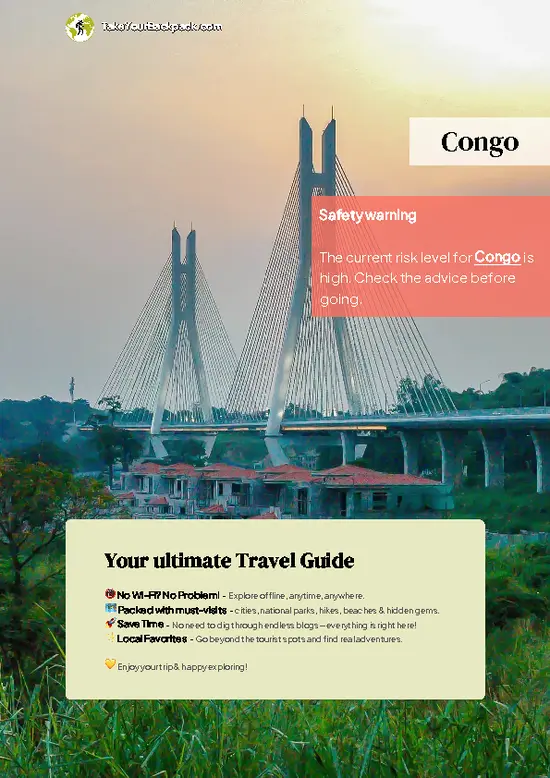
Safety warning

The current risk level for Congo is high. Check the advice before going.


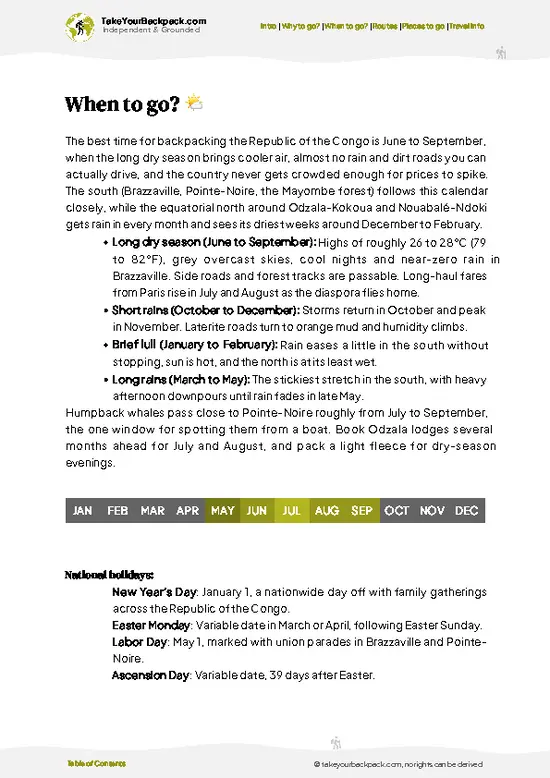
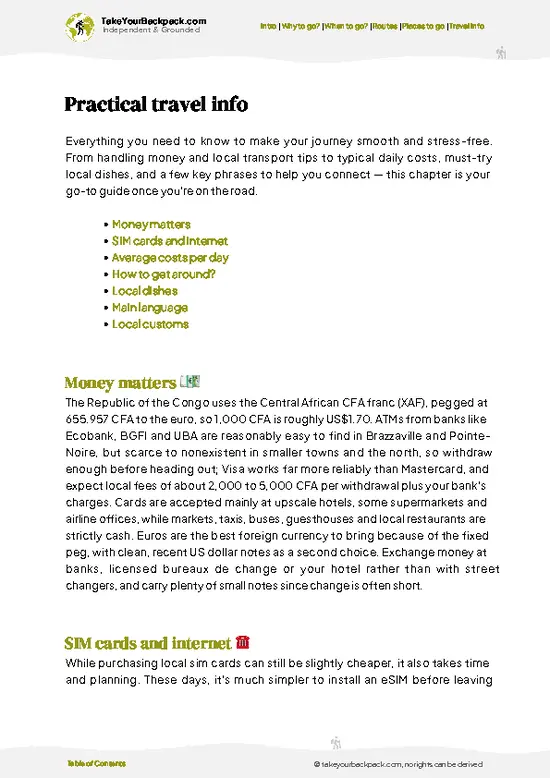
example page 0 from our offline Travel Guide for Republic of the Congo
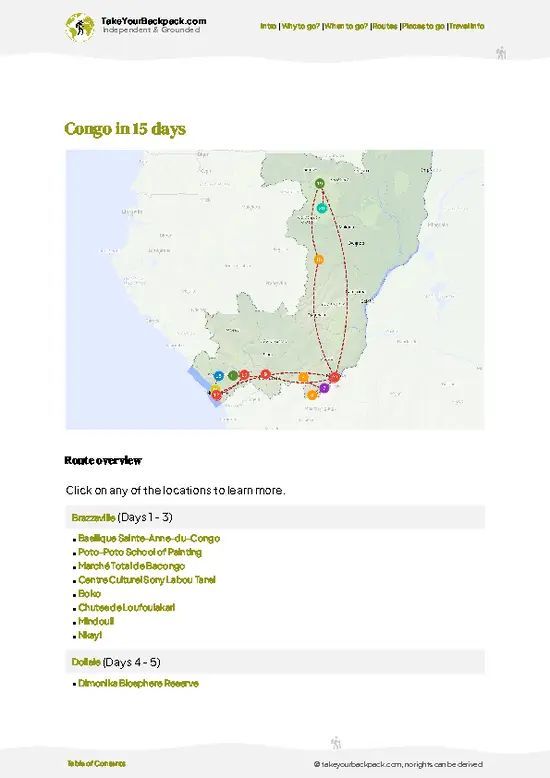
example page 1 from our offline Travel Guide for Republic of the Congo
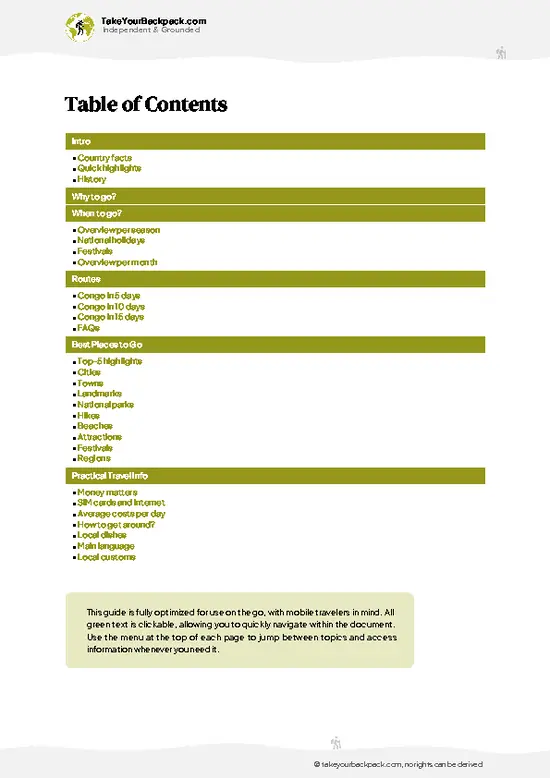
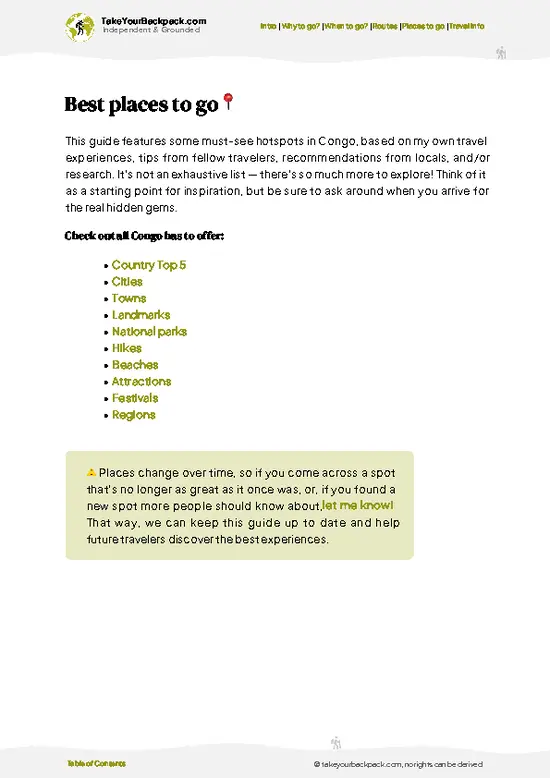
example page 2 from our offline Travel Guide for Republic of the Congo
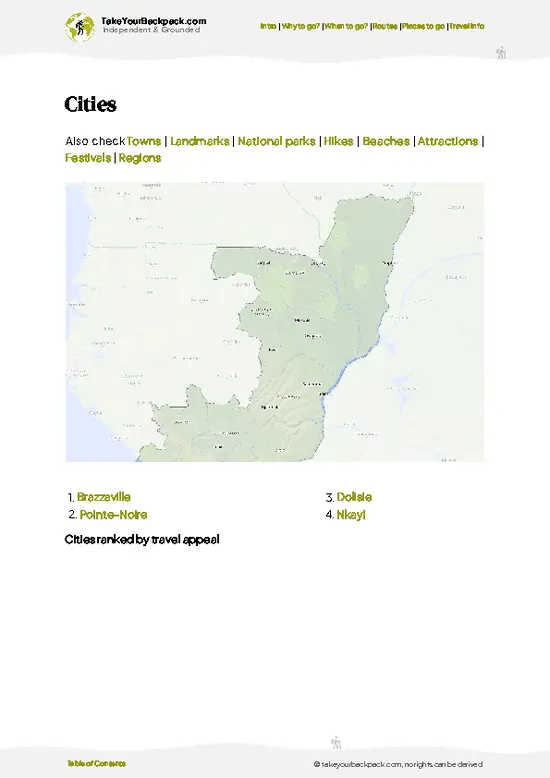
example page 3 from our offline Travel Guide for Republic of the Congo
example page 4 from our offline Travel Guide for Republic of the Congo
example page 5 from our offline Travel Guide for Republic of the Congo
example page 6 from our offline Travel Guide for Republic of the Congo
example page 7 from our offline Travel Guide for Republic of the Congo
Loading the map 🌍
CLICK TO FILTER
cities
towns
landmarks
national parks
hikes
beaches
attractions
festivals
regions
SHOW COUNTRY’S BESTSHOW ALL

✨ Why go?
Ranked #1 region in Congo
What makes this region worth visiting

Kouilou rewards backpackers who want coast, forest and history without repacking every night. Pointe-Noire works as a hub, and from there a shared taxi or a hired driver can reach most of the department in a single day, so you sleep in the same bed and still cover very different ground. The Diosso Gorge and the royal tombs of the old Loango kingdom put pre-colonial history within reach of town, which is rare in a country where most heritage sits far inland. Further out, Conkouati-Douli National Park mixes beach, lagoon and rainforest in one reserve, with a chance of seeing turtles, manatees and forest elephants. That variety means you can spend a morning among red sandstone cliffs and an afternoon on a deserted shore, which is hard to match elsewhere in the region. Slow travel pays here. Roads … read more 👉
Kouilou rewards backpackers who want coast, forest and history without repacking every night. Pointe-Noire works as a hub, and from there a shared taxi or a hired driver can reach most of the department in a single day, so you sleep in the same bed and still cover very different ground. The Diosso Gorge and the royal tombs of the old Loango kingdom put pre-colonial history within reach of town, which is rare in a country where most heritage sits far inland. Further out, Conkouati-Douli National Park mixes beach, lagoon and rainforest in one reserve, with a chance of seeing turtles, manatees and forest elephants. That variety means you can spend a morning among red sandstone cliffs and an afternoon on a deserted shore, which is hard to match elsewhere in the region. Slow travel pays here. Roads are rough and plans shift, so the best days are the ones where you give a single place the whole day, share a meal of grilled fish with locals, and let the pace be set by the road.

💡 HighlightsWhat this place is best known for

  1. Diosso Gorge: Ochre and white sandstone pillars drop into a hollow of green, and locals tell stories about the spirits of the place. A short walk to the rim is enough, and the colors are strongest in afternoon light.
  2. Royal Tombs of Diosso: Burial sites of the kings of Loango, which preserve the memory of a kingdom that traded along this coast for centuries. A local guide explains the lineage and customs.
  3. Conkouati-Douli National Park: Beach, lagoon, savanna and forest in one protected area, with sea turtles nesting on the shore, manatees in the lagoon and gorillas and elephants inland. Getting there takes planning, which keeps it quiet.
  4. Loango Bay: Once a major port of the Loango kingdom and a point of embarkation in the slave trade. Little is built here now, but the empty curve of coast carries
… read more 👉
  1. Diosso Gorge: Ochre and white sandstone pillars drop into a hollow of green, and locals tell stories about the spirits of the place. A short walk to the rim is enough, and the colors are strongest in afternoon light.
  2. Royal Tombs of Diosso: Burial sites of the kings of Loango, which preserve the memory of a kingdom that traded along this coast for centuries. A local guide explains the lineage and customs.
  3. Conkouati-Douli National Park: Beach, lagoon, savanna and forest in one protected area, with sea turtles nesting on the shore, manatees in the lagoon and gorillas and elephants inland. Getting there takes planning, which keeps it quiet.
  4. Loango Bay: Once a major port of the Loango kingdom and a point of embarkation in the slave trade. Little is built here now, but the empty curve of coast carries real weight.
  5. Madingo-Kayes beaches: Long stretches of pale sand backed by palms, where fishermen pull in nets by hand. Strong currents make this a place for walking rather than swimming.
  6. Hinda: The department capital is a small, dusty town where you can see everyday life far from the coast. It has a lively market for fruit and smoked fish, and almost no other visitors.
  7. Kouilou River: A broad brown river winding toward the sea, with pirogue fishermen and riverside villages. A boat ride at dawn is quiet and full of birdsong.
  8. Mayombe forest edge: Hills of dense tropical forest where you can walk with a local guide among tall trees, vines and butterflies. It is lesser known and mostly visited by locals.
  9. Tchimpounga Chimpanzee Sanctuary area: A primate sanctuary set up by the Jane Goodall Institute for orphaned chimpanzees, in a forested stretch near the river. Public access is limited, so it is a place for the well-organized.
  10. Village fish markets along the coast: Small landing beaches where catches are sold straight from the boats in the morning. Lesser known, loved by locals, and a good place to eat fresh grilled fish for a few euros.
Kouilou costs least at the Madingo-Kayes beaches and the coastal fish landings, which are free to walk and need only a taxi to reach.
Spotted a mistake or missing something? Contact us.

⌛️ 5 days5-day itinerary for Kouilou

Plan your days around the heat, with walking in the cool early morning, a long lunch break in shade, and a hired taxi or driver for the afternoon, because public transport is scarce and roads outside town are rough.Day 1: Diosso: Start with Diosso Gorge, close enough to reach from Pointe-Noire on a half-day outing. Walk the rim early, then visit the royal tombs, which give the cliffs their historical context. A driver can wait for you, and that flexibility is worth paying for since there is no fixed schedule.Day 2: Loango Bay: Head to the old port on the coast. The ride is slow and the place is empty, so bring water and snacks. Walk the shore, think about the kingdom that traded here, and finish with grilled fish from a village stall.Day 3: Madingo-Kayes: Spend a slower day on the beaches … read more 👉
Plan your days around the heat, with walking in the cool early morning, a long lunch break in shade, and a hired taxi or driver for the afternoon, because public transport is scarce and roads outside town are rough.Day 1: Diosso: Start with Diosso Gorge, close enough to reach from Pointe-Noire on a half-day outing. Walk the rim early, then visit the royal tombs, which give the cliffs their historical context. A driver can wait for you, and that flexibility is worth paying for since there is no fixed schedule.Day 2: Loango Bay: Head to the old port on the coast. The ride is slow and the place is empty, so bring water and snacks. Walk the shore, think about the kingdom that traded here, and finish with grilled fish from a village stall.Day 3: Madingo-Kayes: Spend a slower day on the beaches and in the fishing villages. Landing times set the rhythm, so arrive in the morning to watch nets coming in. You will rarely share the sand with anyone, and the roads suit one long drive better than several short ones.Day 4: Hinda: Move inland to the department capital for its market and a quieter pace. It is a useful base before the longer push to the national park, because onward transport is easier to arrange here.Day 5: Conkouati-Douli: This is the day that justifies the whole trip. Beach, lagoon and forest meet in one place, and you may see turtle tracks, manatee ripples or elephant signs. Arrange a guide and transport in advance.
For a detour, take a pirogue on the Kouilou River from a village landing. It adds birdsong and riverside life without changing your base, and a morning is enough.

🌤️ When to go?Choosing the right time of year

Kouilou is easiest from June to September, when the coast is cool, dry and mostly overcast.
  • Cool Dry Season (June to September): Highs run 24 to 27°C (75 to 81°F), nights drop to 18 to 21°C (64 to 70°F), and skies stay gray and dusty. Tracks into the forest stay passable. This is peak season for the Conkouati-Douli area, so lodges fill and 4x4 hire costs more.
  • Short Dry Spell (January to February): Heat climbs to 29 to 32°C (84 to 90°F) with sun and humid air. Roads are mostly fine, crowds are thin, and prices soften.
  • Main Rains (October to December, March to May): Downpours turn laterite tracks to red paste, rivers swell, and some lagoon routes close. Temperatures sit around 26 to 31°C (79 to 88°F). Lodges drop rates, but plan on slow, muddy travel.
  • Daylight: Days stay close to 12 hours year-round,
… read more 👉
Kouilou is easiest from June to September, when the coast is cool, dry and mostly overcast.
  • Cool Dry Season (June to September): Highs run 24 to 27°C (75 to 81°F), nights drop to 18 to 21°C (64 to 70°F), and skies stay gray and dusty. Tracks into the forest stay passable. This is peak season for the Conkouati-Douli area, so lodges fill and 4x4 hire costs more.
  • Short Dry Spell (January to February): Heat climbs to 29 to 32°C (84 to 90°F) with sun and humid air. Roads are mostly fine, crowds are thin, and prices soften.
  • Main Rains (October to December, March to May): Downpours turn laterite tracks to red paste, rivers swell, and some lagoon routes close. Temperatures sit around 26 to 31°C (79 to 88°F). Lodges drop rates, but plan on slow, muddy travel.
  • Daylight: Days stay close to 12 hours year-round, so plan to finish drives before dusk.
Book park transport at least two weeks ahead for June to August.


source: climatestotravel.comJANJanuary: fair for travelingFEBFebruary: fair for travelingMARMarch: fair for travelingAPRApril: fair for travelingMAYMay: fair for travelingJUNJune: highly recommended for travelingJULJuly: excellent for travelingAUGAugust: excellent for travelingSEPSeptember: highly recommended for travelingOCTOctober: fair for travelingNOVNovember: fair for travelingDECDecember: fair for traveling
when-to-go

✈️ The backpacker research shortcutCongo Travel Guide

An offline-friendly backpacking guide with optimized travel routes, ranked highlights, transport advice, and the best areas to stay.
example page 0 from our offline Travel Guide for Republic of the Congo
example page 1 from our offline Travel Guide for Republic of the Congo
example page 2 from our offline Travel Guide for Republic of the Congo
example page 3 from our offline Travel Guide for Republic of the Congo
example page 4 from our offline Travel Guide for Republic of the Congo
example page 5 from our offline Travel Guide for Republic of the Congo
example page 6 from our offline Travel Guide for Republic of the Congo
example page 7 from our offline Travel Guide for Republic of the Congo
The digital guide (205 pages) contains:
✅ 46 highlights, ranked by travel appeal
✅ Optimized 5, 10 & 15-day travel routes
✅ Cities, national parks, landmarks, beaches
✅ How to get around
✅ Offline-friendly for travel without Wi-Fi
👉 Click to see all 30+ guide features

📅 Plan smarter in minutes, not weeks
✅ Month by month travel advice
✅ Festivals & national holidays
✅ Budget expectations

🗺️ Go to the right places, skip the overrated ones
✅ Honest pros & cons of destinations
✅ Top hikes, parks & viewpoints
✅ Lesser-known places most travelers miss
✅ Clear “worth it vs skip it” guidance

🛏️ Travel smoothly without rookie mistakes
✅ Best areas to stay
✅ Transport systems explained simply
✅ Common scams & safety advice
✅ SIM cards, money & practical tips

🌍 Understand the country, not just visit it
✅ Culture & traditions
✅ 52 Essential phrases & customs
✅ Festivals worth planning around
✅ Traveler-friendly historical context
✅ Insights that make places more meaningful

📱 Built for real travel conditions
✅ Fully downloadable PDF
✅ Works completely offline
✅ Optimized for phone use
✅ Useful in remote areas & buses
✅ Everything in one place
Stop searching, start planning
Get instant access to your full guide. 30‑day money-back guarantee.
+ Add another guide for just

By proceeding you agree to our terms.
Sent to your inbox immediately after payment • 100% Secure Checkout
Best Backpacking Travel Advisor 2025 tourism awardBest Backpacking
Travel Advisor
2025
What others say about Take Your Backpack Guides:
⭐⭐⭐⭐⭐
Fantastic, amazing amount of information!
⭐⭐⭐⭐⭐
My goodness this is amazing, it's what I've been looking for hats off too you!
⭐⭐⭐⭐⭐
I think this is absolutely BRILLIANT
⭐⭐⭐⭐
Very complete and informative. It's still missing places, but I gotta to commend you
⭐⭐⭐⭐⭐
This is truly amazing, thank you, can't wait to explore it with my kids!
⭐⭐⭐⭐⭐
Awesome resource, thank you!
⭐⭐⭐⭐⭐
This is amazing! Can't wait to explore the ones I haven't seen
⭐⭐⭐⭐
I love this! Well done, great idea.
⭐⭐⭐⭐⭐
Thanks for taking the time to make this gem!
⭐⭐⭐⭐⭐
This might be the best website I've ever seen.
⭐⭐⭐⭐⭐
Congratulations, and thank you so much for your work; it's incredibly valuable.
⭐⭐⭐⭐
In all seriousness I think you did a great job pointing out the important spots
⭐⭐⭐⭐⭐
10/10 very good
⭐⭐⭐⭐⭐
As someone who's only just starting to visit regularly this is awesome, thank you.
⭐⭐⭐⭐
Thank you very much! I'm going to visit my dad, it's going to be very useful!
⭐⭐⭐⭐⭐
This is really cool! We'll be travelling for the first time and this definitely come in handy.
⭐⭐⭐⭐⭐
You are now our minister of culture, congratulations 👨‍💼
⭐⭐⭐⭐⭐
Just wanted to tell you that this is a pearl! Going to follow your recommendations.
⭐⭐⭐⭐⭐
This is so cool. I'll definitely be using the resource for my travels soon.
⭐⭐⭐⭐⭐
This is very impressive! Good work.
⭐⭐⭐⭐⭐
This is an amazing and informative site. Very well done!

🛏️ Where to stay?How to pick the right area

Pointe-Noire is the best base for Kouilou, because its guesthouses, restaurants and transport depots sit within a short ride of the department’s coast, gorges and forest edge. It is the only place nearby where solo travelers reliably meet other backpackers, overlanders and volunteers, usually in the evening around beach bars and street grills. Neighborhoods near the seafront and the central market feel busiest and are easiest for finding a taxi after dark, though you should still avoid walking alone late. From here, day runs reach Diosso Gorge, the coastal villages and Pointe-Indienne.

Hinda, … read more 👉
Pointe-Noire is the best base for Kouilou, because its guesthouses, restaurants and transport depots sit within a short ride of the department’s coast, gorges and forest edge. It is the only place nearby where solo travelers reliably meet other backpackers, overlanders and volunteers, usually in the evening around beach bars and street grills. Neighborhoods near the seafront and the central market feel busiest and are easiest for finding a taxi after dark, though you should still avoid walking alone late. From here, day runs reach Diosso Gorge, the coastal villages and Pointe-Indienne.

Hinda, the administrative center of Kouilou, suits a quieter night. It has simple lodgings, a market, and the road junction that lets you start early toward the north. Social life is low-key, mostly conversation with locals and drivers, which suits travelers who want a calm evening and a cheap meal.

Madingo-Kayes works as a stopover on the way up the coast, with basic rooms and easy access to lagoon and beach country. Stays near Conkouati-Douli are mostly lodge or camp style, pricier at roughly €40 to 100 a night, but they put you next to the lagoon, forest and wildlife. Book those ahead, and bring cash, as card machines are rare outside Pointe-Noire.

🚌 Getting aroundGetting around like a local

Kouilou punishes anyone who waits for a shared taxi to leave after early afternoon, because rides out of Hinda and Madingo-Kayes dry up fast and a roadside night is no fun. Most backpackers base in Pointe-Noire and push north along the coastal road in day runs, or hire a driver for the park country. Paved stretches are quick and predictable. Tracks toward the lagoons are another story, hard red ruts in the dry months and slick paste in the rains, so reliability depends on season and start time.
  • Shared taxis and minibuses: These fill at the gares in Pointe-Noire and run toward Hinda and other towns for about €3 to 6 per seat, one to two hours on good road, with departures thinning after midday. Expect shoulders pressed together, woodsmoke and palm oil drifting through the windows, and the dark
… read more 👉
Kouilou punishes anyone who waits for a shared taxi to leave after early afternoon, because rides out of Hinda and Madingo-Kayes dry up fast and a roadside night is no fun. Most backpackers base in Pointe-Noire and push north along the coastal road in day runs, or hire a driver for the park country. Paved stretches are quick and predictable. Tracks toward the lagoons are another story, hard red ruts in the dry months and slick paste in the rains, so reliability depends on season and start time.
  • Shared taxis and minibuses: These fill at the gares in Pointe-Noire and run toward Hinda and other towns for about €3 to 6 per seat, one to two hours on good road, with departures thinning after midday. Expect shoulders pressed together, woodsmoke and palm oil drifting through the windows, and the dark green wall of the Mayombe ridge slowly rising ahead.
  • Moto-taxis: Short hops in towns and along village roads cost about €1 to 3. You ride in a haze of dust and diesel, passing smoking fish racks and cassava stalls, and a rider who knows the potholes gets you to the market while the grills are still hot.
  • Hired 4x4 with driver: Reaching Conkouati-Douli realistically means a day rate of about €90 to 150 plus fuel, often split between several travelers. The engine hums over sand and laterite, the vehicle lurches through puddles, and you arrive at a lagoon edge where the air smells of salt and mangrove mud.
  • Pirogue: Boatmen cross lagoons and river stretches for roughly €15 to 50 depending on distance and group size. Paddles dip with a soft knock, egrets lift from the reeds, and the stillness after the road feels earned.
Leave Pointe-Noire before 8 am, carry small euro-equivalent bills in local cash, and keep your passport copy handy for checkpoints, since a clear early start decides whether you see the lagoon in soft light or in a rush.

🍲 FoodWhat to Eat & Drink

Coastal Kouilou eats fish first. Grilled barracuda and capitaine arrive blistered and smoky, served with chikwangue, the sour, springy cassava loaf wrapped in leaves, and a sharp pili-pili paste that wakes up every bite. Saka-saka, pounded cassava leaves stewed with palm oil and often fish, tastes deep, green and slightly bitter. Poulet moambe, chicken in rich palm-nut sauce, is the heavier option, best with rice. Grab fried plantains and beignets from roadside women in the morning, still hot and greasy in newspaper.

For drinks, local Primus and Mutzig beers come cold in big bottles, and palm wine appears in villages, milky, faintly sweet and fizzing by afternoon. Ginger juice, fiery and cloudy, is sold in reused plastic bottles.

Eat where locals do: market stalls, smoky roadside grills … read more 👉
Coastal Kouilou eats fish first. Grilled barracuda and capitaine arrive blistered and smoky, served with chikwangue, the sour, springy cassava loaf wrapped in leaves, and a sharp pili-pili paste that wakes up every bite. Saka-saka, pounded cassava leaves stewed with palm oil and often fish, tastes deep, green and slightly bitter. Poulet moambe, chicken in rich palm-nut sauce, is the heavier option, best with rice. Grab fried plantains and beignets from roadside women in the morning, still hot and greasy in newspaper.

For drinks, local Primus and Mutzig beers come cold in big bottles, and palm wine appears in villages, milky, faintly sweet and fizzing by afternoon. Ginger juice, fiery and cloudy, is sold in reused plastic bottles.

Eat where locals do: market stalls, smoky roadside grills and small maquis, open-air spots where a plate costs about €2 to 6. Fish from a coastal beach market often costs more but comes straight off the boat.

Greet people before ordering, and eat with your right hand if food is served that way. Ask the price first when there is no menu, and expect your meal to take time, because everything is cooked to order.

FAQTraveler FAQ

Three to four days is enough for Kouilou if you base in Pointe-Noire and cover Diosso Gorge, Pointe-Indienne and the coastal road to Hinda. Add two or three more days if you want to reach Conkouati-Douli National Park, since the track and lagoon crossings eat up daylight. A private 4x4 with a driver runs about €90 to 150 a day, so sharing the cost helps.
Shared taxis and minibuses from Pointe-Noire reach Hinda and other roadside towns for roughly €3 to 6 per seat in one to two hours. Within towns, moto-taxis cost about €1 to 3 a ride. For Conkouati-Douli, a hired 4x4 with a driver or a pirogue crossing at around €15 to 50 is the realistic way, and leaving before 8 am matters because vehicles thin out by afternoon.
Kouilou is known for its Atlantic coastline, the Mayombe forest and Conkouati-Douli National Park, where lagoon, mangrove and savanna meet within a small area. It also holds Diosso Gorge, with its sandstone formations, and the fishing villages that supply fresh barracuda and capitaine to Pointe-Noire’s markets. The cool dry months from June to September are the main season for visiting.
⚠️ Things can change over time, so always validate details locally before you go.

Other destinations worth considering

Kouilou isn’t the only highlight in Congo. Explore all what Congo has to offer.
Country photo of Congo

We 💚 feedbackIs it worth it?

Kouilou deserves three to four days, and five if you want Conkouati-Douli without rushing. Two days only gets you the gorge and a beach, which is pleasant but thin. I would hire one driver for the whole stay, carry plenty of small cash and water, and start every day early, because the afternoon heat and rough roads slow everything down.

✍️ Help improve this page!
The information on this page is based on in-depth research, insights shared by experienced travelers, and feedback from the local travel community in Congo. While every effort is made to keep the information accurate and current, conditions can change — so if you spot anything incorrect or outdated, please get in touch.


🙋‍♂️ Give feedback

👋 Meet the founderWho’s Behind Take Your Backpack?

Johan, backpacker and founder of TakeYourBackpackHi, I’m Johan (Netherlands 🇳🇱), the creator of TakeYourBackpack. Over the past 3 decades, I’ve backpacked through 90+ countries across six continents, gaining extensive experience with independent travel, long-term trips, and overland routes.

This site is built on a combination of firsthand travel experience and carefully curated insights from other backpackers. Many guides are based on places I’ve personally visited, while others bring together tips, observations, and practical advice shared by trusted travelers I’ve met along the way.

The goal is to provide realistic, experience-driven guidance — not generic itineraries — so you can explore destinations with better context, clearer expectations, and more confidence.