×

Romania🇷🇴 | attractionsDimitrie Gusti National Village Museumhistoric homesteads, folk artifacts, lakeside setting | things to do and best time to go

Explore National Theatre BucharestExplore Brukenthal National Museum

Backpacking in Dimitrie Gusti National Village Museum
🌟 Highlightattraction ranked #6
By Johan Kruseman 🇳🇱 | Updated September 4, 2026

Here’s what nobody tells you until it’s too late: the Dimitrie Gusti National Village Museum is one of the rare places in Bucharest where you can actually breathe. You’ll find it sprawled across the edge of Herăstrău Park, right in the city’s northern quarter—a patchwork of old wooden houses, barns, and churches, all rescued from rural Romania and reassembled under open sky. For backpackers, this isn’t just another museum; it’s a shortcut to the country’s soul, minus the hours on rural buses. The upside? You get to wander through centuries of folk architecture, ducking into creaky cottages and windmills, with enough space to dodge the selfie-stick battalions that clog Romania’s castles and monasteries. The downside: it’s not exactly a secret, so weekends can feel like a school field trip exploded. Entry is cheap by Western standards, but pricier than a city park. Still, for a crash course in Romanian roots—without the tourist circus of Bran or Peleș—it’s a smart, sanity-saving detour.

Discover everything you want to know in the 📖 Romania Travel Guide.


Get your Romania guide
99 ranked highlights, routes & tips, works offline (373 pages)
Loading the map 🌍
CLICK TO FILTER
cities
towns
villages
landmarks
national parks
hikes
beaches
attractions
festivals
SHOW COUNTRY’S BESTSHOW ALL

✨ Why go?
Ranked #6 attraction in Romania
What sets this place apart

The Dimitrie Gusti National Village Museum is not your average open-air museum, and backpackers know it. Yes, it’s a popular stop, so expect crowds, especially on weekends and holidays. But here’s the truth: this place is a cultural powerhouse that goes beyond the usual tourist checklist. It’s a sprawling collection of authentic Romanian village life, with over 300 traditional buildings transported from across the country. This isn’t some staged theme park; it’s a living archive of rural history that captures the soul of Romania’s diverse regions.

Backpackers make time here because it’s a rare chance to walk through centuries of architecture, crafts, and customs all in one spot. The effort to get here—usually a short trip from Bucharest—is minimal compared to the payoff. You’re not just … read more 👉
The Dimitrie Gusti National Village Museum is not your average open-air museum, and backpackers know it. Yes, it’s a popular stop, so expect crowds, especially on weekends and holidays. But here’s the truth: this place is a cultural powerhouse that goes beyond the usual tourist checklist. It’s a sprawling collection of authentic Romanian village life, with over 300 traditional buildings transported from across the country. This isn’t some staged theme park; it’s a living archive of rural history that captures the soul of Romania’s diverse regions.

Backpackers make time here because it’s a rare chance to walk through centuries of architecture, crafts, and customs all in one spot. The effort to get here—usually a short trip from Bucharest—is minimal compared to the payoff. You’re not just snapping photos; you’re stepping into a narrative that explains how Romania’s countryside shaped its people and culture. For anyone trekking through Romania, this museum is a major milestone, a cultural anchor that adds depth to the journey. It’s where history stops being a dry textbook and starts feeling like a real, breathing world. That’s why it’s worth the detour, even if it’s not the quiet, off-the-beaten-path secret some might hope for.
Want to include Dimitrie Gusti National Village Museum in your Romania route?
Create a personalized Romania itinerary that includes Dimitrie Gusti National Village Museum and the places that fit your trip — based on your travel style, budget, and available time. Get your route in seconds.

Generate my trip

💡 HighlightsDon't-miss highlights and experiences

The Wooden Churches (Maramureș and Beyond)
Forget the Instagram shots of “quaint” cottages—these wooden churches are the real deal. Some are over 300 years old, built without a single nail, and still standing tall. The scent of old timber, the creak of the floorboards, and the hand-painted icons inside—this is Romania’s soul, not a backdrop for influencer twirls. Step inside and you’ll feel the centuries pressing in, but in a good way. It’s not just architecture; it’s living history, and you’re in the front row.


The Windmill Alley
You’ll see windmills from across the country, each with its own personality. Some squat and stubborn, others tall and spindly. This isn’t a sterile museum row—it’s a kinetic, slightly chaotic parade of engineering. You can walk right up, touch the weathered wood, … read more 👉
The Wooden Churches (Maramureș and Beyond)
Forget the Instagram shots of “quaint” cottages—these wooden churches are the real deal. Some are over 300 years old, built without a single nail, and still standing tall. The scent of old timber, the creak of the floorboards, and the hand-painted icons inside—this is Romania’s soul, not a backdrop for influencer twirls. Step inside and you’ll feel the centuries pressing in, but in a good way. It’s not just architecture; it’s living history, and you’re in the front row.


The Windmill Alley
You’ll see windmills from across the country, each with its own personality. Some squat and stubborn, others tall and spindly. This isn’t a sterile museum row—it’s a kinetic, slightly chaotic parade of engineering. You can walk right up, touch the weathered wood, and imagine the grind of grain and the gossip of villagers. If you want a photo, fine, but the real entertainment is picturing these things in action, creaking and groaning through a Romanian winter.


Traditional Peasant Houses (Transylvania, Oltenia, Dobrogea, and More)
Here’s where the Village Museum earns its name. Each house is a time capsule, plucked from its original village and rebuilt here, down to the last shingle. You’ll spot differences in roof pitch, porch style, and even the way fences are woven. The interiors are staged with battered furniture, hand-woven rugs, and tools that look like they could still churn butter or thresh wheat. This isn’t a sanitized “folk” display—it’s a crash course in how Romanians actually lived, sweated, and celebrated.


Seasonal Folk Festivals and Live Demonstrations
If you time it right, you’ll catch the museum at its rowdiest. We’re talking real musicians, not piped-in folk music, and craftspeople who can spin, carve, or bake circles around you. There’s dancing, food stalls, and the kind of energy that makes you forget you’re in a museum at all. Yes, it gets crowded, but that’s the point—this is living culture, not a diorama. If you want to see Romania’s rural traditions with the volume cranked up, this is it.


The Danube Delta Fishermen’s Houses
Most visitors breeze past these, but don’t. The reed-thatched huts from the Danube Delta are unlike anything else in the museum. They’re low-slung, almost camouflaged, and built for a life spent on water and mud. Step inside and you’ll see nets, paddles, and the kind of ingenious storage solutions only a fisherman could invent. It’s a reminder that “Romania” isn’t just mountains and castles—there’s a wild, watery edge to this country, and it’s right here if you look.


The Village Green (Central Gathering Space)
This isn’t just a patch of grass. It’s where the museum breathes. Kids run wild, old folks swap stories, and on festival days, it’s the epicenter of the action. If you want to feel the pulse of rural Romania—community, chaos, and a little bit of mischief—plant yourself here and watch the world go by. It’s the opposite of a hushed gallery: noisy, alive, and absolutely worth your time.
Spotted a mistake or missing something? Contact us.

Things to do around Dimitrie Gusti National Village Museum

Ratings based on Tripadvisor reviews. When you book through this link, you support our work at no extra cost to you.

🌤️ When to go?Best time to visit Dimitrie Gusti National Village Museum


  • Weather: The best weather hits from late April through early October. Spring (April-May) brings mild, fresh air with temperatures around 15-20°C (59-68°F), perfect for wandering the open-air exhibits without sweating buckets. Summer (June-August) can get hot, pushing 25-30°C (77-86°F), but the shade of the trees helps. Winters are cold and damp, often below freezing, which kills the outdoor vibe.

  • Temperature: Expect crisp, cool mornings in spring and fall, sometimes dipping to 5°C (41°F), so pack layers. Summer days warm up nicely but can surprise with sudden rain showers. Avoid winter unless you’re into frostbite and closed exhibits.

  • Daylight Hours: Long days from May to August mean more time to explore—up to 15 hours of daylight in June. Short winter days limit your visit to under
read more 👉

  • Weather: The best weather hits from late April through early October. Spring (April-May) brings mild, fresh air with temperatures around 15-20°C (59-68°F), perfect for wandering the open-air exhibits without sweating buckets. Summer (June-August) can get hot, pushing 25-30°C (77-86°F), but the shade of the trees helps. Winters are cold and damp, often below freezing, which kills the outdoor vibe.

  • Temperature: Expect crisp, cool mornings in spring and fall, sometimes dipping to 5°C (41°F), so pack layers. Summer days warm up nicely but can surprise with sudden rain showers. Avoid winter unless you’re into frostbite and closed exhibits.

  • Daylight Hours: Long days from May to August mean more time to explore—up to 15 hours of daylight in June. Short winter days limit your visit to under 9 hours of light, which feels rushed for a sprawling outdoor museum.

  • Crowds: Summer weekends are packed with locals and tourists alike, turning the village into a slow-moving parade. Spring and early fall offer a quieter experience, letting you soak in the details without elbowing through selfie sticks.

  • Seasonal Activities: Spring and fall host traditional craft demonstrations and folk events, adding real cultural depth beyond just looking at old houses. Summer has more festivals but also more tourists, so weigh what matters more to you.

  • Price Fluctuations: Entrance fees stay steady year-round, but local guides and workshops can spike in summer when demand peaks. Booking off-season can snag you better deals and more personalized attention.


Pro-tip: Aim for late April or September to catch mild weather, manageable crowds, and authentic cultural events without the tourist circus.


source: climatestotravel.comJANJanuary: below average for travelingFEBFebruary: below average for travelingMARMarch: fair for travelingAPRApril: highly recommended for travelingMAYMay: excellent for travelingJUNJune: highly recommended for travelingJULJuly: good for travelingAUGAugust: good for travelingSEPSeptember: excellent for travelingOCTOctober: highly recommended for travelingNOVNovember: fair for travelingDECDecember: below average for traveling
when-to-go

✈️ The backpacker research shortcutRomania Travel Guide

An offline-friendly backpacking guide with optimized travel routes, ranked highlights, transport advice, and the best areas to stay.
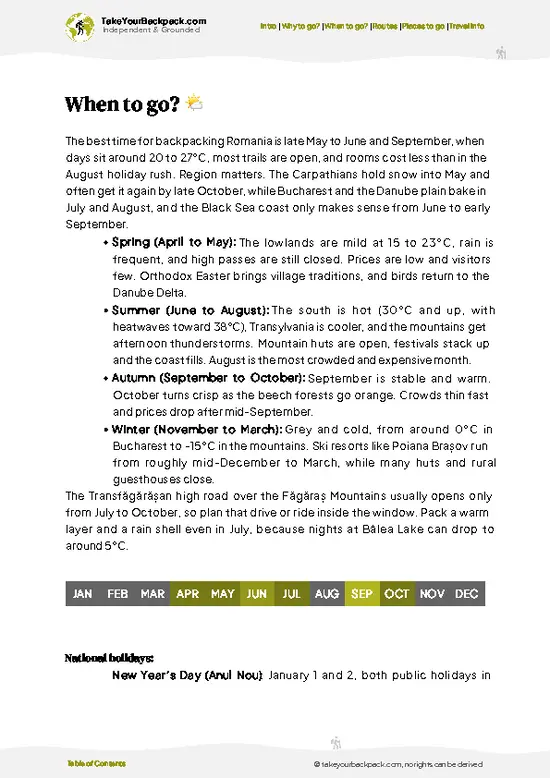
example page 0 from our offline Travel Guide for Romania
example page 1 from our offline Travel Guide for Romania
example page 2 from our offline Travel Guide for Romania
example page 3 from our offline Travel Guide for Romania
example page 4 from our offline Travel Guide for Romania
example page 5 from our offline Travel Guide for Romania
example page 6 from our offline Travel Guide for Romania
example page 7 from our offline Travel Guide for Romania
The digital guide (373 pages) contains:
99 highlights, ranked by travel appeal
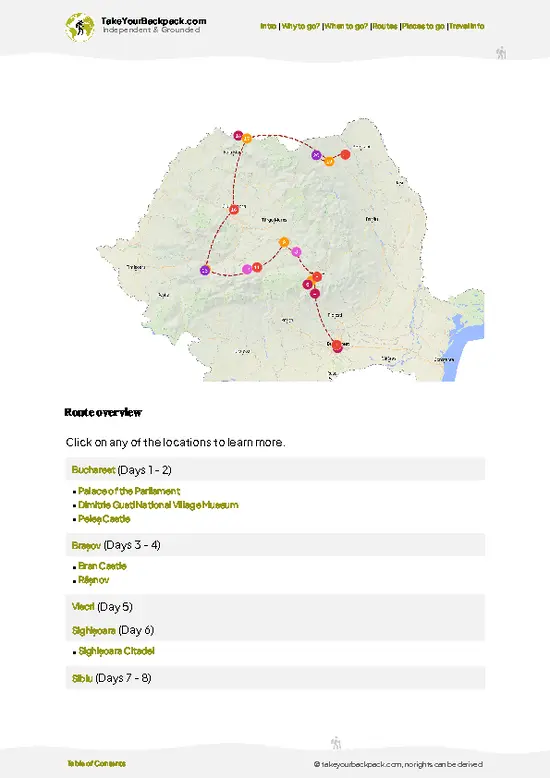
Optimized 5, 10 & 15-day travel routes
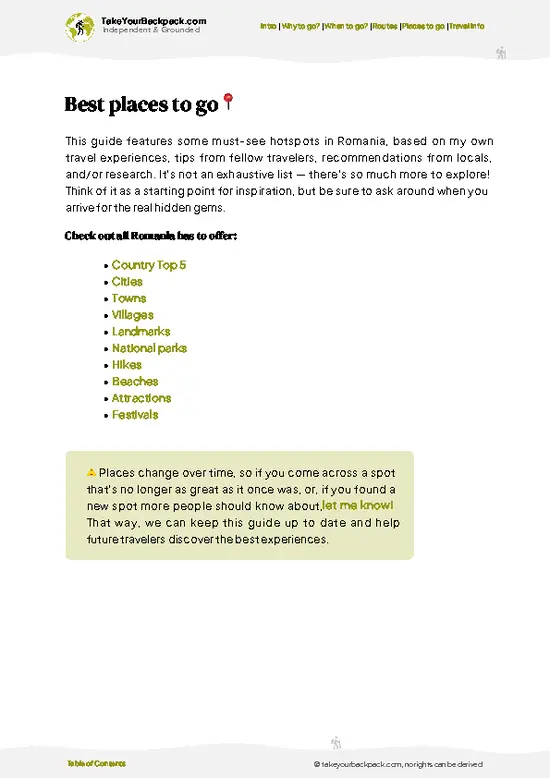
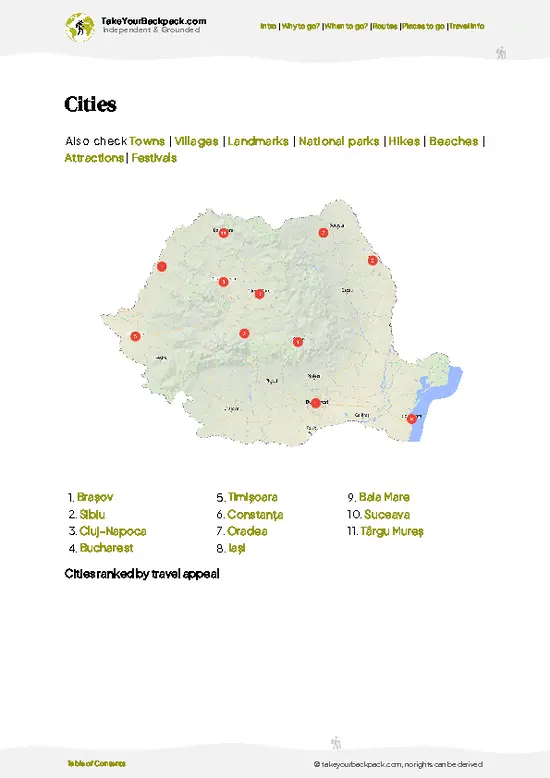
Cities, national parks, landmarks, beaches
How to get around
Offline-friendly for travel without Wi-Fi
👉 Click to see all 30+ guide features

📅 Plan smarter in minutes, not weeks
Month by month travel advice
Festivals & national holidays
Budget expectations

🗺️ Go to the right places, skip the overrated ones
Honest pros & cons of destinations
Top hikes, parks & viewpoints
Lesser-known places most travelers miss
Clear “worth it vs skip it” guidance

🛏️ Travel smoothly without rookie mistakes
Best areas to stay
Transport systems explained simply
Common scams & safety advice
SIM cards, money & practical tips

🌍 Understand the country, not just visit it
Culture & traditions
52 Essential phrases & customs
Festivals worth planning around
Traveler-friendly historical context
Insights that make places more meaningful

📱 Built for real travel conditions
Fully downloadable PDF
Works completely offline
Optimized for phone use
Useful in remote areas & buses
Everything in one place
Save weeks of stressful planning
Get instant access to your full guide. 30‑day money-back guarantee.
+ Add another guide for just US$7.80

By proceeding you agree to our terms.
Sent to your inbox immediately after payment • 100% Secure Checkout
Best Backpacking Travel Advisor 2025 tourism awardBest Backpacking
Travel Advisor
2025
What others say about Take Your Backpack Guides:
⭐⭐⭐⭐⭐
Fantastic, amazing amount of information!
⭐⭐⭐⭐⭐
My goodness this is amazing, it's what I've been looking for hats off too you!
⭐⭐⭐⭐⭐
I think this is absolutely BRILLIANT
⭐⭐⭐⭐
Very complete and informative. It's still missing places, but I gotta to commend you
⭐⭐⭐⭐⭐
This is truly amazing, thank you, can't wait to explore it with my kids!
⭐⭐⭐⭐⭐
Awesome resource, thank you!
⭐⭐⭐⭐⭐
This is amazing! Can't wait to explore the ones I haven't seen
⭐⭐⭐⭐
I love this! Well done, great idea.
⭐⭐⭐⭐⭐
Thanks for taking the time to make this gem!
⭐⭐⭐⭐⭐
This might be the best website I've ever seen.
⭐⭐⭐⭐⭐
Congratulations, and thank you so much for your work; it's incredibly valuable.
⭐⭐⭐⭐
In all seriousness I think you did a great job pointing out the important spots
⭐⭐⭐⭐⭐
10/10 very good
⭐⭐⭐⭐⭐
As someone who's only just starting to visit regularly this is awesome, thank you.
⭐⭐⭐⭐
Thank you very much! I'm going to visit my dad, it's going to be very useful!
⭐⭐⭐⭐⭐
This is really cool! We'll be travelling for the first time and this definitely come in handy.
⭐⭐⭐⭐⭐
You are now our minister of culture, congratulations 👨‍💼
⭐⭐⭐⭐⭐
Just wanted to tell you that this is a pearl! Going to follow your recommendations.
⭐⭐⭐⭐⭐
This is so cool. I'll definitely be using the resource for my travels soon.
⭐⭐⭐⭐⭐
This is very impressive! Good work.
⭐⭐⭐⭐⭐
This is an amazing and informative site. Very well done!

🛏️ Where to stay?Best areas and accommodation options

If you’re backpacking to see the Dimitrie Gusti National Village Museum, forget the touristy hotel zones. The real action—and the best spots for budget travelers—are in Bucharest’s northern neighborhoods, especially Herăstrău and Aviatorilor. These areas aren’t just close to the museum; they’re safe, walkable, and have a surprisingly chill vibe for a capital city. You’ll find plenty of guesthouses, small hostels, and shared apartments where solo travelers can meet others without the forced “party hostel” scene.

Herăstrău Park itself is a massive green lung, perfect for decompressing after a day … read more 👉
If you’re backpacking to see the Dimitrie Gusti National Village Museum, forget the touristy hotel zones. The real action—and the best spots for budget travelers—are in Bucharest’s northern neighborhoods, especially Herăstrău and Aviatorilor. These areas aren’t just close to the museum; they’re safe, walkable, and have a surprisingly chill vibe for a capital city. You’ll find plenty of guesthouses, small hostels, and shared apartments where solo travelers can meet others without the forced “party hostel” scene.

Herăstrău Park itself is a massive green lung, perfect for decompressing after a day of wandering through the open-air museum’s traditional Romanian village setups. The neighborhood has a mix of locals and expats, so you get authentic cafes and markets without the tourist markup. Plus, public transport is solid here—buses and the metro connect you easily to the city center and other sights.

Don’t expect a backpacker ghetto with loud bars or hostel crawls. Instead, you get a relaxed, social atmosphere where you can swap stories over a cheap coffee or local craft beer. It’s the kind of place that makes you want to linger, not just check a box.

👛 Costs (as of 4 September 2026)Money, prices, and spending tips

As of May 2025, the entrance fees for the Dimitrie Gusti National Village Museum in Bucharest are: Adults: 40 lei; Retirees: 20 lei; Students: 10 lei. On Mondays and Tuesdays, when most monuments are closed due to supervision works on Saturdays and Sundays, a 50% discount is applied. For guided tours, the costs are: Romanian language: 200 lei; English, Russian, or French: 300 lei. Additional fees apply for commercial photo and video sessions.

source: muzeul-satului.ro
⚠️ Prices can change and everyone travels differently, so take this as a rough guide. Hope it helps you plan your adventure!

FAQTraveler FAQ

2 to 3 hours is sufficient to explore Dimitrie Gusti National Village Museum thoroughly. The museum covers about 100,000 square meters with over 300 traditional buildings representing Romanian rural life. Allocate extra time if you want to join guided tours or attend special events, which can extend your visit to half a day.
Yes, Dimitrie Gusti National Village Museum is worth the entrance fee, which is around 10 RON (approximately 2 EUR) for adults. The museum offers a unique open-air experience showcasing authentic Romanian village architecture and culture, making it a valuable cultural visit. It provides insight into Romania's rural heritage that is hard to find elsewhere.
To get to Dimitrie Gusti National Village Museum, take tram line 1 or 10 from central Bucharest to the Herăstrău Park stop, then walk about 10 minutes south to the museum entrance. Alternatively, buses 105 and 131 also stop nearby. The museum is located in the northern part of Bucharest, about 5 km from the city center.
⚠️ Things can change over time, so always validate details locally before you go.

Other Romanian attractions near Dimitrie Gusti National Village Museum

Explore more nearby:


💡 Not sure where to go next?
Create a personalized itinerary for Romania including Dimitrie Gusti National Village Museum and the places that fit your trip.

Generate my itinerary

👉 Discover all attractions

Or checkout all Romania has to offer (think cities, towns, villages, national parks, hikes, beaches, festivals)
Country photo of Romania

We 💚 feedbackWhat to keep in mind

The Village Museum can feel like a tourist magnet, especially on weekends, so brace yourself for crowds. But here’s the kicker: once you step off the main paths and into the quieter corners, the place breathes history in a way no glossy Instagram post captures. The real magic is in the details—the creak of wooden gates, the scent of old timber, and the way each house tells a story of a Romania you won’t find in guidebooks. It’s worth the noise if you’re patient enough to look beyond it.

✍️ Help improve this page!
The information on this page is based on in-depth research, insights shared by experienced travelers, and feedback from the local travel community in Romania. While every effort is made to keep the information accurate and current, conditions can change — so if you spot anything incorrect or outdated, please get in touch.


🙋‍♂️ Give feedback

👋 Meet the founderWho’s Behind Take Your Backpack?

Johan, backpacker and founder of TakeYourBackpackHi, I’m Johan (Netherlands 🇳🇱), the creator of TakeYourBackpack. Over the past decade, I’ve backpacked through 80+ countries across six continents, gaining extensive experience with independent travel, long-term trips, and overland routes.

This site is built on a combination of firsthand travel experience and carefully curated insights from other backpackers. Many guides are based on places I’ve personally visited, while others bring together tips, observations, and practical advice shared by trusted travelers I’ve met along the way.

The goal is to provide realistic, experience-driven guidance — not generic itineraries — so you can explore destinations with better context, clearer expectations, and more confidence.

Get full Romania guide •
Instant download • 99 highlights • Full Offline guide