×

Saint Barthélemy🇧🇱 | townsLorientSea grape beach, winter surf, parish church, Breton family graves | things to do and best time to go

Explore GustaviaExplore St. Jean

Backpacking in Lorient
👍 Recommendedtown ranked #3
By Johan Kruseman 🇳🇱 | Updated October 22, 2026

Lorient suits travelers who like quiet villages, a sandy beach and a short walk to a bakery more than they like scheduled sights. Anyone after nightlife, hostels or a long list of attractions will find it thin. The village sits on the north coast of Saint Barthélemy, on the leeward side of the island's northern lobe, about ten minutes from the airport area by road. Most people arrive by rental car, scooter or taxi, because buses are rare and the island's hills make walking between villages slow. Experienced travelers book a car or scooter early, since the island's small fleet sells out in high season. Evenings are slow: a couple of restaurants, a few beach bars, almost no backpacker scene. Meeting other travelers happens on the sand or at a table, not in a common room. Compared with Grand Cul-de-Sac, which is built around resorts and watersports on a calm lagoon, Lorient feels like a residential village with a church, a cemetery and a surf break.

Discover everything you want to know in the 📖 Saint Barthélemy Travel Guide.


example page 0 from our offline Travel Guide for Saint Barthélemy
example page 1 from our offline Travel Guide for Saint Barthélemy
example page 2 from our offline Travel Guide for Saint Barthélemy
example page 3 from our offline Travel Guide for Saint Barthélemy
example page 4 from our offline Travel Guide for Saint Barthélemy
example page 5 from our offline Travel Guide for Saint Barthélemy
example page 6 from our offline Travel Guide for Saint Barthélemy
example page 7 from our offline Travel Guide for Saint Barthélemy
Loading the map 🌍
CLICK TO FILTER
towns
landmarks
hikes
beaches
attractions
festivals
regions
SHOW COUNTRY’S BESTSHOW ALL

✨ Why go?
Ranked #3 town in Saint Barthélemy
What makes this town worth visiting

Lorient works for travelers who want the island's oldest, least polished side. The village was one of the first settled on Saint Barthélemy, and it still has a parish church, a small cemetery and houses on the road to the beach rather than a marina strip. The main draw is the Plage de Lorient, a long sandy beach with shade from sea grape trees and enough swell for bodyboarding when the Atlantic pushes in. Slow travelers and surfers get the most from it, because the days run on weather and tide. Solo travelers will find it quiet, with conversation coming from the beach shack tables rather than a hostel. Most people stay an afternoon or a long morning, but a few linger for a couple of days if they have a rental and a nearby bed. The Anse du Gouverneur and Saline beaches, a short drive south, … read more 👉
Lorient works for travelers who want the island's oldest, least polished side. The village was one of the first settled on Saint Barthélemy, and it still has a parish church, a small cemetery and houses on the road to the beach rather than a marina strip. The main draw is the Plage de Lorient, a long sandy beach with shade from sea grape trees and enough swell for bodyboarding when the Atlantic pushes in. Slow travelers and surfers get the most from it, because the days run on weather and tide. Solo travelers will find it quiet, with conversation coming from the beach shack tables rather than a hostel. Most people stay an afternoon or a long morning, but a few linger for a couple of days if they have a rental and a nearby bed. The Anse du Gouverneur and Saline beaches, a short drive south, make good company for a day of beach hopping. Lorient is best as a calm anchor for the northern coast rather than a place to tick off.

💡 HighlightsWhat this place is best known for

  1. Plage de Lorient: The village's main attraction, a wide sandy beach lined with sea grape trees. Swimming is fine on calm days, though the Atlantic swell can bring a strong shore break, and surfers and bodyboarders use it in winter. Go in the morning for shade and quiet. Free, and 1 to 3 hours is usual.
  2. Église Notre-Dame-de-l’Assomption de Lorient: The parish church sits in the center of the village and anchors it. The Catholic church is small and plain, and a short look inside is enough. Visit in the morning when it is cool and the light is soft. Free, around 15 to 30 minutes.
  3. Cimetière de Lorient: Gravestones here carry the surnames of the Breton and Norman families who settled the island, which tells you more about local history than most signs. Walk through respectfully, in the morning or
… read more 👉
  1. Plage de Lorient: The village's main attraction, a wide sandy beach lined with sea grape trees. Swimming is fine on calm days, though the Atlantic swell can bring a strong shore break, and surfers and bodyboarders use it in winter. Go in the morning for shade and quiet. Free, and 1 to 3 hours is usual.
  2. Église Notre-Dame-de-l’Assomption de Lorient: The parish church sits in the center of the village and anchors it. The Catholic church is small and plain, and a short look inside is enough. Visit in the morning when it is cool and the light is soft. Free, around 15 to 30 minutes.
  3. Cimetière de Lorient: Gravestones here carry the surnames of the Breton and Norman families who settled the island, which tells you more about local history than most signs. Walk through respectfully, in the morning or late afternoon. Free, about 15 minutes.
  4. Surf break at Lorient: The beach holds one of the island's more reliable surf spots, best from winter to spring when Atlantic swells arrive. Watching from the sand is enough for most. Board rental on the island runs roughly €25 to 50 for a few hours. Plan 1 to 2 hours.
  5. Beach restaurants and snack bars: A couple of casual places by the sand serve grilled fish, salads and cold drinks, and they are the village's real social spot. Lunch is the best time. Expect to pay roughly €20 to 40 for a meal, and allow 1 to 2 hours.
Lorient's beach and church cost nothing, and the cemetery is free too. For day trips, drive to Anse du Gouverneur, Saline Beach, or the shops and harbor of Gustavia, all within a short ride of Lorient.
Spotted a mistake or missing something? Contact us.

🏘️ NeighborhoodsWhere things are and how it's laid out

Lorient is a small village on the north coast of Saint Barthélemy, and everything worth knowing sits within a few hundred meters of the main road. Areas here are loose clusters rather than formal districts, so treat them as stops along one short walk.
  • Village center and church: A handful of streets around the Catholic church and the small cemetery, with a bakery, a minimarket and a few restaurants. Mornings are the busiest, when bakery queues form. Buy bread and lunch supplies here, since beach kiosks cost more.
  • Lorient Beach: A long sand beach just north of the center with a reef-protected feel and steady surf, popular with surfers and bodyboarders. The shore is flat and walkable in minutes. Waves can be strong, so locals check the swell before swimming and stay near the lifeguard-free middle
… read more 👉
Lorient is a small village on the north coast of Saint Barthélemy, and everything worth knowing sits within a few hundred meters of the main road. Areas here are loose clusters rather than formal districts, so treat them as stops along one short walk.
  • Village center and church: A handful of streets around the Catholic church and the small cemetery, with a bakery, a minimarket and a few restaurants. Mornings are the busiest, when bakery queues form. Buy bread and lunch supplies here, since beach kiosks cost more.
  • Lorient Beach: A long sand beach just north of the center with a reef-protected feel and steady surf, popular with surfers and bodyboarders. The shore is flat and walkable in minutes. Waves can be strong, so locals check the swell before swimming and stay near the lifeguard-free middle only on calm days.
  • Beachfront restaurant strip: A few casual spots sit right behind the sand. Lunch is the main service, and evenings are quiet, with no club scene. Experienced travelers book dinner ahead because tables are few.
  • Hills toward Saline and Grand Cul-de-Sac: The road climbs inland and east through residential slopes. Distances are short but the road is narrow with no sidewalk, so walk early, face traffic and carry water. Saline Beach is reached on foot from the Saline parking area, not from Lorient itself.

⌛️ 1 dayA smart one-day plan

This is a slow village-and-beach day, built around the east coast and the short walks that link it.
8:00 AM: Lorient village center
Start with coffee and a croissant at one of the bakeries on the main road. The village is quiet early, with locals collecting bread and the occasional scooter passing. Walk five minutes to the small church of Notre-Dame-de-l’Assomption, the island’s oldest-looking parish church, with its simple whitewashed facade and shaded churchyard.
9:30 AM: Lorient cemetery and the old lanes
Wander the back lanes toward the cemetery, where Breton and Norman family names on the graves show who settled this side of the island. It costs nothing and takes about 20 minutes. Few people come here, which is the point.
10:30 AM: Anse de Lorient
Walk or hop on a short ride down to the beach. … read more 👉
This is a slow village-and-beach day, built around the east coast and the short walks that link it.
8:00 AM: Lorient village center
Start with coffee and a croissant at one of the bakeries on the main road. The village is quiet early, with locals collecting bread and the occasional scooter passing. Walk five minutes to the small church of Notre-Dame-de-l’Assomption, the island’s oldest-looking parish church, with its simple whitewashed facade and shaded churchyard.
9:30 AM: Lorient cemetery and the old lanes
Wander the back lanes toward the cemetery, where Breton and Norman family names on the graves show who settled this side of the island. It costs nothing and takes about 20 minutes. Few people come here, which is the point.
10:30 AM: Anse de Lorient
Walk or hop on a short ride down to the beach. The bay is sheltered by a reef, so the water stays calm and good for a swim before the sun gets strong. Surfers sometimes gather at the break just off the point, and watching them from the sand is entertainment enough. Shade under the sea grapes is limited, so bring a hat.
12:30 PM: Lunch on the beach
Order grilled fish or a plain sandwich at one of the small beachside restaurants. Prices run high by Caribbean standards, so a shared plate and tap water is the smarter move. Linger through the hottest hour.
2:30 PM: Walk to Anse du Grand Cul-de-Sac side
Follow the coast road east toward Grand Cul-de-Sac, about 40 minutes on foot, mostly flat. The lagoon there is shallow and wind-protected, with kite and paddle boards skimming across it. Stop wherever the view opens up over the reef.
4:30 PM: Lagoon swim and rest
Cool off in the shallows, which are gentle enough to walk a long way out. Check the bus or ask a local for a ride if your legs have had enough.
6:00 PM: Back in Lorient
Finish with a drink at a village bar as the light softens. Evenings are calm, with conversation rather than crowds, and an early night suits the rhythm of the place.

🌤️ When to go?Seasonal considerations and timing

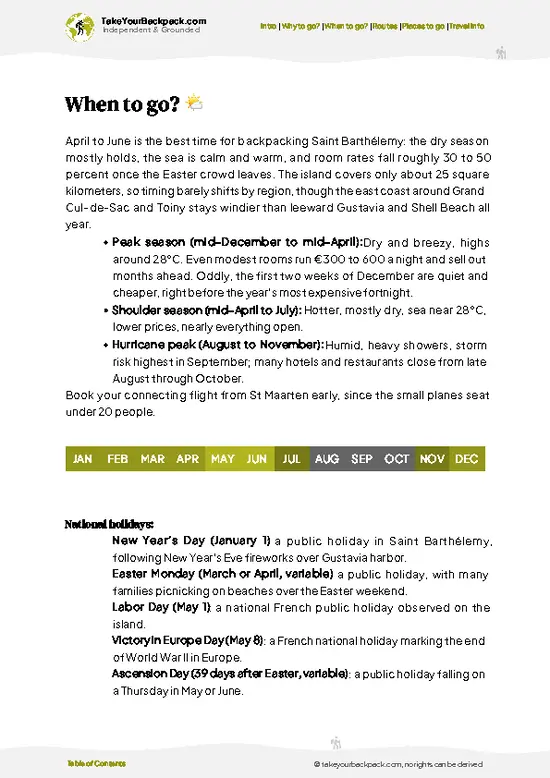
The best months for Lorient are December through April, when days are dry and the Atlantic swell suits surfing.
  • Peak Season (December to April): Highs of 28 to 30°C (82 to 86°F), low humidity and steady trade winds. Crowds and prices are at their highest, especially around Christmas and New Year.
  • Shoulder (May to June, November): Highs of 29 to 31°C (84 to 88°F), with showers rising. Fewer visitors and some discounts on rooms.
  • Hurricane Season (July to October): Hot and humid at 30 to 32°C (86 to 90°F), with the heaviest rain and storm risk peaking in August and September. Several restaurants close for weeks, though prices fall sharply.
  • Surf Season (November to March): North swells reach Lorient Beach and bring the best waves, with bigger currents too.
Book flights and a bed for late January or … read more 👉
The best months for Lorient are December through April, when days are dry and the Atlantic swell suits surfing.
  • Peak Season (December to April): Highs of 28 to 30°C (82 to 86°F), low humidity and steady trade winds. Crowds and prices are at their highest, especially around Christmas and New Year.
  • Shoulder (May to June, November): Highs of 29 to 31°C (84 to 88°F), with showers rising. Fewer visitors and some discounts on rooms.
  • Hurricane Season (July to October): Hot and humid at 30 to 32°C (86 to 90°F), with the heaviest rain and storm risk peaking in August and September. Several restaurants close for weeks, though prices fall sharply.
  • Surf Season (November to March): North swells reach Lorient Beach and bring the best waves, with bigger currents too.
Book flights and a bed for late January or February, before the Easter rush pushes prices up.


source: climatestotravel.comJANJanuary: excellent for travelingFEBFebruary: excellent for travelingMARMarch: excellent for travelingAPRApril: highly recommended for travelingMAYMay: highly recommended for travelingJUNJune: good for travelingJULJuly: fair for travelingAUGAugust: fair for travelingSEPSeptember: fair for travelingOCTOctober: fair for travelingNOVNovember: good for travelingDECDecember: excellent for traveling
when-to-go

✈️ The backpacker research shortcutSaint Barthélemy Travel Guide

An offline-friendly backpacking guide with optimized travel routes, ranked highlights, transport advice, and the best areas to stay.
example page 0 from our offline Travel Guide for Saint Barthélemy
example page 1 from our offline Travel Guide for Saint Barthélemy
example page 2 from our offline Travel Guide for Saint Barthélemy
example page 3 from our offline Travel Guide for Saint Barthélemy
example page 4 from our offline Travel Guide for Saint Barthélemy
example page 5 from our offline Travel Guide for Saint Barthélemy
example page 6 from our offline Travel Guide for Saint Barthélemy
example page 7 from our offline Travel Guide for Saint Barthélemy
The digital guide (107 pages) contains:
✅ 22 highlights, ranked by travel appeal
✅ Optimized 2, 3 & 5-day travel routes
✅ Cities, national parks, landmarks, beaches
✅ How to get around
✅ Offline-friendly for travel without Wi-Fi
👉 Click to see all 30+ guide features

📅 Plan smarter in minutes, not weeks
✅ Month by month travel advice
✅ Festivals & national holidays
✅ Budget expectations

🗺️ Go to the right places, skip the overrated ones
✅ Honest pros & cons of destinations
✅ Top hikes, parks & viewpoints
✅ Lesser-known places most travelers miss
✅ Clear “worth it vs skip it” guidance

🛏️ Travel smoothly without rookie mistakes
✅ Best areas to stay
✅ Transport systems explained simply
✅ Common scams & safety advice
✅ SIM cards, money & practical tips

🌍 Understand the country, not just visit it
✅ Culture & traditions
✅ 52 Essential phrases & customs
✅ Festivals worth planning around
✅ Traveler-friendly historical context
✅ Insights that make places more meaningful

📱 Built for real travel conditions
✅ Fully downloadable PDF
✅ Works completely offline
✅ Optimized for phone use
✅ Useful in remote areas & buses
✅ Everything in one place
Stop searching, start planning
Get instant access to your full guide. 30‑day money-back guarantee.
+ Add another guide for just

By proceeding you agree to our terms.
Sent to your inbox immediately after payment • 100% Secure Checkout
Best Backpacking Travel Advisor 2025 tourism awardBest Backpacking
Travel Advisor
2025
What others say about Take Your Backpack Guides:
⭐⭐⭐⭐⭐
Fantastic, amazing amount of information!
⭐⭐⭐⭐⭐
My goodness this is amazing, it's what I've been looking for hats off too you!
⭐⭐⭐⭐⭐
I think this is absolutely BRILLIANT
⭐⭐⭐⭐
Very complete and informative. It's still missing places, but I gotta to commend you
⭐⭐⭐⭐⭐
This is truly amazing, thank you, can't wait to explore it with my kids!
⭐⭐⭐⭐⭐
Awesome resource, thank you!
⭐⭐⭐⭐⭐
This is amazing! Can't wait to explore the ones I haven't seen
⭐⭐⭐⭐
I love this! Well done, great idea.
⭐⭐⭐⭐⭐
Thanks for taking the time to make this gem!
⭐⭐⭐⭐⭐
This might be the best website I've ever seen.
⭐⭐⭐⭐⭐
Congratulations, and thank you so much for your work; it's incredibly valuable.
⭐⭐⭐⭐
In all seriousness I think you did a great job pointing out the important spots
⭐⭐⭐⭐⭐
10/10 very good
⭐⭐⭐⭐⭐
As someone who's only just starting to visit regularly this is awesome, thank you.
⭐⭐⭐⭐
Thank you very much! I'm going to visit my dad, it's going to be very useful!
⭐⭐⭐⭐⭐
This is really cool! We'll be travelling for the first time and this definitely come in handy.
⭐⭐⭐⭐⭐
You are now our minister of culture, congratulations 👨‍💼
⭐⭐⭐⭐⭐
Just wanted to tell you that this is a pearl! Going to follow your recommendations.
⭐⭐⭐⭐⭐
This is so cool. I'll definitely be using the resource for my travels soon.
⭐⭐⭐⭐⭐
This is very impressive! Good work.
⭐⭐⭐⭐⭐
This is an amazing and informative site. Very well done!

🛏️ Where to stay?Best areas to stay in Saint Barthélemy

Lorient itself is the quietest base, but Gustavia and nearby coastal areas hold most of the cheaper beds on Saint Barthélemy. Budget lodging on the island is scarce and pricey, so expect small guesthouses, shared apartments and rooms in private homes more than true dorms.

In Lorient, a room near the village center works well. You can walk to the bakery, minimarket and beach, and nights are calm with almost no street noise. Safety after dark is not a concern, though the unlit road means a flashlight helps. The tradeoff is limited transport, as taxis need booking ahead.

Gustavia is the practical … read more 👉
Lorient itself is the quietest base, but Gustavia and nearby coastal areas hold most of the cheaper beds on Saint Barthélemy. Budget lodging on the island is scarce and pricey, so expect small guesthouses, shared apartments and rooms in private homes more than true dorms.

In Lorient, a room near the village center works well. You can walk to the bakery, minimarket and beach, and nights are calm with almost no street noise. Safety after dark is not a concern, though the unlit road means a flashlight helps. The tradeoff is limited transport, as taxis need booking ahead.

Gustavia is the practical second option, with more shops and restaurants, the ferry port and the widest choice of rooms. It is livelier at night, and the harbor area can be noisy on weekends. Taxis are easiest to find here, and the airport is a short ride away.

Book months ahead for December to April, when even basic rooms sell out. Shorter stays often cost more per night, so a week in one place is usually cheaper than moving around.

🚌 Getting aroundMoving around without the hassle

Lorient is easy to misjudge: renting a car for the whole stay is the costliest mistake, since the island is only about 10 km (6 miles) long and most trips are short. Rental cars here run roughly €50 to 90 a day, and parking near beaches is limited.
  • Walking: Free and enough for the village center and the beach. The road toward Saline has no sidewalk and is steep in places, so go early and carry water.
  • Taxi: The practical choice for reaching Gustavia or the airport, as fares are fixed by zone and not metered. Expect about €20 to 30 to Gustavia and €15 to 25 to the airport. Late evening rides need booking by phone, because few taxis wait near Lorient after dark.
  • Rental scooter or mini-car: Many budget travelers hire for a day or two at about €35 to 60 a day. Roads are narrow and winding, and the
… read more 👉
Lorient is easy to misjudge: renting a car for the whole stay is the costliest mistake, since the island is only about 10 km (6 miles) long and most trips are short. Rental cars here run roughly €50 to 90 a day, and parking near beaches is limited.
  • Walking: Free and enough for the village center and the beach. The road toward Saline has no sidewalk and is steep in places, so go early and carry water.
  • Taxi: The practical choice for reaching Gustavia or the airport, as fares are fixed by zone and not metered. Expect about €20 to 30 to Gustavia and €15 to 25 to the airport. Late evening rides need booking by phone, because few taxis wait near Lorient after dark.
  • Rental scooter or mini-car: Many budget travelers hire for a day or two at about €35 to 60 a day. Roads are narrow and winding, and the hills are steep, so ride carefully and keep to the right side. A day rental is cheaper than a week and covers the main beaches.
  • Hitchhiking: Locals do stop for walkers, especially in the daytime on the main roads. It is not a guaranteed service, so keep a taxi number as backup.
  • Shuttle bus: Public shuttle service is limited and not a dependable way to plan a trip. Ask your host for current times rather than counting on a bus.
Fuel costs more than in mainland France, and the island has few gas stations, so refill when you pass one. An experienced traveler groups errands into one morning, then uses a taxi only for longer hops.

👛 Costs (as of 22 October 2026)Money, prices, and spending tips

Lorient costs about €145 to 245 a day for a backpacker, and the total below uses €200 as a working figure. Saint Barthélemy is one of the priciest places in the Caribbean, and euros are the currency used.
CategoryBudget RangeLocal Reality
Dorm or budget accommodation€80 to 120True dorms are rare. A basic room or shared apartment in high season is the realistic option.
Meals€35 to 55Bakery breakfast and supermarket lunches keep costs down. A sit-down dinner often runs €30 to 50.
Local transport€20 to 35Taxis are priced by zone. A scooter hire for a day costs less than repeated rides.
Basic activities and entry fees€0 to 15Beaches are free. Snorkel gear or a surf board hire adds a little.
Miscellaneous€10 to 20Water, sunscreen, a drink and small snacks.
Total Daily Budget€145 to 245About €200 on a
… read more 👉
Lorient costs about €145 to 245 a day for a backpacker, and the total below uses €200 as a working figure. Saint Barthélemy is one of the priciest places in the Caribbean, and euros are the currency used.
CategoryBudget RangeLocal Reality
Dorm or budget accommodation€80 to 120True dorms are rare. A basic room or shared apartment in high season is the realistic option.
Meals€35 to 55Bakery breakfast and supermarket lunches keep costs down. A sit-down dinner often runs €30 to 50.
Local transport€20 to 35Taxis are priced by zone. A scooter hire for a day costs less than repeated rides.
Basic activities and entry fees€0 to 15Beaches are free. Snorkel gear or a surf board hire adds a little.
Miscellaneous€10 to 20Water, sunscreen, a drink and small snacks.
Total Daily Budget€145 to 245About €200 on a typical day in high season.
Buy groceries in the village and cook where your lodging allows it, which can cut food costs by half.
⚠️ Prices can change and everyone travels differently, so take this as a rough guide. Hope it helps you plan your adventure!

🚌 Day tripsBest day trips from Lorient

Lorient works well as a base because the island is tiny and every trip below takes under 30 minutes by road.
Saline Beach and Salt Pond: Saline is a wide, wild stretch of sand reached by a short walk of 10 to 15 minutes from the parking area. It has no facilities, so bring water and food. Go in the morning for shade and calmer crowds. A taxi from Lorient costs about €15 to 25 each way.

Gustavia: The harbor town is worth a half day for its museum, the clock tower and the waterfront streets. Cafes are pricey, so many travelers buy a sandwich at a bakery and eat by the water. Allow about 20 minutes by taxi at €20 to 30, and avoid midday heat from May to October.
👉 Explore Gustavia
Gouverneur Beach: Gouverneur sits on the south coast, with calm water, sand and a hillside backdrop. It is quieter … read more 👉
Lorient works well as a base because the island is tiny and every trip below takes under 30 minutes by road.
Saline Beach and Salt Pond: Saline is a wide, wild stretch of sand reached by a short walk of 10 to 15 minutes from the parking area. It has no facilities, so bring water and food. Go in the morning for shade and calmer crowds. A taxi from Lorient costs about €15 to 25 each way.

Gustavia: The harbor town is worth a half day for its museum, the clock tower and the waterfront streets. Cafes are pricey, so many travelers buy a sandwich at a bakery and eat by the water. Allow about 20 minutes by taxi at €20 to 30, and avoid midday heat from May to October.
👉 Explore Gustavia
Gouverneur Beach: Gouverneur sits on the south coast, with calm water, sand and a hillside backdrop. It is quieter than the busier beaches on weekdays. The road down is steep, so scooter riders should take it slowly. Budget about €20 to 30 by taxi each way, plus a picnic.

Colombier Hike: A walking trail of roughly 30 to 45 minutes leads to a quiet cove, reached from Colombier village. The path is rocky, so wear closed shoes. Visit from December to April when it is drier and less muddy. Bring snorkel gear, as there is no rental on site.
👉 Explore Colombier

🛡️ SafetyTraveler Safety Guide

Lorient is very safe, and the main issues are natural rather than criminal. Rip currents and strong surf at Lorient Beach catch swimmers out, especially in the winter swell, so check conditions with locals and avoid swimming alone. Petty theft is rare, but do not leave phones or bags unattended on the sand or in a parked scooter, since a visible item invites a break-in. Walking at night is generally fine, though the roads are dark, narrow and have no sidewalks, so carry a flashlight and keep to the edge facing traffic. Solo travelers, including women, report few problems. Scams are uncommon. The more frequent annoyance is price: restaurants and shops are expensive, and checks may include a service charge, so read the bill before tipping. In hurricane season, follow local weather advisories and ask your host about shelter.

FAQCommon questions from travelers

Lorient is worth a visit if you want a quiet village with a surf beach and few crowds, though it is not a place for sightseeing. The beach, the village bakery and the short drive to Saline are the main draws. Travelers seeking nightlife and shops tend to prefer Gustavia, about 20 minutes away by taxi at roughly €20 to 30.
Lorient suits a stay of two to three days, enough for the beach, a walk to Saline and a trip to Gustavia. Add a day if you want to hike to Colombier or catch surf swells from December to March. Longer stays are costly, as budget rooms are limited and run roughly €80 to 120 a night.
Lorient can be visited as a day trip from Gustavia, since the drive is about 15 to 20 minutes and a taxi costs around €20 to 30 each way. A day covers the beach, a bakery lunch and a walk through the village. Taxis are scarce after dark, so book the return ride in advance if you stay for dinner.
⚠️ Things can change over time, so always validate details locally before you go.

Other Saint-Barthélemois towns near Lorient

Explore more nearby:

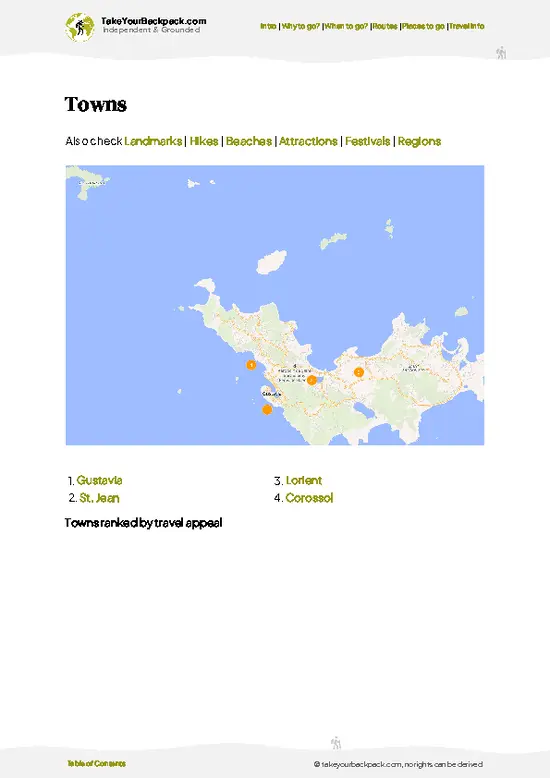
  • St. Jean—Runway beach, calm shallows, Eden Rock snorkeling, paddleboards| 1 km away
  • Gustavia—Yacht harbor, Swedish-era museum, hill viewpoints, Shell Beach| 3 km away
  • Corossol—Painted fishing boats, latanier weaving, morning fish landing, salt pond| 3 km away

💡 Not sure where to go next?
Create a personalized itinerary for Saint Barthélemy including Lorient and the places that fit your trip.

Generate my itinerary

👉 Discover all towns

Or checkout all Saint Barthélemy has to offer (think cities, towns, villages, national parks, hikes, beaches, festivals)
Country photo of Saint Barthélemy

We 💚 feedbackFinal thoughts on visiting Lorient

Lorient is best for travelers who like quiet beaches, a local bakery and a good book, and who do not mind being the only visitor at the church. I would bring a rental car or scooter, pack a picnic and plan the day around the surf break rather than any list. Skip it if you need nightlife.

✍️ Help improve this page!
The information on this page is based on in-depth research, insights shared by experienced travelers, and feedback from the local travel community in Saint Barthélemy. While every effort is made to keep the information accurate and current, conditions can change — so if you spot anything incorrect or outdated, please get in touch.


🙋‍♂️ Give feedback

👋 Meet the founderWho’s Behind Take Your Backpack?

Johan, backpacker and founder of TakeYourBackpackHi, I’m Johan (Netherlands 🇳🇱), the creator of TakeYourBackpack. Over the past 3 decades, I’ve backpacked through 90+ countries across six continents, gaining extensive experience with independent travel, long-term trips, and overland routes.

This site is built on a combination of firsthand travel experience and carefully curated insights from other backpackers. Many guides are based on places I’ve personally visited, while others bring together tips, observations, and practical advice shared by trusted travelers I’ve met along the way.

The goal is to provide realistic, experience-driven guidance — not generic itineraries — so you can explore destinations with better context, clearer expectations, and more confidence.