×

Saint Lucia🇱🇨 | best regionsExplore the Best regions in St. Lucia

Saint Lucia is small enough to cross in about two hours, yet its regions feel like different islands. The north is flatter, drier and resort-heavy, while the south and west are steep, green and cheaper to sleep in. Independent travelers will find that bus access thins out fast beyond the main coastal road, so pick a base first and let the island come to you.

By Johan Kruseman 🇳🇱 | Updated November 3, 2026
Explore the best towns in St. Lucia

Why go?What Makes Them Special

Saint Lucia suits region-hopping because it is a young volcanic island, only about 43 kilometers long, where the interior ridge forces nearly every road to hug the coast. Mountains, rainforest and reefs sit within a short drive of each other, so the character shifts quickly without long journeys.

Know the limits before you commit. Public transport runs on minibuses (around EC$2.50 to 8 per hop, roughly US$1 to 3) that thin out after dark and on Sundays. The roads are narrow, winding and driven on the left, so renting a car takes real nerve. Taxis have set fares, so confirm the price before you get in. Because of its mix of French and British history, Kwéyòl is widely spoken, and a simple “bonjou” opens doors.
How the List Was Created
The list of best regions in St. Lucia is created based on landscapes, local culture, attractions, vibes, and overall appeal. If you feel a region is missing in this list, please let us know.

When to go?When to Plan Your Trip

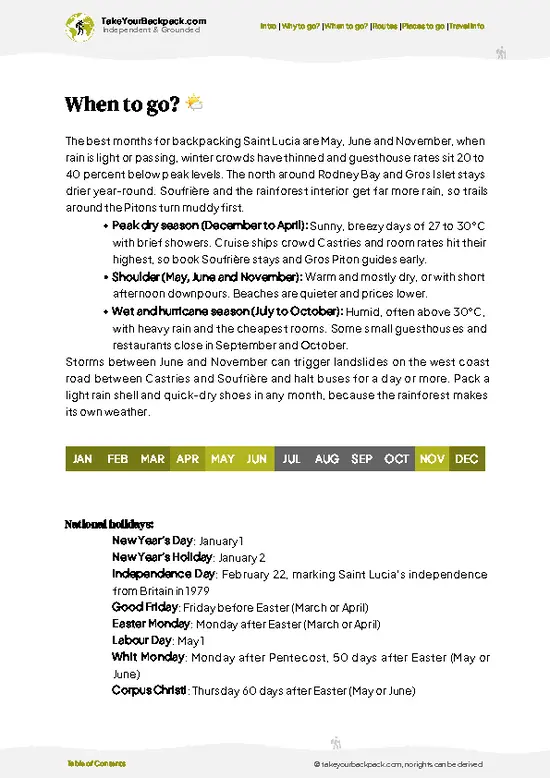
Best Months and Seasons: The best months are December to April, when the dry season brings sunny days around 28 to 31°C, lower humidity and calmer seas. Expect peak prices then, with rooms often 30 to 50 percent above summer rates, so book early for Christmas and February.

Shoulder and Wet Months: May to June and November are the sweet spot for value, with fewer crowds and showers that tend to pass quickly. July to October is the wettest stretch and the heart of hurricane season, with monthly rainfall often above 200 millimeters. Some guesthouses and tour operators cut back then, though deals are real. The rainy season keeps the rainforest interior greener and wetter than the dry coast, so pack a light rain shell whenever you go.

region hoppingSuggested Travel Strategies

How Many Days You Need: A trip combining several regions needs 7 to 10 days, which gives each stop breathing room. Plan on 2 to 3 nights per base, since day trips from one base cover most of what is nearby.

Direction and Transfers: Start near Hewanorra International Airport in the south or George F. L. Charles Airport near Castries, then travel in one direction up or down the west coast. Transfers typically take 45 minutes to 2 hours, longer in Castries rush hour. Minibuses link the main towns, but use taxis for the first and last legs.

Common Planning Mistakes: Travelers often cram in too many stops, assuming a short distance means a short drive. The curves can double estimates. Build in a buffer before any flight, and avoid moving on Sundays when buses are sparse.

The ListHighly Recommended regions of St. Lucia

1 Morne Fortune

Fort Charlotte ramparts, harbor overlooks, garrison ruins, college campus, Government House

Climb above Castries to walk old ramparts and gun batteries, then follow the twisting road down past lookouts, a quiet military cemetery and residential lanes.

saint-lucia-region-morne-fortune
© Google |
Loading the map 🌍

Expert viewTips and Advice from Travelers

How Many Regions to Visit: I would advise three regions for a week and four at most for ten days. Every move costs half a day of packing, waiting for minibuses and winding roads, and a third base is about where that time stops paying back.

Choosing by Travel Style: For hikers and nature lovers, the green, rugged regions give the most for the least money, since trails and waterfalls cost little beyond a guide. For beach and social travelers, the busier coast is comfier but pricier. Budget-minded backpackers get the best value mixing one lively base with one quiet, cheaper village, which trades some comfort for savings of around US$20 to 40 a night.

Budget Figures: Plan US$60 to 110 a day (EC$160 to 300) for guesthouses, local meals and minibuses. Guesthouse rooms run about US$40 to 80, meals … read more 👉
How Many Regions to Visit: I would advise three regions for a week and four at most for ten days. Every move costs half a day of packing, waiting for minibuses and winding roads, and a third base is about where that time stops paying back.

Choosing by Travel Style: For hikers and nature lovers, the green, rugged regions give the most for the least money, since trails and waterfalls cost little beyond a guide. For beach and social travelers, the busier coast is comfier but pricier. Budget-minded backpackers get the best value mixing one lively base with one quiet, cheaper village, which trades some comfort for savings of around US$20 to 40 a night.

Budget Figures: Plan US$60 to 110 a day (EC$160 to 300) for guesthouses, local meals and minibuses. Guesthouse rooms run about US$40 to 80, meals at local spots US$6 to 15, and taxis often US$20 to 60 for longer transfers. Entry fees for gardens, waterfalls and trails are usually US$5 to 15, and a trail guide runs around US$30 to 60, a fair price on steep or muddy paths. A rental car costs US$50 to 80 a day plus a local driving permit of about US$20, which pays off only if you share it.

Safety and Culture: Daytime travel is generally relaxed, but avoid isolated beaches and trails after dark, and do not leave valuables in cars or on sand. Swim only where waves are calm, as some Atlantic-side beaches have strong currents. Dress modestly away from resorts, and greet people before asking anything. Sundays are quiet, with church in the morning and many small shops closed. Always agree on taxi fares and guide fees first, and carry small EC$ notes.

✈️ The backpacker research shortcutSt. Lucia Travel Guide

What the free pages can't give you: ready-made routes, every place ranked, and it works offline. All in 1 guide.
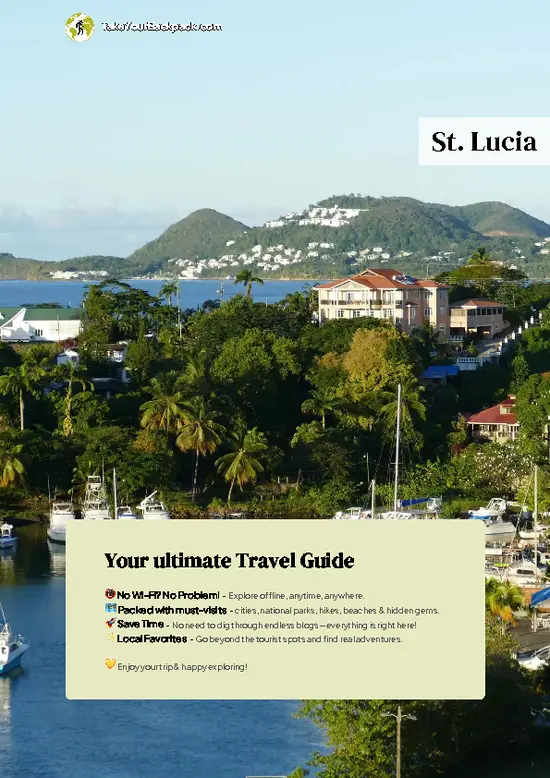
example page 0 from our offline Travel Guide for Saint Lucia
example page 1 from our offline Travel Guide for Saint Lucia
example page 2 from our offline Travel Guide for Saint Lucia
example page 3 from our offline Travel Guide for Saint Lucia
example page 4 from our offline Travel Guide for Saint Lucia
example page 5 from our offline Travel Guide for Saint Lucia
example page 6 from our offline Travel Guide for Saint Lucia
example page 7 from our offline Travel Guide for Saint Lucia
The digital guide (125 pages) contains:-page digital guide:
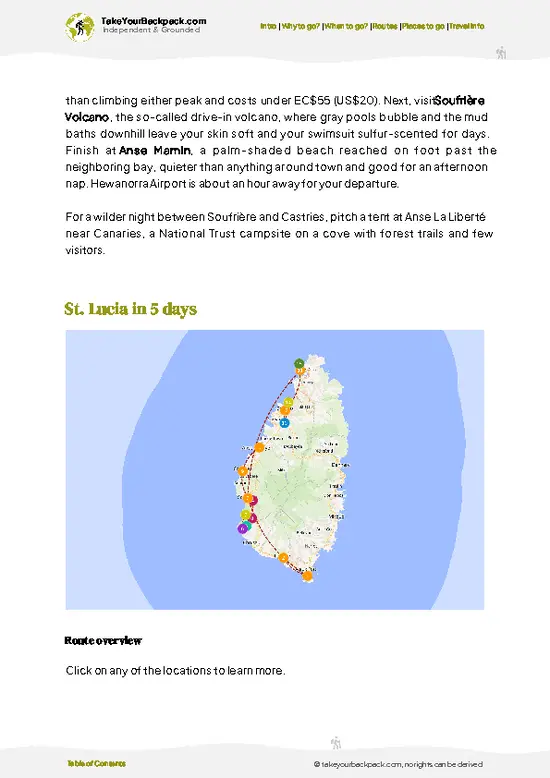
✅ Ready-made 2, 3 & 5-day routes
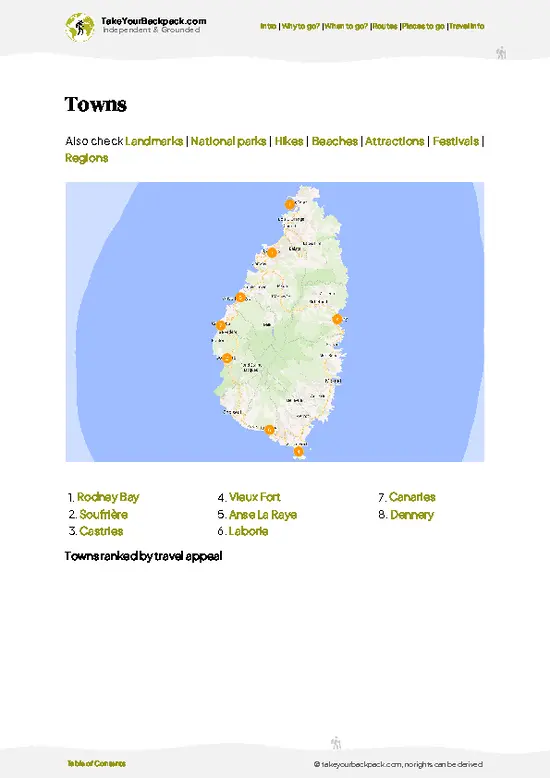
✅ All 31 places ranked, so you skip the overrated ones
✅ Works offline, all in 1 guide
✅ Cities, national parks, landmarks, beaches
✅ How to get around
👉 Click to see all 30+ guide features

📅 Plan smarter in minutes, not weeks
✅ Month by month travel advice
✅ Festivals & national holidays
✅ Budget expectations

🗺️ Go to the right places, skip the overrated ones
✅ Honest pros & cons of destinations
✅ Top hikes, parks & viewpoints
✅ Lesser-known places most travelers miss
✅ Clear “worth it vs skip it” guidance

🛏️ Travel smoothly without rookie mistakes
✅ Best areas to stay
✅ Transport systems explained simply
✅ Common scams & safety advice
✅ SIM cards, money & practical tips

🌍 Understand the country, not just visit it
✅ Culture & traditions
✅ 52 Essential phrases & customs
✅ Festivals worth planning around
✅ Traveler-friendly historical context
✅ Insights that make places more meaningful

📱 Built for real travel conditions
✅ Fully downloadable PDF
✅ Works completely offline
✅ Optimized for phone use
✅ Useful in remote areas & buses
✅ All in 1 guide
Stop searching, start planning
Get instant access to your full guide. 30‑day money-back guarantee.


By proceeding you agree to our terms.
Sent to your inbox immediately after payment • 100% Secure Checkout
Best Backpacking Travel Advisor 2025 tourism awardBest Backpacking
Travel Advisor
2025
What others say about Take Your Backpack Guides:
⭐⭐⭐⭐⭐
Fantastic, amazing amount of information!
⭐⭐⭐⭐⭐
My goodness this is amazing, it's what I've been looking for hats off too you!
⭐⭐⭐⭐⭐
I think this is absolutely BRILLIANT
⭐⭐⭐⭐
Very complete and informative. It's still missing places, but I gotta to commend you
⭐⭐⭐⭐⭐
This is truly amazing, thank you, can't wait to explore it with my kids!
⭐⭐⭐⭐⭐
Awesome resource, thank you!
⭐⭐⭐⭐⭐
This is amazing! Can't wait to explore the ones I haven't seen
⭐⭐⭐⭐
I love this! Well done, great idea.
⭐⭐⭐⭐⭐
Thanks for taking the time to make this gem!
⭐⭐⭐⭐⭐
This might be the best website I've ever seen.
⭐⭐⭐⭐⭐
Congratulations, and thank you so much for your work; it's incredibly valuable.
⭐⭐⭐⭐
In all seriousness I think you did a great job pointing out the important spots
⭐⭐⭐⭐⭐
10/10 very good
⭐⭐⭐⭐⭐
As someone who's only just starting to visit regularly this is awesome, thank you.
⭐⭐⭐⭐
Thank you very much! I'm going to visit my dad, it's going to be very useful!
⭐⭐⭐⭐⭐
This is really cool! We'll be travelling for the first time and this definitely come in handy.
⭐⭐⭐⭐⭐
You are now our minister of culture, congratulations 👨‍💼
⭐⭐⭐⭐⭐
Just wanted to tell you that this is a pearl! Going to follow your recommendations.
⭐⭐⭐⭐⭐
This is so cool. I'll definitely be using the resource for my travels soon.
⭐⭐⭐⭐⭐
This is very impressive! Good work.
⭐⭐⭐⭐⭐
This is an amazing and informative site. Very well done!

🛏️ Where to stay?Best Places to Stay in St. Lucia

Saint Lucia has only a handful of true hostels, so budget travelers mostly stay in family-run guesthouses and self-catering apartments, typically about EC$110 to 190 (US$40 to 70) a night for a private room. Rodney Bay and neighboring Gros Islet have the widest choice, with the island’s main nightlife, the Friday street party and beaches within walking distance, but they are also the noisiest and priciest corner. Soufrière is quiet and close to the Pitons, sulfur springs and rainforest trails, while Castries is cheap and handy for minibuses, though its center empties out and feels less safe after dark.

If you enjoy meeting fellow travelers, consider choosing hostels with high ratings for atmosphere. … read more 👉
Saint Lucia has only a handful of true hostels, so budget travelers mostly stay in family-run guesthouses and self-catering apartments, typically about EC$110 to 190 (US$40 to 70) a night for a private room. Rodney Bay and neighboring Gros Islet have the widest choice, with the island’s main nightlife, the Friday street party and beaches within walking distance, but they are also the noisiest and priciest corner. Soufrière is quiet and close to the Pitons, sulfur springs and rainforest trails, while Castries is cheap and handy for minibuses, though its center empties out and feels less safe after dark.

If you enjoy meeting fellow travelers, consider choosing hostels with high ratings for atmosphere. On the other hand, if you prefer having your own space, a hotel might be a better option.

St. LuciaExplore St. Lucia

👋 Meet the founderWho’s Behind Take Your Backpack?

Johan, backpacker and founder of TakeYourBackpackHi, I’m Johan (Netherlands 🇳🇱), the creator of TakeYourBackpack. Over the past 30 years, I’ve backpacked through 88 countries across six continents, gaining extensive experience with independent travel, long-term trips, and overland routes.

This site is built on a combination of firsthand travel experience and carefully curated insights from other backpackers. Many guides are based on places I’ve personally visited, while others bring together tips, observations, and practical advice shared by trusted travelers I’ve met along the way.

The goal is to provide realistic, experience-driven guidance — not generic itineraries — so you can explore destinations with better context, clearer expectations, and more confidence.