×

Saint Lucia🇱🇨 | best national parksExplore the 3 Best national parks in St. Lucia

Saint Lucia’s national parks are less fenced-off reserves than a patchwork of forest reserves, marine areas and heritage sites, mostly run through the Saint Lucia National Trust and the Forestry Department. Expect small entry fees, mandatory local guides on key trails, and steep rainforest in the south and center versus drier, quieter coast in the north. For independent travelers, buses reach many gateways, but plan on a taxi for the last stretch.

By Johan Kruseman 🇳🇱 | Updated November 3, 2026
Explore the best hikes in St. Lucia

Why go?What Makes Them Special

Saint Lucia packs volcanic peaks, rainforest, reefs and sulfur vents into an island only about 43 kilometers long, so very different ecosystems sit within an hour or two of each other. The twin Pitons rise straight from the sea, which is why the area earned UNESCO World Heritage status. Protection here is a mix of government forest reserves, trust-managed sites and marine management areas, rather than one big national park system. That means access rules vary: some trails need a licensed local guide, some charge fees at a gatehouse, and some sit on private estates. Roads are narrow, winding and slow, so distances look short on a map but eat time. Bring cash in Eastern Caribbean dollars, since small gatehouses rarely take cards, and expect rain showers year-round in the interior.
Why These Made the Cut
The list of best national parks in St. Lucia is created based on landscapes, wildlife, adventure opportunities, facilities, and overall experience. If you feel a national park is missing in this list, please let us know.

When to go?When to Plan Your Trip

Best months and weather: The best months are December to April, when the dry season brings less rain, firmer trails and calmer seas for marine areas. Daytime highs sit around 28 to 31°C (82 to 88°F) on the coast, while the rainforest interior runs a few degrees cooler and stays damp. Shoulder and wet seasons: May to June and November are good shoulder months: fewer visitors, lower accommodation prices, and still plenty of sunny mornings. June to November is the wet season and also hurricane season, with the heaviest rain typically from August to October. Trails get muddy and slippery, and some can close after storms. Crowds and prices: Peak season, mid-December to April, pushes room rates up, often by 30 to 50 percent. Start hikes early, before 9 a.m., when the air is cooler and cloud has not yet built over the peaks.

national park hoppingSuggested Travel Strategies

Days needed: A trip combining several parks needs 4 to 6 days, given how slow the roads are. Grouping and direction: The island splits sensibly into north, center and south. Base around Rodney Bay or Castries for the northern sites, then move to the Soufrière area in the southwest for the Piton region, forest and marine zones. Travel north to south, finishing near Vieux Fort if flying out of Hewanorra International. Allow 1 to 2 hours for most trail visits, or a half day for longer hikes. Castries to Soufrière takes about 1.5 to 2 hours by road. Common planning mistakes: Travelers often pack two big hikes into one day, underestimating switchbacks and heat. Instead, pair one morning hike with a lighter afternoon stop. Others rely on buses to reach trailheads; book a taxi or guide transfer for the final stretch.

The ListHighly Recommended national parks of St. Lucia

1 Pigeon Island National Landmark

Fort Rodney ruins, causeway walk, Martinique views, Jambe de Bois Beach

Walk the causeway from Rodney Bay, climb steep paths to British fortifications, then cool off with a swim on a small sheltered beach.

saint-lucia-national-park-pigeon-island-national-landmark
© Google | Ryan Vilela

2 Soufrière Marine Management Area

Piton waters, reef snorkeling, Key Hole Pinnacles, Sulphur Springs

Snorkel or dive coral walls beneath the twin Pitons, watch for turtles over the reefs, and dry off beside steaming volcanic vents on land.

3 Edmund Forest Reserve

Mount Gimie views, Enbas Saut waterfall, St. Lucia parrot, cloud forest

Climb muddy ridge paths under giant gommier trees and tree ferns, then descend hundreds of steps to a waterfall pool or scan the canopy for parrots.

Loading the map 🌍

Expert viewTips and Advice from Travelers

How many to visit: I advise three parks or protected areas on a typical week. That is enough to cover rainforest, volcanic terrain and coast without burning out on winding roads, and it leaves space for a rest day or beach time. Five is possible, but the extra cost and transport time rarely repay. Which kind for which traveler: Budget hikers get the most from forest reserve trails, where fees are small, usually a few US dollars, and a guide runs roughly US$20 to 50 depending on the route. Marine areas cost more for gear and boats, often US$40 to 100 for a snorkel or dive trip, but they give the most variety for the money. Heritage and volcanic sites sit in the middle at about US$5 to 15 for entry and a short guided walk, and they suit travelers short on time or energy. Daily budget: Plan on … read more 👉
How many to visit: I advise three parks or protected areas on a typical week. That is enough to cover rainforest, volcanic terrain and coast without burning out on winding roads, and it leaves space for a rest day or beach time. Five is possible, but the extra cost and transport time rarely repay. Which kind for which traveler: Budget hikers get the most from forest reserve trails, where fees are small, usually a few US dollars, and a guide runs roughly US$20 to 50 depending on the route. Marine areas cost more for gear and boats, often US$40 to 100 for a snorkel or dive trip, but they give the most variety for the money. Heritage and volcanic sites sit in the middle at about US$5 to 15 for entry and a short guided walk, and they suit travelers short on time or energy. Daily budget: Plan on US$60 to 110 a day for a backpacker mixing parks with guesthouses, local meals and shared taxis. A park day alone, with entry, guide and transport, typically runs US$30 to 70. Safety and etiquette: Trails get slippery after rain, so wear shoes with real grip and carry at least 2 liters of water. Guides are required on some routes and worth hiring on others; they know the footing and the flora, and the fee supports local families. Tip around 10 percent if the guide is good. Dress modestly when walking through villages on the way to a trailhead, greet people with a quick good morning, and ask before photographing residents. Keep valuables out of parked rental cars at trailheads, and carry cash in small bills since most gatehouses will not make change for large notes.

✈️ The backpacker research shortcutSt. Lucia Travel Guide

What the free pages can't give you: ready-made routes, every place ranked, and it works offline. All in 1 guide.
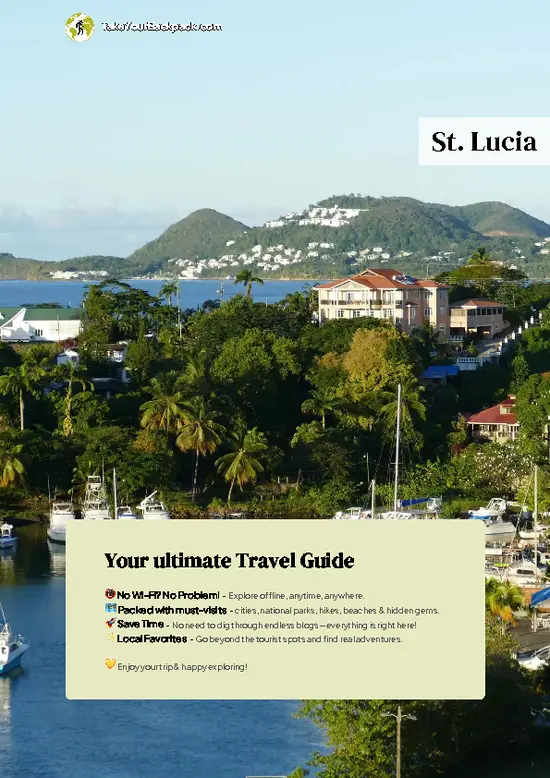
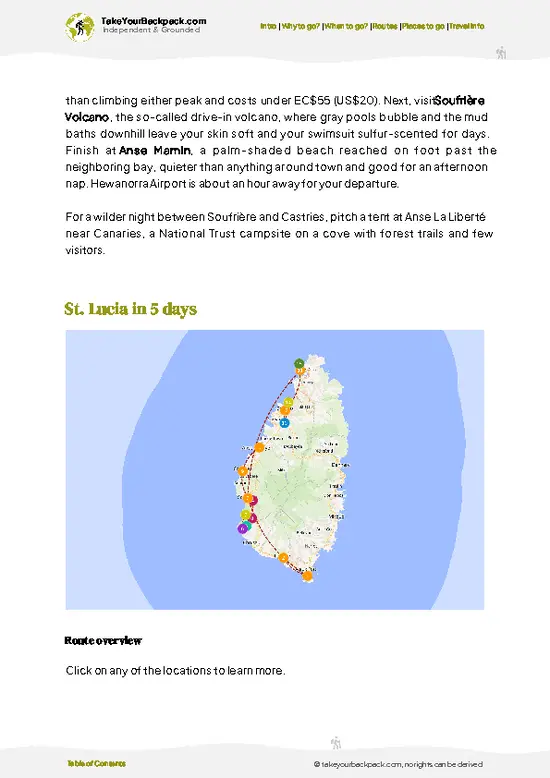
example page 0 from our offline Travel Guide for Saint Lucia
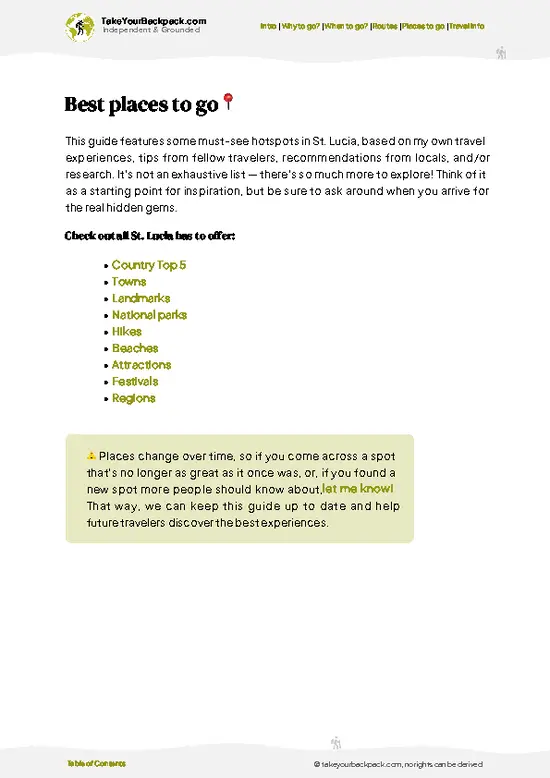
example page 1 from our offline Travel Guide for Saint Lucia
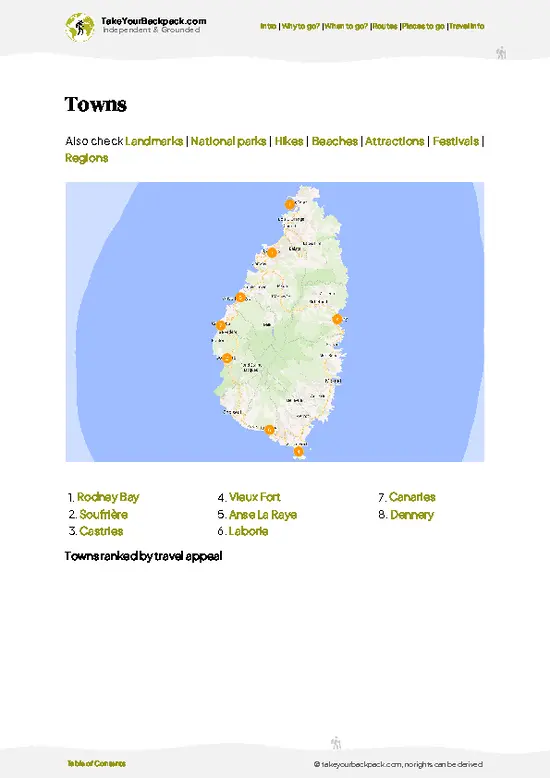
example page 2 from our offline Travel Guide for Saint Lucia
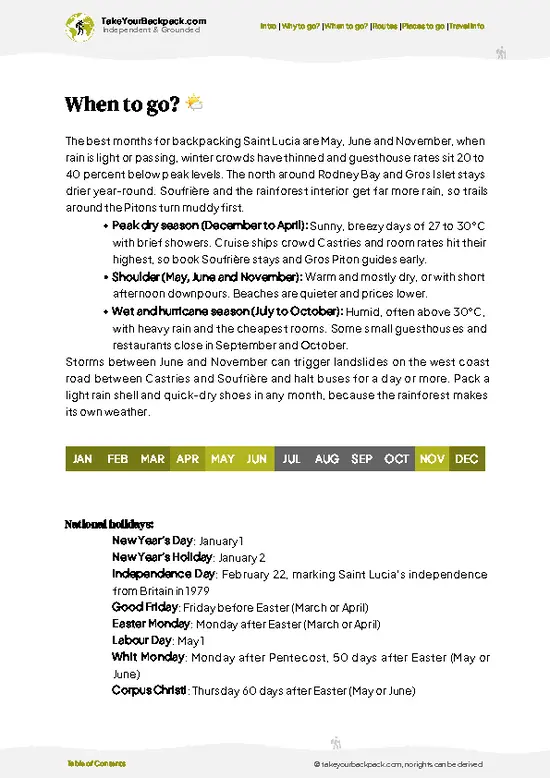
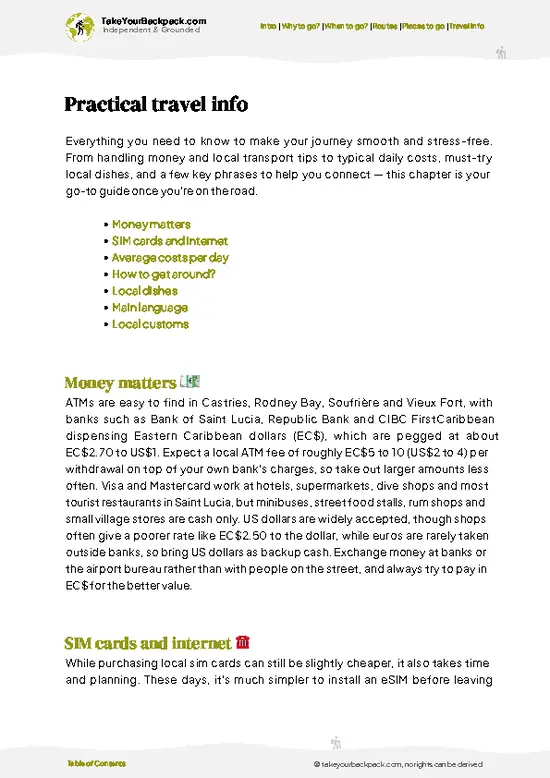
example page 3 from our offline Travel Guide for Saint Lucia
example page 4 from our offline Travel Guide for Saint Lucia
example page 5 from our offline Travel Guide for Saint Lucia
example page 6 from our offline Travel Guide for Saint Lucia
example page 7 from our offline Travel Guide for Saint Lucia
The digital guide (125 pages) contains:-page digital guide:
✅ Ready-made 2, 3 & 5-day routes
✅ All 31 places ranked, so you skip the overrated ones
✅ Works offline, all in 1 guide
✅ Cities, national parks, landmarks, beaches
✅ How to get around
👉 Click to see all 30+ guide features

📅 Plan smarter in minutes, not weeks
✅ Month by month travel advice
✅ Festivals & national holidays
✅ Budget expectations

🗺️ Go to the right places, skip the overrated ones
✅ Honest pros & cons of destinations
✅ Top hikes, parks & viewpoints
✅ Lesser-known places most travelers miss
✅ Clear “worth it vs skip it” guidance

🛏️ Travel smoothly without rookie mistakes
✅ Best areas to stay
✅ Transport systems explained simply
✅ Common scams & safety advice
✅ SIM cards, money & practical tips

🌍 Understand the country, not just visit it
✅ Culture & traditions
✅ 52 Essential phrases & customs
✅ Festivals worth planning around
✅ Traveler-friendly historical context
✅ Insights that make places more meaningful

📱 Built for real travel conditions
✅ Fully downloadable PDF
✅ Works completely offline
✅ Optimized for phone use
✅ Useful in remote areas & buses
✅ All in 1 guide
Stop searching, start planning
Get instant access to your full guide. 30‑day money-back guarantee.


By proceeding you agree to our terms.
Sent to your inbox immediately after payment • 100% Secure Checkout
Best Backpacking Travel Advisor 2025 tourism awardBest Backpacking
Travel Advisor
2025
What others say about Take Your Backpack Guides:
⭐⭐⭐⭐⭐
Fantastic, amazing amount of information!
⭐⭐⭐⭐⭐
My goodness this is amazing, it's what I've been looking for hats off too you!
⭐⭐⭐⭐⭐
I think this is absolutely BRILLIANT
⭐⭐⭐⭐
Very complete and informative. It's still missing places, but I gotta to commend you
⭐⭐⭐⭐⭐
This is truly amazing, thank you, can't wait to explore it with my kids!
⭐⭐⭐⭐⭐
Awesome resource, thank you!
⭐⭐⭐⭐⭐
This is amazing! Can't wait to explore the ones I haven't seen
⭐⭐⭐⭐
I love this! Well done, great idea.
⭐⭐⭐⭐⭐
Thanks for taking the time to make this gem!
⭐⭐⭐⭐⭐
This might be the best website I've ever seen.
⭐⭐⭐⭐⭐
Congratulations, and thank you so much for your work; it's incredibly valuable.
⭐⭐⭐⭐
In all seriousness I think you did a great job pointing out the important spots
⭐⭐⭐⭐⭐
10/10 very good
⭐⭐⭐⭐⭐
As someone who's only just starting to visit regularly this is awesome, thank you.
⭐⭐⭐⭐
Thank you very much! I'm going to visit my dad, it's going to be very useful!
⭐⭐⭐⭐⭐
This is really cool! We'll be travelling for the first time and this definitely come in handy.
⭐⭐⭐⭐⭐
You are now our minister of culture, congratulations 👨‍💼
⭐⭐⭐⭐⭐
Just wanted to tell you that this is a pearl! Going to follow your recommendations.
⭐⭐⭐⭐⭐
This is so cool. I'll definitely be using the resource for my travels soon.
⭐⭐⭐⭐⭐
This is very impressive! Good work.
⭐⭐⭐⭐⭐
This is an amazing and informative site. Very well done!

🛏️ Where to stay?Top Areas to Stay

Saint Lucia has only a handful of true hostels, so budget travelers mostly stay in family-run guesthouses and self-catering apartments, typically about EC$110 to 190 (US$40 to 70) a night for a private room. Rodney Bay and neighboring Gros Islet have the widest choice, with the island’s main nightlife, the Friday street party and beaches within walking distance, but they are also the noisiest and priciest corner. Soufrière is quiet and close to the Pitons, sulfur springs and rainforest trails, while Castries is cheap and handy for minibuses, though its center empties out and feels less safe after dark.

If you enjoy meeting fellow travelers, consider choosing hostels with high ratings for atmosphere. … read more 👉
Saint Lucia has only a handful of true hostels, so budget travelers mostly stay in family-run guesthouses and self-catering apartments, typically about EC$110 to 190 (US$40 to 70) a night for a private room. Rodney Bay and neighboring Gros Islet have the widest choice, with the island’s main nightlife, the Friday street party and beaches within walking distance, but they are also the noisiest and priciest corner. Soufrière is quiet and close to the Pitons, sulfur springs and rainforest trails, while Castries is cheap and handy for minibuses, though its center empties out and feels less safe after dark.

If you enjoy meeting fellow travelers, consider choosing hostels with high ratings for atmosphere. On the other hand, if you prefer having your own space, a hotel might be a better option.

St. LuciaDiscover the Country

👋 Meet the founderWho’s Behind Take Your Backpack?

Johan, backpacker and founder of TakeYourBackpackHi, I’m Johan (Netherlands 🇳🇱), the creator of TakeYourBackpack. Over the past 30 years, I’ve backpacked through 88 countries across six continents, gaining extensive experience with independent travel, long-term trips, and overland routes.

This site is built on a combination of firsthand travel experience and carefully curated insights from other backpackers. Many guides are based on places I’ve personally visited, while others bring together tips, observations, and practical advice shared by trusted travelers I’ve met along the way.

The goal is to provide realistic, experience-driven guidance — not generic itineraries — so you can explore destinations with better context, clearer expectations, and more confidence.