×

St. Lucia🇱🇨 | townsLaborieCalm southern bay, jetty catch, back-lane walk, seafront stroll | things to do and best time to go

Explore Anse La RayeExplore Canaries

Backpacking in Laborie
👌 Worth visitingtown ranked #5
By Johan Kruseman 🇳🇱 | Updated October 22, 2026

Laborie is a fishing and farming town on the south coast of Saint Lucia, and it is not a beach resort, even though the bay looks made for one. Most people drive straight past on the way to Vieux Fort or Soufrière. I’d stop. The town sits on the main southern road, so buses from Castries and Vieux Fort pass through, and you can flag a minibus from the roadside. Locals shop early, so go by mid-morning if you want fresh fish from the jetty before it thins out. Guesthouses here are small and the evenings are quiet, so meeting other backpackers takes effort, and the better move is to eat where locals do. Cash helps, since many small spots don’t take cards. Day trips are easy from here. Fishermen still haul their boats onto the sand beside the bay each afternoon.

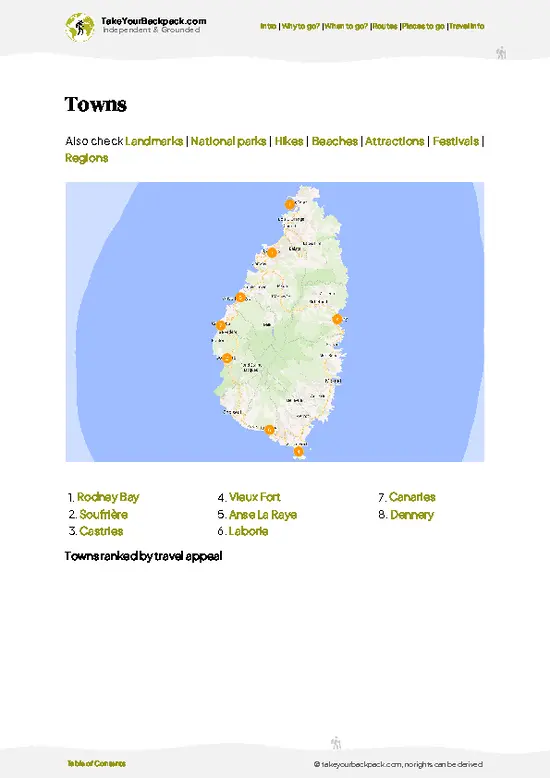
Part of Backpacking in St. Lucia: all 31 places on one map, with routes and the best time to go.
Discover everything you want to know in the 📖 St. Lucia Travel Guide.
Loading the map 🌍
CLICK TO FILTER
towns
landmarks
national parks
hikes
beaches
attractions
festivals
regions
SHOW COUNTRY’S BESTSHOW ALL

✨ Why go?
Ranked #5 town in St. Lucia
What sets this place apart

Laborie suits travelers who want the south coast without the Soufrière crowds. The draw is a working fishing village where the Laborie Bay beach is used by locals, not sold to tourists, and where a morning walk takes you past pastel wooden houses, a church and the jetty in about an hour. Guesthouses are few and family-run, so you get proper conversation with the host, and meals often mean fish caught that day. Backpackers tend to stay one or two nights, long enough to slow down, swim and use the town as a calm base for the Piton coast and the southern rainforest. Slow travelers, solo travelers who like quiet and anyone tired of resort strips will enjoy it most. Nightlife is minimal, mostly a rum shop and a few friendly bars, so if you need a hostel crowd, Soufrière or Rodney Bay will suit … read more 👉
Laborie suits travelers who want the south coast without the Soufrière crowds. The draw is a working fishing village where the Laborie Bay beach is used by locals, not sold to tourists, and where a morning walk takes you past pastel wooden houses, a church and the jetty in about an hour. Guesthouses are few and family-run, so you get proper conversation with the host, and meals often mean fish caught that day. Backpackers tend to stay one or two nights, long enough to slow down, swim and use the town as a calm base for the Piton coast and the southern rainforest. Slow travelers, solo travelers who like quiet and anyone tired of resort strips will enjoy it most. Nightlife is minimal, mostly a rum shop and a few friendly bars, so if you need a hostel crowd, Soufrière or Rodney Bay will suit you better. Laborie rewards people who like to wander.

💡 HighlightsTop highlights of Laborie

  1. Laborie Bay Beach: A long, calm curve of dark-gold sand with fishing boats pulled up and little development. Go in the late afternoon when the boats return and the light is soft. Free, allow 1 to 2 hours.
  2. Laborie Jetty and Fish Landing: The place to watch fishermen unload and sell. Morning is best, and you can buy fish directly from the boats. Free to watch, about 30 to 45 minutes.
  3. Church of the Purification: The town’s Catholic church, central and a good window into local life, especially on Sunday when the congregation fills the benches. Free, 15 to 30 minutes outside service times.
  4. Seafront walk: A short stroll along the shore with views across the bay, pleasant in the early evening when families come out. Free, around 30 minutes.
  5. Laborie Town Walk: A loop through the back lanes past colorful
… read more 👉
  1. Laborie Bay Beach: A long, calm curve of dark-gold sand with fishing boats pulled up and little development. Go in the late afternoon when the boats return and the light is soft. Free, allow 1 to 2 hours.
  2. Laborie Jetty and Fish Landing: The place to watch fishermen unload and sell. Morning is best, and you can buy fish directly from the boats. Free to watch, about 30 to 45 minutes.
  3. Church of the Purification: The town’s Catholic church, central and a good window into local life, especially on Sunday when the congregation fills the benches. Free, 15 to 30 minutes outside service times.
  4. Seafront walk: A short stroll along the shore with views across the bay, pleasant in the early evening when families come out. Free, around 30 minutes.
  5. Laborie Town Walk: A loop through the back lanes past colorful wooden houses, corner shops and small bakeries. Go before noon to avoid the heat. Free, about 1 hour.
From Laborie, easy day trips include the Pitons and Sulphur Springs near Soufrière, Vieux Fort’s beaches and Maria Islands Nature Reserve, and the rainforest of the south. Every sight in Laborie is free, and the beach and jetty cost nothing at all, so a day here costs only what you eat.
Spotted a mistake or missing something? Contact us.

🏘️ NeighborhoodsUnderstanding the local layout

Laborie is small enough to cover on foot in an hour, but each pocket works differently, and knowing why saves you time.
  • Town center and the bay front: The grid of streets around the church and Laborie Bay is where buses stop, bakeries open early and the few snack counters sit. Everything closes early because life here follows daylight, so eat lunch out and buy supplies before late afternoon. Grab fried fish or a bake with saltfish from a small stand and carry it to the seawall. Flat and walkable.
  • Laborie Bay Beach: A long dark-sand stretch on the Caribbean side, with fishing boats pulled up and almost no one around. Swimming is fine on calm days, but there are no lifeguards, so go in the morning when the water is flattest. Bring your own shade and water because vendors are scarce. It is a 10
… read more 👉
Laborie is small enough to cover on foot in an hour, but each pocket works differently, and knowing why saves you time.
  • Town center and the bay front: The grid of streets around the church and Laborie Bay is where buses stop, bakeries open early and the few snack counters sit. Everything closes early because life here follows daylight, so eat lunch out and buy supplies before late afternoon. Grab fried fish or a bake with saltfish from a small stand and carry it to the seawall. Flat and walkable.
  • Laborie Bay Beach: A long dark-sand stretch on the Caribbean side, with fishing boats pulled up and almost no one around. Swimming is fine on calm days, but there are no lifeguards, so go in the morning when the water is flattest. Bring your own shade and water because vendors are scarce. It is a 10 to 15 minute walk from the center.
  • Fishing community: Fishermen land catch in the early morning, so arrive around 7 am if you want to see it or buy fish. Locals are friendly, so greet people first. The roads are quiet and walkable.
  • Upper hillside lanes: Steep lanes climb inland toward farms and views over the coast. Walk them before the midday sun, since there is little shade, and expect dogs and goats rather than nightlife. Evenings are silent, with a rum shop or two as the only action.

⌛️ 1 dayWhat you can realistically do in a day

7:30 AM, Laborie Jetty: Start at the fish landing, the stop not to skip. Fishermen unload the catch and locals haggle, and it shows you how the town actually earns its living. Chat with a few people, then walk along the shoreline toward the bay.
9:00 AM, Laborie Bay Beach: Walk the sand while it is cool and quiet. Swim if the water looks calm, and watch the boats sit at their moorings. Stay about an hour, then head inland on foot toward the center.
10:30 AM, Town Walk and Back Lanes: Wander the side streets past wooden houses and small shops, which most travelers never see because they stay on the main road. Stop at a bakery for a bread and something cold. This is the least visited part of the day and the most telling.
12:30 PM, Church of the Purification: Step inside for a few minutes of shade … read more 👉
7:30 AM, Laborie Jetty: Start at the fish landing, the stop not to skip. Fishermen unload the catch and locals haggle, and it shows you how the town actually earns its living. Chat with a few people, then walk along the shoreline toward the bay.
9:00 AM, Laborie Bay Beach: Walk the sand while it is cool and quiet. Swim if the water looks calm, and watch the boats sit at their moorings. Stay about an hour, then head inland on foot toward the center.
10:30 AM, Town Walk and Back Lanes: Wander the side streets past wooden houses and small shops, which most travelers never see because they stay on the main road. Stop at a bakery for a bread and something cold. This is the least visited part of the day and the most telling.
12:30 PM, Church of the Purification: Step inside for a few minutes of shade and quiet, then find a local spot for lunch, usually fish or chicken with rice and provisions. Take your time, since the afternoon is slow.
3:00 PM, Rest and Reading: The midday heat is at its peak, so rest at your guesthouse or in a shady spot near the bay.
5:00 PM, Seafront Stroll: Stroll the seafront as families come out and boats come in. Sit by the water, watch the light change over the water, and talk to whoever sits nearby.
7:00 PM, Dinner: Finish at a small local eatery or rum shop, where evenings are mellow and conversation comes easily.

🌤️ When to go?Best time to visit Laborie

Laborie is best from December to April, when rain is lightest and the sea is calmer for swimming.
  • Dry Season (December to April): Days reach about 28 to 31°C (82 to 88°F), with breezes and low humidity. Roughly 11 to 12 hours of daylight. Beds and car rentals cost the most around Christmas and New Year.
  • Wet Season (June to November): Expect 26 to 32°C (79 to 90°F), heavy humid showers and a real chance of tropical storms, especially August to October. Prices drop and the bay is empty.
  • Shoulder Months (May and early December): Showers are short, the hillsides are green and rates sit between the extremes.
  • Events: Carnival in July and the Creole festivals in October fill the island with activity, while Laborie stays calm.
Book a few weeks ahead for the Christmas period, and otherwise arrive without a fixed plan.

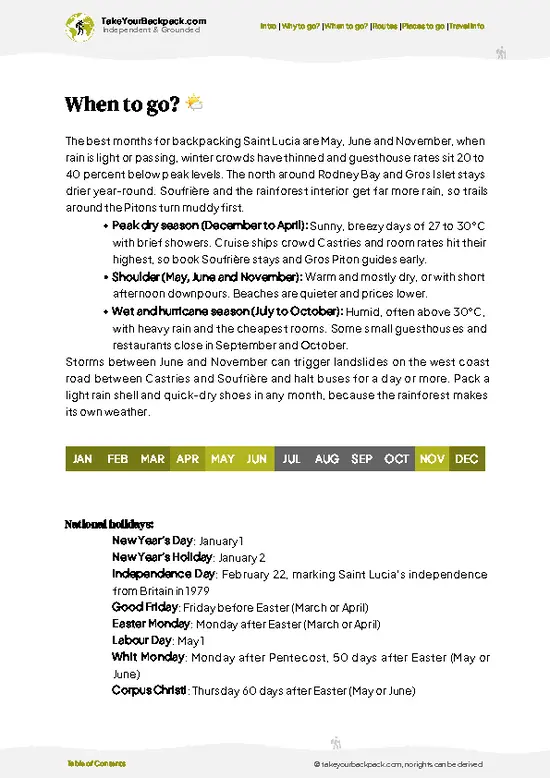
source: climatestotravel.comJANJanuary: highly recommended for travelingFEBFebruary: highly recommended for travelingMARMarch: highly recommended for travelingAPRApril: highly recommended for travelingMAYMay: excellent for travelingJUNJune: highly recommended for travelingJULJuly: fair for travelingAUGAugust: fair for travelingSEPSeptember: fair for travelingOCTOctober: fair for travelingNOVNovember: good for travelingDECDecember: highly recommended for traveling
saint-lucia-city-laborie
© Google |

✈️ The backpacker research shortcutSt. Lucia Travel Guide

What the free pages can't give you: ready-made routes, every place ranked, and it works offline. All in 1 guide.
example page 0 from our offline Travel Guide for Saint Lucia
example page 1 from our offline Travel Guide for Saint Lucia
example page 2 from our offline Travel Guide for Saint Lucia
example page 3 from our offline Travel Guide for Saint Lucia
example page 4 from our offline Travel Guide for Saint Lucia
example page 5 from our offline Travel Guide for Saint Lucia
example page 6 from our offline Travel Guide for Saint Lucia
example page 7 from our offline Travel Guide for Saint Lucia
The digital guide (125 pages) contains:-page digital guide:
✅ Ready-made 2, 3 & 5-day routes
✅ All 31 places ranked, so you skip the overrated ones
✅ Works offline, all in 1 guide
✅ Cities, national parks, landmarks, beaches
✅ How to get around
👉 Click to see all 30+ guide features

📅 Plan smarter in minutes, not weeks
✅ Month by month travel advice
✅ Festivals & national holidays
✅ Budget expectations

🗺️ Go to the right places, skip the overrated ones
✅ Honest pros & cons of destinations
✅ Top hikes, parks & viewpoints
✅ Lesser-known places most travelers miss
✅ Clear “worth it vs skip it” guidance

🛏️ Travel smoothly without rookie mistakes
✅ Best areas to stay
✅ Transport systems explained simply
✅ Common scams & safety advice
✅ SIM cards, money & practical tips

🌍 Understand the country, not just visit it
✅ Culture & traditions
✅ 52 Essential phrases & customs
✅ Festivals worth planning around
✅ Traveler-friendly historical context
✅ Insights that make places more meaningful

📱 Built for real travel conditions
✅ Fully downloadable PDF
✅ Works completely offline
✅ Optimized for phone use
✅ Useful in remote areas & buses
✅ All in 1 guide
Stop searching, start planning
Get instant access to your full guide. 30‑day money-back guarantee.


By proceeding you agree to our terms.
Sent to your inbox immediately after payment • 100% Secure Checkout
Best Backpacking Travel Advisor 2025 tourism awardBest Backpacking
Travel Advisor
2025
What others say about Take Your Backpack Guides:
⭐⭐⭐⭐⭐
Fantastic, amazing amount of information!
⭐⭐⭐⭐⭐
My goodness this is amazing, it's what I've been looking for hats off too you!
⭐⭐⭐⭐⭐
I think this is absolutely BRILLIANT
⭐⭐⭐⭐
Very complete and informative. It's still missing places, but I gotta to commend you
⭐⭐⭐⭐⭐
This is truly amazing, thank you, can't wait to explore it with my kids!
⭐⭐⭐⭐⭐
Awesome resource, thank you!
⭐⭐⭐⭐⭐
This is amazing! Can't wait to explore the ones I haven't seen
⭐⭐⭐⭐
I love this! Well done, great idea.
⭐⭐⭐⭐⭐
Thanks for taking the time to make this gem!
⭐⭐⭐⭐⭐
This might be the best website I've ever seen.
⭐⭐⭐⭐⭐
Congratulations, and thank you so much for your work; it's incredibly valuable.
⭐⭐⭐⭐
In all seriousness I think you did a great job pointing out the important spots
⭐⭐⭐⭐⭐
10/10 very good
⭐⭐⭐⭐⭐
As someone who's only just starting to visit regularly this is awesome, thank you.
⭐⭐⭐⭐
Thank you very much! I'm going to visit my dad, it's going to be very useful!
⭐⭐⭐⭐⭐
This is really cool! We'll be travelling for the first time and this definitely come in handy.
⭐⭐⭐⭐⭐
You are now our minister of culture, congratulations 👨‍💼
⭐⭐⭐⭐⭐
Just wanted to tell you that this is a pearl! Going to follow your recommendations.
⭐⭐⭐⭐⭐
This is so cool. I'll definitely be using the resource for my travels soon.
⭐⭐⭐⭐⭐
This is very impressive! Good work.
⭐⭐⭐⭐⭐
This is an amazing and informative site. Very well done!

🛏️ Where to stay?Best areas and accommodation options

Laborie itself is the best base for a quiet budget stay, with small guesthouses and rooms at roughly US$40 to 80 a night, since the town has no dedicated hostels. Dorm beds are rare, so solo backpackers do better booking a simple private room ahead and splitting it with someone.
Staying near the bay keeps you within walking distance of the beach, the shops and the bus stops, and the area is calm at night, with little traffic or noise beyond roosters and waves. Street lighting is limited, so choose a place close to the center if you will be out after dark.
Vieux Fort, a short ride east, is the second … read more 👉
Laborie itself is the best base for a quiet budget stay, with small guesthouses and rooms at roughly US$40 to 80 a night, since the town has no dedicated hostels. Dorm beds are rare, so solo backpackers do better booking a simple private room ahead and splitting it with someone.
Staying near the bay keeps you within walking distance of the beach, the shops and the bus stops, and the area is calm at night, with little traffic or noise beyond roosters and waves. Street lighting is limited, so choose a place close to the center if you will be out after dark.
Vieux Fort, a short ride east, is the second option. It has more rooms, restaurants, supermarkets and regular minibus links, along with the airport, so it suits late arrivals or early departures. Prices there are similar, and the town is busier with more evening noise. Soufrière, farther up the coast, has more backpacker-oriented stays but needs a longer bus ride. For most people, book ahead in the December to April season, because the small number of rooms fills fast.

🚌 Getting aroundHow to get from A to B

Laborie runs on minibuses, and a ride along the south coast costs roughly US$1 to 3, paid in cash (Eastern Caribbean dollars) directly to the driver or conductor when you get off. The town is flat and compact, so most backpackers walk locally and use buses for the trips out. Services are frequent in the morning and thin out by late afternoon, which is why smart travelers plan to be back before dusk.
  • Walking: Free and enough for the town center, the bay and the fishing area. Carry water and walk early because shade is limited and midday heat is strong.
  • Minibuses: Privately run vans link Laborie with Vieux Fort (about 15 to 20 minutes) and Soufrière or Castries along the main road. Fares run about US$1 to 4 depending on distance. Flag them down at the roadside, have small bills ready, and ask
… read more 👉
Laborie runs on minibuses, and a ride along the south coast costs roughly US$1 to 3, paid in cash (Eastern Caribbean dollars) directly to the driver or conductor when you get off. The town is flat and compact, so most backpackers walk locally and use buses for the trips out. Services are frequent in the morning and thin out by late afternoon, which is why smart travelers plan to be back before dusk.
  • Walking: Free and enough for the town center, the bay and the fishing area. Carry water and walk early because shade is limited and midday heat is strong.
  • Minibuses: Privately run vans link Laborie with Vieux Fort (about 15 to 20 minutes) and Soufrière or Castries along the main road. Fares run about US$1 to 4 depending on distance. Flag them down at the roadside, have small bills ready, and ask the driver about the last run back, which is usually early evening.
  • Taxis: Fares are negotiated, so agree the price before getting in. Expect about US$10 to 20 for short hops to nearby villages or Vieux Fort, and more to reach Hewanorra Airport or the north. Taxis are the sensible choice after dark or with heavy bags.
  • Hitching a ride and shared rides: Locals sometimes offer lifts, but plan on buses or taxis so your schedule does not depend on luck.
  • Rental car: Roughly US$45 to 70 a day, plus a local driving permit of about US$20. Driving is on the left and the roads twist with steep drops, so only rent if you have confidence. It pays off mostly if you split costs with others for beach and waterfall stops.

👛 Costs (as of 22 October 2026)Money, prices, and spending tips

Laborie costs about US$80 a day for a backpacker in high season, with a private room the main expense because dorm beds are scarce.
CategoryBudget RangeLocal Reality
Dorm accommodationUS$40 to 55Small guesthouse rooms are the norm. High season (December to April) sits at the top, and low season runs about US$30 to 45.
MealsUS$15 to 25Local plates of fish, stew chicken or bakes cost US$6 to 10, and bakery snacks are cheaper.
Local transportUS$3 to 8Minibuses cost US$1 to 4 per ride, while taxis are far more.
Basic activities/entry feesUS$5 to 15The beach is free, and sites near Soufrière charge modest entry fees.
Miscellaneous expensesUS$5 to 10Water, snacks, repellent and sunscreen, with a drink at a rum shop.
Total Daily BudgetUS$68 to 113About US$80 for a careful traveler.
Buy fruit and bread from … read more 👉
Laborie costs about US$80 a day for a backpacker in high season, with a private room the main expense because dorm beds are scarce.
CategoryBudget RangeLocal Reality
Dorm accommodationUS$40 to 55Small guesthouse rooms are the norm. High season (December to April) sits at the top, and low season runs about US$30 to 45.
MealsUS$15 to 25Local plates of fish, stew chicken or bakes cost US$6 to 10, and bakery snacks are cheaper.
Local transportUS$3 to 8Minibuses cost US$1 to 4 per ride, while taxis are far more.
Basic activities/entry feesUS$5 to 15The beach is free, and sites near Soufrière charge modest entry fees.
Miscellaneous expensesUS$5 to 10Water, snacks, repellent and sunscreen, with a drink at a rum shop.
Total Daily BudgetUS$68 to 113About US$80 for a careful traveler.
Buy fruit and bread from local sellers and cook where your room has a kitchen, which cuts food costs sharply.
⚠️ Prices can change and everyone travels differently, so take this as a rough guide. Hope it helps you plan your adventure!

🚌 Day tripsExploring the surroundings

Laborie works well as a quiet base, with buses reaching the south coast sights in under an hour and most trips costing US$5 to 30 all in.
Vieux Fort and Moule a Chique:
A 15 to 20 minute minibus ride east gets you to the island’s southern tip, where a short climb to the lighthouse at Moule a Chique gives views toward St. Vincent on clear days. Allow a half day, with about US$3 to 6 in fares. Go in the morning, since cloud builds later. Wear real shoes because the last stretch is steep.

Soufrière and the Pitons:
About 45 minutes to an hour by bus or taxi, Soufrière is the base for Sulphur Springs, Diamond Falls and the beaches below the Pitons. Budget US$25 to 50 including entry fees. Start early because buses back thin out by afternoon, a common trap for first-timers who linger.
👉 Explore Soufrière
Choiseul: … read more 👉
Laborie works well as a quiet base, with buses reaching the south coast sights in under an hour and most trips costing US$5 to 30 all in.
Vieux Fort and Moule a Chique:
A 15 to 20 minute minibus ride east gets you to the island’s southern tip, where a short climb to the lighthouse at Moule a Chique gives views toward St. Vincent on clear days. Allow a half day, with about US$3 to 6 in fares. Go in the morning, since cloud builds later. Wear real shoes because the last stretch is steep.

Soufrière and the Pitons:
About 45 minutes to an hour by bus or taxi, Soufrière is the base for Sulphur Springs, Diamond Falls and the beaches below the Pitons. Budget US$25 to 50 including entry fees. Start early because buses back thin out by afternoon, a common trap for first-timers who linger.
👉 Explore Soufrière
Choiseul:
A short ride west, Choiseul is a craft village known for pottery and weaving, and its small Arts and Crafts Centre sells pieces at fair prices. Plan two to three hours and about US$5 to 10 with transport. Visit on weekdays when workshops are active.

Maria Islands Nature Reserve:
Near Vieux Fort, the offshore reserve protects lizards and seabirds and is reached by boat with a guide. Count on a half day. The reserve is closed to visitors from May to July for the bird nesting season.
👉 Explore Maria Islands Nature Reserve

🛡️ SafetyTraveler Safety Guide

Laborie is a quiet, low-crime village, and most problems come from carelessness rather than threat. Walk the center freely by day and keep valuables out of sight on the beach, where there are few people watching your bag. Swim only when the water is calm, because there are no lifeguards and currents can pull on rougher days.
After dark, streetlights are sparse, so stick to the main road or take a taxi arranged by your guesthouse. Solo travelers, women included, generally report friendly attention, though a firm, polite no handles persistent offers. Agree taxi fares before getting in, and carry small bills so there is no argument over change. Sun and mosquitoes are the real everyday annoyances, so bring repellent and cover up during midday.

FAQFrequently asked questions about Laborie

Laborie is worth a visit if you want a quiet fishing village rather than a resort, with a long dark-sand bay and a walkable center. It pairs well with Vieux Fort, 15 to 20 minutes away by minibus, and Soufrière, roughly an hour away. Expect few restaurants and little nightlife.
One to two days is enough for Laborie itself, with a morning at the bay, a walk through the fishing area and an evening in town. Add a third day if you plan trips to Soufrière or Moule a Chique. Rooms cost about US$40 to 80 a night.
Laborie works as a day trip from Vieux Fort, which is about 15 to 20 minutes by minibus, or from Soufrière in roughly an hour. Fares are US$1 to 4, but services thin out by early evening. A taxi from the airport area costs about US$10 to 20, so a half day is realistic.
⚠️ Things can change over time, so always validate details locally before you go.

Other Saint Lucian towns near Laborie

Explore more nearby:

  • Vieux Fort—Kitesurf beach, southern headland, whiptail islets, Mankòté mangrove| 6 km away
  • Soufrière—Piton climbs, sulfur vents, reef snorkeling, waterfront market| 14 km away
  • Canaries—River-mouth bay, waterfall trail, fish landing, quiet village street| 19 km away

💡 Not sure where to go next?
Create a personalized itinerary for St. Lucia including Laborie and the places that fit your trip.

Generate my itinerary

👉 Discover all towns

Or checkout all St. Lucia has to offer (think cities, towns, villages, national parks, hikes, beaches, festivals)
Country photo of St. Lucia

We 💚 feedbackParting advice and final tips

Laborie works best as one night, two if you want to slow down properly. One night gets you the jetty at dawn and a quiet evening by the bay, and a second gives you time to do nothing. I’d bring cash and book the guesthouse ahead, since choices are limited. Skip it if you need nightlife.

✍️ Help improve this page!
The information on this page is based on in-depth research, insights shared by experienced travelers, and feedback from the local travel community in St. Lucia. While every effort is made to keep the information accurate and current, conditions can change — so if you spot anything incorrect or outdated, please get in touch.


🙋‍♂️ Give feedback

👋 Meet the founderWho’s Behind Take Your Backpack?

Johan, backpacker and founder of TakeYourBackpackHi, I’m Johan (Netherlands 🇳🇱), the creator of TakeYourBackpack. Over the past 30 years, I’ve backpacked through 88 countries across six continents, gaining extensive experience with independent travel, long-term trips, and overland routes.

This site is built on a combination of firsthand travel experience and carefully curated insights from other backpackers. Many guides are based on places I’ve personally visited, while others bring together tips, observations, and practical advice shared by trusted travelers I’ve met along the way.

The goal is to provide realistic, experience-driven guidance — not generic itineraries — so you can explore destinations with better context, clearer expectations, and more confidence.