×

St. Lucia🇱🇨 | national parksMaria Islands Nature ReserveGuided boat visit, whiptail lizard, Kouwès snake, seabird cliffs | things to do and best time to go

Explore Edmund Forest ReserveExplore Morne Fortune

Backpacking in Maria Islands Nature Reserve
By Johan Kruseman 🇳🇱 | Updated October 22, 2026

Maria Islands Nature Reserve gives you a wildlife encounter that no other spot on the island can match, with a guide, a short boat ride and a very good chance of lizards at your feet. It sits in the south of Saint Lucia, just off the coast beyond Vieux Fort, as two small scrubby islands off Pointe Sable. Underfoot it is dry, rocky and sun-baked, with cactus, low woodland and no shade to speak of. The walk is short, so nobody is out for a summit or a sweat. What you get is the Saint Lucia whiptail, one of the rarest lizards on earth, plus nesting seabirds wheeling overhead and the odd glimpse of a racer snake. Crowds are tiny because visits are small and guided. Go in the morning, when the lizards are active and the heat is gentler. Book your slot with the Saint Lucia National Trust before you turn up, because you cannot land without a guide.

Part of Backpacking in St. Lucia: all 31 places on one map, with routes and the best time to go.
Discover everything you want to know in the 📖 St. Lucia Travel Guide.
Loading the map 🌍
CLICK TO FILTER
towns
landmarks
national parks
hikes
beaches
attractions
festivals
regions
SHOW COUNTRY’S BESTSHOW ALL

✨ Why go?
Ranked #99 national park in St. Lucia
The unique appeal for travelers

Maria Islands Nature Reserve suits backpackers who want wildlife that cannot be seen anywhere else, not another beach day. The Saint Lucia whiptail, lives on these two islets and nowhere else in the wild, and a guide can usually put one in front of you within minutes of landing. That alone sets it apart from the rainforest hikes in the island's interior, where wildlife tends to hide.

The reserve also fits a loose, independent itinerary. It is a quick, flexible half-day, so you can fold it in around the south coast's beaches, the windswept headland near Vieux Fort and the town's cheap local eateries without booking a full tour package. The only structure is the guided crossing, which keeps the fragile habitat intact. Bring your own binoculars and you will pick out seabirds along the cliffs … read more 👉
Maria Islands Nature Reserve suits backpackers who want wildlife that cannot be seen anywhere else, not another beach day. The Saint Lucia whiptail, lives on these two islets and nowhere else in the wild, and a guide can usually put one in front of you within minutes of landing. That alone sets it apart from the rainforest hikes in the island's interior, where wildlife tends to hide.

The reserve also fits a loose, independent itinerary. It is a quick, flexible half-day, so you can fold it in around the south coast's beaches, the windswept headland near Vieux Fort and the town's cheap local eateries without booking a full tour package. The only structure is the guided crossing, which keeps the fragile habitat intact. Bring your own binoculars and you will pick out seabirds along the cliffs of Maria Major that tour groups on a cruise-ship schedule never see. The trail is short and flat enough for anyone, which makes it a relaxed counterweight to the Pitons climbs.

💡 HighlightsWhat this place is best known for

  1. Saint Lucia whiptail: The reason the reserve exists. Males are dark with a bright blue tail and pale stripes, and they scurry across the bare ground in the open. Maria Major holds the main population of this very rare lizard.
  2. Maria Major island trail: The larger of the two islands has a short loop through dry coastal scrub and cactus. It is rocky and exposed, and from it you can see the Atlantic crashing on one side and calm bay water on the other.
  3. Kouwès snake (Saint Lucia racer): One of the rarest snakes in the world, once feared extinct and now clinging on here. It is slim, quick and shy, so a sighting is luck, but guides know where it tends to shelter. It is harmless to people.
  4. Seabird colonies: Red-billed tropicbirds nest in the cliff crevices, and brown noddies, bridled terns and sooty
… read more 👉
  1. Saint Lucia whiptail: The reason the reserve exists. Males are dark with a bright blue tail and pale stripes, and they scurry across the bare ground in the open. Maria Major holds the main population of this very rare lizard.
  2. Maria Major island trail: The larger of the two islands has a short loop through dry coastal scrub and cactus. It is rocky and exposed, and from it you can see the Atlantic crashing on one side and calm bay water on the other.
  3. Kouwès snake (Saint Lucia racer): One of the rarest snakes in the world, once feared extinct and now clinging on here. It is slim, quick and shy, so a sighting is luck, but guides know where it tends to shelter. It is harmless to people.
  4. Seabird colonies: Red-billed tropicbirds nest in the cliff crevices, and brown noddies, bridled terns and sooty terns gather on the rocks in the breeding season. The noise and the wheeling birds make the cliffs the liveliest spot on the walk.
  5. Maria Minor: The smaller island is kept as a quiet refuge and is mostly watched from the boat or from Maria Major. It is rugged and low, and it shelters nesting birds away from foot traffic.
  6. Pointe Sable departure point: The Saint Lucia National Trust office on the mainland, where the visit begins. A guide gives a short briefing on the species and on the rules for walking in the reserve before you board.
Maria Islands Nature Reserve requires a guided visit arranged ahead with the Saint Lucia National Trust, so reserve your slot before you travel to the south coast.
Spotted a mistake or missing something? Contact us.

🌤️ When to go?Seasonal considerations and timing

  • February to May: Dry, calm and the easiest window for the boat crossing from Pointe Sable. Days run 27-31°C (81-88°F), nights around 22-24°C (72-75°F), with about 11.5 hours of daylight.
  • June to November: Wetter and more humid, with highs of 30-32°C (86-90°F) and heavier showers. The reserve is closed to visitors from May to July for the bird nesting season. Hurricane season peaks August to October, and swells can cancel crossings. The islands turn green, and seabird nesting, plus Maria Island ground lizards and Kouwes snakes, remain active.
  • December to January: Cooler trade-wind days of 28-30°C (82-86°F), with about 11 hours of daylight. Hotels around Vieux Fort fill up and prices rise, though tours here are small-group anyway.
  • Time of day: Morning visits are cooler, and the islets have almost
… read more 👉
  • February to May: Dry, calm and the easiest window for the boat crossing from Pointe Sable. Days run 27-31°C (81-88°F), nights around 22-24°C (72-75°F), with about 11.5 hours of daylight.
  • June to November: Wetter and more humid, with highs of 30-32°C (86-90°F) and heavier showers. The reserve is closed to visitors from May to July for the bird nesting season. Hurricane season peaks August to October, and swells can cancel crossings. The islands turn green, and seabird nesting, plus Maria Island ground lizards and Kouwes snakes, remain active.
  • December to January: Cooler trade-wind days of 28-30°C (82-86°F), with about 11 hours of daylight. Hotels around Vieux Fort fill up and prices rise, though tours here are small-group anyway.
  • Time of day: Morning visits are cooler, and the islets have almost no shade.
Book the guided visit with the Saint Lucia National Trust a few days ahead, since groups are small and weather decides the boat.


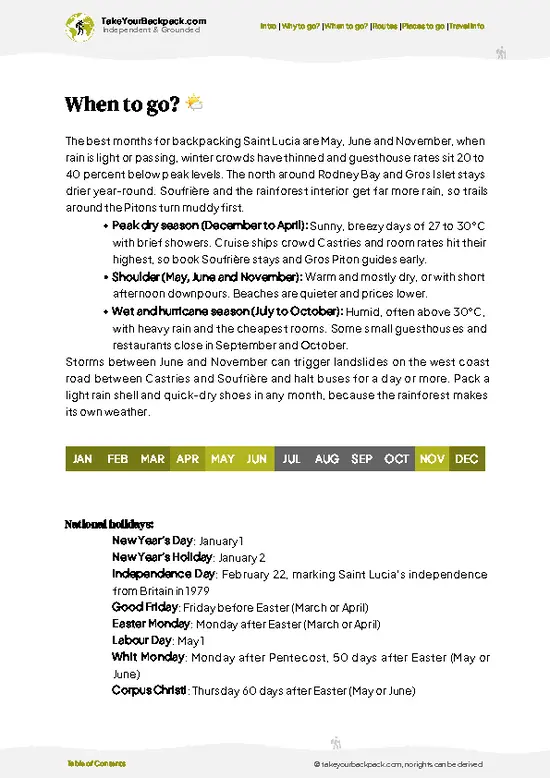
source: climatestotravel.comJANJanuary: excellent for travelingFEBFebruary: excellent for travelingMARMarch: excellent for travelingAPRApril: highly recommended for travelingMAYMay: highly recommended for travelingJUNJune: good for travelingJULJuly: fair for travelingAUGAugust: fair for travelingSEPSeptember: fair for travelingOCTOctober: fair for travelingNOVNovember: good for travelingDECDecember: excellent for traveling
when-to-go

✈️ The backpacker research shortcutSt. Lucia Travel Guide

What the free pages can't give you: ready-made routes, every place ranked, and it works offline. All in 1 guide.
example page 0 from our offline Travel Guide for Saint Lucia
example page 1 from our offline Travel Guide for Saint Lucia
example page 2 from our offline Travel Guide for Saint Lucia
example page 3 from our offline Travel Guide for Saint Lucia
example page 4 from our offline Travel Guide for Saint Lucia
example page 5 from our offline Travel Guide for Saint Lucia
example page 6 from our offline Travel Guide for Saint Lucia
example page 7 from our offline Travel Guide for Saint Lucia
The digital guide (125 pages) contains:-page digital guide:
✅ Ready-made 2, 3 & 5-day routes
✅ All 31 places ranked, so you skip the overrated ones
✅ Works offline, all in 1 guide
✅ Cities, national parks, landmarks, beaches
✅ How to get around
👉 Click to see all 30+ guide features

📅 Plan smarter in minutes, not weeks
✅ Month by month travel advice
✅ Festivals & national holidays
✅ Budget expectations

🗺️ Go to the right places, skip the overrated ones
✅ Honest pros & cons of destinations
✅ Top hikes, parks & viewpoints
✅ Lesser-known places most travelers miss
✅ Clear “worth it vs skip it” guidance

🛏️ Travel smoothly without rookie mistakes
✅ Best areas to stay
✅ Transport systems explained simply
✅ Common scams & safety advice
✅ SIM cards, money & practical tips

🌍 Understand the country, not just visit it
✅ Culture & traditions
✅ 52 Essential phrases & customs
✅ Festivals worth planning around
✅ Traveler-friendly historical context
✅ Insights that make places more meaningful

📱 Built for real travel conditions
✅ Fully downloadable PDF
✅ Works completely offline
✅ Optimized for phone use
✅ Useful in remote areas & buses
✅ All in 1 guide
Stop searching, start planning
Get instant access to your full guide. 30‑day money-back guarantee.


By proceeding you agree to our terms.
Sent to your inbox immediately after payment • 100% Secure Checkout
Best Backpacking Travel Advisor 2025 tourism awardBest Backpacking
Travel Advisor
2025
What others say about Take Your Backpack Guides:
⭐⭐⭐⭐⭐
Fantastic, amazing amount of information!
⭐⭐⭐⭐⭐
My goodness this is amazing, it's what I've been looking for hats off too you!
⭐⭐⭐⭐⭐
I think this is absolutely BRILLIANT
⭐⭐⭐⭐
Very complete and informative. It's still missing places, but I gotta to commend you
⭐⭐⭐⭐⭐
This is truly amazing, thank you, can't wait to explore it with my kids!
⭐⭐⭐⭐⭐
Awesome resource, thank you!
⭐⭐⭐⭐⭐
This is amazing! Can't wait to explore the ones I haven't seen
⭐⭐⭐⭐
I love this! Well done, great idea.
⭐⭐⭐⭐⭐
Thanks for taking the time to make this gem!
⭐⭐⭐⭐⭐
This might be the best website I've ever seen.
⭐⭐⭐⭐⭐
Congratulations, and thank you so much for your work; it's incredibly valuable.
⭐⭐⭐⭐
In all seriousness I think you did a great job pointing out the important spots
⭐⭐⭐⭐⭐
10/10 very good
⭐⭐⭐⭐⭐
As someone who's only just starting to visit regularly this is awesome, thank you.
⭐⭐⭐⭐
Thank you very much! I'm going to visit my dad, it's going to be very useful!
⭐⭐⭐⭐⭐
This is really cool! We'll be travelling for the first time and this definitely come in handy.
⭐⭐⭐⭐⭐
You are now our minister of culture, congratulations 👨‍💼
⭐⭐⭐⭐⭐
Just wanted to tell you that this is a pearl! Going to follow your recommendations.
⭐⭐⭐⭐⭐
This is so cool. I'll definitely be using the resource for my travels soon.
⭐⭐⭐⭐⭐
This is very impressive! Good work.
⭐⭐⭐⭐⭐
This is an amazing and informative site. Very well done!

🛏️ Where to stay?Choosing the right base

Vieux Fort is the best base, a few minutes by road from the Pointe Sable departure point, and nobody can stay on the islands themselves. The reserve is two uninhabited islets just offshore, visited on a short guided trip, so all beds are on the mainland.
In Vieux Fort you will find simple guesthouses and small hotels near the airport and the town center, usually US$60 to 110 a night for a double. It is the practical option for backpackers: supermarkets, local bakeries, bars, and buses to Castries and Soufrière. The Anse des Sables beach next door is a windy kitesurfing spot with a few beachfront … read more 👉
Vieux Fort is the best base, a few minutes by road from the Pointe Sable departure point, and nobody can stay on the islands themselves. The reserve is two uninhabited islets just offshore, visited on a short guided trip, so all beds are on the mainland.
In Vieux Fort you will find simple guesthouses and small hotels near the airport and the town center, usually US$60 to 110 a night for a double. It is the practical option for backpackers: supermarkets, local bakeries, bars, and buses to Castries and Soufrière. The Anse des Sables beach next door is a windy kitesurfing spot with a few beachfront apartments and a hostel-style vibe in season.
Laborie, a quiet fishing village about 20 minutes west, has family-run guesthouses and homestays at roughly US$40 to 80 and a more local feel. Soufrière is around an hour away and has the widest choice, including budget rooms from about US$35 to 60, but it makes the morning start harder.
Book ahead from December to April. Self-catering apartments around Vieux Fort suit longer stays, and kitchens help because eating options are limited in the evening.

👛 Costs (as of 22 October 2026)Travel costs and budget guide for Maria Islands Nature Reserve

Maria Islands Nature Reserve costs roughly US$92 to 170 a day for a backpacker, with the guided visit as the main expense. Travelers pay in Eastern Caribbean dollars, though US dollars are widely accepted in tourist spots.
CategoryBudget RangeLocal Reality
Guided visit and boatUS$35 to 50Arranged through the Saint Lucia National Trust, with a small-group tour including the crossing and guide. Prices vary with group size.
Accommodation (high season)US$40 to 80Guesthouses or simple rooms in Laborie and Vieux Fort. Low season is often 15 to 25 percent cheaper.
Local transportUS$2 to 10Minibuses run between Vieux Fort and Laborie for small fares. A taxi to Pointe Sable is around US$8 to 15 each way.
Food and suppliesUS$15 to 30Local bakeries, roadside stalls and small restaurants in Vieux Fort. Buy
… read more 👉
Maria Islands Nature Reserve costs roughly US$92 to 170 a day for a backpacker, with the guided visit as the main expense. Travelers pay in Eastern Caribbean dollars, though US dollars are widely accepted in tourist spots.
CategoryBudget RangeLocal Reality
Guided visit and boatUS$35 to 50Arranged through the Saint Lucia National Trust, with a small-group tour including the crossing and guide. Prices vary with group size.
Accommodation (high season)US$40 to 80Guesthouses or simple rooms in Laborie and Vieux Fort. Low season is often 15 to 25 percent cheaper.
Local transportUS$2 to 10Minibuses run between Vieux Fort and Laborie for small fares. A taxi to Pointe Sable is around US$8 to 15 each way.
Food and suppliesUS$15 to 30Local bakeries, roadside stalls and small restaurants in Vieux Fort. Buy water beforehand.
Total Daily BudgetUS$92 to 170Per person, per day, in high season.
⚠️ Prices can change and everyone travels differently, so take this as a rough guide. Hope it helps you plan your adventure!

🥾 TrailsScenic routes and wildlife spotting in Maria Islands Nature Reserve

Maria Islands Nature Reserve is a walk for slow looking, not distance, with one short footpath on the larger island and no marked network beyond it. Everything is done on foot with a guide from the National Trust, who leads you ashore and explains what you are seeing.
  • Maria Major loop: A short circuit of roughly 1 km that takes about an hour to 90 minutes with stops. The surface is uneven rock, sand and packed earth, with low scrub and cactus on both sides. Difficulty is easy, though the sun is strong and there is almost no shade.
  • Landing and shoreline: The crossing from Pointe Sable is brief, and
… read more 👉
Maria Islands Nature Reserve is a walk for slow looking, not distance, with one short footpath on the larger island and no marked network beyond it. Everything is done on foot with a guide from the National Trust, who leads you ashore and explains what you are seeing.
  • Maria Major loop: A short circuit of roughly 1 km that takes about an hour to 90 minutes with stops. The surface is uneven rock, sand and packed earth, with low scrub and cactus on both sides. Difficulty is easy, though the sun is strong and there is almost no shade.
  • Landing and shoreline: The crossing from Pointe Sable is brief, and you step off onto a rough shore. Expect to get your feet wet in the shallows and wear shoes with grip.
  • Wildlife: The Saint Lucia whiptail is the highlight and turns up along open ground. Seabirds nest on the cliff faces in the breeding season, roughly spring into summer, and the Kouwès snake is a rare bonus.
  • Maria Minor: Not part of the walking route. You look at it from Maria Major or from the boat, which protects its nesting birds.
  • Terrain and gear: Closed shoes, a hat, sunscreen, binoculars and water are the useful kit. Keep to the path and do not handle animals or leave anything behind.
Getting to the departure point from Vieux Fort is simple by local minibus or a short taxi ride, and the mainland is reachable on foot from the south coast road once you are in the area. Visits run in small groups, so the reserve never feels crowded, but slots can fill in busy weeks. There is an entrance and guide fee payable through the National Trust, and you should confirm the schedule when you book, because trips depend on the sea and the bird-nesting calendar. Calm mornings give the best crossing and the most active lizards.
⚠️ Hiking info can sometimes be outdated or inaccurate. Before you hit the trail, check the latest conditions with locals. If you do spot anything that's off, I'd love to hear from you, so I can update it for fellow travelers.

🛡️ SafetyStaying Safe: What Travelers Should Know

The reserve is short and straightforward, but the open exposure and the boat landing are what catch people out. The crossing from Pointe Sable is by small boat, and the landing on the rocky shore can be wet and slippery, so wear closed shoes with grip rather than flip-flops. Seas can be rough in the hurricane season, and operators cancel when conditions turn.
There is almost no shade on the islets, so bring a hat, reef-safe sunscreen and more water than you expect to drink, since nothing is sold on the islands. Stay on the marked path and follow your guide, because seabirds nest on the ground and the ground lizards and Kouwes snakes live in the scrub. The Kouwes snake is a rare and harmless species. Do not touch or chase any wildlife. Carry out all trash, and keep to the guide’s pace in the midday heat.

FAQFrequently asked questions about Maria Islands Nature Reserve

Half a day is enough for Maria Islands Nature Reserve, since the guided boat visit takes about 2 to 3 hours including the crossing. Most travelers combine it with a second day around Vieux Fort, Anse des Sables beach and Laborie. Allow a spare day in the hurricane season, as rough seas can cancel the boat.
You can reach Maria Islands Nature Reserve without a car, but you will need a short taxi or arranged transfer for the last stretch. Minibuses run to Vieux Fort from Castries (about 1.5 to 2 hours) and Soufrière (about 1 hour). From Vieux Fort, a taxi to the Pointe Sable departure point takes about 10 minutes and costs roughly US$8 to 15.
Yes, Maria Islands Nature Reserve requires a guided visit arranged through the Saint Lucia National Trust, and there is no independent landing. Book a few days ahead, since groups are small and trips run only in suitable sea conditions.
⚠️ Things can change over time, so always validate details locally before you go.

Other Saint Lucian national parks near Maria Islands Nature Reserve

Explore more nearby:


💡 Not sure where to go next?
Create a personalized itinerary for St. Lucia including Maria Islands Nature Reserve and the places that fit your trip.

Generate my itinerary

👉 Discover all national parks

Or checkout all St. Lucia has to offer (think cities, towns, villages, national parks, hikes, beaches, festivals)
Country photo of St. Lucia

We 💚 feedbackIs it worth it?

Maria Islands Nature Reserve needs about half a day, and that includes the briefing, the crossing and the hour on the island. Stay longer and you will only be waiting for the sun to climb and bake the rocks. I would book the earliest slot, bring binoculars and keep the rest of the day for Vieux Fort's beaches.

✍️ Help improve this page!
The information on this page is based on in-depth research, insights shared by experienced travelers, and feedback from the local travel community in St. Lucia. While every effort is made to keep the information accurate and current, conditions can change — so if you spot anything incorrect or outdated, please get in touch.


🙋‍♂️ Give feedback

👋 Meet the founderWho’s Behind Take Your Backpack?

Johan, backpacker and founder of TakeYourBackpackHi, I’m Johan (Netherlands 🇳🇱), the creator of TakeYourBackpack. Over the past 30 years, I’ve backpacked through 88 countries across six continents, gaining extensive experience with independent travel, long-term trips, and overland routes.

This site is built on a combination of firsthand travel experience and carefully curated insights from other backpackers. Many guides are based on places I’ve personally visited, while others bring together tips, observations, and practical advice shared by trusted travelers I’ve met along the way.

The goal is to provide realistic, experience-driven guidance — not generic itineraries — so you can explore destinations with better context, clearer expectations, and more confidence.