×

Samoa🇼🇸 | villagesLalomanuWhite-sand lagoon, beach fales, Aleipata islands, Sunday hymns | things to do and best time to go

Explore To Sua Ocean TrenchExplore Mulifanua

Backpacking in Lalomanu
🏆 Top pickvillage ranked #1
By Johan Kruseman 🇳🇱 | Updated October 16, 2026

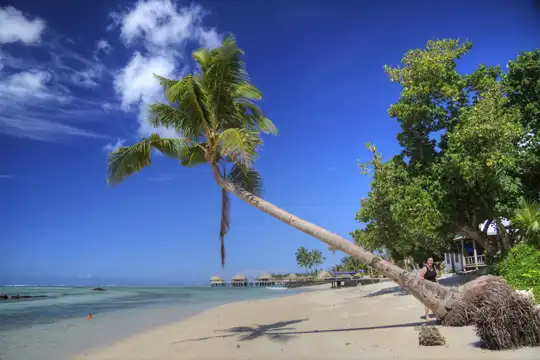
The lagoon at Lalomanu is shallow and coral-strewn at low tide, so the swimming you see in photos happens around high tide. The village sits on the southeast end of Upolu, in Samoa, on the Aleipata coast, facing sunrise and two offshore islands. Pale sand squeaks underfoot, coconut fronds clatter in the trade wind, and the sea turns from milky green to deep blue at the reef edge. Accommodation is open-sided beach fales with thin mattresses and mosquito nets, so you hear every wave and every rooster. Roosters, church bells and village dogs set the pace. Evenings are quiet: set dinners at your fale, a few beers, and lights out early. Meeting people is easy because the fales sit side by side on the sand. Roads are narrow and the village is small, with little to do beyond the water, but that is the point. It suits a pause after Apia more than a long stay. Bring enough cash in tala, since there is no ATM and card machines are rare.

Discover everything you want to know in the 📖 Samoa Travel Guide.


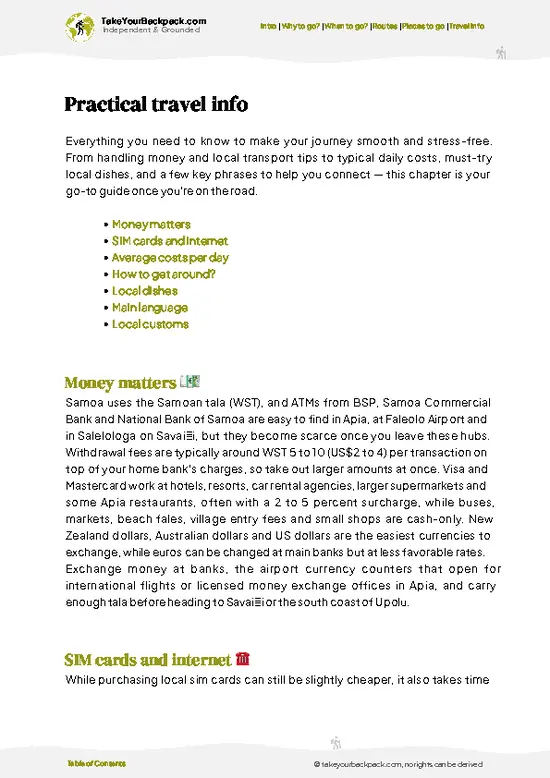
example page 0 from our offline Travel Guide for Samoa
example page 1 from our offline Travel Guide for Samoa
example page 2 from our offline Travel Guide for Samoa
example page 3 from our offline Travel Guide for Samoa
example page 4 from our offline Travel Guide for Samoa
example page 5 from our offline Travel Guide for Samoa
example page 6 from our offline Travel Guide for Samoa
example page 7 from our offline Travel Guide for Samoa
Loading the map 🌍
CLICK TO FILTER
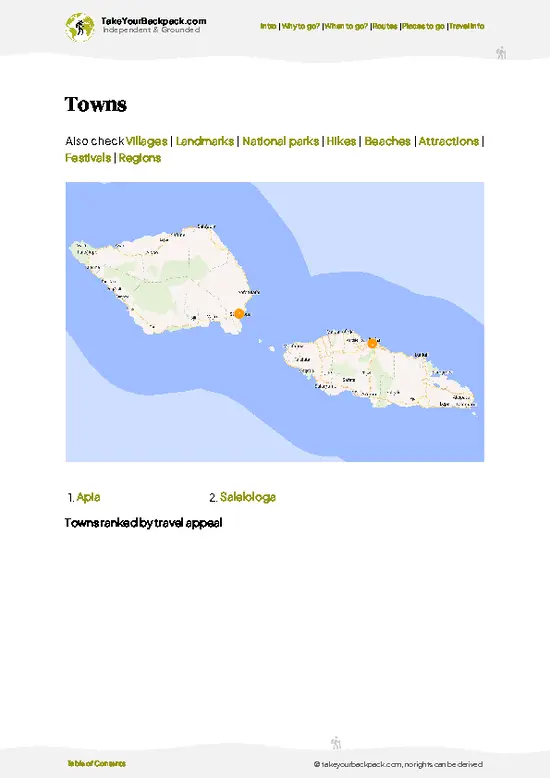
towns
villages
landmarks
national parks
hikes
beaches
attractions
festivals
regions
SHOW COUNTRY’S BESTSHOW ALL

✨ Why go?
Ranked #1 village in Samoa
What makes it a must-see village

Backpackers come to Lalomanu for one thing done well: a white-sand beach where you sleep a few steps from the water. Facing east, it gives you sunrise over the lagoon instead of the sunset-side views most of Samoa offers, and the light at 6 a.m. is worth the early wake-up from the rooster. Snorkeling is the main activity, with the Nu’utele and Nu’ulua islands sitting on the horizon and calm days making the reef edge reachable. Most travelers stay two or three nights, and plenty stretch it because there is no pressure to be anywhere. The scene is social without being rowdy. Fales share a stretch of sand, so you end up comparing notes over dinner, and by 10 p.m. most people are asleep. It works best for couples, solo travelers who want calm, and anyone coming off the crowds and traffic of town. … read more 👉
Backpackers come to Lalomanu for one thing done well: a white-sand beach where you sleep a few steps from the water. Facing east, it gives you sunrise over the lagoon instead of the sunset-side views most of Samoa offers, and the light at 6 a.m. is worth the early wake-up from the rooster. Snorkeling is the main activity, with the Nu’utele and Nu’ulua islands sitting on the horizon and calm days making the reef edge reachable. Most travelers stay two or three nights, and plenty stretch it because there is no pressure to be anywhere. The scene is social without being rowdy. Fales share a stretch of sand, so you end up comparing notes over dinner, and by 10 p.m. most people are asleep. It works best for couples, solo travelers who want calm, and anyone coming off the crowds and traffic of town. Light sleepers and anyone who needs walls, air conditioning or a lively bar will want a different base. Hikers will find little here, but the waterfalls and sea pools of the island’s southern side are a day away. On a rainy day the village empties quickly, so check the forecast before committing to a long stay.

💡 HighlightsDon't-miss highlights and experiences

  1. Lalomanu Beach: The reason the village exists on travelers’ maps. A long curve of fine white sand with a shallow lagoon, shade from coconut palms and fales a few steps from the water. Swim around high tide, when the coral is covered, and go in the morning or late afternoon when the sun is softer. Walking the sand is free, and most people spend half a day or more here.
  2. Lagoon and reef snorkeling: The lagoon holds small reef fish, giant clams in places and clear water on calm days, with the reef edge and the Aleipata islands as the backdrop. Go at high tide and in the morning, when the water is still and visibility is best. Many fales lend or rent masks and fins for roughly WST 15 to 30 (US$5 to 11), and a session takes 1 to 2 hours. Wear reef shoes, since the coral is sharp at low tide.
  3. Sunday
… read more 👉
  1. Lalomanu Beach: The reason the village exists on travelers’ maps. A long curve of fine white sand with a shallow lagoon, shade from coconut palms and fales a few steps from the water. Swim around high tide, when the coral is covered, and go in the morning or late afternoon when the sun is softer. Walking the sand is free, and most people spend half a day or more here.
  2. Lagoon and reef snorkeling: The lagoon holds small reef fish, giant clams in places and clear water on calm days, with the reef edge and the Aleipata islands as the backdrop. Go at high tide and in the morning, when the water is still and visibility is best. Many fales lend or rent masks and fins for roughly WST 15 to 30 (US$5 to 11), and a session takes 1 to 2 hours. Wear reef shoes, since the coral is sharp at low tide.
  3. Sunday church service in the village: On Sundays the village dresses in white and fills its church with a cappella hymns that carry across the beach. Visitors are welcome at most services if they dress modestly, with shoulders and knees covered. There is no fee, though a small donation of WST 5 to 10 (US$2 to 4) is appropriate. Plan on about 1 to 2 hours, and sit near the back. Many fales serve a large Sunday lunch afterward, so book it with your host.
Day trips from Lalomanu can take in the To Sua Ocean Trench, the Togitogiga waterfalls in O Le Pupu-Pu’e National Park, and boat trips to the Aleipata islands and Namu’a. Most visitors skip the church service, yet it is the one hour in Lalomanu where you meet the village as it actually lives.
Spotted a mistake or missing something? Contact us.

Things to do near Lalomanu

Ratings based on Tripadvisor reviews. When you book through this link, you support our work at no extra cost to you.

🌤️ When to go?Best time to visit Lalomanu

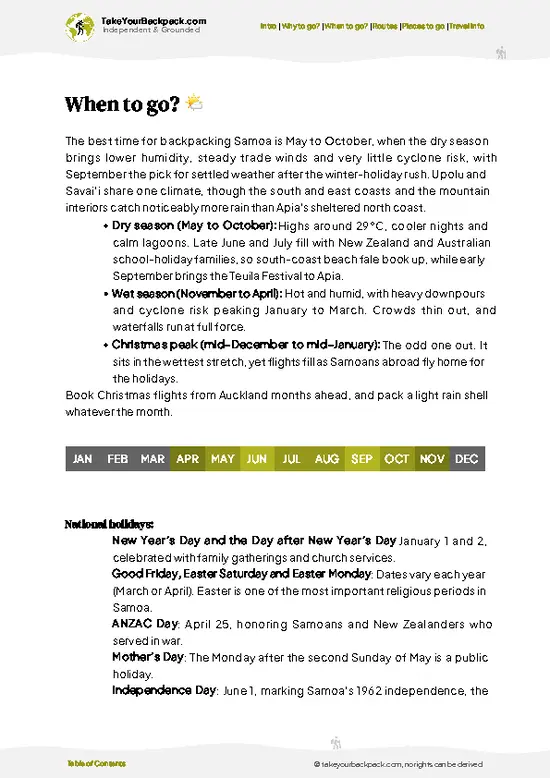
  • Dry Season (May to October): Lalomanu is at its most reliable from May to October, with days of 27 to 30°C (81 to 86°F), cooler nights around 22°C (72°F), and the clearest water for snorkeling. Sunrise is near 6:30 am and sunset near 6:15 pm. Beach fales fill up on weekends and from July to August, and rates edge up.
  • Wet Season (November to April): Expect 28 to 32°C (82 to 90°F), heavy humidity, and downpours that often pass within an hour. Cyclone risk peaks from December to March, and the east coast road can flood. Fales are easy to book and often cheaper, and you can usually walk in.
  • Holiday Peaks: Christmas, New Year and the early September Teuila Festival in Apia push up demand, and locals travel home for family gatherings. Reserve ahead for these dates.
Arrive on a weekday in May, June … read more 👉
  • Dry Season (May to October): Lalomanu is at its most reliable from May to October, with days of 27 to 30°C (81 to 86°F), cooler nights around 22°C (72°F), and the clearest water for snorkeling. Sunrise is near 6:30 am and sunset near 6:15 pm. Beach fales fill up on weekends and from July to August, and rates edge up.
  • Wet Season (November to April): Expect 28 to 32°C (82 to 90°F), heavy humidity, and downpours that often pass within an hour. Cyclone risk peaks from December to March, and the east coast road can flood. Fales are easy to book and often cheaper, and you can usually walk in.
  • Holiday Peaks: Christmas, New Year and the early September Teuila Festival in Apia push up demand, and locals travel home for family gatherings. Reserve ahead for these dates.
Arrive on a weekday in May, June or September for the calmest sand and the best chance of a fale right on the water.


source: climatestotravel.comJANJanuary: fair for travelingFEBFebruary: fair for travelingMARMarch: fair for travelingAPRApril: fair for travelingMAYMay: highly recommended for travelingJUNJune: highly recommended for travelingJULJuly: highly recommended for travelingAUGAugust: highly recommended for travelingSEPSeptember: highly recommended for travelingOCTOctober: highly recommended for travelingNOVNovember: fair for travelingDECDecember: fair for traveling
when-to-go

✈️ The backpacker research shortcutSamoa Travel Guide

An offline-friendly backpacking guide with optimized travel routes, ranked highlights, transport advice, and the best areas to stay.
example page 0 from our offline Travel Guide for Samoa
example page 1 from our offline Travel Guide for Samoa
example page 2 from our offline Travel Guide for Samoa
example page 3 from our offline Travel Guide for Samoa
example page 4 from our offline Travel Guide for Samoa
example page 5 from our offline Travel Guide for Samoa
example page 6 from our offline Travel Guide for Samoa
example page 7 from our offline Travel Guide for Samoa
The digital guide (138 pages) contains:
✅ 37 highlights, ranked by travel appeal
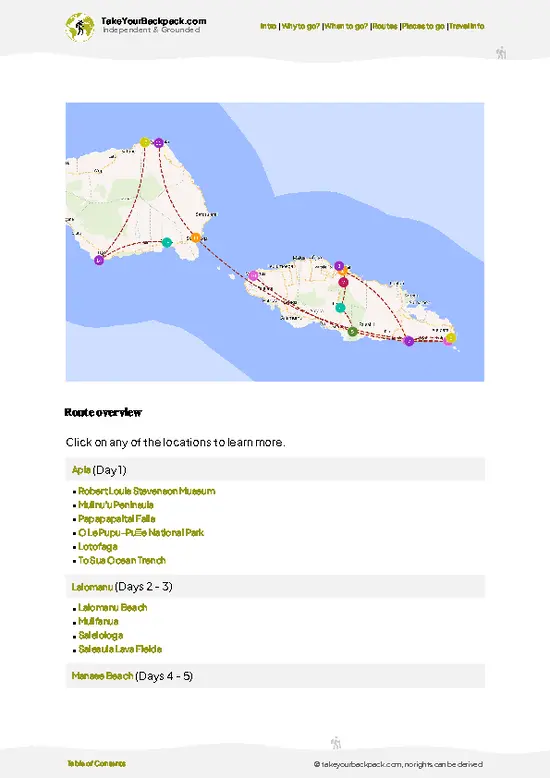
✅ Optimized 2, 3 & 5-day travel routes
✅ Cities, national parks, landmarks, beaches
✅ How to get around
✅ Offline-friendly for travel without Wi-Fi
👉 Click to see all 30+ guide features

📅 Plan smarter in minutes, not weeks
✅ Month by month travel advice
✅ Festivals & national holidays
✅ Budget expectations

🗺️ Go to the right places, skip the overrated ones
✅ Honest pros & cons of destinations
✅ Top hikes, parks & viewpoints
✅ Lesser-known places most travelers miss
✅ Clear “worth it vs skip it” guidance

🛏️ Travel smoothly without rookie mistakes
✅ Best areas to stay
✅ Transport systems explained simply
✅ Common scams & safety advice
✅ SIM cards, money & practical tips

🌍 Understand the country, not just visit it
✅ Culture & traditions
✅ 52 Essential phrases & customs
✅ Festivals worth planning around
✅ Traveler-friendly historical context
✅ Insights that make places more meaningful

📱 Built for real travel conditions
✅ Fully downloadable PDF
✅ Works completely offline
✅ Optimized for phone use
✅ Useful in remote areas & buses
✅ Everything in one place
Stop searching, start planning
Get instant access to your full guide. 30‑day money-back guarantee.
+ Add another guide for just

By proceeding you agree to our terms.
Sent to your inbox immediately after payment • 100% Secure Checkout
Best Backpacking Travel Advisor 2025 tourism awardBest Backpacking
Travel Advisor
2025
What others say about Take Your Backpack Guides:
⭐⭐⭐⭐⭐
Fantastic, amazing amount of information!
⭐⭐⭐⭐⭐
My goodness this is amazing, it's what I've been looking for hats off too you!
⭐⭐⭐⭐⭐
I think this is absolutely BRILLIANT
⭐⭐⭐⭐
Very complete and informative. It's still missing places, but I gotta to commend you
⭐⭐⭐⭐⭐
This is truly amazing, thank you, can't wait to explore it with my kids!
⭐⭐⭐⭐⭐
Awesome resource, thank you!
⭐⭐⭐⭐⭐
This is amazing! Can't wait to explore the ones I haven't seen
⭐⭐⭐⭐
I love this! Well done, great idea.
⭐⭐⭐⭐⭐
Thanks for taking the time to make this gem!
⭐⭐⭐⭐⭐
This might be the best website I've ever seen.
⭐⭐⭐⭐⭐
Congratulations, and thank you so much for your work; it's incredibly valuable.
⭐⭐⭐⭐
In all seriousness I think you did a great job pointing out the important spots
⭐⭐⭐⭐⭐
10/10 very good
⭐⭐⭐⭐⭐
As someone who's only just starting to visit regularly this is awesome, thank you.
⭐⭐⭐⭐
Thank you very much! I'm going to visit my dad, it's going to be very useful!
⭐⭐⭐⭐⭐
This is really cool! We'll be travelling for the first time and this definitely come in handy.
⭐⭐⭐⭐⭐
You are now our minister of culture, congratulations 👨‍💼
⭐⭐⭐⭐⭐
Just wanted to tell you that this is a pearl! Going to follow your recommendations.
⭐⭐⭐⭐⭐
This is so cool. I'll definitely be using the resource for my travels soon.
⭐⭐⭐⭐⭐
This is very impressive! Good work.
⭐⭐⭐⭐⭐
This is an amazing and informative site. Very well done!

🛏️ Where to stay?Best areas to stay in Samoa

Beach fales, open-sided thatched huts on posts right on the sand, are the standard and best-value place to sleep in Lalomanu. Most sit along the same long white beach, so the choice is about price, food and how much privacy you want.
Basic fales run about WST 80 to 150 (US$30 to 55) per person, and most rates include dinner and breakfast, which matters because shops are scarce. You get a mattress, a mosquito net and a mat, with curtains or blinds on the sides for privacy. Bathrooms and showers are shared and cold water is common. Bring a flashlight, earplugs for the roosters and waves, and a padlock … read more 👉
Beach fales, open-sided thatched huts on posts right on the sand, are the standard and best-value place to sleep in Lalomanu. Most sit along the same long white beach, so the choice is about price, food and how much privacy you want.
Basic fales run about WST 80 to 150 (US$30 to 55) per person, and most rates include dinner and breakfast, which matters because shops are scarce. You get a mattress, a mosquito net and a mat, with curtains or blinds on the sides for privacy. Bathrooms and showers are shared and cold water is common. Bring a flashlight, earplugs for the roosters and waves, and a padlock for your bag.
Mid-range options include sturdier fales with lockable walls, private bathrooms and fans, usually WST 250 to 500 (US$90 to 180) per night for two. A few small resorts are scattered nearby, and some sit on the hillside across the road with sea views.
The beach was hit hard by the 2009 tsunami and rebuilt, so every place now has a similar setup. Pick one with a sandy frontage and a lagoon you can swim in at high tide. Cash is simplest, since card machines and ATMs are not reliable here. Book ahead from July to August and over Christmas. Walk-ins are normally fine the rest of the year.

🚌 Day tripsBest day trips from Lalomanu

Lalomanu works well as a base for day trips, but there is no frequent public transport, so plan around the Apia buses, rental cars or a driver hired through your fale.
To Sua Ocean Trench:
This huge flooded sinkhole with a ladder down to turquoise water is about 30 to 40 minutes west by car or bus. Entry is around WST 30 to 50 (US$11 to 18) per person, and a taxi or shared ride adds roughly WST 40 to 80 (US$15 to 30). Go early before tour groups arrive, and bring water shoes for the slippery ladder rungs and rocks.
👉 Explore To Sua Ocean Trench
Fagaloa Bay and Uafato:
The road north climbs into forest above the bay, with gaps for ocean views. Allow about 1 hour 15 minutes each way, mostly on rough road, so a 4WD or good driver helps. Plan for roughly WST 100 to 200 (US$35 to 70) in transport … read more 👉
Lalomanu works well as a base for day trips, but there is no frequent public transport, so plan around the Apia buses, rental cars or a driver hired through your fale.
To Sua Ocean Trench:
This huge flooded sinkhole with a ladder down to turquoise water is about 30 to 40 minutes west by car or bus. Entry is around WST 30 to 50 (US$11 to 18) per person, and a taxi or shared ride adds roughly WST 40 to 80 (US$15 to 30). Go early before tour groups arrive, and bring water shoes for the slippery ladder rungs and rocks.
👉 Explore To Sua Ocean Trench
Fagaloa Bay and Uafato:
The road north climbs into forest above the bay, with gaps for ocean views. Allow about 1 hour 15 minutes each way, mostly on rough road, so a 4WD or good driver helps. Plan for roughly WST 100 to 200 (US$35 to 70) in transport and any village fee, and bring cash. It is best in the dry season, since heavy rain can close the track. Many first-timers underestimate the road and arrive late.

Apia:
The capital is about 1.5 to 2 hours away by bus over the Cross Island Road, with fares around WST 6 to 12 (US$2 to 4.5). Go for the Savalalo flea market, Maketi Fou produce stalls and the Robert Louis Stevenson museum at Vailima. Buses run less often in the afternoon, so check the last return before heading out, or you may need an expensive taxi back.
👉 Explore Apia
Aleipata Islands:
Nuutele and Nuulua lie just offshore and can be reached by a boat from the beach for around WST 100 to 200 (US$35 to 70) per boat, depending on bargaining and group size. Calm mornings from May to October are best. Ask the fale owners to arrange it, and agree on the price and return time in advance.

FAQFrequently asked questions about Lalomanu

From Apia, take a bus from the main terminal toward Lalomanu over the Cross Island Road or along the coast, which takes about 1.5 to 2 hours and costs roughly WST 6 to 12 (US$2 to 4.5). A taxi or a hired car with a driver costs much more but is faster, at around 1 hour 15 minutes. Faleolo International Airport is about 40 minutes further west of Apia, so allow a full half day from landing. Buses thin out by late afternoon, so arrive before dark.
Yes, if you want the best beach in Samoa and a classic fale stay. The white sand and calm, clear water suit snorkeling and swimming, and To Sua Ocean Trench lies about 30 to 40 minutes away. Plan two or three nights at roughly WST 80 to 150 (US$30 to 55) per person with meals, and bring cash. It is quiet in the evenings, so it suits relaxing more than nightlife.
It can, but a night or two is better. From Apia it is a 1.5 to 2 hour trip each way, so a day return leaves just a few hours on the sand, and the last buses back leave in the afternoon. A rental car or private driver makes it easier, costing about WST 150 to 300 (US$55 to 110) for the day. Combine it with To Sua Ocean Trench to make the long drive count.
⚠️ Things can change over time, so always validate details locally before you go.

Other Samoan villages near Lalomanu

Explore more nearby:

  • Lotofaga—Reef-break surf, coast road, kilikiti games, south-coast fales| 14 km away
  • Poutasi—Lava shelf, Sunday church, taro plots| 27 km away
  • Mulifanua—Ferry wharf, Savai’i crossing, departure point| 69 km away

💡 Not sure where to go next?
Create a personalized itinerary for Samoa including Lalomanu and the places that fit your trip.

Generate my itinerary

👉 Discover all villages

Or checkout all Samoa has to offer (think cities, towns, villages, national parks, hikes, beaches, festivals)
Country photo of Samoa

We 💚 feedbackKey takeaways before you go

Be on the beach at dawn, when the sky behind Nu’utele turns orange and the lagoon is flat. The dry months from May to October give the clearest water and the most reliable mornings, though high tide matters more than the month. I would book a fale right on the sand, bring reef shoes and cash, and skip packing a schedule.

✍️ Help improve this page!
The information on this page is based on in-depth research, insights shared by experienced travelers, and feedback from the local travel community in Samoa. While every effort is made to keep the information accurate and current, conditions can change — so if you spot anything incorrect or outdated, please get in touch.


🙋‍♂️ Give feedback

👋 Meet the founderWho’s Behind Take Your Backpack?

Johan, backpacker and founder of TakeYourBackpackHi, I’m Johan (Netherlands 🇳🇱), the creator of TakeYourBackpack. Over the past 3 decades, I’ve backpacked through 90+ countries across six continents, gaining extensive experience with independent travel, long-term trips, and overland routes.

This site is built on a combination of firsthand travel experience and carefully curated insights from other backpackers. Many guides are based on places I’ve personally visited, while others bring together tips, observations, and practical advice shared by trusted travelers I’ve met along the way.

The goal is to provide realistic, experience-driven guidance — not generic itineraries — so you can explore destinations with better context, clearer expectations, and more confidence.