×

San Marino🇸🇲 | best villagesExplore the 5 Best villages in San Marino

San Marino’s villages are the nine castelli, small districts packed into 61 square kilometers, so the real difference is altitude and crowds. The Mount Titano ridge is steep, busy by midday and pricier, while the eastern and southern hills are quiet, farm-edged and easy on a wallet. For independent travel, arrive before 9 a.m. or after 5 p.m. and the ridge is nearly yours.

By Johan Kruseman 🇳🇱 | Updated October 19, 2026
Explore the best landmarks in San Marino

Why go?Why These village Stand Out

San Marino suits village hopping because everything sits inside 61 square kilometers of Apennine foothills, split into nine castelli whose borders have barely moved in centuries. It claims to be the world’s oldest surviving republic, founded in 301, and that independence kept medieval street plans and stone fortifications intact while neighbors rebuilt. The historic center and Mount Titano have held UNESCO status since 2008. The catch is variety: away from the old core, many districts are modern residential and commercial areas, so expect hillside suburbs rather than postcard clusters. Buses are sparse outside the main roads, and steep gradients make walking slower than the map suggests. Duty-free shops dominate the busiest streets. Bring sturdy shoes, carry euros, and expect Italian in everyday … read more 👉
San Marino suits village hopping because everything sits inside 61 square kilometers of Apennine foothills, split into nine castelli whose borders have barely moved in centuries. It claims to be the world’s oldest surviving republic, founded in 301, and that independence kept medieval street plans and stone fortifications intact while neighbors rebuilt. The historic center and Mount Titano have held UNESCO status since 2008. The catch is variety: away from the old core, many districts are modern residential and commercial areas, so expect hillside suburbs rather than postcard clusters. Buses are sparse outside the main roads, and steep gradients make walking slower than the map suggests. Duty-free shops dominate the busiest streets. Bring sturdy shoes, carry euros, and expect Italian in everyday conversation. Evenings go quiet early, which is when the country feels most local.
Why These Made the Cut
The list of best villages in San Marino is created based on authenticity, scenic beauty, community spirit, traditions, and overall character. If you feel a village is missing in this list, please let us know.

When to go?Best Time to Visit San Marino for villages

Best months: The best months are May, June, September and early October, when daytime highs sit around 20 to 27°C and the hillsides are green or golden without the summer crush. Rain falls mostly in spring and autumn, and annual totals are moderate, so carry a light shell and expect a shower or two rather than a washout.
Summer, winter and prices: July and August bring highs of 28 to 31°C and heavy day-tripper traffic from the Rimini coast, peaking from late morning to mid-afternoon. Go early or stay for the evening. Hotel rates climb in summer and during the medieval festival in July, so room prices can run well above shoulder-season levels. November to March means 0 to 8°C, fog on the ridge, and occasional snow. Some museums and restaurants shorten their hours, but you will have the lanes to yourself and rooms cost noticeably less.

village hoppingOptimizing Your Multi-Stop Itinerary

How many days: A trip linking several villages in San Marino needs 2 to 3 days, because the whole country is only about 61 square kilometers and the limit is slopes and bus timetables, not distance. Cluster the Mount Titano ridge together, then spend a second day in the lower eastern and southern hills, with the northern border zone around Serravalle as an easy add-on if you arrive from Rimini.
Direction and timing: Start high in the early morning, then work downhill as the day warms and the ridge fills up. Allow 1 to 3 hours per stop, and 3 to 4 hours for the ridge. Crossing between regions takes 15 to 30 minutes by car or bus. From Rimini, the bus to San Marino takes roughly 50 to 60 minutes.
The usual mistakes are cramming five stops into one day, relying on frequent buses in the quiet hills, … read more 👉
How many days: A trip linking several villages in San Marino needs 2 to 3 days, because the whole country is only about 61 square kilometers and the limit is slopes and bus timetables, not distance. Cluster the Mount Titano ridge together, then spend a second day in the lower eastern and southern hills, with the northern border zone around Serravalle as an easy add-on if you arrive from Rimini.
Direction and timing: Start high in the early morning, then work downhill as the day warms and the ridge fills up. Allow 1 to 3 hours per stop, and 3 to 4 hours for the ridge. Crossing between regions takes 15 to 30 minutes by car or bus. From Rimini, the bus to San Marino takes roughly 50 to 60 minutes.
The usual mistakes are cramming five stops into one day, relying on frequent buses in the quiet hills, and walking uphill at midday in summer. Instead, check the timetable the night before, pick two or three stops per day, and rent a car or e-bike for the outer districts.

The ListTop villages of San Marino

1 Montegiardino

university campus, medieval gate, hillside gardens

Discover a scholarly enclave framed by ancient walls, where students mingle with locals and terraced gardens overlook the countryside.

san-marino-city-montegiardino
© Google |

2 Fiorentino

hilltop fort, panoramic terraces, rural lanes

Climb to a quiet summit where stone ramparts overlook patchwork fields, and winding roads reveal San Marino’s agricultural heartland.

3 Acquaviva

wooded slopes, limestone cliffs, borderland views

Follow forested trails beneath dramatic rock faces and glimpse the Italian border, with secluded corners offering a sense of remoteness.

san-marino-city-acquaviva
© Google |

4 Chiesanuova

village square, artisan workshops, local festivals

Join residents in a compact center where crafts endure, and seasonal gatherings give insight into San Marino’s living traditions.

5 Faetano

river valley, tiled rooftops, quiet piazzas

Wander gentle slopes dotted with family homes, where the Marano river shapes daily life and the pace slows near tranquil squares.

san-marino-city-faetano
© Google |
Loading the map 🌍

Expert viewExpert Commentary on villages

How many villages: Visit three or four. The country is small, but each district sits on a different slope, and a fourth stop usually means rushing past lunch and a viewpoint. More than that and the stops blur into one hillside of terracotta roofs.
Which kind for which traveler: First-timers and photographers should put the historic ridge first and go early. Slow travelers and cyclists get more from the outer farming districts, where you can walk lanes between vineyards and see little traffic. Culture seekers should add a stop with a working church or small museum, since the outer districts are quieter, with fewer exhibits.
What it costs: Plan on €50 to 90 a day if you sleep in nearby Rimini (hostel or budget hotel) and eat simply, or €90 to 140 if you sleep in San Marino itself, where rooms … read more 👉
How many villages: Visit three or four. The country is small, but each district sits on a different slope, and a fourth stop usually means rushing past lunch and a viewpoint. More than that and the stops blur into one hillside of terracotta roofs.
Which kind for which traveler: First-timers and photographers should put the historic ridge first and go early. Slow travelers and cyclists get more from the outer farming districts, where you can walk lanes between vineyards and see little traffic. Culture seekers should add a stop with a working church or small museum, since the outer districts are quieter, with fewer exhibits.
What it costs: Plan on €50 to 90 a day if you sleep in nearby Rimini (hostel or budget hotel) and eat simply, or €90 to 140 if you sleep in San Marino itself, where rooms are pricier. The towers cost roughly €6 to 8 for a combined ticket, the cable car a few euros, and the Rimini bus about €5 to 6 each way. A piadina or pasta lunch runs €10 to 16, and a passport stamp at the tourist office is around €5. Guides are optional, with group tours typically €10 to 20 per person.
Safety and etiquette: Crime is very low, but wet cobbles are slick and some ridge paths drop away with limited railings, so wear shoes with grip and keep children close. Wind on the ridge can be strong in winter. Residents live in these districts, so keep voices down in the evening and ask before photographing people. Cover shoulders and knees in churches. Many restaurants close between about 2:30 and 6:30 p.m., and Sundays are quiet outside the ridge, so buy water and snacks beforehand. Carry your ID, since the border with Italy is open but police do spot checks.

✈️ The backpacker research shortcutSan Marino Travel Guide

An offline-friendly backpacking guide with optimized travel routes, ranked highlights, transport advice, and the best areas to stay.
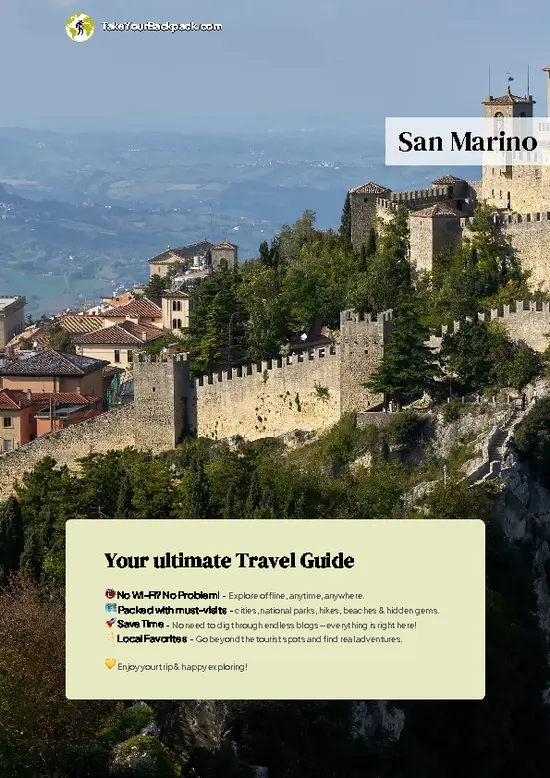
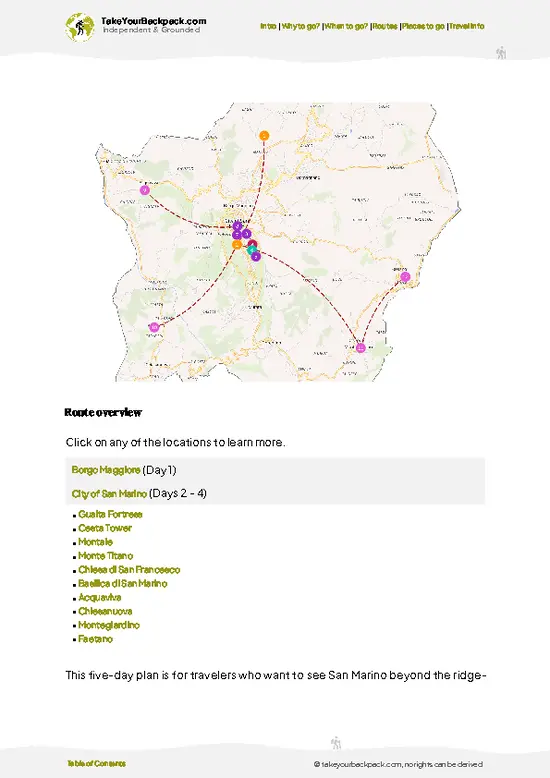
example page 0 from our offline Travel Guide for San Marino
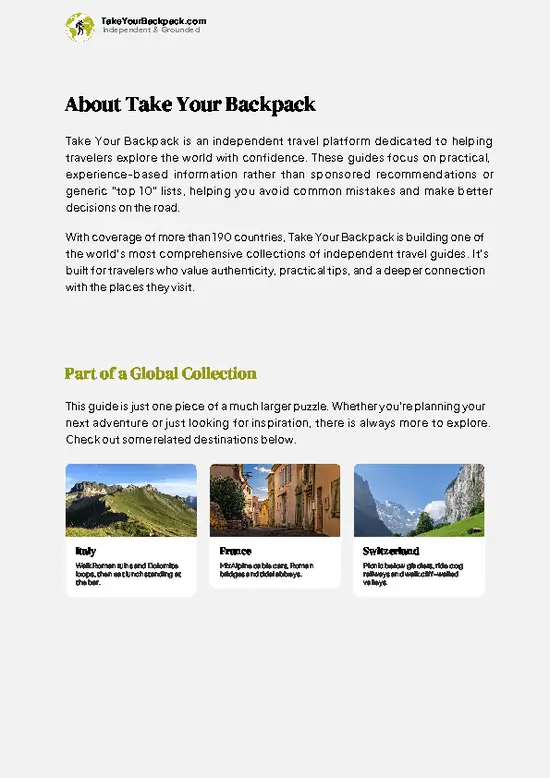
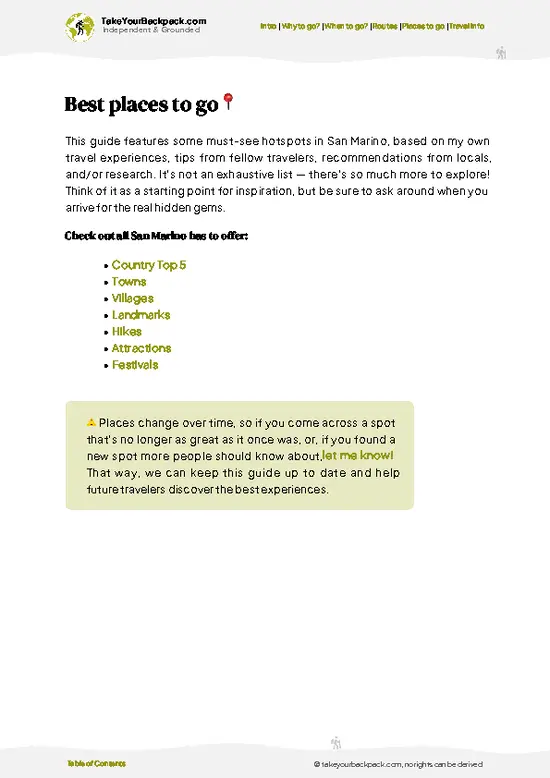
example page 1 from our offline Travel Guide for San Marino
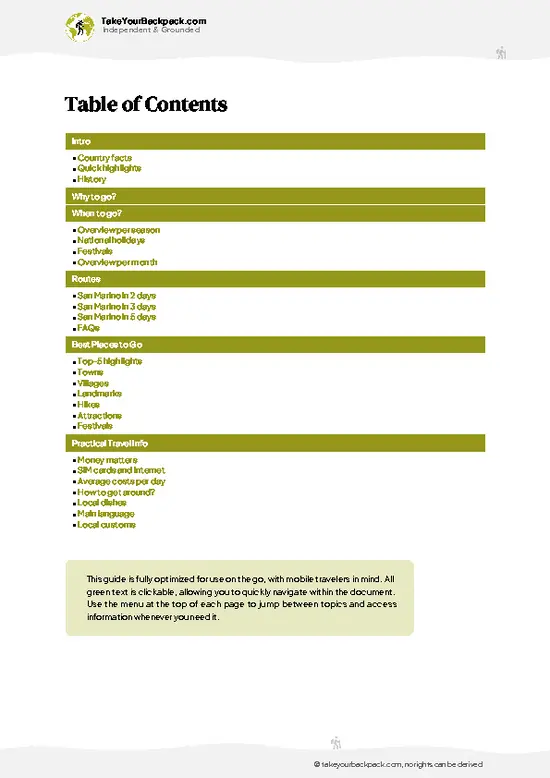
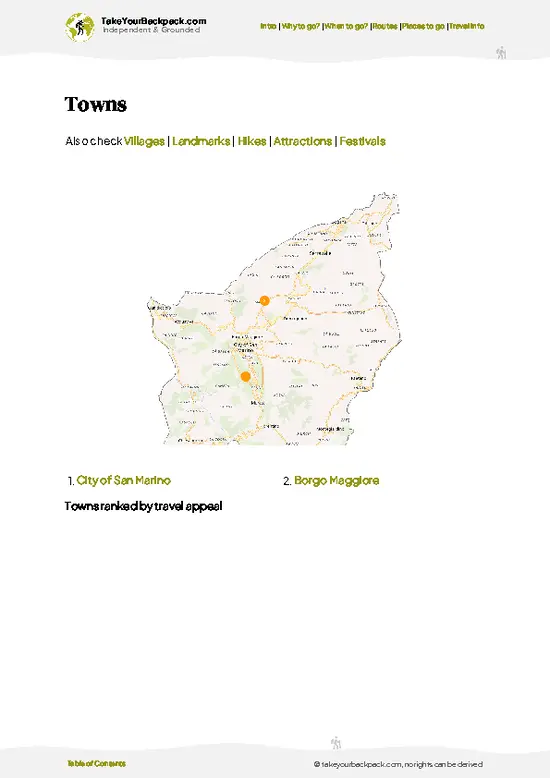
example page 2 from our offline Travel Guide for San Marino
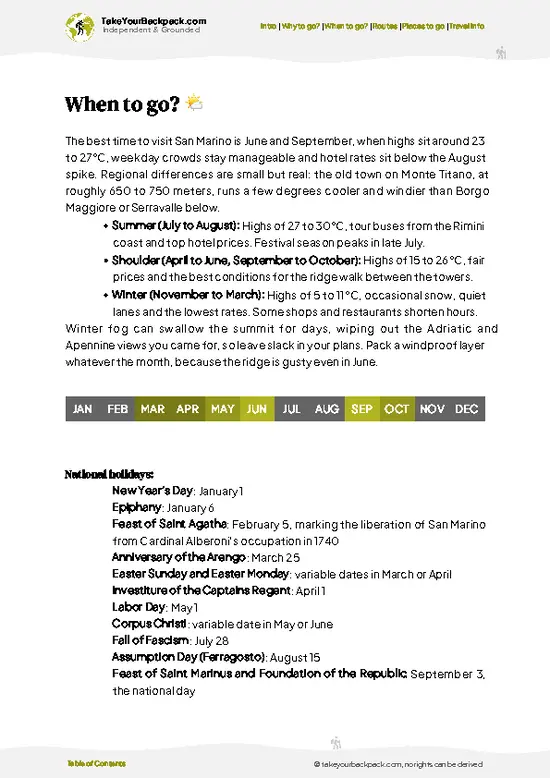
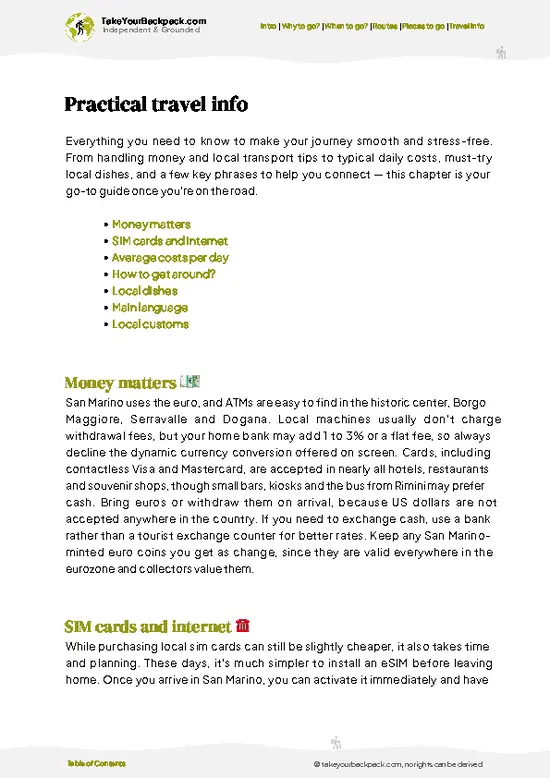
example page 3 from our offline Travel Guide for San Marino
example page 4 from our offline Travel Guide for San Marino
example page 5 from our offline Travel Guide for San Marino
example page 6 from our offline Travel Guide for San Marino
example page 7 from our offline Travel Guide for San Marino
The digital guide (87 pages) contains:
✅ 18 highlights, ranked by travel appeal
✅ Optimized 2, 3 & 5-day travel routes
✅ Cities, national parks, landmarks, beaches
✅ How to get around
✅ Offline-friendly for travel without Wi-Fi
👉 Click to see all 30+ guide features

📅 Plan smarter in minutes, not weeks
✅ Month by month travel advice
✅ Festivals & national holidays
✅ Budget expectations

🗺️ Go to the right places, skip the overrated ones
✅ Honest pros & cons of destinations
✅ Top hikes, parks & viewpoints
✅ Lesser-known places most travelers miss
✅ Clear “worth it vs skip it” guidance

🛏️ Travel smoothly without rookie mistakes
✅ Best areas to stay
✅ Transport systems explained simply
✅ Common scams & safety advice
✅ SIM cards, money & practical tips

🌍 Understand the country, not just visit it
✅ Culture & traditions
✅ 52 Essential phrases & customs
✅ Festivals worth planning around
✅ Traveler-friendly historical context
✅ Insights that make places more meaningful

📱 Built for real travel conditions
✅ Fully downloadable PDF
✅ Works completely offline
✅ Optimized for phone use
✅ Useful in remote areas & buses
✅ Everything in one place
Stop searching, start planning
Get instant access to your full guide. 30‑day money-back guarantee.
+ Add another guide for just

By proceeding you agree to our terms.
Sent to your inbox immediately after payment • 100% Secure Checkout
Best Backpacking Travel Advisor 2025 tourism awardBest Backpacking
Travel Advisor
2025
What others say about Take Your Backpack Guides:
⭐⭐⭐⭐⭐
Fantastic, amazing amount of information!
⭐⭐⭐⭐⭐
My goodness this is amazing, it's what I've been looking for hats off too you!
⭐⭐⭐⭐⭐
I think this is absolutely BRILLIANT
⭐⭐⭐⭐
Very complete and informative. It's still missing places, but I gotta to commend you
⭐⭐⭐⭐⭐
This is truly amazing, thank you, can't wait to explore it with my kids!
⭐⭐⭐⭐⭐
Awesome resource, thank you!
⭐⭐⭐⭐⭐
This is amazing! Can't wait to explore the ones I haven't seen
⭐⭐⭐⭐
I love this! Well done, great idea.
⭐⭐⭐⭐⭐
Thanks for taking the time to make this gem!
⭐⭐⭐⭐⭐
This might be the best website I've ever seen.
⭐⭐⭐⭐⭐
Congratulations, and thank you so much for your work; it's incredibly valuable.
⭐⭐⭐⭐
In all seriousness I think you did a great job pointing out the important spots
⭐⭐⭐⭐⭐
10/10 very good
⭐⭐⭐⭐⭐
As someone who's only just starting to visit regularly this is awesome, thank you.
⭐⭐⭐⭐
Thank you very much! I'm going to visit my dad, it's going to be very useful!
⭐⭐⭐⭐⭐
This is really cool! We'll be travelling for the first time and this definitely come in handy.
⭐⭐⭐⭐⭐
You are now our minister of culture, congratulations 👨‍💼
⭐⭐⭐⭐⭐
Just wanted to tell you that this is a pearl! Going to follow your recommendations.
⭐⭐⭐⭐⭐
This is so cool. I'll definitely be using the resource for my travels soon.
⭐⭐⭐⭐⭐
This is very impressive! Good work.
⭐⭐⭐⭐⭐
This is an amazing and informative site. Very well done!

🛏️ Where to stay?Where to Stay: San Marino Edition

San Marino has almost no dorm-style hostels, so budget travelers usually stay in family-run guesthouses, B&Bs and simple two-star hotels, with doubles typically running €60 to €100 a night, or sleep in a cheaper hostel bed in nearby Rimini and visit on a day trip. The walled City of San Marino on Monte Titano puts you steps from the towers and viewpoints and goes very quiet and safe once the day-trippers leave, though rooms cost more and nightlife is limited to a few bars, while Borgo Maggiore just below is cheaper and linked to the old town by cable car. Serravalle and Dogana, near the Italian border, have the widest choice of practical, lower-priced rooms and easy bus access, but they feel … read more 👉
San Marino has almost no dorm-style hostels, so budget travelers usually stay in family-run guesthouses, B&Bs and simple two-star hotels, with doubles typically running €60 to €100 a night, or sleep in a cheaper hostel bed in nearby Rimini and visit on a day trip. The walled City of San Marino on Monte Titano puts you steps from the towers and viewpoints and goes very quiet and safe once the day-trippers leave, though rooms cost more and nightlife is limited to a few bars, while Borgo Maggiore just below is cheaper and linked to the old town by cable car. Serravalle and Dogana, near the Italian border, have the widest choice of practical, lower-priced rooms and easy bus access, but they feel like ordinary commuter towns with little character.

If you enjoy meeting fellow travelers, consider choosing hostels with high ratings for atmosphere. On the other hand, if you prefer having your own space, a hotel might be a better option.

San MarinoExplore Beyond This Category

👋 Meet the founderWho’s Behind Take Your Backpack?

Johan, backpacker and founder of TakeYourBackpackHi, I’m Johan (Netherlands 🇳🇱), the creator of TakeYourBackpack. Over the past 3 decades, I’ve backpacked through 90+ countries across six continents, gaining extensive experience with independent travel, long-term trips, and overland routes.

This site is built on a combination of firsthand travel experience and carefully curated insights from other backpackers. Many guides are based on places I’ve personally visited, while others bring together tips, observations, and practical advice shared by trusted travelers I’ve met along the way.

The goal is to provide realistic, experience-driven guidance — not generic itineraries — so you can explore destinations with better context, clearer expectations, and more confidence.