×

São Tomé and Príncipe🇸🇹 | national parksObô Natural ParkPico Cão Grande, 2,024 m summit climb, crater lake, mossy cloud forest, guided trails | things to do and best time to go

Explore Lagoa AméliaExplore Parque Natural do Príncipe

Backpacking in Obô Natural Park
🏆 Top picknational park ranked #1
By Johan Kruseman 🇳🇱 | Updated October 22, 2026

Obô Natural Park puts primary rainforest within a short taxi ride of the capital, so you can be under the canopy before the morning mist has burned off. It covers the mountainous interior of São Tomé and Príncipe’s main island, rising south of the capital toward the island’s highest summit. On the ground, that means red mud, buttress roots and the constant drip of wet leaves, with a damp, mossy smell that clings to your clothes. Trails climb steeply, and you earn every view with burning thighs, then a gap in the cloud opens onto a crater lake or a lone volcanic needle. Endemic birds call from the dark understory, though you will hear far more than you see. Crowds are close to nonexistent, but signage is thin and a local guide is practically required. Hikers who like rough, quiet forest will love it. Anyone who wants paved paths, facilities and guaranteed clear views will not.

Discover everything you want to know in the 📖 São Tomé and Príncipe Travel Guide.


example page 0 from our offline Travel Guide for São Tomé and Príncipe
example page 1 from our offline Travel Guide for São Tomé and Príncipe
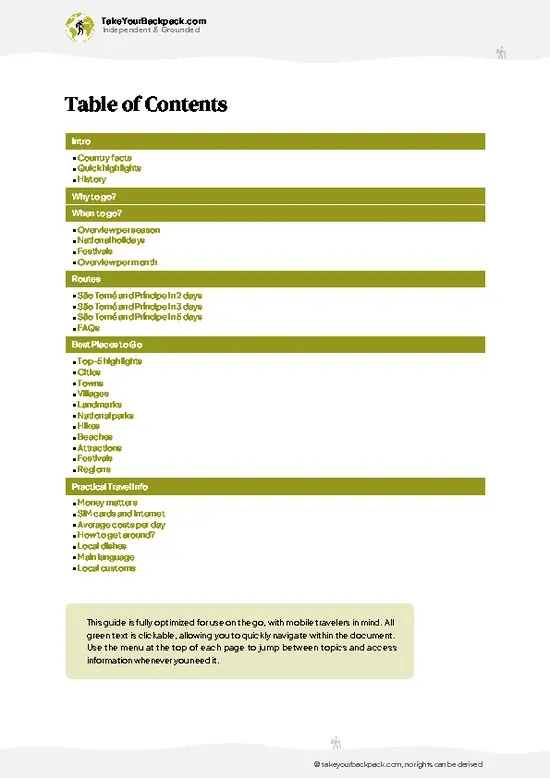
example page 2 from our offline Travel Guide for São Tomé and Príncipe
example page 3 from our offline Travel Guide for São Tomé and Príncipe
example page 4 from our offline Travel Guide for São Tomé and Príncipe
example page 5 from our offline Travel Guide for São Tomé and Príncipe
example page 6 from our offline Travel Guide for São Tomé and Príncipe
example page 7 from our offline Travel Guide for São Tomé and Príncipe
Loading the map 🌍
CLICK TO FILTER
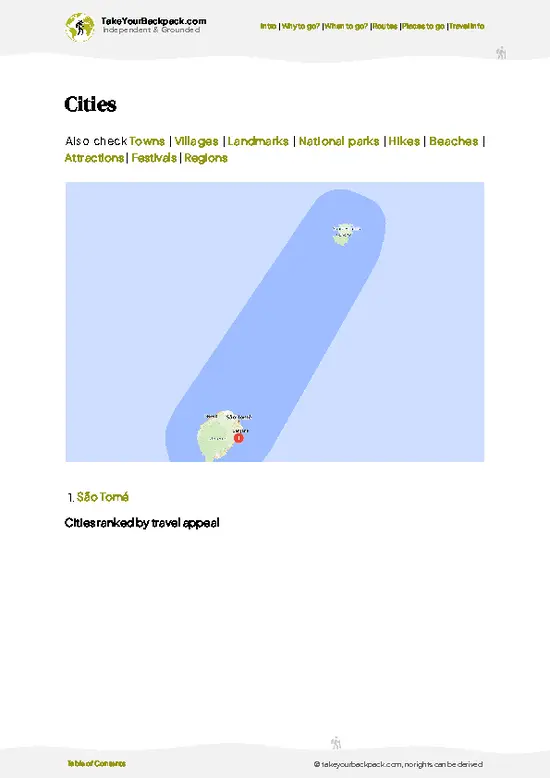
cities
towns
villages
landmarks
national parks
hikes
beaches
attractions
festivals
regions
SHOW COUNTRY’S BESTSHOW ALL

✨ Why go?
Ranked #1 national park in São Tomé and Príncipe
What makes this national park worth exploring

Obô Natural Park rewards backpackers who like to piece a trip together themselves, because the forest sits on the island’s only real interior road network and the trailheads are reachable by local transport and chartered taxis. You skip the tour-bus layer entirely. Instead you hire a village guide, usually from Bom Sucesso, the park’s main gateway, and set your own pace. That matters here, since the best walks are long, muddy and weather-dependent, and a fixed itinerary would waste the clear mornings.

The other draw is the sheer ecological payload packed into a small island. Obô shelters species found nowhere else, including the São Tomé grosbeak and the dwarf olive ibis, and its upper slopes hold cloud forest that looks nothing like the coconut-lined coast. The mix of terrain gives you options: … read more 👉
Obô Natural Park rewards backpackers who like to piece a trip together themselves, because the forest sits on the island’s only real interior road network and the trailheads are reachable by local transport and chartered taxis. You skip the tour-bus layer entirely. Instead you hire a village guide, usually from Bom Sucesso, the park’s main gateway, and set your own pace. That matters here, since the best walks are long, muddy and weather-dependent, and a fixed itinerary would waste the clear mornings.

The other draw is the sheer ecological payload packed into a small island. Obô shelters species found nowhere else, including the São Tomé grosbeak and the dwarf olive ibis, and its upper slopes hold cloud forest that looks nothing like the coconut-lined coast. The mix of terrain gives you options: an easy loop through gardens and secondary forest for a gentle first day, or a steep push toward the 2,024 m summit of Pico de São Tomé when your legs are ready. Few places let you step from beach to cloud forest within a single day.

💡 HighlightsEssential experiences to have while exploring Obô Natural Park

  1. Pico Cão Grande: The “Great Dog Peak” is the image everyone associates with São Tomé, a bare volcanic plug that rises roughly 370 m above the surrounding jungle. It is a hardened magma core left after the rest of the volcano eroded away. Seen from the road or from clearings in the forest, it dominates the horizon, and the best light comes early before cloud builds on its flanks.
  2. Pico de São Tomé: The island’s highest point at 2,024 m is a serious, guided climb through rising forest zones, from dense lowland growth to mossy, stunted trees. Reaching the top on a clear morning gives a view over the whole island and out to sea, though cloud often wins.
  3. Lagoa Amélia: A crater lake high in the park, ringed by thick forest and quiet except for birds and frogs. It makes a good goal for a long day hike,
… read more 👉
  1. Pico Cão Grande: The “Great Dog Peak” is the image everyone associates with São Tomé, a bare volcanic plug that rises roughly 370 m above the surrounding jungle. It is a hardened magma core left after the rest of the volcano eroded away. Seen from the road or from clearings in the forest, it dominates the horizon, and the best light comes early before cloud builds on its flanks.
  2. Pico de São Tomé: The island’s highest point at 2,024 m is a serious, guided climb through rising forest zones, from dense lowland growth to mossy, stunted trees. Reaching the top on a clear morning gives a view over the whole island and out to sea, though cloud often wins.
  3. Lagoa Amélia: A crater lake high in the park, ringed by thick forest and quiet except for birds and frogs. It makes a good goal for a long day hike, or a camp for those heading on toward the summit.
  4. Bom Sucesso Botanical Garden: The park’s information base and gentlest introduction, with labeled tropical plants, a small visitor center and easy shaded paths. Cool air and birdsong greet you here, and it is the place to arrange a guide. A small entry fee of roughly €3 to 5 applies.
  5. Endemic birdwatching: Obô holds a handful of São Tomé’s endemic species, among them the São Tomé grosbeak, the São Tomé oriole and the elusive dwarf olive ibis. Early morning along forest trails is the productive window, and a guide who knows the calls will find birds you would walk right past.
  6. Upper cloud forest: Above about 1,400 m the trees shrink and drape themselves in moss, ferns and orchids, and the air turns noticeably cooler. Walking here feels like another island entirely, with fog drifting between trunks and a soft, spongy floor underfoot.
Obô Natural Park costs least at the roadside viewpoints for Pico Cão Grande, which are free to enjoy at any hour you can see the peak.
Spotted a mistake or missing something? Contact us.

Things to do near Obô Natural Park

Ratings based on Tripadvisor reviews. When you book through this link, you support our work at no extra cost to you.

🌤️ When to go?Best time to explore Obô Natural Park

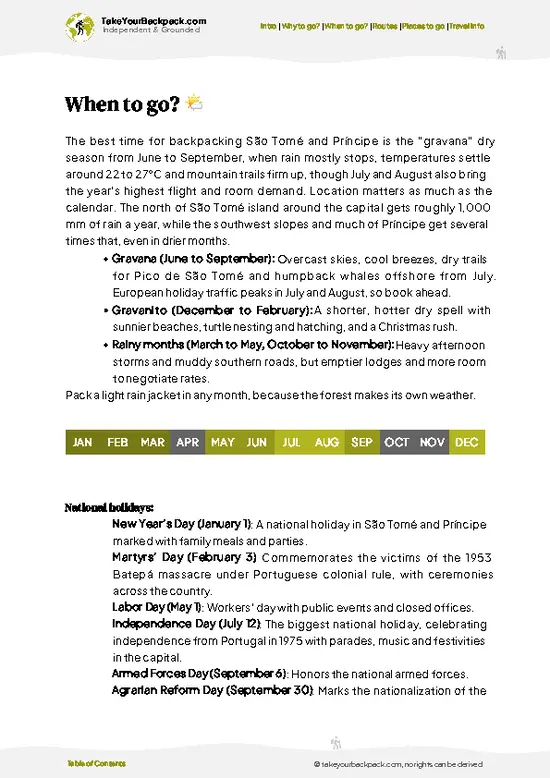
  • Gravana (dry season, June to September): Obô Natural Park is easiest to hike from June to September, when days run 24 to 28°C (75 to 82°F) at the coast and 18 to 23°C (64 to 73°F) in the forest interior. Trails are firmer, mist lifts by midmorning, and this is peak season for the few visitors who come.
  • Main Rainy Season (October to December): Expect heavy afternoon downpours, slick clay paths and leech-friendly mud. Temperatures stay near 23 to 29°C (73 to 84°F). Guides and lodges are quieter, and some rooms drop in price.
  • Short Dry Spell (January to February): Showers ease and the forest is still green. Daytime highs reach 29 to 30°C (84 to 86°F). This is a good window for birding and summit attempts.
  • Second Rainy Season (March to May): The wettest, most humid stretch, with rivers swollen and
… read more 👉
  • Gravana (dry season, June to September): Obô Natural Park is easiest to hike from June to September, when days run 24 to 28°C (75 to 82°F) at the coast and 18 to 23°C (64 to 73°F) in the forest interior. Trails are firmer, mist lifts by midmorning, and this is peak season for the few visitors who come.
  • Main Rainy Season (October to December): Expect heavy afternoon downpours, slick clay paths and leech-friendly mud. Temperatures stay near 23 to 29°C (73 to 84°F). Guides and lodges are quieter, and some rooms drop in price.
  • Short Dry Spell (January to February): Showers ease and the forest is still green. Daytime highs reach 29 to 30°C (84 to 86°F). This is a good window for birding and summit attempts.
  • Second Rainy Season (March to May): The wettest, most humid stretch, with rivers swollen and trails often muddy. Prices are lowest, but visibility on ridges is poor.
  • Daylight: Days stay close to 12 hours all year, so start walking by 7 am to finish before dark and the usual afternoon cloud.
Book your guide a few days ahead in June to September, since the small guide pool fills first.


source: climatestotravel.comJANJanuary: below average for travelingFEBFebruary: below average for travelingMARMarch: below average for travelingAPRApril: below average for travelingMAYMay: good for travelingJUNJune: excellent for travelingJULJuly: excellent for travelingAUGAugust: excellent for travelingSEPSeptember: excellent for travelingOCTOctober: good for travelingNOVNovember: below average for travelingDECDecember: below average for traveling
when-to-go

✈️ The backpacker research shortcutSão Tomé and Príncipe Travel Guide

An offline-friendly backpacking guide with optimized travel routes, ranked highlights, transport advice, and the best areas to stay.
example page 0 from our offline Travel Guide for São Tomé and Príncipe
example page 1 from our offline Travel Guide for São Tomé and Príncipe
example page 2 from our offline Travel Guide for São Tomé and Príncipe
example page 3 from our offline Travel Guide for São Tomé and Príncipe
example page 4 from our offline Travel Guide for São Tomé and Príncipe
example page 5 from our offline Travel Guide for São Tomé and Príncipe
example page 6 from our offline Travel Guide for São Tomé and Príncipe
example page 7 from our offline Travel Guide for São Tomé and Príncipe
The digital guide (151 pages) contains:
✅ 38 highlights, ranked by travel appeal
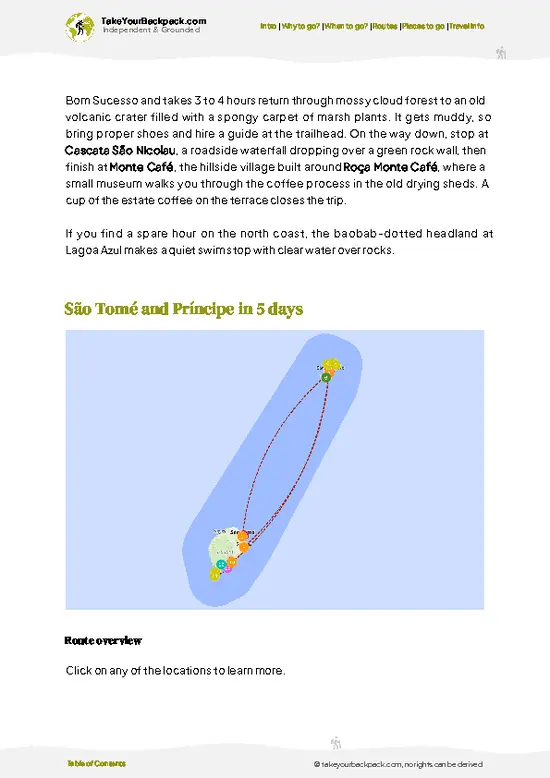
✅ Optimized 2, 3 & 5-day travel routes
✅ Cities, national parks, landmarks, beaches
✅ How to get around
✅ Offline-friendly for travel without Wi-Fi
👉 Click to see all 30+ guide features

📅 Plan smarter in minutes, not weeks
✅ Month by month travel advice
✅ Festivals & national holidays
✅ Budget expectations

🗺️ Go to the right places, skip the overrated ones
✅ Honest pros & cons of destinations
✅ Top hikes, parks & viewpoints
✅ Lesser-known places most travelers miss
✅ Clear “worth it vs skip it” guidance

🛏️ Travel smoothly without rookie mistakes
✅ Best areas to stay
✅ Transport systems explained simply
✅ Common scams & safety advice
✅ SIM cards, money & practical tips

🌍 Understand the country, not just visit it
✅ Culture & traditions
✅ 52 Essential phrases & customs
✅ Festivals worth planning around
✅ Traveler-friendly historical context
✅ Insights that make places more meaningful

📱 Built for real travel conditions
✅ Fully downloadable PDF
✅ Works completely offline
✅ Optimized for phone use
✅ Useful in remote areas & buses
✅ Everything in one place
Stop searching, start planning
Get instant access to your full guide. 30‑day money-back guarantee.
+ Add another guide for just

By proceeding you agree to our terms.
Sent to your inbox immediately after payment • 100% Secure Checkout
Best Backpacking Travel Advisor 2025 tourism awardBest Backpacking
Travel Advisor
2025
What others say about Take Your Backpack Guides:
⭐⭐⭐⭐⭐
Fantastic, amazing amount of information!
⭐⭐⭐⭐⭐
My goodness this is amazing, it's what I've been looking for hats off too you!
⭐⭐⭐⭐⭐
I think this is absolutely BRILLIANT
⭐⭐⭐⭐
Very complete and informative. It's still missing places, but I gotta to commend you
⭐⭐⭐⭐⭐
This is truly amazing, thank you, can't wait to explore it with my kids!
⭐⭐⭐⭐⭐
Awesome resource, thank you!
⭐⭐⭐⭐⭐
This is amazing! Can't wait to explore the ones I haven't seen
⭐⭐⭐⭐
I love this! Well done, great idea.
⭐⭐⭐⭐⭐
Thanks for taking the time to make this gem!
⭐⭐⭐⭐⭐
This might be the best website I've ever seen.
⭐⭐⭐⭐⭐
Congratulations, and thank you so much for your work; it's incredibly valuable.
⭐⭐⭐⭐
In all seriousness I think you did a great job pointing out the important spots
⭐⭐⭐⭐⭐
10/10 very good
⭐⭐⭐⭐⭐
As someone who's only just starting to visit regularly this is awesome, thank you.
⭐⭐⭐⭐
Thank you very much! I'm going to visit my dad, it's going to be very useful!
⭐⭐⭐⭐⭐
This is really cool! We'll be travelling for the first time and this definitely come in handy.
⭐⭐⭐⭐⭐
You are now our minister of culture, congratulations 👨‍💼
⭐⭐⭐⭐⭐
Just wanted to tell you that this is a pearl! Going to follow your recommendations.
⭐⭐⭐⭐⭐
This is so cool. I'll definitely be using the resource for my travels soon.
⭐⭐⭐⭐⭐
This is very impressive! Good work.
⭐⭐⭐⭐⭐
This is an amazing and informative site. Very well done!

🛏️ Where to stay?Choosing the right base

Most backpackers sleep in São Tomé city or in Bom Sucesso, since there are no lodges inside Obô Natural Park itself. Bom Sucesso sits at the park edge near the botanical garden, and it is the best base for an early start into the forest. Expect a handful of simple guesthouses and homestays there, with cold showers and spotty electricity. Ask the park office or a local guide to arrange a room.

São Tomé city, about 20 to 30 minutes by road from the Bom Sucesso area, has the widest choice. Budget guesthouses cost roughly €15 to 30 a night for a private room with fan. Mid-range hotels run about €45 … read more 👉
Most backpackers sleep in São Tomé city or in Bom Sucesso, since there are no lodges inside Obô Natural Park itself. Bom Sucesso sits at the park edge near the botanical garden, and it is the best base for an early start into the forest. Expect a handful of simple guesthouses and homestays there, with cold showers and spotty electricity. Ask the park office or a local guide to arrange a room.

São Tomé city, about 20 to 30 minutes by road from the Bom Sucesso area, has the widest choice. Budget guesthouses cost roughly €15 to 30 a night for a private room with fan. Mid-range hotels run about €45 to 90. Pensions near the waterfront and Praia Lagarto are handy for restaurants, taxis and bus connections.

Trindade, a small town on the main road east of the capital, is another option. It has a few cheap rooms and sits close to the trailheads that lead into the park from the east. Camping is possible with a guide on longer treks, but you must carry all food and water gear. A tent and a light sleeping bag are enough because nights stay warm.

I would stay in the capital for the first night to organize a guide and cash, then move to Bom Sucesso for the hike.

👛 Costs (as of 22 October 2026)How expensive it really is

A realistic budget for Obô Natural Park is about €2 to 5 per day, and the total daily budget works out to €88. Most of the cost is the guide and transport, since the park itself charges little. Travelers pay in dobras, but euros are often accepted in hotels.
CategoryBudget RangeLocal Reality
Entrance fee€2 to 5A small fee is collected at the botanical garden or park office, so carry cash.
Guide€15 to 30Needed for forest treks, and the price depends on route length and group size.
Accommodation (low season)€12 to 30Simple guesthouse or homestay rooms near Bom Sucesso or in the capital.
Accommodation (high season)€20 to 40Prices rise slightly from June to September and rooms need booking ahead.
Local transport€8 to 20Shared taxis, motorbike taxis or a private driver from the capital, where prices
… read more 👉
A realistic budget for Obô Natural Park is about €2 to 5 per day, and the total daily budget works out to €88. Most of the cost is the guide and transport, since the park itself charges little. Travelers pay in dobras, but euros are often accepted in hotels.
CategoryBudget RangeLocal Reality
Entrance fee€2 to 5A small fee is collected at the botanical garden or park office, so carry cash.
Guide€15 to 30Needed for forest treks, and the price depends on route length and group size.
Accommodation (low season)€12 to 30Simple guesthouse or homestay rooms near Bom Sucesso or in the capital.
Accommodation (high season)€20 to 40Prices rise slightly from June to September and rooms need booking ahead.
Local transport€8 to 20Shared taxis, motorbike taxis or a private driver from the capital, where prices are negotiated.
Food and supplies€8 to 15Grilled fish, rice and fruit at local eateries, plus a packed lunch for the trail.
Total Daily Budget€63 to 95About €88 a day in high season.
⚠️ Prices can change and everyone travels differently, so take this as a rough guide. Hope it helps you plan your adventure!

🥾 TrailsScenic routes and wildlife spotting in Obô Natural Park

Obô Natural Park is walking country, and nearly every trail climbs through wet, slippery forest, so expect mud, roots and fast-changing weather. Guides from Bom Sucesso know the unmarked junctions, and most routes are not reliably signed. Here are the main options.
  • Botanical Garden loop: Short and easy, with gentle paths and clear labeling, about one hour of relaxed walking. Good for acclimatizing and for spotting small birds near the visitor center.
  • Lagoa Amélia trail: Moderate to hard, a climb of several hours each way through primary forest with steady ascent and muddy stretches. The reward is
… read more 👉
Obô Natural Park is walking country, and nearly every trail climbs through wet, slippery forest, so expect mud, roots and fast-changing weather. Guides from Bom Sucesso know the unmarked junctions, and most routes are not reliably signed. Here are the main options.
  • Botanical Garden loop: Short and easy, with gentle paths and clear labeling, about one hour of relaxed walking. Good for acclimatizing and for spotting small birds near the visitor center.
  • Lagoa Amélia trail: Moderate to hard, a climb of several hours each way through primary forest with steady ascent and muddy stretches. The reward is the crater lake and a real sense of isolation. Allow a full day with a guide.
  • Pico de São Tomé ascent: Hard. Most trekkers split it over two days with a night camped high on the mountain, since the final sections are steep and the weather turns quickly. Bring waterproofs, warm layers for the cold summit zone and sturdy boots with real grip.
  • Pico Cão Grande viewpoints: Easy. Short walks and roadside stops for the needle itself, best in the morning. The peak is not a casual climb and is not open to ordinary visitors.
Wildlife is the quiet highlight. Endemic birds call all day, giant snails cross the paths after rain, and colorful frogs and lizards hide in the leaf litter. Mammals are few, mostly monkeys and small forest creatures, so go for the birds and the plants.

Getting there is straightforward but not slick. Shared taxis and minibuses run from the capital toward Bom Sucesso, and the final stretch is often covered by chartered taxi or on foot. Obô is rarely crowded, and you may share a trail with no one else for hours. A park fee and guide charge apply, typically totaling roughly €20 to 50 per person depending on the route, and you pay in local currency. Go in the drier months for firmer ground, and start early because afternoon cloud and rain are common.
⚠️ Hiking info can sometimes be outdated or inaccurate. Before you hit the trail, check the latest conditions with locals. If you do spot anything that's off, I'd love to hear from you, so I can update it for fellow travelers.

🛡️ SafetyTraveler Safety Guide

Obô Natural Park is a safe place to hike, and the real challenges are mud, humidity and getting lost. Trails in the primary forest are steep and often unmarked, with roots and wet clay that make descents slippery. Hire a local guide for anything beyond the short botanical garden paths. They know the routes and the weather, and they cost little compared with a wrong turn in dense forest.

Rain can arrive within minutes even in the dry season, so carry a light waterproof, wear shoes with real grip and keep your phone in a dry bag. Streams swell fast after storms, so wait rather than force a crossing. Walk early, because afternoon cloud blurs ridge views and trail junctions.

Wildlife is not a danger. There are no large predators, and the snakes here are rarely seen. Insects, leeches and sun … read more 👉
Obô Natural Park is a safe place to hike, and the real challenges are mud, humidity and getting lost. Trails in the primary forest are steep and often unmarked, with roots and wet clay that make descents slippery. Hire a local guide for anything beyond the short botanical garden paths. They know the routes and the weather, and they cost little compared with a wrong turn in dense forest.

Rain can arrive within minutes even in the dry season, so carry a light waterproof, wear shoes with real grip and keep your phone in a dry bag. Streams swell fast after storms, so wait rather than force a crossing. Walk early, because afternoon cloud blurs ridge views and trail junctions.

Wildlife is not a danger. There are no large predators, and the snakes here are rarely seen. Insects, leeches and sun are the bigger nuisance, so bring repellent and long, quick-drying trousers. Carry at least 2 liters of water and a basic first-aid kit. Mobile signal fades inside the forest, so tell your guesthouse your route and return time.

FAQTraveler FAQ

Plan on one full day for Obô Natural Park if you stick to the botanical garden and lower forest trails, and two to three days if you want the longer treks toward the high ridges. Most walks start early and last 4 to 8 hours. A base in Bom Sucesso or São Tomé city lets you add a second day easily.
Yes, Obô Natural Park can be reached without a car, though you will rely on taxis. From São Tomé city, shared taxis and motorbike taxis reach Bom Sucesso in roughly 20 to 40 minutes for about €2 to 10, depending on how you bargain. A hired driver for the day costs about €30 to 50 and can collect you after a trek.
Obô Natural Park charges a small fee of about €2 to 5, usually paid in cash at the park office or botanical garden near Bom Sucesso. A separate permit is not usually required for day hikes, but a local guide is strongly advised for forest routes and costs about €15 to 30 per day. Arrange this through your guesthouse or the park office a day ahead.
⚠️ Things can change over time, so always validate details locally before you go.

Expanding your trip beyond this stop

Obô Natural Park isn’t the only highlight in São Tomé and Príncipe. Explore all what São Tomé and Príncipe has to offer.
Country photo of São Tomé and Príncipe

We 💚 feedbackWhat to keep in mind

Obô Natural Park deserves two nights, not a single hurried morning. Spend the first day on the garden paths and the Lagoa Amélia trail, then keep the second for the summit or the Pico Cão Grande viewpoints, whichever the weather allows. I would book the guide the evening before and pack a real rain jacket. Mud is guaranteed, and so is a bird you cannot name.

✍️ Help improve this page!
The information on this page is based on in-depth research, insights shared by experienced travelers, and feedback from the local travel community in São Tomé and Príncipe. While every effort is made to keep the information accurate and current, conditions can change — so if you spot anything incorrect or outdated, please get in touch.


🙋‍♂️ Give feedback

👋 Meet the founderWho’s Behind Take Your Backpack?

Johan, backpacker and founder of TakeYourBackpackHi, I’m Johan (Netherlands 🇳🇱), the creator of TakeYourBackpack. Over the past 3 decades, I’ve backpacked through 90+ countries across six continents, gaining extensive experience with independent travel, long-term trips, and overland routes.

This site is built on a combination of firsthand travel experience and carefully curated insights from other backpackers. Many guides are based on places I’ve personally visited, while others bring together tips, observations, and practical advice shared by trusted travelers I’ve met along the way.

The goal is to provide realistic, experience-driven guidance — not generic itineraries — so you can explore destinations with better context, clearer expectations, and more confidence.