×

Senegal🇸🇳 | national parksDjoudj National Bird SanctuaryPelican colony, Gorom channel, winter migrants, flamingo flats | things to do and best time to go

Explore Basse Casamance National ParkExplore Fathala Wildlife Reserve

Backpacking in Djoudj National Bird Sanctuary
UNESCO World Heritage site
🏆 Top picknational park ranked #2
By Johan Kruseman 🇳🇱 | Updated October 22, 2026

Djoudj sits on the Senegal River delta and holds more than a million migratory birds in a good winter, yet it has no public transport inside the park and no real village shop, so you arrive carrying your own water and snacks. The sanctuary lies in the north of Senegal, a short drive north of Saint-Louis, right against the Mauritanian border. Here is how it works: the park is a maze of marshes, channels and flat acacia scrub, so you see it by boat and by sandy track, not on long trails. Hire a guide at the gate, because they know which backwater holds the pelicans that day. The upside is real. White pelicans cover the shallows in thousands, the air smells of wet reeds and fish, and the din of wings and grunts carries for a kilometer. The downside is heat, dust and flies, plus a rutted approach road that rattles bones. Crowds stay thin. A first day could start with a dawn boat run through the channels, then a hot noon rest in shade, then a slow late-afternoon drive past warthogs and wading flocks.

Discover everything you want to know in the 📖 Senegal Travel Guide.


example page 0 from our offline Travel Guide for Senegal
example page 1 from our offline Travel Guide for Senegal
example page 2 from our offline Travel Guide for Senegal
example page 3 from our offline Travel Guide for Senegal
example page 4 from our offline Travel Guide for Senegal
example page 5 from our offline Travel Guide for Senegal
example page 6 from our offline Travel Guide for Senegal
example page 7 from our offline Travel Guide for Senegal
Loading the map 🌍
CLICK TO FILTER
cities
towns
villages
landmarks
national parks
beaches
attractions
festivals
regions
SHOW COUNTRY’S BESTSHOW ALL

✨ Why go?
Ranked #2 national park in Senegal
Why Djoudj National Bird Sanctuary should be on your travel list

Djoudj National Bird Sanctuary suits backpackers who like to arrange things themselves, because the cheapest way in is a shared ride from Saint-Louis plus a guide hired on the spot, with no tour package needed. The reason to bother is scale. The park is a UNESCO World Heritage site, and the winter arrivals include great white pelicans in colonies that can run to tens of thousands, plus flamingos, spoonbills and ruffs that have flown in from Europe. You can watch all of it from a small pirogue drifting along the Djoudj and Gorom channels, close enough to hear the pelicans clack their bills. Trails are short and flat, so this is not a trekking destination. It is a place to go slowly, sit still and let the birds come to you. The simple campement lodging near the gate keeps costs modest and puts … read more 👉
Djoudj National Bird Sanctuary suits backpackers who like to arrange things themselves, because the cheapest way in is a shared ride from Saint-Louis plus a guide hired on the spot, with no tour package needed. The reason to bother is scale. The park is a UNESCO World Heritage site, and the winter arrivals include great white pelicans in colonies that can run to tens of thousands, plus flamingos, spoonbills and ruffs that have flown in from Europe. You can watch all of it from a small pirogue drifting along the Djoudj and Gorom channels, close enough to hear the pelicans clack their bills. Trails are short and flat, so this is not a trekking destination. It is a place to go slowly, sit still and let the birds come to you. The simple campement lodging near the gate keeps costs modest and puts you on the water early, when the light is soft and the wind has not yet stirred up dust. Bring binoculars, a hat and patience, and you will leave with a longer bird list than most safaris deliver.

💡 HighlightsKey sights and experiences for travelers

  1. Great white pelican colony: The park’s signature sight, and the reason it was protected. Thousands nest and fish in the shallows, and a boat can drift within a respectful distance of the crowded sandbanks.
  2. Pirogue trip on the Gorom channel: A guided paddle or motor ride through reed-lined water, the best way to see herons, cormorants, African darters and kingfishers up close in quiet.
  3. Flamingo flats: Greater and lesser flamingos wade in shallow pools, and the pink mass of birds lifting off together makes a loud, rushing sound.
  4. Palearctic migrant flocks: Ruffs, garganey, pintails and northern shovelers arrive from Europe in winter, so you may recognize species from home among the African residents.
  5. Warthogs, jackals and patas monkeys: The dry scrub between wetlands shelters these mammals, and the
… read more 👉
  1. Great white pelican colony: The park’s signature sight, and the reason it was protected. Thousands nest and fish in the shallows, and a boat can drift within a respectful distance of the crowded sandbanks.
  2. Pirogue trip on the Gorom channel: A guided paddle or motor ride through reed-lined water, the best way to see herons, cormorants, African darters and kingfishers up close in quiet.
  3. Flamingo flats: Greater and lesser flamingos wade in shallow pools, and the pink mass of birds lifting off together makes a loud, rushing sound.
  4. Palearctic migrant flocks: Ruffs, garganey, pintails and northern shovelers arrive from Europe in winter, so you may recognize species from home among the African residents.
  5. Warthogs, jackals and patas monkeys: The dry scrub between wetlands shelters these mammals, and the fast, long-legged patas monkey is often spotted crossing the tracks.
  6. Lac du Lamantin area: Quiet waters where a few West African manatees and crocodiles are reported, and a good spot for sitting still and scanning with binoculars.
  7. Acacia woodland birding: The dry drive between the main wetlands passes thorny trees full of hornbills, bee-eaters and the occasional raptor perched on a bare branch.
  8. Visitor center and observation points: Simple lookouts and a small display near the entrance help you identify species before heading out on the water.
Djoudj National Bird Sanctuary charges an entrance fee at the gate, and the boat trip with its guide is arranged on arrival, though booking through your campement the day before saves waiting when the winter crowds peak.
Spotted a mistake or missing something? Contact us.

🌤️ When to go?Seasonal considerations and timing

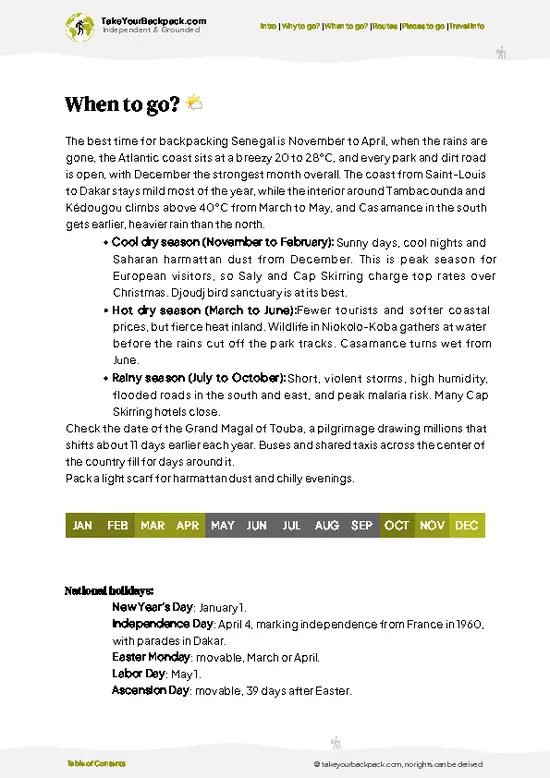
  • Peak Birding, November to February: Water levels in the Senegal River delta are high and pelicans, flamingos, spoonbills and thousands of migrant ducks crowd the channels. Days run 28 to 33°C (82 to 91°F), nights drop to 15 to 18°C (59 to 64°F). Daylight lasts roughly 11 to 12 hours. Expect the highest lodge rates and the most visitors, though crowds stay small by any standard.
  • Hot Dry Months, March to May: Many migrants leave. Afternoons climb to 35 to 42°C (95 to 108°F) with dusty harmattan haze, so boat trips are best at first light. Rooms are easier to book and cheaper.
  • Rainy Season, July to October: Heat and humidity peak at 33 to 38°C (91 to 100°F), tracks turn muddy, and most birds are gone. Some camps close or discount heavily.
  • Resident Birds, June: Local breeders remain, but sightings
… read more 👉
  • Peak Birding, November to February: Water levels in the Senegal River delta are high and pelicans, flamingos, spoonbills and thousands of migrant ducks crowd the channels. Days run 28 to 33°C (82 to 91°F), nights drop to 15 to 18°C (59 to 64°F). Daylight lasts roughly 11 to 12 hours. Expect the highest lodge rates and the most visitors, though crowds stay small by any standard.
  • Hot Dry Months, March to May: Many migrants leave. Afternoons climb to 35 to 42°C (95 to 108°F) with dusty harmattan haze, so boat trips are best at first light. Rooms are easier to book and cheaper.
  • Rainy Season, July to October: Heat and humidity peak at 33 to 38°C (91 to 100°F), tracks turn muddy, and most birds are gone. Some camps close or discount heavily.
  • Resident Birds, June: Local breeders remain, but sightings are thin.
Arrive in December or January and book a dawn pirogue the evening before, when boat crews are easiest to arrange.


source: climatestotravel.comJANJanuary: excellent for travelingFEBFebruary: excellent for travelingMARMarch: excellent for travelingAPRApril: highly recommended for travelingMAYMay: highly recommended for travelingJUNJune: fair for travelingJULJuly: fair for travelingAUGAugust: fair for travelingSEPSeptember: fair for travelingOCTOctober: fair for travelingNOVNovember: excellent for travelingDECDecember: excellent for traveling
when-to-go

✈️ The backpacker research shortcutSenegal Travel Guide

An offline-friendly backpacking guide with optimized travel routes, ranked highlights, transport advice, and the best areas to stay.
example page 0 from our offline Travel Guide for Senegal
example page 1 from our offline Travel Guide for Senegal
example page 2 from our offline Travel Guide for Senegal
example page 3 from our offline Travel Guide for Senegal
example page 4 from our offline Travel Guide for Senegal
example page 5 from our offline Travel Guide for Senegal
example page 6 from our offline Travel Guide for Senegal
example page 7 from our offline Travel Guide for Senegal
The digital guide (360 pages) contains:
✅ 85 highlights, ranked by travel appeal
✅ Optimized 5, 10 & 15-day travel routes
✅ Cities, national parks, landmarks, beaches
✅ How to get around
✅ Offline-friendly for travel without Wi-Fi
👉 Click to see all 30+ guide features

📅 Plan smarter in minutes, not weeks
✅ Month by month travel advice
✅ Festivals & national holidays
✅ Budget expectations

🗺️ Go to the right places, skip the overrated ones
✅ Honest pros & cons of destinations
✅ Top hikes, parks & viewpoints
✅ Lesser-known places most travelers miss
✅ Clear “worth it vs skip it” guidance

🛏️ Travel smoothly without rookie mistakes
✅ Best areas to stay
✅ Transport systems explained simply
✅ Common scams & safety advice
✅ SIM cards, money & practical tips

🌍 Understand the country, not just visit it
✅ Culture & traditions
✅ 52 Essential phrases & customs
✅ Festivals worth planning around
✅ Traveler-friendly historical context
✅ Insights that make places more meaningful

📱 Built for real travel conditions
✅ Fully downloadable PDF
✅ Works completely offline
✅ Optimized for phone use
✅ Useful in remote areas & buses
✅ Everything in one place
Stop searching, start planning
Get instant access to your full guide. 30‑day money-back guarantee.
+ Add another guide for just

By proceeding you agree to our terms.
Sent to your inbox immediately after payment • 100% Secure Checkout
Best Backpacking Travel Advisor 2025 tourism awardBest Backpacking
Travel Advisor
2025
What others say about Take Your Backpack Guides:
⭐⭐⭐⭐⭐
Fantastic, amazing amount of information!
⭐⭐⭐⭐⭐
My goodness this is amazing, it's what I've been looking for hats off too you!
⭐⭐⭐⭐⭐
I think this is absolutely BRILLIANT
⭐⭐⭐⭐
Very complete and informative. It's still missing places, but I gotta to commend you
⭐⭐⭐⭐⭐
This is truly amazing, thank you, can't wait to explore it with my kids!
⭐⭐⭐⭐⭐
Awesome resource, thank you!
⭐⭐⭐⭐⭐
This is amazing! Can't wait to explore the ones I haven't seen
⭐⭐⭐⭐
I love this! Well done, great idea.
⭐⭐⭐⭐⭐
Thanks for taking the time to make this gem!
⭐⭐⭐⭐⭐
This might be the best website I've ever seen.
⭐⭐⭐⭐⭐
Congratulations, and thank you so much for your work; it's incredibly valuable.
⭐⭐⭐⭐
In all seriousness I think you did a great job pointing out the important spots
⭐⭐⭐⭐⭐
10/10 very good
⭐⭐⭐⭐⭐
As someone who's only just starting to visit regularly this is awesome, thank you.
⭐⭐⭐⭐
Thank you very much! I'm going to visit my dad, it's going to be very useful!
⭐⭐⭐⭐⭐
This is really cool! We'll be travelling for the first time and this definitely come in handy.
⭐⭐⭐⭐⭐
You are now our minister of culture, congratulations 👨‍💼
⭐⭐⭐⭐⭐
Just wanted to tell you that this is a pearl! Going to follow your recommendations.
⭐⭐⭐⭐⭐
This is so cool. I'll definitely be using the resource for my travels soon.
⭐⭐⭐⭐⭐
This is very impressive! Good work.
⭐⭐⭐⭐⭐
This is an amazing and informative site. Very well done!

🛏️ Where to stay?Best areas to stay in Senegal

The most practical base inside the sanctuary is Le Djoudj Hotel Dioudj area lodge, Campement du Djoudj, which sits near the park gate and offers simple air-conditioned or fan rooms from about €30 to 50 plus bungalows, a restaurant and boat departures at dawn. Beds here put you at the water before the day-trippers arrive, which matters because birds are most active early.

Outside the gate, the Djoudj Hotel option is limited, and most backpackers use Saint-Louis, roughly 60 to 70 km south, as the real hub. The island old town has guesthouses and hostels with dorm beds from about €8 to 15 and private … read more 👉
The most practical base inside the sanctuary is Le Djoudj Hotel Dioudj area lodge, Campement du Djoudj, which sits near the park gate and offers simple air-conditioned or fan rooms from about €30 to 50 plus bungalows, a restaurant and boat departures at dawn. Beds here put you at the water before the day-trippers arrive, which matters because birds are most active early.

Outside the gate, the Djoudj Hotel option is limited, and most backpackers use Saint-Louis, roughly 60 to 70 km south, as the real hub. The island old town has guesthouses and hostels with dorm beds from about €8 to 15 and private rooms from €20 to 45, plus restaurants, ATMs and shared taxis. The drive to the park takes around 1.5 to 2 hours on a mostly paved road, then a stretch of dirt track.

The small riverside town of Rosso-Sénégal and village of Debi offer very basic rooms, but they are less convenient. Camping is possible near the park lodge if you carry your own gear and ask permission. Book ahead from December to February, since rooms near the gate are few.

👛 Costs (as of 22 October 2026)Typical daily expenses

A realistic budget for Djoudj National Bird Sanctuary is about €62 a day, including a night at the park lodge, entry, a boat trip and transport. Prices are paid in CFA francs, and cash is needed because there are no ATMs near the gate.
CategoryBudget RangeLocal Reality
Entrance fee€4 to 8Charged per person, with a separate vehicle fee; foreign rates are higher than for residents.
Accommodation, high season€30 to 50Simple lodge room near the gate from November to February; dorm beds in Saint-Louis are €8 to 15.
Accommodation, low season€20 to 35Discounts are common from June to October, and some camps close.
Boat trip€8 to 20Pirogue with guide, priced per boat and shared among passengers; a dawn departure is best.
Transport€10 to 25Shared taxi or minibus to the Djoudj turnoff, then a private ride
… read more 👉
A realistic budget for Djoudj National Bird Sanctuary is about €62 a day, including a night at the park lodge, entry, a boat trip and transport. Prices are paid in CFA francs, and cash is needed because there are no ATMs near the gate.
CategoryBudget RangeLocal Reality
Entrance fee€4 to 8Charged per person, with a separate vehicle fee; foreign rates are higher than for residents.
Accommodation, high season€30 to 50Simple lodge room near the gate from November to February; dorm beds in Saint-Louis are €8 to 15.
Accommodation, low season€20 to 35Discounts are common from June to October, and some camps close.
Boat trip€8 to 20Pirogue with guide, priced per boat and shared among passengers; a dawn departure is best.
Transport€10 to 25Shared taxi or minibus to the Djoudj turnoff, then a private ride or hired car; a day return from Saint-Louis costs about €45 to 70 per vehicle.
Food and supplies€6 to 12Lodge meals of fish or chicken with rice cost €5 to 10; bring snacks and water.
Total Daily Budget€62Based on high season lodge stay with a shared boat and ride.
⚠️ Prices can change and everyone travels differently, so take this as a rough guide. Hope it helps you plan your adventure!

🥾 TrailsScenic routes and wildlife spotting in Djoudj National Bird Sanctuary

Djoudj National Bird Sanctuary is a flat wetland, so hiking here means short, easy walks and sandy tracks, not climbs. Most of your time goes to boat trips and slow drives, with short walks at lookouts. The terrain is dust, dried mud, reeds and thorny scrub, and the sun is fierce from mid-morning onward.
  • Gorom Channel boat circuit: Roughly 2 to 3 hours by pirogue or small motorboat. Easy and seated. Highlights are pelican colonies, herons, cormorants and the odd crocodile along reedy banks.
  • Pelican colony viewpoint walk: A short, level walk of about 1 to 2 kilometers, taking around 45 minutes with
… read more 👉
Djoudj National Bird Sanctuary is a flat wetland, so hiking here means short, easy walks and sandy tracks, not climbs. Most of your time goes to boat trips and slow drives, with short walks at lookouts. The terrain is dust, dried mud, reeds and thorny scrub, and the sun is fierce from mid-morning onward.
  • Gorom Channel boat circuit: Roughly 2 to 3 hours by pirogue or small motorboat. Easy and seated. Highlights are pelican colonies, herons, cormorants and the odd crocodile along reedy banks.
  • Pelican colony viewpoint walk: A short, level walk of about 1 to 2 kilometers, taking around 45 minutes with stops. Easy. It follows a sandy path to a lookout over the main nesting area.
  • Scrub track drive and walk: A half-day loop of about 3 to 4 hours by vehicle, with short walks. Easy to moderate because of heat. It passes acacia woodland, warthogs and patas monkeys.
  • Dawn bird walk near the gate: About 1 to 2 hours, easy. Cool air, active songbirds and soft light make this the best short walk for beginners.
The park is reached by a road from Saint-Louis, with a final stretch of rough track. Public transport stops at nearby villages, so most backpackers share a hired car or taxi, or ride a motorbike if confident on sand. There is no regular shuttle inside the park. An entrance fee applies, with guides and boats paid separately, and you pay in local currency in cash. Crowds are small even in peak winter, mostly small tour groups and a few birdwatchers, so the quiet is part of the experience. Wear a hat, long sleeves against the sun and insects, and bring plenty of water, since supplies inside are limited.
⚠️ Hiking info can sometimes be outdated or inaccurate. Before you hit the trail, check the latest conditions with locals. If you do spot anything that's off, I'd love to hear from you, so I can update it for fellow travelers.

🛡️ SafetyScams, Hazards, and Annoyances

Djoudj is a flat, well-run reserve, and the main issues are heat, sun and getting there rather than anything dramatic. Midday temperatures often pass 35°C (95°F) from March onward, so carry at least 3 liters of water per person, wear a hat and long light sleeves, and plan activity for early morning and late afternoon. Tracks inside are sandy or muddy and can be slow after rain, so a driver familiar with the route matters more than navigation skills.

Boat trips run on shallow channels with guides, and life jackets are provided. Warthogs, jackals and a few crocodiles live here, but encounters are uneventful if you keep your distance, stay on paths and never approach nesting colonies. Mosquitoes are active at dusk, so bring repellent and consider malaria prophylaxis. Phone coverage is patchy, … read more 👉
Djoudj is a flat, well-run reserve, and the main issues are heat, sun and getting there rather than anything dramatic. Midday temperatures often pass 35°C (95°F) from March onward, so carry at least 3 liters of water per person, wear a hat and long light sleeves, and plan activity for early morning and late afternoon. Tracks inside are sandy or muddy and can be slow after rain, so a driver familiar with the route matters more than navigation skills.

Boat trips run on shallow channels with guides, and life jackets are provided. Warthogs, jackals and a few crocodiles live here, but encounters are uneventful if you keep your distance, stay on paths and never approach nesting colonies. Mosquitoes are active at dusk, so bring repellent and consider malaria prophylaxis. Phone coverage is patchy, and fuel and cash are not available at the lodge, so fill up and withdraw in Saint-Louis first.

FAQFrequently asked questions about Djoudj National Bird Sanctuary

Plan on 1 to 2 days at Djoudj National Bird Sanctuary. A single morning boat trip covers the main pelican colonies, but staying one night near the gate lets you do a dawn pirogue ride and a second, quieter outing on the tracks. Most visitors base themselves in Saint-Louis, about 1.5 to 2 hours away.
Reaching Djoudj National Bird Sanctuary without your own car is possible but takes planning. From Saint-Louis you can take a shared taxi toward Ross Béthio, then hire a local driver for the last 20 to 30 km of track, or book a guided day tour from about €45 to 70 per vehicle. Public transport does not run to the gate, so arrange the return ride in advance.
Yes, Djoudj National Bird Sanctuary charges an entrance fee, roughly €4 to 8 per adult for foreign visitors, plus a small fee for vehicles and a guide or boat fee of about €8 to 20. No special permit is required beyond paying at the park gate. Bring cash in CFA francs, since cards are not accepted and the nearest ATMs are in Saint-Louis.
⚠️ Things can change over time, so always validate details locally before you go.

Other Senegalese national parks near Djoudj National Bird Sanctuary

Explore more nearby:


💡 Not sure where to go next?
Create a personalized itinerary for Senegal including Djoudj National Bird Sanctuary and the places that fit your trip.

Generate my itinerary

👉 Discover all national parks

Or checkout all Senegal has to offer (think cities, towns, villages, national parks, hikes, beaches, festivals)
Country photo of Senegal

We 💚 feedbackParting advice and final tips

Djoudj National Bird Sanctuary is at its best in the cool early hours of a winter morning, when pelicans lift off the water in waves and the heat has not yet turned the air heavy. I would book the first boat of the day, pack binoculars and a scarf for the dust, and skip the midday run entirely.

✍️ Help improve this page!
The information on this page is based on in-depth research, insights shared by experienced travelers, and feedback from the local travel community in Senegal. While every effort is made to keep the information accurate and current, conditions can change — so if you spot anything incorrect or outdated, please get in touch.


🙋‍♂️ Give feedback

👋 Meet the founderWho’s Behind Take Your Backpack?

Johan, backpacker and founder of TakeYourBackpackHi, I’m Johan (Netherlands 🇳🇱), the creator of TakeYourBackpack. Over the past 3 decades, I’ve backpacked through 90+ countries across six continents, gaining extensive experience with independent travel, long-term trips, and overland routes.

This site is built on a combination of firsthand travel experience and carefully curated insights from other backpackers. Many guides are based on places I’ve personally visited, while others bring together tips, observations, and practical advice shared by trusted travelers I’ve met along the way.

The goal is to provide realistic, experience-driven guidance — not generic itineraries — so you can explore destinations with better context, clearer expectations, and more confidence.