×

Senegal🇸🇳 | beachesNgor IslandPirogue crossing, car-free lanes, wall murals, sheltered cove | things to do and best time to go

Explore Lac RoseExplore Pointe Sarène

Backpacking in Ngor Island
🌟 Highlightbeach ranked #3
By Johan Kruseman 🇳🇱 | Updated October 22, 2026

Ngor Island has no cars, no paved roads and no hotel towers, and you reach it only by a pirogue ride from the mainland Ngor village beach. The island sits just off Dakar, Senegal’s capital, on the northwest tip of the peninsula. Sand lanes between low painted houses are soft underfoot, and you hear waves, roosters and the pirogue engines. The island beach on the sheltered side is clean, with calm, shallow water that suits easy swimming, and a few reef spots give modest snorkeling. Crowds thicken on weekends, when Dakar families arrive, and mid-week feels nearly empty. Surf is the mainland’s business, not the island’s. Food is simple: grilled fish and rice at small beachfront places, plus guesthouses with basic rooms. Sellers can be persistent and the sun is fierce. Spend a first day taking the morning boat, wandering the lanes past murals, swimming, then eating fish under a thatched roof before the last boat back.

Discover everything you want to know in the 📖 Senegal Travel Guide.


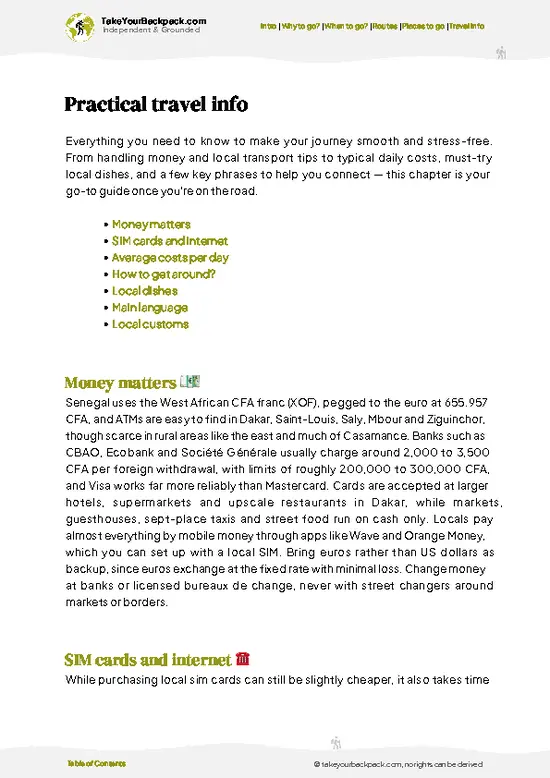
example page 0 from our offline Travel Guide for Senegal
example page 1 from our offline Travel Guide for Senegal
example page 2 from our offline Travel Guide for Senegal
example page 3 from our offline Travel Guide for Senegal
example page 4 from our offline Travel Guide for Senegal
example page 5 from our offline Travel Guide for Senegal
example page 6 from our offline Travel Guide for Senegal
example page 7 from our offline Travel Guide for Senegal
Loading the map 🌍
CLICK TO FILTER
cities
towns
villages
landmarks
national parks
beaches
attractions
festivals
regions
SHOW COUNTRY’S BESTSHOW ALL

✨ Why go?
Ranked #3 beach in Senegal
Why Ngor Island should be on your travel list

Ngor Island beach gives you a beach day with no traffic noise, which in Dakar is a rarity. The boat crossing takes a few minutes and runs all day, so you can stay for an hour or sleep over. The island’s car-free sand lanes and small guesthouses make an overnight feel like a different country from the mainland capital, with early mornings that belong to fishermen and a handful of residents. Reasons that matter most:
The atmosphere is relaxed and the scale is tiny, so you can walk the whole island in under an hour and find a spot that suits you. Cheap grilled fish lunches and simple rooms keep costs low compared with mainland beach resorts. The short pirogue hop from Ngor village also works as a pause between city sightseeing and the surf beaches along the peninsula, so you can fold it into a … read more 👉
Ngor Island beach gives you a beach day with no traffic noise, which in Dakar is a rarity. The boat crossing takes a few minutes and runs all day, so you can stay for an hour or sleep over. The island’s car-free sand lanes and small guesthouses make an overnight feel like a different country from the mainland capital, with early mornings that belong to fishermen and a handful of residents. Reasons that matter most:
The atmosphere is relaxed and the scale is tiny, so you can walk the whole island in under an hour and find a spot that suits you. Cheap grilled fish lunches and simple rooms keep costs low compared with mainland beach resorts. The short pirogue hop from Ngor village also works as a pause between city sightseeing and the surf beaches along the peninsula, so you can fold it into a Dakar stay without rearranging plans. Artists have painted walls and sell small works, which gives wandering a purpose beyond the sand.

💡 HighlightsThe experiences that define the visit

  1. The island beach: A pale sand strip on the sheltered side, with calm water that lets even nervous swimmers float. Pirogues sit at the shore and you can rent a sunbed or simply claim a patch of sand.
  2. The pirogue crossing from Ngor village: A short ride in a painted wooden boat, with a view back at the mainland coast and the cliffs. It is part of the experience, and you pay a small fare in cash.
  3. Snorkeling around the rocks: Rocky patches off the island hold small reef fish and urchins. Visibility varies, so bring your own mask and watch where you step.
  4. The sand lanes and murals: Walking the car-free lanes takes you past colorful house walls and small art stalls. Artists sell paintings and crafts, and you can bargain gently.
  5. Grilled fish at a beachfront table: Local cooks serve the day’s catch with
… read more 👉
  1. The island beach: A pale sand strip on the sheltered side, with calm water that lets even nervous swimmers float. Pirogues sit at the shore and you can rent a sunbed or simply claim a patch of sand.
  2. The pirogue crossing from Ngor village: A short ride in a painted wooden boat, with a view back at the mainland coast and the cliffs. It is part of the experience, and you pay a small fare in cash.
  3. Snorkeling around the rocks: Rocky patches off the island hold small reef fish and urchins. Visibility varies, so bring your own mask and watch where you step.
  4. The sand lanes and murals: Walking the car-free lanes takes you past colorful house walls and small art stalls. Artists sell paintings and crafts, and you can bargain gently.
  5. Grilled fish at a beachfront table: Local cooks serve the day’s catch with rice or fries, usually near the landing. Order early on weekends, because kitchens run out.
All of it fits comfortably into one relaxed day, with an overnight stay giving you slow evenings.
Spotted a mistake or missing something? Contact us.

Things to do around Ngor Island

Ratings based on Tripadvisor reviews. When you book through this link, you support our work at no extra cost to you.

🌤️ When to go?Weather, crowds, and seasonal trade-offs

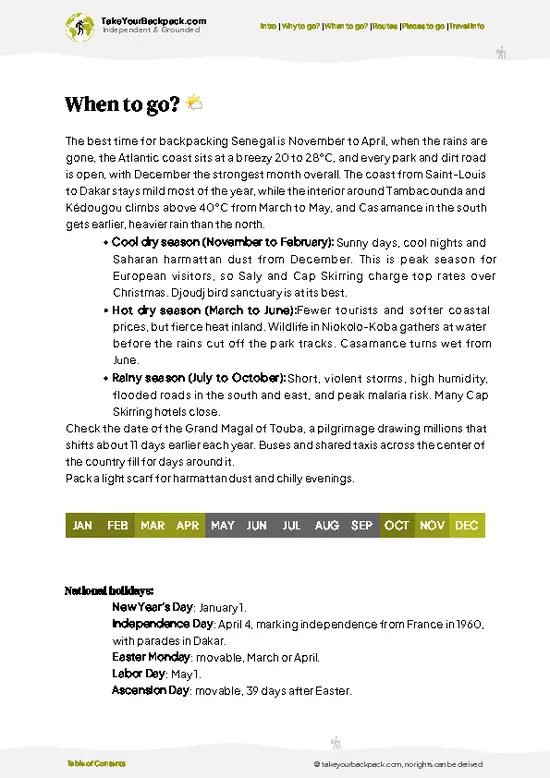
  • November to May: Dry and breezy, with Atlantic-cooled days around 24 to 29°C (75 to 84°F) and nights near 18 to 21°C (64 to 70°F). Ngor Island beach is at its easiest for swimming, and the pirogue crossing is calm most mornings.
  • December to February: Coolest stretch, with a dusty Harmattan haze some days and water that feels bracing. Prices for rooms in Ngor village rise a little around Christmas and New Year.
  • June to October: Hot, humid and rainy, with highs of 30 to 33°C (86 to 91°F) and the heaviest downpours in August and September. Crowds thin out and rooms can drop by 20 to 30 percent, but storms occasionally cancel crossings.
  • Weekends and holidays: Day-trippers from Dakar fill the sand on Sundays, so weekdays give you space.
  • Daylight: Roughly 11 to 13 hours, longer in summer.
Book a weekday … read more 👉
  • November to May: Dry and breezy, with Atlantic-cooled days around 24 to 29°C (75 to 84°F) and nights near 18 to 21°C (64 to 70°F). Ngor Island beach is at its easiest for swimming, and the pirogue crossing is calm most mornings.
  • December to February: Coolest stretch, with a dusty Harmattan haze some days and water that feels bracing. Prices for rooms in Ngor village rise a little around Christmas and New Year.
  • June to October: Hot, humid and rainy, with highs of 30 to 33°C (86 to 91°F) and the heaviest downpours in August and September. Crowds thin out and rooms can drop by 20 to 30 percent, but storms occasionally cancel crossings.
  • Weekends and holidays: Day-trippers from Dakar fill the sand on Sundays, so weekdays give you space.
  • Daylight: Roughly 11 to 13 hours, longer in summer.
Book a weekday visit in February or March and you get calm water, good light and a quiet beach.


source: climatestotravel.comJANJanuary: excellent for travelingFEBFebruary: excellent for travelingMARMarch: excellent for travelingAPRApril: highly recommended for travelingMAYMay: highly recommended for travelingJUNJune: fair for travelingJULJuly: fair for travelingAUGAugust: fair for travelingSEPSeptember: fair for travelingOCTOctober: fair for travelingNOVNovember: highly recommended for travelingDECDecember: excellent for traveling
when-to-go

✈️ The backpacker research shortcutSenegal Travel Guide

An offline-friendly backpacking guide with optimized travel routes, ranked highlights, transport advice, and the best areas to stay.
example page 0 from our offline Travel Guide for Senegal
example page 1 from our offline Travel Guide for Senegal
example page 2 from our offline Travel Guide for Senegal
example page 3 from our offline Travel Guide for Senegal
example page 4 from our offline Travel Guide for Senegal
example page 5 from our offline Travel Guide for Senegal
example page 6 from our offline Travel Guide for Senegal
example page 7 from our offline Travel Guide for Senegal
The digital guide (360 pages) contains:
✅ 85 highlights, ranked by travel appeal
✅ Optimized 5, 10 & 15-day travel routes
✅ Cities, national parks, landmarks, beaches
✅ How to get around
✅ Offline-friendly for travel without Wi-Fi
👉 Click to see all 30+ guide features

📅 Plan smarter in minutes, not weeks
✅ Month by month travel advice
✅ Festivals & national holidays
✅ Budget expectations

🗺️ Go to the right places, skip the overrated ones
✅ Honest pros & cons of destinations
✅ Top hikes, parks & viewpoints
✅ Lesser-known places most travelers miss
✅ Clear “worth it vs skip it” guidance

🛏️ Travel smoothly without rookie mistakes
✅ Best areas to stay
✅ Transport systems explained simply
✅ Common scams & safety advice
✅ SIM cards, money & practical tips

🌍 Understand the country, not just visit it
✅ Culture & traditions
✅ 52 Essential phrases & customs
✅ Festivals worth planning around
✅ Traveler-friendly historical context
✅ Insights that make places more meaningful

📱 Built for real travel conditions
✅ Fully downloadable PDF
✅ Works completely offline
✅ Optimized for phone use
✅ Useful in remote areas & buses
✅ Everything in one place
Stop searching, start planning
Get instant access to your full guide. 30‑day money-back guarantee.
+ Add another guide for just

By proceeding you agree to our terms.
Sent to your inbox immediately after payment • 100% Secure Checkout
Best Backpacking Travel Advisor 2025 tourism awardBest Backpacking
Travel Advisor
2025
What others say about Take Your Backpack Guides:
⭐⭐⭐⭐⭐
Fantastic, amazing amount of information!
⭐⭐⭐⭐⭐
My goodness this is amazing, it's what I've been looking for hats off too you!
⭐⭐⭐⭐⭐
I think this is absolutely BRILLIANT
⭐⭐⭐⭐
Very complete and informative. It's still missing places, but I gotta to commend you
⭐⭐⭐⭐⭐
This is truly amazing, thank you, can't wait to explore it with my kids!
⭐⭐⭐⭐⭐
Awesome resource, thank you!
⭐⭐⭐⭐⭐
This is amazing! Can't wait to explore the ones I haven't seen
⭐⭐⭐⭐
I love this! Well done, great idea.
⭐⭐⭐⭐⭐
Thanks for taking the time to make this gem!
⭐⭐⭐⭐⭐
This might be the best website I've ever seen.
⭐⭐⭐⭐⭐
Congratulations, and thank you so much for your work; it's incredibly valuable.
⭐⭐⭐⭐
In all seriousness I think you did a great job pointing out the important spots
⭐⭐⭐⭐⭐
10/10 very good
⭐⭐⭐⭐⭐
As someone who's only just starting to visit regularly this is awesome, thank you.
⭐⭐⭐⭐
Thank you very much! I'm going to visit my dad, it's going to be very useful!
⭐⭐⭐⭐⭐
This is really cool! We'll be travelling for the first time and this definitely come in handy.
⭐⭐⭐⭐⭐
You are now our minister of culture, congratulations 👨‍💼
⭐⭐⭐⭐⭐
Just wanted to tell you that this is a pearl! Going to follow your recommendations.
⭐⭐⭐⭐⭐
This is so cool. I'll definitely be using the resource for my travels soon.
⭐⭐⭐⭐⭐
This is very impressive! Good work.
⭐⭐⭐⭐⭐
This is an amazing and informative site. Very well done!

🛏️ Where to stay?Best areas and accommodation options

Ngor village on the mainland is the best base for Ngor Island beach, because the pirogues to the island leave from its small beach and run every few minutes during the day for about €1.50 to 3 return. Guesthouses and small hostels here cost roughly €15 to 35 for a bed or simple private room, and you can walk to the departure point in minutes. The village has a relaxed fishing-community feel, with cheap grilled fish plates, coffee stalls and a few surf-oriented spots, which makes it easy to meet other travelers over dinner.

Ngor Island itself has a handful of small guesthouses with sea-facing … read more 👉
Ngor village on the mainland is the best base for Ngor Island beach, because the pirogues to the island leave from its small beach and run every few minutes during the day for about €1.50 to 3 return. Guesthouses and small hostels here cost roughly €15 to 35 for a bed or simple private room, and you can walk to the departure point in minutes. The village has a relaxed fishing-community feel, with cheap grilled fish plates, coffee stalls and a few surf-oriented spots, which makes it easy to meet other travelers over dinner.

Ngor Island itself has a handful of small guesthouses with sea-facing rooms, usually €30 to 60 a night. Staying there means quiet evenings after the day-trippers leave, no cars and a very local feel, though choices for food and nightlife are limited and the last boat back runs early.

Yoff and Ouakam, a short taxi ride away, are cheaper and more residential, with surf camps and local life. They suit longer stays, but they are less social for short visits. Dakar’s Plateau is farther and busier. I would choose Ngor village for convenience and company.

🛡️ SafetyTraveler Safety Guide

Ngor Island beach is a calm, sheltered stretch where families and local kids swim, and most travelers have an easy time of it. The island screens the small bay from the biggest Atlantic swell, so the water is usually gentle, though currents pick up near the rocky edges and at the channel between island and mainland. Stay within the sandy cove, where locals swim, and skip the rocks on the outer side, where waves hit hard. Sea urchins sit on those rocks, so reef shoes help if you explore. Sun is strong all year, and the sea breeze hides how fast you burn, so bring a hat and reef-safe sunscreen. Shade is limited on the sand. Petty theft is uncommon but not unknown, so keep phones and cash in a bag you watch. Sellers and guides approach politely, and a clear no is usually enough. Settle the pirogue … read more 👉
Ngor Island beach is a calm, sheltered stretch where families and local kids swim, and most travelers have an easy time of it. The island screens the small bay from the biggest Atlantic swell, so the water is usually gentle, though currents pick up near the rocky edges and at the channel between island and mainland. Stay within the sandy cove, where locals swim, and skip the rocks on the outer side, where waves hit hard. Sea urchins sit on those rocks, so reef shoes help if you explore. Sun is strong all year, and the sea breeze hides how fast you burn, so bring a hat and reef-safe sunscreen. Shade is limited on the sand. Petty theft is uncommon but not unknown, so keep phones and cash in a bag you watch. Sellers and guides approach politely, and a clear no is usually enough. Settle the pirogue fare before boarding and confirm the last return time.

FAQCommon questions from travelers

From central Dakar, take a taxi to Ngor village, about 20 to 40 minutes depending on traffic and €4 to 8 if you bargain, then board a pirogue from the village beach. The crossing to Ngor Island beach takes about 5 to 10 minutes and costs roughly €1.50 to 3 return. Boats run through the day and stop in the late afternoon, so check the last return before you settle in.
Swimming is the main draw at Ngor Island beach, thanks to a small sheltered bay with mostly gentle water. Snorkeling is possible around the rocks, though visibility varies and urchins are common, so wear reef shoes. Surfing happens on the famous Ngor Right and Ngor Left breaks just off the island and mainland, best for experienced surfers, with boards rentable in Ngor village for roughly €10 to 20 a day.
Reaching the sand at Ngor Island beach is free, and there is no entry fee for the beach itself. You pay only for the pirogue, about €1.50 to 3 return, and for any extras like sun loungers or umbrellas, usually €2 to 5. Lunch at the beachside restaurants, mostly grilled fish, typically runs €6 to 12.
⚠️ Things can change over time, so always validate details locally before you go.

Other Senegalese beaches near Ngor Island

Explore more nearby:

  • Lac Rose—pink-hued water, salt harvesting, dune landscapes, camel rides| 32 km away
  • Popenguine—Marian shrine, baobab reserve, calm bay, village stalls| 49 km away
  • Pointe Sarène—Fish landing, wide firm sand, mangrove lagoon, bodyboard waves| 84 km away

💡 Not sure where to go next?
Create a personalized itinerary for Senegal including Ngor Island and the places that fit your trip.

Generate my itinerary

👉 Discover all beaches

Or checkout all Senegal has to offer (think cities, towns, villages, national parks, hikes, beaches, festivals)
Country photo of Senegal

We 💚 feedbackFinal thoughts on visiting Ngor Island

Ngor Island beach is best on a weekday morning, when the first boats cross in soft light and the sand is yours. I would arrive early, swim before the sun gets harsh, and eat lunch before the weekend families fill the tables. Bring cash, a mask and sunscreen, and stay for the last boat only if you like quiet.

✍️ Help improve this page!
The information on this page is based on in-depth research, insights shared by experienced travelers, and feedback from the local travel community in Senegal. While every effort is made to keep the information accurate and current, conditions can change — so if you spot anything incorrect or outdated, please get in touch.


🙋‍♂️ Give feedback

👋 Meet the founderWho’s Behind Take Your Backpack?

Johan, backpacker and founder of TakeYourBackpackHi, I’m Johan (Netherlands 🇳🇱), the creator of TakeYourBackpack. Over the past 3 decades, I’ve backpacked through 90+ countries across six continents, gaining extensive experience with independent travel, long-term trips, and overland routes.

This site is built on a combination of firsthand travel experience and carefully curated insights from other backpackers. Many guides are based on places I’ve personally visited, while others bring together tips, observations, and practical advice shared by trusted travelers I’ve met along the way.

The goal is to provide realistic, experience-driven guidance — not generic itineraries — so you can explore destinations with better context, clearer expectations, and more confidence.