×

Senegal🇸🇳 | best beachesBest 4 beaches in Senegal

Senegal’s coastline runs about 530 kilometers of Atlantic sand, and no two stretches feel alike. Around Dakar, the Petite Côte and Saly, you get surf breaks, resort pools and grilled-fish shacks, with easy minibus access and higher prices. North, near Saint-Louis, long windy strands face fishing pirogues painted in red and green. South of the Gambia, the Casamance brings palm-backed sand, mangrove creeks and quiet villages, but slower transport. For backpacking and independent travel, the trade is simple: the north and center are easy and busy, the south is remote and calm. Expect hot sun, salt wind, diesel from boats and drumming at sunset.

By Johan Kruseman 🇳🇱 | Updated October 19, 2026
Explore the best attractions in Senegal

Why go?Why These beach Stand Out

Senegal sits at the western tip of Africa, so its beaches face the open Atlantic rather than a sheltered sea. That gives swell, steady wind and strong currents, which suit surfers and kitesurfers far better than casual paddlers. The cold Canary Current keeps water cooler than in the Caribbean, often around 20 to 26°C depending on the season, and the sea can feel brisk after a hot day.

Beaches here are working places first. Fishing pirogues launch and land catch every day, nets dry on the sand, and women sell fish while gulls and kites circle. Expect smoke, fish smells, plastic litter near towns and a lot of life, rather than empty postcard sand. The Atlantic coast is also shaped by the Saloum Delta and Casamance estuaries, where mangroves, lagoons and sandbars sit beside the ocean.

Before … read more 👉
Senegal sits at the western tip of Africa, so its beaches face the open Atlantic rather than a sheltered sea. That gives swell, steady wind and strong currents, which suit surfers and kitesurfers far better than casual paddlers. The cold Canary Current keeps water cooler than in the Caribbean, often around 20 to 26°C depending on the season, and the sea can feel brisk after a hot day.

Beaches here are working places first. Fishing pirogues launch and land catch every day, nets dry on the sand, and women sell fish while gulls and kites circle. Expect smoke, fish smells, plastic litter near towns and a lot of life, rather than empty postcard sand. The Atlantic coast is also shaped by the Saloum Delta and Casamance estuaries, where mangroves, lagoons and sandbars sit beside the ocean.

Before choosing Senegal for its beaches, know that infrastructure varies sharply. Resort strips near Dakar have restaurants, sunbeds and lifeguard-free swimming, while remote areas have basic guesthouses and long, bumpy rides. Teranga, the local sense of hospitality, makes visitors feel welcome, but modest dress away from resorts and respect for religious norms are expected. Strong rip currents are common, so swimming judgment matters.
How the List Was Created
The list of best beaches in Senegal is created based on beauty, vibe, water quality, activities, and surrounding scenery. If you feel a beach is missing in this list, please let us know.

When to go?When to Plan Your Trip

Best months: The best months for Senegal’s beaches are November to April, when the dry season brings almost no rain, blue skies and daytime highs around 26 to 32°C on the coast. Mornings can be cool and breezy, and the harmattan wind may leave a pale dust haze in the sky from December to February.
Shoulder and wet season: May and October are shoulder months, hotter and more humid, with temperatures often 30 to 35°C and occasional storms. From June to September, the rainy season arrives. Dakar and the north see moderate rainfall, but the Casamance is much wetter, often receiving over 1,000 mm, with sticky heat, roads turned to mud and mosquitoes thick near the mangroves. Some small lodges and seasonal beach camps in remote areas close or run limited services.
Crowds and prices: Peak demand runs … read more 👉
Best months: The best months for Senegal’s beaches are November to April, when the dry season brings almost no rain, blue skies and daytime highs around 26 to 32°C on the coast. Mornings can be cool and breezy, and the harmattan wind may leave a pale dust haze in the sky from December to February.
Shoulder and wet season: May and October are shoulder months, hotter and more humid, with temperatures often 30 to 35°C and occasional storms. From June to September, the rainy season arrives. Dakar and the north see moderate rainfall, but the Casamance is much wetter, often receiving over 1,000 mm, with sticky heat, roads turned to mud and mosquitoes thick near the mangroves. Some small lodges and seasonal beach camps in remote areas close or run limited services.
Crowds and prices: Peak demand runs from December to February, when European visitors fill Saly and the Petite Côte. Room prices there can be 20 to 40 percent higher, and booking ahead helps around Christmas and New Year. Surf and kite conditions are strongest in the northern winter, with steady wind and swell. For lower prices and quieter sand, aim for November or March to April. In the rainy months, ocean swimming is warmer at about 26 to 28°C, but expect cloud, humidity and sudden downpours.

beach hoppingPlanning Your Route Efficiently

How many days: A trip linking several Senegalese beaches needs 8 to 14 days, because distances are modest on a map but slow on the ground. Roads can be crowded, minibuses leave when full, and heat makes long rides tiring.
Grouping regions: The easiest cluster is Dakar, the Petite Côte and the Saloum Delta, with short hops between each. Saint-Louis and the northern coast form a second cluster, about 4 to 6 hours from Dakar by sept-place taxi or bus, depending on traffic. The Casamance is best treated separately, since overland travel from Dakar takes about 10 to 14 hours via the Gambia, and the Gambia ferry and border crossing add unpredictability. Many travelers fly from Dakar to Ziguinchor in about an hour, then continue by road.
Pacing and direction: Plan 2 to 3 nights per stop, and 3 to 4 … read more 👉
How many days: A trip linking several Senegalese beaches needs 8 to 14 days, because distances are modest on a map but slow on the ground. Roads can be crowded, minibuses leave when full, and heat makes long rides tiring.
Grouping regions: The easiest cluster is Dakar, the Petite Côte and the Saloum Delta, with short hops between each. Saint-Louis and the northern coast form a second cluster, about 4 to 6 hours from Dakar by sept-place taxi or bus, depending on traffic. The Casamance is best treated separately, since overland travel from Dakar takes about 10 to 14 hours via the Gambia, and the Gambia ferry and border crossing add unpredictability. Many travelers fly from Dakar to Ziguinchor in about an hour, then continue by road.
Pacing and direction: Plan 2 to 3 nights per stop, and 3 to 4 in the Casamance, where villages are far apart and boats run slowly. A practical direction is north first, then back through Dakar, then south, so long rides do not come at the end when delays bite. The common mistakes are packing in too many coastal stops, leaving no buffer before a flight, and trusting Google Maps times. Build in a spare day, travel early before the midday heat, and carry cash for transfers and ferry fees.

The ListThe Best beaches of Senegal

1 Cap Skirring

wide sandy bay, palm groves, fishing pirogues, Casamance culture

Experience a relaxed coastal town where local rhythms, fresh seafood, and broad beaches meet the lush forests of southern Senegal.

senegal-beach-cap-skirring
© Google |

2 Ngor Island

rocky coves, surf breaks, laid-back village, boat access

Arrive by pirogue to a small island with quiet beaches, local art, and a relaxed pace just offshore from Dakar.

3 Popenguine

cliffside views, nature reserve, Catholic pilgrimage site, small town

Walk coastal trails above the sea, explore a protected reserve, and observe local traditions in a village with spiritual significance.

4 Pointe Sarène

untouched shoreline, baobab trees, tidal flats, rural setting

Discover a quiet point where the Atlantic meets open land, offering solitude, birdlife, and a sense of space away from crowds.

Loading the map 🌍

Expert viewInsights from Locals and Experts

How many beaches: I advise three to four beaches on one trip, ideally from different regions. Senegal’s roads are slow, and each move costs half a day of dust, horn noise and crowded minibuses. With that number you spend your time on the sand, with salt on your skin and grilled fish on the table, not on transport.
Choosing a kind: Surf and kite travelers should prioritize windy Atlantic strands, where steady gusts and swell give action all afternoon. Social travelers and first-timers suit the resort-lined Petite Côte, where hostels, bars and beach restaurants cluster. If you want quiet, pick the Casamance or Saloum Delta, with calm mangrove channels, birdsong and simple bungalows, and accept the longer transfers. Culture-minded backpackers get the most from fishing beaches, where pirogues land … read more 👉
How many beaches: I advise three to four beaches on one trip, ideally from different regions. Senegal’s roads are slow, and each move costs half a day of dust, horn noise and crowded minibuses. With that number you spend your time on the sand, with salt on your skin and grilled fish on the table, not on transport.
Choosing a kind: Surf and kite travelers should prioritize windy Atlantic strands, where steady gusts and swell give action all afternoon. Social travelers and first-timers suit the resort-lined Petite Côte, where hostels, bars and beach restaurants cluster. If you want quiet, pick the Casamance or Saloum Delta, with calm mangrove channels, birdsong and simple bungalows, and accept the longer transfers. Culture-minded backpackers get the most from fishing beaches, where pirogues land at dusk and the catch is sold from the sand in a loud, fishy scramble.
What it costs: Budget about US$25 to 45 a day (roughly 15,000 to 27,000 CFA francs) for a basic room, street food, local transport and a beach stop. Resort areas push it to US$50 to 80. Beach entry is usually free, but private resort beaches may charge about 2,000 to 5,000 CFA francs (US$3 to 8), often credited toward food or drink. Pirogue rides in the delta cost around 5,000 to 15,000 CFA francs a person, and boards or kite lessons run higher. Short taxi rides cost 1,000 to 3,000 CFA francs, and a shared ride between towns US$3 to 10.
Safety and manners: The sea is the main hazard. Rip currents and shore break are strong, lifeguards are rare, and water can turn rough fast, so swim near others and ask local fishermen where the current is calmest. Do not leave phones or cameras on towels, as opportunistic theft happens near busy resort beaches. Persistent vendors and unofficial guides are common, and a firm, friendly “no merci” works better than avoiding eye contact. Senegal is mostly Muslim, so away from resorts cover shoulders and thighs when walking through villages, and ask before photographing fishermen or women selling fish. Alcohol and public displays of affection draw more attention outside tourist zones. Follow those habits and you will be welcomed with tea, shared meals and a lot of laughter.

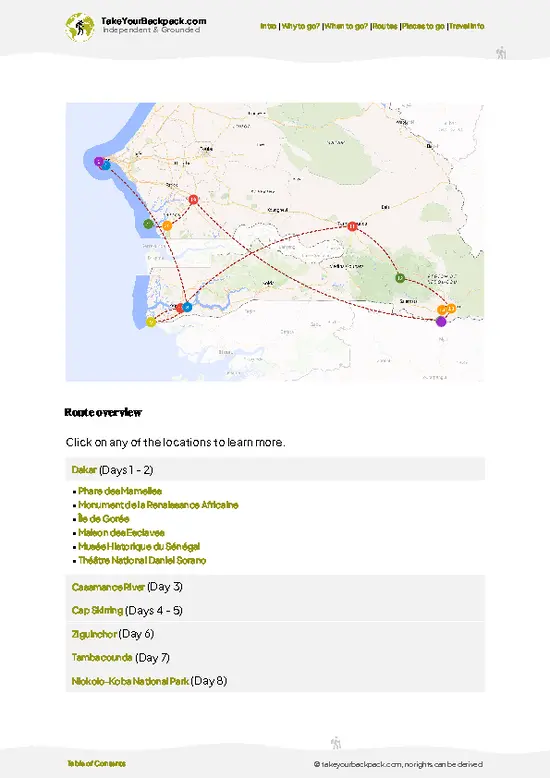
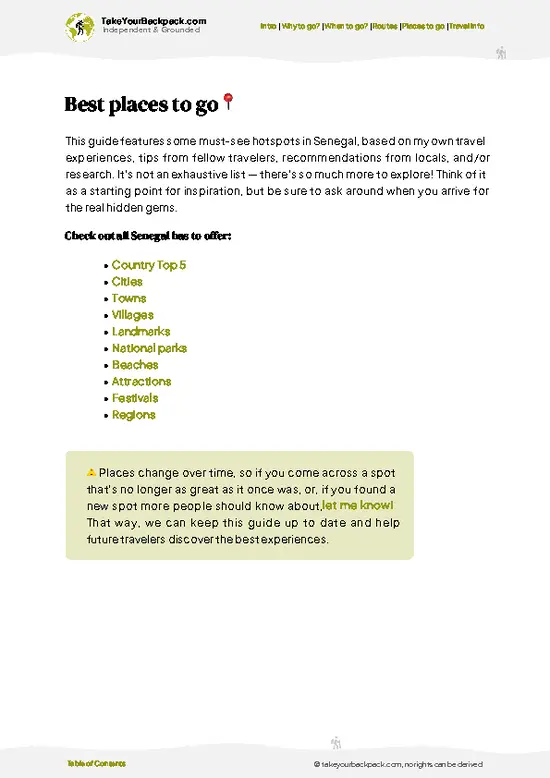
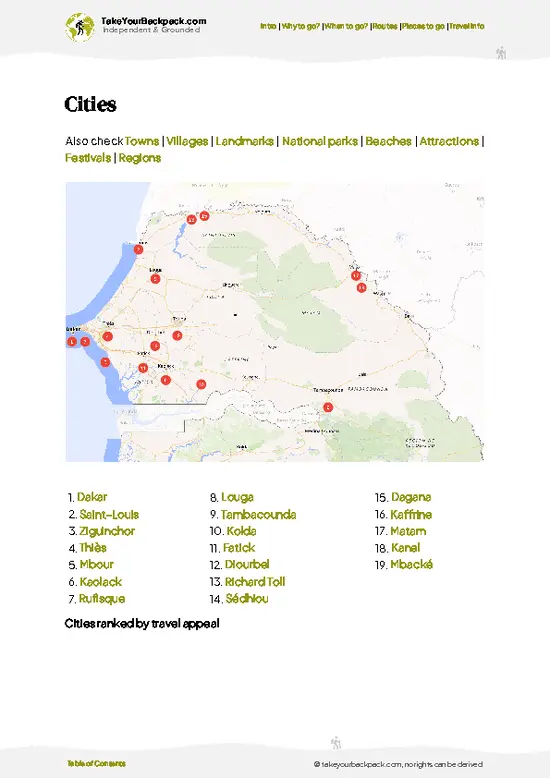
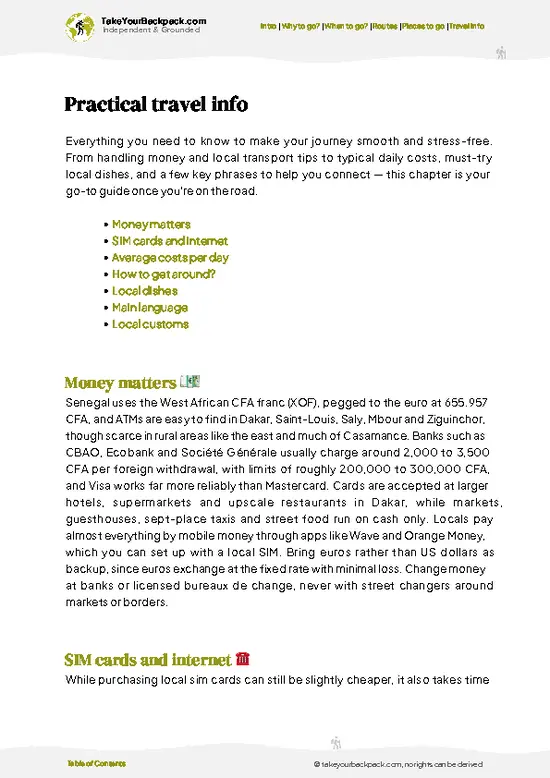
✈️ The backpacker research shortcutSenegal Travel Guide

An offline-friendly backpacking guide with optimized travel routes, ranked highlights, transport advice, and the best areas to stay.
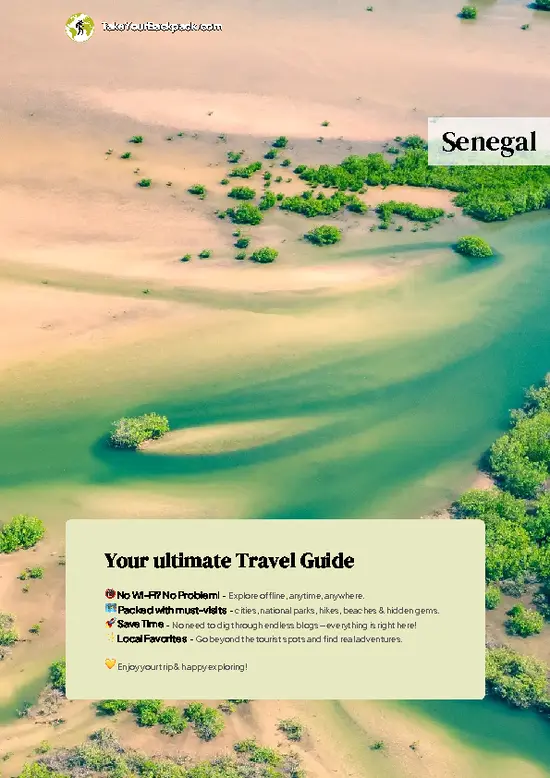
example page 0 from our offline Travel Guide for Senegal
example page 1 from our offline Travel Guide for Senegal
example page 2 from our offline Travel Guide for Senegal
example page 3 from our offline Travel Guide for Senegal
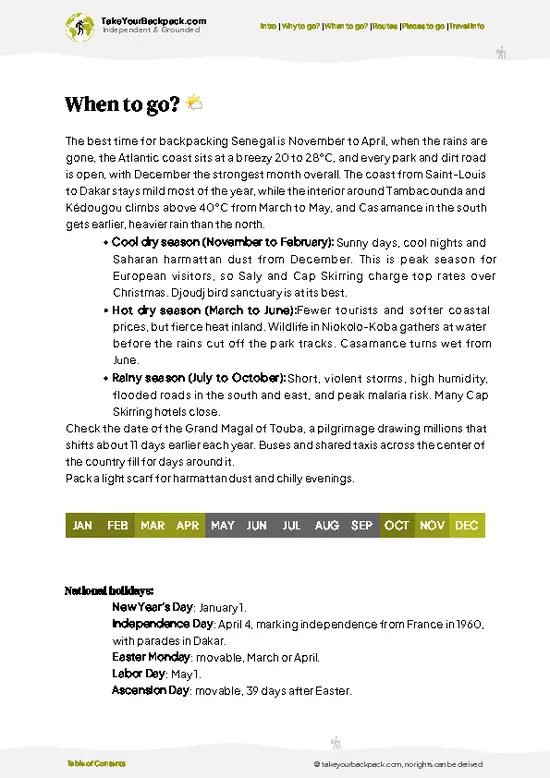
example page 4 from our offline Travel Guide for Senegal
example page 5 from our offline Travel Guide for Senegal
example page 6 from our offline Travel Guide for Senegal
example page 7 from our offline Travel Guide for Senegal
The digital guide (360 pages) contains:
✅ 85 highlights, ranked by travel appeal
✅ Optimized 5, 10 & 15-day travel routes
✅ Cities, national parks, landmarks, beaches
✅ How to get around
✅ Offline-friendly for travel without Wi-Fi
👉 Click to see all 30+ guide features

📅 Plan smarter in minutes, not weeks
✅ Month by month travel advice
✅ Festivals & national holidays
✅ Budget expectations

🗺️ Go to the right places, skip the overrated ones
✅ Honest pros & cons of destinations
✅ Top hikes, parks & viewpoints
✅ Lesser-known places most travelers miss
✅ Clear “worth it vs skip it” guidance

🛏️ Travel smoothly without rookie mistakes
✅ Best areas to stay
✅ Transport systems explained simply
✅ Common scams & safety advice
✅ SIM cards, money & practical tips

🌍 Understand the country, not just visit it
✅ Culture & traditions
✅ 52 Essential phrases & customs
✅ Festivals worth planning around
✅ Traveler-friendly historical context
✅ Insights that make places more meaningful

📱 Built for real travel conditions
✅ Fully downloadable PDF
✅ Works completely offline
✅ Optimized for phone use
✅ Useful in remote areas & buses
✅ Everything in one place
Stop searching, start planning
Get instant access to your full guide. 30‑day money-back guarantee.
+ Add another guide for just

By proceeding you agree to our terms.
Sent to your inbox immediately after payment • 100% Secure Checkout
Best Backpacking Travel Advisor 2025 tourism awardBest Backpacking
Travel Advisor
2025
What others say about Take Your Backpack Guides:
⭐⭐⭐⭐⭐
Fantastic, amazing amount of information!
⭐⭐⭐⭐⭐
My goodness this is amazing, it's what I've been looking for hats off too you!
⭐⭐⭐⭐⭐
I think this is absolutely BRILLIANT
⭐⭐⭐⭐
Very complete and informative. It's still missing places, but I gotta to commend you
⭐⭐⭐⭐⭐
This is truly amazing, thank you, can't wait to explore it with my kids!
⭐⭐⭐⭐⭐
Awesome resource, thank you!
⭐⭐⭐⭐⭐
This is amazing! Can't wait to explore the ones I haven't seen
⭐⭐⭐⭐
I love this! Well done, great idea.
⭐⭐⭐⭐⭐
Thanks for taking the time to make this gem!
⭐⭐⭐⭐⭐
This might be the best website I've ever seen.
⭐⭐⭐⭐⭐
Congratulations, and thank you so much for your work; it's incredibly valuable.
⭐⭐⭐⭐
In all seriousness I think you did a great job pointing out the important spots
⭐⭐⭐⭐⭐
10/10 very good
⭐⭐⭐⭐⭐
As someone who's only just starting to visit regularly this is awesome, thank you.
⭐⭐⭐⭐
Thank you very much! I'm going to visit my dad, it's going to be very useful!
⭐⭐⭐⭐⭐
This is really cool! We'll be travelling for the first time and this definitely come in handy.
⭐⭐⭐⭐⭐
You are now our minister of culture, congratulations 👨‍💼
⭐⭐⭐⭐⭐
Just wanted to tell you that this is a pearl! Going to follow your recommendations.
⭐⭐⭐⭐⭐
This is so cool. I'll definitely be using the resource for my travels soon.
⭐⭐⭐⭐⭐
This is very impressive! Good work.
⭐⭐⭐⭐⭐
This is an amazing and informative site. Very well done!

🛏️ Where to stay?Top Places to Consider Staying

Senegal has a small but growing hostel scene, with dorm beds at roughly 8,000 to 15,000 CFA (US$13 to 25) and simple guesthouses, called “auberges” or “campements”, filling most of the budget gaps. In Dakar, Ngor and Yoff hold the most backpacker-friendly beds, close to surf breaks, beach bars and Ngor Island, with quieter streets than the center but a 30 to 45 minute ride to the city’s markets. Nearby Almadies has the best nightlife and the highest prices. Plateau puts you within walking distance of Sandaga market and the ferry to Gorée, but it empties out after dark and has more petty theft. Outside the capital, the old island quarter of Saint-Louis and the villages of the Sine-Saloum delta … read more 👉
Senegal has a small but growing hostel scene, with dorm beds at roughly 8,000 to 15,000 CFA (US$13 to 25) and simple guesthouses, called “auberges” or “campements”, filling most of the budget gaps. In Dakar, Ngor and Yoff hold the most backpacker-friendly beds, close to surf breaks, beach bars and Ngor Island, with quieter streets than the center but a 30 to 45 minute ride to the city’s markets. Nearby Almadies has the best nightlife and the highest prices. Plateau puts you within walking distance of Sandaga market and the ferry to Gorée, but it empties out after dark and has more petty theft. Outside the capital, the old island quarter of Saint-Louis and the villages of the Sine-Saloum delta offer good-value guesthouses in a far calmer setting.

If you enjoy meeting fellow travelers, consider choosing hostels with high ratings for atmosphere. On the other hand, if you prefer having your own space, a hotel might be a better option.

SenegalMore Places Across Senegal

👋 Meet the founderWho’s Behind Take Your Backpack?

Johan, backpacker and founder of TakeYourBackpackHi, I’m Johan (Netherlands 🇳🇱), the creator of TakeYourBackpack. Over the past 3 decades, I’ve backpacked through 90+ countries across six continents, gaining extensive experience with independent travel, long-term trips, and overland routes.

This site is built on a combination of firsthand travel experience and carefully curated insights from other backpackers. Many guides are based on places I’ve personally visited, while others bring together tips, observations, and practical advice shared by trusted travelers I’ve met along the way.

The goal is to provide realistic, experience-driven guidance — not generic itineraries — so you can explore destinations with better context, clearer expectations, and more confidence.