×

Singapore🇸🇬 | attractionsChinatown Heritage Centrerestored shophouses, recreated living quarters, immigrant stories | things to do and best time to go

Explore National Gallery SingaporeExplore Asian Civilisations Museum

Backpacking in Chinatown Heritage Centre
👌 Worth visitingattraction ranked #10
By Johan Kruseman 🇳🇱 | Updated September 4, 2026

Let’s kill the myth: the Chinatown Heritage Centre isn’t some sleepy, sanitized museum where you’ll just snap a few photos and move on. It’s right on Pagoda Street, in the thick of Singapore’s Chinatown—so yes, you’ll dodge selfie sticks and tour groups at the entrance. But step inside and you’re hit with the grit and sweat of old Singapore, recreated in claustrophobic shophouse rooms that smell faintly of incense and ambition. Backpackers will notice the price is steeper than a hawker lunch, and the crowds can bottleneck on weekends, but the payoff is real: you get a raw, immersive hit of migrant stories and street life that most of Singapore’s polished attractions gloss over. If you want glossy, go to Marina Bay Sands. If you want soul, start here.

Discover everything you want to know in the 📖 Singapore Travel Guide.
Loading the map 🌍
CLICK TO FILTER
cities
towns
national parks
hikes
beaches
attractions
festivals
regions
SHOW COUNTRY’S BESTSHOW ALL

✨ Why go?
Ranked #10 attraction in Singapore
Reasons people choose to visit here

The Chinatown Heritage Centre in Singapore isn’t just another tourist checkbox—it’s a raw, unfiltered dive into the gritty reality behind the city’s polished facade. Sure, it draws crowds, but that’s because it’s a crucial cultural landmark that unpacks the lives of early Chinese immigrants with brutal honesty. Forget sanitized history; this place hits you with cramped living quarters, personal stories, and the relentless hustle that built modern Singapore. It’s not about flashy displays but about feeling the weight of history in a way that’s both educational and emotionally gripping. For backpackers, it’s a major milestone on the country route—offering a deep, authentic connection to Singapore’s roots that no glossy guidebook can replicate. The effort to navigate the sometimes crowded space … read more 👉
The Chinatown Heritage Centre in Singapore isn’t just another tourist checkbox—it’s a raw, unfiltered dive into the gritty reality behind the city’s polished facade. Sure, it draws crowds, but that’s because it’s a crucial cultural landmark that unpacks the lives of early Chinese immigrants with brutal honesty. Forget sanitized history; this place hits you with cramped living quarters, personal stories, and the relentless hustle that built modern Singapore. It’s not about flashy displays but about feeling the weight of history in a way that’s both educational and emotionally gripping. For backpackers, it’s a major milestone on the country route—offering a deep, authentic connection to Singapore’s roots that no glossy guidebook can replicate. The effort to navigate the sometimes crowded space pays off with a rich, immersive experience that’s as much about empathy as it is about facts. This is history you live, not just read.
Want to include Chinatown Heritage Centre in your Singapore route?
Create a personalized Singapore itinerary that includes Chinatown Heritage Centre and the places that fit your trip — based on your travel style, budget, and available time. Get your route in seconds.

Generate my trip

💡 HighlightsWhat this place is best known for

The Shophouse Living Quarters
Forget the sanitized, airbrushed version of Singapore you see on social media. The Chinatown Heritage Centre’s reconstructed shophouse interiors drop you straight into the cramped, chaotic, and deeply human world of early Chinese immigrants. You’ll duck under laundry lines, peer into tiny bedrooms, and smell the faint echo of incense and sweat. This isn’t a museum that keeps you at arm’s length; it’s a time machine with peeling paint and all. If you want to understand how Singapore was built—literally, brick by brick and bunk by bunk—this is the place.


The Tailor’s Shop
This isn’t just a display of old sewing machines. The tailor’s shop is a living diorama of hustle culture before hashtags. You’ll see the tools, the cramped workspace, and the relentless grind … read more 👉
The Shophouse Living Quarters
Forget the sanitized, airbrushed version of Singapore you see on social media. The Chinatown Heritage Centre’s reconstructed shophouse interiors drop you straight into the cramped, chaotic, and deeply human world of early Chinese immigrants. You’ll duck under laundry lines, peer into tiny bedrooms, and smell the faint echo of incense and sweat. This isn’t a museum that keeps you at arm’s length; it’s a time machine with peeling paint and all. If you want to understand how Singapore was built—literally, brick by brick and bunk by bunk—this is the place.


The Tailor’s Shop
This isn’t just a display of old sewing machines. The tailor’s shop is a living diorama of hustle culture before hashtags. You’ll see the tools, the cramped workspace, and the relentless grind that powered a whole community. The details are sharp: half-finished shirts, order books, and the sense that someone just stepped out for a quick kopi. It’s a rare, unvarnished look at the backbone of Chinatown’s economy.


The Street Scenes
The Centre recreates the street life of 1950s Chinatown with a level of detail that’s almost cinematic. You’ll walk past hawker stalls, herbal medicine shops, and gambling dens—minus the Instagram filters and curated chaos. The soundscape alone (shouts, clatter, the occasional rooster) is worth the price of admission. This is where you get the pulse of old Singapore, not just the postcard.


The Personal Stories and Audio Guides
Here’s where the Centre earns its stripes. The audio guides are packed with first-person accounts—real voices, real memories, no sugarcoating. You’ll hear about heartbreak, hustle, and hope from the people who lived it. It’s raw, sometimes funny, sometimes gut-punching. My personal favorite: the story of a young woman navigating the labyrinth of family, work, and tradition in a single, suffocating room. It’s the kind of detail you won’t find on a walking tour.


The Migrant Experience Exhibits
This isn’t a nostalgia trip. The exhibits on migration are blunt about the hardships—poverty, discrimination, and the sheer grit it took to survive. You’ll leave with a new respect for the generations who turned struggle into a city. No soft-focus romance here; just the real, unfiltered story of Singapore’s Chinatown.
Spotted a mistake or missing something? Contact us.

Things to do around Chinatown Heritage Centre

Ratings based on Tripadvisor reviews. When you book through this link, you support our work at no extra cost to you.

🌤️ When to go?Seasonal considerations and timing


  • Weather: Singapore is hot and humid year-round, with temperatures hovering between 26°C to 32°C (79°F to 90°F). The wettest months are November to January, bringing heavy but brief showers that can disrupt your visit.

  • Temperature: Expect consistent warmth; no real winter relief here. The heat can feel intense, especially in the afternoon, so mornings or late afternoons are your best bet for exploring Chinatown Heritage Centre comfortably.

  • Daylight Hours: Singapore sits near the equator, so daylight is steady—about 12 hours daily year-round. Sunrise is around 7 AM, sunset near 7 PM, giving you a reliable window for sightseeing.

  • Crowds: Peak tourist season hits from June to August and December, when the centre gets busy with families and tour groups. For a quieter, more immersive experience,
read more 👉

  • Weather: Singapore is hot and humid year-round, with temperatures hovering between 26°C to 32°C (79°F to 90°F). The wettest months are November to January, bringing heavy but brief showers that can disrupt your visit.

  • Temperature: Expect consistent warmth; no real winter relief here. The heat can feel intense, especially in the afternoon, so mornings or late afternoons are your best bet for exploring Chinatown Heritage Centre comfortably.

  • Daylight Hours: Singapore sits near the equator, so daylight is steady—about 12 hours daily year-round. Sunrise is around 7 AM, sunset near 7 PM, giving you a reliable window for sightseeing.

  • Crowds: Peak tourist season hits from June to August and December, when the centre gets busy with families and tour groups. For a quieter, more immersive experience, aim for February to April or September to October.

  • Seasonal Activities: Chinese New Year (January or February) floods Chinatown with energy, decorations, and events—great if you want cultural buzz but expect crowds and higher prices.

  • Price Fluctuations: Entry fees stay stable year-round, but accommodation and flights spike during holiday seasons, especially around Chinese New Year and mid-year school breaks.


Pro-tip: Visit early on a weekday morning outside major holidays to dodge crowds and soak in the stories without the Instagram mobs.


source: climatestotravel.comJANJanuary: fair for travelingFEBFebruary: highly recommended for travelingMARMarch: highly recommended for travelingAPRApril: highly recommended for travelingMAYMay: good for travelingJUNJune: good for travelingJULJuly: good for travelingAUGAugust: good for travelingSEPSeptember: highly recommended for travelingOCTOctober: highly recommended for travelingNOVNovember: fair for travelingDECDecember: good for traveling
when-to-go

✈️ The backpacker research shortcutSingapore Travel Guide

An offline-friendly backpacking guide with optimized travel routes, ranked highlights, transport advice, and the best areas to stay.
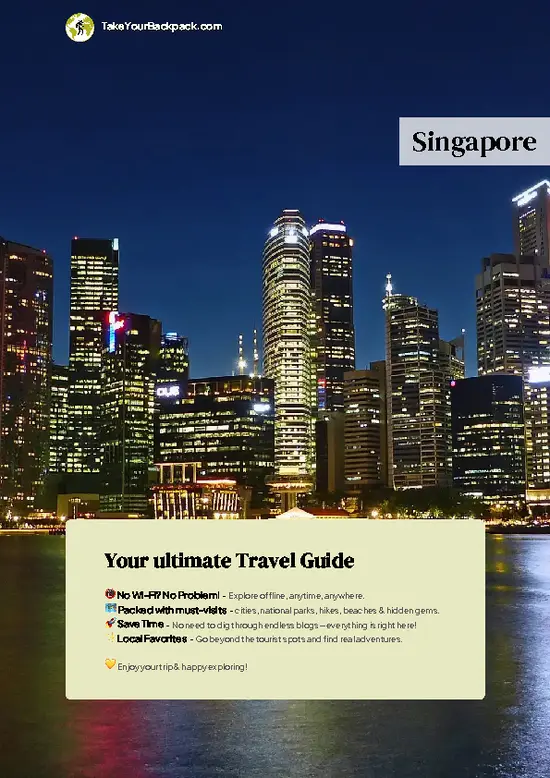
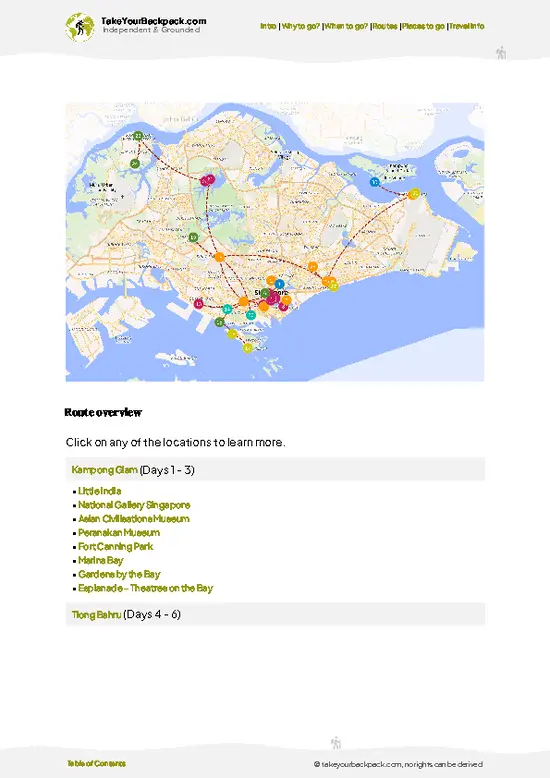
example page 0 from our offline Travel Guide for Singapore
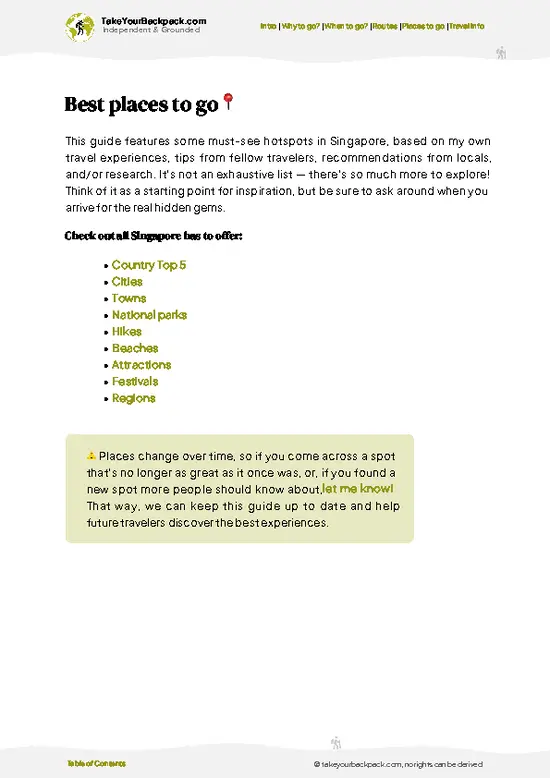
example page 1 from our offline Travel Guide for Singapore
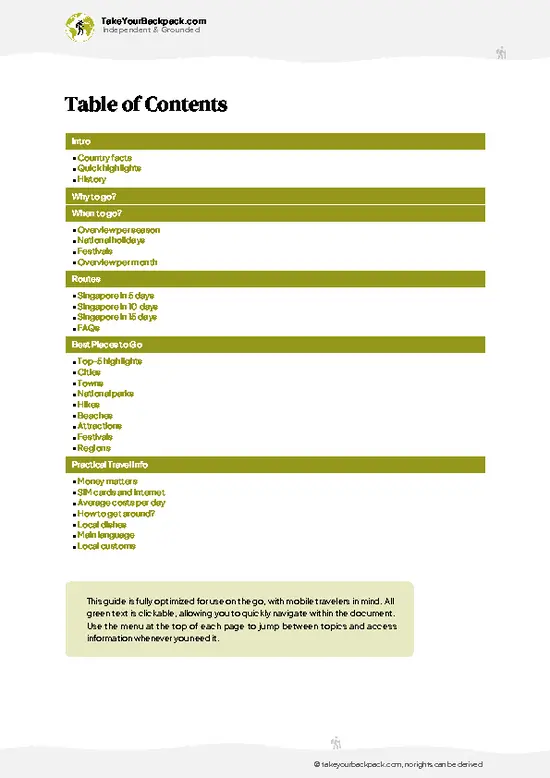
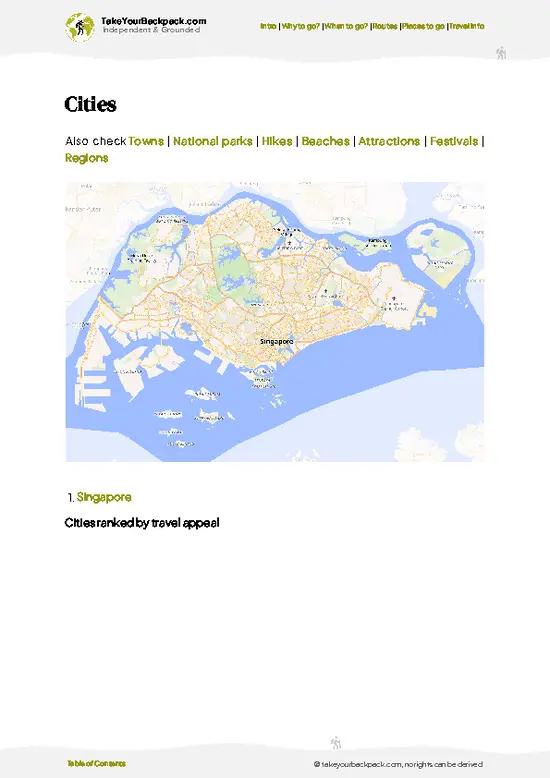
example page 2 from our offline Travel Guide for Singapore
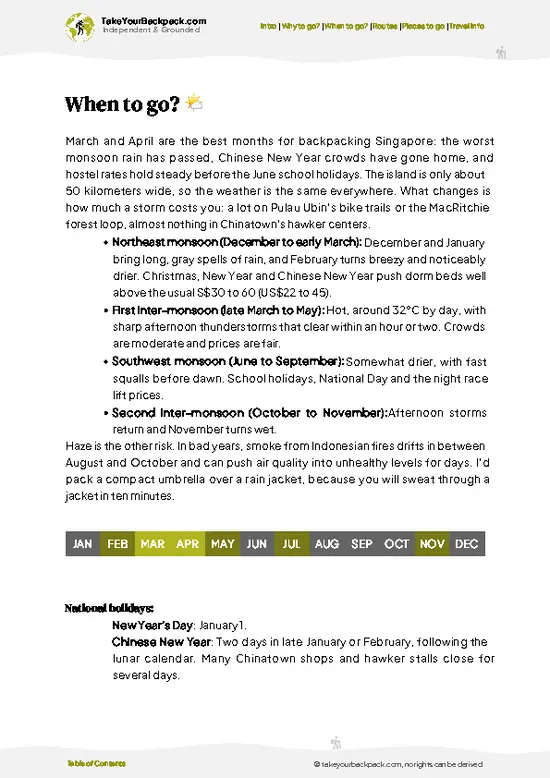
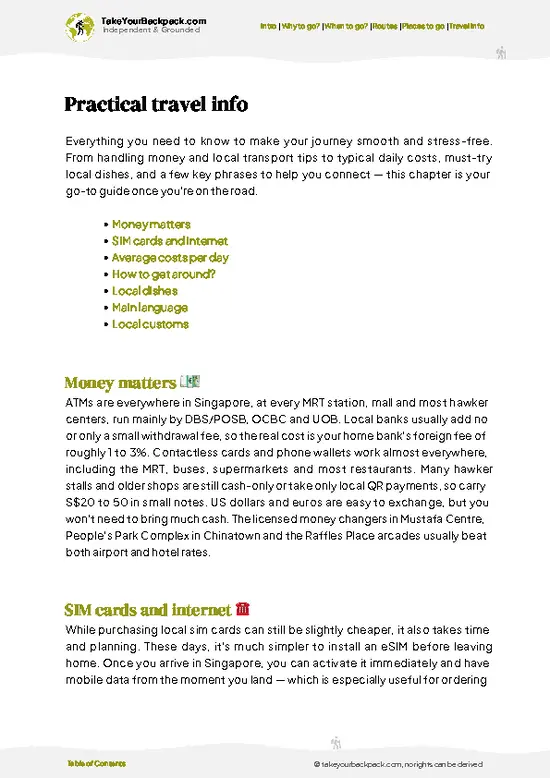
example page 3 from our offline Travel Guide for Singapore
example page 4 from our offline Travel Guide for Singapore
example page 5 from our offline Travel Guide for Singapore
example page 6 from our offline Travel Guide for Singapore
example page 7 from our offline Travel Guide for Singapore
The digital guide (256 pages) contains:
66 highlights, ranked by travel appeal
Optimized 5, 10 & 15-day travel routes
Cities, national parks, landmarks, beaches
How to get around
Offline-friendly for travel without Wi-Fi
👉 Click to see all 30+ guide features

📅 Plan smarter in minutes, not weeks
Month by month travel advice
Festivals & national holidays
Budget expectations

🗺️ Go to the right places, skip the overrated ones
Honest pros & cons of destinations
Top hikes, parks & viewpoints
Lesser-known places most travelers miss
Clear “worth it vs skip it” guidance

🛏️ Travel smoothly without rookie mistakes
Best areas to stay
Transport systems explained simply
Common scams & safety advice
SIM cards, money & practical tips

🌍 Understand the country, not just visit it
Culture & traditions
Local customs
Festivals worth planning around
Traveler-friendly historical context
Insights that make places more meaningful

📱 Built for real travel conditions
Fully downloadable PDF
Works completely offline
Optimized for phone use
Useful in remote areas & buses
Everything in one place
Save weeks of stressful planning
Get instant access to your full guide. 30‑day money-back guarantee.
+ Add another guide for just US$7.80

By proceeding you agree to our terms.
Sent to your inbox immediately after payment • 100% Secure Checkout
Best Backpacking Travel Advisor 2025 tourism awardBest Backpacking
Travel Advisor
2025
What others say about Take Your Backpack Guides:
⭐⭐⭐⭐⭐
Fantastic, amazing amount of information!
⭐⭐⭐⭐⭐
My goodness this is amazing, it's what I've been looking for hats off too you!
⭐⭐⭐⭐⭐
I think this is absolutely BRILLIANT
⭐⭐⭐⭐
Very complete and informative. It's still missing places, but I gotta to commend you
⭐⭐⭐⭐⭐
This is truly amazing, thank you, can't wait to explore it with my kids!
⭐⭐⭐⭐⭐
Awesome resource, thank you!
⭐⭐⭐⭐⭐
This is amazing! Can't wait to explore the ones I haven't seen
⭐⭐⭐⭐
I love this! Well done, great idea.
⭐⭐⭐⭐⭐
Thanks for taking the time to make this gem!
⭐⭐⭐⭐⭐
This might be the best website I've ever seen.
⭐⭐⭐⭐⭐
Congratulations, and thank you so much for your work; it's incredibly valuable.
⭐⭐⭐⭐
In all seriousness I think you did a great job pointing out the important spots
⭐⭐⭐⭐⭐
10/10 very good
⭐⭐⭐⭐⭐
As someone who's only just starting to visit regularly this is awesome, thank you.
⭐⭐⭐⭐
Thank you very much! I'm going to visit my dad, it's going to be very useful!
⭐⭐⭐⭐⭐
This is really cool! We'll be travelling for the first time and this definitely come in handy.
⭐⭐⭐⭐⭐
You are now our minister of culture, congratulations 👨‍💼
⭐⭐⭐⭐⭐
Just wanted to tell you that this is a pearl! Going to follow your recommendations.
⭐⭐⭐⭐⭐
This is so cool. I'll definitely be using the resource for my travels soon.
⭐⭐⭐⭐⭐
This is very impressive! Good work.
⭐⭐⭐⭐⭐
This is an amazing and informative site. Very well done!

🛏️ Where to stay?Choosing the right base

If you’re aiming to soak in the Chinatown Heritage Centre without selling a kidney for a hotel room, your best bet is to camp out right in the Chinatown district itself. This area is the heartbeat of old Singapore, packed with budget-friendly guesthouses and hostels that don’t skimp on safety or social vibes. You’ll find plenty of fellow backpackers here, which means instant travel buddies and a lively atmosphere after dark.

Skip the tourist traps on the main drag and look for spots tucked into the side streets—these tend to be quieter but still close enough to the action. Plus, you’re steps … read more 👉
If you’re aiming to soak in the Chinatown Heritage Centre without selling a kidney for a hotel room, your best bet is to camp out right in the Chinatown district itself. This area is the heartbeat of old Singapore, packed with budget-friendly guesthouses and hostels that don’t skimp on safety or social vibes. You’ll find plenty of fellow backpackers here, which means instant travel buddies and a lively atmosphere after dark.

Skip the tourist traps on the main drag and look for spots tucked into the side streets—these tend to be quieter but still close enough to the action. Plus, you’re steps away from hawker stalls serving up killer local eats that won’t blow your budget. If you want a bit more space and a slightly calmer scene, the nearby Tanjong Pagar neighborhood is a solid alternative. It’s still walkable to Chinatown Heritage Centre but offers a more local feel and some cool bars where you can unwind without the tourist crush.

Bottom line: Chinatown and Tanjong Pagar deliver the perfect mix of safety, social buzz, and wallet-friendly digs for backpackers who want to experience the real pulse of Singapore’s heritage.

👛 Costs (as of 4 September 2026)What things cost and how to budget

The entrance ticket to Chinatown Heritage Centre typically costs around USD15 for adults. Additional expenses may include guided tours or audio guides, which can add a few dollars more. Budget for snacks or drinks if you plan to spend extra time exploring nearby eateries.

source: nhb.gov.sg
⚠️ Prices can change and everyone travels differently, so take this as a rough guide. Hope it helps you plan your adventure!

FAQFrequently asked questions about Chinatown Heritage Centre

Allocate about 1 to 1.5 hours to visit Chinatown Heritage Centre to fully explore the exhibits and immersive displays.
Yes, Chinatown Heritage Centre is worth the entrance fee of around SGD 15, as it offers a detailed and engaging insight into the lives of early Chinese immigrants in Singapore.
Take the MRT to Chinatown Station (NE4/DT19) and use Exit A; the centre is a short 5-minute walk from the station along Pagoda Street.
⚠️ Things can change over time, so always validate details locally before you go.

Other Singaporean attractions near Chinatown Heritage Centre

Explore more nearby:


💡 Not sure where to go next?
Create a personalized itinerary for Singapore including Chinatown Heritage Centre and the places that fit your trip.

Generate my itinerary

👉 Discover all attractions

Or checkout all Singapore has to offer (think cities, towns, villages, national parks, hikes, beaches, festivals)
Country photo of Singapore

We 💚 feedbackParting advice and final tips

Chinatown Heritage Centre isn’t some glossy, sanitized museum—it’s a gritty, immersive dive into the lives of early Chinese immigrants, complete with cramped living quarters and raw stories that hit harder than any postcard-perfect shot. But heads up: it can get crowded, especially on weekends, and the entry fee isn’t dirt cheap. Still, if you want history that punches through the usual tourist fluff, this is where it’s at.

✈️ When did I visit Singapore?
During a short stop-over, I was able to celebrate Chinese New Year in 2016.

✍️ Help improve this page!
The information on this page is based on my own backpacking experience in Singapore, supplemented with up-to-date research and feedback from other travelers. Travel details can change, so if you notice anything outdated or incomplete, feel free to let me know.


🙋‍♂️ Give feedback

👋 Meet the founderWho’s Behind Take Your Backpack?

Johan, backpacker and founder of TakeYourBackpackHi, I’m Johan (Netherlands 🇳🇱), the creator of TakeYourBackpack. Over the past decade, I’ve backpacked through 80+ countries across six continents, gaining extensive experience with independent travel, long-term trips, and overland routes.

This site is built on a combination of firsthand travel experience and carefully curated insights from other backpackers. Many guides are based on places I’ve personally visited, while others bring together tips, observations, and practical advice shared by trusted travelers I’ve met along the way.

The goal is to provide realistic, experience-driven guidance — not generic itineraries — so you can explore destinations with better context, clearer expectations, and more confidence.

Get full Singapore guide •
Instant download • 66 highlights • Full Offline guide