×

Solomon Islands🇸🇧 | attractionsBonegi WrecksShore-entry wrecks, black volcanic beach, rusted hull ribs, Kinugawa Maru | things to do and best time to go

Explore Solomon Peace Memorial ParkExplore Tulagi World War II Wrecks

Backpacking in Bonegi Wrecks
🏆 Top pickattraction ranked #1
By Johan Kruseman 🇳🇱 | Updated October 22, 2026

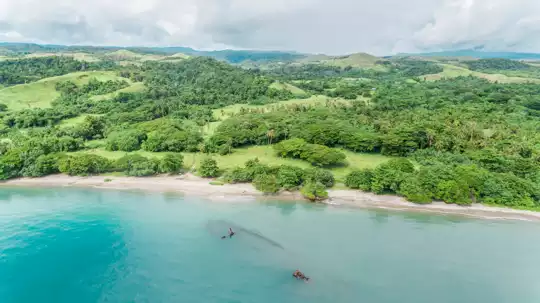
Two Japanese freighters lie on their sides just off a black-sand beach, and you can reach both by wading in from the shore. That shore entry is the part people overlook: no boat, no long transfer, just a gear check on the beach and a few kick strokes. Bonegi I & II sit on the north coast of Guadalcanal in the Solomon Islands, west of Honiara. Bonegi II breaks the surface, its rusted remains rising out of the swell and streaked with orange. Bonegi I runs deeper, with its bow reaching up toward the shallows and its stern at about 55 meters. The beach is volcanic gravel, hot underfoot by midday, so wear booties, because the stones are why the entry takes patience. Dive early, when the water is clearest and the sun is lower. Snorkelers get the top of the wreck free of tanks. A first day could mean a morning shore dive on Bonegi I, lunch on the sand, then a snorkel over the hull while the light is high.

Discover everything you want to know in the 📖 Solomon Islands Travel Guide.


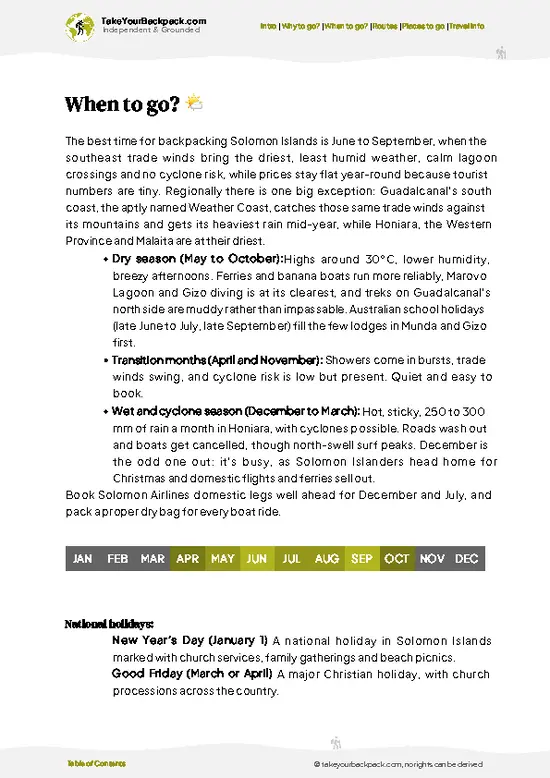
example page 0 from our offline Travel Guide for Solomon Islands
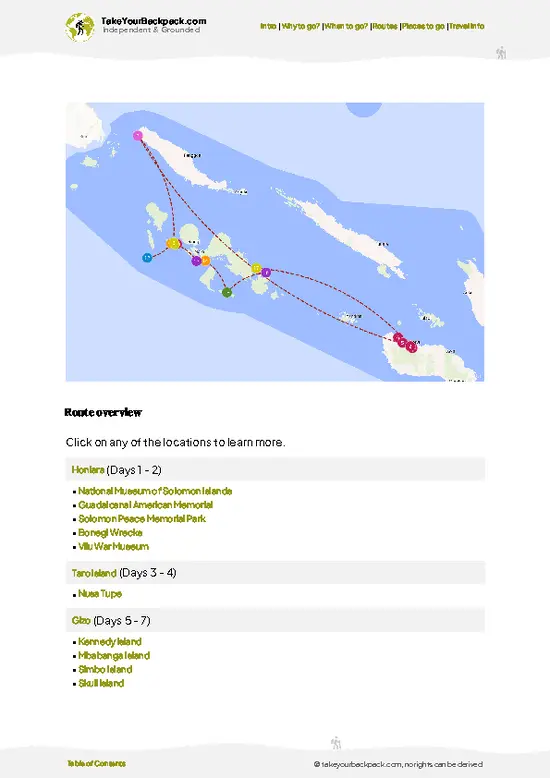
example page 1 from our offline Travel Guide for Solomon Islands
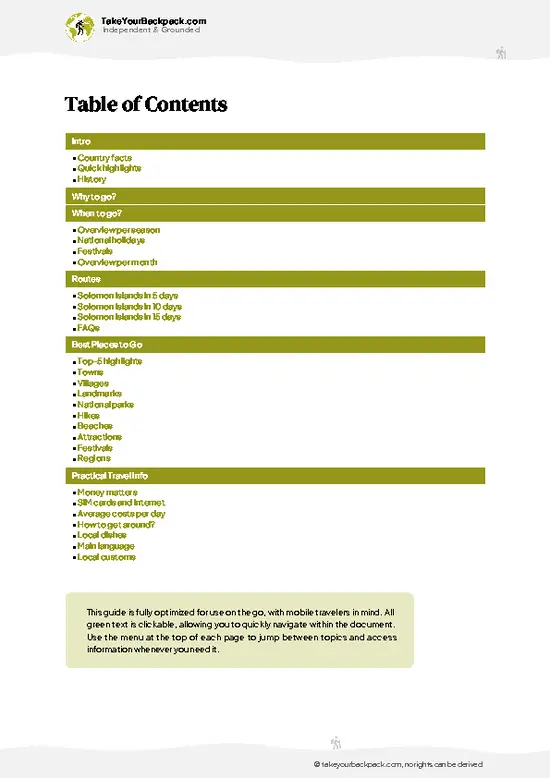
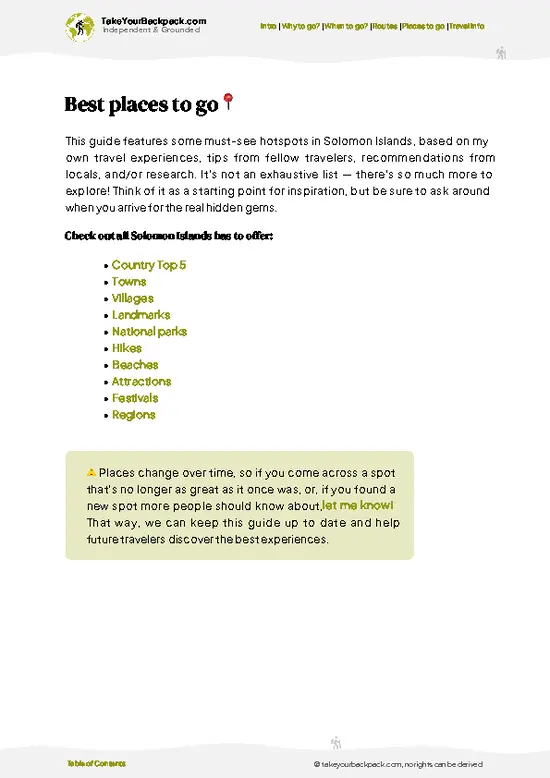
example page 2 from our offline Travel Guide for Solomon Islands
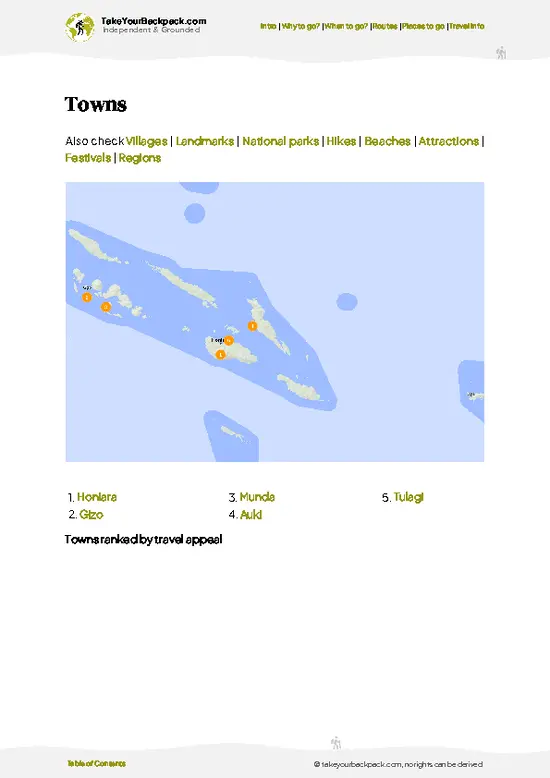
example page 3 from our offline Travel Guide for Solomon Islands
example page 4 from our offline Travel Guide for Solomon Islands
example page 5 from our offline Travel Guide for Solomon Islands
example page 6 from our offline Travel Guide for Solomon Islands
example page 7 from our offline Travel Guide for Solomon Islands
Loading the map 🌍
CLICK TO FILTER
towns
villages
landmarks
national parks
hikes
beaches
attractions
festivals
regions
SHOW COUNTRY’S BESTSHOW ALL

✨ Why go?
Ranked #1 attraction in Solomon Islands
What makes this attraction worth visiting

Bonegi is a rare case where a World War II wreck is a few fin kicks from the beach. The ships were part of the 1942 Guadalcanal campaign, and the Kinugawa Maru (Bonegi II) still has parts of its bow and engine above the surface, so even a non-diver can float over a war freighter and watch fish move through the structure. Diving it feels different from a boat trip, because you walk in, drop down and finish in the same spot, with time to look properly at every corner.

The second reason is the choice of depth. Bonegi I, the Hirokawa Maru, runs deeper, from a bow in the shallows to a stern at about 55 meters, and gives certified divers a larger, darker wreck to explore with encrusted coral growth. Together the two sites let you do a gentle first dive and a more demanding second one without changing … read more 👉
Bonegi is a rare case where a World War II wreck is a few fin kicks from the beach. The ships were part of the 1942 Guadalcanal campaign, and the Kinugawa Maru (Bonegi II) still has parts of its bow and engine above the surface, so even a non-diver can float over a war freighter and watch fish move through the structure. Diving it feels different from a boat trip, because you walk in, drop down and finish in the same spot, with time to look properly at every corner.

The second reason is the choice of depth. Bonegi I, the Hirokawa Maru, runs deeper, from a bow in the shallows to a stern at about 55 meters, and gives certified divers a larger, darker wreck to explore with encrusted coral growth. Together the two sites let you do a gentle first dive and a more demanding second one without changing base.

There is also the history in the water. The area is part of the story of Iron Bottom Sound, so the dives link directly to Guadalcanal’s wartime past. For a backpacker, it ranks among the easiest and most atmospheric ways to touch that past.

💡 HighlightsTop highlights of Bonegi Wrecks

  1. Bonegi II (Kinugawa Maru): The best known of the pair. Parts of the wreck stick out of the water, so snorkelers can see the wreck’s upper structure while divers follow it down along the slope. Corals and sponges cover the plates, and schooling fish gather in the shade of the hull.
  2. Bonegi I (Hirokawa Maru): A deeper, larger wreck, with the bow in the shallows and the stern at about 55 meters. It suits certified divers who want more structure to explore, with the best light in the morning.
  3. The shore entry: You wade in from the black volcanic beach and swim out to the wreck. It keeps logistics simple and lets you dive without a boat, though footing on the stones needs care.
  4. Snorkeling over the hull: The shallow upper sections of Bonegi II are close enough to the surface for a mask and snorkel to
… read more 👉
  1. Bonegi II (Kinugawa Maru): The best known of the pair. Parts of the wreck stick out of the water, so snorkelers can see the wreck’s upper structure while divers follow it down along the slope. Corals and sponges cover the plates, and schooling fish gather in the shade of the hull.
  2. Bonegi I (Hirokawa Maru): A deeper, larger wreck, with the bow in the shallows and the stern at about 55 meters. It suits certified divers who want more structure to explore, with the best light in the morning.
  3. The shore entry: You wade in from the black volcanic beach and swim out to the wreck. It keeps logistics simple and lets you dive without a boat, though footing on the stones needs care.
  4. Snorkeling over the hull: The shallow upper sections of Bonegi II are close enough to the surface for a mask and snorkel to show the rusted frame and the reef life that has grown on it.
  5. Coral growth on the wrecks: Soft and hard corals have taken over the steel, and small reef fish, including anemonefish, move through the gaps. Bring a torch for the shadowed corners.
  6. Wartime remains: Look for the hull plating, openings and ribs that show how the freighter was built. Keep your hands off the structure to protect both the wreck and the coral.
  7. The black-sand beach: A dark volcanic shoreline with gravel that gets hot by midday. It is a good place to rest between dives and watch the swell roll over the wreck.
Allow half a day for one dive and a snorkel at Bonegi I, or a full day to cover both sites with a surface interval between them.
Spotted a mistake or missing something? Contact us.

Things to do near Bonegi Wrecks

Ratings based on Tripadvisor reviews. When you book through this link, you support our work at no extra cost to you.

🌤️ When to go?Seasonal considerations and timing

  • May to October (drier months): Bonegi sits on Guadalcanal's north coast, a short drive west of Honiara, and visibility on the wrecks is usually best now, often 20 to 30 meters. Days run 28 to 31°C (82 to 88°F), water about 28°C (82°F), and sunrise and sunset stay close to 6:00 and 18:00.
  • November to April (wetter months): Expect humid heat of 30 to 32°C (86 to 90°F), heavy downpours, and runoff that can cloud the shallows. Cyclone swells are rare but can cancel boat trips and make the road muddy. Dive operators are quiet and room rates in Honiara are easy to haggle.
  • Crowds: Bonegi never gets crowded. Cruise ship calls and visiting dive groups bring a few extra boats, mostly in the drier months, and weekends see local families picnicking on the black sand beach.
  • Time of day: Mornings give calmer
… read more 👉
  • May to October (drier months): Bonegi sits on Guadalcanal's north coast, a short drive west of Honiara, and visibility on the wrecks is usually best now, often 20 to 30 meters. Days run 28 to 31°C (82 to 88°F), water about 28°C (82°F), and sunrise and sunset stay close to 6:00 and 18:00.
  • November to April (wetter months): Expect humid heat of 30 to 32°C (86 to 90°F), heavy downpours, and runoff that can cloud the shallows. Cyclone swells are rare but can cancel boat trips and make the road muddy. Dive operators are quiet and room rates in Honiara are easy to haggle.
  • Crowds: Bonegi never gets crowded. Cruise ship calls and visiting dive groups bring a few extra boats, mostly in the drier months, and weekends see local families picnicking on the black sand beach.
  • Time of day: Mornings give calmer water and clearer light on Bonegi I, whose bow rises to just 3 meters below the surface, which also suits snorkelers.
Book your dive a day ahead in Honiara, since operators need a minimum group to run the truck out here.


source: climatestotravel.comJANJanuary: fair for travelingFEBFebruary: fair for travelingMARMarch: fair for travelingAPRApril: excellent for travelingMAYMay: excellent for travelingJUNJune: excellent for travelingJULJuly: highly recommended for travelingAUGAugust: highly recommended for travelingSEPSeptember: excellent for travelingOCTOctober: excellent for travelingNOVNovember: fair for travelingDECDecember: fair for traveling
solomon-islands-attraction-bonegi-wrecks
© Google |

✈️ The backpacker research shortcutSolomon Islands Travel Guide

An offline-friendly backpacking guide with optimized travel routes, ranked highlights, transport advice, and the best areas to stay.
example page 0 from our offline Travel Guide for Solomon Islands
example page 1 from our offline Travel Guide for Solomon Islands
example page 2 from our offline Travel Guide for Solomon Islands
example page 3 from our offline Travel Guide for Solomon Islands
example page 4 from our offline Travel Guide for Solomon Islands
example page 5 from our offline Travel Guide for Solomon Islands
example page 6 from our offline Travel Guide for Solomon Islands
example page 7 from our offline Travel Guide for Solomon Islands
The digital guide (145 pages) contains:
✅ 33 highlights, ranked by travel appeal
✅ Optimized 5, 10 & 15-day travel routes
✅ Cities, national parks, landmarks, beaches
✅ How to get around
✅ Offline-friendly for travel without Wi-Fi
👉 Click to see all 30+ guide features

📅 Plan smarter in minutes, not weeks
✅ Month by month travel advice
✅ Festivals & national holidays
✅ Budget expectations

🗺️ Go to the right places, skip the overrated ones
✅ Honest pros & cons of destinations
✅ Top hikes, parks & viewpoints
✅ Lesser-known places most travelers miss
✅ Clear “worth it vs skip it” guidance

🛏️ Travel smoothly without rookie mistakes
✅ Best areas to stay
✅ Transport systems explained simply
✅ Common scams & safety advice
✅ SIM cards, money & practical tips

🌍 Understand the country, not just visit it
✅ Culture & traditions
✅ 52 Essential phrases & customs
✅ Festivals worth planning around
✅ Traveler-friendly historical context
✅ Insights that make places more meaningful

📱 Built for real travel conditions
✅ Fully downloadable PDF
✅ Works completely offline
✅ Optimized for phone use
✅ Useful in remote areas & buses
✅ Everything in one place
Stop searching, start planning
Get instant access to your full guide. 30‑day money-back guarantee.
+ Add another guide for just

By proceeding you agree to our terms.
Sent to your inbox immediately after payment • 100% Secure Checkout
Best Backpacking Travel Advisor 2025 tourism awardBest Backpacking
Travel Advisor
2025
What others say about Take Your Backpack Guides:
⭐⭐⭐⭐⭐
Fantastic, amazing amount of information!
⭐⭐⭐⭐⭐
My goodness this is amazing, it's what I've been looking for hats off too you!
⭐⭐⭐⭐⭐
I think this is absolutely BRILLIANT
⭐⭐⭐⭐
Very complete and informative. It's still missing places, but I gotta to commend you
⭐⭐⭐⭐⭐
This is truly amazing, thank you, can't wait to explore it with my kids!
⭐⭐⭐⭐⭐
Awesome resource, thank you!
⭐⭐⭐⭐⭐
This is amazing! Can't wait to explore the ones I haven't seen
⭐⭐⭐⭐
I love this! Well done, great idea.
⭐⭐⭐⭐⭐
Thanks for taking the time to make this gem!
⭐⭐⭐⭐⭐
This might be the best website I've ever seen.
⭐⭐⭐⭐⭐
Congratulations, and thank you so much for your work; it's incredibly valuable.
⭐⭐⭐⭐
In all seriousness I think you did a great job pointing out the important spots
⭐⭐⭐⭐⭐
10/10 very good
⭐⭐⭐⭐⭐
As someone who's only just starting to visit regularly this is awesome, thank you.
⭐⭐⭐⭐
Thank you very much! I'm going to visit my dad, it's going to be very useful!
⭐⭐⭐⭐⭐
This is really cool! We'll be travelling for the first time and this definitely come in handy.
⭐⭐⭐⭐⭐
You are now our minister of culture, congratulations 👨‍💼
⭐⭐⭐⭐⭐
Just wanted to tell you that this is a pearl! Going to follow your recommendations.
⭐⭐⭐⭐⭐
This is so cool. I'll definitely be using the resource for my travels soon.
⭐⭐⭐⭐⭐
This is very impressive! Good work.
⭐⭐⭐⭐⭐
This is an amazing and informative site. Very well done!

🛏️ Where to stay?How to pick the right area

Honiara is the place to sleep, since Bonegi itself has no real accommodation scene beyond a couple of basic beachside options. The wrecks lie about 15 kilometers west of the capital along the Guadalcanal coastal road, roughly 30 to 40 minutes by vehicle, so you can easily dive in the morning and be back for lunch.
The best area for backpackers is the central strip around Chinatown and Point Cruz. You can walk to the Central Market, cheap Chinese and local food, ATMs, and the dive shops that run trips to Bonegi, which saves on transport. It is also where you will meet other travelers, volunteers … read more 👉
Honiara is the place to sleep, since Bonegi itself has no real accommodation scene beyond a couple of basic beachside options. The wrecks lie about 15 kilometers west of the capital along the Guadalcanal coastal road, roughly 30 to 40 minutes by vehicle, so you can easily dive in the morning and be back for lunch.
The best area for backpackers is the central strip around Chinatown and Point Cruz. You can walk to the Central Market, cheap Chinese and local food, ATMs, and the dive shops that run trips to Bonegi, which saves on transport. It is also where you will meet other travelers, volunteers and Pacific hoppers, so sharing a ride to the wrecks is simple.
The hillside neighborhoods toward Mataniko and the Kukum Highway are quieter and cheaper, but you will want taxis after dark. Crime in Honiara is mostly opportunistic, so avoid walking unlit streets at night and keep valuables in your room.
If you want a beach for the night, a few small guesthouses and homestays sit west of town along the coast, offering sea views and dorm-style or private rooms. They are fewer, less social and need your own transport for food. Most budget divers choose Honiara and head out for the day.

👛 Costs (as of 22 October 2026)How expensive it really is

Expect to spend about US$75 to 130 a day in Honiara while diving the Bonegi wrecks, with the dive itself taking most of the budget.
CategoryBudget RangeLocal Reality
Accommodation (high season)US$25 to 50Dorm bed or basic guesthouse room in Honiara; rooms run higher than elsewhere in the country.
Site access feeUS$2 to 5Landowners often collect a small beach or reef fee in Solomon dollars at Bonegi.
Diving or snorkelingUS$0 to 60Snorkeling the shallow bow of Bonegi I costs only the access fee with your own gear. A guided single-tank dive is around US$55 to 90, and gear hire is extra.
TransportUS$10 to 25Shared minibuses along the coast cost a few dollars one way, but a taxi round trip with waiting time costs more, often US$20 to 40 split between riders.
Food and drinkUS$12 to 25Rice and fish meals
… read more 👉
Expect to spend about US$75 to 130 a day in Honiara while diving the Bonegi wrecks, with the dive itself taking most of the budget.
CategoryBudget RangeLocal Reality
Accommodation (high season)US$25 to 50Dorm bed or basic guesthouse room in Honiara; rooms run higher than elsewhere in the country.
Site access feeUS$2 to 5Landowners often collect a small beach or reef fee in Solomon dollars at Bonegi.
Diving or snorkelingUS$0 to 60Snorkeling the shallow bow of Bonegi I costs only the access fee with your own gear. A guided single-tank dive is around US$55 to 90, and gear hire is extra.
TransportUS$10 to 25Shared minibuses along the coast cost a few dollars one way, but a taxi round trip with waiting time costs more, often US$20 to 40 split between riders.
Food and drinkUS$12 to 25Rice and fish meals at market stalls or Chinese cafes are cheapest; sit-down restaurants cost more.
Total Daily BudgetUS$75 to 130Lower end assumes snorkeling and shared transport; higher end includes a guided dive.
⚠️ Prices can change and everyone travels differently, so take this as a rough guide. Hope it helps you plan your adventure!

FAQTraveler FAQ

Plan a half day, or about 3 to 4 hours on site, plus the 30 to 40 minute drive from Honiara each way. A guided dive on the two wrecks, Bonegi I (Hirokawa Maru, from a shallow bow down to about 55 meters) and Bonegi II (Kinugawa Maru, bow above water, stern at about 27 meters), takes about 1.5 hours including the briefing. Snorkelers can see the top of Bonegi I within an hour. Divers who want both wrecks and a second tank often spend a full morning.
Yes for divers, and mostly yes for snorkelers, since the access fee is only about US$2 to 5. Bonegi I's bow lies about 3 meters down and Bonegi II's breaks the surface, so you can see a Japanese transport ship from the Guadalcanal campaign covered in coral just a few strokes from shore. The deeper sections, down to about 55 meters on Bonegi I, are better suited to certified divers, with guided dives around US$55 to 90. Non-swimmers who only want to look will find less to see.
Take a taxi or shared minibus from Honiara west along the Guadalcanal coastal road, a 30 to 40 minute trip of about 15 kilometers. Taxis cost roughly US$20 to 40 return including waiting time, and minibuses are a few dollars each way but do not wait. Most visitors go with a Honiara dive operator that includes truck transport in the trip price. Renting a car in the capital also works, as the shoreline entry is signposted from the road.
⚠️ Things can change over time, so always validate details locally before you go.

Other Solomon Islander attractions near Bonegi Wrecks

Explore more nearby:


💡 Not sure where to go next?
Create a personalized itinerary for Solomon Islands including Bonegi Wrecks and the places that fit your trip.

Generate my itinerary

👉 Discover all attractions

Or checkout all Solomon Islands has to offer (think cities, towns, villages, national parks, hikes, beaches, festivals)
Country photo of Solomon Islands

We 💚 feedbackParting advice and final tips

The classic mistake is treating Bonegi as a quick snorkel stop and arriving at midday, when the beach gravel burns and the light is flat. Go early instead, wear reef shoes for the stones, and plan both sites so you are not rushing the deeper wreck. I would bring a torch for the shadowed corners.

✍️ Help improve this page!
The information on this page is based on in-depth research, insights shared by experienced travelers, and feedback from the local travel community in Solomon Islands. While every effort is made to keep the information accurate and current, conditions can change — so if you spot anything incorrect or outdated, please get in touch.


🙋‍♂️ Give feedback

👋 Meet the founderWho’s Behind Take Your Backpack?

Johan, backpacker and founder of TakeYourBackpackHi, I’m Johan (Netherlands 🇳🇱), the creator of TakeYourBackpack. Over the past 3 decades, I’ve backpacked through 90+ countries across six continents, gaining extensive experience with independent travel, long-term trips, and overland routes.

This site is built on a combination of firsthand travel experience and carefully curated insights from other backpackers. Many guides are based on places I’ve personally visited, while others bring together tips, observations, and practical advice shared by trusted travelers I’ve met along the way.

The goal is to provide realistic, experience-driven guidance — not generic itineraries — so you can explore destinations with better context, clearer expectations, and more confidence.