×

South Africa🇿🇦 | national parksMokala National Parkthornveld savanna, rare antelope, koppie outcrops | things to do and best time to go

Explore Marakele NPExplore Mongena Private Game Reserve

Backpacking in Mokala
👀 For curious travelersnational park ranked #25
By Johan Kruseman 🇳🇱 | Updated July 6, 2026

The first real fork in the road at Mokala National Park is whether to splurge on a 4x4 rental or stick with a sedan—because your choice will decide how much of the park you actually see. Mokala sits in South Africa’s Northern Cape, about an hour southwest of Kimberley, and it’s the quiet cousin to the country’s blockbuster reserves. You get rolling koppies, rare antelope, and almost no crowds, but the hiking is limited and the scenery is more subtle than showy. Entrance fees are reasonable, but public transport is nonexistent, and camping is basic—think more “practical” than “picturesque.” If you want lions and drama, head to Kgalagadi or Kruger; if you want peace, space, and a real sense of being out there, Mokala is the move. I once spent a whole afternoon watching a herd of sable antelope with no one else in sight—worth every logistical headache.

Discover everything you want to know in the 📖 South Africa Travel Guide.
Loading the map 🌍
CLICK TO FILTER
cities
towns
villages
landmarks
national parks
hikes
beaches
attractions
festivals
regions
SHOW COUNTRY’S BESTSHOW ALL

✨ Why go?
Ranked #25 national park in South Africa
Why visitors keep coming back

Mokala National Park attracts backpackers for its independent exploration opportunities. You can roam freely, soaking in the diverse trails that cater to various skill levels. Budget-conscious travelers appreciate the affordable camping options and nearby hostels, making it easy to stretch your funds. The park is particularly suited for self-guided adventures, allowing you to set your own pace without the constraints of tours. This freedom enhances the experience, letting you connect with the landscape and wildlife on your terms. Just remember, planning ahead can save you from unexpected costs and keep your energy focused on the adventure.
Want to include Mokala National Park in your South Africa route?
Create a personalized South Africa itinerary that includes Mokala National Park and the places that fit your trip — based on your travel style, budget, and available time. Get your route in seconds.

Generate my trip

💡 HighlightsMust-see experiences and standout moments

  • Black rhino viewing — Mokala is one of the SANParks reserves chosen to reintroduce and protect critically endangered black rhino, so sightings on game drives or from hides feel special and meaningful rather than just another checklist tick.
  • Kalahari thornveld landscapes — low red dunes, open savannah and scattered camel-thorn trees give the park a raw, uncluttered Kalahari vibe; that mix of rust-coloured sand and hardy vegetation is quietly photogenic at sunrise and late afternoon.
  • Rare and big-antelope species — the park supports reintroduced species like roan and tsessebe alongside buffalo and gemsbok, so game viewing here highlights conservation success as much as the animals themselves.
  • Salt pans and seasonal waterholes — broad pans and small drinking spots attract concentrated wildlife
read more 👉
  • Black rhino viewing — Mokala is one of the SANParks reserves chosen to reintroduce and protect critically endangered black rhino, so sightings on game drives or from hides feel special and meaningful rather than just another checklist tick.
  • Kalahari thornveld landscapes — low red dunes, open savannah and scattered camel-thorn trees give the park a raw, uncluttered Kalahari vibe; that mix of rust-coloured sand and hardy vegetation is quietly photogenic at sunrise and late afternoon.
  • Rare and big-antelope species — the park supports reintroduced species like roan and tsessebe alongside buffalo and gemsbok, so game viewing here highlights conservation success as much as the animals themselves.
  • Salt pans and seasonal waterholes — broad pans and small drinking spots attract concentrated wildlife and a surprising variety of birds after rains; these are the best places to watch predator-prey interactions at a respectful distance.
  • Birdlife and raptors — open habitat suits large ground-birds and raptors; keep an eye out for korhaans, bustards and soaring hawks, especially from elevated roads or hides.
  • Simple hiking and guided walks — short, well-marked walks and ranger-led outings let you learn the plants, spoor and ecology up close—more about noticing small things than pounding out kilometres.
  • Night skies and quiet solitude — Northern Cape clarity makes for excellent stargazing; combine that with few crowds and you get real peace, lovely night photography, and the occasional nocturnal mammal calling nearby.
Spotted a mistake or missing something? Contact us.

🌤️ When to go?When to go for the best experience


  • Weather: Mokala’s semi-arid climate means hot summers with temperatures often hitting 35°C (95°F), while winters are cooler and dry, averaging 15°C (59°F). Rain is scarce but mostly falls in summer, which can make trails slippery.

  • Temperature: Daytime highs in winter hover around 15-20°C (59-68°F), perfect for hiking without overheating. Summer nights can still be warm, around 20°C (68°F), but daytime heat can be draining.

  • Daylight Hours: Longer days from October to March offer up to 14 hours of light, giving you more time to explore. Winter days shrink to about 10 hours, so plan hikes accordingly.

  • Crowds: Mokala isn’t overrun, but weekends and South African holidays see a spike. Visiting midweek in shoulder seasons keeps the experience peaceful.

  • Seasonal Activities: Wildlife viewing
read more 👉

  • Weather: Mokala’s semi-arid climate means hot summers with temperatures often hitting 35°C (95°F), while winters are cooler and dry, averaging 15°C (59°F). Rain is scarce but mostly falls in summer, which can make trails slippery.

  • Temperature: Daytime highs in winter hover around 15-20°C (59-68°F), perfect for hiking without overheating. Summer nights can still be warm, around 20°C (68°F), but daytime heat can be draining.

  • Daylight Hours: Longer days from October to March offer up to 14 hours of light, giving you more time to explore. Winter days shrink to about 10 hours, so plan hikes accordingly.

  • Crowds: Mokala isn’t overrun, but weekends and South African holidays see a spike. Visiting midweek in shoulder seasons keeps the experience peaceful.

  • Seasonal Activities: Wildlife viewing peaks in dry winter months when animals gather around waterholes. Summer’s lush growth hides game but brings vibrant birdlife.

  • Price Fluctuations: Accommodation and park fees tend to rise during South Africa’s school holidays (July and December-January). Booking off-peak can save you a decent chunk.


Pro-tip: Aim for late winter to early spring—cooler temps, fewer crowds, and prime game spotting without the summer scorch.


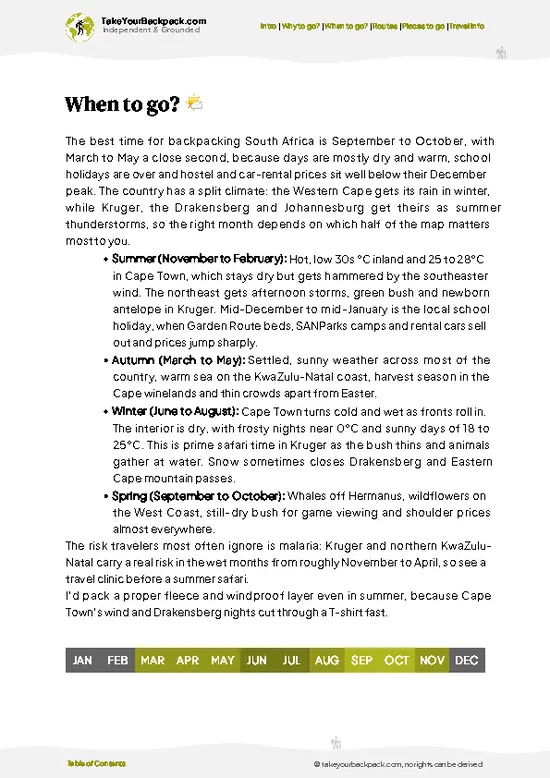
source: climatestotravel.comJANJanuary: good for travelingFEBFebruary: good for travelingMARMarch: highly recommended for travelingAPRApril: highly recommended for travelingMAYMay: highly recommended for travelingJUNJune: highly recommended for travelingJULJuly: fair for travelingAUGAugust: excellent for travelingSEPSeptember: excellent for travelingOCTOctober: highly recommended for travelingNOVNovember: good for travelingDECDecember: fair for traveling
when-to-go

✈️ The backpacker research shortcutSouth Africa Travel Guide

An offline-friendly backpacking guide with optimized travel routes, ranked highlights, transport advice, and the best areas to stay.
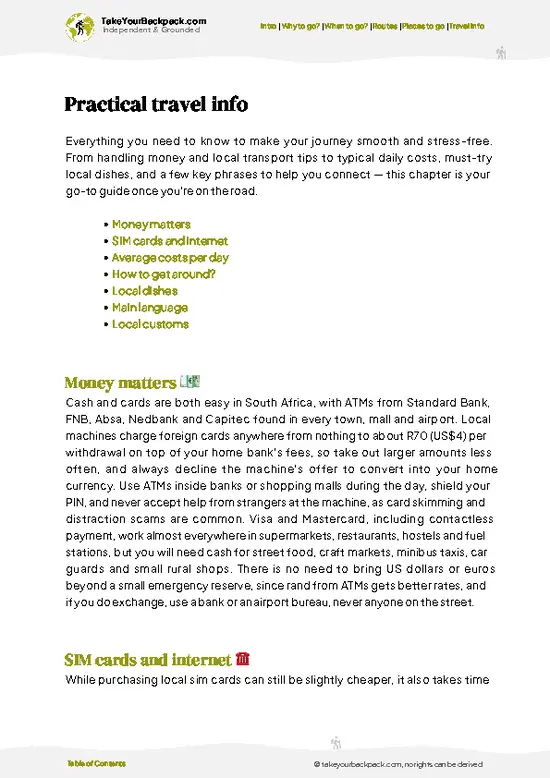
example page 0 from our offline Travel Guide for South Africa
example page 1 from our offline Travel Guide for South Africa
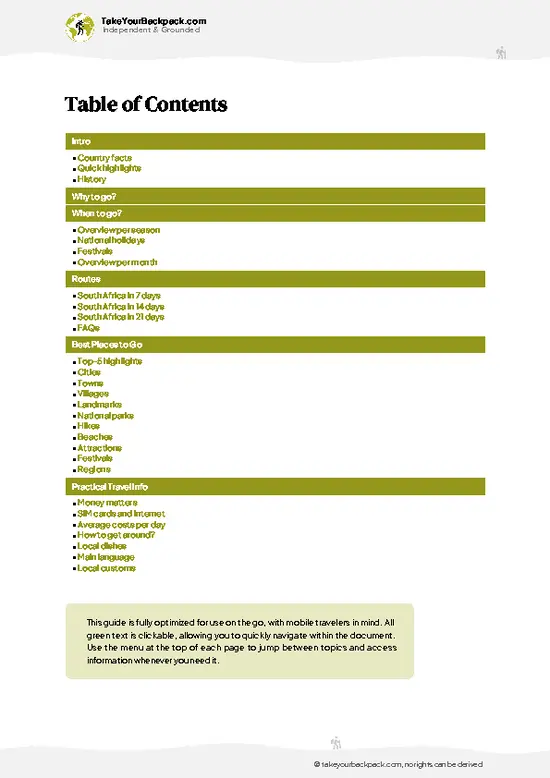
example page 2 from our offline Travel Guide for South Africa
example page 3 from our offline Travel Guide for South Africa
example page 4 from our offline Travel Guide for South Africa
example page 5 from our offline Travel Guide for South Africa
example page 6 from our offline Travel Guide for South Africa
example page 7 from our offline Travel Guide for South Africa
The digital guide (453 pages) contains:
129 highlights, ranked by travel appeal
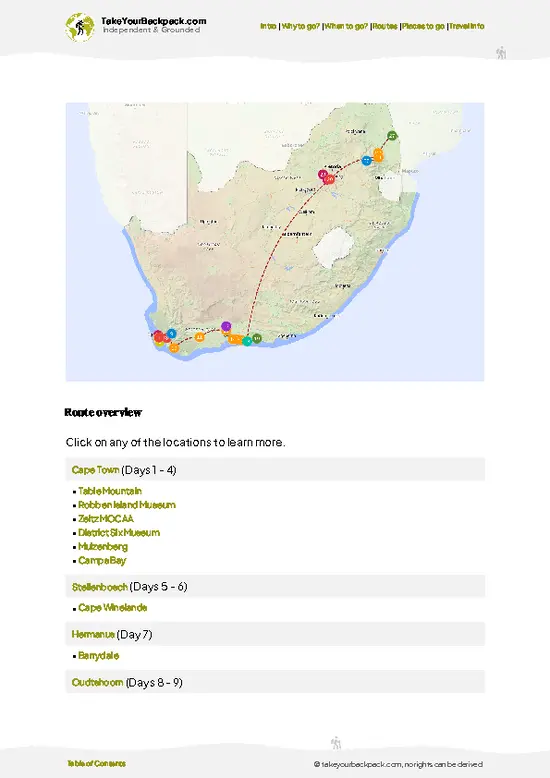
Optimized 7, 14 & 21-day travel routes
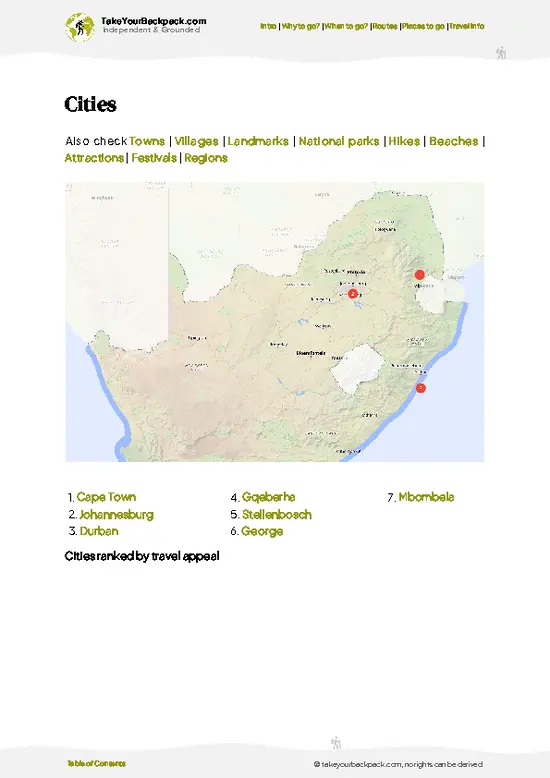
Cities, national parks, landmarks, beaches
How to get around
Offline-friendly for travel without Wi-Fi
👉 Click to see all 30+ guide features

📅 Plan smarter in minutes, not weeks
Month by month travel advice
Festivals & national holidays
Budget expectations

🗺️ Go to the right places, skip the overrated ones
Honest pros & cons of destinations
Top hikes, parks & viewpoints
Lesser-known places most travelers miss
Clear “worth it vs skip it” guidance

🛏️ Travel smoothly without rookie mistakes
Best areas to stay
Transport systems explained simply
Common scams & safety advice
SIM cards, money & practical tips

🌍 Understand the country, not just visit it
Culture & traditions
Local customs
Festivals worth planning around
Traveler-friendly historical context
Insights that make places more meaningful

📱 Built for real travel conditions
Fully downloadable PDF
Works completely offline
Optimized for phone use
Useful in remote areas & buses
Everything in one place
Save weeks of stressful planning
Get instant access to your full guide. 30‑day money-back guarantee.


By proceeding you agree to our terms.
Sent to your inbox immediately after payment • 100% Secure Checkout
Best Backpacking Travel Advisor 2025 tourism awardBest Backpacking
Travel Advisor
2025
What others say about Take Your Backpack Guides:
⭐⭐⭐⭐⭐
Fantastic, amazing amount of information!
⭐⭐⭐⭐⭐
My goodness this is amazing, it's what I've been looking for hats off too you!
⭐⭐⭐⭐⭐
I think this is absolutely BRILLIANT
⭐⭐⭐⭐
Very complete and informative. It's still missing places, but I gotta to commend you
⭐⭐⭐⭐⭐
This is truly amazing, thank you, can't wait to explore it with my kids!
⭐⭐⭐⭐⭐
Awesome resource, thank you!
⭐⭐⭐⭐⭐
This is amazing! Can't wait to explore the ones I haven't seen
⭐⭐⭐⭐
I love this! Well done, great idea.
⭐⭐⭐⭐⭐
Thanks for taking the time to make this gem!
⭐⭐⭐⭐⭐
This might be the best website I've ever seen.
⭐⭐⭐⭐⭐
Congratulations, and thank you so much for your work; it's incredibly valuable.
⭐⭐⭐⭐
In all seriousness I think you did a great job pointing out the important spots
⭐⭐⭐⭐⭐
10/10 very good
⭐⭐⭐⭐⭐
As someone who's only just starting to visit regularly this is awesome, thank you.
⭐⭐⭐⭐
Thank you very much! I'm going to visit my dad, it's going to be very useful!
⭐⭐⭐⭐⭐
This is really cool! We'll be travelling for the first time and this definitely come in handy.
⭐⭐⭐⭐⭐
You are now our minister of culture, congratulations 👨‍💼
⭐⭐⭐⭐⭐
Just wanted to tell you that this is a pearl! Going to follow your recommendations.
⭐⭐⭐⭐⭐
This is so cool. I'll definitely be using the resource for my travels soon.
⭐⭐⭐⭐⭐
This is very impressive! Good work.
⭐⭐⭐⭐⭐
This is an amazing and informative site. Very well done!

🛏️ Where to stay?Best areas to stay in South Africa

Mokala National Park offers limited accommodation options, but they’re solid choices for backpackers. Inside the park, the Mokala Rest Camp provides basic yet comfortable chalets and campsites. It’s a great spot to immerse yourself in nature without breaking the bank.

If you prefer to stay outside the park, the nearby town of Kimberley has budget-friendly guesthouses and hostels. This gives you access to local culture and amenities while keeping you close to the park. Just be aware of the distance; it’s about an hour’s drive back to the park entrance. Plan your trips wisely to maximize your time in the wild.

👛 Costs (as of 4 July 2026)What things cost and how to budget

Mokala National Park in South Africa offers a range of costs that can catch you off guard if you’re not prepared.

Entry fees for adults typically range from $10 to $15. Children often pay about half that. If you’re planning to stay overnight, accommodation options vary widely. Campsites can cost around $10 to $20 per person per night. For more comfort, chalets or lodges can set you back anywhere from $50 to $150 per night, depending on the season and availability.

Don’t forget about additional costs. Guided game drives can run between $30 and $60 per person. If you’re keen on self-driving, ensure your vehicle is suitable for the terrain; some roads can be rough. Fuel prices in South Africa fluctuate, so budget accordingly.

Food and drink are another consideration. If you’re self-catering, … read more 👉
Mokala National Park in South Africa offers a range of costs that can catch you off guard if you’re not prepared.

Entry fees for adults typically range from $10 to $15. Children often pay about half that. If you’re planning to stay overnight, accommodation options vary widely. Campsites can cost around $10 to $20 per person per night. For more comfort, chalets or lodges can set you back anywhere from $50 to $150 per night, depending on the season and availability.

Don’t forget about additional costs. Guided game drives can run between $30 and $60 per person. If you’re keen on self-driving, ensure your vehicle is suitable for the terrain; some roads can be rough. Fuel prices in South Africa fluctuate, so budget accordingly.

Food and drink are another consideration. If you’re self-catering, grocery prices are reasonable, but dining at park facilities can be pricier, with meals averaging $10 to $25.

Plan for these costs upfront. It helps preserve your energy and budget for the experiences that truly matter.
⚠️ Prices can change and everyone travels differently, so take this as a rough guide. Hope it helps you plan your adventure!

🥾 TrailsPlan your hike in Mokala: routes, terrain, and sights

Mokala National Park is a hidden gem in South Africa, perfect for those who appreciate wide-open spaces and unique landscapes. The park is characterized by its rolling hills and savannah, making it a scenic spot for hiking. The terrain varies from flat plains to gentle slopes, and you’ll often find yourself surrounded by acacia trees and the occasional rocky outcrop. Wildlife is abundant here, with species like giraffes, springboks, and even the elusive black rhino roaming the area.

There are a couple of designated trails that cater to different hiking preferences. One of the standout options … read more 👉
Mokala National Park is a hidden gem in South Africa, perfect for those who appreciate wide-open spaces and unique landscapes. The park is characterized by its rolling hills and savannah, making it a scenic spot for hiking. The terrain varies from flat plains to gentle slopes, and you’ll often find yourself surrounded by acacia trees and the occasional rocky outcrop. Wildlife is abundant here, with species like giraffes, springboks, and even the elusive black rhino roaming the area.

There are a couple of designated trails that cater to different hiking preferences. One of the standout options is the Mokala Hiking Trail. Here are the details:
  • Length: 10 km
  • Estimated Duration: 3-4 hours
  • Difficulty Level: Moderate
  • Key Features: Scenic views, diverse flora, and fauna
  • Terrain: Mix of flat and slightly hilly areas

Another option is the Letseng Trail. This one’s a bit shorter but still offers great sights:
  • Length: 5 km
  • Estimated Duration: 1.5-2 hours
  • Difficulty Level: Easy
  • Key Features: Good for birdwatching, beautiful landscapes
  • Terrain: Mostly flat with a few gentle inclines

Getting to Mokala National Park can be a bit of a trek, as public transport options are limited. It’s best accessed by car, but if you’re relying on buses, you might have to get creative with connections from nearby towns like Kimberley. Expect a relatively serene experience; it’s not usually overcrowded, so you can enjoy the trails without feeling rushed. As for the entrance fee, it’s quite reasonable, making it a budget-friendly choice for nature lovers. Just check the latest rates before you go, as they can fluctuate.
⚠️ Hiking info can sometimes be outdated or inaccurate. Before you hit the trail, check the latest conditions with locals. If you do spot anything that's off, I'd love to hear from you, so I can update it for fellow travelers.

🛡️ SafetyTraveler Safety Guide

Mokala National Park is generally straightforward for backpackers, but a few practical considerations can enhance your experience. Weather can shift quickly, so pack layers and be ready for sun or sudden rain. The terrain is mostly flat, but some trails have uneven footing; sturdy shoes are essential. Wildlife encounters are possible, so keep a respectful distance—don’t approach animals, and store food securely. Timing your hikes for early morning or late afternoon helps avoid the heat. Stay aware, and you’ll enjoy the park’s beauty without unnecessary stress.

Other South African national parks near Mokala

Explore more nearby:


💡 Not sure where to go next?
Create a personalized itinerary for South Africa including Mokala and the places that fit your trip.

Generate my itinerary

👉 Discover all national parks

Or checkout all South Africa has to offer (think cities, towns, villages, national parks, hikes, beaches, festivals)
Country photo of South Africa

We 💚 feedbackSumming up the experience

Mokala National Park offers a unique chance to see rare wildlife, like the endangered roan antelope, in a serene setting. But be ready for the heat; it can be intense, especially in summer. Hydration and timing your hikes are key to enjoying this beautiful park.

✈️ When did I visit South Africa?
I have visited South Africa, before and after my Zimbabwe trip in 2001.

✍️ Help improve this page!
The information on this page is based on my own backpacking experience in South Africa, supplemented with up-to-date research and feedback from other travelers. Travel details can change, so if you notice anything outdated or incomplete, feel free to let me know.


🙋‍♂️ Give feedback

👋 Meet the founderWho’s Behind Take Your Backpack?

Johan, backpacker and founder of TakeYourBackpackHi, I’m Johan (Netherlands 🇳🇱), the creator of TakeYourBackpack. Over the past decade, I’ve backpacked through 80+ countries across six continents, gaining extensive experience with independent travel, long-term trips, and overland routes.

This site is built on a combination of firsthand travel experience and carefully curated insights from other backpackers. Many guides are based on places I’ve personally visited, while others bring together tips, observations, and practical advice shared by trusted travelers I’ve met along the way.

The goal is to provide realistic, experience-driven guidance — not generic itineraries — so you can explore destinations with better context, clearer expectations, and more confidence.

Get full country guide •
Instant download • 129 highlights • Full Offline guide