×

South Sudan🇸🇸 | national parksBandingilo National ParkWhite-eared kob herds, Mongalla gazelle, Nile floodplain, ranger walks | things to do and best time to go

Explore Jebel Kujur TrailExplore Boma National Park

Backpacking in Bandingilo
🌟 Highlightnational park ranked #3
By Johan Kruseman 🇳🇱 | Updated October 22, 2026

Bandingilo National Park gives you one of Africa’s great antelope movements without a single tour bus in sight, because almost nobody goes. The park sits in the south of South Sudan, north of Juba on the Nile’s east side, in open grassland and seasonal floodplain. On the ground you walk or drive flat, grassy tracks with long horizons, and the reward is herds of white-eared kob, tiang and Mongalla gazelle moving across the plain. There are no marked viewpoints or visitor centers, and getting here needs planning, local contacts and current security advice. Skip it if you want ticked-off sights, easy buses or a comfortable lodge. Go if you are experienced, patient and happy with rough logistics. Wildlife watchers and independent travelers with a high tolerance for uncertainty will like it most. First-timers and anyone short on time won’t.

Discover everything you want to know in the 📖 South Sudan Travel Guide.
Safety warning

The current risk level for South Sudan is high. Check the advice before going.


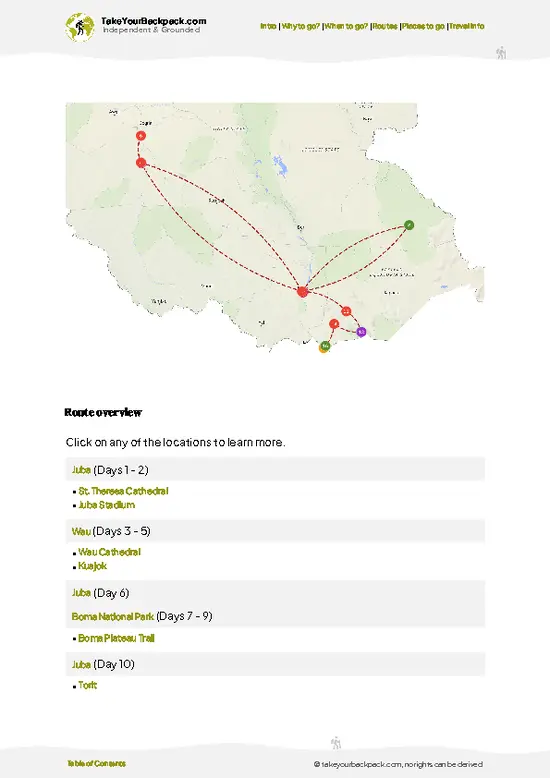
example page 0 from our offline Travel Guide for South Sudan
example page 1 from our offline Travel Guide for South Sudan
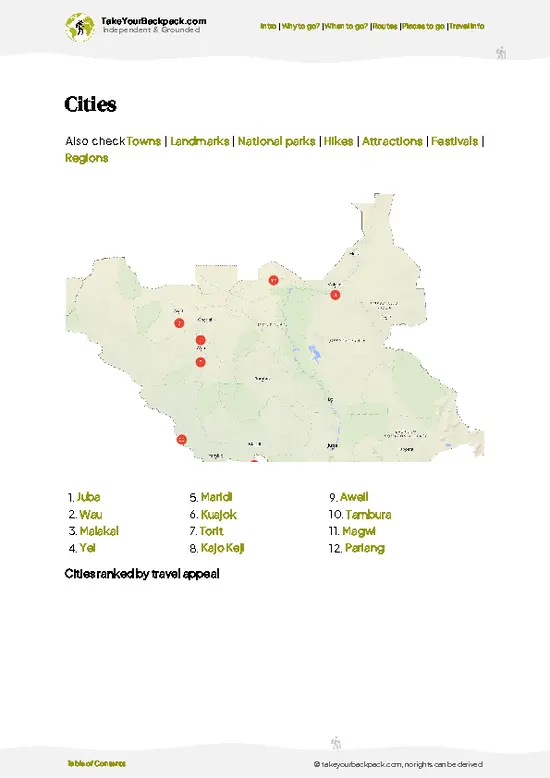
example page 2 from our offline Travel Guide for South Sudan
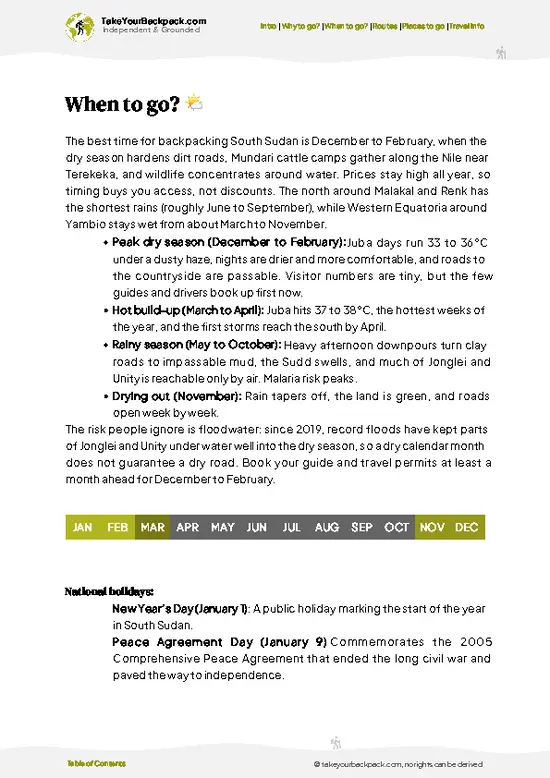
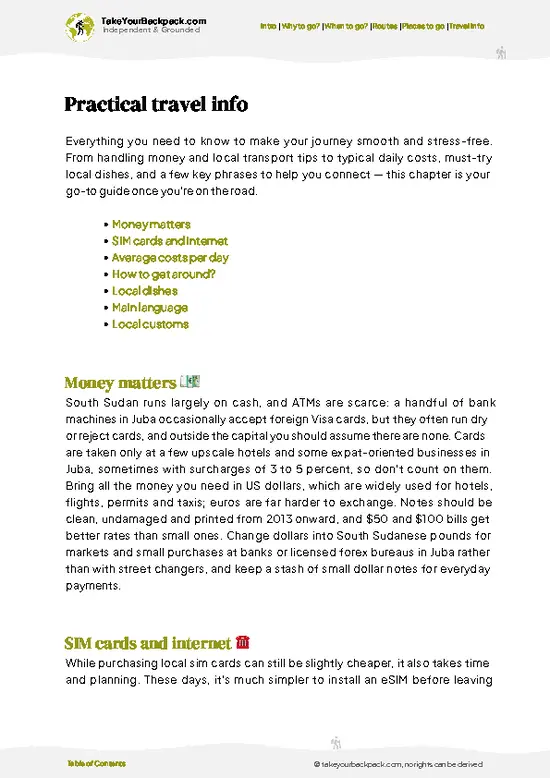
example page 3 from our offline Travel Guide for South Sudan
example page 4 from our offline Travel Guide for South Sudan
example page 5 from our offline Travel Guide for South Sudan
example page 6 from our offline Travel Guide for South Sudan
example page 7 from our offline Travel Guide for South Sudan
Loading the map 🌍
CLICK TO FILTER
cities
towns
landmarks
national parks
hikes
attractions
festivals
regions
SHOW COUNTRY’S BESTSHOW ALL

✨ Why go?
Ranked #3 national park in South Sudan
What sets this place apart

Bandingilo National Park attracts a very small group of backpackers for one reason: the Boma-Jonglei migration, among the largest land mammal movements on Earth, passes through this landscape. Seeing it means you are outside any standard circuit, with no queue and nobody selling you a package.
The park also suits self-reliant travelers because the terrain is open. You read the land yourself: white-eared kob bunching on the grass, tiang trailing behind, birds working the wet margins. There is no tour infrastructure to hide behind, so every day is built from local knowledge, ranger contacts and your own judgment.
Finally, Bandingilo National Park is close to the Nile corridor, so a trip can be combined with time on the river near Mongalla. That makes it a place to go if you want wildlife and rural … read more 👉
Bandingilo National Park attracts a very small group of backpackers for one reason: the Boma-Jonglei migration, among the largest land mammal movements on Earth, passes through this landscape. Seeing it means you are outside any standard circuit, with no queue and nobody selling you a package.
The park also suits self-reliant travelers because the terrain is open. You read the land yourself: white-eared kob bunching on the grass, tiang trailing behind, birds working the wet margins. There is no tour infrastructure to hide behind, so every day is built from local knowledge, ranger contacts and your own judgment.
Finally, Bandingilo National Park is close to the Nile corridor, so a trip can be combined with time on the river near Mongalla. That makes it a place to go if you want wildlife and rural South Sudan in one trip, and are willing to accept that the effort is real and the facilities are close to nonexistent.

💡 HighlightsKey sights and experiences for travelers

  1. White-eared kob migration: The park’s defining spectacle. Huge herds of these lyre-horned antelope move across the grassland following the rains and fresh grazing, and the dust and sound of them is the reason people come at all.
  2. Tiang herds: This large, dark-faced subspecies of topi travels with the kob. Standing on termite mounds as lookouts, the animals are easy to spot against the flat horizon.
  3. Mongalla gazelle: A pale, slender gazelle of the southern savanna that is a regional specialty. Watch for small groups at the edge of the bigger herds, often alert and quick to bolt.
  4. Bohor reedbuck and other grassland antelope: Look in tall grass near drainage lines and wetter ground, where reedbuck freeze and then spring away in sharp, bouncing runs.
  5. Floodplain birdlife: Seasonal pools and wet grassland
… read more 👉
  1. White-eared kob migration: The park’s defining spectacle. Huge herds of these lyre-horned antelope move across the grassland following the rains and fresh grazing, and the dust and sound of them is the reason people come at all.
  2. Tiang herds: This large, dark-faced subspecies of topi travels with the kob. Standing on termite mounds as lookouts, the animals are easy to spot against the flat horizon.
  3. Mongalla gazelle: A pale, slender gazelle of the southern savanna that is a regional specialty. Watch for small groups at the edge of the bigger herds, often alert and quick to bolt.
  4. Bohor reedbuck and other grassland antelope: Look in tall grass near drainage lines and wetter ground, where reedbuck freeze and then spring away in sharp, bouncing runs.
  5. Floodplain birdlife: Seasonal pools and wet grassland draw waterbirds and raptors. Bring binoculars and spend time at the water’s edge rather than driving past.
  6. Nile edge near Mongalla: The river bounds this landscape. Broad, slow water, papyrus and fishing canoes give a calm contrast to the dry plains.
  7. Open savanna walks with a ranger: Walking the grassland at animal pace shows details a vehicle misses: tracks, dung middens, termite towers and the smell of crushed grass.
Bandingilo National Park works best if you pair the Nile edge with the kob and tiang herds on the same day, since the river and the plains are close enough to combine in one outing.
Spotted a mistake or missing something? Contact us.

🌤️ When to go?Choosing the right time of year

  • Dry Season (December to March): Grass burns off or dries, tracks harden and animals gather along the Nile. Days run 32 to 38°C (90 to 100°F), nights 20 to 24°C (68 to 75°F). Daylight stays near 12 hours. Access is easiest and Juba hotel and vehicle hire prices peak.
  • Early Rains (April to June): Storms build in the afternoon, grass shoots up and visibility drops. Highs of 30 to 35°C (86 to 95°F). Roads turn to slick black cotton mud in places, so transfers slow down.
  • Peak Rains (July to October): Heavy downpours, 26 to 31°C (79 to 88°F), flooded tracks and swarming insects. Many routes close and operators rarely run trips. Rates drop, but you gain little.
  • Late Rains (November): Tracks begin to dry, skies clear and the landscape is green. Temperatures of 30 to 34°C (86 to 93°F). Crowds are essentially
… read more 👉
  • Dry Season (December to March): Grass burns off or dries, tracks harden and animals gather along the Nile. Days run 32 to 38°C (90 to 100°F), nights 20 to 24°C (68 to 75°F). Daylight stays near 12 hours. Access is easiest and Juba hotel and vehicle hire prices peak.
  • Early Rains (April to June): Storms build in the afternoon, grass shoots up and visibility drops. Highs of 30 to 35°C (86 to 95°F). Roads turn to slick black cotton mud in places, so transfers slow down.
  • Peak Rains (July to October): Heavy downpours, 26 to 31°C (79 to 88°F), flooded tracks and swarming insects. Many routes close and operators rarely run trips. Rates drop, but you gain little.
  • Late Rains (November): Tracks begin to dry, skies clear and the landscape is green. Temperatures of 30 to 34°C (86 to 93°F). Crowds are essentially absent all year.
Bandingilo has no regular visitor season, so book a guide and vehicle for January or February and confirm road conditions a few days before leaving Juba.


source: climatestotravel.comJANJanuary: highly recommended for travelingFEBFebruary: highly recommended for travelingMARMarch: excellent for travelingAPRApril: excellent for travelingMAYMay: fair for travelingJUNJune: below average for travelingJULJuly: below average for travelingAUGAugust: below average for travelingSEPSeptember: fair for travelingOCTOctober: fair for travelingNOVNovember: good for travelingDECDecember: highly recommended for traveling
when-to-go

✈️ The backpacker research shortcutSouth Sudan Travel Guide

An offline-friendly backpacking guide with optimized travel routes, ranked highlights, transport advice, and the best areas to stay.
example page 0 from our offline Travel Guide for South Sudan
example page 1 from our offline Travel Guide for South Sudan
example page 2 from our offline Travel Guide for South Sudan
example page 3 from our offline Travel Guide for South Sudan
example page 4 from our offline Travel Guide for South Sudan
example page 5 from our offline Travel Guide for South Sudan
example page 6 from our offline Travel Guide for South Sudan
example page 7 from our offline Travel Guide for South Sudan
The digital guide (242 pages) contains:
✅ 57 highlights, ranked by travel appeal
✅ Optimized 5, 10 & 15-day travel routes
✅ Cities, national parks, landmarks, beaches
✅ How to get around
✅ Offline-friendly for travel without Wi-Fi
👉 Click to see all 30+ guide features

📅 Plan smarter in minutes, not weeks
✅ Month by month travel advice
✅ Festivals & national holidays
✅ Budget expectations

🗺️ Go to the right places, skip the overrated ones
✅ Honest pros & cons of destinations
✅ Top hikes, parks & viewpoints
✅ Lesser-known places most travelers miss
✅ Clear “worth it vs skip it” guidance

🛏️ Travel smoothly without rookie mistakes
✅ Best areas to stay
✅ Transport systems explained simply
✅ Common scams & safety advice
✅ SIM cards, money & practical tips

🌍 Understand the country, not just visit it
✅ Culture & traditions
✅ 52 Essential phrases & customs
✅ Festivals worth planning around
✅ Traveler-friendly historical context
✅ Insights that make places more meaningful

📱 Built for real travel conditions
✅ Fully downloadable PDF
✅ Works completely offline
✅ Optimized for phone use
✅ Useful in remote areas & buses
✅ Everything in one place
Stop searching, start planning
Get instant access to your full guide. 30‑day money-back guarantee.
+ Add another guide for just

By proceeding you agree to our terms.
Sent to your inbox immediately after payment • 100% Secure Checkout
Best Backpacking Travel Advisor 2025 tourism awardBest Backpacking
Travel Advisor
2025
What others say about Take Your Backpack Guides:
⭐⭐⭐⭐⭐
Fantastic, amazing amount of information!
⭐⭐⭐⭐⭐
My goodness this is amazing, it's what I've been looking for hats off too you!
⭐⭐⭐⭐⭐
I think this is absolutely BRILLIANT
⭐⭐⭐⭐
Very complete and informative. It's still missing places, but I gotta to commend you
⭐⭐⭐⭐⭐
This is truly amazing, thank you, can't wait to explore it with my kids!
⭐⭐⭐⭐⭐
Awesome resource, thank you!
⭐⭐⭐⭐⭐
This is amazing! Can't wait to explore the ones I haven't seen
⭐⭐⭐⭐
I love this! Well done, great idea.
⭐⭐⭐⭐⭐
Thanks for taking the time to make this gem!
⭐⭐⭐⭐⭐
This might be the best website I've ever seen.
⭐⭐⭐⭐⭐
Congratulations, and thank you so much for your work; it's incredibly valuable.
⭐⭐⭐⭐
In all seriousness I think you did a great job pointing out the important spots
⭐⭐⭐⭐⭐
10/10 very good
⭐⭐⭐⭐⭐
As someone who's only just starting to visit regularly this is awesome, thank you.
⭐⭐⭐⭐
Thank you very much! I'm going to visit my dad, it's going to be very useful!
⭐⭐⭐⭐⭐
This is really cool! We'll be travelling for the first time and this definitely come in handy.
⭐⭐⭐⭐⭐
You are now our minister of culture, congratulations 👨‍💼
⭐⭐⭐⭐⭐
Just wanted to tell you that this is a pearl! Going to follow your recommendations.
⭐⭐⭐⭐⭐
This is so cool. I'll definitely be using the resource for my travels soon.
⭐⭐⭐⭐⭐
This is very impressive! Good work.
⭐⭐⭐⭐⭐
This is an amazing and informative site. Very well done!

🛏️ Where to stay?Best areas and accommodation options

No lodges or campsites operate inside Bandingilo National Park, so your base is Juba, the capital, roughly 150 to 200 km north of the park by road, a long day over rough tracks. Plan the park as an organized expedition rather than a drop-in visit.

In Juba, the cheapest beds are in basic guesthouses and hostel-style rooms at US$30 to 60 a night, often with a fan, a shared bathroom and unreliable power. Mid-range hotels with air conditioning, generators and a restaurant run US$80 to 150. Most are around Tongping, Hai Jebel and the Nile riverfront. Camps on the Nile outside town, such as those on … read more 👉
No lodges or campsites operate inside Bandingilo National Park, so your base is Juba, the capital, roughly 150 to 200 km north of the park by road, a long day over rough tracks. Plan the park as an organized expedition rather than a drop-in visit.

In Juba, the cheapest beds are in basic guesthouses and hostel-style rooms at US$30 to 60 a night, often with a fan, a shared bathroom and unreliable power. Mid-range hotels with air conditioning, generators and a restaurant run US$80 to 150. Most are around Tongping, Hai Jebel and the Nile riverfront. Camps on the Nile outside town, such as those on the river bank, offer tents or huts from about US$60 to 120 and a calmer night.

Nearer the park, the small towns along the Juba to Terekeka route have only simple local lodgings with minimal facilities, and I would not count on them. If you go with a registered tour operator or a conservation partner, they usually arrange tented bush camping along the Nile, which is the practical choice. Bring your own tent, water filter, food and fuel, and book Juba rooms ahead since the good ones fill quickly with aid workers.

👛 Costs (as of 22 October 2026)What things cost and how to budget

A day at Bandingilo National Park costs roughly US$0 to 30 for one traveler, and the total daily budget works out at US$290 when you travel with an operator. Almost everything is priced in US dollars and imported goods are costly.
CategoryBudget RangeLocal Reality
Entrance and permitsUS$0 to 30No standard ticket office. Operators usually arrange access and any local fees.
Accommodation (high season)US$30 to 120Juba guesthouse or hotel. Bush camping with your own tent costs little.
Local transportUS$80 to 150A hired 4x4 with driver, split between passengers. Boda-bodas and shared minibuses stop well short of the park.
Guide and securityUS$30 to 60Local guide or escort, essential for access and route knowledge.
Food and suppliesUS$20 to 40Juba restaurants and markets are pricey. Stock water, canned
… read more 👉
A day at Bandingilo National Park costs roughly US$0 to 30 for one traveler, and the total daily budget works out at US$290 when you travel with an operator. Almost everything is priced in US dollars and imported goods are costly.
CategoryBudget RangeLocal Reality
Entrance and permitsUS$0 to 30No standard ticket office. Operators usually arrange access and any local fees.
Accommodation (high season)US$30 to 120Juba guesthouse or hotel. Bush camping with your own tent costs little.
Local transportUS$80 to 150A hired 4x4 with driver, split between passengers. Boda-bodas and shared minibuses stop well short of the park.
Guide and securityUS$30 to 60Local guide or escort, essential for access and route knowledge.
Food and suppliesUS$20 to 40Juba restaurants and markets are pricey. Stock water, canned food and fuel before leaving town.
Total Daily BudgetUS$290Lower if you share a vehicle among several travelers.
⚠️ Prices can change and everyone travels differently, so take this as a rough guide. Hope it helps you plan your adventure!

🥾 TrailsHiking Bandingilo national park: highlights and difficulty

Bandingilo National Park has no signed trail network, so hiking here means ranger-led walks across open savanna and floodplain edges. The ground is flat, grassy and sun-exposed, easy on legs but hard on skin and water supplies. Most walks are built around finding the herds.
  • Savanna herd walk: Start from your camp or ranger post and follow game tracks onto the grassland. Allow half a day. Easy gradient, but the heat is serious, and you move slowly to avoid scattering animals. You pass termite mounds, scattered trees and grazing kob and tiang.
  • Floodplain edge walk: Follow the wetter margins where
… read more 👉
Bandingilo National Park has no signed trail network, so hiking here means ranger-led walks across open savanna and floodplain edges. The ground is flat, grassy and sun-exposed, easy on legs but hard on skin and water supplies. Most walks are built around finding the herds.
  • Savanna herd walk: Start from your camp or ranger post and follow game tracks onto the grassland. Allow half a day. Easy gradient, but the heat is serious, and you move slowly to avoid scattering animals. You pass termite mounds, scattered trees and grazing kob and tiang.
  • Floodplain edge walk: Follow the wetter margins where grass turns greener and waterbirds gather. Allow two to three hours. The ground can be soft or muddy after rain, and you may see Bohor reedbuck and gazelle on the drier rises.
  • Nile bank stroll near Mongalla: A short, flat walk along the river to watch fishing canoes and papyrus. Easy and low effort, a good counterpoint to the dry plains.
  • Full-day tracking: Longer outings with a ranger covering large stretches of grassland in search of the main herds. Moderate difficulty, mainly because of heat, distance and the lack of shade.
Carry more water than you think you need, wear a wide-brimmed hat and cover your skin. Wildlife is the draw, so move quietly and let the ranger lead. Buffalo and other large animals can be present, and walking without an armed or experienced guide is not sensible.
Bandingilo National Park is reached by road from Juba, and there is no scheduled public transport to the park itself, so travelers usually arrange a hired vehicle or a lift through contacts. Crowds are essentially absent. Entry arrangements go through the wildlife authorities and local officials, and security conditions along the route can change quickly, so check locally before you set out.
⚠️ Hiking info can sometimes be outdated or inaccurate. Before you hit the trail, check the latest conditions with locals. If you do spot anything that's off, I'd love to hear from you, so I can update it for fellow travelers.

🛡️ SafetySafety Tips and Common Scams in Bandingilo

Bandingilo is remote and unmanaged by visitor standards, so the main risks are logistical rather than wildlife. Do not go without a local guide or operator who knows current conditions, since security in parts of South Sudan changes quickly and checkpoints, cattle-camp tensions and rural roads all matter. Check travel advisories and register with your embassy before leaving Juba.

Heat is the daily hazard. Carry at least 4 to 5 liters of water per person, wear a hat and start walking at first light. Tracks flood in the rains and vehicles get stuck, so travel in two vehicles with recovery gear in the wet months. Malaria is present year-round, so take prophylaxis, repellent and a net. Hippos and crocodiles live along the Nile, so keep well back from the water edge and never swim. Elephants and … read more 👉
Bandingilo is remote and unmanaged by visitor standards, so the main risks are logistical rather than wildlife. Do not go without a local guide or operator who knows current conditions, since security in parts of South Sudan changes quickly and checkpoints, cattle-camp tensions and rural roads all matter. Check travel advisories and register with your embassy before leaving Juba.

Heat is the daily hazard. Carry at least 4 to 5 liters of water per person, wear a hat and start walking at first light. Tracks flood in the rains and vehicles get stuck, so travel in two vehicles with recovery gear in the wet months. Malaria is present year-round, so take prophylaxis, repellent and a net. Hippos and crocodiles live along the Nile, so keep well back from the water edge and never swim. Elephants and buffalo are possible; keep distance, stay downwind and follow your guide. Carry a satellite phone, since mobile coverage is patchy to absent.

FAQFrequently asked questions about Bandingilo

Plan on 3 to 5 days for Bandingilo National Park, including a full day each way from Juba over rough roads. That gives you one or two days on the ground for game viewing near the Nile. Add a spare day in the wet months, because flooded tracks can delay the return.
Bandingilo National Park is very difficult without a vehicle, since no public transport reaches it. Juba lies roughly 150 to 200 km away, and the last stretches are unpaved tracks that need a 4x4. Hiring a vehicle and driver costs about US$80 to 150 a day, usually shared through a Juba tour operator.
Bandingilo National Park has no standard ticket booth, and fees and permits are generally arranged through your operator or the wildlife authority in Juba. Expect to pay roughly US$0 to 30 for access, plus a local guide or escort at about US$30 to 60 a day. Confirm requirements before leaving Juba and carry your passport, visa and any travel permits for checkpoints.
⚠️ Things can change over time, so always validate details locally before you go.

Other South Sudanese national parks near Bandingilo

Explore more nearby:


💡 Not sure where to go next?
Create a personalized itinerary for South Sudan including Bandingilo and the places that fit your trip.

Generate my itinerary

👉 Discover all national parks

Or checkout all South Sudan has to offer (think cities, towns, villages, national parks, hikes, beaches, festivals)
Country photo of South Sudan

We 💚 feedbackWhat to keep in mind

Bandingilo National Park rewards those who watch the termite mounds. Tiang stand on them as lookouts, which tells you where the herd is heading before you see it, and the best photos come when you stop moving and wait. I would bring a good pair of binoculars, a thick hat and a ranger you trust, and skip any plan that depends on tight schedules.

✍️ Help improve this page!
The information on this page is based on in-depth research, insights shared by experienced travelers, and feedback from the local travel community in South Sudan. While every effort is made to keep the information accurate and current, conditions can change — so if you spot anything incorrect or outdated, please get in touch.


🙋‍♂️ Give feedback

👋 Meet the founderWho’s Behind Take Your Backpack?

Johan, backpacker and founder of TakeYourBackpackHi, I’m Johan (Netherlands 🇳🇱), the creator of TakeYourBackpack. Over the past 3 decades, I’ve backpacked through 90+ countries across six continents, gaining extensive experience with independent travel, long-term trips, and overland routes.

This site is built on a combination of firsthand travel experience and carefully curated insights from other backpackers. Many guides are based on places I’ve personally visited, while others bring together tips, observations, and practical advice shared by trusted travelers I’ve met along the way.

The goal is to provide realistic, experience-driven guidance — not generic itineraries — so you can explore destinations with better context, clearer expectations, and more confidence.