×

South Sudan🇸🇸 | citiesMalakalNile port, fishing landings, Shilluk elders, mixed-community market | things to do and best time to go

Explore Kajo KejiExplore Wau

Backpacking in Malakal
🏆 Top pickcity ranked #3
By Johan Kruseman 🇳🇱 | Updated October 22, 2026

Malakal suits experienced, independent travelers with a real reason to be here (research, reporting, aid work, or local contacts) and the patience to watch a Nile river town work. Casual sightseers and anyone who wants hostels, bars and a checklist of landmarks will find it unrewarding, because organized tourism barely exists and formal sights are few. Malakal lies in the north of South Sudan, on the west bank of the White Nile, just downstream of where the Sobat River joins it. The riverbank, the market and the mix of Shilluk, Dinka and Nuer residents deserve your time. The war-damaged blocks of the old center and the fenced compounds deserve a quick look at most, and no camera. Years of conflict left the town quieter and thinner than its place on the map suggests. A first day works best like this: reach the river early, walk the market to get your bearings, then spend the afternoon with a local host who can sort out whatever comes next.

Discover everything you want to know in the 📖 South Sudan Travel Guide.
Safety warning

The current risk level for South Sudan is high. Check the advice before going.


example page 0 from our offline Travel Guide for South Sudan
example page 1 from our offline Travel Guide for South Sudan
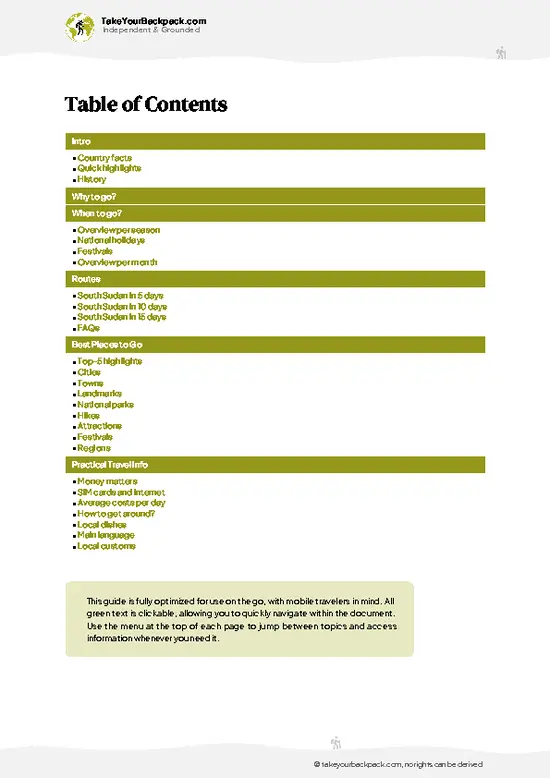
example page 2 from our offline Travel Guide for South Sudan
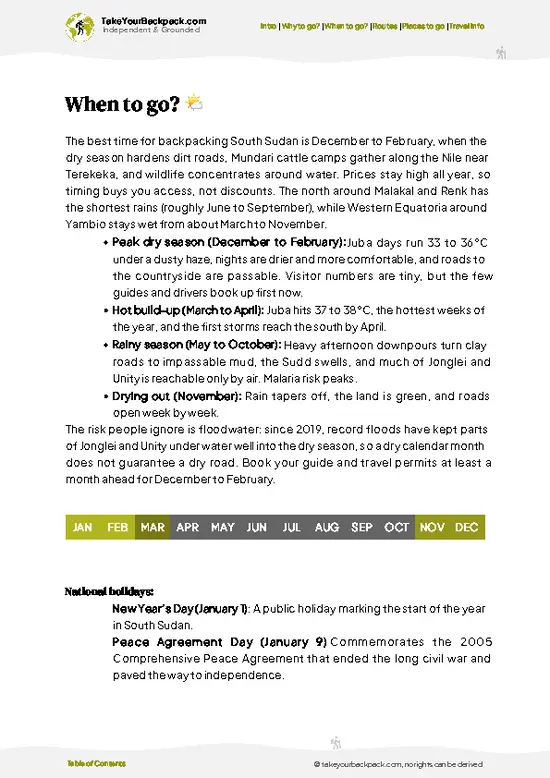
example page 3 from our offline Travel Guide for South Sudan
example page 4 from our offline Travel Guide for South Sudan
example page 5 from our offline Travel Guide for South Sudan
example page 6 from our offline Travel Guide for South Sudan
example page 7 from our offline Travel Guide for South Sudan
Loading the map 🌍
CLICK TO FILTER
cities
towns
landmarks
national parks
hikes
attractions
festivals
regions
SHOW COUNTRY’S BESTSHOW ALL

✨ Why go?
Ranked #3 city in South Sudan
What sets this place apart

Malakal matters on a route because it is the main White Nile river port of Upper Nile State, and almost everything moving between the north, the Sobat valley and the south passes through here. People come to see how a Nile trading town rebuilds itself: fishermen pulling in the catch, traders unloading goods, and neighbors from several communities sharing one market. Anyone interested in the Shilluk Kingdom, whose historic heartland lies a short distance upriver, uses Malakal as the practical gateway and the place to find guides and introductions. It is also one of the few towns in the region with an airstrip and river access in the same place, which makes onward movement more flexible than in most of the north. Be realistic, though. There are no backpacker hostels, no nightlife scene and little … read more 👉
Malakal matters on a route because it is the main White Nile river port of Upper Nile State, and almost everything moving between the north, the Sobat valley and the south passes through here. People come to see how a Nile trading town rebuilds itself: fishermen pulling in the catch, traders unloading goods, and neighbors from several communities sharing one market. Anyone interested in the Shilluk Kingdom, whose historic heartland lies a short distance upriver, uses Malakal as the practical gateway and the place to find guides and introductions. It is also one of the few towns in the region with an airstrip and river access in the same place, which makes onward movement more flexible than in most of the north. Be realistic, though. There are no backpacker hostels, no nightlife scene and little in the way of walkable sightseeing. Think of it as a working base for a purposeful trip, and a short, well-planned stop rather than a place to drift through.

💡 HighlightsWhat this place is best known for

  1. White Nile Riverfront and Port: The town’s reason for existing. Wide brown water, wooden boats, cargo being carried up the bank and women washing clothes at the edge. Go in the early morning when boats come and go. Free, 1 to 2 hours. Ask permission before photographing people or the port.
  2. Malakal Main Market: Fish from the Nile, sorghum, onions, tea stalls and cloth sellers, with traders from several communities working side by side. Mornings are busiest and best. Entry is free, a few dollars buys tea and snacks (US$1 to 3), allow 1 to 2 hours.
  3. Fishing Landing Sites Along the Bank: Away from the main port, small landing points where fishermen sort and sell the catch, a good look at the river economy without any show put on for visitors. Early morning is best. Free, about 1 hour.
  4. Shilluk Cultural
… read more 👉
  1. White Nile Riverfront and Port: The town’s reason for existing. Wide brown water, wooden boats, cargo being carried up the bank and women washing clothes at the edge. Go in the early morning when boats come and go. Free, 1 to 2 hours. Ask permission before photographing people or the port.
  2. Malakal Main Market: Fish from the Nile, sorghum, onions, tea stalls and cloth sellers, with traders from several communities working side by side. Mornings are busiest and best. Entry is free, a few dollars buys tea and snacks (US$1 to 3), allow 1 to 2 hours.
  3. Fishing Landing Sites Along the Bank: Away from the main port, small landing points where fishermen sort and sell the catch, a good look at the river economy without any show put on for visitors. Early morning is best. Free, about 1 hour.
  4. Shilluk Cultural Encounters: Malakal sits at the edge of Shilluk country, and local hosts can introduce you to community elders who explain kingship traditions, the role of the reth and Shilluk history. Arrange it through a trusted contact. Costs vary, a small gift or guide fee of US$10 to 30 is reasonable, 2 to 3 hours.
  5. Malakal Churches on a Sunday: Services in the town’s Catholic and Episcopal congregations bring strong choral singing in several local languages. Visit on Sunday morning, dress modestly and sit at the back. Free, 1 to 2 hours.
Malakal rewards visitors who pair the riverfront with the main market in a single morning, since both are within easy reach of each other and are liveliest early in the day. Beyond town, the old Shilluk capital at Kodok (Fashoda), the Sobat River confluence and the edges of the Sudd wetland are the usual trips for those with time and local support.
Spotted a mistake or missing something? Contact us.

🏘️ NeighborhoodsHow different areas shape the experience

Malakal is small and spread along the east bank of the White Nile, and most of what matters sits within a few kilometers of the river. Treat it as a handful of areas with very different uses.
  • Riverfront and Port: This is the part worth your time. Barges, fishing boats and traders unloading goods give you the clearest picture of how the city lives. Photography needs a permit and an escort, so ask before lifting a camera. It is walkable in the cooler hours.
  • Old Town and Central Market: Colonial-era buildings stand scarred, and the market is the place to eat grilled fish, drink sweet tea and buy phone credit. It is crowded and loud, and it is the most useful area for practical errands. Go in the morning.
  • Airport Road area: Skip it for sightseeing. It holds offices, compounds and checkpoints, and
… read more 👉
Malakal is small and spread along the east bank of the White Nile, and most of what matters sits within a few kilometers of the river. Treat it as a handful of areas with very different uses.
  • Riverfront and Port: This is the part worth your time. Barges, fishing boats and traders unloading goods give you the clearest picture of how the city lives. Photography needs a permit and an escort, so ask before lifting a camera. It is walkable in the cooler hours.
  • Old Town and Central Market: Colonial-era buildings stand scarred, and the market is the place to eat grilled fish, drink sweet tea and buy phone credit. It is crowded and loud, and it is the most useful area for practical errands. Go in the morning.
  • Airport Road area: Skip it for sightseeing. It holds offices, compounds and checkpoints, and you will pass through only to fly in or out. Distances here are too long to walk comfortably.
  • Northern outskirts and Lakes area: Quiet, with open ground and few services. There is little to see, and moving around here without a local contact is not worthwhile.
  • Across the river (Lelo side): Not a place to wander casually. Cross only with a reason and a local guide, since access depends on the situation at the time.

⌛️ 1 dayA smart one-day plan

A river-and-market day, with the White Nile setting the pace and a lot of walking in the heat. Go only if the security situation allows and local contacts confirm the areas are open.
7:00 AM: Malakal river port Start where the Nile does the talking. Fishing boats, barges and people loading sacks fill the bank, and early light is the only comfortable time to stand in the open. Ask permission before you point a camera at anything or anyone, and keep it in your bag if the answer is no. Walk on toward the center along the main road.
9:00 AM: Malakal central market Stalls sell fresh Nile fish, onions, tomatoes, groundnuts, cloth and phone credit, and you hear Arabic, Shilluk, Dinka and Nuer in the same few meters. Buy a bag of groundnuts and watch how the day’s prices move. Browse for about an hour, … read more 👉
A river-and-market day, with the White Nile setting the pace and a lot of walking in the heat. Go only if the security situation allows and local contacts confirm the areas are open.
7:00 AM: Malakal river port Start where the Nile does the talking. Fishing boats, barges and people loading sacks fill the bank, and early light is the only comfortable time to stand in the open. Ask permission before you point a camera at anything or anyone, and keep it in your bag if the answer is no. Walk on toward the center along the main road.
9:00 AM: Malakal central market Stalls sell fresh Nile fish, onions, tomatoes, groundnuts, cloth and phone credit, and you hear Arabic, Shilluk, Dinka and Nuer in the same few meters. Buy a bag of groundnuts and watch how the day’s prices move. Browse for about an hour, then head to a tea seller in the shade.
11:00 AM: Tea stall near the market Sit down for spiced tea or sweet coffee, served in small glasses. It is the easiest way to start a conversation with traders and students, and locals will tell you which roads are passable today. Their advice is more useful than any map.
12:30 PM: Lunch in a riverside eatery Order grilled Nile perch or tilapia with flatbread or rice. Pay in cash, and keep small notes handy. After eating, rest through the hottest hours indoors.
3:30 PM: Old town streets and church grounds This is the part that rarely makes it onto a standard route. Wander the older quarters, where courtyards, shaded mango trees and church compounds show how the town has rebuilt and resettled over decades. Greet people first and keep your pace slow.
5:30 PM: Nile bank at golden hour Finish back at the water as the heat drops, with herders, fishermen and children bathing along the shore. Head back before dark, since power is patchy and streets get dim quickly.

🌤️ When to go?When to go for the best experience

Malakal is hot all year, so timing is about rain, mud and river conditions more than temperature.
  • Dry Season (November to March): Days reach 34 to 38°C (93 to 100°F), nights drop to 20 to 24°C (68 to 75°F). Roads are firm, flights run reliably and the haze can be heavy. Prices for transport and rooms are highest because aid and business travel peaks.
  • Hot Season (April to May): The hottest stretch, with afternoons of 38 to 41°C (100 to 106°F). Midday is hard going, so plan around it.
  • Rainy Season (June to October): Highs of 30 to 34°C (86 to 93°F), heavy downpours and flooding. Dirt roads turn to mud, mosquitoes multiply and overland movement slows or stops. Boats and flights become the realistic options.
Daylight stays close to even all year, so evenings arrive early. Aim for December or January, … read more 👉
Malakal is hot all year, so timing is about rain, mud and river conditions more than temperature.
  • Dry Season (November to March): Days reach 34 to 38°C (93 to 100°F), nights drop to 20 to 24°C (68 to 75°F). Roads are firm, flights run reliably and the haze can be heavy. Prices for transport and rooms are highest because aid and business travel peaks.
  • Hot Season (April to May): The hottest stretch, with afternoons of 38 to 41°C (100 to 106°F). Midday is hard going, so plan around it.
  • Rainy Season (June to October): Highs of 30 to 34°C (86 to 93°F), heavy downpours and flooding. Dirt roads turn to mud, mosquitoes multiply and overland movement slows or stops. Boats and flights become the realistic options.
Daylight stays close to even all year, so evenings arrive early. Aim for December or January, when roads are firm and the heat is manageable.


source: climatestotravel.comJANJanuary: excellent for travelingFEBFebruary: highly recommended for travelingMARMarch: fair for travelingAPRApril: fair for travelingMAYMay: below average for travelingJUNJune: below average for travelingJULJuly: below average for travelingAUGAugust: below average for travelingSEPSeptember: below average for travelingOCTOctober: fair for travelingNOVNovember: highly recommended for travelingDECDecember: excellent for traveling
when-to-go

✈️ The backpacker research shortcutSouth Sudan Travel Guide

An offline-friendly backpacking guide with optimized travel routes, ranked highlights, transport advice, and the best areas to stay.
example page 0 from our offline Travel Guide for South Sudan
example page 1 from our offline Travel Guide for South Sudan
example page 2 from our offline Travel Guide for South Sudan
example page 3 from our offline Travel Guide for South Sudan
example page 4 from our offline Travel Guide for South Sudan
example page 5 from our offline Travel Guide for South Sudan
example page 6 from our offline Travel Guide for South Sudan
example page 7 from our offline Travel Guide for South Sudan
The digital guide (242 pages) contains:
✅ 57 highlights, ranked by travel appeal
✅ Optimized 5, 10 & 15-day travel routes
✅ Cities, national parks, landmarks, beaches
✅ How to get around
✅ Offline-friendly for travel without Wi-Fi
👉 Click to see all 30+ guide features

📅 Plan smarter in minutes, not weeks
✅ Month by month travel advice
✅ Festivals & national holidays
✅ Budget expectations

🗺️ Go to the right places, skip the overrated ones
✅ Honest pros & cons of destinations
✅ Top hikes, parks & viewpoints
✅ Lesser-known places most travelers miss
✅ Clear “worth it vs skip it” guidance

🛏️ Travel smoothly without rookie mistakes
✅ Best areas to stay
✅ Transport systems explained simply
✅ Common scams & safety advice
✅ SIM cards, money & practical tips

🌍 Understand the country, not just visit it
✅ Culture & traditions
✅ 52 Essential phrases & customs
✅ Festivals worth planning around
✅ Traveler-friendly historical context
✅ Insights that make places more meaningful

📱 Built for real travel conditions
✅ Fully downloadable PDF
✅ Works completely offline
✅ Optimized for phone use
✅ Useful in remote areas & buses
✅ Everything in one place
Stop searching, start planning
Get instant access to your full guide. 30‑day money-back guarantee.
+ Add another guide for just

By proceeding you agree to our terms.
Sent to your inbox immediately after payment • 100% Secure Checkout
Best Backpacking Travel Advisor 2025 tourism awardBest Backpacking
Travel Advisor
2025
What others say about Take Your Backpack Guides:
⭐⭐⭐⭐⭐
Fantastic, amazing amount of information!
⭐⭐⭐⭐⭐
My goodness this is amazing, it's what I've been looking for hats off too you!
⭐⭐⭐⭐⭐
I think this is absolutely BRILLIANT
⭐⭐⭐⭐
Very complete and informative. It's still missing places, but I gotta to commend you
⭐⭐⭐⭐⭐
This is truly amazing, thank you, can't wait to explore it with my kids!
⭐⭐⭐⭐⭐
Awesome resource, thank you!
⭐⭐⭐⭐⭐
This is amazing! Can't wait to explore the ones I haven't seen
⭐⭐⭐⭐
I love this! Well done, great idea.
⭐⭐⭐⭐⭐
Thanks for taking the time to make this gem!
⭐⭐⭐⭐⭐
This might be the best website I've ever seen.
⭐⭐⭐⭐⭐
Congratulations, and thank you so much for your work; it's incredibly valuable.
⭐⭐⭐⭐
In all seriousness I think you did a great job pointing out the important spots
⭐⭐⭐⭐⭐
10/10 very good
⭐⭐⭐⭐⭐
As someone who's only just starting to visit regularly this is awesome, thank you.
⭐⭐⭐⭐
Thank you very much! I'm going to visit my dad, it's going to be very useful!
⭐⭐⭐⭐⭐
This is really cool! We'll be travelling for the first time and this definitely come in handy.
⭐⭐⭐⭐⭐
You are now our minister of culture, congratulations 👨‍💼
⭐⭐⭐⭐⭐
Just wanted to tell you that this is a pearl! Going to follow your recommendations.
⭐⭐⭐⭐⭐
This is so cool. I'll definitely be using the resource for my travels soon.
⭐⭐⭐⭐⭐
This is very impressive! Good work.
⭐⭐⭐⭐⭐
This is an amazing and informative site. Very well done!

🛏️ Where to stay?Best areas and accommodation options

The best area for a budget bed in Malakal is the central district near the market and the old town, within walking distance of food and money changers. Formal hostels are scarce. Expect basic guesthouses and small hotels with simple rooms, and a bed or private room usually costs US$15 to 40 a night, with generators supplying power when the grid fails.

The central zone works because errands are close, motorbike taxis are easy to find and most places have a compound wall and a night guard. Noise from generators, the market and early prayers is part of the deal, so bring earplugs. Mosquito nets … read more 👉
The best area for a budget bed in Malakal is the central district near the market and the old town, within walking distance of food and money changers. Formal hostels are scarce. Expect basic guesthouses and small hotels with simple rooms, and a bed or private room usually costs US$15 to 40 a night, with generators supplying power when the grid fails.

The central zone works because errands are close, motorbike taxis are easy to find and most places have a compound wall and a night guard. Noise from generators, the market and early prayers is part of the deal, so bring earplugs. Mosquito nets are worth checking for before you commit to a room.

The second option is the stretch nearer the riverside, which is quieter in the evening and breezier in the heat. Transport links there are thinner, so expect to pay a bit more for a ride at night. Book ahead when possible, since room numbers are limited and aid workers often fill the better ones. Ask your lodging to arrange a trusted driver for airport transfers, and avoid walking between areas after dark.

🚌 Getting aroundHow to get from A to B

From the airport, the city center is a 10 to 15 minute ride, and a boda-boda or a pre-arranged car handles it for US$3 to 8, since no regular bus or train serves Malakal. Roads are patchy, checkpoints are common and public transport is informal, so plan each movement ahead.
  • Walking: Fine for the market, the old town and the riverfront, which sit close together. Do it in the morning, since afternoon heat is punishing and distances beyond the center are too long.
  • Boda-boda (motorbike taxi): The default for short hops, usually US$1 to 3 per ride, and you agree the price before climbing on. It is fast in traffic but offers no protection in rain or on rough surfaces. Skip it after dark.
  • Hired car with driver: Worth it for airport runs, longer errands or anything off the main roads, at roughly US$30
… read more 👉
From the airport, the city center is a 10 to 15 minute ride, and a boda-boda or a pre-arranged car handles it for US$3 to 8, since no regular bus or train serves Malakal. Roads are patchy, checkpoints are common and public transport is informal, so plan each movement ahead.
  • Walking: Fine for the market, the old town and the riverfront, which sit close together. Do it in the morning, since afternoon heat is punishing and distances beyond the center are too long.
  • Boda-boda (motorbike taxi): The default for short hops, usually US$1 to 3 per ride, and you agree the price before climbing on. It is fast in traffic but offers no protection in rain or on rough surfaces. Skip it after dark.
  • Hired car with driver: Worth it for airport runs, longer errands or anything off the main roads, at roughly US$30 to 60 a day. Local contacts or your lodging can arrange one, and it is the safest choice at night.
  • Shared minibus and rickshaw (tuk-tuk): Cheap at US$0.50 to 1.50 and common on main routes, but there are no fixed timetables and vehicles leave when full. Useful if you know the route, confusing if you do not.
  • River boats: The Nile links Malakal with Juba and other towns, but sailings are irregular and often slow. Only consider them with local advice, as schedules and security change.
For leaving the city, flights from Juba take about 1.5 hours and cost roughly US$150 to 250 one way. Overland journeys in the rainy season can take days.

👛 Costs (as of 22 October 2026)Travel costs and budget guide for Malakal

Malakal costs about US$85 a day for a backpacker, which is high for the region because goods arrive by air or river and prices reflect it.
CategoryBudget RangeLocal Reality
Dorm accommodation (high season)US$20 to 35Formal dorms are rare, so this means a basic guesthouse bed or shared room from November to March.
Dorm accommodation (off-season)US$15 to 25Rates ease in the rainy months, though generators and water still add cost.
MealsUS$10 to 20Fish, asida and grilled meat at market stalls and small restaurants.
Local transportUS$5 to 12Motorbike taxis at US$1 to 3 a ride, and a driver is more for longer trips.
City transport passNot availableNo pass exists, so you pay each ride in cash.
Basic activities and entry feesUS$5 to 15Mostly guides, boat hire and photo permits rather than formal entry tickets.
… read more 👉
Malakal costs about US$85 a day for a backpacker, which is high for the region because goods arrive by air or river and prices reflect it.
CategoryBudget RangeLocal Reality
Dorm accommodation (high season)US$20 to 35Formal dorms are rare, so this means a basic guesthouse bed or shared room from November to March.
Dorm accommodation (off-season)US$15 to 25Rates ease in the rainy months, though generators and water still add cost.
MealsUS$10 to 20Fish, asida and grilled meat at market stalls and small restaurants.
Local transportUS$5 to 12Motorbike taxis at US$1 to 3 a ride, and a driver is more for longer trips.
City transport passNot availableNo pass exists, so you pay each ride in cash.
Basic activities and entry feesUS$5 to 15Mostly guides, boat hire and photo permits rather than formal entry tickets.
MiscellaneousUS$5 to 10Water, phone credit, SIM data and bribes you should avoid paying.
Total Daily BudgetUS$85Based on high-season guesthouse prices.
Carry small US dollar notes in good condition, as large or torn bills are often refused and the exchange rate on the street beats the hotel rate.
⚠️ Prices can change and everyone travels differently, so take this as a rough guide. Hope it helps you plan your adventure!

🚌 Day tripsWhere to go beyond the main area

Malakal is a limited base for day trips because security and road conditions control what is possible, so keep plans modest and local advice first.
Nile Riverbank and Fishing Villages:
A short boat or motorbike ride from the city, small communities along the White Nile show Shilluk and Dinka fishing life, with nets drying and canoes pulled onto the mud. Budget US$10 to 30 with a local guide or boat owner. Go in the dry season, when banks are accessible, and clear access with local contacts first, since turning up unannounced is the common mistake.

Tonga:
A Nile-side town north of Malakal and a traditional Shilluk area. It is reachable by boat or road when conditions allow, taking roughly 1 to 3 hours depending on season and route. Costs run US$20 to 50 including transport. Best from December … read more 👉
Malakal is a limited base for day trips because security and road conditions control what is possible, so keep plans modest and local advice first.
Nile Riverbank and Fishing Villages:
A short boat or motorbike ride from the city, small communities along the White Nile show Shilluk and Dinka fishing life, with nets drying and canoes pulled onto the mud. Budget US$10 to 30 with a local guide or boat owner. Go in the dry season, when banks are accessible, and clear access with local contacts first, since turning up unannounced is the common mistake.

Tonga:
A Nile-side town north of Malakal and a traditional Shilluk area. It is reachable by boat or road when conditions allow, taking roughly 1 to 3 hours depending on season and route. Costs run US$20 to 50 including transport. Best from December to February, when the roads are firm. Check the security situation before leaving.

Wau Shilluk:
On the opposite side of the river, this is the center of Shilluk culture, tied to their kingdom and its ruler. Access normally needs a local guide and a boat crossing, with total costs of about US$20 to 40. Dry months are best, and first-timers often forget to arrange permission with local authorities.

🍲 FoodLocal Cuisine & Drinks

Eating in Malakal means the White Nile, and fish comes first. Look for grilled Nile perch and tilapia from riverside stalls, served whole with onion, chili and flatbread or kisra, a thin sorghum pancake. Smoked and dried fish also fills market tables, and the smell hangs in the air around midday.

Shilluk and Dinka cooking leans on sorghum and millet. Asida, a thick sorghum porridge, comes with a stew of okra or dried meat, and it is filling and cheap at about US$2 to 4. Beef and goat are grilled over charcoal, and a plate of nyama choma style meat costs roughly US$4 to 8.

For drinks, sweet spiced tea and strong coffee come from women sitting under tarpaulins at the market and along the main roads. Fresh hibiscus (karkadé) is sold cold, and bottled soda and water are widely available. Beer … read more 👉
Eating in Malakal means the White Nile, and fish comes first. Look for grilled Nile perch and tilapia from riverside stalls, served whole with onion, chili and flatbread or kisra, a thin sorghum pancake. Smoked and dried fish also fills market tables, and the smell hangs in the air around midday.

Shilluk and Dinka cooking leans on sorghum and millet. Asida, a thick sorghum porridge, comes with a stew of okra or dried meat, and it is filling and cheap at about US$2 to 4. Beef and goat are grilled over charcoal, and a plate of nyama choma style meat costs roughly US$4 to 8.

For drinks, sweet spiced tea and strong coffee come from women sitting under tarpaulins at the market and along the main roads. Fresh hibiscus (karkadé) is sold cold, and bottled soda and water are widely available. Beer is sold in some hotels and restaurants, usually for US$2 to 4.

The central market and the roads around it are where backpackers eat, standing or sitting on low benches. Small local restaurants fill up at lunch, and many close early in the evening, so eat before dusk.

🛡️ SafetyTraveler Safety Guide

Malakal needs more care than most places, so treat it as somewhere you travel with local contacts rather than alone. Conflict has affected the area in recent years, and the situation can change quickly, so check with aid agencies, your embassy or your lodging before moving around. Checkpoints are routine. Carry your passport, visa, registration papers and a photo permit, stay polite and keep your documents ready. Photography without permission causes more trouble than anything else, especially near the port, government buildings and soldiers.

Petty theft occurs in the market, so keep your phone and cash out of sight. Avoid walking after dark, particularly alone. Take a trusted driver instead. Solo travelers, women especially, should arrange local support and dress conservatively. Scams are … read more 👉
Malakal needs more care than most places, so treat it as somewhere you travel with local contacts rather than alone. Conflict has affected the area in recent years, and the situation can change quickly, so check with aid agencies, your embassy or your lodging before moving around. Checkpoints are routine. Carry your passport, visa, registration papers and a photo permit, stay polite and keep your documents ready. Photography without permission causes more trouble than anything else, especially near the port, government buildings and soldiers.

Petty theft occurs in the market, so keep your phone and cash out of sight. Avoid walking after dark, particularly alone. Take a trusted driver instead. Solo travelers, women especially, should arrange local support and dress conservatively. Scams are mostly inflated prices for foreigners, so agree fares before you ride. Carry malaria prophylaxis and drink only bottled water.

FAQCommon questions from travelers

Two to three days is enough for Malakal, since the sights are limited and getting around takes time. A day covers the market, the old town and the riverfront, and another can go to a guided trip toward Tonga or the Shilluk riverbank. Flights from Juba take about 1.5 hours, so most travelers plan around those.
Malakal is not an easy place for solo backpackers, and most should travel with a local guide or an organization. Conflict has affected the area, checkpoints are common and permits are needed for photos. Avoid walking after dark, use a trusted driver and check security updates before moving, since conditions can change within days.
Malakal is known for its position on the White Nile, its role as the main city of Upper Nile State and its connection to Shilluk culture. The riverside port and fishing life are the main sights, with Wau Shilluk and Tonga within a few hours by boat or road. The city has also seen conflict and large displacement in recent years.
⚠️ Things can change over time, so always validate details locally before you go.

Other South Sudanese cities near Malakal

Explore more nearby:

  • Pariang—Border-region trade, sorghum stalls, no tourist layer, checkpoint paperwork| 190 km away
  • Kuajok—Warrap capital, Jur River, horned herds, Dinka market| 427 km away
  • Wau—Brick cathedral, idle railway terminus, Jur River shade, grain market| 453 km away

💡 Not sure where to go next?
Create a personalized itinerary for South Sudan including Malakal and the places that fit your trip.

Generate my itinerary

👉 Discover all cities

Or checkout all South Sudan has to offer (think cities, towns, villages, national parks, hikes, beaches, festivals)
Country photo of South Sudan

We 💚 feedbackParting advice and final tips

The mistake people make in Malakal is arriving with a sightseeing list and no local contact. Get it right by lining up a trusted host before you land, letting them set the pace, and asking before every photo. Plan the day around the river, bring small bills for tea and snacks, and leave the rest of the schedule loose.

✍️ Help improve this page!
The information on this page is based on in-depth research, insights shared by experienced travelers, and feedback from the local travel community in South Sudan. While every effort is made to keep the information accurate and current, conditions can change — so if you spot anything incorrect or outdated, please get in touch.


🙋‍♂️ Give feedback

👋 Meet the founderWho’s Behind Take Your Backpack?

Johan, backpacker and founder of TakeYourBackpackHi, I’m Johan (Netherlands 🇳🇱), the creator of TakeYourBackpack. Over the past 3 decades, I’ve backpacked through 90+ countries across six continents, gaining extensive experience with independent travel, long-term trips, and overland routes.

This site is built on a combination of firsthand travel experience and carefully curated insights from other backpackers. Many guides are based on places I’ve personally visited, while others bring together tips, observations, and practical advice shared by trusted travelers I’ve met along the way.

The goal is to provide realistic, experience-driven guidance — not generic itineraries — so you can explore destinations with better context, clearer expectations, and more confidence.