×

South Sudan🇸🇸 | best citiesDiscover the 12 Best cities Across South Sudan

Cities in South Sudan are small, spread far apart and built around rivers, oil money and aid operations rather than old quarters or sights. Expect dirt roads, generator hum, tin-roofed markets and prices that run well above East African norms, with a basic room often US$60 to 150 a night. The capital on the White Nile is the main entry point and the most expensive. Riverside and southern towns are greener and calmer, while the north and east are hotter, drier and harder to reach. Independent backpacking here means permits, fixers and flights. Skip any hope of casual wandering or cheap hostel life; choose cities for access, not atmosphere.

By Johan Kruseman 🇳🇱 | Updated October 23, 2026
Explore the best towns in South Sudan

Why go?Key Factors That Shape the Experience

South Sudan is poorly suited to a conventional city trip, and that is worth saying plainly. The country has very little urban heritage. Most settlements grew from river trading posts, colonial-era administrative centers and wartime garrisons, so there are no walled old towns, grand museums or dense street-food districts. The 2011 independence and the civil conflict from 2013 stalled construction and public services, and much of the population lives in rural areas or in displacement settlements.

The infrastructure reflects this. Paved roads are rare and many routes turn impassable in the rains, so towns sit effectively isolated for months. Domestic flights, mostly by small operators, connect the larger centers and cost far more than overland options in neighboring countries. Accommodation … read more 👉
South Sudan is poorly suited to a conventional city trip, and that is worth saying plainly. The country has very little urban heritage. Most settlements grew from river trading posts, colonial-era administrative centers and wartime garrisons, so there are no walled old towns, grand museums or dense street-food districts. The 2011 independence and the civil conflict from 2013 stalled construction and public services, and much of the population lives in rural areas or in displacement settlements.

The infrastructure reflects this. Paved roads are rare and many routes turn impassable in the rains, so towns sit effectively isolated for months. Domestic flights, mostly by small operators, connect the larger centers and cost far more than overland options in neighboring countries. Accommodation is thin, dominated by compounds aimed at aid workers and officials, which pushes up prices and limits choice. Fuel and electricity are costly, and the economy is cash-heavy, with US dollars widely used and ATMs unreliable.

Before choosing South Sudan for its cities, know that security conditions vary by state and change quickly, that a visa and registration with authorities are required, and that photography permits are needed. Go for rare access to a young nation, not for comfort or sights. If you want walkable, easy cities, Uganda or Ethiopia deliver far more for the money.
Our Approach to Ranking
The list of best cities in South Sudan is created based on culture, vibe, attractions, transport ease, and local charm. If you feel a city is missing in this list, please let us know.

When to go?Seasonal Guide to Visiting

Best months for city travel: The best months are December to February, when the dry season keeps roads passable, flights run reliably and daytime highs sit around 33 to 38°C instead of the humid stickiness of the rains. Nights in the south are bearable, around 20 to 24°C.
Shoulder seasons: March and April are the hottest stretch, with highs of 38 to 42°C in the north and Upper Nile region, and the first rains can start in the south by April. November is a workable shoulder month as the roads dry out, though some dirt routes stay soft. Rainfall in the green southern belt around Equatoria reaches roughly 1,000 to 1,500 mm a year, much higher than the arid northeast, so the south feels the rains most.
Months to skip: June to September is the wet season. Roads between towns turn to mud, flights … read more 👉
Best months for city travel: The best months are December to February, when the dry season keeps roads passable, flights run reliably and daytime highs sit around 33 to 38°C instead of the humid stickiness of the rains. Nights in the south are bearable, around 20 to 24°C.
Shoulder seasons: March and April are the hottest stretch, with highs of 38 to 42°C in the north and Upper Nile region, and the first rains can start in the south by April. November is a workable shoulder month as the roads dry out, though some dirt routes stay soft. Rainfall in the green southern belt around Equatoria reaches roughly 1,000 to 1,500 mm a year, much higher than the arid northeast, so the south feels the rains most.
Months to skip: June to September is the wet season. Roads between towns turn to mud, flights get delayed or canceled, and flooded areas along the Nile and Sudd wetlands cut off whole districts. Not worth the risk for a first visit.
Prices and crowds: There are no tourist crowds in any month. Hotels and flights stay expensive all year, since demand comes from aid and business travel. Rates can rise around year-end when staff rotate, so book December rooms early.

city hoppingOptimizing Your Multi-Stop Itinerary

How many days to plan: A trip linking several cities in South Sudan needs 10 to 14 days, and even that is tight because flights and permits eat time. Treat it as a hub-and-spoke trip, not a loop.
Regions and direction: Start in the capital on the White Nile, since arrival, registration and travel permits are all handled there. From there the Equatoria region in the south clusters sensibly, with lower, greener terrain and the best road links toward the Ugandan border. The Upper Nile and northern areas sit far from everything else and should only be added if flights and security clearances are confirmed. Finish by exiting south to Uganda overland or flying out from the capital.
Time per stop: Allow 2 to 3 nights per city. Less than two means paying heavily for transit and seeing only an airport … read more 👉
How many days to plan: A trip linking several cities in South Sudan needs 10 to 14 days, and even that is tight because flights and permits eat time. Treat it as a hub-and-spoke trip, not a loop.
Regions and direction: Start in the capital on the White Nile, since arrival, registration and travel permits are all handled there. From there the Equatoria region in the south clusters sensibly, with lower, greener terrain and the best road links toward the Ugandan border. The Upper Nile and northern areas sit far from everything else and should only be added if flights and security clearances are confirmed. Finish by exiting south to Uganda overland or flying out from the capital.
Time per stop: Allow 2 to 3 nights per city. Less than two means paying heavily for transit and seeing only an airport and a hotel. Overland legs in the south run roughly 4 to 8 hours on poor roads; long distances between regions are usually flown, at about 1 to 2 hours.
Planning mistakes: Travelers often pack in four or five stops and lose days to delayed flights. Pick two or three. Another error is booking rigid connections in the rains; leave a spare day before every international departure. Many also arrive without permits sorted for each state, so get written travel permission before leaving the capital.

The ListThe Best cities of South Sudan

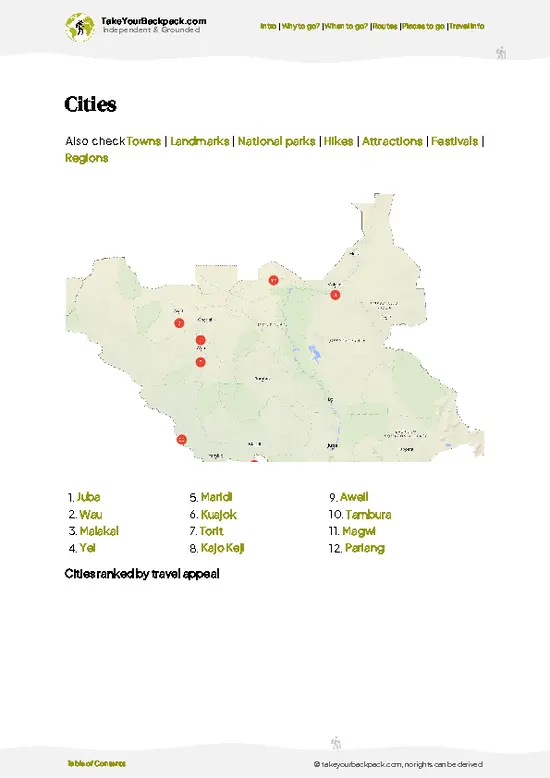
1 Juba

Garang mausoleum, Konyokonyo Market, White Nile terraces, Jebel Kujur

Visit the national leader’s tomb, push through the city’s biggest market, and end the day over grilled tilapia beside the White Nile.

2 Wau

Brick cathedral, idle railway terminus, Jur River shade, grain market

Time a Sunday visit for choir-filled Mass, then wander past rusting wagons on the old platform and sit by the river with tea.

3 Malakal

Nile port, fishing landings, Shilluk elders, mixed-community market

Reach the riverbank at dawn to watch boats and cargo move, then meet elders who explain Shilluk kingship and its history.

4 Yei

Teak plantations, mango lanes, coffee stalls, rainy southwest

Walk shaded plantation rows with a local guide, browse pineapples and cassava in the market, and drink local coffee on plastic stools.

5 Maridi

Coffee and teak country, mission-era brick churches, red dirt streets, evening football

Join a guided walk through coffee, mango and banana plots, hear choirs in old brick churches, and watch pickup matches at dusk.

6 Kuajok

Warrap capital, Jur River, horned herds, Dinka market

Trace daily routines from the mid-morning market to the river banks, and arrange a host to reach cattle camps on the town edges.

7 Torit

Imatong views, cathedral singing, cooler air, airstrip history

Climb low hills for views over tin roofs and farmland toward the Imatong range, then follow Sunday singing to the cathedral grounds.

8 Kajo Keji

Green hills, Episcopal cathedral, ridge paths, tea-stall talk

Climb farm paths above town for views toward Uganda, then join a packed Sunday service and linger over chapati and sweet tea.

9 Aweil

Dinka cattle camps, Lol River banks, rail terminus, permit checks

Walk the grain-and-dried-fish market at stock-in-the-morning hours, then visit cattle camps with a host and settle into a roadside tea stall.

10 Tambura

Zande villages, granaries, far-west frontier, long church choirs

Set out early with a host along dirt paths past cassava fields and thatched homesteads, then settle into the late-afternoon crowd on the main road.

11 Magwi

Acholi and Madi farmland, sesame and cassava, border hills, quiet crossroads

Follow field paths past maize and sorghum plots, then catch the market at its morning peak and climb a low rise for plain views.

12 Pariang

Border-region trade, sorghum stalls, no tourist layer, checkpoint paperwork

Spend a morning in the single market, where traders from nearby villages and settlements trade news on prices and road conditions.

Loading the map 🌍

Expert viewInsights from Locals and Experts

How many cities to visit: I advise two, three at most. Distances are huge, flights are costly and delays are routine, so each added city cuts into time and budget without adding variety. Two well-chosen stops with a spare buffer day beat a rushed five.
Which kind to prioritize: The capital suits travelers who want logistics handled and a window into the country’s administration, media and aid scene. Greener southern towns in Equatoria suit those who prefer cooler air, road access from Uganda and a calmer pace. River and northern towns suit experienced travelers with a local fixer and a flexible schedule. Skip any city you cannot reach safely and legally; a mediocre stop with a confirmed permit is better than a famous one you cannot enter.
What it costs: Expect US$120 to 250 a day on a lean independent … read more 👉
How many cities to visit: I advise two, three at most. Distances are huge, flights are costly and delays are routine, so each added city cuts into time and budget without adding variety. Two well-chosen stops with a spare buffer day beat a rushed five.
Which kind to prioritize: The capital suits travelers who want logistics handled and a window into the country’s administration, media and aid scene. Greener southern towns in Equatoria suit those who prefer cooler air, road access from Uganda and a calmer pace. River and northern towns suit experienced travelers with a local fixer and a flexible schedule. Skip any city you cannot reach safely and legally; a mediocre stop with a confirmed permit is better than a famous one you cannot enter.
What it costs: Expect US$120 to 250 a day on a lean independent trip. Rooms run US$60 to 150 a night in basic compounds, meals US$8 to 20, and a local fixer or driver US$80 to 200 a day. Domestic flights often cost US$150 to 400 one way. The visa is around US$100 and a photography permit adds a smaller fee, usually under US$50. Budget extra for registration with the immigration office and for road checkpoints, where small payments are sometimes demanded. Carry crisp, recent US dollar notes, since older or torn bills are often refused and ATMs are unreliable. Pay for flights early, because seats on small planes sell out.
Safety and culture: Check the security situation for each state right before travel, as conditions shift quickly and some areas are closed to foreigners. Register with your embassy, carry photocopies of your passport, visa and permits, and keep originals secure. Photography is a real risk. Never photograph soldiers, government buildings, bridges, airports or checkpoints, and ask before photographing people. Carry cash in several pockets.
Dress modestly and cover shoulders and knees. Greet people before asking for anything; courtesy matters. Avoid discussing ethnic tensions or politics with strangers. Malaria is a constant risk, so take prophylaxis and carry a net, and bring yellow fever documentation. Travel only by day, and keep a buffer in your budget for a delayed plane or an extra night.

✈️ The backpacker research shortcutSouth Sudan Travel Guide

An offline-friendly backpacking guide with optimized travel routes, ranked highlights, transport advice, and the best areas to stay.
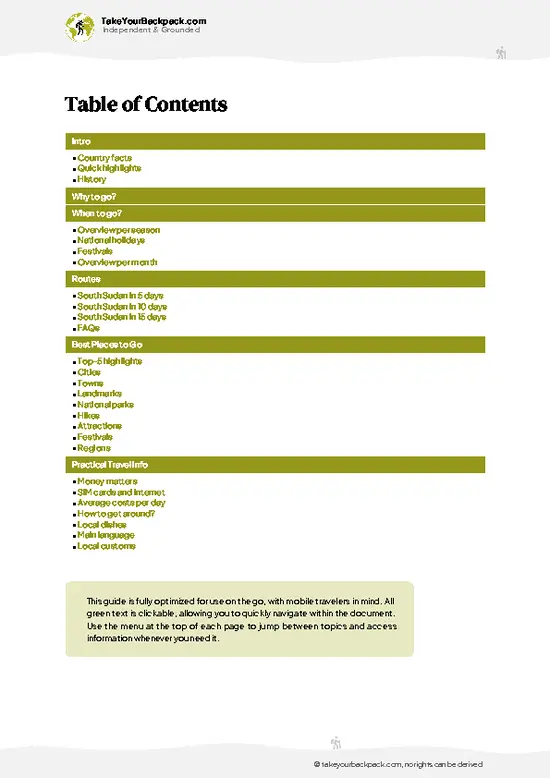
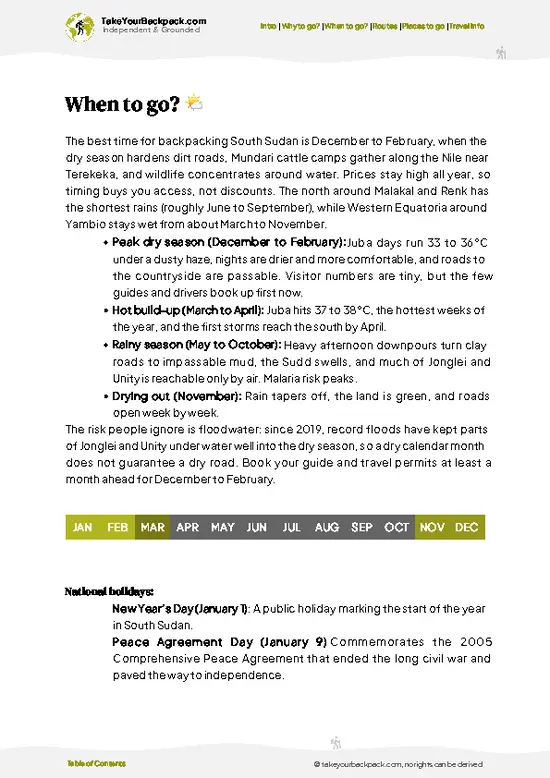
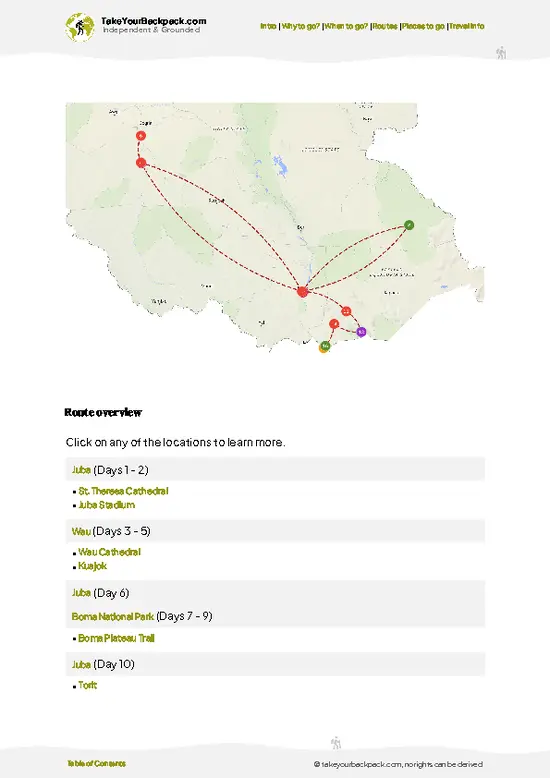
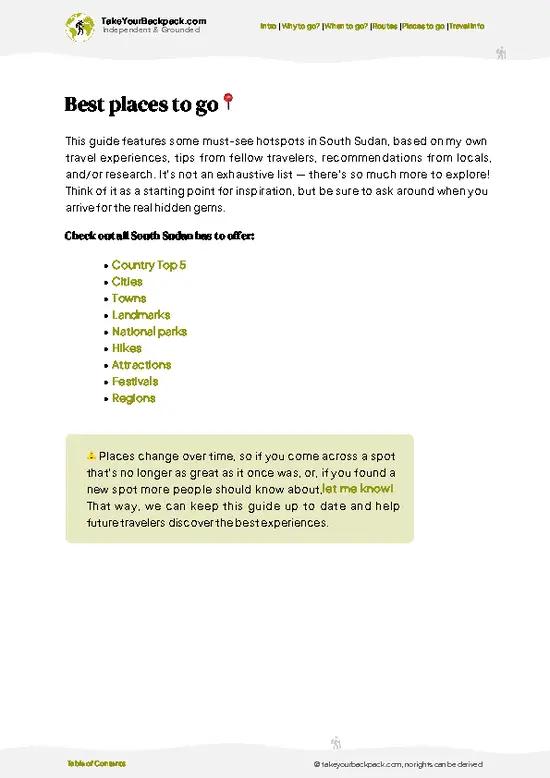
example page 0 from our offline Travel Guide for South Sudan
example page 1 from our offline Travel Guide for South Sudan
example page 2 from our offline Travel Guide for South Sudan
example page 3 from our offline Travel Guide for South Sudan
example page 4 from our offline Travel Guide for South Sudan
example page 5 from our offline Travel Guide for South Sudan
example page 6 from our offline Travel Guide for South Sudan
example page 7 from our offline Travel Guide for South Sudan
The digital guide (242 pages) contains:
✅ 57 highlights, ranked by travel appeal
✅ Optimized 5, 10 & 15-day travel routes
✅ Cities, national parks, landmarks, beaches
✅ How to get around
✅ Offline-friendly for travel without Wi-Fi
👉 Click to see all 30+ guide features

📅 Plan smarter in minutes, not weeks
✅ Month by month travel advice
✅ Festivals & national holidays
✅ Budget expectations

🗺️ Go to the right places, skip the overrated ones
✅ Honest pros & cons of destinations
✅ Top hikes, parks & viewpoints
✅ Lesser-known places most travelers miss
✅ Clear “worth it vs skip it” guidance

🛏️ Travel smoothly without rookie mistakes
✅ Best areas to stay
✅ Transport systems explained simply
✅ Common scams & safety advice
✅ SIM cards, money & practical tips

🌍 Understand the country, not just visit it
✅ Culture & traditions
✅ 52 Essential phrases & customs
✅ Festivals worth planning around
✅ Traveler-friendly historical context
✅ Insights that make places more meaningful

📱 Built for real travel conditions
✅ Fully downloadable PDF
✅ Works completely offline
✅ Optimized for phone use
✅ Useful in remote areas & buses
✅ Everything in one place
Stop searching, start planning
Get instant access to your full guide. 30‑day money-back guarantee.
+ Add another guide for just

By proceeding you agree to our terms.
Sent to your inbox immediately after payment • 100% Secure Checkout
Best Backpacking Travel Advisor 2025 tourism awardBest Backpacking
Travel Advisor
2025
What others say about Take Your Backpack Guides:
⭐⭐⭐⭐⭐
Fantastic, amazing amount of information!
⭐⭐⭐⭐⭐
My goodness this is amazing, it's what I've been looking for hats off too you!
⭐⭐⭐⭐⭐
I think this is absolutely BRILLIANT
⭐⭐⭐⭐
Very complete and informative. It's still missing places, but I gotta to commend you
⭐⭐⭐⭐⭐
This is truly amazing, thank you, can't wait to explore it with my kids!
⭐⭐⭐⭐⭐
Awesome resource, thank you!
⭐⭐⭐⭐⭐
This is amazing! Can't wait to explore the ones I haven't seen
⭐⭐⭐⭐
I love this! Well done, great idea.
⭐⭐⭐⭐⭐
Thanks for taking the time to make this gem!
⭐⭐⭐⭐⭐
This might be the best website I've ever seen.
⭐⭐⭐⭐⭐
Congratulations, and thank you so much for your work; it's incredibly valuable.
⭐⭐⭐⭐
In all seriousness I think you did a great job pointing out the important spots
⭐⭐⭐⭐⭐
10/10 very good
⭐⭐⭐⭐⭐
As someone who's only just starting to visit regularly this is awesome, thank you.
⭐⭐⭐⭐
Thank you very much! I'm going to visit my dad, it's going to be very useful!
⭐⭐⭐⭐⭐
This is really cool! We'll be travelling for the first time and this definitely come in handy.
⭐⭐⭐⭐⭐
You are now our minister of culture, congratulations 👨‍💼
⭐⭐⭐⭐⭐
Just wanted to tell you that this is a pearl! Going to follow your recommendations.
⭐⭐⭐⭐⭐
This is so cool. I'll definitely be using the resource for my travels soon.
⭐⭐⭐⭐⭐
This is very impressive! Good work.
⭐⭐⭐⭐⭐
This is an amazing and informative site. Very well done!

🛏️ Where to stay?Best Places to Stay in South Sudan

South Sudan has no real backpacker hostel scene, so budget travel means basic guesthouses and prefab container-room camps in Juba, typically US$50 to 100 a night, with mid-range hotels running US$120 to 250. Tongping, by the airport, has the densest cluster of guesthouses, restaurants and bars, plus some of the city’s better security. Hai Amarat and Hai Cinema are quieter and have good places to eat, the riverside camps along the White Nile are pleasant at sundown but a ride from everything, and the cheaper rooms around Juba Town and Konyo Konyo market sit beside the action but are noisier and rougher after dark.

If you enjoy meeting fellow travelers, consider choosing hostels with high ratings … read more 👉
South Sudan has no real backpacker hostel scene, so budget travel means basic guesthouses and prefab container-room camps in Juba, typically US$50 to 100 a night, with mid-range hotels running US$120 to 250. Tongping, by the airport, has the densest cluster of guesthouses, restaurants and bars, plus some of the city’s better security. Hai Amarat and Hai Cinema are quieter and have good places to eat, the riverside camps along the White Nile are pleasant at sundown but a ride from everything, and the cheaper rooms around Juba Town and Konyo Konyo market sit beside the action but are noisier and rougher after dark.

If you enjoy meeting fellow travelers, consider choosing hostels with high ratings for atmosphere. On the other hand, if you prefer having your own space, a hotel might be a better option.

South SudanExplore South Sudan

👋 Meet the founderWho’s Behind Take Your Backpack?

Johan, backpacker and founder of TakeYourBackpackHi, I’m Johan (Netherlands 🇳🇱), the creator of TakeYourBackpack. Over the past 3 decades, I’ve backpacked through 90+ countries across six continents, gaining extensive experience with independent travel, long-term trips, and overland routes.

This site is built on a combination of firsthand travel experience and carefully curated insights from other backpackers. Many guides are based on places I’ve personally visited, while others bring together tips, observations, and practical advice shared by trusted travelers I’ve met along the way.

The goal is to provide realistic, experience-driven guidance — not generic itineraries — so you can explore destinations with better context, clearer expectations, and more confidence.