×

South Sudan🇸🇸 | attractionsNyakuron Cultural CentreDance troupes, Juba bands, theater nights, courtyard crowd | things to do and best time to go

Explore South Sudan National MuseumExplore Juba Stadium

Backpacking in Nyakuron Cultural Centre
🏆 Top pickattraction ranked #2
By Johan Kruseman 🇳🇱 | Updated October 22, 2026

Nyakuron Cultural Centre is where Juba goes to hear its own music. Traditional dance troupes, live bands, theater and film nights pass through, and that is the reason to come. What gets overlooked is the crowd. Most of the audience is local, so you meet young Juba, its artists and its organizers, which beats any museum label for understanding the country. Skip it on a day with nothing scheduled, because the compound itself is modest and holds no permanent exhibits worth a special trip. Go for an event and you will leave with more than a photo. The centre sits in the Nyakuron neighborhood of Juba, South Sudan’s capital, close to the middle of town. Entry to most events is cheap, and the atmosphere is relaxed and friendly rather than polished. Before going, check what is on that week through hostel staff or local social media pages, since the programming changes and a dead evening is a wasted one.

Discover everything you want to know in the 📖 South Sudan Travel Guide.
Safety warning

The current risk level for South Sudan is high. Check the advice before going.


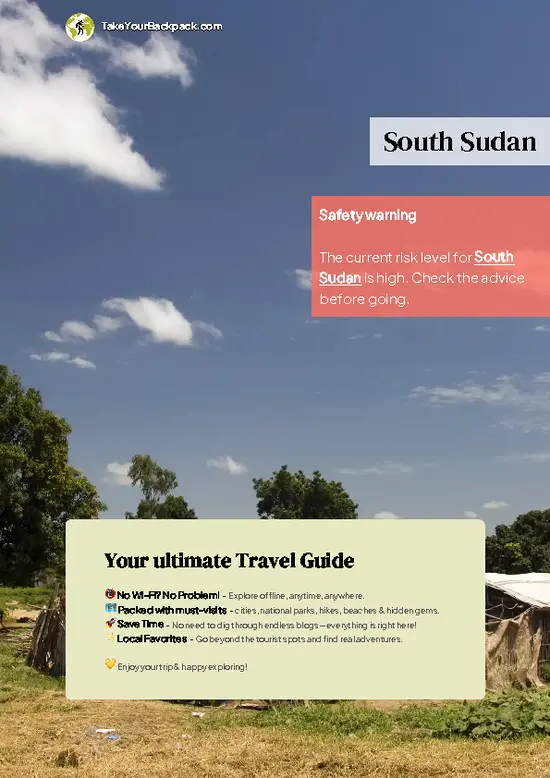
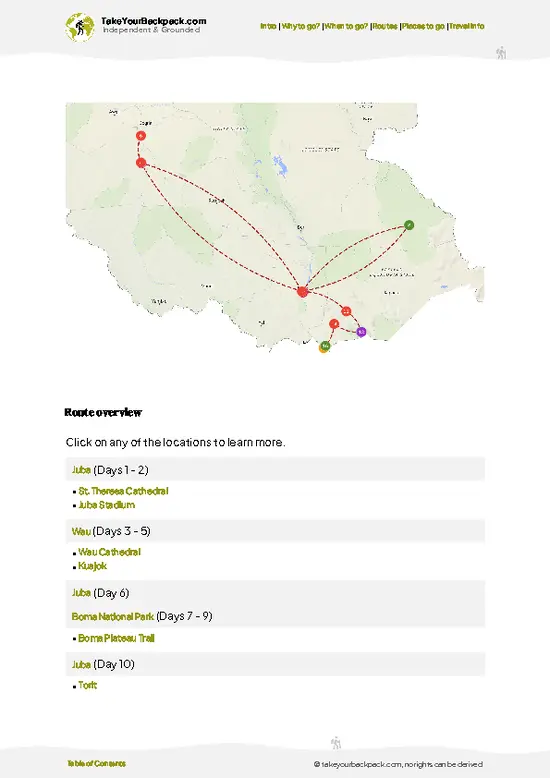
example page 0 from our offline Travel Guide for South Sudan
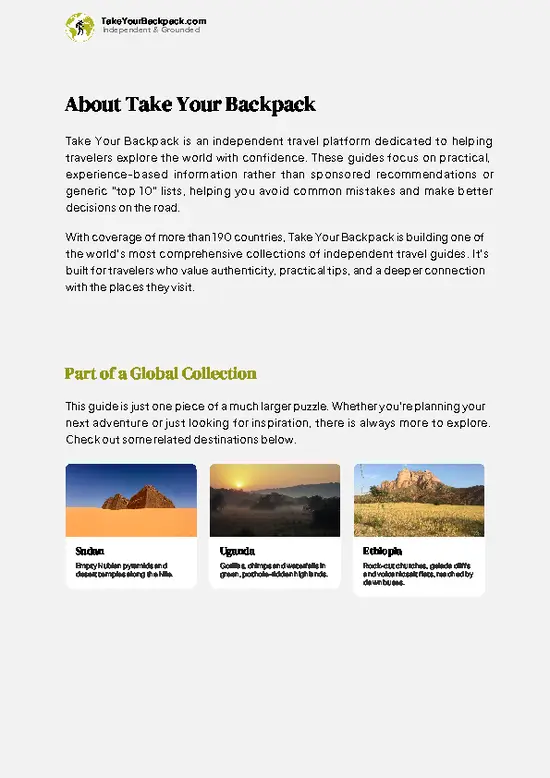
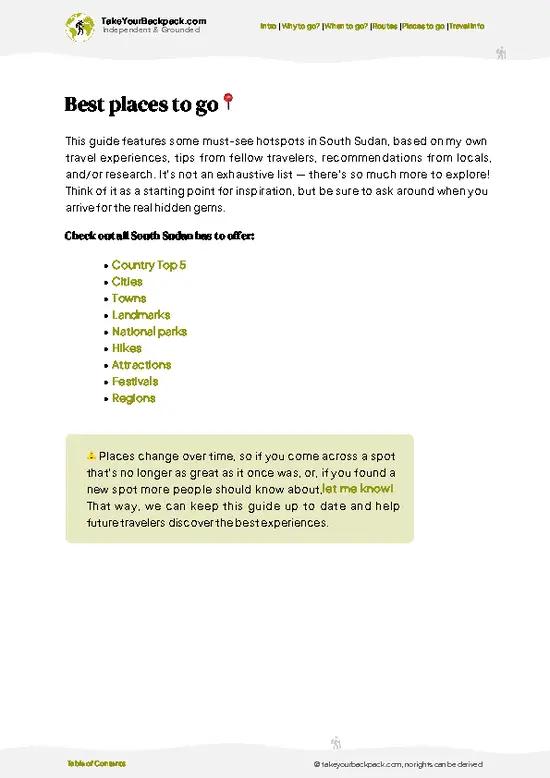
example page 1 from our offline Travel Guide for South Sudan
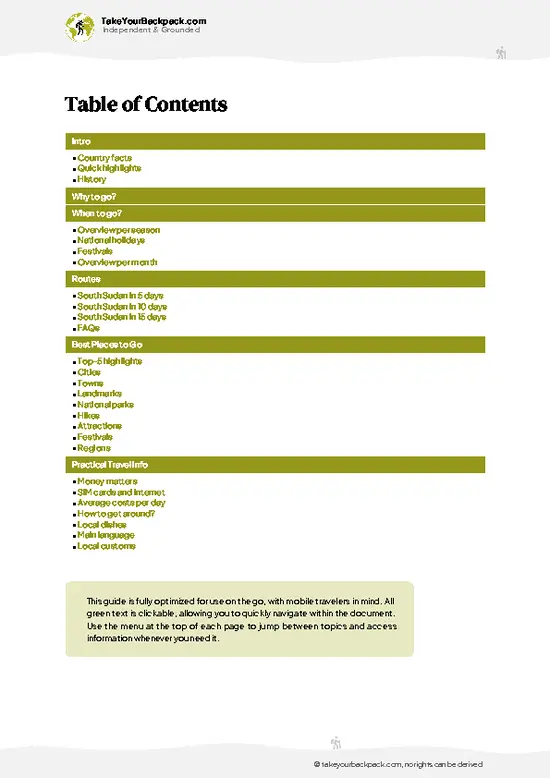
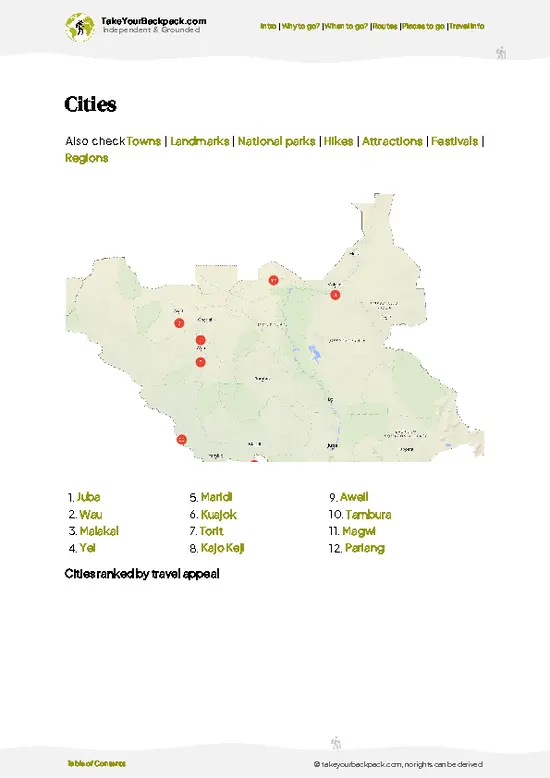
example page 2 from our offline Travel Guide for South Sudan
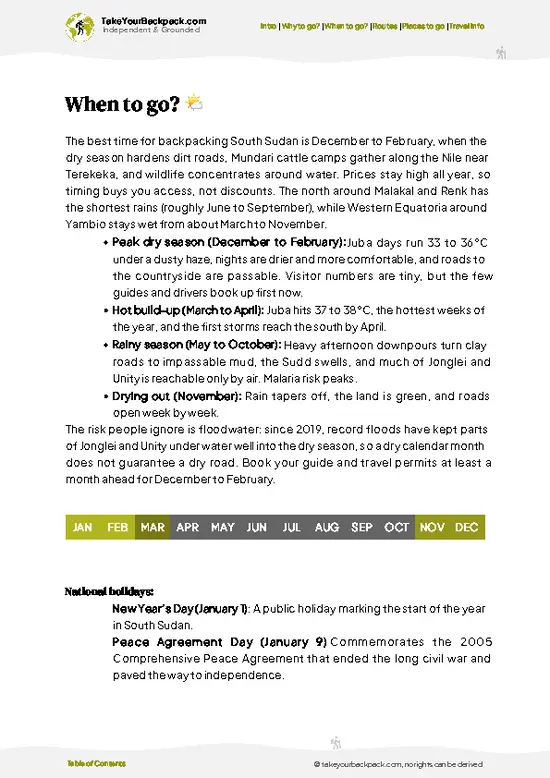
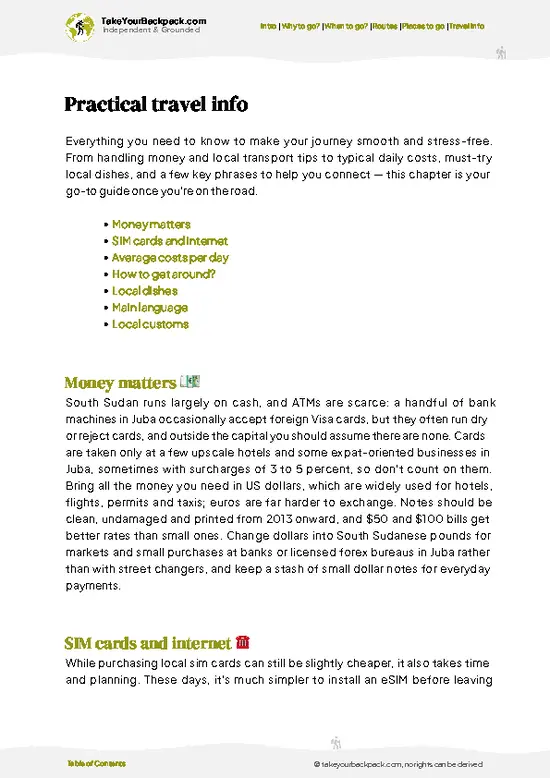
example page 3 from our offline Travel Guide for South Sudan
example page 4 from our offline Travel Guide for South Sudan
example page 5 from our offline Travel Guide for South Sudan
example page 6 from our offline Travel Guide for South Sudan
example page 7 from our offline Travel Guide for South Sudan
Loading the map 🌍
CLICK TO FILTER
cities
towns
landmarks
national parks
hikes
attractions
festivals
regions
SHOW COUNTRY’S BESTSHOW ALL

✨ Why go?
Ranked #2 attraction in South Sudan
Reasons people choose to visit here

Nyakuron Cultural Centre gives you something Juba otherwise hides: a room full of South Sudanese enjoying themselves. The country’s headlines are heavy, and the city has few public places where you can simply watch people play music, dance and argue about art. That is worth the effort.
The first reason is the live performance side. Dance groups from different ethnic communities, including drumming and call-and-response singing, show how varied South Sudan is far better than a guidebook paragraph does. One evening here teaches you more about the country’s many cultures than a week of eating at hotel restaurants.
The second is access. The centre sits in Nyakuron neighborhood, so you reach it without a long expedition across town, and locals are usually curious about visitors who bother to turn … read more 👉
Nyakuron Cultural Centre gives you something Juba otherwise hides: a room full of South Sudanese enjoying themselves. The country’s headlines are heavy, and the city has few public places where you can simply watch people play music, dance and argue about art. That is worth the effort.
The first reason is the live performance side. Dance groups from different ethnic communities, including drumming and call-and-response singing, show how varied South Sudan is far better than a guidebook paragraph does. One evening here teaches you more about the country’s many cultures than a week of eating at hotel restaurants.
The second is access. The centre sits in Nyakuron neighborhood, so you reach it without a long expedition across town, and locals are usually curious about visitors who bother to turn up. Conversations start easily, and you often leave with contacts and recommendations for the rest of your route.
For a backpacker passing through the capital, it is one of the few stops that feels like participation instead of observation.

💡 HighlightsMust-see experiences and standout moments

  1. Live traditional dance nights: Troupes perform in costume with drums, horns and rattles, and each group brings its own community’s rhythms. This is the main draw and the best use of an evening here.
  2. Concerts by Juba artists: Local musicians mix hip-hop, Afrobeat, gospel and songs in Juba Arabic, English and several local languages. The crowd sings along, so you pick up the hits fast.
  3. Theater performances: Plays and skits often tackle everyday issues such as reconciliation, youth and city life. Even with limited language, the acting and audience reactions carry the meaning.
  4. Film screenings: Films by South Sudanese and regional makers appear at events hosted here. They are a rare chance to see the country described by its own storytellers.
  5. Art and craft displays: Painters and craftspeople show work
… read more 👉
  1. Live traditional dance nights: Troupes perform in costume with drums, horns and rattles, and each group brings its own community’s rhythms. This is the main draw and the best use of an evening here.
  2. Concerts by Juba artists: Local musicians mix hip-hop, Afrobeat, gospel and songs in Juba Arabic, English and several local languages. The crowd sings along, so you pick up the hits fast.
  3. Theater performances: Plays and skits often tackle everyday issues such as reconciliation, youth and city life. Even with limited language, the acting and audience reactions carry the meaning.
  4. Film screenings: Films by South Sudanese and regional makers appear at events hosted here. They are a rare chance to see the country described by its own storytellers.
  5. Art and craft displays: Painters and craftspeople show work at events, usually with the artist standing nearby. Prices are negotiable, and buying directly supports local creators.
  6. The open courtyard atmosphere: Before shows begin, people gather, chat and eat nearby snacks. Arrive early, because this informal hour is where most conversations happen.
For a first visit, the live traditional dance night at Nyakuron Cultural Centre is the one to build your plans around.
Spotted a mistake or missing something? Contact us.

🌤️ When to go?Choosing the right time of year

  • Dry Season (November to March): Days run 32 to 38°C (90 to 100°F) with cool nights around 20 to 23°C (68 to 73°F). Roads around Juba are firm, and cultural events and gatherings are easiest to catch. Dust and haze arrive in January and February. Guesthouse rates in Juba climb when aid workers and returning diaspora fill rooms.
  • Early Rains (April to June): Afternoon storms push in, with highs of 31 to 35°C (88 to 95°F). Humidity rises, mornings stay workable, and the red dirt lanes in Nyakuron turn to mud after heavy downpours.
  • Peak Rains (July to October): Highs settle at 29 to 33°C (84 to 91°F) with frequent downpours. Rooms are easier to book and a little cheaper, but flooded streets slow every moto ride and outdoor performances get postponed.
  • Daylight: Sun hours barely shift near the equator,
… read more 👉
  • Dry Season (November to March): Days run 32 to 38°C (90 to 100°F) with cool nights around 20 to 23°C (68 to 73°F). Roads around Juba are firm, and cultural events and gatherings are easiest to catch. Dust and haze arrive in January and February. Guesthouse rates in Juba climb when aid workers and returning diaspora fill rooms.
  • Early Rains (April to June): Afternoon storms push in, with highs of 31 to 35°C (88 to 95°F). Humidity rises, mornings stay workable, and the red dirt lanes in Nyakuron turn to mud after heavy downpours.
  • Peak Rains (July to October): Highs settle at 29 to 33°C (84 to 91°F) with frequent downpours. Rooms are easier to book and a little cheaper, but flooded streets slow every moto ride and outdoor performances get postponed.
  • Daylight: Sun hours barely shift near the equator, so plan around heat and rain, not light.
Call ahead to confirm opening and performance days, and plan visits for mornings, before the afternoon storms and the midday heat.


source: climatestotravel.comJANJanuary: excellent for travelingFEBFebruary: highly recommended for travelingMARMarch: fair for travelingAPRApril: below average for travelingMAYMay: below average for travelingJUNJune: below average for travelingJULJuly: below average for travelingAUGAugust: below average for travelingSEPSeptember: below average for travelingOCTOctober: fair for travelingNOVNovember: highly recommended for travelingDECDecember: excellent for traveling
when-to-go

✈️ The backpacker research shortcutSouth Sudan Travel Guide

An offline-friendly backpacking guide with optimized travel routes, ranked highlights, transport advice, and the best areas to stay.
example page 0 from our offline Travel Guide for South Sudan
example page 1 from our offline Travel Guide for South Sudan
example page 2 from our offline Travel Guide for South Sudan
example page 3 from our offline Travel Guide for South Sudan
example page 4 from our offline Travel Guide for South Sudan
example page 5 from our offline Travel Guide for South Sudan
example page 6 from our offline Travel Guide for South Sudan
example page 7 from our offline Travel Guide for South Sudan
The digital guide (242 pages) contains:
✅ 57 highlights, ranked by travel appeal
✅ Optimized 5, 10 & 15-day travel routes
✅ Cities, national parks, landmarks, beaches
✅ How to get around
✅ Offline-friendly for travel without Wi-Fi
👉 Click to see all 30+ guide features

📅 Plan smarter in minutes, not weeks
✅ Month by month travel advice
✅ Festivals & national holidays
✅ Budget expectations

🗺️ Go to the right places, skip the overrated ones
✅ Honest pros & cons of destinations
✅ Top hikes, parks & viewpoints
✅ Lesser-known places most travelers miss
✅ Clear “worth it vs skip it” guidance

🛏️ Travel smoothly without rookie mistakes
✅ Best areas to stay
✅ Transport systems explained simply
✅ Common scams & safety advice
✅ SIM cards, money & practical tips

🌍 Understand the country, not just visit it
✅ Culture & traditions
✅ 52 Essential phrases & customs
✅ Festivals worth planning around
✅ Traveler-friendly historical context
✅ Insights that make places more meaningful

📱 Built for real travel conditions
✅ Fully downloadable PDF
✅ Works completely offline
✅ Optimized for phone use
✅ Useful in remote areas & buses
✅ Everything in one place
Stop searching, start planning
Get instant access to your full guide. 30‑day money-back guarantee.
+ Add another guide for just

By proceeding you agree to our terms.
Sent to your inbox immediately after payment • 100% Secure Checkout
Best Backpacking Travel Advisor 2025 tourism awardBest Backpacking
Travel Advisor
2025
What others say about Take Your Backpack Guides:
⭐⭐⭐⭐⭐
Fantastic, amazing amount of information!
⭐⭐⭐⭐⭐
My goodness this is amazing, it's what I've been looking for hats off too you!
⭐⭐⭐⭐⭐
I think this is absolutely BRILLIANT
⭐⭐⭐⭐
Very complete and informative. It's still missing places, but I gotta to commend you
⭐⭐⭐⭐⭐
This is truly amazing, thank you, can't wait to explore it with my kids!
⭐⭐⭐⭐⭐
Awesome resource, thank you!
⭐⭐⭐⭐⭐
This is amazing! Can't wait to explore the ones I haven't seen
⭐⭐⭐⭐
I love this! Well done, great idea.
⭐⭐⭐⭐⭐
Thanks for taking the time to make this gem!
⭐⭐⭐⭐⭐
This might be the best website I've ever seen.
⭐⭐⭐⭐⭐
Congratulations, and thank you so much for your work; it's incredibly valuable.
⭐⭐⭐⭐
In all seriousness I think you did a great job pointing out the important spots
⭐⭐⭐⭐⭐
10/10 very good
⭐⭐⭐⭐⭐
As someone who's only just starting to visit regularly this is awesome, thank you.
⭐⭐⭐⭐
Thank you very much! I'm going to visit my dad, it's going to be very useful!
⭐⭐⭐⭐⭐
This is really cool! We'll be travelling for the first time and this definitely come in handy.
⭐⭐⭐⭐⭐
You are now our minister of culture, congratulations 👨‍💼
⭐⭐⭐⭐⭐
Just wanted to tell you that this is a pearl! Going to follow your recommendations.
⭐⭐⭐⭐⭐
This is so cool. I'll definitely be using the resource for my travels soon.
⭐⭐⭐⭐⭐
This is very impressive! Good work.
⭐⭐⭐⭐⭐
This is an amazing and informative site. Very well done!

🛏️ Where to stay?Best areas to stay in South Sudan

Stay in Juba’s Tongping, Hai Jalaba or Hai Malakal areas, or in Nyakuron itself, because each is a short moto or taxi hop from the Nyakuron Cultural Centre. Nyakuron is a residential neighborhood with embassies, NGO offices and small restaurants, and it is one of the calmer parts of the capital. Guesthouses and compounds here suit solo travelers who want walled yards, generators and a staff member who can arrange a trusted driver. Social life is thin compared with other backpacker hubs, so expect to meet aid workers, journalists and overland travelers over a shared table at compound restaurants … read more 👉
Stay in Juba’s Tongping, Hai Jalaba or Hai Malakal areas, or in Nyakuron itself, because each is a short moto or taxi hop from the Nyakuron Cultural Centre. Nyakuron is a residential neighborhood with embassies, NGO offices and small restaurants, and it is one of the calmer parts of the capital. Guesthouses and compounds here suit solo travelers who want walled yards, generators and a staff member who can arrange a trusted driver. Social life is thin compared with other backpacker hubs, so expect to meet aid workers, journalists and overland travelers over a shared table at compound restaurants rather than in party dorms.
Tongping, near the airport road, is practical for early flights and has the widest choice of compounds and rooms. Hai Jalaba sits closer to the town center and the Nile bank, with more places to eat cheaply and more local color, though it is noisier. Whichever area you choose, pick a place with a security guard and reliable water, and book ahead in the dry season, when beds fill quickly. Movement after dark should be by arranged car, not on foot.

👛 Costs (as of 22 October 2026)Travel costs and budget guide for Nyakuron Cultural Centre

Nyakuron Cultural Centre costs a budget traveler roughly US$97 to 125 a day in Juba, with the venue itself usually cheap or free to enter. Juba is among the priciest capitals in Africa for its standard, and imported goods drive most of that. Travelers pay in local pounds, but many guesthouses quote in US dollars and cash dollars in newer, undamaged notes are widely accepted.
CategoryBudget RangeLocal Reality
Entry / event feeUS$0 to 5Visiting is often free or a small donation; performances may carry a modest charge.
Accommodation (high season)US$40 to 80Simple guesthouse rooms with fan or AC. Cheaper rooms exist but are scarce and basic.
Accommodation (low season)US$30 to 60Prices ease during the rains, with more room to bargain.
FoodUS$10 to 20Local meals of stew, beans or grilled fish run US$3
… read more 👉
Nyakuron Cultural Centre costs a budget traveler roughly US$97 to 125 a day in Juba, with the venue itself usually cheap or free to enter. Juba is among the priciest capitals in Africa for its standard, and imported goods drive most of that. Travelers pay in local pounds, but many guesthouses quote in US dollars and cash dollars in newer, undamaged notes are widely accepted.
CategoryBudget RangeLocal Reality
Entry / event feeUS$0 to 5Visiting is often free or a small donation; performances may carry a modest charge.
Accommodation (high season)US$40 to 80Simple guesthouse rooms with fan or AC. Cheaper rooms exist but are scarce and basic.
Accommodation (low season)US$30 to 60Prices ease during the rains, with more room to bargain.
FoodUS$10 to 20Local meals of stew, beans or grilled fish run US$3 to 6. Restaurants serving international food cost far more.
Local transportUS$5 to 15Motorbike rides across Juba run US$1 to 3. A private taxi or driver costs more and is safer at night.
Water and extrasUS$2 to 5Bottled water and small tips for guides or performers.
Total Daily BudgetUS$97 to 125Based on high-season lodging and mostly local food.


source: jubainthemaking.com
⚠️ Prices can change and everyone travels differently, so take this as a rough guide. Hope it helps you plan your adventure!

FAQFrequently asked questions about Nyakuron Cultural Centre

Plan on one to two hours for Nyakuron Cultural Centre, longer if a performance, workshop or exhibition is running. It sits in the Nyakuron neighborhood of Juba, so you can easily pair it with a morning at the nearby Juba Nile bank or a lunch stop in town. Check opening days before you go, because schedules change.
Nyakuron Cultural Centre is worth a visit if you want to see South Sudanese music, dance and crafts in Juba, where formal attractions are few. Entry is usually free or a small donation of up to about US$5, so the cost is low even with a performance charge. Go on an event day for the best experience, and carry small US dollar bills for tips or crafts.
To reach Nyakuron Cultural Centre, take a motorbike or taxi from central Juba, a ride of about 10 to 20 minutes depending on traffic. Motorbike fares run roughly US$1 to 3, while a private taxi costs about US$5 to 10 each way. Most visitors arrive by air at Juba International Airport, a 15 to 25 minute drive away, and ask their guesthouse to arrange a trusted driver.
⚠️ Things can change over time, so always validate details locally before you go.

Other South Sudanese attractions near Nyakuron Cultural Centre

Explore more nearby:


💡 Not sure where to go next?
Create a personalized itinerary for South Sudan including Nyakuron Cultural Centre and the places that fit your trip.

Generate my itinerary

👉 Discover all attractions

Or checkout all South Sudan has to offer (think cities, towns, villages, national parks, hikes, beaches, festivals)
Country photo of South Sudan

We 💚 feedbackIs it worth it?

Give Nyakuron Cultural Centre one evening, two if a festival or multi-night program is running. A single show covers the atmosphere, and extra nights only pay off with a different lineup. I would arrive early, bring small bills and a phone with the contact of a local host, and leave before the crowd thins so your ride back is simple.

✍️ Help improve this page!
The information on this page is based on in-depth research, insights shared by experienced travelers, and feedback from the local travel community in South Sudan. While every effort is made to keep the information accurate and current, conditions can change — so if you spot anything incorrect or outdated, please get in touch.


🙋‍♂️ Give feedback

👋 Meet the founderWho’s Behind Take Your Backpack?

Johan, backpacker and founder of TakeYourBackpackHi, I’m Johan (Netherlands 🇳🇱), the creator of TakeYourBackpack. Over the past 3 decades, I’ve backpacked through 90+ countries across six continents, gaining extensive experience with independent travel, long-term trips, and overland routes.

This site is built on a combination of firsthand travel experience and carefully curated insights from other backpackers. Many guides are based on places I’ve personally visited, while others bring together tips, observations, and practical advice shared by trusted travelers I’ve met along the way.

The goal is to provide realistic, experience-driven guidance — not generic itineraries — so you can explore destinations with better context, clearer expectations, and more confidence.