×

Suriname🇸🇷 | beachesGalibi BeachLeatherback nesting, Kali’na village, Marowijne river mouth, silty surf | things to do and best time to go

Explore Arya Diwaker Hindu TempleExplore Pikin Saramacca Beach

Backpacking in Galibi Beach
🏆 Top pickbeach ranked #1
By Johan Kruseman 🇳🇱 | Updated October 19, 2026

Sleeping in a Kali’na village lodge means you are already on the sand when leatherback turtles haul themselves ashore at night, which no day visitor from the capital can say. Galibi Beach sits in the far northeast of Suriname, where the brown Marowijne River spills into the Atlantic with French Guiana on the opposite bank. Expect empty sand, a steady salty wind, ghost crabs scuttling at dusk and shells crunching underfoot. Swimming is poor: the water is silty, the current pulls, and nobody comes for waves or reef. Getting here takes a river crossing by boat, so it is pricey for a beach stop, and lodging is simple hammocks and mosquito nets with bugs to match. Crowds stay thin outside nesting season. What you get is a turtle-nesting shore with real darkness and the sound of surf. Compared with Braamspunt, the easy beach near Paramaribo, Galibi is far more remote and far better for wildlife.

Discover everything you want to know in the 📖 Suriname Travel Guide.


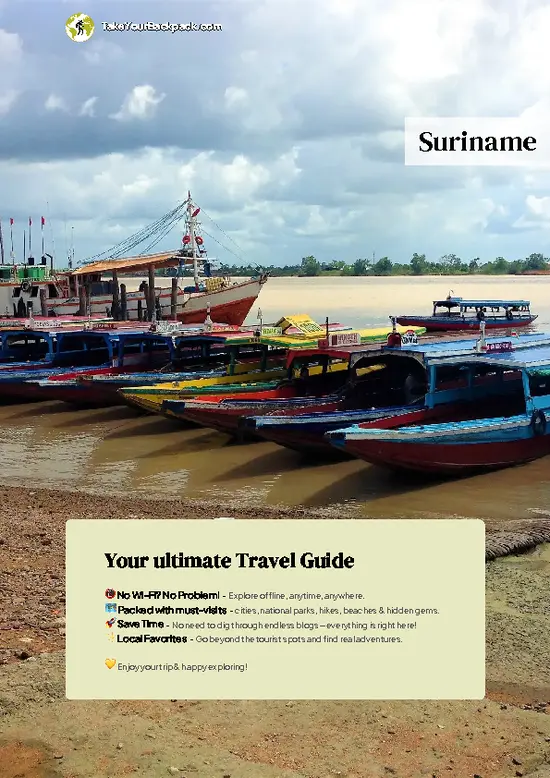
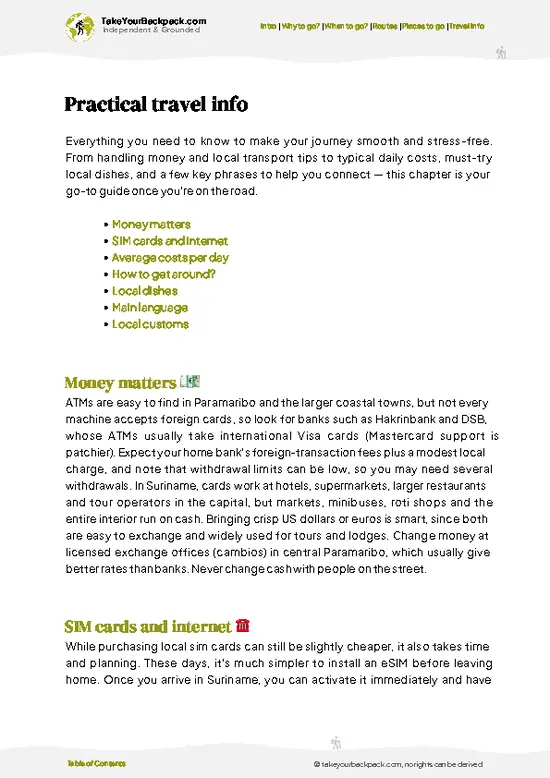
example page 0 from our offline Travel Guide for Suriname
example page 1 from our offline Travel Guide for Suriname
example page 2 from our offline Travel Guide for Suriname
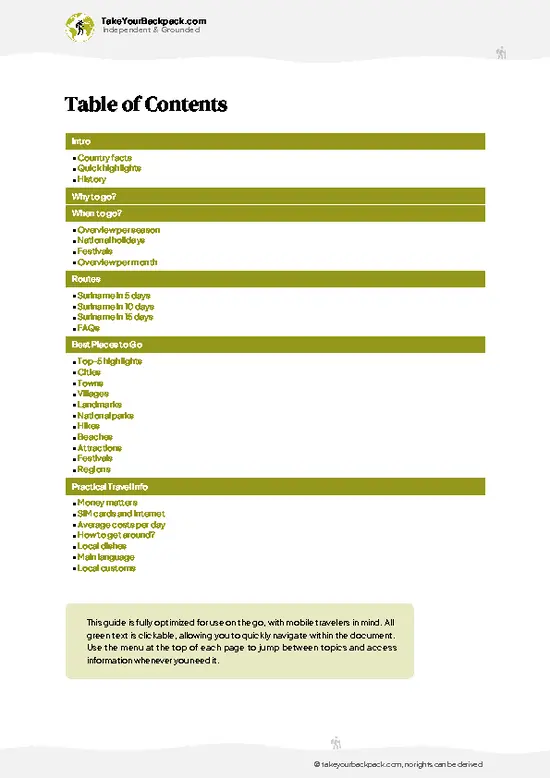
example page 3 from our offline Travel Guide for Suriname
example page 4 from our offline Travel Guide for Suriname
example page 5 from our offline Travel Guide for Suriname
example page 6 from our offline Travel Guide for Suriname
example page 7 from our offline Travel Guide for Suriname
Loading the map 🌍
CLICK TO FILTER
cities
towns
villages
landmarks
national parks
hikes
beaches
attractions
festivals
regions
SHOW COUNTRY’S BESTSHOW ALL

✨ Why go?
Ranked #1 beach in Suriname
What makes it a must-see beach

Galibi Beach earns its detour for one reason above all: the nesting turtles of the Galibi Nature Reserve. Leatherbacks, green turtles and olive ridleys come up this shore, and the season runs roughly from February through August, with the biggest leatherbacks arriving in the first half of it. Guides from the village lead small groups along the dark beach with red light or none at all, and you stand a few steps from a creature the size of a coffee table digging a nest. That is a rare thing to see in the wild, and nothing in the region does it as simply.

The second pull is the people. The beach belongs to a Kali’na community, and sleeping in a village lodge means your money lands locally, you eat fish and cassava bread cooked by your hosts, and you hear Kali’na spoken over the evening meal. … read more 👉
Galibi Beach earns its detour for one reason above all: the nesting turtles of the Galibi Nature Reserve. Leatherbacks, green turtles and olive ridleys come up this shore, and the season runs roughly from February through August, with the biggest leatherbacks arriving in the first half of it. Guides from the village lead small groups along the dark beach with red light or none at all, and you stand a few steps from a creature the size of a coffee table digging a nest. That is a rare thing to see in the wild, and nothing in the region does it as simply.

The second pull is the people. The beach belongs to a Kali’na community, and sleeping in a village lodge means your money lands locally, you eat fish and cassava bread cooked by your hosts, and you hear Kali’na spoken over the evening meal.

The third is the location. Galibi marks the mouth of the Marowijne River, the border with French Guiana, so the boat ride in, with mangroves sliding past and wide brown water opening toward the sea, becomes part of the trip rather than just transit.

💡 HighlightsEssential experiences to have while visiting Galibi Beach

  1. Night turtle watching on the beach: This is what Galibi is known for. In nesting season, village guides take you along the sand after dark to watch females come ashore, dig, lay and return to the sea. Flash photography is banned, voices stay low, and you may wait an hour or more for a turtle to appear. Leatherbacks are enormous, and the sound of one pushing sand with her flippers carries in the dark.
  2. Hatchling releases: Between nesting and the sea run the tiny hatchlings. Depending on timing, guides may let you watch young turtles scramble down the slope toward the surf. Check with your lodge, since it only happens when nests are hatching.
  3. The Kali’na village of Galibi: Walk the sandy lanes between wooden houses on stilts and see how an Amerindian community lives beside the sea. Handmade beadwork,
… read more 👉
  1. Night turtle watching on the beach: This is what Galibi is known for. In nesting season, village guides take you along the sand after dark to watch females come ashore, dig, lay and return to the sea. Flash photography is banned, voices stay low, and you may wait an hour or more for a turtle to appear. Leatherbacks are enormous, and the sound of one pushing sand with her flippers carries in the dark.
  2. Hatchling releases: Between nesting and the sea run the tiny hatchlings. Depending on timing, guides may let you watch young turtles scramble down the slope toward the surf. Check with your lodge, since it only happens when nests are hatching.
  3. The Kali’na village of Galibi: Walk the sandy lanes between wooden houses on stilts and see how an Amerindian community lives beside the sea. Handmade beadwork, woven baskets and carved items are sold by residents, and buying directly is the most useful thing you can do for the village.
  4. Boat trip on the Marowijne mouth: A short boat outing takes you where river meets ocean, with the French Guiana shore visible across the water. The mix of mangrove edges, sandbars and wading birds makes it a good early-morning or late-afternoon excursion, and the muddy water is a sight in itself.
  5. Dawn beach walks and birdwatching: Before the heat builds, the strand is quiet apart from surf and the calls of terns, plovers and other shorebirds working the tideline. Turtle tracks from the night before still scar the sand, and shells and driftwood wash up along the high-water mark. The silty water is not for swimming, but wading at the edge is fine.
If time is tight, skip the village craft browsing and put every spare hour into the night turtle walk.
Spotted a mistake or missing something? Contact us.

🌤️ When to go?Seasonal considerations and timing

  • Main Dry Season (August to mid-November): Calm days of 28 to 32°C (82 to 90°F) and the lowest rain odds make boat crossings on the Marowijne River easiest. Day length stays close to 12 hours all year, so plan around the tides.
  • Turtle Season (February to August): Leatherback, green and olive ridley turtles come ashore to nest, with leatherbacks peaking around April to June. This is the reason most people come, and Galibi Beach sees its steadiest stream of visitors then. Tour operators in Paramaribo book up, and package prices tend to be at their highest.
  • Long Rainy Season (late April to mid-August): Heavy downpours of 2 to 4 hours are common, humidity is thick, and the river runs choppy and brown. Lodging is easier to find outside turtle peak weekends.
  • Short Rainy Season (December to January):
… read more 👉
  • Main Dry Season (August to mid-November): Calm days of 28 to 32°C (82 to 90°F) and the lowest rain odds make boat crossings on the Marowijne River easiest. Day length stays close to 12 hours all year, so plan around the tides.
  • Turtle Season (February to August): Leatherback, green and olive ridley turtles come ashore to nest, with leatherbacks peaking around April to June. This is the reason most people come, and Galibi Beach sees its steadiest stream of visitors then. Tour operators in Paramaribo book up, and package prices tend to be at their highest.
  • Long Rainy Season (late April to mid-August): Heavy downpours of 2 to 4 hours are common, humidity is thick, and the river runs choppy and brown. Lodging is easier to find outside turtle peak weekends.
  • Short Rainy Season (December to January): Showers are briefer and temperatures sit at 26 to 31°C (79 to 88°F). Quiet, with few other travelers around.
Book your Galibi transfer at least a week ahead for May and June, when beds and boat seats fill.


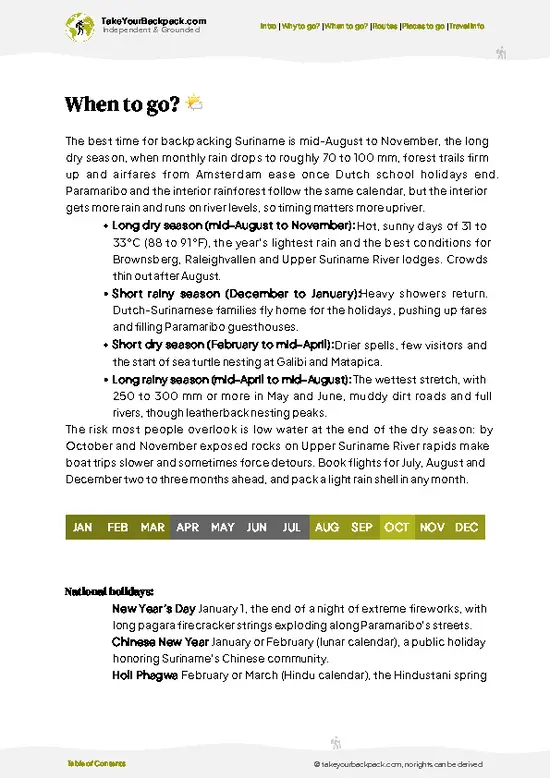
source: climatestotravel.comJANJanuary: fair for travelingFEBFebruary: good for travelingMARMarch: good for travelingAPRApril: good for travelingMAYMay: good for travelingJUNJune: fair for travelingJULJuly: fair for travelingAUGAugust: highly recommended for travelingSEPSeptember: excellent for travelingOCTOctober: excellent for travelingNOVNovember: highly recommended for travelingDECDecember: fair for traveling
when-to-go

✈️ The backpacker research shortcutSuriname Travel Guide

An offline-friendly backpacking guide with optimized travel routes, ranked highlights, transport advice, and the best areas to stay.
example page 0 from our offline Travel Guide for Suriname
example page 1 from our offline Travel Guide for Suriname
example page 2 from our offline Travel Guide for Suriname
example page 3 from our offline Travel Guide for Suriname
example page 4 from our offline Travel Guide for Suriname
example page 5 from our offline Travel Guide for Suriname
example page 6 from our offline Travel Guide for Suriname
example page 7 from our offline Travel Guide for Suriname
The digital guide (153 pages) contains:
✅ 40 highlights, ranked by travel appeal
✅ Optimized 5, 10 & 15-day travel routes
✅ Cities, national parks, landmarks, beaches
✅ How to get around
✅ Offline-friendly for travel without Wi-Fi
👉 Click to see all 30+ guide features

📅 Plan smarter in minutes, not weeks
✅ Month by month travel advice
✅ Festivals & national holidays
✅ Budget expectations

🗺️ Go to the right places, skip the overrated ones
✅ Honest pros & cons of destinations
✅ Top hikes, parks & viewpoints
✅ Lesser-known places most travelers miss
✅ Clear “worth it vs skip it” guidance

🛏️ Travel smoothly without rookie mistakes
✅ Best areas to stay
✅ Transport systems explained simply
✅ Common scams & safety advice
✅ SIM cards, money & practical tips

🌍 Understand the country, not just visit it
✅ Culture & traditions
✅ 52 Essential phrases & customs
✅ Festivals worth planning around
✅ Traveler-friendly historical context
✅ Insights that make places more meaningful

📱 Built for real travel conditions
✅ Fully downloadable PDF
✅ Works completely offline
✅ Optimized for phone use
✅ Useful in remote areas & buses
✅ Everything in one place
Stop searching, start planning
Get instant access to your full guide. 30‑day money-back guarantee.
+ Add another guide for just

By proceeding you agree to our terms.
Sent to your inbox immediately after payment • 100% Secure Checkout
Best Backpacking Travel Advisor 2025 tourism awardBest Backpacking
Travel Advisor
2025
What others say about Take Your Backpack Guides:
⭐⭐⭐⭐⭐
Fantastic, amazing amount of information!
⭐⭐⭐⭐⭐
My goodness this is amazing, it's what I've been looking for hats off too you!
⭐⭐⭐⭐⭐
I think this is absolutely BRILLIANT
⭐⭐⭐⭐
Very complete and informative. It's still missing places, but I gotta to commend you
⭐⭐⭐⭐⭐
This is truly amazing, thank you, can't wait to explore it with my kids!
⭐⭐⭐⭐⭐
Awesome resource, thank you!
⭐⭐⭐⭐⭐
This is amazing! Can't wait to explore the ones I haven't seen
⭐⭐⭐⭐
I love this! Well done, great idea.
⭐⭐⭐⭐⭐
Thanks for taking the time to make this gem!
⭐⭐⭐⭐⭐
This might be the best website I've ever seen.
⭐⭐⭐⭐⭐
Congratulations, and thank you so much for your work; it's incredibly valuable.
⭐⭐⭐⭐
In all seriousness I think you did a great job pointing out the important spots
⭐⭐⭐⭐⭐
10/10 very good
⭐⭐⭐⭐⭐
As someone who's only just starting to visit regularly this is awesome, thank you.
⭐⭐⭐⭐
Thank you very much! I'm going to visit my dad, it's going to be very useful!
⭐⭐⭐⭐⭐
This is really cool! We'll be travelling for the first time and this definitely come in handy.
⭐⭐⭐⭐⭐
You are now our minister of culture, congratulations 👨‍💼
⭐⭐⭐⭐⭐
Just wanted to tell you that this is a pearl! Going to follow your recommendations.
⭐⭐⭐⭐⭐
This is so cool. I'll definitely be using the resource for my travels soon.
⭐⭐⭐⭐⭐
This is very impressive! Good work.
⭐⭐⭐⭐⭐
This is an amazing and informative site. Very well done!

🛏️ Where to stay?Where staying makes the most sense

The best option for backpackers is the Kali’na village of Galibi on the Marowijne River mouth, since that is where the beds, boats and meals are. There is no hostel scene here, so expect simple, community-run lodging: hammocks under open-sided shelters with mosquito nets, or basic rooms with shared bathrooms. Plan on roughly US$25 to 60 a night per person, and meals are often included in package pricing. Electricity can be limited to certain hours, so bring a power bank.

The social side comes from the village itself. You share long wooden tables with other turtle watchers, guides and local families, … read more 👉
The best option for backpackers is the Kali’na village of Galibi on the Marowijne River mouth, since that is where the beds, boats and meals are. There is no hostel scene here, so expect simple, community-run lodging: hammocks under open-sided shelters with mosquito nets, or basic rooms with shared bathrooms. Plan on roughly US$25 to 60 a night per person, and meals are often included in package pricing. Electricity can be limited to certain hours, so bring a power bank.

The social side comes from the village itself. You share long wooden tables with other turtle watchers, guides and local families, and evenings are spent swapping stories by lantern light. Most visitors arrive on an organized tour from Paramaribo, which can be a solid choice for solo travelers because you meet a group straight away and the boat, food and guide are bundled.

The nearby village of Langamankondre, on the Suriname side of the river, is another spot where some lodging is based. It is quieter and a little more spread out, and suits you if you want less company. Staying on the village side puts you within a short boat ride of the nesting beaches, so you can walk out after dark with a guide rather than commute long distances.

🛡️ SafetySafety Tips and Common Scams in Galibi Beach

Galibi Beach is a calm, low-risk place for visitors, and the main considerations are the river mouth and the nesting rules. Currents where the Marowijne meets the Atlantic can be strong, the water is murky and brown, and tides shift the sandbanks, so most people wade rather than swim far. Locals swim near the village rather than at the open beach. Stingrays can sit in shallows, so shuffle your feet.

The sun is fierce close to the equator, and there is little shade on the sand, so bring a hat and reef-safe sunscreen. Mosquitoes come out at dusk, so cover up and use repellent.

Turtle viewing is done at night with a guide, using red or no light and no flash photography. Keep your distance from nesting females. Theft is rarely an issue in the village, but keep valuables with you on boats, and pack things in dry bags for the river crossing.

FAQFrequently asked questions about Galibi Beach

Galibi Beach is reached by road and boat from Paramaribo, usually as an organized tour of 1 to 3 days. The drive east to Albina takes about 2.5 to 3 hours, then a motorized dugout canoe runs to Galibi for roughly 1 to 1.5 hours. Tours with transfers, lodging and meals typically cost US$150 to 350 depending on length and group size, and independent travelers can arrange the Albina boat locally for a lower price.
Swimming at Galibi Beach is possible but not the main draw, because the water is brown, shifts with the river and the tides, and currents near the river mouth can be strong. There is no surf scene, and no snorkeling since visibility is very poor. Wading near the village is fine, and what people come for is watching nesting sea turtles, mostly between February and August.
Galibi Beach has no entrance gate, but access is through the village and the nature reserve, so you pay for the boat, guide and lodging. Reserve and turtle-watching fees are usually folded into tour packages, generally around US$5 to 20 if charged separately. Boat transfers from Albina commonly run about US$30 to 60 per person return, and you should carry cash.
⚠️ Things can change over time, so always validate details locally before you go.

Ideas for continuing your journey

Galibi Beach isn’t the only highlight in Suriname. Explore all what Suriname has to offer.
Country photo of Suriname

We 💚 feedbackParting advice and final tips

One night at Galibi Beach gives you a real shot at turtles, but two nights are better, because nesting is never guaranteed on a given evening and a second try removes the pressure. Bring a headlamp with a red setting, strong repellent and a light long-sleeved shirt for the night walks. I would book the lodge through a Paramaribo operator in nesting season, then spend the spare daylight just listening to the surf.

✍️ Help improve this page!
The information on this page is based on in-depth research, insights shared by experienced travelers, and feedback from the local travel community in Suriname. While every effort is made to keep the information accurate and current, conditions can change — so if you spot anything incorrect or outdated, please get in touch.


🙋‍♂️ Give feedback

👋 Meet the founderWho’s Behind Take Your Backpack?

Johan, backpacker and founder of TakeYourBackpackHi, I’m Johan (Netherlands 🇳🇱), the creator of TakeYourBackpack. Over the past 3 decades, I’ve backpacked through 90+ countries across six continents, gaining extensive experience with independent travel, long-term trips, and overland routes.

This site is built on a combination of firsthand travel experience and carefully curated insights from other backpackers. Many guides are based on places I’ve personally visited, while others bring together tips, observations, and practical advice shared by trusted travelers I’ve met along the way.

The goal is to provide realistic, experience-driven guidance — not generic itineraries — so you can explore destinations with better context, clearer expectations, and more confidence.