v2.webp)
- The Carolingian fresco cycle — Some of Europe’s oldest and best-preserved wall paintings, painted around the turn of the 9th century. The colors and figural scenes (biblical narratives, prophets and Christ imagery) are strikingly intact, so you’re essentially looking at nearly 1,200-year-old “graphics.”
- Layered architecture of the church — The building reads like a timeline: Carolingian bones with Romanesque and later additions. That visible palimpsest of styles makes the church an architectural textbook you can walk through, not just read about.
- The cloister and carved capitals — Small but full of detail: capitals and stonework carved with biblical scenes, animals and strange hybrids. It’s quiet, compact and ridiculously photogenic for anyone who likes close-up medieval stonework.
- The
- The Carolingian fresco cycle — Some of Europe’s oldest and best-preserved wall paintings, painted around the turn of the 9th century. The colors and figural scenes (biblical narratives, prophets and Christ imagery) are strikingly intact, so you’re essentially looking at nearly 1,200-year-old “graphics.”
- Layered architecture of the church — The building reads like a timeline: Carolingian bones with Romanesque and later additions. That visible palimpsest of styles makes the church an architectural textbook you can walk through, not just read about.
- The cloister and carved capitals — Small but full of detail: capitals and stonework carved with biblical scenes, animals and strange hybrids. It’s quiet, compact and ridiculously photogenic for anyone who likes close-up medieval stonework.
- The crypt and early medieval spaces — Descend into the low, atmospheric rooms beneath the church where you’ll feel the age of the place. These compact, intact lower chambers are where the monastery’s early rituals and burials happened — good for a tangible sense of continuity.
- Living Benedictine community — Nuns still live and worship here, so it’s not a frozen museum. That continuity (monastic life ongoing for centuries) adds real cultural and spiritual depth — you’ll notice the rhythms of daily prayer and a quiet, lived-in feel.
- On-site interpretation and guided visits — The site offers focused explanations (and often guided tours) that unpack the fresco iconography and history. These short, expert-led insights turn what could be opaque medieval imagery into clear stories — highly worth timing your visit to catch one.
- Val Müstair setting and easy walks — The convent sits in a peaceful alpine valley. Even if you’re on a shoestring, you can pair a monastery visit with short hikes or village strolls for big scenery without needing a car or expensive guides.
Spotted a mistake or missing something? Contact us.

From Milan: St. Moritz and Panoramic Bernina Express Tour
✓ Free cancellation

Explore St. Moritz in 60 minutes with a Local
✓ Free cancellation
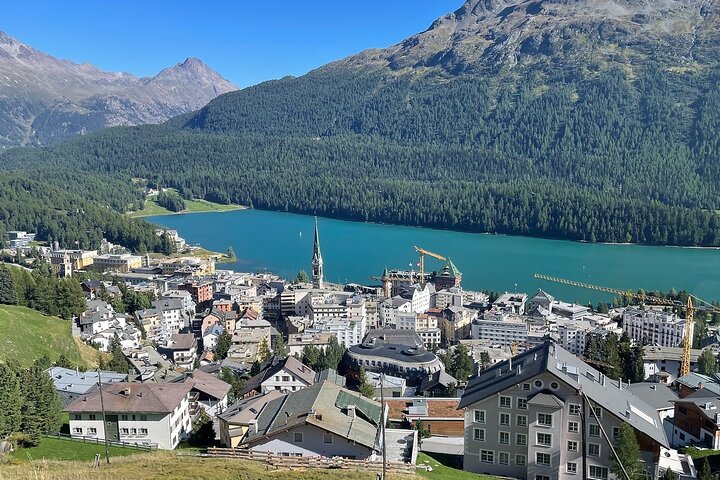
St Moritz Private Guided Panorama Hike
✓ Free cancellation

Lake, Legends & Luxury: A St. Moritz Walking Experience

Bernina Red Train Experience

Private Transfer from Sankt-Moritz to Zurich Airport
✓ Free cancellation

Ski & Snowboard Lesson - 3 Hours St Moritz
✓ Free cancellation

St Moritz, Switzerland to Malpensa Airport (MXP) -Departure Private Transfer
✓ Free cancellation

St. Moritz to Milan Bergamo Airport (BGY) - Departure Transfer
✓ Free cancellation

Private direct transfer from St. Moritz to Munich
✓ Free cancellation

 Best Backpacking
.jpg) Hi, I’m Johan (Netherlands 🇳🇱), the creator of TakeYourBackpack. Over the past decade, I’ve backpacked through 80+ countries across six continents, gaining extensive experience with independent travel, long-term trips, and overland routes.
Hi, I’m Johan (Netherlands 🇳🇱), the creator of TakeYourBackpack. Over the past decade, I’ve backpacked through 80+ countries across six continents, gaining extensive experience with independent travel, long-term trips, and overland routes.