v2.webp)
The Umayyad Palace Facade
Let’s cut through the Instagram fog: yes, you’ll see this ancient stone wall on every travel blog, but standing in front of it is a different animal. This isn’t a replica or a “reconstruction” in the theme-park sense—it’s the actual eighth-century gateway from the Umayyad Palace at Raqqa, painstakingly moved and rebuilt stone by stone. The scale is humbling. The carvings are battered but defiant. It’s a rare chance to walk through a portal that once led caliphs and courtiers into the heart of an empire. If you want a photo, fine, but give yourself a minute to just stand there and feel the weight of real history.
The Prehistoric Collection
If you think “museum” means glass cases of pottery shards, you’re half right—but here, those shards are the oldest in the world. … read more 👉
Let’s cut through the Instagram fog: yes, you’ll see this ancient stone wall on every travel blog, but standing in front of it is a different animal. This isn’t a replica or a “reconstruction” in the theme-park sense—it’s the actual eighth-century gateway from the Umayyad Palace at Raqqa, painstakingly moved and rebuilt stone by stone. The scale is humbling. The carvings are battered but defiant. It’s a rare chance to walk through a portal that once led caliphs and courtiers into the heart of an empire. If you want a photo, fine, but give yourself a minute to just stand there and feel the weight of real history.
The Prehistoric Collection
If you think “museum” means glass cases of pottery shards, you’re half right—but here, those shards are the oldest in the world. … read more 👉
The Umayyad Palace Facade
Let’s cut through the Instagram fog: yes, you’ll see this ancient stone wall on every travel blog, but standing in front of it is a different animal. This isn’t a replica or a “reconstruction” in the theme-park sense—it’s the actual eighth-century gateway from the Umayyad Palace at Raqqa, painstakingly moved and rebuilt stone by stone. The scale is humbling. The carvings are battered but defiant. It’s a rare chance to walk through a portal that once led caliphs and courtiers into the heart of an empire. If you want a photo, fine, but give yourself a minute to just stand there and feel the weight of real history.
The Prehistoric Collection
If you think “museum” means glass cases of pottery shards, you’re half right—but here, those shards are the oldest in the world. The museum’s prehistoric section is a crash course in human ingenuity, with artifacts from some of the earliest known settlements on earth. We’re talking about tools and figurines from Tell Ramad and Tell Halaf, dating back to the Neolithic. It’s not flashy, but it’s the kind of deep-time perspective that makes you realize how long people have been making, breaking, and remaking this land.
The Dura-Europos Synagogue Frescoes
This is the showstopper. The synagogue at Dura-Europos was buried for centuries, its vibrant wall paintings preserved by accident. The museum houses the original frescoes—yes, the real ones—depicting biblical scenes with a wild, almost psychedelic energy. Forget the sanitized textbook version of ancient religion; these murals are raw, colorful, and weirdly modern. You won’t see anything like this in Jerusalem, Rome, or anywhere else. This is my personal favorite—standing in that room is like time travel with the volume cranked up.
Islamic Art and Calligraphy
Skip the generic “Islamic art” section you’ve seen in other museums. Here, the calligraphy and ceramics are local, personal, and often centuries old. The Qur’anic manuscripts and wooden minbar panels are not just beautiful—they’re survivors, rescued from mosques and madrasas across Syria. The artistry is intricate, but the real thrill is knowing these objects were part of daily life, not just museum pieces.
Palmyra’s Sculptures and Reliefs
The Palmyra room is a punch to the gut. These statues and funerary busts survived both Roman conquest and, more recently, the ravages of war and looting. They’re battered, yes, but their faces—stoic, stylized, unmistakably human—are a reminder that Palmyra was once a cosmopolitan crossroads. You’ll see traces of Greek, Persian, and local styles all mashed together, proof that Syria has always been a meeting place, not a monolith.
Let’s cut through the Instagram fog: yes, you’ll see this ancient stone wall on every travel blog, but standing in front of it is a different animal. This isn’t a replica or a “reconstruction” in the theme-park sense—it’s the actual eighth-century gateway from the Umayyad Palace at Raqqa, painstakingly moved and rebuilt stone by stone. The scale is humbling. The carvings are battered but defiant. It’s a rare chance to walk through a portal that once led caliphs and courtiers into the heart of an empire. If you want a photo, fine, but give yourself a minute to just stand there and feel the weight of real history.
The Prehistoric Collection
If you think “museum” means glass cases of pottery shards, you’re half right—but here, those shards are the oldest in the world. The museum’s prehistoric section is a crash course in human ingenuity, with artifacts from some of the earliest known settlements on earth. We’re talking about tools and figurines from Tell Ramad and Tell Halaf, dating back to the Neolithic. It’s not flashy, but it’s the kind of deep-time perspective that makes you realize how long people have been making, breaking, and remaking this land.
The Dura-Europos Synagogue Frescoes
This is the showstopper. The synagogue at Dura-Europos was buried for centuries, its vibrant wall paintings preserved by accident. The museum houses the original frescoes—yes, the real ones—depicting biblical scenes with a wild, almost psychedelic energy. Forget the sanitized textbook version of ancient religion; these murals are raw, colorful, and weirdly modern. You won’t see anything like this in Jerusalem, Rome, or anywhere else. This is my personal favorite—standing in that room is like time travel with the volume cranked up.
Islamic Art and Calligraphy
Skip the generic “Islamic art” section you’ve seen in other museums. Here, the calligraphy and ceramics are local, personal, and often centuries old. The Qur’anic manuscripts and wooden minbar panels are not just beautiful—they’re survivors, rescued from mosques and madrasas across Syria. The artistry is intricate, but the real thrill is knowing these objects were part of daily life, not just museum pieces.
Palmyra’s Sculptures and Reliefs
The Palmyra room is a punch to the gut. These statues and funerary busts survived both Roman conquest and, more recently, the ravages of war and looting. They’re battered, yes, but their faces—stoic, stylized, unmistakably human—are a reminder that Palmyra was once a cosmopolitan crossroads. You’ll see traces of Greek, Persian, and local styles all mashed together, proof that Syria has always been a meeting place, not a monolith.
Spotted a mistake or missing something? Contact us.
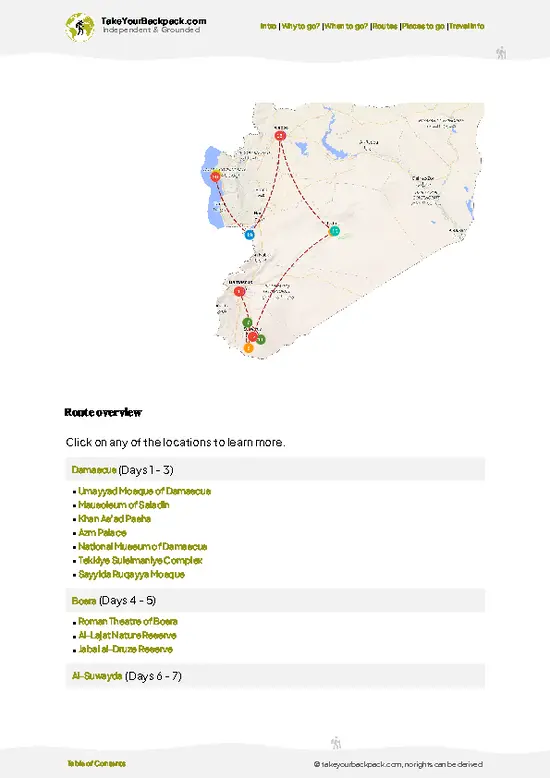

 Best Backpacking
.jpg) Hi, I’m Johan (Netherlands 🇳🇱), the creator of TakeYourBackpack. Over the past decade, I’ve backpacked through 80+ countries across six continents, gaining extensive experience with independent travel, long-term trips, and overland routes.
Hi, I’m Johan (Netherlands 🇳🇱), the creator of TakeYourBackpack. Over the past decade, I’ve backpacked through 80+ countries across six continents, gaining extensive experience with independent travel, long-term trips, and overland routes.