

×

Thailand🇹🇭 | townsPaimountain valley, bamboo huts, night market | things to do and best time to go

Explore Mon JamExplore Pang Mapha

Backpacking in Pai
🏆 Top picktown ranked #1
By Johan Kruseman 🇳🇱 | Updated June 10, 2026

Pai is the rare Thai mountain town where the online image of a nonstop party is about ten years out of date; what you actually find now is a mellow, semi-touristy valley base where hammocks and scooters matter more than buckets and bar crawls. It sits in northern Thailand, a few hours northwest of Chiang Mai on a famously winding mountain road. Backpackers land here to exhale: misty mornings over rice fields, hot springs in the hills, and sunset viewpoints where the light turns the whole valley gold. The trade-off is real. The main street feels built for foreigners, and you’ll hear more English than Thai at some cafés, but step a few minutes out and it’s farm tracks, bamboo bridges, and quiet temples. Evenings are soft: street food, acoustic covers, a couple of livelier bars, easy hostel chats. Compared to sleepy Mae Hong Son or more local Soppong, Pai is busier, prettier at first glance, and far more social, which is exactly why so many backpackers pause here on the Chiang Mai–Mae Hong Son loop.

Discover everything you want to know in the 📖 Thailand Travel Guide.
Loading the map 🌍
CLICK TO FILTER
cities
towns
landmarks
national parks
hikes
beaches
attractions
festivals
regions
SHOW COUNTRY’S BESTSHOW ALL

✨ Why go?
Ranked #1 town in Thailand
Why Pai should be on your travel list

In the heart of northern Thailand, Pai offers a unique blend of atmosphere and natural beauty that draws backpackers like moths to a flame. The village exudes a laid-back vibe, perfect for those looking to slow down after the hustle of places like Chiang Mai. You’ll find café-lined streets where the aroma of fresh coffee mingles with the scent of local street food, inviting you to linger a little longer.

Hiking trails are just a stone’s throw away, leading you through lush landscapes and to stunning waterfalls, making it a haven for nature lovers. The proximity to cultural landmarks adds depth to your stay, with temples and hot springs nearby, enriching your experience without overwhelming you.

Most travelers find themselves staying a few days, soaking in the local character and connecting … read more 👉
In the heart of northern Thailand, Pai offers a unique blend of atmosphere and natural beauty that draws backpackers like moths to a flame. The village exudes a laid-back vibe, perfect for those looking to slow down after the hustle of places like Chiang Mai. You’ll find café-lined streets where the aroma of fresh coffee mingles with the scent of local street food, inviting you to linger a little longer.

Hiking trails are just a stone’s throw away, leading you through lush landscapes and to stunning waterfalls, making it a haven for nature lovers. The proximity to cultural landmarks adds depth to your stay, with temples and hot springs nearby, enriching your experience without overwhelming you.

Most travelers find themselves staying a few days, soaking in the local character and connecting with fellow backpackers in cozy hostels or chill guesthouses. It’s a place where solo travelers seeking calm can recharge, while couples can enjoy intimate moments away from the crowds. Whether you’re a slow traveler or just passing through, Pai’s charm makes it a worthwhile stop on your journey through Thailand.
Want to include Pai in your Thailand route?
Create a personalized Thailand itinerary that includes Pai and the places that fit your trip — based on your travel style, budget, and available time. Get your route in seconds.

Generate my trip

💡 HighlightsWhat this place is best known for

  • Tha Pai Walking Street — The heartbeat of town after sundown: street food stalls, local crafts, live buskers and a great place to people-watch while sampling northern Thai snacks.
  • Pai Memorial Bridge (the old wooden/WWII bridge) — A short, photogenic walk over the river with layers of local history; good for golden-hour photos and a sense of Pai’s wartime past.
  • Wat Phra That Mae Yen (Mae Yen hill temple) — The white seated Buddha up the hill that gives a panoramic view over Pai; quick climb, peaceful monastery vibe and a lovely sunset spot.
  • Pai River & riverside walkways — Low-key riverside life: bamboo benches, simple cafes, local kids jumping in the water and mellow sunsets — a truly Pai experience if you want to slow down.
  • Pai Fresh Market (Talat) — Morning market where locals shop:
read more 👉
  • Tha Pai Walking Street — The heartbeat of town after sundown: street food stalls, local crafts, live buskers and a great place to people-watch while sampling northern Thai snacks.
  • Pai Memorial Bridge (the old wooden/WWII bridge) — A short, photogenic walk over the river with layers of local history; good for golden-hour photos and a sense of Pai’s wartime past.
  • Wat Phra That Mae Yen (Mae Yen hill temple) — The white seated Buddha up the hill that gives a panoramic view over Pai; quick climb, peaceful monastery vibe and a lovely sunset spot.
  • Pai River & riverside walkways — Low-key riverside life: bamboo benches, simple cafes, local kids jumping in the water and mellow sunsets — a truly Pai experience if you want to slow down.
  • Pai Fresh Market (Talat) — Morning market where locals shop: fresh fruit, grilled snacks, herbs and a small cross-section of hill-tribe produce — excellent for an early, authentic wander.
  • Santichon (Yunnan Cultural Village) — A compact cluster of Yunnan-style tea houses and traditional architecture just on the edge of town; offers tea ceremonies, costumes and a slice of Chinese-Mountain culture that shaped Pai.
  • Wat Klang Wiang (central town temple) — The everyday temple in the middle of town where you can watch daily rituals, check out Lanna-style architecture and see how locals practice Buddhism up close.
  • Small galleries and artisan shops — Scattered around the walking street and side alleys: independent galleries, printmakers and craft shops selling real locally made souvenirs rather than tourist tat.
  • Old wooden houses and quiet alleys — Wander the side streets near the river to find old teak houses, shady lanes and the slower, lived-in side of Pai that’s easy to miss from the main road.
  • Live-music bars and coffee culture — The town’s small, friendly venues and dozens of cafés are where Pai’s atmosphere really happens: local bands, chilled expats, and baristas who take their coffee seriously.
A few easy day trips just outside Pai worth planning for: Pai Canyon, Tha Pai Hot Springs and Tham Lod (Lod) Cave.
Spotted a mistake or missing something? Contact us.

Things to do near Pai

Ratings based on Tripadvisor reviews. When you book through this link, you support our work at no extra cost to you.

🏘️ NeighborhoodsUnderstanding the local layout

Pai is a small town, but its neighborhoods each offer a distinct flavor that shapes your stay. Knowing where to drop your pack can turn a good trip into a smooth, memorable one.

Walking Street Area
This is Pai’s heartbeat after dark. The narrow street fills with stalls, food carts, and a steady buzz of travelers. It’s perfect if you want nightlife within arm’s reach—bars, live music, and street eats. Expect a lively, sometimes noisy atmosphere, so it’s better for short stays or if you’re okay with late nights. Walkability is excellent; everything’s a few steps away, but don’t expect quiet mornings here.

Riverside
If you want to wake up to the sound of flowing water and a cooler breeze, Riverside is your spot. It’s quieter than Walking Street but still close enough to stroll into town. … read more 👉
Pai is a small town, but its neighborhoods each offer a distinct flavor that shapes your stay. Knowing where to drop your pack can turn a good trip into a smooth, memorable one.

Walking Street Area
This is Pai’s heartbeat after dark. The narrow street fills with stalls, food carts, and a steady buzz of travelers. It’s perfect if you want nightlife within arm’s reach—bars, live music, and street eats. Expect a lively, sometimes noisy atmosphere, so it’s better for short stays or if you’re okay with late nights. Walkability is excellent; everything’s a few steps away, but don’t expect quiet mornings here.

Riverside
If you want to wake up to the sound of flowing water and a cooler breeze, Riverside is your spot. It’s quieter than Walking Street but still close enough to stroll into town. Accommodations here range from budget bungalows to mid-range guesthouses, making it a solid choice for longer stays. The vibe is laid-back, with a few chill cafes and bars. Transport access is decent—motorbike rentals and songthaews are easy to find.

Ban Santichon (Chinese Yunnan Village)
This area offers a cultural detour with a slower pace. It’s a bit out of the main hustle, so expect fewer tourists and a more local feel. The vibe is peaceful, with tea houses and traditional architecture. It’s ideal for those who want to escape the crowds and soak in something different. Transport is less frequent here, so a motorbike or taxi is handy. Best for longer stays if you want to balance quiet with occasional town visits.

Highway 1095 Corridor
Stretching out from town, this area is for the independent traveler who values space and nature over convenience. Accommodations here are often more rustic or boutique, with stunning views of the hills. It’s not walkable, so a motorbike is essential. Nightlife is minimal, but the early mornings and sunsets make up for it. Perfect if you’re here to recharge or explore the surrounding countryside extensively.

⌛️ 1 dayHow to make the most of one day

Pai is a small town that feels like a breath of fresh air after the winding roads that lead you there. The air carries a mix of earth and wood smoke, a hint of lemongrass from nearby stalls, and the faint buzz of motorbikes weaving through narrow streets. It’s a place where the pace slows, but the senses sharpen. What makes Pai special isn’t just the postcard-perfect rice fields or the hot springs—it’s the way the town invites you to settle in and discover its layers, one slow step at a time.

Start your morning with a walk through the Santichon Chinese Village on the outskirts. It’s often overlooked by the rush to Pai Canyon or the waterfalls, but here you’ll find a quiet patch of history and culture. The scent of freshly brewed Yunnan tea drifts from small shops, and the locals’ smiles are … read more 👉
Pai is a small town that feels like a breath of fresh air after the winding roads that lead you there. The air carries a mix of earth and wood smoke, a hint of lemongrass from nearby stalls, and the faint buzz of motorbikes weaving through narrow streets. It’s a place where the pace slows, but the senses sharpen. What makes Pai special isn’t just the postcard-perfect rice fields or the hot springs—it’s the way the town invites you to settle in and discover its layers, one slow step at a time.

Start your morning with a walk through the Santichon Chinese Village on the outskirts. It’s often overlooked by the rush to Pai Canyon or the waterfalls, but here you’ll find a quiet patch of history and culture. The scent of freshly brewed Yunnan tea drifts from small shops, and the locals’ smiles are as warm as the sun filtering through the bamboo groves. Grab a cup, sit on a wooden bench, and watch the village wake up. From there, head back toward the town center and stop by the Pai Walking Street market. It’s lively but not overwhelming in the morning, perfect for sampling sticky rice with mango or a strong Thai coffee to fuel your day.

By afternoon, the heat calls for a dip. Skip the crowded Tha Pai Hot Springs and instead visit the less touristy Sai Ngam Hot Springs. The pools are smaller, the water warmer, and the surrounding forest quieter. It’s a chance to soak in mineral-rich water while birds chatter overhead, a moment of calm that feels earned after your morning wanderings. Afterward, take a short motorbike ride to the Pai Canyon. The light in the late afternoon sharpens the red earth, casting long shadows and turning the narrow ridges into a natural labyrinth. It’s a perfect spot to stretch your legs and watch the sun begin its slow descent.

Evening in Pai means returning to the town’s heart. The Walking Street transforms into a sensory playground—fragrant spices, sizzling grills, and the hum of live music spilling from open-air bars. Find a spot with a view of the river, order a cold Chang beer, and let the day’s layers settle. Pai isn’t about rushing to the next sight; it’s about savoring the moments between, where the town’s true character reveals itself in the light, the smells, and the easy rhythm of life.
Turn your Pai visit into an Thailand adventure
Build a complete Thailand route with Pai, hidden gems, must-see destinations, and realistic travel times included.

Generate my trip

🌤️ When to go?Choosing the right time of year


  • Topic: Weather — Pai’s dry season from November to February is your best bet. Expect clear skies and minimal rain, making trails and waterfalls accessible without the mud slog. Temperatures hover between 15°C and 28°C (59°F to 82°F), perfect for daytime exploring and cool nights.

  • Topic: Temperature — Outside the dry season, especially April to June, Pai heats up to 35°C (95°F) or more. The intense sun can drain your energy fast, so plan early hikes or late afternoon strolls to avoid the scorch.

  • Topic: Daylight Hours — Around 11 to 12 hours of daylight year-round means you have plenty of time to soak in the scenery. Sunrise is roughly 6:30 AM, so an early start rewards you with softer light and fewer people at key spots.

  • Topic: Crowds — Peak season (Nov-Feb) draws a steady stream of
read more 👉

  • Topic: Weather — Pai’s dry season from November to February is your best bet. Expect clear skies and minimal rain, making trails and waterfalls accessible without the mud slog. Temperatures hover between 15°C and 28°C (59°F to 82°F), perfect for daytime exploring and cool nights.

  • Topic: Temperature — Outside the dry season, especially April to June, Pai heats up to 35°C (95°F) or more. The intense sun can drain your energy fast, so plan early hikes or late afternoon strolls to avoid the scorch.

  • Topic: Daylight Hours — Around 11 to 12 hours of daylight year-round means you have plenty of time to soak in the scenery. Sunrise is roughly 6:30 AM, so an early start rewards you with softer light and fewer people at key spots.

  • Topic: Crowds — Peak season (Nov-Feb) draws a steady stream of backpackers and tourists, especially around Christmas and New Year. If you crave space and quiet, aim for shoulder months like October or March when the vibe is more laid-back but still pleasant.

  • Topic: Seasonal Activities — The cool season hosts local festivals like Pai Jazz & Blues in January, adding a cultural layer to your visit. The rainy season (June-Oct) brings lush greenery and fewer tourists but expect slippery trails and occasional road closures.

  • Topic: Price Fluctuations — Accommodation and transport costs spike during the dry season’s peak months. Booking ahead can save you headaches and cash. Off-season offers better deals but weigh that against the risk of rain disrupting plans.


Pro-tip: Arrive just before the dry season kicks in—October to early November—when the air is fresh from recent rains, the landscape is still green, and you’ll dodge both the crowds and the highest prices.


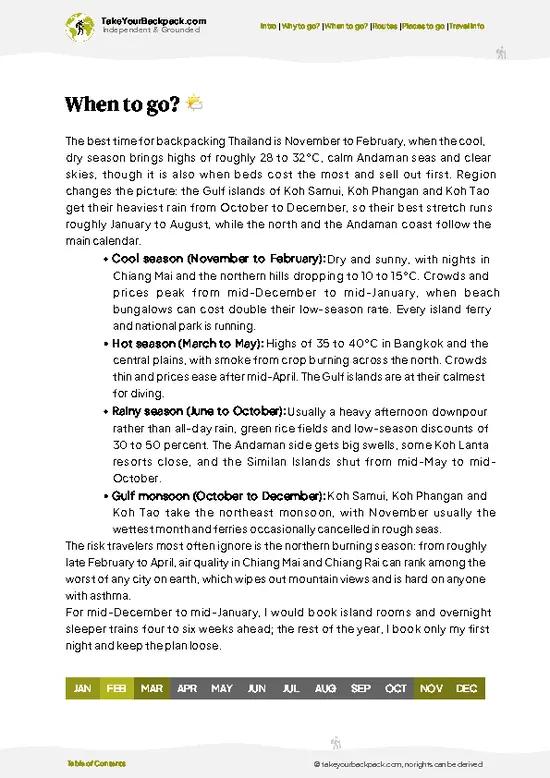
source: climatestotravel.comJANJanuary: excellent for travelingFEBFebruary: excellent for travelingMARMarch: highly recommended for travelingAPRApril: fair for travelingMAYMay: fair for travelingJUNJune: fair for travelingJULJuly: fair for travelingAUGAugust: fair for travelingSEPSeptember: fair for travelingOCTOctober: highly recommended for travelingNOVNovember: excellent for travelingDECDecember: excellent for traveling
when-to-go

✈️ The backpacker research shortcutThailand Travel Guide

An offline-friendly backpacking guide with optimized travel routes, ranked highlights, transport advice, and the best areas to stay.
example page 0 from our offline Travel Guide for Thailand
example page 1 from our offline Travel Guide for Thailand
example page 2 from our offline Travel Guide for Thailand
example page 3 from our offline Travel Guide for Thailand
example page 4 from our offline Travel Guide for Thailand
example page 5 from our offline Travel Guide for Thailand
example page 6 from our offline Travel Guide for Thailand
example page 7 from our offline Travel Guide for Thailand
The digital guide (510 pages) contains:
139 highlights, ranked by travel appeal
Optimized 7, 14 & 21-day travel routes
Cities, national parks, landmarks, beaches
How to get around
Offline-friendly for travel without Wi-Fi
👉 Click to see all 30+ guide features

📅 Plan smarter in minutes, not weeks
Month by month travel advice
Festivals & national holidays
Budget expectations

🗺️ Go to the right places, skip the overrated ones
Honest pros & cons of destinations
Top hikes, parks & viewpoints
Lesser-known places most travelers miss
Clear “worth it vs skip it” guidance

🛏️ Travel smoothly without rookie mistakes
Best areas to stay
Transport systems explained simply
Common scams & safety advice
SIM cards, money & practical tips

🌍 Understand the country, not just visit it
Culture & traditions
52 Essential phrases & customs
Festivals worth planning around
Traveler-friendly historical context
Insights that make places more meaningful

📱 Built for real travel conditions
Fully downloadable PDF
Works completely offline
Optimized for phone use
Useful in remote areas & buses
Everything in one place
Save weeks of stressful planning
Get instant access to your full guide. 30‑day money-back guarantee.


By proceeding you agree to our terms.
Sent to your inbox immediately after payment • 100% Secure Checkout
Best Backpacking Travel Advisor 2025 tourism awardBest Backpacking
Travel Advisor
2025
What others say about Take Your Backpack Guides:
⭐⭐⭐⭐⭐
Fantastic, amazing amount of information!
⭐⭐⭐⭐⭐
My goodness this is amazing, it's what I've been looking for hats off too you!
⭐⭐⭐⭐⭐
I think this is absolutely BRILLIANT
⭐⭐⭐⭐
Very complete and informative. It's still missing places, but I gotta to commend you
⭐⭐⭐⭐⭐
This is truly amazing, thank you, can't wait to explore it with my kids!
⭐⭐⭐⭐⭐
Awesome resource, thank you!
⭐⭐⭐⭐⭐
This is amazing! Can't wait to explore the ones I haven't seen
⭐⭐⭐⭐
I love this! Well done, great idea.
⭐⭐⭐⭐⭐
Thanks for taking the time to make this gem!
⭐⭐⭐⭐⭐
This might be the best website I've ever seen.
⭐⭐⭐⭐⭐
Congratulations, and thank you so much for your work; it's incredibly valuable.
⭐⭐⭐⭐
In all seriousness I think you did a great job pointing out the important spots
⭐⭐⭐⭐⭐
10/10 very good
⭐⭐⭐⭐⭐
As someone who's only just starting to visit regularly this is awesome, thank you.
⭐⭐⭐⭐
Thank you very much! I'm going to visit my dad, it's going to be very useful!
⭐⭐⭐⭐⭐
This is really cool! We'll be travelling for the first time and this definitely come in handy.
⭐⭐⭐⭐⭐
You are now our minister of culture, congratulations 👨‍💼
⭐⭐⭐⭐⭐
Just wanted to tell you that this is a pearl! Going to follow your recommendations.
⭐⭐⭐⭐⭐
This is so cool. I'll definitely be using the resource for my travels soon.
⭐⭐⭐⭐⭐
This is very impressive! Good work.
⭐⭐⭐⭐⭐
This is an amazing and informative site. Very well done!

🛏️ Where to stay?Best areas to stay in Thailand

Pai’s charm is in its laid-back vibe and natural beauty, but the village’s small size means your choice of stay shapes your whole experience. The best places for backpackers cluster around the Walking Street and the river, where you get the pulse of Pai without losing the calm.

Start with the riverbank hostels. They’re not just budget-friendly; they offer a sensory reset after the bumpy ride in. Imagine waking up to the soft murmur of the Pai River, the scent of damp earth and wildflowers drifting through open windows. This isn’t just a place to crash—it’s a natural soundtrack that sets the tone … read more 👉
Pai’s charm is in its laid-back vibe and natural beauty, but the village’s small size means your choice of stay shapes your whole experience. The best places for backpackers cluster around the Walking Street and the river, where you get the pulse of Pai without losing the calm.

Start with the riverbank hostels. They’re not just budget-friendly; they offer a sensory reset after the bumpy ride in. Imagine waking up to the soft murmur of the Pai River, the scent of damp earth and wildflowers drifting through open windows. This isn’t just a place to crash—it’s a natural soundtrack that sets the tone for your day. Plus, these spots often have hammocks strung between trees, perfect for that afternoon nap or swapping stories with fellow travelers.

If you want to be in the thick of things, the guesthouses near Walking Street put you steps from the night market’s sizzling street food and the buzz of local bars. The trade-off is a bit more noise, but it’s the kind that feels alive, not intrusive. Staying here means you can wander back late without worrying about transport, and you soak in the village’s energy as it shifts from day to night.

For a quieter, more immersive stay, look for eco-lodges on the outskirts. They’re a short scooter ride away, surrounded by rice paddies and hills. The air here is cooler, fresher, and the sunsets hit with a golden glow that feels like a reward for the effort it takes to get out of the village center.

In Pai, where you stay isn’t just about convenience—it’s about tuning into the rhythm of the place. Pick your spot based on how you want to feel when you wake up, and you’ll unlock a smoother, richer experience.

🚌 Getting aroundGetting around like a local

Pai moves at its own rhythm — a laid-back pulse that feels like the slow burn of incense drifting through the air, mingling with the sharp scent of fresh herbs from the market. It’s not a place where strict timetables rule your day; instead, the town flows with a relaxed, almost improvisational vibe. Locals and travelers alike navigate by intuition, with scooters zipping past in a casual dance and tuk-tuks waiting patiently for their next fare. The sun casts long shadows on cracked pavement, and the occasional bell chimes from a temple, marking time in a way that feels more spiritual than mechanical. This is a town where you don’t just get from A to B—you soak in the journey, and the transit options reflect that easygoing spirit while still serving up practical routes for the budget traveler. … read more 👉
Pai moves at its own rhythm — a laid-back pulse that feels like the slow burn of incense drifting through the air, mingling with the sharp scent of fresh herbs from the market. It’s not a place where strict timetables rule your day; instead, the town flows with a relaxed, almost improvisational vibe. Locals and travelers alike navigate by intuition, with scooters zipping past in a casual dance and tuk-tuks waiting patiently for their next fare. The sun casts long shadows on cracked pavement, and the occasional bell chimes from a temple, marking time in a way that feels more spiritual than mechanical. This is a town where you don’t just get from A to B—you soak in the journey, and the transit options reflect that easygoing spirit while still serving up practical routes for the budget traveler.


  • Walking: Pai’s compact center is best explored on foot. The streets are narrow, often shaded by tall trees or colorful awnings, and walking lets you catch the scent of grilled street food and the chatter of locals. Most guesthouses, cafes, and markets are within a 10-15 minute stroll, making this the cheapest and most immersive way to get around.


  • Motorbike Rental: For about 150-250 THB per day, renting a scooter is the go-to for budget travelers who want freedom. The roads can be winding and steep outside town, so a helmet is non-negotiable. Rentals usually open early (around 8 AM) and close by sunset, but you can negotiate 24-hour access. This option lets you chase waterfalls or hot springs at your own pace, avoiding the crowds and rigid schedules of group tours.


  • Tuk-Tuks: These three-wheeled workhorses are everywhere, but they don’t run on a fixed schedule. You’ll find them parked near the main street or outside popular spots, ready to negotiate a fare. Expect to pay 50-100 THB for short rides within town, more for trips to the outskirts. They’re slower than scooters but offer shade and a break from the sun, perfect for short hops when you’re tired of walking.


  • Songthaews (Shared Pickup Trucks): These are the budget-friendly lifeline for longer distances, like the 3-4 hour trip to Chiang Mai. They leave when full, so timing is flexible but unpredictable. Fares hover around 150-200 THB. Inside Pai, they’re less common but can be flagged down for trips to nearby villages or the bus station. It’s a rougher ride but a genuine local experience.


  • Bicycle Rental: For about 50-100 THB per day, renting a bike is a slower, sweatier alternative to scooters but perfect for short distances and exploring the rice paddies just outside town. The terrain is mostly flat around the center, and early mornings or late afternoons offer cooler light and softer air, making the ride more pleasant.

👛 Costs (as of 21 June 2026)Money, prices, and spending tips

Backpacking in Pai, Thailand, feels like stepping into a slow-motion film where the air carries the scent of fresh herbs and wood smoke, but knowing the daily costs helps you savor the experience without surprises.
  • Dorm Accommodation: Expect to pay around $5 to $10 per night for a bed in a basic dorm. These places are simple but clean, often with open-air common areas where the evening breeze cools the day’s heat. If you want a bit more comfort, small guesthouses with private rooms start at about $15, but dorms are the sweet spot for budget travelers.
  • Meals: Street food here is a highlight and won’t break the bank. You can grab a hearty plate of khao soi or pad thai for $1.50 to $3. Local markets and food stalls dominate, so eating well on $5 to $7 a day is totally doable. If you want to splurge
read more 👉
Backpacking in Pai, Thailand, feels like stepping into a slow-motion film where the air carries the scent of fresh herbs and wood smoke, but knowing the daily costs helps you savor the experience without surprises.
  • Dorm Accommodation: Expect to pay around $5 to $10 per night for a bed in a basic dorm. These places are simple but clean, often with open-air common areas where the evening breeze cools the day’s heat. If you want a bit more comfort, small guesthouses with private rooms start at about $15, but dorms are the sweet spot for budget travelers.
  • Meals: Street food here is a highlight and won’t break the bank. You can grab a hearty plate of khao soi or pad thai for $1.50 to $3. Local markets and food stalls dominate, so eating well on $5 to $7 a day is totally doable. If you want to splurge on a western-style meal or a smoothie bowl, expect to pay closer to $5 to $8 per meal.
  • Local Transport: Pai is small, and most travelers get around by renting a scooter for about $5 to $7 per day. This is the best way to explore the surrounding hills and waterfalls at your own pace. If you’re not comfortable on two wheels, songthaews (shared pickup trucks) run around $1 to $2 per trip within town or to nearby spots.
  • Basic Activities/Entry Fees: Many natural attractions like waterfalls and hot springs charge small entry fees, usually between $1 and $3. Renting a bicycle for $2 to $3 a day is another cheap way to explore. Guided tours or yoga classes can push the budget higher, around $10 to $20, but these are optional extras.
  • Miscellaneous Expenses: Think bottled water, snacks, occasional coffee, or a cold Chang beer. These add up to about $2 to $5 daily. Wi-Fi is generally free at cafes and guesthouses, so no extra cost there.

All told, you’re looking at roughly $15 to $25 a day to live comfortably in Pai without cutting corners. It’s a place where the slow rhythm of life matches a budget that lets you linger over a meal or a sunset without counting every cent. The trick is to embrace the simple pleasures Pai offers—cheap food, easy transport, and nature’s quiet invitations—so your money stretches as far as the winding roads outside town.
⚠️ Prices can change and everyone travels differently, so take this as a rough guide. Hope it helps you plan your adventure!

🚌 Day tripsExploring the surroundings

Using Pai as your base opens up a world of adventure, with day trips that blend stunning scenery and local culture. Here’s how to make the most of your time.

Waterfall Hopping
Just a short ride from Pai, the waterfalls are a refreshing escape. Start with Pam Bok, where you can swim in cool pools surrounded by lush greenery. The ride takes about 30 minutes, and you’ll spend a few hours exploring. Bring a picnic; the sound of rushing water is the perfect backdrop. Expect to spend around 100 baht for transport and snacks. The rainy season (June to October) makes the falls more impressive, but be cautious of slippery paths. First-timers often miss the smaller falls; don’t just stick to the main ones. Explore! 👉 Explore Pai

Tham Lod Cave
This cave system is a must-see, about an hour’s drive … read more 👉
Using Pai as your base opens up a world of adventure, with day trips that blend stunning scenery and local culture. Here’s how to make the most of your time.

Waterfall Hopping
Just a short ride from Pai, the waterfalls are a refreshing escape. Start with Pam Bok, where you can swim in cool pools surrounded by lush greenery. The ride takes about 30 minutes, and you’ll spend a few hours exploring. Bring a picnic; the sound of rushing water is the perfect backdrop. Expect to spend around 100 baht for transport and snacks. The rainy season (June to October) makes the falls more impressive, but be cautious of slippery paths. First-timers often miss the smaller falls; don’t just stick to the main ones. Explore! 👉 Explore Pai

Tham Lod Cave
This cave system is a must-see, about an hour’s drive from Pai. The journey takes you through winding roads with breathtaking views. Once there, you can take a bamboo raft through the cave, marveling at the stalactites and ancient burial sites. Entry is around 200 baht, plus transport costs. Aim for early morning to avoid crowds and catch the soft light filtering through the cave openings. Many backpackers underestimate the time needed; allow at least half a day to soak it all in. 👉 Explore Pai

Hot Springs
The Pai Hot Springs are a perfect way to unwind after a day of exploration. Located about 30 minutes from town, these natural springs offer a serene atmosphere. Entry is about 300 baht, and you can easily spend a couple of hours soaking in the warm waters. Visit in the late afternoon to enjoy the sunset glow. A common mistake is to rush through; take your time to relax and enjoy the surroundings. Bring a towel and some snacks to enhance the experience. 👉 Explore Pai

Chinese Village
A trip to the nearby Chinese Village offers a unique cultural experience. It’s about a 40-minute ride, and the vibrant architecture and tea plantations are a feast for the eyes. Spend a few hours wandering the village, sampling local snacks, and enjoying the views. Expect to spend around 150 baht for transport and food. The best time to visit is early morning when the village is quiet and the light is soft. Many travelers overlook this spot, but it’s a fantastic way to connect with the local culture. 👉 Explore Pai
Want to know what more Thailand offers?
The Thailand Travel Guide describes 139 highlights, from cities to national parks, from beaches to hikes

Get the Travel Guide -

🛡️ SafetySafety Tips and Common Scams in Pai

Pai is a laid-back town where the biggest safety issue is usually your own overenthusiasm after a long day of exploring. The streets are generally safe, even at night, but the dim lighting and narrow lanes around the walking street market call for a bit more attention—watch your step and keep your belongings close. Solo travelers blend in easily, but it’s smart to avoid wandering too far off the main drag after dark; the quiet can feel peaceful but also a little isolating.

Scooter rentals are the lifeblood of Pai, but they’re also where most travelers trip up. Helmets are a must, and checking brakes and lights before you ride saves you from a roadside scramble. Watch out for overly friendly tuk-tuk drivers offering “special” tours at suspiciously low prices—these often end in overpriced … read more 👉
Pai is a laid-back town where the biggest safety issue is usually your own overenthusiasm after a long day of exploring. The streets are generally safe, even at night, but the dim lighting and narrow lanes around the walking street market call for a bit more attention—watch your step and keep your belongings close. Solo travelers blend in easily, but it’s smart to avoid wandering too far off the main drag after dark; the quiet can feel peaceful but also a little isolating.

Scooter rentals are the lifeblood of Pai, but they’re also where most travelers trip up. Helmets are a must, and checking brakes and lights before you ride saves you from a roadside scramble. Watch out for overly friendly tuk-tuk drivers offering “special” tours at suspiciously low prices—these often end in overpriced stops or long waits. Staying clear of these setups means you keep control of your time and budget.

In short, Pai’s charm comes with simple, practical awareness: respect the slow pace, keep your wits about you on two wheels, and you’ll find the town’s relaxed vibe rewarding rather than frustrating.

Other Thai towns near Pai

Explore more nearby:

  • Pang Mapha—cave systems, karst landscape, ethnic villages| 37 km away
  • Chiang Dao—limestone peaks, cave temples, hill tribe villages| 55 km away
  • Mon Jam—hilltop farms, panoramic views, cool air| 62 km away

💡 Not sure where to go next?
Create a personalized itinerary for Thailand including Pai and the places that fit your trip.

Generate my itinerary

👉 Discover all towns

Or checkout all Thailand has to offer (think cities, towns, villages, national parks, hikes, beaches, festivals)
Country photo of Thailand

We 💚 feedbackIs it worth it?

Pai is a slice of paradise, where the air is thick with the scent of fresh herbs and the sound of laughter echoes through the night markets. You’ll find a community that feels like family, with locals eager to share their stories. But be ready for the reality: the roads leading in can be a wild ride, with twists and turns that test your stomach. Embrace the journey; it’s part of what makes Pai special.

✈️ When did I visit Thailand?
Before visiting Vietnam (1998), I had some time in Thailand to explore the country.

✍️ Help improve this page!
The information on this page is based on my own backpacking experience in Thailand, supplemented with up-to-date research and feedback from other travelers. Travel details can change, so if you notice anything outdated or incomplete, feel free to let me know.


🙋‍♂️ Give feedback

👋 Meet the founderWho’s Behind Take Your Backpack?

Johan, backpacker and founder of TakeYourBackpackHi, I’m Johan (Netherlands 🇳🇱), the creator of TakeYourBackpack. Over the past decade, I’ve backpacked through 80+ countries across six continents, gaining extensive experience with independent travel, long-term trips, and overland routes.

This site is built on a combination of firsthand travel experience and carefully curated insights from other backpackers. Many guides are based on places I’ve personally visited, while others bring together tips, observations, and practical advice shared by trusted travelers I’ve met along the way.

The goal is to provide realistic, experience-driven guidance — not generic itineraries — so you can explore destinations with better context, clearer expectations, and more confidence.

Get full Thailand guide •
Instant download • 139 highlights • Full Offline guide