×

Togo🇹🇬 | national parksKéran National ParkKéran River, hippo pools, roan antelope, armed ranger patrols | things to do and best time to go

Explore Fosse aux Lions National ParkExplore Lake Togo

Backpacking in Kéran
🌟 Highlightnational park ranked #2
By Johan Kruseman 🇳🇱 | Updated October 22, 2026

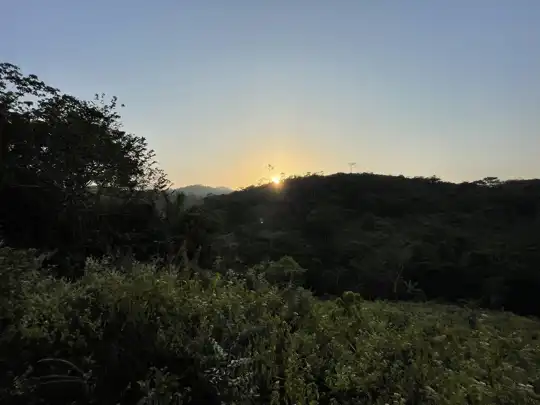
The dry grass hisses against your trousers at first light, and somewhere ahead a ranger stops, lifts two fingers and points at a line of kob freezing in the ochre haze. Kéran National Park sits in the north of Togo, northeast of Kara, a savanna and woodland reserve of roughly 1,600 square kilometers with few visitors and almost no infrastructure. That is both its charm and its challenge. Walking is allowed only with an armed ranger, because wildlife is real and sparse, so arrange the guide at the park entrance rather than going alone. Animals keep their distance from people after years of poaching pressure, so sightings take patience and quiet feet. Roads turn to red mud in the rains and dust in the dry months, so a motorbike or a hired 4x4 beats a regular taxi. Heat builds by mid-morning, so walk early. Expect termite mounds, sun-baked laterite and the dry rattle of shea trees.

Discover everything you want to know in the 📖 Togo Travel Guide.


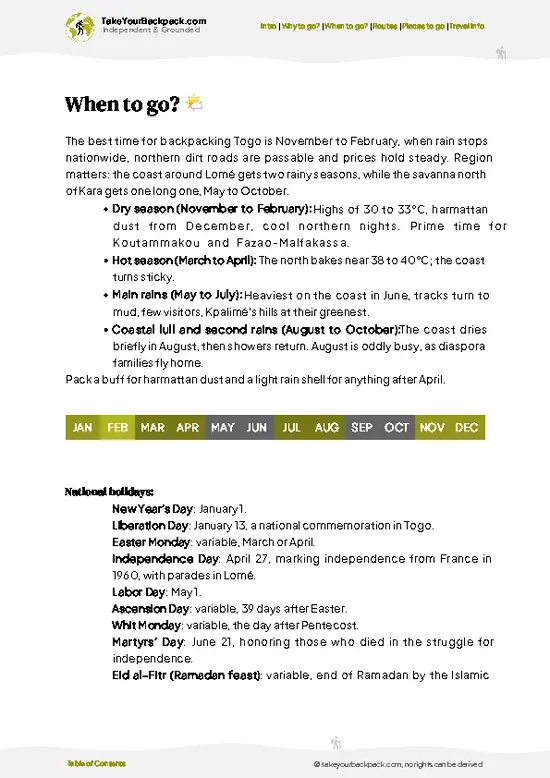
example page 0 from our offline Travel Guide for Togo
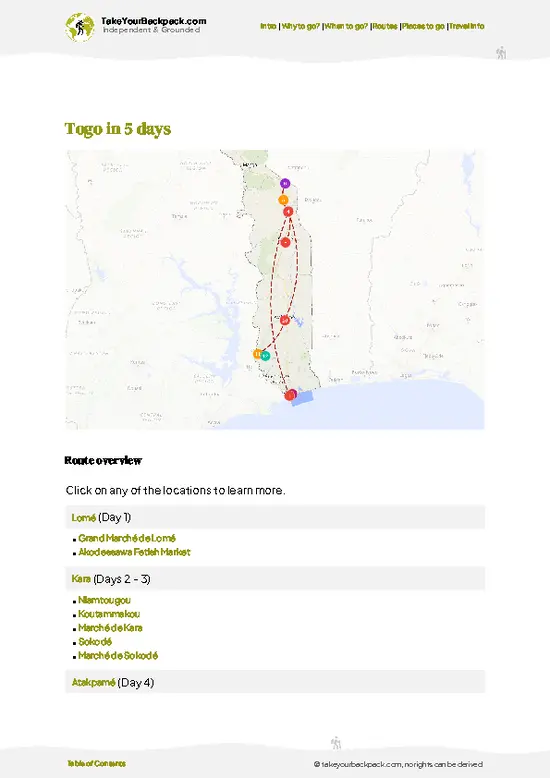
example page 1 from our offline Travel Guide for Togo
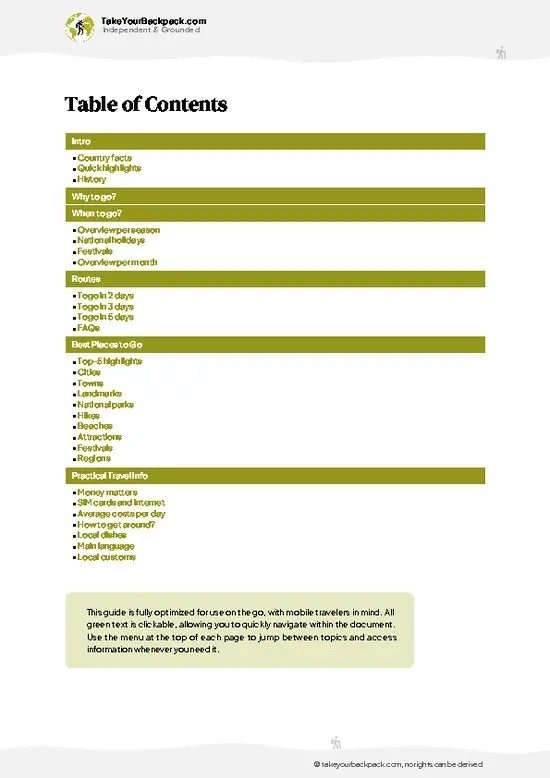
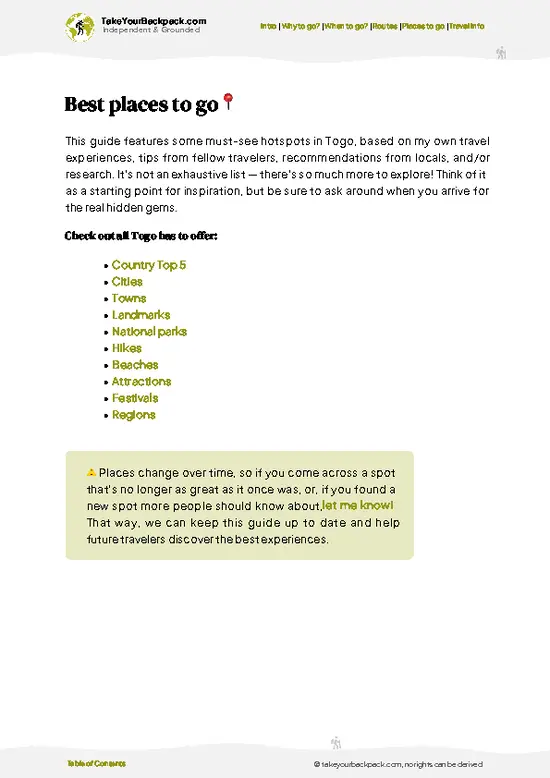
example page 2 from our offline Travel Guide for Togo
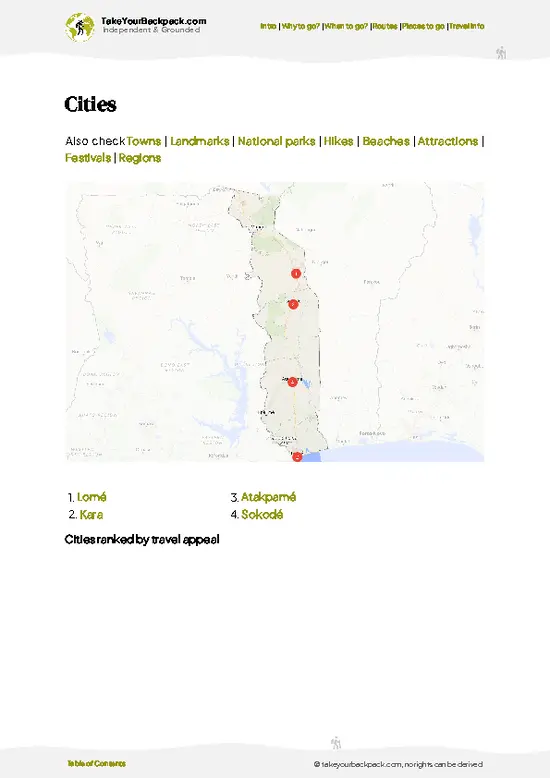
example page 3 from our offline Travel Guide for Togo
example page 4 from our offline Travel Guide for Togo
example page 5 from our offline Travel Guide for Togo
example page 6 from our offline Travel Guide for Togo
example page 7 from our offline Travel Guide for Togo
Loading the map 🌍
CLICK TO FILTER
cities
towns
landmarks
national parks
hikes
beaches
attractions
festivals
regions
SHOW COUNTRY’S BESTSHOW ALL

✨ Why go?
Ranked #2 national park in Togo
The unique appeal for travelers

Kéran National Park suits the traveler who wants wild country without a queue. You will probably share the savanna with a ranger and perhaps one other group, which almost never happens at the better-known parks of West Africa. The park forms part of the Oti-Kéran-Mandouri protected complex, one of the largest blocks of Sudanian savanna in Togo, so the walking feels open and unmanaged. Wildlife is thinner than in East African parks, but that gives each sighting weight: a roan antelope on a ridge, hippo snorts from the river, or elephant dung still damp on the track. The second draw is independence at low cost. Trips are arranged on the spot with rangers and local drivers instead of through tour operators, which suits improvisers with a flexible schedule. Pair it with nearby villages in the … read more 👉
Kéran National Park suits the traveler who wants wild country without a queue. You will probably share the savanna with a ranger and perhaps one other group, which almost never happens at the better-known parks of West Africa. The park forms part of the Oti-Kéran-Mandouri protected complex, one of the largest blocks of Sudanian savanna in Togo, so the walking feels open and unmanaged. Wildlife is thinner than in East African parks, but that gives each sighting weight: a roan antelope on a ridge, hippo snorts from the river, or elephant dung still damp on the track. The second draw is independence at low cost. Trips are arranged on the spot with rangers and local drivers instead of through tour operators, which suits improvisers with a flexible schedule. Pair it with nearby villages in the north, where daily life follows the farming year and visitors are still a curiosity. Bring your own water, snacks and patience, and the park pays you back with solitude.

💡 HighlightsMust-see experiences and standout moments

  1. Kéran River: The park’s lifeline, a sandy, slow-moving watercourse lined with tall gallery forest. Animals gather along its banks in the dry months, so a morning walk here gives your best odds of sightings.
  2. Hippo pools on the Oti River: Where the river runs deep, hippos wallow all day and grunt after dark. Binoculars matter, since approaching the banks on foot is dangerous and rangers will keep you well back.
  3. Elephant tracks and dung trails: A small elephant population moves through the park and the wider reserve complex. Seeing the animal itself is rare, but a ranger reading fresh tracks, broken branches and dung is a lesson in tracking.
  4. Kob, roan antelope and waterbuck: These are the antelope you are most likely to see on the open grass. Roan are the largest, with long backswept horns and a
… read more 👉
  1. Kéran River: The park’s lifeline, a sandy, slow-moving watercourse lined with tall gallery forest. Animals gather along its banks in the dry months, so a morning walk here gives your best odds of sightings.
  2. Hippo pools on the Oti River: Where the river runs deep, hippos wallow all day and grunt after dark. Binoculars matter, since approaching the banks on foot is dangerous and rangers will keep you well back.
  3. Elephant tracks and dung trails: A small elephant population moves through the park and the wider reserve complex. Seeing the animal itself is rare, but a ranger reading fresh tracks, broken branches and dung is a lesson in tracking.
  4. Kob, roan antelope and waterbuck: These are the antelope you are most likely to see on the open grass. Roan are the largest, with long backswept horns and a pale facial mask, and tend to stand watchful on rises.
  5. Sudanian savanna woodland: Shea, locust bean and combretum trees dot a landscape of tall grass that burns gold in the dry months and turns bright green after the rains. Termite mounds taller than a person rise from the ground, and the quality of the light is best early in the day.
  6. Birdlife along the watercourses: Hornbills, bee-eaters, kingfishers and raptors work the gallery forest and river margins. Dawn is noisy and the best time for photography, as the birds are active before the heat builds.
  7. Baboons and monkeys in the riverine forest: Troops move through the shady strips beside the water, calling to each other long before you see them. They are the most reliable wildlife encounter in the park.
For a first visit, the Kéran River at dawn with a ranger is the best choice, because it combines water, shade, birds and antelope in one short walk.
Spotted a mistake or missing something? Contact us.

🌤️ When to go?Best time to explore Kéran

  • Harmattan (December to February): Mornings run 18 to 22°C (64 to 72°F) and afternoons reach 32 to 36°C (90 to 97°F). Dust haze softens views, but the grass is short and elephants, antelope and baboons are easier to spot. Daylight lasts roughly 11.5 to 12 hours.
  • Hot Season (March to May): Highs of 36 to 40°C (97 to 104°F) make midday walking punishing. Waterholes shrink, so animals gather there, and the first storms arrive late in the season.
  • Rains (June to October): Expect 26 to 31°C (79 to 88°F), tall grass, muddy tracks and swollen streams. Wildlife hides, trails get slow, and some tracks may be impassable.
  • Crowds and Prices: Kéran sees few visitors in any month. Guide and lodging prices barely shift, though Christmas week can fill the few rooms in nearby Kara and Kanté.
Start walks at first … read more 👉
  • Harmattan (December to February): Mornings run 18 to 22°C (64 to 72°F) and afternoons reach 32 to 36°C (90 to 97°F). Dust haze softens views, but the grass is short and elephants, antelope and baboons are easier to spot. Daylight lasts roughly 11.5 to 12 hours.
  • Hot Season (March to May): Highs of 36 to 40°C (97 to 104°F) make midday walking punishing. Waterholes shrink, so animals gather there, and the first storms arrive late in the season.
  • Rains (June to October): Expect 26 to 31°C (79 to 88°F), tall grass, muddy tracks and swollen streams. Wildlife hides, trails get slow, and some tracks may be impassable.
  • Crowds and Prices: Kéran sees few visitors in any month. Guide and lodging prices barely shift, though Christmas week can fill the few rooms in nearby Kara and Kanté.
Start walks at first light in any month, before the heat builds, and plan around December or January for the clearest wildlife viewing.


source: climatestotravel.comJANJanuary: excellent for travelingFEBFebruary: excellent for travelingMARMarch: excellent for travelingAPRApril: good for travelingMAYMay: good for travelingJUNJune: below average for travelingJULJuly: below average for travelingAUGAugust: below average for travelingSEPSeptember: below average for travelingOCTOctober: fair for travelingNOVNovember: excellent for travelingDECDecember: excellent for traveling
when-to-go

✈️ The backpacker research shortcutTogo Travel Guide

An offline-friendly backpacking guide with optimized travel routes, ranked highlights, transport advice, and the best areas to stay.
example page 0 from our offline Travel Guide for Togo
example page 1 from our offline Travel Guide for Togo
example page 2 from our offline Travel Guide for Togo
example page 3 from our offline Travel Guide for Togo
example page 4 from our offline Travel Guide for Togo
example page 5 from our offline Travel Guide for Togo
example page 6 from our offline Travel Guide for Togo
example page 7 from our offline Travel Guide for Togo
The digital guide (194 pages) contains:
✅ 42 highlights, ranked by travel appeal
✅ Optimized 2, 3 & 5-day travel routes
✅ Cities, national parks, landmarks, beaches
✅ How to get around
✅ Offline-friendly for travel without Wi-Fi
👉 Click to see all 30+ guide features

📅 Plan smarter in minutes, not weeks
✅ Month by month travel advice
✅ Festivals & national holidays
✅ Budget expectations

🗺️ Go to the right places, skip the overrated ones
✅ Honest pros & cons of destinations
✅ Top hikes, parks & viewpoints
✅ Lesser-known places most travelers miss
✅ Clear “worth it vs skip it” guidance

🛏️ Travel smoothly without rookie mistakes
✅ Best areas to stay
✅ Transport systems explained simply
✅ Common scams & safety advice
✅ SIM cards, money & practical tips

🌍 Understand the country, not just visit it
✅ Culture & traditions
✅ 52 Essential phrases & customs
✅ Festivals worth planning around
✅ Traveler-friendly historical context
✅ Insights that make places more meaningful

📱 Built for real travel conditions
✅ Fully downloadable PDF
✅ Works completely offline
✅ Optimized for phone use
✅ Useful in remote areas & buses
✅ Everything in one place
Stop searching, start planning
Get instant access to your full guide. 30‑day money-back guarantee.
+ Add another guide for just

By proceeding you agree to our terms.
Sent to your inbox immediately after payment • 100% Secure Checkout
Best Backpacking Travel Advisor 2025 tourism awardBest Backpacking
Travel Advisor
2025
What others say about Take Your Backpack Guides:
⭐⭐⭐⭐⭐
Fantastic, amazing amount of information!
⭐⭐⭐⭐⭐
My goodness this is amazing, it's what I've been looking for hats off too you!
⭐⭐⭐⭐⭐
I think this is absolutely BRILLIANT
⭐⭐⭐⭐
Very complete and informative. It's still missing places, but I gotta to commend you
⭐⭐⭐⭐⭐
This is truly amazing, thank you, can't wait to explore it with my kids!
⭐⭐⭐⭐⭐
Awesome resource, thank you!
⭐⭐⭐⭐⭐
This is amazing! Can't wait to explore the ones I haven't seen
⭐⭐⭐⭐
I love this! Well done, great idea.
⭐⭐⭐⭐⭐
Thanks for taking the time to make this gem!
⭐⭐⭐⭐⭐
This might be the best website I've ever seen.
⭐⭐⭐⭐⭐
Congratulations, and thank you so much for your work; it's incredibly valuable.
⭐⭐⭐⭐
In all seriousness I think you did a great job pointing out the important spots
⭐⭐⭐⭐⭐
10/10 very good
⭐⭐⭐⭐⭐
As someone who's only just starting to visit regularly this is awesome, thank you.
⭐⭐⭐⭐
Thank you very much! I'm going to visit my dad, it's going to be very useful!
⭐⭐⭐⭐⭐
This is really cool! We'll be travelling for the first time and this definitely come in handy.
⭐⭐⭐⭐⭐
You are now our minister of culture, congratulations 👨‍💼
⭐⭐⭐⭐⭐
Just wanted to tell you that this is a pearl! Going to follow your recommendations.
⭐⭐⭐⭐⭐
This is so cool. I'll definitely be using the resource for my travels soon.
⭐⭐⭐⭐⭐
This is very impressive! Good work.
⭐⭐⭐⭐⭐
This is an amazing and informative site. Very well done!

🛏️ Where to stay?Where staying makes the most sense

No lodging operates inside Kéran National Park, so most backpackers sleep in Kanté, the small town at the park’s edge. It has a few basic guesthouses with fan rooms and shared or simple private bathrooms, usually €6 to 14 a night. Book ahead if you can by phone, since places are few and there is no online booking to speak of.

Kara, the regional capital roughly 1.5 to 2 hours away by road, has a much wider choice. Expect hostel-style rooms and budget hotels at €10 to 30, plus restaurants, ATMs and a market for stocking up. It works well if you want comfort and reliable supplies, then a morning … read more 👉
No lodging operates inside Kéran National Park, so most backpackers sleep in Kanté, the small town at the park’s edge. It has a few basic guesthouses with fan rooms and shared or simple private bathrooms, usually €6 to 14 a night. Book ahead if you can by phone, since places are few and there is no online booking to speak of.

Kara, the regional capital roughly 1.5 to 2 hours away by road, has a much wider choice. Expect hostel-style rooms and budget hotels at €10 to 30, plus restaurants, ATMs and a market for stocking up. It works well if you want comfort and reliable supplies, then a morning drive to the park with a guide.

Napari and other small villages around the park offer simple rooms or a mat in a host’s compound at times, arranged through local contacts or the park office. Camping is possible near park entry points only with the agreement of rangers, so ask before pitching a tent. Bring your own food, water treatment and a mosquito net wherever you sleep. Electricity is patchy outside Kara, so carry a power bank. Rooms rarely sell out, but arriving before dark is wise because finding a bed after nightfall is harder.

👛 Costs (as of 22 October 2026)How expensive it really is

Kéran National Park costs a backpacker roughly €2 to 5 a day, with a total daily budget of about €55 when you hire a guide and use a motorbike taxi. Travelers pay in West African CFA francs, and cash is needed because card use is rare outside Kara.
CategoryBudget RangeLocal Reality
Entrance fee€2 to 5Paid at the park office or to rangers. Prices for foreigners are higher than for locals.
Guide or ranger€8 to 15Strongly advised. Rates depend on group size and the length of the walk.
Accommodation (low season)€6 to 12Basic fan rooms in Kanté or Kara guesthouses.
Accommodation (high season)€8 to 15Slightly pricier from December to February when rooms are scarce.
Local transport€10 to 18Shared taxi or minibus from Kara to Kanté, then a motorbike taxi to the park gate.
Food and supplies€5 to 10Rice, beans,
… read more 👉
Kéran National Park costs a backpacker roughly €2 to 5 a day, with a total daily budget of about €55 when you hire a guide and use a motorbike taxi. Travelers pay in West African CFA francs, and cash is needed because card use is rare outside Kara.
CategoryBudget RangeLocal Reality
Entrance fee€2 to 5Paid at the park office or to rangers. Prices for foreigners are higher than for locals.
Guide or ranger€8 to 15Strongly advised. Rates depend on group size and the length of the walk.
Accommodation (low season)€6 to 12Basic fan rooms in Kanté or Kara guesthouses.
Accommodation (high season)€8 to 15Slightly pricier from December to February when rooms are scarce.
Local transport€10 to 18Shared taxi or minibus from Kara to Kanté, then a motorbike taxi to the park gate.
Food and supplies€5 to 10Rice, beans, grilled meat and fried plantain at local stalls. Bring snacks and water.
Total Daily Budget€33 to 63About €55 for one day using high season lodging.
⚠️ Prices can change and everyone travels differently, so take this as a rough guide. Hope it helps you plan your adventure!

🥾 TrailsExploring Kéran: trails, terrain, and views

Kéran National Park has no waymarked trail network, so walks follow ranger-led routes that change with the season, the grass height and where animals have been seen. You set the length and pace when you arrange the guide at the entrance.
  • River walk: Starts near the Kéran River and follows its banks and gallery forest. Expect flat, sandy ground, shade in places, and a couple of hours of easy walking with frequent stops for birds, monkeys and tracks.
  • Savanna loop: A longer circuit across open grassland and woodland, usually a half-day outing. The terrain is mostly flat with gentle rises, but the lack
… read more 👉
Kéran National Park has no waymarked trail network, so walks follow ranger-led routes that change with the season, the grass height and where animals have been seen. You set the length and pace when you arrange the guide at the entrance.
  • River walk: Starts near the Kéran River and follows its banks and gallery forest. Expect flat, sandy ground, shade in places, and a couple of hours of easy walking with frequent stops for birds, monkeys and tracks.
  • Savanna loop: A longer circuit across open grassland and woodland, usually a half-day outing. The terrain is mostly flat with gentle rises, but the lack of shade and the heat make it moderately demanding by late morning.
  • Waterhole and lookout stops: Rangers lead small detours to pools and rocky rises where animals gather at the end of the dry season. These are short, easy side trips that suit tired legs.
  • Wildlife: Kob, waterbuck, roan antelope, warthog, baboons and many birds are the most likely sightings. Hippos live in the deeper river sections, and elephants and buffalo exist but are elusive.
  • Difficulty: Easy to moderate on the ground, but heat, sun exposure and the occasional thorny scrub raise the effort. Long sleeves, a hat and plenty of water make a real difference.
Reaching the park takes some determination. Public transport runs from Kara toward Kandé and the northern towns, but the final stretch to the park usually requires a motorbike taxi or a hired vehicle, and tracks become slippery in the rainy season. Crowds are essentially absent, and you may meet no other visitors. An entrance fee and a guide fee are paid in West African CFA francs on arrival, so carry small notes, as there is no cash machine nearby. Walk at dawn, since the heat and the animals’ activity peak at opposite times of day.
⚠️ Hiking info can sometimes be outdated or inaccurate. Before you hit the trail, check the latest conditions with locals. If you do spot anything that's off, I'd love to hear from you, so I can update it for fellow travelers.

🛡️ SafetyScams, Hazards, and Annoyances

Kéran is a quiet, lightly visited park where the main hazards are heat, dehydration and getting lost, not dramatic wildlife. Temperatures climb steeply by mid-morning, so walk at dawn, rest at midday and carry at least 3 liters of water per person. Hire a ranger or local guide. Trails are faint, signage is minimal and the grass can hide the path in the rainy months.

Elephants, buffalo and baboons live here, along with snakes. Keep a respectful distance from large animals, never walk between a mother and calf, and stay quiet and still if you meet one. Watch your footing in tall grass and wear closed shoes and long trousers.

Malaria is present year-round, so take prophylaxis and use repellent and a net. Rain turns tracks to mud and fills streams, so check conditions before heading out. Phone … read more 👉
Kéran is a quiet, lightly visited park where the main hazards are heat, dehydration and getting lost, not dramatic wildlife. Temperatures climb steeply by mid-morning, so walk at dawn, rest at midday and carry at least 3 liters of water per person. Hire a ranger or local guide. Trails are faint, signage is minimal and the grass can hide the path in the rainy months.

Elephants, buffalo and baboons live here, along with snakes. Keep a respectful distance from large animals, never walk between a mother and calf, and stay quiet and still if you meet one. Watch your footing in tall grass and wear closed shoes and long trousers.

Malaria is present year-round, so take prophylaxis and use repellent and a net. Rain turns tracks to mud and fills streams, so check conditions before heading out. Phone signal is patchy, so tell your guesthouse your plan and carry a basic first-aid kit and sun protection.

FAQCommon questions from travelers

Two days is the practical minimum for Kéran National Park, one for a guided walk at dawn and one for a second route or to cover the transfer from Kara. Kara is roughly 1.5 to 2 hours away by road, so a rushed single day leaves little time on the trails. Add a third day if you want to look for elephants at waterholes in the dry months.
Kéran National Park is reachable without a car, but it takes some effort. Take a shared taxi or minibus from Kara to Kanté (around €3 to 6), then hire a motorbike taxi for the last stretch to the park gate (around €5 to 12). Once inside, you walk with a ranger, so you do not need your own vehicle.
Yes, Kéran National Park charges a fee, usually around €2 to 5 for foreign visitors, paid in cash at the park office or to rangers. No advance permit is generally required, but a ranger or guide is strongly recommended and costs about €8 to 15 a day. Bring small bills in CFA francs, since change can be hard to find.
⚠️ Things can change over time, so always validate details locally before you go.

Other Togolese national parks near Kéran

Explore more nearby:


💡 Not sure where to go next?
Create a personalized itinerary for Togo including Kéran and the places that fit your trip.

Generate my itinerary

👉 Discover all national parks

Or checkout all Togo has to offer (think cities, towns, villages, national parks, hikes, beaches, festivals)
Country photo of Togo

We 💚 feedbackSumming up the experience

Kéran National Park works best as the wild chapter of a northern Togo loop, tucked between a few days in Kara and the mud-walled Tamberma villages near Kéran-side Koutammakou. I would pair it with the cooler hills and markets around Kara, and skip it entirely if you expect big-game density. Bring binoculars, start walking at first light, and arrange the ranger the evening before.

✍️ Help improve this page!
The information on this page is based on in-depth research, insights shared by experienced travelers, and feedback from the local travel community in Togo. While every effort is made to keep the information accurate and current, conditions can change — so if you spot anything incorrect or outdated, please get in touch.


🙋‍♂️ Give feedback

👋 Meet the founderWho’s Behind Take Your Backpack?

Johan, backpacker and founder of TakeYourBackpackHi, I’m Johan (Netherlands 🇳🇱), the creator of TakeYourBackpack. Over the past 3 decades, I’ve backpacked through 90+ countries across six continents, gaining extensive experience with independent travel, long-term trips, and overland routes.

This site is built on a combination of firsthand travel experience and carefully curated insights from other backpackers. Many guides are based on places I’ve personally visited, while others bring together tips, observations, and practical advice shared by trusted travelers I’ve met along the way.

The goal is to provide realistic, experience-driven guidance — not generic itineraries — so you can explore destinations with better context, clearer expectations, and more confidence.