×

Tonga🇹🇴 | hikesTofua Volcano TrailCrater lake, steaming vent, caldera rim, wild kava | things to do and best time to go

Explore Mount TalauExplore ʻEua National Park Coastal Track

Backpacking in Tofua Volcano Trail
🌟 Highlighthike ranked #2
By Johan Kruseman 🇳🇱 | Updated October 15, 2026

Whether to go with a local charter boat or try to piece together a visit on your own comes down to the sea: Tofua has no pier and no scheduled service, so a landing is only possible when the swell allows it. The island sits in the Ha’apai group in the middle of Tonga, north of Nuku’alofa. The trail climbs from a black boulder shore through damp forest, with the smell of sulfur growing stronger toward a caldera rim, then drops to a green crater lake with a steaming vent. It is short, steep, hot and loose underfoot. Pangai on Lifuka is the nearest practical base, reached by flight or ferry. Boats get cancelled in rough weather, so leave two spare days. Book the charter before arriving, carry all your water, and wear closed shoes because ash slides and roots trip. Kao, the tall cone beside Tofua, is a far harder, trailless scramble, while Tofua gives you a rough path to the rim and a lake.

Discover everything you want to know in the 📖 Tonga Travel Guide.
Best time to go: April - November
Duration: 5 hours
Distance: 7 kilometers
Total ascent: 500 meters


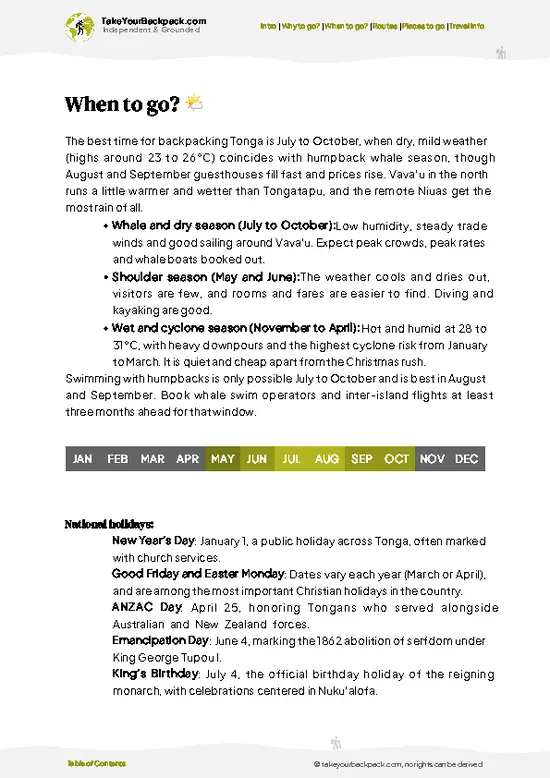
example page 0 from our offline Travel Guide for Tonga
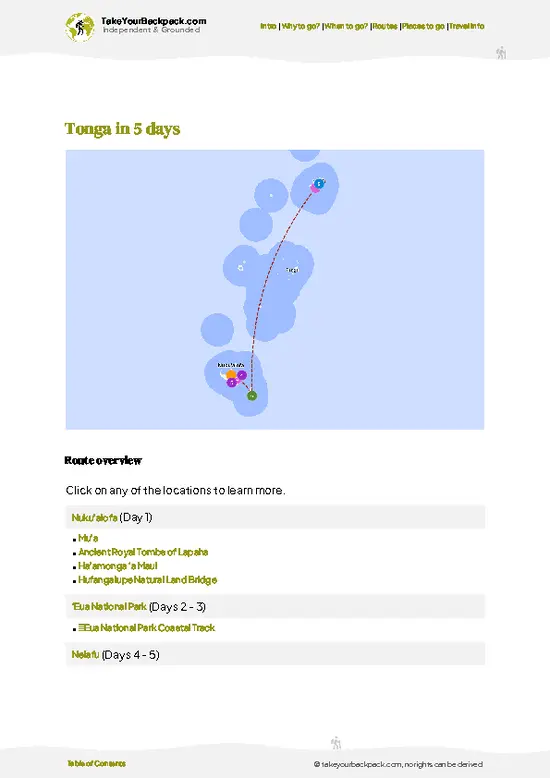
example page 1 from our offline Travel Guide for Tonga
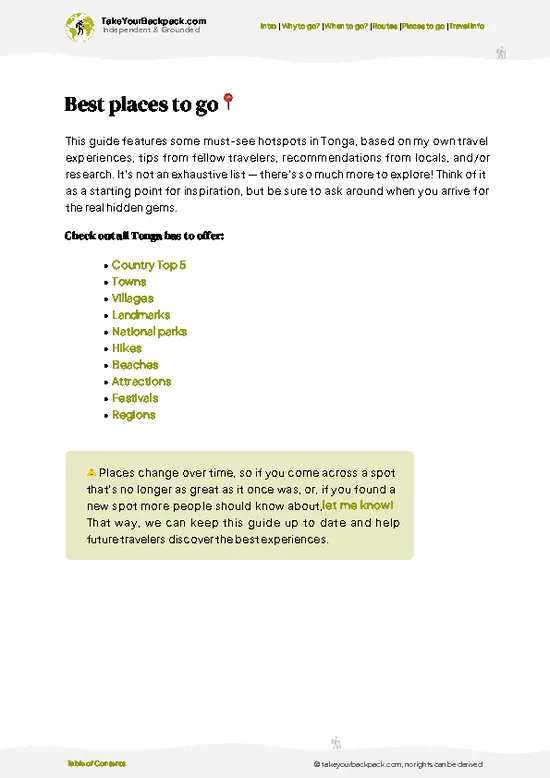
example page 2 from our offline Travel Guide for Tonga
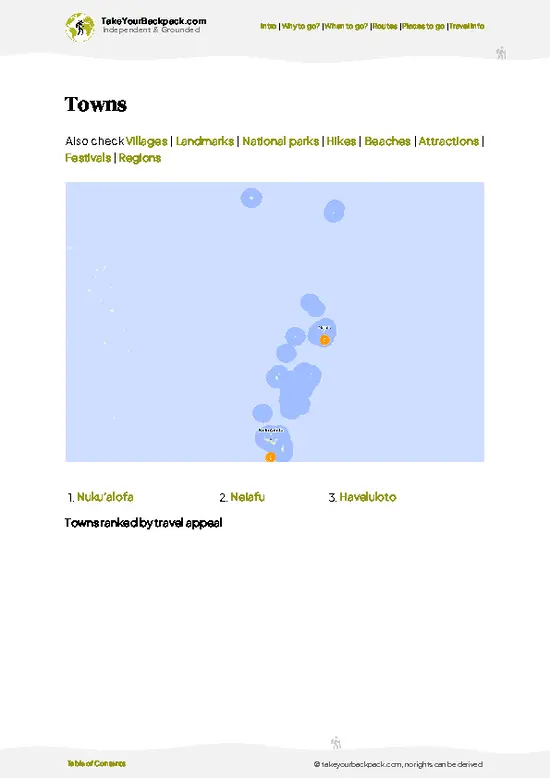
example page 3 from our offline Travel Guide for Tonga
example page 4 from our offline Travel Guide for Tonga
example page 5 from our offline Travel Guide for Tonga
example page 6 from our offline Travel Guide for Tonga
example page 7 from our offline Travel Guide for Tonga
Loading the map 🌍
CLICK TO FILTER
towns
villages
landmarks
national parks
hikes
beaches
attractions
festivals
regions
SHOW COUNTRY’S BESTSHOW ALL

✨ Why go?
Ranked #2 hike in Tonga
What sets this place apart

Tofua is the rare volcano where the walk is short but the payoff is huge. In roughly half a day you go from a boulder beach to a caldera rim, then down to a lake sitting inside an active volcano. Few places let you do that without a guide company, a permit queue or a week of planning.
The second pull is the isolation. Nobody lives here, so you meet wild kava groves and the odd Ha’apai harvester rather than other trekkers. The island also carries history: Captain Bligh’s 1789 landing after the Bounty mutiny happened on this coast, and a crewman died here before the boat fled.
It also fits a longer Tonga route easily. Ha’apai is the slow, quiet middle of the island chain, with beach camping, whale season and sleepy villages around it, and Tofua gives that stretch a proper day of effort. You come … read more 👉
Tofua is the rare volcano where the walk is short but the payoff is huge. In roughly half a day you go from a boulder beach to a caldera rim, then down to a lake sitting inside an active volcano. Few places let you do that without a guide company, a permit queue or a week of planning.
The second pull is the isolation. Nobody lives here, so you meet wild kava groves and the odd Ha’apai harvester rather than other trekkers. The island also carries history: Captain Bligh’s 1789 landing after the Bounty mutiny happened on this coast, and a crewman died here before the boat fled.
It also fits a longer Tonga route easily. Ha’apai is the slow, quiet middle of the island chain, with beach camping, whale season and sleepy villages around it, and Tofua gives that stretch a proper day of effort. You come back to Lifuka sunburnt, ash-streaked and happy, with a rim-to-lake story no resort beach can match.

💡 HighlightsEssential experiences to have while hiking the Tofua Volcano Trail

  1. The Crater Lake: The green-blue lake inside the caldera is the sight everyone comes for. It sits far below the rim, ringed by steep walls, and the color shifts with the light and the cloud shadow. The air near the shore smells of sulfur.
  2. The Caldera Rim: The rim walk is the high point of the day. You come out of the forest onto open ridge, the wind picks up, and the island drops away on both sides toward the ocean and the lake. Footing is narrow and crumbly, so go slowly.
  3. The Active Vent: Inside the caldera a steaming cone sends up a thin plume, and you can smell it before you see it. The ground nearby is gray ash and cinder, warm in places. Keep your distance and watch the wind direction.
  4. Wild Kava Groves: On the lower slopes, kava plants grow in the forest shade. Ha’apai islanders have long
… read more 👉
  1. The Crater Lake: The green-blue lake inside the caldera is the sight everyone comes for. It sits far below the rim, ringed by steep walls, and the color shifts with the light and the cloud shadow. The air near the shore smells of sulfur.
  2. The Caldera Rim: The rim walk is the high point of the day. You come out of the forest onto open ridge, the wind picks up, and the island drops away on both sides toward the ocean and the lake. Footing is narrow and crumbly, so go slowly.
  3. The Active Vent: Inside the caldera a steaming cone sends up a thin plume, and you can smell it before you see it. The ground nearby is gray ash and cinder, warm in places. Keep your distance and watch the wind direction.
  4. Wild Kava Groves: On the lower slopes, kava plants grow in the forest shade. Ha’apai islanders have long traveled here to harvest the roots, and the groves show why Tofua kava has a name across Tonga. Leave the plants alone, because they belong to harvesters.
  5. The Bounty Landing Coast: Captain Bligh and his loyal crew came ashore on this coast after the mutiny of 1789 looking for supplies. The rocky shoreline and surf explain why it went badly. You can picture the scene while you hop boulders from the boat.
The crater lake and the caldera rim go together in one day, since the descent to the water starts right from the ridge.
Spotted a mistake or missing something? Contact us.

🌤️ When to go?Seasonal considerations and timing

  • May to October (cooler, drier): This is the window for Tofua, with daytime highs around 24 to 27°C (75 to 81°F), nights near 17 to 20°C (63 to 68°F), and less rain on the crater rim. Daylight runs roughly 11 to 12 hours, so start climbing early.
  • July to September (peak boat season): Yacht traffic and the few charter trips to Ha’apai are busiest, so book boats and beds ahead. Prices for charters sit at their highest, and southeast trades can make crossings lumpy.
  • November to April (hot, wet): Expect 28 to 32°C (82 to 90°F), heavy humidity, sudden downpours and a cyclone risk, peaking January to March. Slippery ash slopes and cancelled sailings make this a poor choice.
  • Shoulder months (late October, November): Seas are calming and heat is still tolerable, though showers are creeping in.
Pick a calm-weather … read more 👉
  • May to October (cooler, drier): This is the window for Tofua, with daytime highs around 24 to 27°C (75 to 81°F), nights near 17 to 20°C (63 to 68°F), and less rain on the crater rim. Daylight runs roughly 11 to 12 hours, so start climbing early.
  • July to September (peak boat season): Yacht traffic and the few charter trips to Ha’apai are busiest, so book boats and beds ahead. Prices for charters sit at their highest, and southeast trades can make crossings lumpy.
  • November to April (hot, wet): Expect 28 to 32°C (82 to 90°F), heavy humidity, sudden downpours and a cyclone risk, peaking January to March. Slippery ash slopes and cancelled sailings make this a poor choice.
  • Shoulder months (late October, November): Seas are calming and heat is still tolerable, though showers are creeping in.
Pick a calm-weather week in June or August, then keep two spare days, because boat departures to the island depend on the sea state, not the calendar.


source: climatestotravel.comJANJanuary: fair for travelingFEBFebruary: fair for travelingMARMarch: fair for travelingAPRApril: good for travelingMAYMay: excellent for travelingJUNJune: excellent for travelingJULJuly: excellent for travelingAUGAugust: excellent for travelingSEPSeptember: excellent for travelingOCTOctober: excellent for travelingNOVNovember: good for travelingDECDecember: fair for traveling
when-to-go

✈️ The backpacker research shortcutTonga Travel Guide

An offline-friendly backpacking guide with optimized travel routes, ranked highlights, transport advice, and the best areas to stay.
example page 0 from our offline Travel Guide for Tonga
example page 1 from our offline Travel Guide for Tonga
example page 2 from our offline Travel Guide for Tonga
example page 3 from our offline Travel Guide for Tonga
example page 4 from our offline Travel Guide for Tonga
example page 5 from our offline Travel Guide for Tonga
example page 6 from our offline Travel Guide for Tonga
example page 7 from our offline Travel Guide for Tonga
The digital guide (128 pages) contains:
✅ 31 highlights, ranked by travel appeal
✅ Optimized 2, 3 & 5-day travel routes
✅ Cities, national parks, landmarks, beaches
✅ How to get around
✅ Offline-friendly for travel without Wi-Fi
👉 Click to see all 30+ guide features

📅 Plan smarter in minutes, not weeks
✅ Month by month travel advice
✅ Festivals & national holidays
✅ Budget expectations

🗺️ Go to the right places, skip the overrated ones
✅ Honest pros & cons of destinations
✅ Top hikes, parks & viewpoints
✅ Lesser-known places most travelers miss
✅ Clear “worth it vs skip it” guidance

🛏️ Travel smoothly without rookie mistakes
✅ Best areas to stay
✅ Transport systems explained simply
✅ Common scams & safety advice
✅ SIM cards, money & practical tips

🌍 Understand the country, not just visit it
✅ Culture & traditions
✅ 52 Essential phrases & customs
✅ Festivals worth planning around
✅ Traveler-friendly historical context
✅ Insights that make places more meaningful

📱 Built for real travel conditions
✅ Fully downloadable PDF
✅ Works completely offline
✅ Optimized for phone use
✅ Useful in remote areas & buses
✅ Everything in one place
Stop searching, start planning
Get instant access to your full guide. 30‑day money-back guarantee.
+ Add another guide for just

By proceeding you agree to our terms.
Sent to your inbox immediately after payment • 100% Secure Checkout
Best Backpacking Travel Advisor 2025 tourism awardBest Backpacking
Travel Advisor
2025
What others say about Take Your Backpack Guides:
⭐⭐⭐⭐⭐
Fantastic, amazing amount of information!
⭐⭐⭐⭐⭐
My goodness this is amazing, it's what I've been looking for hats off too you!
⭐⭐⭐⭐⭐
I think this is absolutely BRILLIANT
⭐⭐⭐⭐
Very complete and informative. It's still missing places, but I gotta to commend you
⭐⭐⭐⭐⭐
This is truly amazing, thank you, can't wait to explore it with my kids!
⭐⭐⭐⭐⭐
Awesome resource, thank you!
⭐⭐⭐⭐⭐
This is amazing! Can't wait to explore the ones I haven't seen
⭐⭐⭐⭐
I love this! Well done, great idea.
⭐⭐⭐⭐⭐
Thanks for taking the time to make this gem!
⭐⭐⭐⭐⭐
This might be the best website I've ever seen.
⭐⭐⭐⭐⭐
Congratulations, and thank you so much for your work; it's incredibly valuable.
⭐⭐⭐⭐
In all seriousness I think you did a great job pointing out the important spots
⭐⭐⭐⭐⭐
10/10 very good
⭐⭐⭐⭐⭐
As someone who's only just starting to visit regularly this is awesome, thank you.
⭐⭐⭐⭐
Thank you very much! I'm going to visit my dad, it's going to be very useful!
⭐⭐⭐⭐⭐
This is really cool! We'll be travelling for the first time and this definitely come in handy.
⭐⭐⭐⭐⭐
You are now our minister of culture, congratulations 👨‍💼
⭐⭐⭐⭐⭐
Just wanted to tell you that this is a pearl! Going to follow your recommendations.
⭐⭐⭐⭐⭐
This is so cool. I'll definitely be using the resource for my travels soon.
⭐⭐⭐⭐⭐
This is very impressive! Good work.
⭐⭐⭐⭐⭐
This is an amazing and informative site. Very well done!

🛏️ Where to stay?Best areas and accommodation options

If you enjoy meeting fellow travelers, consider choosing hostels with high ratings for atmosphere. On the other hand, if you prefer having your own space, a hotel might be a better option.

🥾 Hike detailsHike details: route, duration, and difficulty of Tofua Volcano Trail

Total Distance: Roughly 6 to 8 kilometers return from the landing to the crater lake, depending on where the boat can drop you.
Estimated Duration: 5 to 6 hours including a break at the lake. Add boat time on top, which depends on sea conditions.
Difficulty: Moderate to demanding. The climb is steady and steep, with loose ash and roots on the upper section, and there is no shade at the rim.
Starting Point: A rocky shore on the island, reached only by chartered boat from Pangai on Lifuka in Ha’apai. Lifuka itself is reached by plane or ferry from Nuku’alofa. There is no public transport on Tofua.
Major
… read more 👉
Total Distance: Roughly 6 to 8 kilometers return from the landing to the crater lake, depending on where the boat can drop you.
Estimated Duration: 5 to 6 hours including a break at the lake. Add boat time on top, which depends on sea conditions.
Difficulty: Moderate to demanding. The climb is steady and steep, with loose ash and roots on the upper section, and there is no shade at the rim.
Starting Point: A rocky shore on the island, reached only by chartered boat from Pangai on Lifuka in Ha’apai. Lifuka itself is reached by plane or ferry from Nuku’alofa. There is no public transport on Tofua.
Major Landmarks:
  • Landing shore: Black boulders and surf, tricky with a heavy pack.
  • Forest belt: A shaded climb with kava plants among the trees.
  • Caldera rim: Open ridge with wide views, including Kao to the north.
  • Crater lake: A green-blue lake at the bottom of the caldera, close to a steaming vent.
Terrain and Scenery: Boulders, then a root-laced forest path, then crumbly cinder and ash on the rim. The descent to the lake is steep and slides underfoot, so trekking poles help. The air smells of sulfur near the vent.
Vegetation: Dense tropical forest on the lower slopes, thinning to scrub and bare ash near the top. Wild kava grows in the understory.
Wildlife: Seabirds along the coast and rim, plus insects and forest birds in the trees. Expect no other visitors, so carry all water, food and a first aid kit, and keep an eye on the sea for your pickup.
⚠️ Hiking info can sometimes be outdated or inaccurate. Before you hit the trail, check the latest conditions with locals. If you do spot anything that's off, I'd love to hear from you, so I can update it for fellow travelers.

🛡️ SafetyTraveler Safety Guide

Tofua is an active volcano with no marked trail, no rangers and no phone coverage, so treat it as a self-reliant expedition. The biggest hazard is the landing: there is no wharf, and surf on the black boulder shore can make getting ashore and back off tricky, so rely on an experienced Ha’apai boat operator and agree a pickup plan. On land, the track climbs through thick forest on loose volcanic soil that turns slick after rain, so wear boots with real grip and carry a headlamp. Gas and ash can drift from the crater, and activity changes, so check the latest advisories before sailing and never approach the active vent or steep inner walls. Carry all your water, at least 3 liters per person, plus sun protection, a first-aid kit and a satellite messenger or VHF radio via your boat. Pace yourself … read more 👉
Tofua is an active volcano with no marked trail, no rangers and no phone coverage, so treat it as a self-reliant expedition. The biggest hazard is the landing: there is no wharf, and surf on the black boulder shore can make getting ashore and back off tricky, so rely on an experienced Ha’apai boat operator and agree a pickup plan. On land, the track climbs through thick forest on loose volcanic soil that turns slick after rain, so wear boots with real grip and carry a headlamp. Gas and ash can drift from the crater, and activity changes, so check the latest advisories before sailing and never approach the active vent or steep inner walls. Carry all your water, at least 3 liters per person, plus sun protection, a first-aid kit and a satellite messenger or VHF radio via your boat. Pace yourself in the humidity and keep your group together. Feral pigs and goats roam the island, but they rarely bother hikers.

FAQFrequently asked questions about Tofua Volcano Trail

Plan on a full day, roughly 5 to 8 hours round trip from the landing on the coast to the crater rim and back. The boat journey from Pangai in Ha’apai takes about 3 to 5 hours each way depending on the vessel and seas, so many groups camp a night. Allow a spare day in your schedule for weather delays.
Moderate to hard. The climb gains several hundred meters through dense forest and over loose volcanic soil, with no marked path, and the heat and humidity add to the effort. Fitness for a 6 to 8 hour day on rough, slippery terrain is needed, and the landing through surf requires some agility.
A local guide or operator is strongly advised, since the track is unsigned and the landing is difficult without local boat knowledge. There is no formal permit office, but you should get approval from Ha’apai island authorities and the landowner or nobles’ representatives, which your boat operator usually arranges. Expect to pay roughly TOP 400 to 1,000 (about US$170 to 420) per group for charter and guiding, depending on size and season.
⚠️ Things can change over time, so always validate details locally before you go.

Other Tongan hikes near Tofua Volcano Trail

Explore more nearby:


💡 Not sure where to go next?
Create a personalized itinerary for Tonga including Tofua Volcano Trail and the places that fit your trip.

Generate my itinerary

👉 Discover all hikes

Or checkout all Tonga has to offer (think cities, towns, villages, national parks, hikes, beaches, festivals)
Country photo of Tonga

We 💚 feedbackKey takeaways before you go

Go early in the morning, ideally in the drier months when the sea is calmer, so you reach the rim before the heat flattens you and the cloud builds. Pack more water than seems sensible, and let the boat captain decide whether the landing is safe.

✍️ Help improve this page!
The information on this page is based on in-depth research, insights shared by experienced travelers, and feedback from the local travel community in Tonga. While every effort is made to keep the information accurate and current, conditions can change — so if you spot anything incorrect or outdated, please get in touch.


🙋‍♂️ Give feedback

👋 Meet the founderWho’s Behind Take Your Backpack?

Johan, backpacker and founder of TakeYourBackpackHi, I’m Johan (Netherlands 🇳🇱), the creator of TakeYourBackpack. Over the past 3 decades, I’ve backpacked through 90+ countries across six continents, gaining extensive experience with independent travel, long-term trips, and overland routes.

This site is built on a combination of firsthand travel experience and carefully curated insights from other backpackers. Many guides are based on places I’ve personally visited, while others bring together tips, observations, and practical advice shared by trusted travelers I’ve met along the way.

The goal is to provide realistic, experience-driven guidance — not generic itineraries — so you can explore destinations with better context, clearer expectations, and more confidence.