

×

Tonga🇹🇴 | hikesʻEua National Park Coastal TrackRazor-edged limestone, sea cliffs, freshwater pool, tropicbirds | things to do and best time to go

Explore Tofua Volcano TrailExplore ‘Eua National Park

Backpacking in ʻEua Coastal Track
🏆 Top pickhike ranked #1
By Johan Kruseman 🇳🇱 | Updated October 15, 2026

The Coastal Track is a rough-footed clifftop and shoreline route over sharp raised limestone, and it is far less groomed than the forest walks in the park’s ridge country. It lies on the eastern side of ʻEua, the island in southern Tonga. Underfoot you get pitted, razor-edged coral rock that grabs at your soles, then patches of sand and thick roots where the bush closes in. The reward is the Pacific smashing into the base of the cliffs, salt spray on your lips, and long stretches where the only sounds are surf and tropicbirds. There are no signs worth trusting, shade is patchy, and the heat comes off the rock like an oven door. Moderate fitness handles it, but footing demands attention. Getting to the island is simple enough, with a short flight or a ferry from Tongatapu, then a local ride or a guesthouse transfer to the start. Carry more water than seems sensible, because you will not find any on the way.

Discover everything you want to know in the 📖 Tonga Travel Guide.
Best time to go: May - October
Duration: 1 day
Distance: 30 kilometers
Total ascent: 600 meters


example page 0 from our offline Travel Guide for Tonga
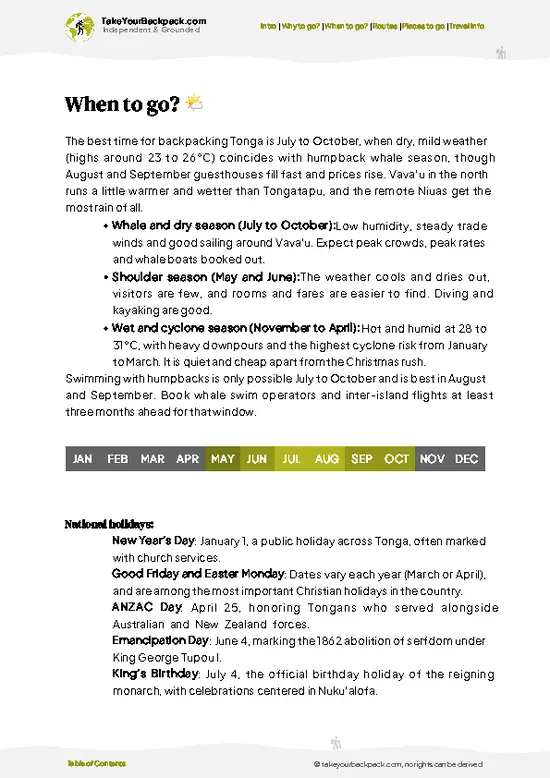
example page 1 from our offline Travel Guide for Tonga
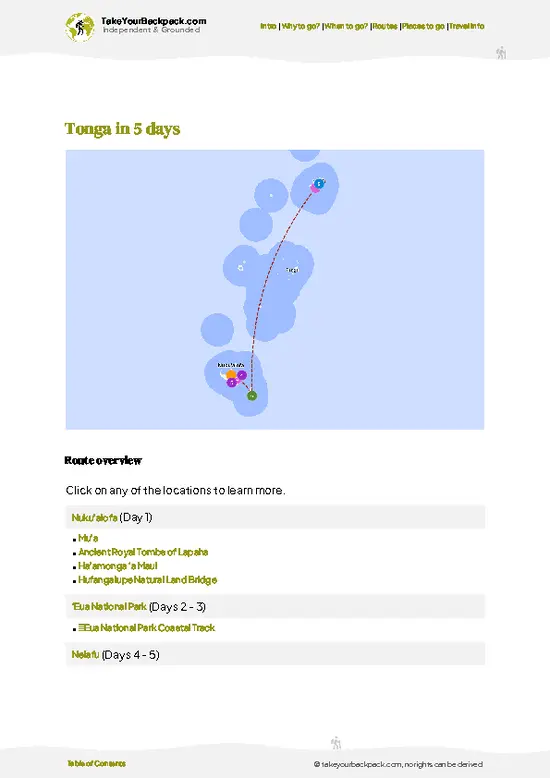
example page 2 from our offline Travel Guide for Tonga
example page 3 from our offline Travel Guide for Tonga
example page 4 from our offline Travel Guide for Tonga
example page 5 from our offline Travel Guide for Tonga
example page 6 from our offline Travel Guide for Tonga
example page 7 from our offline Travel Guide for Tonga
Loading the map 🌍
CLICK TO FILTER
towns
villages
landmarks
national parks
hikes
beaches
attractions
festivals
regions
SHOW COUNTRY’S BESTSHOW ALL

✨ Why go?
Ranked #1 hike in Tonga
Why ʻEua Coastal Track should be on your travel list

Backpackers come to ʻEua because it is the one place in Tonga where you can walk for hours without meeting a resort, a road or a crowd. The cliff edge above the open Pacific gives you the scale of the coast that a beach day on Tongatapu never will, and the walk can be cut short or stretched out depending on your legs and the tide. You can do it as a day trip from a village guesthouse, which keeps costs low, and a local guide is easy to arrange through your host if you want the route found for you. It also pairs well with the island’s rainforest tracks and the swimming at Hafu Pool, so two or three days here give you ridge, jungle and sea cliff in one stay. Few islands in the South Pacific let you cover that much ground so cheaply and in such quiet. Even on a longer Tonga loop, ʻEua is the stop people mention afterward.

💡 HighlightsEssential experiences to have while hiking the ʻEua Coastal Track

  1. Hafu Pool: A group of freshwater pools near the route to Lokupo Lookout. It is a good place to cool off after the heat of the rock.
  2. Eastern cliffs: The sheer limestone drop on the eastern coast is the signature view of ʻEua. You look straight down to white water breaking on the reef, with tropicbirds hanging on the updrafts at eye level.
  3. Lokupo Beach: A small pocket of pale sand tucked below the rock, reached on foot. The sand is soft after the sharp limestone, and the water is clear enough to see the reef shelf drop away.
  4. Forest edge above the coast: Where the track leaves the cliff line, tall trees, ferns and vines close in overhead and the air turns cool and damp. Fruit bats and bright forest birds are most active here in the early morning, and the change from glare to shade is immediate.
Allow … read more 👉
  1. Hafu Pool: A group of freshwater pools near the route to Lokupo Lookout. It is a good place to cool off after the heat of the rock.
  2. Eastern cliffs: The sheer limestone drop on the eastern coast is the signature view of ʻEua. You look straight down to white water breaking on the reef, with tropicbirds hanging on the updrafts at eye level.
  3. Lokupo Beach: A small pocket of pale sand tucked below the rock, reached on foot. The sand is soft after the sharp limestone, and the water is clear enough to see the reef shelf drop away.
  4. Forest edge above the coast: Where the track leaves the cliff line, tall trees, ferns and vines close in overhead and the air turns cool and damp. Fruit bats and bright forest birds are most active here in the early morning, and the change from glare to shade is immediate.
Allow a full day, about six to eight hours with stops for swimming and photographs.
Spotted a mistake or missing something? Contact us.

🌤️ When to go?Choosing the right time of year

  • May to October (cooler, drier): This is the best window for the Coastal Track on ʻEua, with daytime highs of 24 to 27°C (75 to 81°F) and nights near 17 to 20°C (63 to 68°F). Rain is lighter and the forest paths dry out, though the red clay can still turn slick after a shower. Daylight runs roughly 11 to 12 hours, so start early.
  • July to September (whale season): Humpbacks arrive in Tongan waters, and cliff-top sections give you a chance of spotting spouts offshore. Flights from Tongatapu and guesthouse beds fill faster, and prices edge up.
  • November to April (hot, wet): Expect 28 to 31°C (82 to 88°F), heavy humidity, and downpours that muddy the trail and swell small streams. Cyclone risk peaks from January to March, and flights or ferries can be cancelled. Lodging is easy to book and often cheaper.
… read more 👉
  • May to October (cooler, drier): This is the best window for the Coastal Track on ʻEua, with daytime highs of 24 to 27°C (75 to 81°F) and nights near 17 to 20°C (63 to 68°F). Rain is lighter and the forest paths dry out, though the red clay can still turn slick after a shower. Daylight runs roughly 11 to 12 hours, so start early.
  • July to September (whale season): Humpbacks arrive in Tongan waters, and cliff-top sections give you a chance of spotting spouts offshore. Flights from Tongatapu and guesthouse beds fill faster, and prices edge up.
  • November to April (hot, wet): Expect 28 to 31°C (82 to 88°F), heavy humidity, and downpours that muddy the trail and swell small streams. Cyclone risk peaks from January to March, and flights or ferries can be cancelled. Lodging is easy to book and often cheaper.
  • Shoulder months (April, May, November): Fewer visitors and fresh greenery, with a moderate chance of rain.
Book the ʻEua flight or ferry at least a few weeks ahead for July to September, and keep a spare day in your schedule.


source: climatestotravel.comJANJanuary: fair for travelingFEBFebruary: fair for travelingMARMarch: fair for travelingAPRApril: fair for travelingMAYMay: highly recommended for travelingJUNJune: excellent for travelingJULJuly: excellent for travelingAUGAugust: excellent for travelingSEPSeptember: highly recommended for travelingOCTOctober: highly recommended for travelingNOVNovember: fair for travelingDECDecember: fair for traveling
when-to-go

✈️ The backpacker research shortcutTonga Travel Guide

An offline-friendly backpacking guide with optimized travel routes, ranked highlights, transport advice, and the best areas to stay.
example page 0 from our offline Travel Guide for Tonga
example page 1 from our offline Travel Guide for Tonga
example page 2 from our offline Travel Guide for Tonga
example page 3 from our offline Travel Guide for Tonga
example page 4 from our offline Travel Guide for Tonga
example page 5 from our offline Travel Guide for Tonga
example page 6 from our offline Travel Guide for Tonga
example page 7 from our offline Travel Guide for Tonga
The digital guide (128 pages) contains:
✅ 31 highlights, ranked by travel appeal
✅ Optimized 2, 3 & 5-day travel routes
✅ Cities, national parks, landmarks, beaches
✅ How to get around
✅ Offline-friendly for travel without Wi-Fi
👉 Click to see all 30+ guide features

📅 Plan smarter in minutes, not weeks
✅ Month by month travel advice
✅ Festivals & national holidays
✅ Budget expectations

🗺️ Go to the right places, skip the overrated ones
✅ Honest pros & cons of destinations
✅ Top hikes, parks & viewpoints
✅ Lesser-known places most travelers miss
✅ Clear “worth it vs skip it” guidance

🛏️ Travel smoothly without rookie mistakes
✅ Best areas to stay
✅ Transport systems explained simply
✅ Common scams & safety advice
✅ SIM cards, money & practical tips

🌍 Understand the country, not just visit it
✅ Culture & traditions
✅ 52 Essential phrases & customs
✅ Festivals worth planning around
✅ Traveler-friendly historical context
✅ Insights that make places more meaningful

📱 Built for real travel conditions
✅ Fully downloadable PDF
✅ Works completely offline
✅ Optimized for phone use
✅ Useful in remote areas & buses
✅ Everything in one place
Stop searching, start planning
Get instant access to your full guide. 30‑day money-back guarantee.
+ Add another guide for just

By proceeding you agree to our terms.
Sent to your inbox immediately after payment • 100% Secure Checkout
Best Backpacking Travel Advisor 2025 tourism awardBest Backpacking
Travel Advisor
2025
What others say about Take Your Backpack Guides:
⭐⭐⭐⭐⭐
Fantastic, amazing amount of information!
⭐⭐⭐⭐⭐
My goodness this is amazing, it's what I've been looking for hats off too you!
⭐⭐⭐⭐⭐
I think this is absolutely BRILLIANT
⭐⭐⭐⭐
Very complete and informative. It's still missing places, but I gotta to commend you
⭐⭐⭐⭐⭐
This is truly amazing, thank you, can't wait to explore it with my kids!
⭐⭐⭐⭐⭐
Awesome resource, thank you!
⭐⭐⭐⭐⭐
This is amazing! Can't wait to explore the ones I haven't seen
⭐⭐⭐⭐
I love this! Well done, great idea.
⭐⭐⭐⭐⭐
Thanks for taking the time to make this gem!
⭐⭐⭐⭐⭐
This might be the best website I've ever seen.
⭐⭐⭐⭐⭐
Congratulations, and thank you so much for your work; it's incredibly valuable.
⭐⭐⭐⭐
In all seriousness I think you did a great job pointing out the important spots
⭐⭐⭐⭐⭐
10/10 very good
⭐⭐⭐⭐⭐
As someone who's only just starting to visit regularly this is awesome, thank you.
⭐⭐⭐⭐
Thank you very much! I'm going to visit my dad, it's going to be very useful!
⭐⭐⭐⭐⭐
This is really cool! We'll be travelling for the first time and this definitely come in handy.
⭐⭐⭐⭐⭐
You are now our minister of culture, congratulations 👨‍💼
⭐⭐⭐⭐⭐
Just wanted to tell you that this is a pearl! Going to follow your recommendations.
⭐⭐⭐⭐⭐
This is so cool. I'll definitely be using the resource for my travels soon.
⭐⭐⭐⭐⭐
This is very impressive! Good work.
⭐⭐⭐⭐⭐
This is an amazing and informative site. Very well done!

🛏️ Where to stay?How to pick the right area

If you enjoy meeting fellow travelers, consider choosing hostels with high ratings for atmosphere. On the other hand, if you prefer having your own space, a hotel might be a better option.

🥾 Hike detailsHike details: route, duration, and difficulty of ʻEua Coastal Track

Total Distance: A day-hike route along the eastern coast of the park, with the length varying by where you start and how far you push on.
Estimated Duration: A full day with swim and photo stops, starting early to keep ahead of the midday heat.
Difficulty: Moderate. The effort is in the rough footing rather than steep climbs, and the limestone is hard on shoes and knees.
Starting Point: Reached from the main villages on ʻEua by local taxi or a lift arranged through your guesthouse. Public transport on the island is thin, so most hikers organize a drop-off and a pickup.
Major Landmarks:
  • Eastern cliffs:
… read more 👉
Total Distance: A day-hike route along the eastern coast of the park, with the length varying by where you start and how far you push on.
Estimated Duration: A full day with swim and photo stops, starting early to keep ahead of the midday heat.
Difficulty: Moderate. The effort is in the rough footing rather than steep climbs, and the limestone is hard on shoes and knees.
Starting Point: Reached from the main villages on ʻEua by local taxi or a lift arranged through your guesthouse. Public transport on the island is thin, so most hikers organize a drop-off and a pickup.
Major Landmarks:
  • Eastern cliffs: Sheer drops to the reef with long open views.
  • Hafu Pool: Freshwater pools near the Lokupo route.
  • Lokupo Beach: A small sand beach reached after rocky ground.
Terrain and Scenery: Sharp raised coral limestone, sandy patches, root-tangled forest paths and open clifftop. The sea is always on one side, loud and bright.
Vegetation: Coastal scrub and pandanus near the cliff edge, then taller forest with ferns, vines and banyan-like trees inland. Shade is patchy, so a hat and sunscreen matter.
Wildlife: Tropicbirds along the cliffs, fruit bats in the trees, and in the right season humpback whales blowing offshore. The reef below holds fish you can see from the cliff on a calm day.
Practical Notes: Wear closed shoes with a solid sole, carry all your water, and watch the tide and swell before swimming. Paths are not well marked, and a local guide saves time and wrong turns.
⚠️ Hiking info can sometimes be outdated or inaccurate. Before you hit the trail, check the latest conditions with locals. If you do spot anything that's off, I'd love to hear from you, so I can update it for fellow travelers.

🛡️ SafetySafety Tips and Common Scams in ʻEua Coastal Track

The Coastal Track is a manageable hike, but heat, footing and a lack of services cause most of the trouble. Much of it follows uneven limestone cliff edges and forest paths where the rock is sharp and the red clay turns slippery after rain, so wear closed shoes with real grip rather than sandals. Some sections run close to sheer drops, and the sea below is rough, so keep a safe distance from the edge, especially in wind. Waymarking is limited, and paths can be overgrown, so carry an offline map and tell your guesthouse your route and expected return. Shade is patchy and humidity is high, so carry at least 2 to 3 liters of water per person, a hat and sunscreen, and start early to finish before the afternoon heat. There are no shops along the way. Mobile signal is unreliable. Stray dogs and … read more 👉
The Coastal Track is a manageable hike, but heat, footing and a lack of services cause most of the trouble. Much of it follows uneven limestone cliff edges and forest paths where the rock is sharp and the red clay turns slippery after rain, so wear closed shoes with real grip rather than sandals. Some sections run close to sheer drops, and the sea below is rough, so keep a safe distance from the edge, especially in wind. Waymarking is limited, and paths can be overgrown, so carry an offline map and tell your guesthouse your route and expected return. Shade is patchy and humidity is high, so carry at least 2 to 3 liters of water per person, a hat and sunscreen, and start early to finish before the afternoon heat. There are no shops along the way. Mobile signal is unreliable. Stray dogs and pigs are the main animals you will meet, and both usually ignore walkers. Cave and sinkhole areas are best visited with local advice.

FAQTraveler FAQ

Plan on a full day, roughly 5 to 8 hours of walking, depending on which section of the coast you cover and how often you stop at the cliff viewpoints. Many hikers combine it with the ʻEua National Park sights such as Hafu Pool and the Lokupo beach area. Starting around 7 or 8 a.m. from your guesthouse in ʻOhonua leaves a comfortable buffer before dark.
Moderate overall, with short rough sections but no technical climbing. The footing is uneven limestone and clay, with steady ups and downs rather than one big ascent, and humidity of 70 to 90 percent makes it feel harder than the distance suggests. Reasonably fit walkers with good shoes manage it comfortably. Carry 2 to 3 liters of water, since there are no shops on the route.
A guide is not required, but hiring a local one is a good idea because trails are lightly marked and can be overgrown. Guides through ʻEua guesthouses typically charge around TOP 50 to 150 (about US$20 to 65) for a day, depending on group size and route. Entry to ʻEua National Park generally involves no formal permit for independent walkers, though some sites may ask for a small fee or local permission, so check with your accommodation in ʻOhonua.
⚠️ Things can change over time, so always validate details locally before you go.

Other Tongan hikes near ʻEua Coastal Track

Explore more nearby:

  • Tofua Volcano Trail—Crater lake, steaming vent, caldera rim, wild kava| 184 km away
  • Mount Talau—Neiafu harbor lookout, flat summit, short forest climb, moored sailboats| 320 km away

💡 Not sure where to go next?
Create a personalized itinerary for Tonga including ʻEua Coastal Track and the places that fit your trip.

Generate my itinerary

👉 Discover all hikes

Or checkout all Tonga has to offer (think cities, towns, villages, national parks, hikes, beaches, festivals)
Country photo of Tonga

We 💚 feedbackIs it worth it?

Most people watch their feet and miss the sea. Stop every so often and scan the water below the cliffs, because in whale season the humpbacks are often close enough to see their spouts from the rock. I would bring sturdy shoes, not sandals, and leave early.

✍️ Help improve this page!
The information on this page is based on in-depth research, insights shared by experienced travelers, and feedback from the local travel community in Tonga. While every effort is made to keep the information accurate and current, conditions can change — so if you spot anything incorrect or outdated, please get in touch.


🙋‍♂️ Give feedback

👋 Meet the founderWho’s Behind Take Your Backpack?

Johan, backpacker and founder of TakeYourBackpackHi, I’m Johan (Netherlands 🇳🇱), the creator of TakeYourBackpack. Over the past 3 decades, I’ve backpacked through 90+ countries across six continents, gaining extensive experience with independent travel, long-term trips, and overland routes.

This site is built on a combination of firsthand travel experience and carefully curated insights from other backpackers. Many guides are based on places I’ve personally visited, while others bring together tips, observations, and practical advice shared by trusted travelers I’ve met along the way.

The goal is to provide realistic, experience-driven guidance — not generic itineraries — so you can explore destinations with better context, clearer expectations, and more confidence.