×

Tonga🇹🇴 | festivals‘Eua Tourism FestivalVillage dance, umu feast, limestone cliffs, rainforest trails | things to do and best time to go

Explore Mānuka BeachExplore Heilala Festival

Backpacking in ‘Eua Tourism
👌 Worth visitingfestival ranked #4
By Johan Kruseman 🇳🇱 | Updated October 15, 2026

Book your ferry or flight before anything else, because ʻEua has few seats and festival weekends fill them first. The festival takes place on ʻEua, the raised limestone island southeast of Nukuʻalofa in Tonga, and the setting is a big part of the draw. Expect Tongan song, dance and food, with brass-band sound drifting between village halls and the smell of earth ovens (umu) and woodsmoke. The crowd is mostly locals and families, with a few travelers. The vibe is warm and unhurried, and the light over the cliffs turns orange by late afternoon. Hard parts: accommodation is limited, so reserve early. Bring cash, since ATMs are scarce and card machines unreliable. Shops close on Sundays, so stock up on water before then. Rain can turn the dirt tracks to mud, so pack sturdy sandals. It suits curious travelers who like village-scale events and hiking. It won't suit anyone wanting big stages, nightlife or polished facilities.

Discover everything you want to know in the 📖 Tonga Travel Guide.


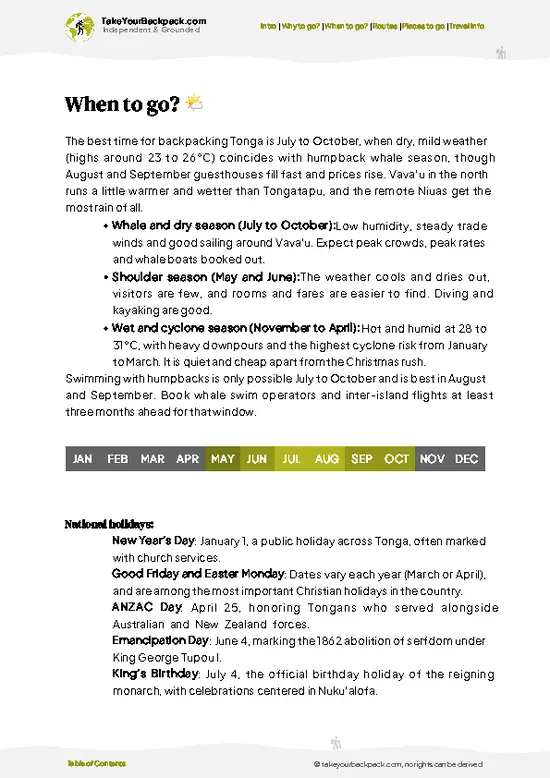
example page 0 from our offline Travel Guide for Tonga
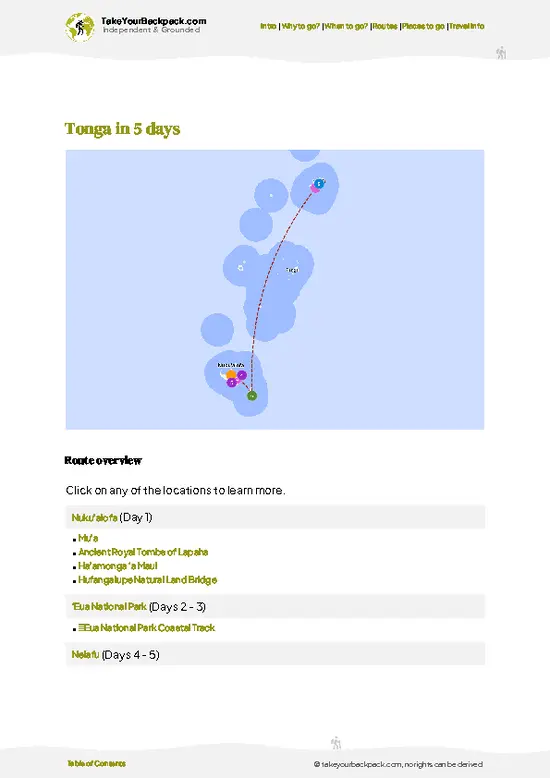
example page 1 from our offline Travel Guide for Tonga
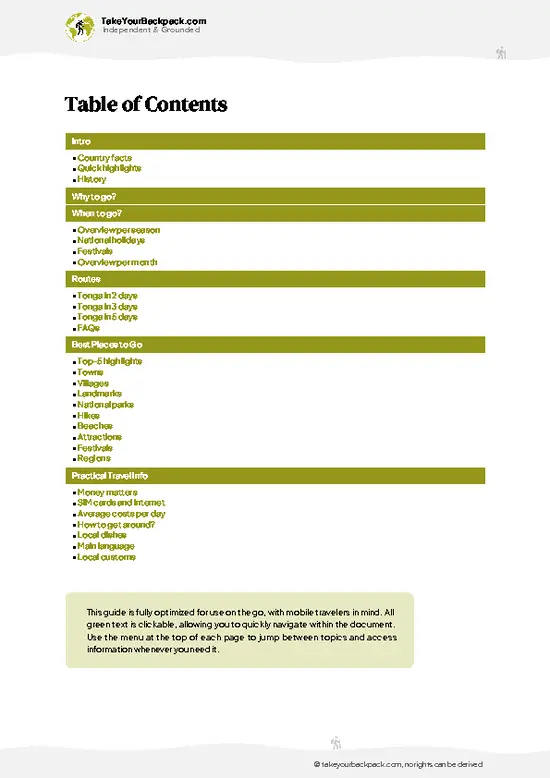
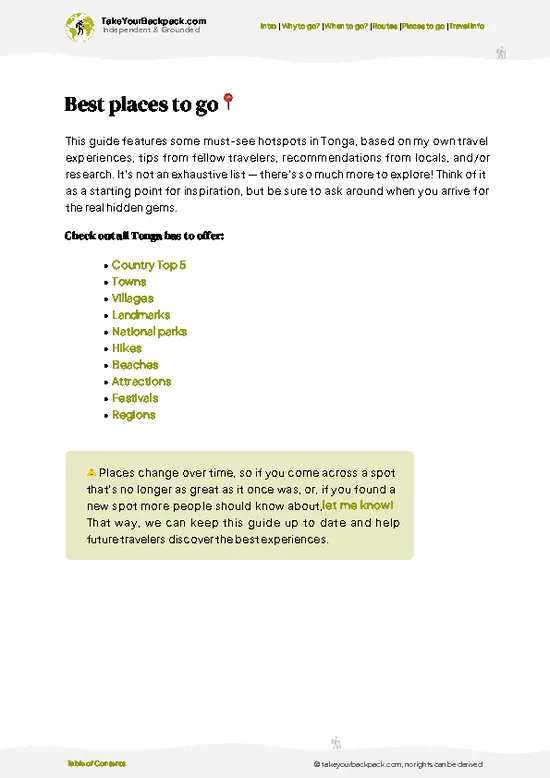
example page 2 from our offline Travel Guide for Tonga
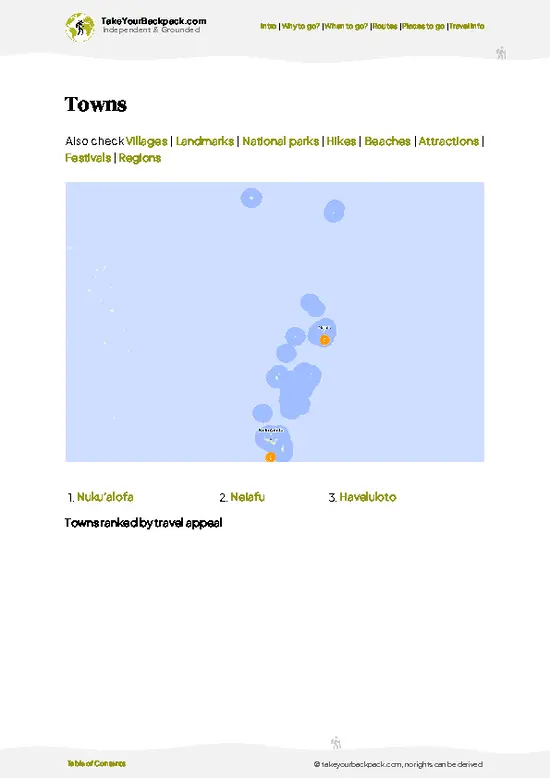
example page 3 from our offline Travel Guide for Tonga
example page 4 from our offline Travel Guide for Tonga
example page 5 from our offline Travel Guide for Tonga
example page 6 from our offline Travel Guide for Tonga
example page 7 from our offline Travel Guide for Tonga
Loading the map 🌍
CLICK TO FILTER
towns
villages
landmarks
national parks
hikes
beaches
attractions
festivals
regions
SHOW COUNTRY’S BESTSHOW ALL

✨ Why go?
Ranked #4 festival in Tonga
Why visitors keep coming back

Backpackers build a route around this because ʻEua is the Tongan island where travelers actually meet the community instead of watching it from a resort. A festival here puts you at the same village feasts and dance performances that locals attend, usually with an invitation to sit and eat. Because the island is small and sees few visitors, strangers get noticed, greeted and often adopted for the afternoon. That kind of access is hard to engineer on the main island.

The other reason is fit. ʻEua is already the island people visit for rainforest trails and sea cliffs, so the festival turns a hiking detour into a few days with a purpose. You can walk in the morning, watch performances in the afternoon and share a table at night. Compared with Tonga’s bigger events, crowds are small and nobody … read more 👉
Backpackers build a route around this because ʻEua is the Tongan island where travelers actually meet the community instead of watching it from a resort. A festival here puts you at the same village feasts and dance performances that locals attend, usually with an invitation to sit and eat. Because the island is small and sees few visitors, strangers get noticed, greeted and often adopted for the afternoon. That kind of access is hard to engineer on the main island.

The other reason is fit. ʻEua is already the island people visit for rainforest trails and sea cliffs, so the festival turns a hiking detour into a few days with a purpose. You can walk in the morning, watch performances in the afternoon and share a table at night. Compared with Tonga’s bigger events, crowds are small and nobody is selling you a wristband. It slots easily between time in Nukuʻalofa and the outer island groups.

💡 HighlightsPlaces and moments you shouldn't skip

  1. Festival performances and village dance: Tongan group dancing, with its precise hand movements and strong choral singing, is the center of the event. Brass-band sound often travels well beyond the venue.
  2. Umu feast: food cooked in an underground oven with root crops, pork and taro leaves gets its smoky, soft texture from hours under hot stones. Eat with your hands and take what you’re offered.
  3. ʻEua National Park rainforest: shaded trails climb through ferns and banyan roots on the island’s ridge. It is the best way to cool off and see why the island feels so different from flat Tongatapu.
  4. Hafu Pool: a group of freshwater pools near the route to Lokupo Lookout, good for a cool dip after a hike.
  5. Coastal cliffs of the east side: the island rises steeply from the sea, with sheer drops and strong wind
… read more 👉
  1. Festival performances and village dance: Tongan group dancing, with its precise hand movements and strong choral singing, is the center of the event. Brass-band sound often travels well beyond the venue.
  2. Umu feast: food cooked in an underground oven with root crops, pork and taro leaves gets its smoky, soft texture from hours under hot stones. Eat with your hands and take what you’re offered.
  3. ʻEua National Park rainforest: shaded trails climb through ferns and banyan roots on the island’s ridge. It is the best way to cool off and see why the island feels so different from flat Tongatapu.
  4. Hafu Pool: a group of freshwater pools near the route to Lokupo Lookout, good for a cool dip after a hike.
  5. Coastal cliffs of the east side: the island rises steeply from the sea, with sheer drops and strong wind over the edge. Go in the late afternoon when the light is softest.
If time is short, skip the coastal cliff walk and keep the performances and the feast.
Spotted a mistake or missing something? Contact us.

🌤️ When to go?When is the celebration of ‘Eua Tourism Festival?

The ʻEua Festival is held on ʻEua island, a short hop southeast of Nukuʻalofa, usually in the second week of May, with events based around Ohonua and the island’s villages, and the exact dates are announced locally each year.
  • Best day: Go for the main cultural day, when villages show dance, music and food displays. Quieter days suit hiking and caving.
  • Weather: Expect about 20 to 26°C (68 to 79°F) by day, cooler nights, short showers and roughly 11 hours of daylight. Bring a light rain jacket, sun hat, reef shoes and a sweater for evenings.
  • Booking: Reserve ferry or flight seats and a room two to three months ahead, since the island has few beds. Prices for rooms can rise by 20 to 30 percent.
  • Travel timing: Arrive a day early, because flights are small and ferry sailings are weather-dependent.
… read more 👉
The ʻEua Festival is held on ʻEua island, a short hop southeast of Nukuʻalofa, usually in the second week of May, with events based around Ohonua and the island’s villages, and the exact dates are announced locally each year.
  • Best day: Go for the main cultural day, when villages show dance, music and food displays. Quieter days suit hiking and caving.
  • Weather: Expect about 20 to 26°C (68 to 79°F) by day, cooler nights, short showers and roughly 11 hours of daylight. Bring a light rain jacket, sun hat, reef shoes and a sweater for evenings.
  • Booking: Reserve ferry or flight seats and a room two to three months ahead, since the island has few beds. Prices for rooms can rise by 20 to 30 percent.
  • Travel timing: Arrive a day early, because flights are small and ferry sailings are weather-dependent. Leave the day after the closing event, not the same evening.
Book transport to the island before anything else, since seats vanish first.


source: climatestotravel.comJANJanuary: not recommended for travelingFEBFebruary: not recommended for travelingMARMarch: not recommended for travelingAPRApril: excellent for travelingMAYMay: not recommended for travelingJUNJune: not recommended for travelingJULJuly: not recommended for travelingAUGAugust: not recommended for travelingSEPSeptember: not recommended for travelingOCTOctober: not recommended for travelingNOVNovember: not recommended for travelingDECDecember: not recommended for traveling

✈️ The backpacker research shortcutTonga Travel Guide

An offline-friendly backpacking guide with optimized travel routes, ranked highlights, transport advice, and the best areas to stay.
example page 0 from our offline Travel Guide for Tonga
example page 1 from our offline Travel Guide for Tonga
example page 2 from our offline Travel Guide for Tonga
example page 3 from our offline Travel Guide for Tonga
example page 4 from our offline Travel Guide for Tonga
example page 5 from our offline Travel Guide for Tonga
example page 6 from our offline Travel Guide for Tonga
example page 7 from our offline Travel Guide for Tonga
The digital guide (128 pages) contains:
✅ 31 highlights, ranked by travel appeal
✅ Optimized 2, 3 & 5-day travel routes
✅ Cities, national parks, landmarks, beaches
✅ How to get around
✅ Offline-friendly for travel without Wi-Fi
👉 Click to see all 30+ guide features

📅 Plan smarter in minutes, not weeks
✅ Month by month travel advice
✅ Festivals & national holidays
✅ Budget expectations

🗺️ Go to the right places, skip the overrated ones
✅ Honest pros & cons of destinations
✅ Top hikes, parks & viewpoints
✅ Lesser-known places most travelers miss
✅ Clear “worth it vs skip it” guidance

🛏️ Travel smoothly without rookie mistakes
✅ Best areas to stay
✅ Transport systems explained simply
✅ Common scams & safety advice
✅ SIM cards, money & practical tips

🌍 Understand the country, not just visit it
✅ Culture & traditions
✅ 52 Essential phrases & customs
✅ Festivals worth planning around
✅ Traveler-friendly historical context
✅ Insights that make places more meaningful

📱 Built for real travel conditions
✅ Fully downloadable PDF
✅ Works completely offline
✅ Optimized for phone use
✅ Useful in remote areas & buses
✅ Everything in one place
Stop searching, start planning
Get instant access to your full guide. 30‑day money-back guarantee.
+ Add another guide for just

By proceeding you agree to our terms.
Sent to your inbox immediately after payment • 100% Secure Checkout
Best Backpacking Travel Advisor 2025 tourism awardBest Backpacking
Travel Advisor
2025
What others say about Take Your Backpack Guides:
⭐⭐⭐⭐⭐
Fantastic, amazing amount of information!
⭐⭐⭐⭐⭐
My goodness this is amazing, it's what I've been looking for hats off too you!
⭐⭐⭐⭐⭐
I think this is absolutely BRILLIANT
⭐⭐⭐⭐
Very complete and informative. It's still missing places, but I gotta to commend you
⭐⭐⭐⭐⭐
This is truly amazing, thank you, can't wait to explore it with my kids!
⭐⭐⭐⭐⭐
Awesome resource, thank you!
⭐⭐⭐⭐⭐
This is amazing! Can't wait to explore the ones I haven't seen
⭐⭐⭐⭐
I love this! Well done, great idea.
⭐⭐⭐⭐⭐
Thanks for taking the time to make this gem!
⭐⭐⭐⭐⭐
This might be the best website I've ever seen.
⭐⭐⭐⭐⭐
Congratulations, and thank you so much for your work; it's incredibly valuable.
⭐⭐⭐⭐
In all seriousness I think you did a great job pointing out the important spots
⭐⭐⭐⭐⭐
10/10 very good
⭐⭐⭐⭐⭐
As someone who's only just starting to visit regularly this is awesome, thank you.
⭐⭐⭐⭐
Thank you very much! I'm going to visit my dad, it's going to be very useful!
⭐⭐⭐⭐⭐
This is really cool! We'll be travelling for the first time and this definitely come in handy.
⭐⭐⭐⭐⭐
You are now our minister of culture, congratulations 👨‍💼
⭐⭐⭐⭐⭐
Just wanted to tell you that this is a pearl! Going to follow your recommendations.
⭐⭐⭐⭐⭐
This is so cool. I'll definitely be using the resource for my travels soon.
⭐⭐⭐⭐⭐
This is very impressive! Good work.
⭐⭐⭐⭐⭐
This is an amazing and informative site. Very well done!

🛏️ Where to stay?Where staying makes the most sense

Ohonua is the best base for backpackers, because it is the main village and the festival activity, the market, the small shops and the harbor are all within walking distance.

Staying in or near Ohonua keeps you close to the events without needing a vehicle, and guesthouses and homestays here tend to be run by families who will talk you through what is on. It is also where other independent travelers usually end up, so shared meals and lifts to hikes are easy to arrange.

The area around Houma and the Hafu Pools side of the island is a second option if you want quieter nights near the coast and … read more 👉
Ohonua is the best base for backpackers, because it is the main village and the festival activity, the market, the small shops and the harbor are all within walking distance.

Staying in or near Ohonua keeps you close to the events without needing a vehicle, and guesthouses and homestays here tend to be run by families who will talk you through what is on. It is also where other independent travelers usually end up, so shared meals and lifts to hikes are easy to arrange.

The area around Houma and the Hafu Pools side of the island is a second option if you want quieter nights near the coast and the limestone cliffs. It is further from the main festival venues, so you will need to arrange rides, but hosts often help with that.

Safety is rarely a concern on the island. Villages are small, people know each other, and walking home after an evening event is normal. Bring a flashlight, since streetlights are few.

Because rooms are limited, book early and consider a homestay. You get a local perspective, and it is usually the cheapest and most social way to experience the festival.

👛 Costs (as of 15 October 2026)How expensive it really is

Expect to spend about US$75 to 125 a day at the ʻEua Festival, including transport from the main island.
CategoryBudget RangeLocal Reality
Festival ticketsUS$0 to 15Many village events are free or by small donation, with some paid cultural shows.
AccommodationUS$35 to 70Homestays and guesthouses fill early, and festival week pushes prices to the upper end.
Local transportUS$10 to 25Ferry or flight to the island costs extra, so local rides and a rented scooter or truck add up.
Food & drinksUS$15 to 30Village plates are cheap, and guesthouse dinners cost more.
Miscellaneous expensesUS$10 to 20Cash donations, crafts, vanilla, cave or pool visits and mobile data.
Total Daily BudgetUS$75 to 125Add the return ferry or flight on top if arriving from Nukuʻalofa.
⚠️ Prices can change and everyone travels differently, so take this as a rough guide. Hope it helps you plan your adventure!

🍲 FoodEating & Drinking in ‘Eua Tourism

Festival food on ʻEua is village food, cooked by families and church groups, so expect generous portions rather than polished stalls.

The core of the spread is ʻumu, the underground oven. Root crops such as taro, cassava and yam come out alongside pork, chicken and fish. Lu pulu, corned beef with coconut cream baked in taro leaves, is the dish to try first. ʻOtai, a cold drink of watermelon or mango with coconut, is a good fix on warm afternoons. Fresh coconuts are everywhere, and local vanilla and tropical fruit often turn up at market tables.

Plates are meant to be shared, and refusing food can feel awkward, so take a little of everything and eat slowly. Lines form fast when the ʻumu is opened, so go early.

Bring cash in Tongan paʻanga, because card machines are rare on the island and … read more 👉
Festival food on ʻEua is village food, cooked by families and church groups, so expect generous portions rather than polished stalls.

The core of the spread is ʻumu, the underground oven. Root crops such as taro, cassava and yam come out alongside pork, chicken and fish. Lu pulu, corned beef with coconut cream baked in taro leaves, is the dish to try first. ʻOtai, a cold drink of watermelon or mango with coconut, is a good fix on warm afternoons. Fresh coconuts are everywhere, and local vanilla and tropical fruit often turn up at market tables.

Plates are meant to be shared, and refusing food can feel awkward, so take a little of everything and eat slowly. Lines form fast when the ʻumu is opened, so go early.

Bring cash in Tongan paʻanga, because card machines are rare on the island and ATMs are limited. Prices are low, and a plate often costs only a few paʻanga. Carry water and snacks for the hikes between events, since shops close early and on Sundays.

FAQFrequently asked questions about ‘Eua Tourism

The festival usually runs in the second week of May on ʻEua island, with the exact dates announced locally each year. Most events centre on Ohonua and nearby villages. The island lies a short ferry or flight from Nukuʻalofa, so plan to arrive a day early.
Budget about US$75 to 125 a day, covering a bed at US$35 to 70, food at US$15 to 30 and local transport at US$10 to 25. Many village events are free or donation-based, and paid shows cost around US$0 to 15. The ferry or flight from Nukuʻalofa is extra.
Most village events need no ticket, though a few paid shows may sell entry on the day. The real advance booking is for the ferry or flight and a bed, which should be reserved two to three months ahead. The island has few guesthouses, so rooms near Ohonua sell out first.
⚠️ Things can change over time, so always validate details locally before you go.

Other Tongan festivals near ‘Eua Tourism

Explore more nearby:


💡 Not sure where to go next?
Create a personalized itinerary for Tonga including ‘Eua Tourism and the places that fit your trip.

Generate my itinerary

👉 Discover all festivals

Or checkout all Tonga has to offer (think cities, towns, villages, national parks, hikes, beaches, festivals)
Country photo of Tonga

We 💚 feedbackSumming up the experience

The usual mistake is treating ʻEua as a day trip and rushing back to the ferry. Stay at least two nights so the festival evenings and the hiking both fit in. Book a bed early, carry enough cash and plan hikes for mornings, leaving afternoons free to wander wherever the music is.

✍️ Help improve this page!
The information on this page is based on in-depth research, insights shared by experienced travelers, and feedback from the local travel community in Tonga. While every effort is made to keep the information accurate and current, conditions can change — so if you spot anything incorrect or outdated, please get in touch.


🙋‍♂️ Give feedback

👋 Meet the founderWho’s Behind Take Your Backpack?

Johan, backpacker and founder of TakeYourBackpackHi, I’m Johan (Netherlands 🇳🇱), the creator of TakeYourBackpack. Over the past 3 decades, I’ve backpacked through 90+ countries across six continents, gaining extensive experience with independent travel, long-term trips, and overland routes.

This site is built on a combination of firsthand travel experience and carefully curated insights from other backpackers. Many guides are based on places I’ve personally visited, while others bring together tips, observations, and practical advice shared by trusted travelers I’ve met along the way.

The goal is to provide realistic, experience-driven guidance — not generic itineraries — so you can explore destinations with better context, clearer expectations, and more confidence.