×

Tonga🇹🇴 | festivalsTongan Cultural FestivalLakalaka, tapa beating, kava bowls, market stalls | things to do and best time to go

Explore Heilala FestivalExplore Emancipation Day

Backpacking in Tongan Cultural
By Johan Kruseman 🇳🇱 | Updated October 15, 2026

Tonga’s cultural festival is held in the capital, Nuku’alofa on Tongatapu, and not out on the beaches, so you stay in town and walk to everything. There is no festival ground, no camping and no ticketed gate. Events spread across the waterfront, church halls and the market area, and Sunday is a full day off because the whole country shuts for church. Expect tapa cloth beaten on wooden anvils, coconut oil on dancers’ skin, drumming from slit logs, kava bowls and smoke from underground ovens. It’s community-run, Polynesian and unpolished, with plenty of heat, mosquitoes and long waits for things to start. The audience is mostly Tongan families, with a thin scatter of backpackers and yachties. It’s well worth the trip if you like your culture unstaged. Unlike the nightly dinner shows at beach resorts along the south coast of Tongatapu, which are scheduled for visitors, this belongs to locals first.

Discover everything you want to know in the 📖 Tonga Travel Guide.


example page 0 from our offline Travel Guide for Tonga
example page 1 from our offline Travel Guide for Tonga
example page 2 from our offline Travel Guide for Tonga
example page 3 from our offline Travel Guide for Tonga
example page 4 from our offline Travel Guide for Tonga
example page 5 from our offline Travel Guide for Tonga
example page 6 from our offline Travel Guide for Tonga
example page 7 from our offline Travel Guide for Tonga
Loading the map 🌍
CLICK TO FILTER
towns
villages
landmarks
national parks
hikes
beaches
attractions
festivals
regions
SHOW COUNTRY’S BESTSHOW ALL

✨ Why go?
Ranked #99 festival in Tonga
What sets this place apart

Backpackers plan around it because Tonga rarely lets you see its culture without a price tag attached. Here the audience is the community, so you end up sitting on a woven mat beside a grandmother who explains why a dancer’s lakalaka movements tell the story of a chiefly line. The kava circle is the fastest social shortcut in the Pacific: join one, clap once before you drink and you will be offered a second cup and three new friends. Costs stay low because most of the action is free to watch, so your spending goes on food and a bed rather than entry fees. It also fits a longer Pacific route well. Nuku’alofa is the arrival point for flights and ferries, so you can start a Tonga loop here, learn the manners (cover your knees, no swimwear in town, nothing on Sundays) and then head to the outer islands with some context.

💡 HighlightsMust-see experiences and standout moments

  1. Lakalaka performances: Tonga’s signature group dance, recognized by UNESCO, features rows of dancers moving their arms in unison to sung poetry. The words are a lesson in history and genealogy. Watch from a distance first, then notice how the gestures echo the lyrics.
  2. Tapa making: Women beat mulberry bark strips with wooden mallets, producing a steady thud you hear before you see them. The sheets are pasted together and stamped with brown and black patterns. Watching it done is the best way to understand why a large tapa is a gift worth thousands of hours of work.
  3. Kava ceremony: A bowl is passed in a circle in a formal sequence, and the drink is peppery, muddy and numbs your tongue. Clap, drink it in one go and say thanks. It is the social center of the festival.
  4. Underground oven feast: Food
… read more 👉
  1. Lakalaka performances: Tonga’s signature group dance, recognized by UNESCO, features rows of dancers moving their arms in unison to sung poetry. The words are a lesson in history and genealogy. Watch from a distance first, then notice how the gestures echo the lyrics.
  2. Tapa making: Women beat mulberry bark strips with wooden mallets, producing a steady thud you hear before you see them. The sheets are pasted together and stamped with brown and black patterns. Watching it done is the best way to understand why a large tapa is a gift worth thousands of hours of work.
  3. Kava ceremony: A bowl is passed in a circle in a formal sequence, and the drink is peppery, muddy and numbs your tongue. Clap, drink it in one go and say thanks. It is the social center of the festival.
  4. Underground oven feast: Food cooked in an umu is lifted out in clouds of steam, with roast pork, root vegetables and taro-leaf parcels. Go early, because the best pieces go quickly and the smell of smoke and banana leaf pulls you in from the next street.
  5. Talamahu Market: The central market shows the Tongan food that supports the festival: piles of yams and taro, woven baskets, fans and mats, and handmade crafts at honest prices. Early morning is best, before the heat sets in.
Pair the tapa making in the morning with the market, which is close by, then save the lakalaka and the kava circle for the cooler evening.
Spotted a mistake or missing something? Contact us.

🌤️ When to go?When is the celebration of Tongan Cultural Festival?

The festival takes place in Nuku’alofa on Tongatapu in July, over about a week of events built around the King’s birthday on 4 July, so the dates follow the calendar rather than the moon.
  • Best days: Aim for the opening parade and the weekend events, when brass bands, dancers and church groups fill the waterfront and the royal grounds area. Weekdays are calmer but have fewer performances.
  • Weather: Cool dry season, roughly 18 to 25°C (64 to 77°F), with the occasional passing shower and about 11 hours of daylight. Bring a light rain shell, a hat, sunscreen and a sarong for sitting on the grass.
  • Booking: Reserve a bed 2 to 3 months ahead, since guesthouses fill and rates rise by roughly 20 to 40 percent. Flights from Auckland and Fiji sell out first.
  • Crowds: Arrive 2 days early. Roads around the center
… read more 👉
The festival takes place in Nuku’alofa on Tongatapu in July, over about a week of events built around the King’s birthday on 4 July, so the dates follow the calendar rather than the moon.
  • Best days: Aim for the opening parade and the weekend events, when brass bands, dancers and church groups fill the waterfront and the royal grounds area. Weekdays are calmer but have fewer performances.
  • Weather: Cool dry season, roughly 18 to 25°C (64 to 77°F), with the occasional passing shower and about 11 hours of daylight. Bring a light rain shell, a hat, sunscreen and a sarong for sitting on the grass.
  • Booking: Reserve a bed 2 to 3 months ahead, since guesthouses fill and rates rise by roughly 20 to 40 percent. Flights from Auckland and Fiji sell out first.
  • Crowds: Arrive 2 days early. Roads around the center close for processions, so walk in and leave the day after the finale.
Book your return flight with a day of slack, because July flights out of Tongatapu are the first to fill.


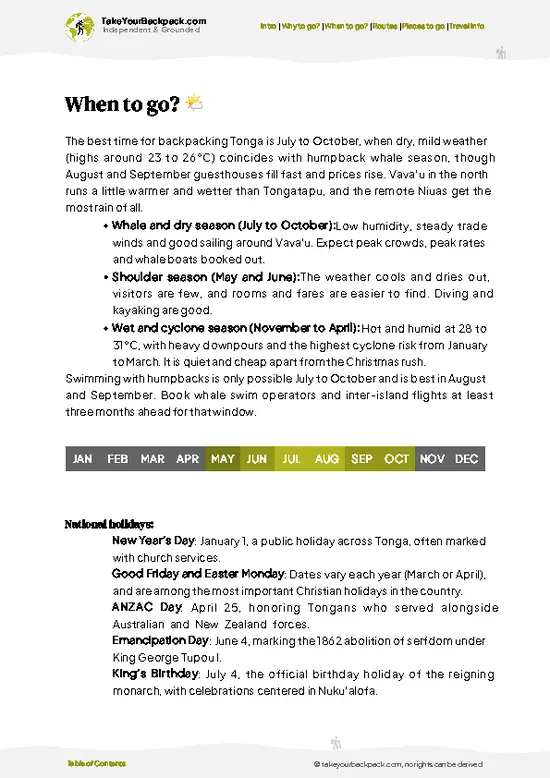
source: climatestotravel.comJANJanuary: not recommended for travelingFEBFebruary: not recommended for travelingMARMarch: not recommended for travelingAPRApril: not recommended for travelingMAYMay: excellent for travelingJUNJune: not recommended for travelingJULJuly: not recommended for travelingAUGAugust: not recommended for travelingSEPSeptember: not recommended for travelingOCTOctober: not recommended for travelingNOVNovember: not recommended for travelingDECDecember: not recommended for traveling

✈️ The backpacker research shortcutTonga Travel Guide

An offline-friendly backpacking guide with optimized travel routes, ranked highlights, transport advice, and the best areas to stay.
example page 0 from our offline Travel Guide for Tonga
example page 1 from our offline Travel Guide for Tonga
example page 2 from our offline Travel Guide for Tonga
example page 3 from our offline Travel Guide for Tonga
example page 4 from our offline Travel Guide for Tonga
example page 5 from our offline Travel Guide for Tonga
example page 6 from our offline Travel Guide for Tonga
example page 7 from our offline Travel Guide for Tonga
The digital guide (128 pages) contains:
✅ 31 highlights, ranked by travel appeal
✅ Optimized 2, 3 & 5-day travel routes
✅ Cities, national parks, landmarks, beaches
✅ How to get around
✅ Offline-friendly for travel without Wi-Fi
👉 Click to see all 30+ guide features

📅 Plan smarter in minutes, not weeks
✅ Month by month travel advice
✅ Festivals & national holidays
✅ Budget expectations

🗺️ Go to the right places, skip the overrated ones
✅ Honest pros & cons of destinations
✅ Top hikes, parks & viewpoints
✅ Lesser-known places most travelers miss
✅ Clear “worth it vs skip it” guidance

🛏️ Travel smoothly without rookie mistakes
✅ Best areas to stay
✅ Transport systems explained simply
✅ Common scams & safety advice
✅ SIM cards, money & practical tips

🌍 Understand the country, not just visit it
✅ Culture & traditions
✅ 52 Essential phrases & customs
✅ Festivals worth planning around
✅ Traveler-friendly historical context
✅ Insights that make places more meaningful

📱 Built for real travel conditions
✅ Fully downloadable PDF
✅ Works completely offline
✅ Optimized for phone use
✅ Useful in remote areas & buses
✅ Everything in one place
Stop searching, start planning
Get instant access to your full guide. 30‑day money-back guarantee.
+ Add another guide for just

By proceeding you agree to our terms.
Sent to your inbox immediately after payment • 100% Secure Checkout
Best Backpacking Travel Advisor 2025 tourism awardBest Backpacking
Travel Advisor
2025
What others say about Take Your Backpack Guides:
⭐⭐⭐⭐⭐
Fantastic, amazing amount of information!
⭐⭐⭐⭐⭐
My goodness this is amazing, it's what I've been looking for hats off too you!
⭐⭐⭐⭐⭐
I think this is absolutely BRILLIANT
⭐⭐⭐⭐
Very complete and informative. It's still missing places, but I gotta to commend you
⭐⭐⭐⭐⭐
This is truly amazing, thank you, can't wait to explore it with my kids!
⭐⭐⭐⭐⭐
Awesome resource, thank you!
⭐⭐⭐⭐⭐
This is amazing! Can't wait to explore the ones I haven't seen
⭐⭐⭐⭐
I love this! Well done, great idea.
⭐⭐⭐⭐⭐
Thanks for taking the time to make this gem!
⭐⭐⭐⭐⭐
This might be the best website I've ever seen.
⭐⭐⭐⭐⭐
Congratulations, and thank you so much for your work; it's incredibly valuable.
⭐⭐⭐⭐
In all seriousness I think you did a great job pointing out the important spots
⭐⭐⭐⭐⭐
10/10 very good
⭐⭐⭐⭐⭐
As someone who's only just starting to visit regularly this is awesome, thank you.
⭐⭐⭐⭐
Thank you very much! I'm going to visit my dad, it's going to be very useful!
⭐⭐⭐⭐⭐
This is really cool! We'll be travelling for the first time and this definitely come in handy.
⭐⭐⭐⭐⭐
You are now our minister of culture, congratulations 👨‍💼
⭐⭐⭐⭐⭐
Just wanted to tell you that this is a pearl! Going to follow your recommendations.
⭐⭐⭐⭐⭐
This is so cool. I'll definitely be using the resource for my travels soon.
⭐⭐⭐⭐⭐
This is very impressive! Good work.
⭐⭐⭐⭐⭐
This is an amazing and informative site. Very well done!

🛏️ Where to stay?Choosing the right base

Stay in central Nuku’alofa, because every parade, stage and market stall sits within a 15 minute walk and you can get home on foot after dark events.
The streets around the Talamahu market and the main shopping blocks are the most practical base. You can eat at cheap bakeries and cafés, change money at the banks, and meet other travelers over breakfast. Budget guesthouses and small hostels cluster here, and the shared kitchens and verandas are where solo backpackers swap plans for the day.
The Vuna Road waterfront is the second choice. It is breezier and a little quieter, with sea views and easy … read more 👉
Stay in central Nuku’alofa, because every parade, stage and market stall sits within a 15 minute walk and you can get home on foot after dark events.
The streets around the Talamahu market and the main shopping blocks are the most practical base. You can eat at cheap bakeries and cafés, change money at the banks, and meet other travelers over breakfast. Budget guesthouses and small hostels cluster here, and the shared kitchens and verandas are where solo backpackers swap plans for the day.
The Vuna Road waterfront is the second choice. It is breezier and a little quieter, with sea views and easy access to the royal grounds and the harbor, and it is a pleasant walk back after evening performances. Rooms here run slightly pricier, but the area feels safe, and the locals are used to visitors strolling at night.
If you want beach time between events, look at the west coast around Ha’atafu, roughly 25 to 30 minutes by taxi or rental car. It suits surfers and snorkelers, but you will need transport arranged for evening shows, and taxis thin out late.
Avoid staying far inland on Tongatapu during festival week. Taxis are scarce, and there is no night bus service.

👛 Costs (as of 15 October 2026)How expensive it really is

Expect to spend roughly US$60 to 120 a day at the Tongan Cultural Festival, with accommodation taking the largest share. Prices below are in pa’anga (TOP) with US$ equivalents, at about TOP 2.3 to the dollar.
CategoryBudget RangeLocal Reality
Festival ticketsUS$8 to 20 (TOP 18 to 45)Parades and street events are mostly free to watch. Paid entry applies to some evening shows and cultural performances.
AccommodationUS$25 to 45 (TOP 58 to 105)Dorm beds and basic guesthouse rooms in central Nuku’alofa. Rates rise noticeably in July and rooms sell out early.
Local transportUS$3 to 8 (TOP 7 to 18)Most events are walkable. Short taxi rides cost a few dollars, and the local buses are cheap but irregular and stop early.
Food & drinksUS$16 to 30 (TOP 37 to 70)Bakeries, market stalls and festival plates are
… read more 👉
Expect to spend roughly US$60 to 120 a day at the Tongan Cultural Festival, with accommodation taking the largest share. Prices below are in pa’anga (TOP) with US$ equivalents, at about TOP 2.3 to the dollar.
CategoryBudget RangeLocal Reality
Festival ticketsUS$8 to 20 (TOP 18 to 45)Parades and street events are mostly free to watch. Paid entry applies to some evening shows and cultural performances.
AccommodationUS$25 to 45 (TOP 58 to 105)Dorm beds and basic guesthouse rooms in central Nuku’alofa. Rates rise noticeably in July and rooms sell out early.
Local transportUS$3 to 8 (TOP 7 to 18)Most events are walkable. Short taxi rides cost a few dollars, and the local buses are cheap but irregular and stop early.
Food & drinksUS$16 to 30 (TOP 37 to 70)Bakeries, market stalls and festival plates are the cheapest options. Cafés and restaurants cost noticeably more, and imported drinks are pricey.
Miscellaneous expensesUS$8 to 17 (TOP 18 to 40)Handwoven mats, tapa cloth souvenirs, sunscreen, and a donation if you attend a church service. Withdraw cash in town, since stalls rarely take cards.
Total Daily BudgetUS$60 to 120The lower figure means a dorm bed and market meals. The upper figure covers a private room and a few paid shows.
⚠️ Prices can change and everyone travels differently, so take this as a rough guide. Hope it helps you plan your adventure!

🍲 FoodEating & Drinking in Tongan Cultural

Eat where the locals do. During festival week, the stalls near the waterfront and around Talamahu market turn out the kind of Tongan food that most tourist menus skip.
Look for the umu, the earth oven. Pork, chicken and root vegetables like taro and cassava come out smoky and soft, often served on a pile of banana leaf. Lu pulu is corned beef baked in taro leaves with coconut cream, rich and a little sweet. ʻOta ika, raw fish cured in lime and coconut milk, is the freshest thing you will eat all week. Finish with a cold fresh coconut, opened with a machete, or a bottle of Ikale beer.
Bring cash in pa’anga, since most stalls do not take cards, and small notes make life easier. Plates are generous, usually TOP 8 to 20 (US$3.50 to 8.50), so sharing one with a new friend is normal and lets you try … read more 👉
Eat where the locals do. During festival week, the stalls near the waterfront and around Talamahu market turn out the kind of Tongan food that most tourist menus skip.
Look for the umu, the earth oven. Pork, chicken and root vegetables like taro and cassava come out smoky and soft, often served on a pile of banana leaf. Lu pulu is corned beef baked in taro leaves with coconut cream, rich and a little sweet. ʻOta ika, raw fish cured in lime and coconut milk, is the freshest thing you will eat all week. Finish with a cold fresh coconut, opened with a machete, or a bottle of Ikale beer.
Bring cash in pa’anga, since most stalls do not take cards, and small notes make life easier. Plates are generous, usually TOP 8 to 20 (US$3.50 to 8.50), so sharing one with a new friend is normal and lets you try more. Lines move slowly and nobody minds, so settle in and chat.
If you are invited to a family or church feast, accept. Hosts tend to give you more food than you can eat, and taking a little home is considered polite. Kava is sometimes offered at gatherings, so accept a cup, clap once after drinking and enjoy the numbing tingle.

FAQTraveler FAQ

The festival is held in Nuku’alofa on Tongatapu in July, over roughly a week of events centered on the King’s birthday on 4 July. Most visitors come for the opening parade and the weekend performances. Arrive a day or two early, since flights from Auckland and Fiji fill up in the weeks before.
Budget around US$60 to 120 a day all in. A dorm bed or basic guesthouse room runs US$25 to 45 a night in festival week, meals from market stalls cost about US$3.50 to 8.50 a plate, and paid evening shows typically cost US$8 to 20. Most parades and street events are free to watch.
Tickets are not needed for the parades and most street events in central Nuku’alofa, which you can watch for free. Some evening shows and cultural performances are ticketed, so buy these at the venue or ask your guesthouse a few days ahead. The bigger need is advance booking of flights and beds, which should be done 2 to 3 months before July.
⚠️ Things can change over time, so always validate details locally before you go.

Other Tongan festivals near Tongan Cultural

Explore more nearby:


💡 Not sure where to go next?
Create a personalized itinerary for Tonga including Tongan Cultural and the places that fit your trip.

Generate my itinerary

👉 Discover all festivals

Or checkout all Tonga has to offer (think cities, towns, villages, national parks, hikes, beaches, festivals)
Country photo of Tonga

We 💚 feedbackSumming up the experience

Treat the festival as the opening act of a longer Pacific loop. Spend your first days in Nuku’alofa, then continue to Ha’apai or Vava’u for whale season and quiet anchorages once you have the local etiquette down. Bring a sarong or knee-length skirt for the days you spend in town, and plan your food and cash before Sunday arrives.

✍️ Help improve this page!
The information on this page is based on in-depth research, insights shared by experienced travelers, and feedback from the local travel community in Tonga. While every effort is made to keep the information accurate and current, conditions can change — so if you spot anything incorrect or outdated, please get in touch.


🙋‍♂️ Give feedback

👋 Meet the founderWho’s Behind Take Your Backpack?

Johan, backpacker and founder of TakeYourBackpackHi, I’m Johan (Netherlands 🇳🇱), the creator of TakeYourBackpack. Over the past 3 decades, I’ve backpacked through 90+ countries across six continents, gaining extensive experience with independent travel, long-term trips, and overland routes.

This site is built on a combination of firsthand travel experience and carefully curated insights from other backpackers. Many guides are based on places I’ve personally visited, while others bring together tips, observations, and practical advice shared by trusted travelers I’ve met along the way.

The goal is to provide realistic, experience-driven guidance — not generic itineraries — so you can explore destinations with better context, clearer expectations, and more confidence.