×

Tunisia🇹🇳 | landmarksDouggaSix-column capitol, hillside theater, Numidian mausoleum, windrose paving | things to do and best time to go

Explore Chott el JeridExplore Ksar Ouled Soltane

Backpacking in Dougga
UNESCO World Heritage site
🏆 Top pickunique site ranked #2
By Johan Kruseman 🇳🇱 | Updated October 22, 2026

The Libyco-Punic mausoleum of Dougga carries a bilingual inscription, and the stone it was carved on now sits in the British Museum, so what you see on the monument is a copy. The original tomb still stands on the southwest edge of the site, a three-tiered tower about 21 meters tall. Dougga lies in the north of Tunisia, on a hillside above olive fields southwest of Tunis. It is the best-preserved Roman town in North Africa, and it earns that title: a theater with real seats, a capitol with six columns, streets with ruts you can measure. The downsides are modest. Public transport is slow, shade is scarce, and a guide may find you before you find the ticket booth. The wry truth is that you will take the same photo of the capitol as everyone else, and it will still look great. Dougga suits history lovers, photographers and anyone who likes ruins without turnstiles. It won't please travelers who want a cafe on every corner or a quick stop of fifteen minutes.

Discover everything you want to know in the 📖 Tunisia Travel Guide.


example page 0 from our offline Travel Guide for Tunisia
example page 1 from our offline Travel Guide for Tunisia
example page 2 from our offline Travel Guide for Tunisia
example page 3 from our offline Travel Guide for Tunisia
example page 4 from our offline Travel Guide for Tunisia
example page 5 from our offline Travel Guide for Tunisia
example page 6 from our offline Travel Guide for Tunisia
example page 7 from our offline Travel Guide for Tunisia
Loading the map 🌍
CLICK TO FILTER
cities
towns
villages
landmarks
national parks
hikes
beaches
attractions
festivals
regions
SHOW COUNTRY’S BESTSHOW ALL

✨ Why go?
Ranked #2 unique site in Tunisia
What sets this place apart

Dougga is the ruin to choose if Tunisia's Roman sites blur together in your head. The place is a hillside town rather than a single monument, so you wander from a Capitol with its six Corinthian columns down to a theater built for about 3,500 spectators, then across to the odd, angular Libyco-Punic Mausoleum, which predates Roman rule here. Each area feels different underfoot, and the site is large enough that you can often find a corner to yourself.

The effort is real but manageable. Getting here takes a connection or a hired driver, which is exactly why the crowds stay thin compared with the coastal sites. The reward is a landscape of wheat and olive groves that has barely changed in feel since the Romans farmed it.

Dougga also slots into a northern loop. Pair it with Bulla Regia, whose … read more 👉
Dougga is the ruin to choose if Tunisia's Roman sites blur together in your head. The place is a hillside town rather than a single monument, so you wander from a Capitol with its six Corinthian columns down to a theater built for about 3,500 spectators, then across to the odd, angular Libyco-Punic Mausoleum, which predates Roman rule here. Each area feels different underfoot, and the site is large enough that you can often find a corner to yourself.

The effort is real but manageable. Getting here takes a connection or a hired driver, which is exactly why the crowds stay thin compared with the coastal sites. The reward is a landscape of wheat and olive groves that has barely changed in feel since the Romans farmed it.

Dougga also slots into a northern loop. Pair it with Bulla Regia, whose underground villas contrast nicely with Dougga's hilltop layout, or with Tunis and the Bardo Museum, where many of the site's best mosaics ended up. You get a full picture of Roman Africa without ever repeating yourself.

💡 HighlightsDon't-miss highlights and experiences

  1. The Capitol: The sight everyone searches for. Its six Corinthian columns and pediment, dedicated to Jupiter, Juno and Minerva, stand above the forum and dominate the hillside. Dougga's best photo is taken from the square below.
  2. The Roman Theater: Built in the second century AD with seating for roughly 3,500 people, it is remarkably intact. Sit on the upper rows and look out over the valley, because the view is part of the design.
  3. The Libyco-Punic Mausoleum: A three-storey tomb about 21 meters tall, built for a Numidian chieftain around the second century BC. Its Greek-influenced stepped form looks unlike any Roman building here.
  4. The Temple of Juno Caelestis: A semicircular colonnaded court that honored the Punic goddess Tanit under her Roman name. It shows how local belief survived under Roman
… read more 👉
  1. The Capitol: The sight everyone searches for. Its six Corinthian columns and pediment, dedicated to Jupiter, Juno and Minerva, stand above the forum and dominate the hillside. Dougga's best photo is taken from the square below.
  2. The Roman Theater: Built in the second century AD with seating for roughly 3,500 people, it is remarkably intact. Sit on the upper rows and look out over the valley, because the view is part of the design.
  3. The Libyco-Punic Mausoleum: A three-storey tomb about 21 meters tall, built for a Numidian chieftain around the second century BC. Its Greek-influenced stepped form looks unlike any Roman building here.
  4. The Temple of Juno Caelestis: A semicircular colonnaded court that honored the Punic goddess Tanit under her Roman name. It shows how local belief survived under Roman rule.
  5. The Licinian Baths: Among the most complete bath complexes on site. The vaulted rooms and the latrine, with its stone seating in a ring, are far more informative than the guidebooks make them sound.
  6. The Temple of Saturn: Located on a ridge, with the remains of a monumental stair. It is one of the quieter spots and gives a wide view over the farmland.
  7. The Windrose Square: A paved plaza with a compass carved in the stone, naming twelve winds in Latin. It is easy to walk past, so look down.
  8. The House of the Trifolium: A large residence that has been called a brothel in some accounts, with its courtyard layout still readable. It gives a sense of daily life in the town.
The theater and the Capitol combine well in a single morning, because they sit close together at the heart of the site and you can finish with the Windrose Square on the way back.
Spotted a mistake or missing something? Contact us.

Things to do near Dougga

Ratings based on Tripadvisor reviews. When you book through this link, you support our work at no extra cost to you.

🌤️ When to go?Best time to visit Dougga

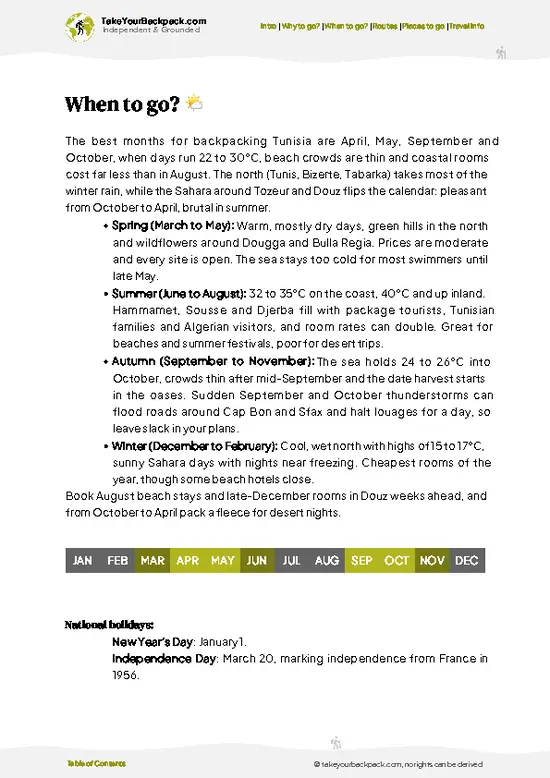
  • Spring (March to May): Dougga is at its greenest, with wheat fields and wildflowers around the ruins. Highs run 17 to 25°C (63 to 77°F), and the Roman theater is comfortable to climb at midday. Daylight stretches to about 13 hours by May. School groups fill the site on weekday mornings in April.
  • Summer (June to August): Highs reach 30 to 38°C (86 to 100°F), and the site has almost no shade. Daylight lasts around 14 hours, but the stone radiates heat after noon. Crowds thin out and some guesthouses drop prices.
  • Autumn (September to November): Highs ease from 30°C (86°F) to about 20°C (68°F). Light is soft for photographing the Capitol columns, and the first rains arrive in late October.
  • Winter (December to February): Highs sit at 10 to 15°C (50 to 59°F) with cold, wet spells and occasional fog
… read more 👉
  • Spring (March to May): Dougga is at its greenest, with wheat fields and wildflowers around the ruins. Highs run 17 to 25°C (63 to 77°F), and the Roman theater is comfortable to climb at midday. Daylight stretches to about 13 hours by May. School groups fill the site on weekday mornings in April.
  • Summer (June to August): Highs reach 30 to 38°C (86 to 100°F), and the site has almost no shade. Daylight lasts around 14 hours, but the stone radiates heat after noon. Crowds thin out and some guesthouses drop prices.
  • Autumn (September to November): Highs ease from 30°C (86°F) to about 20°C (68°F). Light is soft for photographing the Capitol columns, and the first rains arrive in late October.
  • Winter (December to February): Highs sit at 10 to 15°C (50 to 59°F) with cold, wet spells and occasional fog on the ridge. Days are about 10 hours long. You may have the ruins nearly to yourself, and lodging is at its cheapest.
Arrive when the gate opens, and spring or October gives you the best mix of cool air and open skies.


source: climatestotravel.comJANJanuary: highly recommended for travelingFEBFebruary: highly recommended for travelingMARMarch: excellent for travelingAPRApril: excellent for travelingMAYMay: excellent for travelingJUNJune: highly recommended for travelingJULJuly: fair for travelingAUGAugust: fair for travelingSEPSeptember: excellent for travelingOCTOctober: excellent for travelingNOVNovember: highly recommended for travelingDECDecember: highly recommended for traveling
tunisia-unique-site-dougga
© Google |

✈️ The backpacker research shortcutTunisia Travel Guide

An offline-friendly backpacking guide with optimized travel routes, ranked highlights, transport advice, and the best areas to stay.
example page 0 from our offline Travel Guide for Tunisia
example page 1 from our offline Travel Guide for Tunisia
example page 2 from our offline Travel Guide for Tunisia
example page 3 from our offline Travel Guide for Tunisia
example page 4 from our offline Travel Guide for Tunisia
example page 5 from our offline Travel Guide for Tunisia
example page 6 from our offline Travel Guide for Tunisia
example page 7 from our offline Travel Guide for Tunisia
The digital guide (355 pages) contains:
✅ 90 highlights, ranked by travel appeal
✅ Optimized 5, 10 & 15-day travel routes
✅ Cities, national parks, landmarks, beaches
✅ How to get around
✅ Offline-friendly for travel without Wi-Fi
👉 Click to see all 30+ guide features

📅 Plan smarter in minutes, not weeks
✅ Month by month travel advice
✅ Festivals & national holidays
✅ Budget expectations

🗺️ Go to the right places, skip the overrated ones
✅ Honest pros & cons of destinations
✅ Top hikes, parks & viewpoints
✅ Lesser-known places most travelers miss
✅ Clear “worth it vs skip it” guidance

🛏️ Travel smoothly without rookie mistakes
✅ Best areas to stay
✅ Transport systems explained simply
✅ Common scams & safety advice
✅ SIM cards, money & practical tips

🌍 Understand the country, not just visit it
✅ Culture & traditions
✅ 52 Essential phrases & customs
✅ Festivals worth planning around
✅ Traveler-friendly historical context
✅ Insights that make places more meaningful

📱 Built for real travel conditions
✅ Fully downloadable PDF
✅ Works completely offline
✅ Optimized for phone use
✅ Useful in remote areas & buses
✅ Everything in one place
Stop searching, start planning
Get instant access to your full guide. 30‑day money-back guarantee.
+ Add another guide for just

By proceeding you agree to our terms.
Sent to your inbox immediately after payment • 100% Secure Checkout
Best Backpacking Travel Advisor 2025 tourism awardBest Backpacking
Travel Advisor
2025
What others say about Take Your Backpack Guides:
⭐⭐⭐⭐⭐
Fantastic, amazing amount of information!
⭐⭐⭐⭐⭐
My goodness this is amazing, it's what I've been looking for hats off too you!
⭐⭐⭐⭐⭐
I think this is absolutely BRILLIANT
⭐⭐⭐⭐
Very complete and informative. It's still missing places, but I gotta to commend you
⭐⭐⭐⭐⭐
This is truly amazing, thank you, can't wait to explore it with my kids!
⭐⭐⭐⭐⭐
Awesome resource, thank you!
⭐⭐⭐⭐⭐
This is amazing! Can't wait to explore the ones I haven't seen
⭐⭐⭐⭐
I love this! Well done, great idea.
⭐⭐⭐⭐⭐
Thanks for taking the time to make this gem!
⭐⭐⭐⭐⭐
This might be the best website I've ever seen.
⭐⭐⭐⭐⭐
Congratulations, and thank you so much for your work; it's incredibly valuable.
⭐⭐⭐⭐
In all seriousness I think you did a great job pointing out the important spots
⭐⭐⭐⭐⭐
10/10 very good
⭐⭐⭐⭐⭐
As someone who's only just starting to visit regularly this is awesome, thank you.
⭐⭐⭐⭐
Thank you very much! I'm going to visit my dad, it's going to be very useful!
⭐⭐⭐⭐⭐
This is really cool! We'll be travelling for the first time and this definitely come in handy.
⭐⭐⭐⭐⭐
You are now our minister of culture, congratulations 👨‍💼
⭐⭐⭐⭐⭐
Just wanted to tell you that this is a pearl! Going to follow your recommendations.
⭐⭐⭐⭐⭐
This is so cool. I'll definitely be using the resource for my travels soon.
⭐⭐⭐⭐⭐
This is very impressive! Good work.
⭐⭐⭐⭐⭐
This is an amazing and informative site. Very well done!

🛏️ Where to stay?Where staying makes the most sense

Teboursouk, about 6 km (4 miles) from the ruins, is the most practical base for backpackers staying near Dougga. It is a working market town with cheap cafés, grocery shops and a few simple guesthouses, and you can reach the site by short taxi ride in about 10 minutes. Evenings are quiet, so expect conversation with locals rather than a hostel bar scene. Rooms run roughly US$15 to 30.

The small village near the ruins has a handful of family-run guesthouses and rural stays. They suit travelers who want to walk to the site at opening time and watch the hills turn from gray to gold in near silence. … read more 👉
Teboursouk, about 6 km (4 miles) from the ruins, is the most practical base for backpackers staying near Dougga. It is a working market town with cheap cafés, grocery shops and a few simple guesthouses, and you can reach the site by short taxi ride in about 10 minutes. Evenings are quiet, so expect conversation with locals rather than a hostel bar scene. Rooms run roughly US$15 to 30.

The small village near the ruins has a handful of family-run guesthouses and rural stays. They suit travelers who want to walk to the site at opening time and watch the hills turn from gray to gold in near silence. Choices are limited, so book ahead in spring. Expect US$20 to 40, often with home-cooked meals.

Béja, around 50 km (31 miles) north, is a larger city with more budget hotels, restaurants and frequent buses and louages (shared vans). It is more convenient if you are linking Dougga with other northern stops. Tunis is the choice for socializing, since its medina area has the nearest hostels and a steady stream of other backpackers. Most people visit Dougga from there on an early start, though that makes for a long day. Teboursouk is better if you want to see the ruins unhurried.

👛 Costs (as of 22 October 2026)Money, prices, and spending tips

Dougga costs most backpackers about US$48 a day, with the entrance ticket the single biggest fixed expense. Travelers pay in Tunisian dinars, and the figures below are converted to US dollars as rough guides.
CategoryBudget RangeLocal Reality
Entrance ticketUS$3 to 6Foreign visitors pay more than residents. A camera fee may apply.
Accommodation (high season)US$15 to 30Simple guesthouses in Teboursouk or near the site. Prices drop in winter.
Accommodation (low season)US$10 to 20Negotiable in winter, when few travelers stay overnight.
FoodUS$5 to 10Sandwiches, grilled meat and couscous in Teboursouk cafés. Site-side meals cost more.
Local transportUS$3 to 8Louages and buses to Teboursouk are cheap. The last leg to the ruins is by taxi, around US$4 to 8 each way.
Guide (optional)US$0 to 10Informal guides
… read more 👉
Dougga costs most backpackers about US$48 a day, with the entrance ticket the single biggest fixed expense. Travelers pay in Tunisian dinars, and the figures below are converted to US dollars as rough guides.
CategoryBudget RangeLocal Reality
Entrance ticketUS$3 to 6Foreign visitors pay more than residents. A camera fee may apply.
Accommodation (high season)US$15 to 30Simple guesthouses in Teboursouk or near the site. Prices drop in winter.
Accommodation (low season)US$10 to 20Negotiable in winter, when few travelers stay overnight.
FoodUS$5 to 10Sandwiches, grilled meat and couscous in Teboursouk cafés. Site-side meals cost more.
Local transportUS$3 to 8Louages and buses to Teboursouk are cheap. The last leg to the ruins is by taxi, around US$4 to 8 each way.
Guide (optional)US$0 to 10Informal guides at the gate offer tours of about an hour. Agree on the price first.
Water and snacksUS$1 to 3Bring your own, as the site has little shade or shopping.
Total Daily BudgetUS$48Based on high season prices and one overnight stay near the ruins.
⚠️ Prices can change and everyone travels differently, so take this as a rough guide. Hope it helps you plan your adventure!

FAQFrequently asked questions about Dougga

Dougga is a Roman-era town in northern Tunisia and a UNESCO World Heritage Site, listed in 1997. Its hillside ruins include a well-preserved Capitol temple, a theater seating about 3,500 and the Libyco-Punic mausoleum. The site sits at roughly 600 meters (about 2,000 feet) above sea level, looking over olive and wheat country.
Plan on 2 to 3 hours to see the main monuments, or about half a day if you want to wander the outer areas and photograph at leisure. The ruins cover around 65 hectares (160 acres), with uneven paths and little shade. Add travel time from Tunis, so a day trip from the capital takes about 8 to 9 hours in total. Staying overnight nearby is more relaxed.
From Tunis, take a bus or louage to Teboursouk, about 2 to 2.5 hours and roughly US$4 to 7. From Teboursouk, a taxi covers the remaining 6 km (4 miles) to the site in about 10 minutes for US$4 to 8. Driving from Tunis takes roughly 1.5 to 2 hours via the A3 and local roads, and a rental car gives you the most flexibility.
⚠️ Things can change over time, so always validate details locally before you go.

Other Tunisian landmarks near Dougga

Explore more nearby:

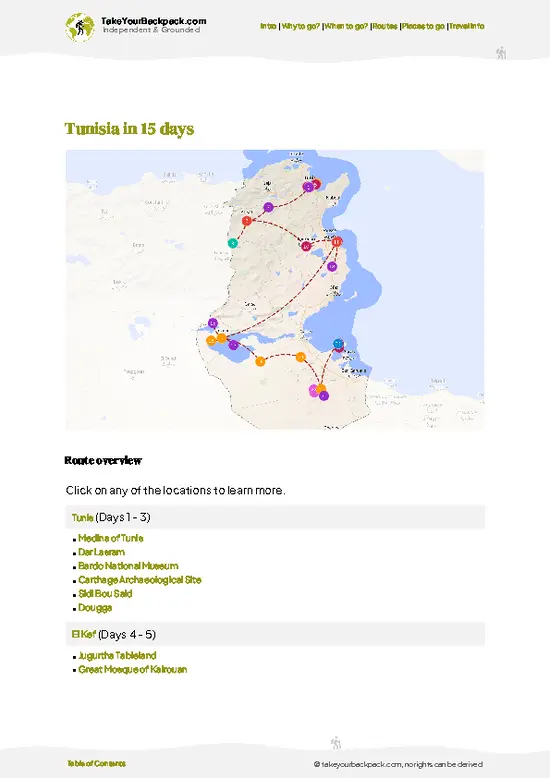
  • Bulla Regia—Underground villas, sea-themed mosaics, goat-grazed ruins, Jendouba countryside| 44 km away
  • Les Aiguilles—Sandstone spires, surf-line coast path, Tabarka shore, low-sun glow| 73 km away
  • Zaghouan Water Temple—Spring-fed nymphaeum, aqueduct arches, mountain trails, whitewashed lanes| 82 km away

💡 Not sure where to go next?
Create a personalized itinerary for Tunisia including Dougga and the places that fit your trip.

Generate my itinerary

👉 Discover all landmarks

Or checkout all Tunisia has to offer (think cities, towns, villages, national parks, hikes, beaches, festivals)
Country photo of Tunisia

We 💚 feedbackKey takeaways before you go

Dougga rewards anyone who looks down as well as up. The Windrose Square, with its twelve winds carved into the paving, is easy to walk straight over while you're chasing the Capitol. I would bring a hat, a big bottle of water and sturdy shoes, because the stones are uneven and shade is rare, and I would stay until the light softens over the olive groves.

✍️ Help improve this page!
The information on this page is based on in-depth research, insights shared by experienced travelers, and feedback from the local travel community in Tunisia. While every effort is made to keep the information accurate and current, conditions can change — so if you spot anything incorrect or outdated, please get in touch.


🙋‍♂️ Give feedback

👋 Meet the founderWho’s Behind Take Your Backpack?

Johan, backpacker and founder of TakeYourBackpackHi, I’m Johan (Netherlands 🇳🇱), the creator of TakeYourBackpack. Over the past 3 decades, I’ve backpacked through 90+ countries across six continents, gaining extensive experience with independent travel, long-term trips, and overland routes.

This site is built on a combination of firsthand travel experience and carefully curated insights from other backpackers. Many guides are based on places I’ve personally visited, while others bring together tips, observations, and practical advice shared by trusted travelers I’ve met along the way.

The goal is to provide realistic, experience-driven guidance — not generic itineraries — so you can explore destinations with better context, clearer expectations, and more confidence.