×

Turkmenistan🇹🇲 | national parksSyunt-Hasardag Nature ReserveLimestone massif, archa juniper forest, Kopet Dag gorges, leopard country | things to do and best time to go

Explore Bereketli Garagum Nature ReserveExplore Amudarya Nature Reserve

Backpacking in Syunt-Hasardag Nature Reserve
👌 Worth visitingnational park ranked #8
By Johan Kruseman 🇳🇱 | Updated November 17, 2026

Syunt-Hasardag Nature Reserve sits in the Kopet Dag range of southwestern Turkmenistan, in Balkan Province, roughly northwest of Ashgabat by road and close to the Iranian border. It is best known for the Syunt-Hasardag massif, a high limestone ridge with juniper woodland, plus rare mountain wildlife such as the wild goat, the Persian leopard and the urial. Trails are rough and mostly unmarked, and there is almost nobody else about. Services are minimal. The costs and delays are bureaucratic: entry needs a permit arranged in advance through a registered agency, and border-zone checkpoints can stall a late start, so apply weeks ahead and carry your passport. Fuel, food and water must come with you. Unlike the more visited Kow Ata or Bakharden sites, this is a true mountain wilderness rather than a roadside attraction.

Part of Backpacking in Turkmenistan: all 41 places on one map, with routes and the best time to go.
Discover everything you want to know in the 📖 Turkmenistan Travel Guide.


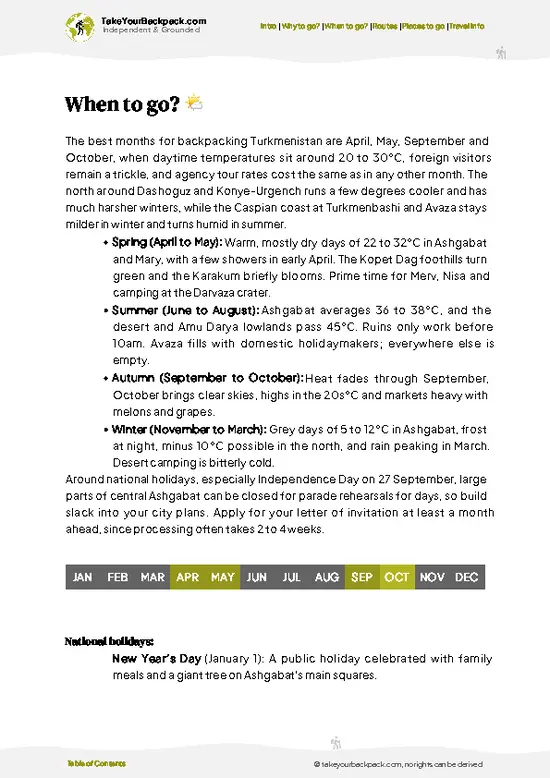
example page 0 from our offline Travel Guide for Turkmenistan
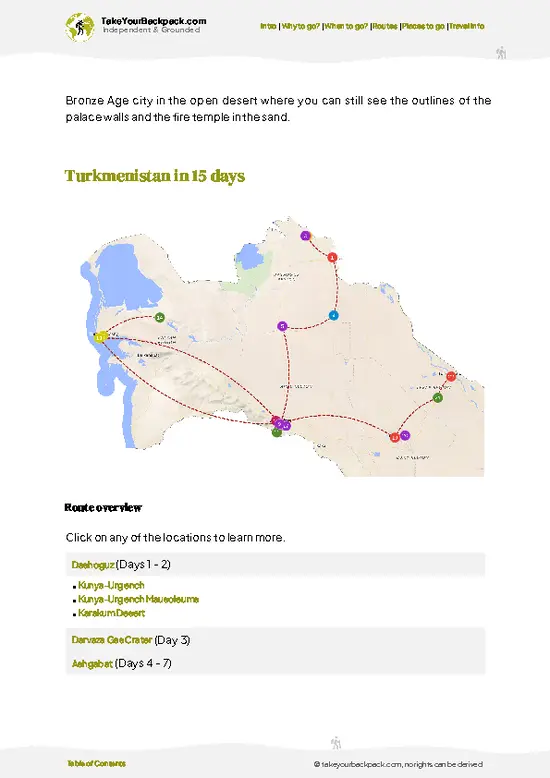
example page 1 from our offline Travel Guide for Turkmenistan
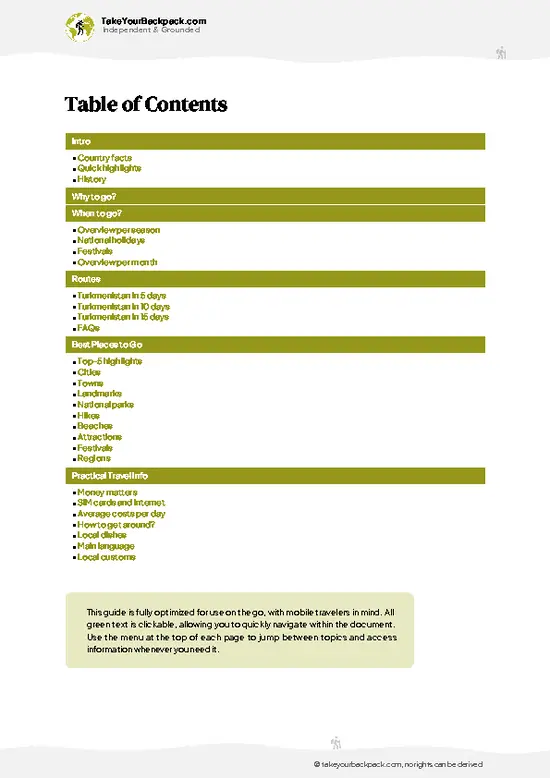
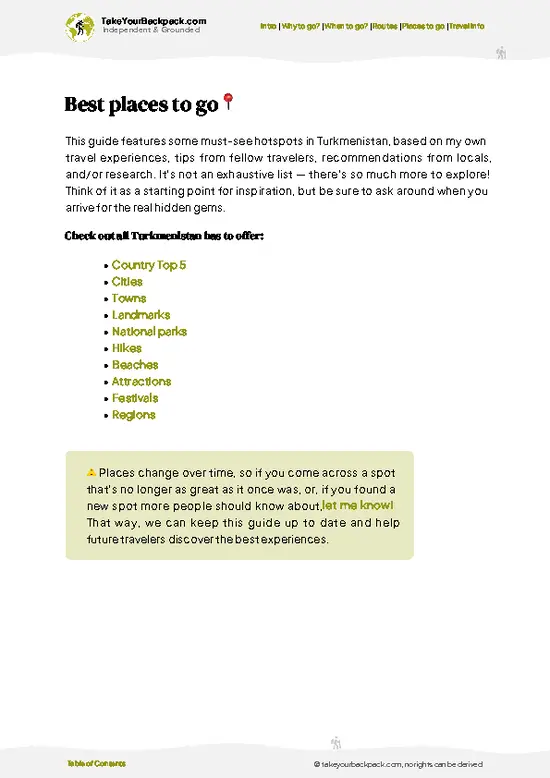
example page 2 from our offline Travel Guide for Turkmenistan
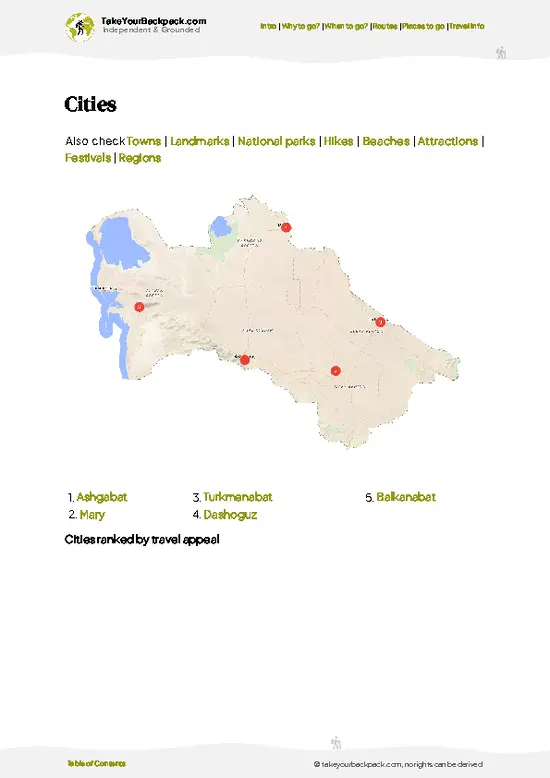
example page 3 from our offline Travel Guide for Turkmenistan
example page 4 from our offline Travel Guide for Turkmenistan
example page 5 from our offline Travel Guide for Turkmenistan
example page 6 from our offline Travel Guide for Turkmenistan
example page 7 from our offline Travel Guide for Turkmenistan
Loading the map 🌍
CLICK TO FILTER
cities
towns
landmarks
national parks
hikes
beaches
attractions
festivals
regions
SHOW COUNTRY’S BESTSHOW ALL

✨ Why go?
Ranked #8 national park in Turkmenistan
Why visitors keep coming back

Syunt-Hasardag Nature Reserve suits backpackers who want real mountain country in a nation where most sights are desert, monuments or cave pools. Its appeal is the lack of infrastructure: no ticketed viewpoints, no cafés, and long ridgelines you can follow on your own feet with a guide or driver arranged for the permit.

The terrain is the reason to come. The juniper forests of the Kopet Dag cover slopes that look more like the Caucasus than anything in the Karakum, and the limestone cliffs hold wild goat and urial that you may spot with binoculars from a ridge. Birdlife includes raptors riding thermals over the gorges.

Self-guided travel is limited by the permit system, but once inside you set the pace, camp where conditions allow and skip any group itinerary. It is a rare place in Turkmenistan … read more 👉
Syunt-Hasardag Nature Reserve suits backpackers who want real mountain country in a nation where most sights are desert, monuments or cave pools. Its appeal is the lack of infrastructure: no ticketed viewpoints, no cafés, and long ridgelines you can follow on your own feet with a guide or driver arranged for the permit.

The terrain is the reason to come. The juniper forests of the Kopet Dag cover slopes that look more like the Caucasus than anything in the Karakum, and the limestone cliffs hold wild goat and urial that you may spot with binoculars from a ridge. Birdlife includes raptors riding thermals over the gorges.

Self-guided travel is limited by the permit system, but once inside you set the pace, camp where conditions allow and skip any group itinerary. It is a rare place in Turkmenistan where slow, self-reliant walking is the whole point.

💡 HighlightsPlaces and moments you shouldn't skip

  1. Syunt-Hasardag massif: The reserve's signature ridge, a high limestone crest that gives wide views over the Kopet Dag folds and toward the Iranian side.
  2. Juniper woodland: Slopes of slow-growing archa juniper, with a resinous smell on warm afternoons.
  3. Wild goat habitat: Rocky ledges and gorges where the bezoar ibex lives. Binoculars and patience are needed.
  4. Urial sheep ranges: Open, steep slopes where these wild sheep graze, best watched from a distance at dawn.
  5. Persian leopard country: The reserve is part of the range of this elusive cat. Sightings are very rare, but tracks and the remote setting are the draw.
  6. Mountain gorges and streams: Narrow canyons with seasonal water, rock walls layered in tilted strata and small patches of green in spring.
  7. Raptor watching: Eagles and vultures patrol the cliffs,
… read more 👉
  1. Syunt-Hasardag massif: The reserve's signature ridge, a high limestone crest that gives wide views over the Kopet Dag folds and toward the Iranian side.
  2. Juniper woodland: Slopes of slow-growing archa juniper, with a resinous smell on warm afternoons.
  3. Wild goat habitat: Rocky ledges and gorges where the bezoar ibex lives. Binoculars and patience are needed.
  4. Urial sheep ranges: Open, steep slopes where these wild sheep graze, best watched from a distance at dawn.
  5. Persian leopard country: The reserve is part of the range of this elusive cat. Sightings are very rare, but tracks and the remote setting are the draw.
  6. Mountain gorges and streams: Narrow canyons with seasonal water, rock walls layered in tilted strata and small patches of green in spring.
  7. Raptor watching: Eagles and vultures patrol the cliffs, and the open ridgelines make good lookout points.
The massif and the juniper woodland combine well in one day, since the climb through the trees leads straight up to the ridge views.
Spotted a mistake or missing something? Contact us.

🌤️ When to go?Best time to explore Syunt-Hasardag Nature Reserve

  • Spring (April to May): Daytime highs run 20 to 30°C (68 to 86°F) and the Kopet Dag slopes are green, with wildflowers and flowing streams at their peak. Nights in the hills drop to 8 to 14°C (46 to 57°F). Days are long enough for full trekking loops.
  • Summer (June to August): Highs reach 38 to 45°C (100 to 113°F) on the lowlands and the desert approach. Hiking is miserable at midday, and few visitors come, so prices for guides and transfers can be negotiated down.
  • Autumn (September to October): Highs ease to 22 to 32°C (72 to 90°F), the air is dry and clear, and trails are firm. Demand for drivers and guides rises a little.
  • Winter (November to March): Days sit at 3 to 12°C (37 to 54°F), nights fall below freezing, and snow can close higher tracks. Daylight is short, and access roads can be slow.
… read more 👉
  • Spring (April to May): Daytime highs run 20 to 30°C (68 to 86°F) and the Kopet Dag slopes are green, with wildflowers and flowing streams at their peak. Nights in the hills drop to 8 to 14°C (46 to 57°F). Days are long enough for full trekking loops.
  • Summer (June to August): Highs reach 38 to 45°C (100 to 113°F) on the lowlands and the desert approach. Hiking is miserable at midday, and few visitors come, so prices for guides and transfers can be negotiated down.
  • Autumn (September to October): Highs ease to 22 to 32°C (72 to 90°F), the air is dry and clear, and trails are firm. Demand for drivers and guides rises a little.
  • Winter (November to March): Days sit at 3 to 12°C (37 to 54°F), nights fall below freezing, and snow can close higher tracks. Daylight is short, and access roads can be slow.
Syunt-Hasardag Nature Reserve is best visited from mid-April to early June or in late September and October, when temperatures are comfortable and trails are dry.


source: climatestotravel.comJANJanuary: fair for travelingFEBFebruary: fair for travelingMARMarch: good for travelingAPRApril: excellent for travelingMAYMay: highly recommended for travelingJUNJune: good for travelingJULJuly: fair for travelingAUGAugust: fair for travelingSEPSeptember: highly recommended for travelingOCTOctober: excellent for travelingNOVNovember: good for travelingDECDecember: fair for traveling
turkmenistan-national-park-syunt-hasardag-nature-reserve
© Google |

✈️ The backpacker research shortcutTurkmenistan Travel Guide

What the free pages can't give you: ready-made routes, every place ranked, and it works offline. All in 1 guide.
example page 0 from our offline Travel Guide for Turkmenistan
example page 1 from our offline Travel Guide for Turkmenistan
example page 2 from our offline Travel Guide for Turkmenistan
example page 3 from our offline Travel Guide for Turkmenistan
example page 4 from our offline Travel Guide for Turkmenistan
example page 5 from our offline Travel Guide for Turkmenistan
example page 6 from our offline Travel Guide for Turkmenistan
example page 7 from our offline Travel Guide for Turkmenistan
The digital guide (153 pages) contains:-page digital guide:
✅ Ready-made 5, 10 & 15-day routes
✅ All 41 places ranked, so you skip the overrated ones
✅ Works offline, all in 1 guide
✅ Cities, national parks, landmarks, beaches
✅ How to get around
👉 Click to see all 30+ guide features

📅 Plan smarter in minutes, not weeks
✅ Month by month travel advice
✅ Festivals & national holidays
✅ Budget expectations

🗺️ Go to the right places, skip the overrated ones
✅ Honest pros & cons of destinations
✅ Top hikes, parks & viewpoints
✅ Lesser-known places most travelers miss
✅ Clear “worth it vs skip it” guidance

🛏️ Travel smoothly without rookie mistakes
✅ Best areas to stay
✅ Transport systems explained simply
✅ Common scams & safety advice
✅ SIM cards, money & practical tips

🌍 Understand the country, not just visit it
✅ Culture & traditions
✅ 52 Essential phrases & customs
✅ Festivals worth planning around
✅ Traveler-friendly historical context
✅ Insights that make places more meaningful

📱 Built for real travel conditions
✅ Fully downloadable PDF
✅ Works completely offline
✅ Optimized for phone use
✅ Useful in remote areas & buses
✅ All in 1 guide
Stop searching, start planning
Get instant access to your full guide. 30‑day money-back guarantee.


By proceeding you agree to our terms.
Sent to your inbox immediately after payment • 100% Secure Checkout
Best Backpacking Travel Advisor 2025 tourism awardBest Backpacking
Travel Advisor
2025
What others say about Take Your Backpack Guides:
⭐⭐⭐⭐⭐
Fantastic, amazing amount of information!
⭐⭐⭐⭐⭐
My goodness this is amazing, it's what I've been looking for hats off too you!
⭐⭐⭐⭐⭐
I think this is absolutely BRILLIANT
⭐⭐⭐⭐
Very complete and informative. It's still missing places, but I gotta to commend you
⭐⭐⭐⭐⭐
This is truly amazing, thank you, can't wait to explore it with my kids!
⭐⭐⭐⭐⭐
Awesome resource, thank you!
⭐⭐⭐⭐⭐
This is amazing! Can't wait to explore the ones I haven't seen
⭐⭐⭐⭐
I love this! Well done, great idea.
⭐⭐⭐⭐⭐
Thanks for taking the time to make this gem!
⭐⭐⭐⭐⭐
This might be the best website I've ever seen.
⭐⭐⭐⭐⭐
Congratulations, and thank you so much for your work; it's incredibly valuable.
⭐⭐⭐⭐
In all seriousness I think you did a great job pointing out the important spots
⭐⭐⭐⭐⭐
10/10 very good
⭐⭐⭐⭐⭐
As someone who's only just starting to visit regularly this is awesome, thank you.
⭐⭐⭐⭐
Thank you very much! I'm going to visit my dad, it's going to be very useful!
⭐⭐⭐⭐⭐
This is really cool! We'll be travelling for the first time and this definitely come in handy.
⭐⭐⭐⭐⭐
You are now our minister of culture, congratulations 👨‍💼
⭐⭐⭐⭐⭐
Just wanted to tell you that this is a pearl! Going to follow your recommendations.
⭐⭐⭐⭐⭐
This is so cool. I'll definitely be using the resource for my travels soon.
⭐⭐⭐⭐⭐
This is very impressive! Good work.
⭐⭐⭐⭐⭐
This is an amazing and informative site. Very well done!

🛏️ Where to stay?How to pick the right area

Nearly all backpackers sleep in Balkanabat or Turkmenbashi, because the reserve is remote and has no hostels or guesthouses of its own. The closest practical base is Balkanabat, a few hours by road, where small hotels cost roughly US$25 to 60 a night and a handful of cheaper guesthouses sit near the center. Turkmenbashi on the Caspian coast offers more choice, including seafront hotels in the US$40 to 90 range, and works if you are combining the reserve with the coast. Ashgabat has the widest range of beds, from US$20 to 30 for a basic room to polished hotels at US$100 and up, but it means a long … read more 👉
Nearly all backpackers sleep in Balkanabat or Turkmenbashi, because the reserve is remote and has no hostels or guesthouses of its own. The closest practical base is Balkanabat, a few hours by road, where small hotels cost roughly US$25 to 60 a night and a handful of cheaper guesthouses sit near the center. Turkmenbashi on the Caspian coast offers more choice, including seafront hotels in the US$40 to 90 range, and works if you are combining the reserve with the coast. Ashgabat has the widest range of beds, from US$20 to 30 for a basic room to polished hotels at US$100 and up, but it means a long day of driving each way. Inside the reserve, organized trips usually involve camping with a tent and food supplied by your guide or driver. Because independent travel in Turkmenistan runs through a licensed agency, ask them to confirm your accommodation and any camping arrangements in advance.

👛 Costs (as of 17 November 2026)Money, prices, and spending tips

A day at Syunt-Hasardag Nature Reserve costs roughly US$105 to 270 for most backpackers, since a guide, driver and permit arrangement are needed. Costs are driven mainly by the agency and vehicle rather than by the park itself.
CategoryBudget RangeLocal Reality
Entrance and permitUS$10 to 30Handled through a licensed agency, usually bundled into the trip price
Guide and driverUS$60 to 150Per vehicle per day, so sharing with others cuts the cost sharply
Accommodation (high season)US$25 to 60Guesthouse or small hotel in Balkanabat; camping on organized trips costs less
Food and suppliesUS$8 to 20Simple meals in town, plus bread, fruit and water bought before leaving
Local transportUS$2 to 10Shared taxis or buses between towns, paid in cash
Total Daily BudgetUS$105 to 270Lower end assumes a shared vehicle and camping


source: turkmenistan.gov.tm
⚠️ Prices can change and everyone travels differently, so take this as a rough guide. Hope it helps you plan your adventure!

🥾 TrailsTrail guide for Syunt-Hasardag Nature Reserve national park

Syunt-Hasardag Nature Reserve has no widely published, signed trail network, so walks follow ranger tracks, shepherd paths and gorge floors from wherever your permitted vehicle drops you.

  • Juniper slope walk: Starts near the lower reserve edge and climbs through open juniper woodland. Allow 3 to 4 hours return. Moderate, on loose stony ground.
  • Ridge approach: A steeper route up toward the limestone crest of the massif. Plan a full day. Hard, with sharp rock, little shade and no water on the upper section.
  • Gorge floor walk: Follows a dry or seasonal streambed between cliff walls. Roughly 2 to 3 hours,
… read more 👉
Syunt-Hasardag Nature Reserve has no widely published, signed trail network, so walks follow ranger tracks, shepherd paths and gorge floors from wherever your permitted vehicle drops you.

  • Juniper slope walk: Starts near the lower reserve edge and climbs through open juniper woodland. Allow 3 to 4 hours return. Moderate, on loose stony ground.
  • Ridge approach: A steeper route up toward the limestone crest of the massif. Plan a full day. Hard, with sharp rock, little shade and no water on the upper section.
  • Gorge floor walk: Follows a dry or seasonal streambed between cliff walls. Roughly 2 to 3 hours, easy to moderate, best for spotting birds and tracks.
  • Wildlife viewing: Wild goats and urial are glimpsed on far slopes, usually at dawn. Leopards are almost never seen.
Getting here is difficult without arranged transport. No regular public service reaches the reserve, so travelers normally go by hired 4x4 with a driver and a guide from a registered agency, which also covers the border-zone permit. Expect checkpoints. Crowds are non-existent, and you may not meet another group all day. Entry requires the permit, and the cost is usually folded into the agency price, so ask what it includes. Carry all food and water, and wear sturdy boots because the limestone is abrasive.
⚠️ Hiking info can sometimes be outdated or inaccurate. Before you hit the trail, check the latest conditions with locals. If you do spot anything that's off, I'd love to hear from you, so I can update it for fellow travelers.

🛡️ SafetyTraveler Safety Guide

Syunt-Hasardag is a remote, arid mountain reserve where the main risks are heat, dehydration and being far from help. Summer temperatures climb quickly, so start walking at dawn, carry at least 3 liters of water per person and wear a hat and sun cover. Tracks are rough and often unsigned, so a guide or experienced driver is not optional, and your agency will arrange one. Footing on loose limestone slopes can be slippery, so sturdy boots matter. Wildlife is part of the draw, including wild goats and other mountain species, and animals keep their distance. Watch for snakes and scorpions when turning rocks or reaching into crevices. Phone signal is patchy to absent, so tell your guide your plans, carry a charged power bank and a basic first-aid kit, and keep a day of spare food.

FAQCommon questions from travelers

Plan on two days for Syunt-Hasardag Nature Reserve, including the drive from Balkanabat or Ashgabat. One full day on site covers the main mountain scenery and wildlife viewing, and a second day lets you hike farther or camp overnight. Add a day each way if you are coming from Ashgabat by road.
Reaching Syunt-Hasardag Nature Reserve without a car is difficult, because there is no public transport into the mountains and tracks are rough. Buses and shared taxis reach Balkanabat, but you then need a hired 4x4 with a driver, usually US$60 to 150 a day. Most travelers book this through a licensed agency in Ashgabat, which also handles permits.
Syunt-Hasardag Nature Reserve requires an entry permit, and foreign visitors normally arrange it through a licensed agency. Expect roughly US$10 to 30, often bundled into the trip price. Allow at least a week for processing, and carry your passport and visa at all times, since checkpoints on the road are common.
⚠️ Things can change over time, so always validate details locally before you go.

Other Turkmen national parks near Syunt-Hasardag Nature Reserve

Explore more nearby:


💡 Not sure where to go next?
Create a personalized itinerary for Turkmenistan including Syunt-Hasardag Nature Reserve and the places that fit your trip.

Generate my itinerary

👉 Discover all national parks

Or checkout all Turkmenistan has to offer (think cities, towns, villages, national parks, hikes, beaches, festivals)
Country photo of Turkmenistan

We 💚 feedbackIs it worth it?

Syunt-Hasardag Nature Reserve repays two full days: one for the juniper slopes and one for a ridge or gorge walk, with a spare morning for wildlife watching. A single day is mostly spent on the road and at checkpoints. I would bring binoculars, extra water and a flexible schedule.

✍️ Help improve this page!
The information on this page is based on in-depth research, insights shared by experienced travelers, and feedback from the local travel community in Turkmenistan. While every effort is made to keep the information accurate and current, conditions can change — so if you spot anything incorrect or outdated, please get in touch.


🙋‍♂️ Give feedback

👋 Meet the founderWho’s Behind Take Your Backpack?

Johan, backpacker and founder of TakeYourBackpackHi, I’m Johan (Netherlands 🇳🇱), the creator of TakeYourBackpack. Over the past 30 years, I’ve backpacked through 88 countries across six continents, gaining extensive experience with independent travel, long-term trips, and overland routes.

This site is built on a combination of firsthand travel experience and carefully curated insights from other backpackers. Many guides are based on places I’ve personally visited, while others bring together tips, observations, and practical advice shared by trusted travelers I’ve met along the way.

The goal is to provide realistic, experience-driven guidance — not generic itineraries — so you can explore destinations with better context, clearer expectations, and more confidence.